Anthropic's Boris Cherny: Why Coding Is Solved, and What Comes Next
In a Nutshell
Boris Cherny declares coding "solved" as Claude Code achieved 100% model-written code last year, with exponential growth via Opus 4+ models enabling tiny teams to generate dozens of PRs daily through phone-based agents, /loop routines, and multi-agent parallelism. AI slashes code costs 10-100x without killing SaaS, empowering generalist teams and startups to disrupt via reduced switching costs while preserving network effects and scale economies. Future shifts democratize software like the printing press did literacy, with models auto-handling cloud/local decisions, computer use, and tools like MCP for seamless workflows.
These notes were generated by AI and may contain inaccuracies.
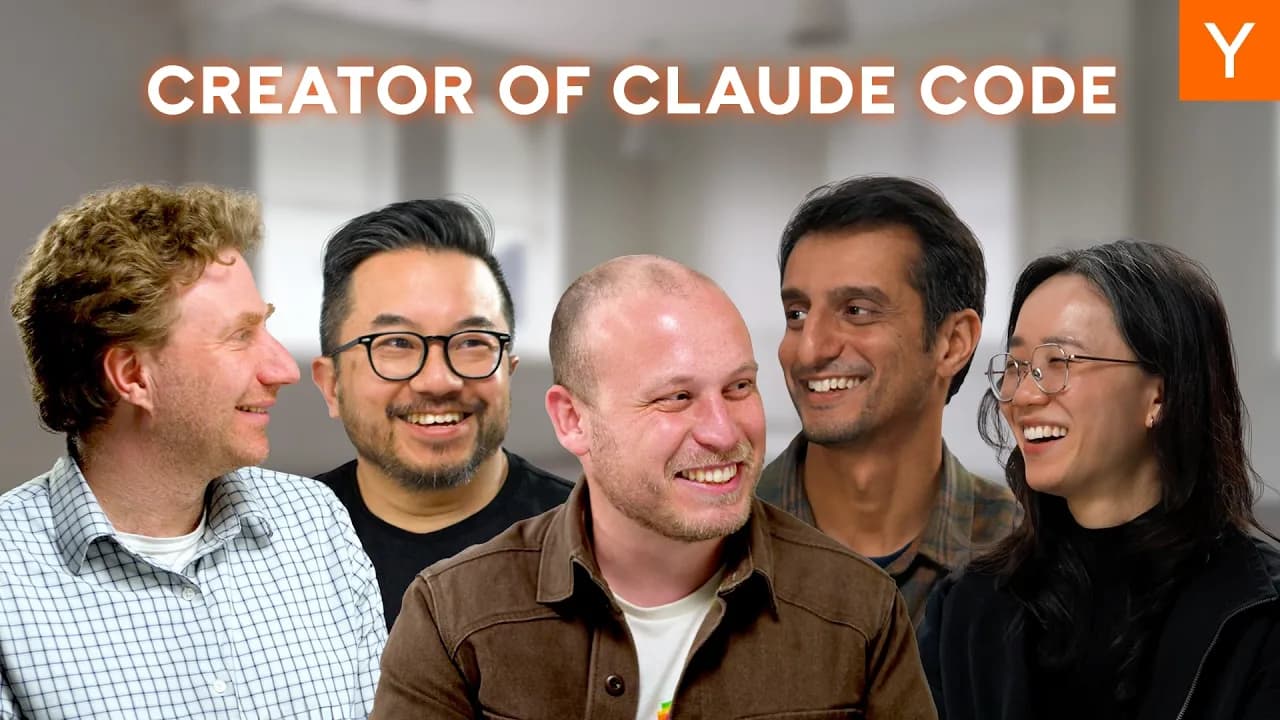
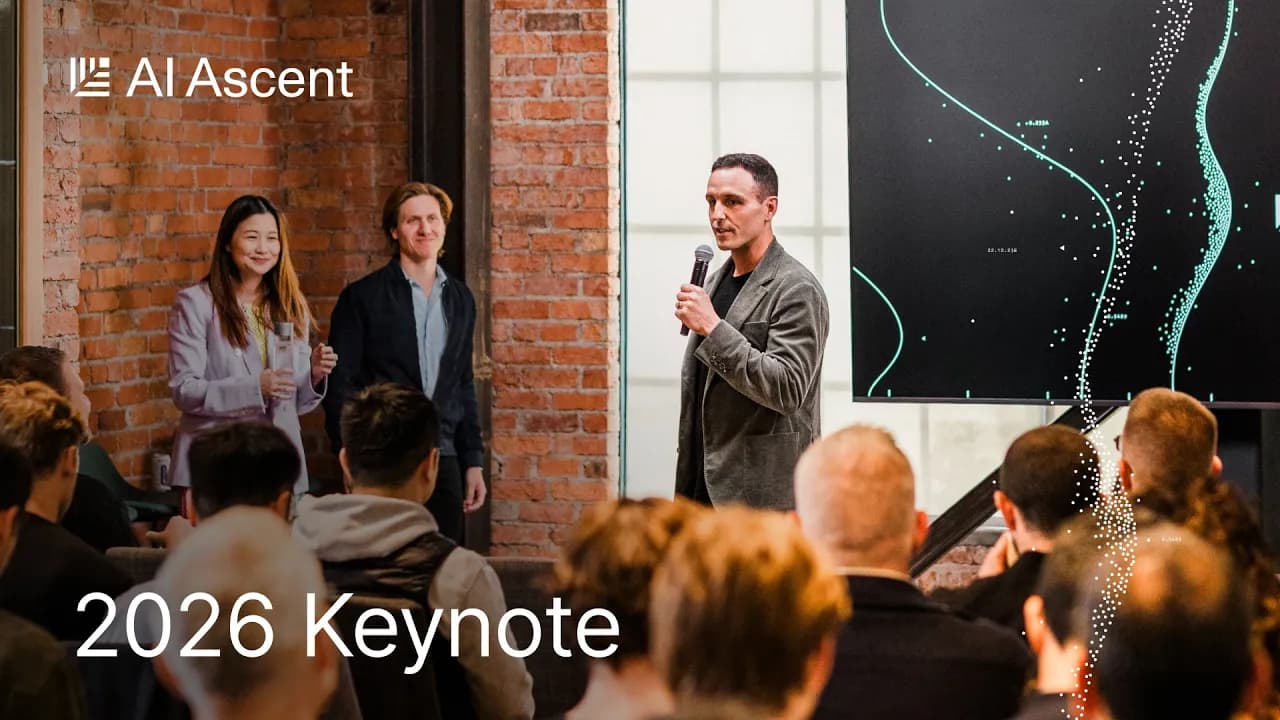
Speaker introduces Boris Cherny as creator of Claude code, with front-row seat to reinventing software development. Team calls speaker "Claude code psychosis." Interviewed by Lauren Reader.
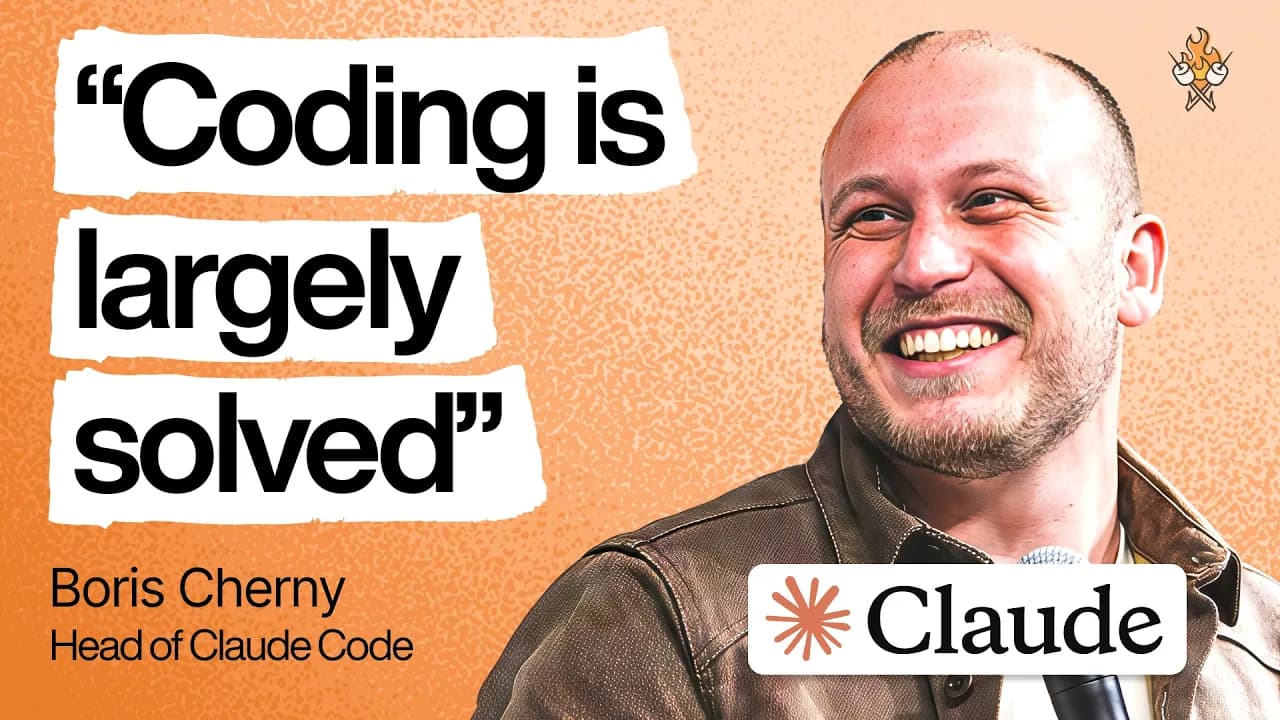
Boris wrote code throughout career, authored Programming in TypeScript. Hasn't written code in 2026 so far. Wrote BASIC guide for TI-83 Plus in middle school, still online.
Audience poll: Majority use Claude code CLI, desktop, some VS Code/JetBrains, iOS.
Started accidentally in late 2024 in Anthropic Labs incubator. Team created Claude code, MCP, desktop app; disbanded, now back under Mike Krieger (CPO, ex-Instagram co-founder).
Product overhang: Models capable beyond type-ahead (state of art with Sonnet 3.5). Built agent to write all code. Didn't work first 6 months, barely usable (10% of code). Initial release not a hit; exponential growth started with Opus 4 in May, inflected with 4.5, 4.6, 4.7.
Built pre-PMF for next model. Anthropic focus: business, enterprise, safety, coding.
Audience poll: Few write 100% code by hand; none 100% agent; most in between ("50% solved").
Claude code codebase: TypeScript + React (on-distribution for models). Achieved 100% model-written code Oct/Nov last year. Boris: 100% model-written; few dozen PRs/day, record 150 PRs one day.
Not universal: big codebases, weird languages. Solution: wait for next model.
Mostly from phone via Claude app code tab: 5-10 sessions, few hundred agents (thousands overnight).
Uses /loop (Claude schedules cron jobs: every minute/5 min/day). Dozens running: babysits PRs (fix CI, auto-rebase), keeps CI healthy (fix flaky tests), clusters Twitter feedback every 30 min.
Routines: server-side loops, persist if laptop closed.
More generalists (cross-disciplinary: engineering + product/design/data science).
Claude code team: Everyone codes (engineering manager, PM, designers, data scientist, finance, user researcher).
AI makes code 10-100x cheaper. No SaaS apocalypse.
Seven Powers (Acquired podcast, Hamilton book): AI diminishes switching costs, process power (Claude 4.7 hill-climbs/iterates to target). Network effects, scale economies, cornered resources unchanged.
Startups 10x more disruptive: tiny teams build vs. large cos (process resistance). Best time to build/startups.
Mix; was 50/50. Product: Build what people love (YC lesson), details for all-day use.
As models improve, harness less critical (e.g., make loops first-class, easier multi-agents). Future: models auto-aligned, less need for safety (prompt injection, verification, permissions, human-in-loop).
Claude code cultural shift: shop owners build software, program microcontrollers.
Future: Skill like sending text message (not just tech industry).
Parallel: Printing press (1400s Europe). Pre-press: 10% literate. 50 years post: more literature than prior 1000 years, book cost down 100x. Literacy to 70% globally (took centuries). Software democratized faster; domain experts (e.g., accountants) best for domain software.
No model gap (use same: Mythos for testing, Opus 4.7 for coding). Product/process gap: Anthropic uses Claude for everything; Claudes communicate via Slack loops. No manual code/SQL.
Ahead in organization/process; dogfood platform for developers.
/batch, /loop, sub-teams/teams. Prompting for parallelism; models (4.7) naturally loop/propose (e.g., data query → auto-loop + Slack reports). Model responsibility to intuit parallelism.
Doesn't matter: Models will decide (start agents, build environments, choose local/cloud). No longer engineer decisions.
Questions from Jamie. Nester. Thank you.
Claude Code leverages local developers' tools and workflows. For general knowledge work, tools are often cloud-based like Salesforce and Docs. For Co-work, the simplest answer is MCP (same MCP connector in Claude AI). Hook up Salesforce, Google Docs, Google Calendar. Co-work, Claude CLI, and Claude Code can all use it.
For systems without MCPs, computer use is a big opportunity. Anthropic is ahead on computer use; through Co-work, it handles any software on your computer. It's slow but effective, especially with 4.7. Otherwise, MCP is the answer. All this—MCPs, APIs, programmatic access—doesn't matter much to the model; it's just tokens.
If building a product today that becomes more interesting as models improve in 6 months to a year:
- Claude design: Pretty good today, going to get a lot better.
- Upcoming features for Claude Code landing in coming weeks.
- Loop, batch, and massively parallelizing agents: Going to get better.
- Computer use: Another good one.
Thank you to Boris. Applause.
Keep Sequoia Capital in your library
Save the videos and channels worth coming back to, and find them again in one place.