High Load vs High Volume for Muscle Growth | Dr. Mike Roberts & Dr. Andy Galpin
In a Nutshell
High-load (80% 1RM) and high-volume (30% 1RM to failure) training produce identical hypertrophy when both are taken near failure, because both reach the same cellular tension threshold that triggers mTOR-driven protein synthesis. Only the heavier loads also build strength; the lighter protocol does not. Volume load and key molecular markers are statistically equivalent between the two approaches.
These notes were generated by AI and may contain inaccuracies.
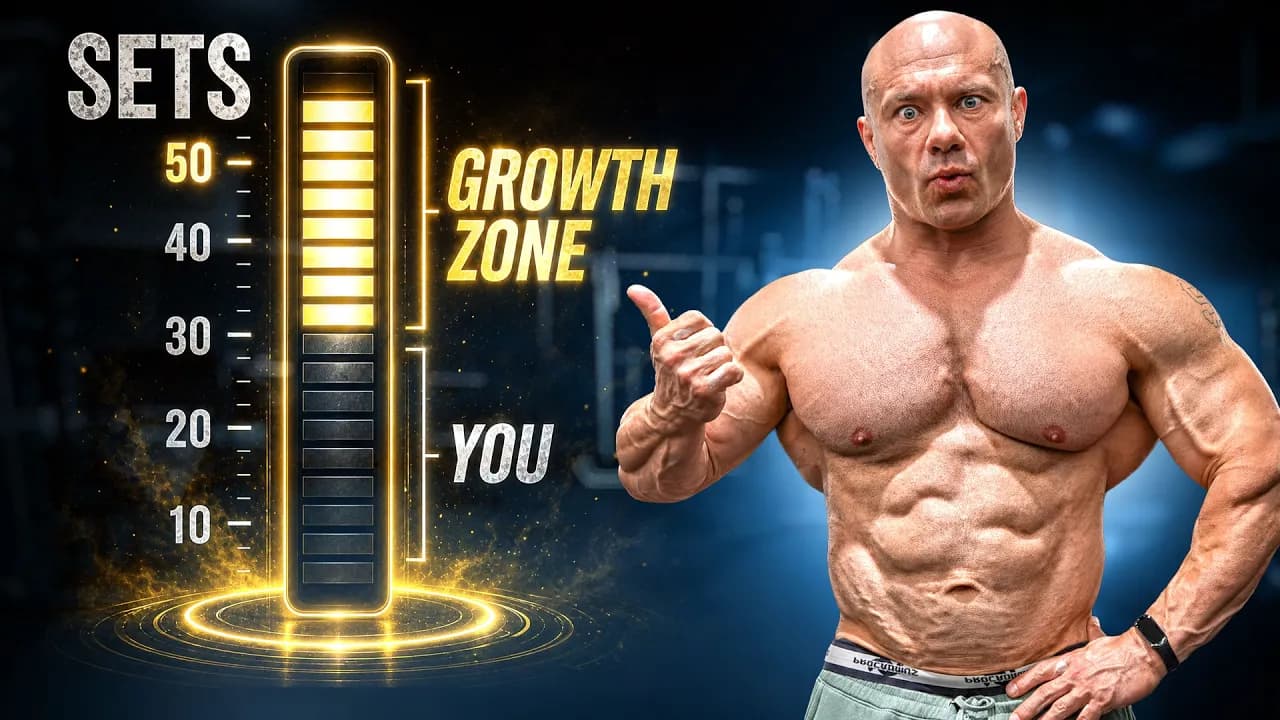
When comparing high load versus high volume training for muscle growth, the data shows that training at 30% of 1RM to near failure produces similar hypertrophy results as training at 80% of 1RM to near failure. At 30% 1RM, trainees perform approximately 40 repetitions per set to reach failure, while 80% 1RM typically requires 10-12 repetitions.
For hypertrophy purposes, both 30% 1RM training close to failure and 80% 1RM close to failure are effective according to the data. The key distinction is that higher loads at 80% 1RM produce greater strength adaptations in addition to hypertrophy. Training at 30% 1RM does not challenge overload sufficiently to stimulate meaningful strength gains.
Research by Casey Sexton examined well-trained individuals who performed either 30% or 80% squat and leg extensor training. Pre- and post-biopsies taken at 3 and 6 hours showed identical results for:
- Global mRNA expression signatures
- mTOR/TORC1 signaling pathways
- Myostatin pathway downregulation
Stu Phillips' research demonstrates that the muscle protein synthetic response is relatively similar between 30% failure and 80% failure training protocols.
When calculating volume load (reps multiplied by weight), there is no statistical difference between 80% failure training and 30% failure training. This suggests that both protocols achieve equivalent total mechanical work.
The mechanical tension from resistance training is transduced through integrin proteins that span the cell membrane. These integrins connect the extracellular matrix to intracellular signaling complexes, ultimately triggering mTOR activation and muscle protein synthesis. The question arises whether time under tension differences between 30% failure (40-50 reps) versus 80% failure training should produce different responses.
The signaling response appears to follow an all-or-none pattern once a minimal threshold is reached at the cellular level. Whether through 80% failure or 30% failure training, once this threshold is met, the signaling cascade proceeds similarly. The physical stretching of muscle tissue triggers membrane changes that initiate the gene and ribosomal cascade leading to protein synthesis.
Stretching alone can induce hypertrophy, though protocols are extremely demanding. The quail wing model demonstrates this principle: weights are attached to the wing, stretching the anterior latissimus dorsi (ALD) muscle continuously. This stretch-under-load protocol produces massive hypertrophy. In human terms, this would be equivalent to holding 120 pounds in each hand on an incline bench while looking upward for extended periods. Stretch under load protocols can produce hypertrophy provided muscles and tendons remain intact.
Keep Andy Galpin in your library
Save the videos and channels worth coming back to, and find them again in one place.