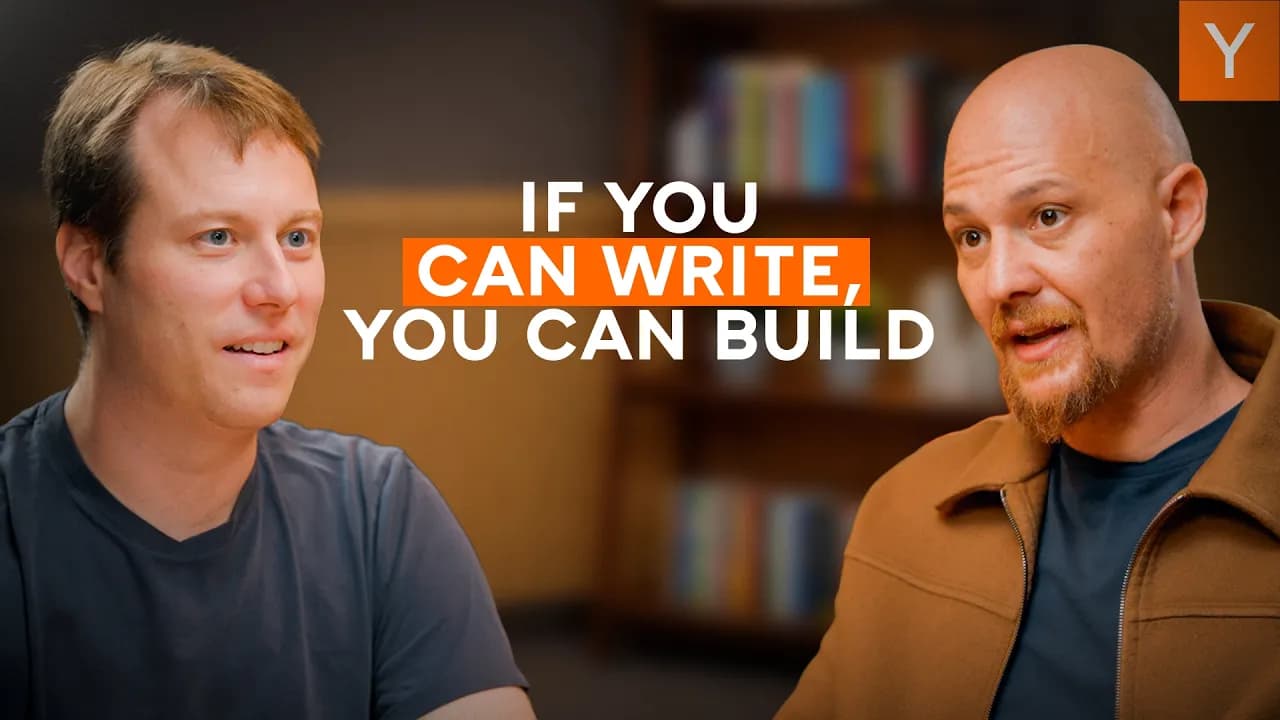
How Amjad Masad Saw Vibe Coding A Decade Early
In a Nutshell
Amjad Masad and Replit invented vibe coding a decade early by watching users manually copy-paste between ChatGPT and Replit, then automating the entire back-and-forth loop so LLMs could run to completion rather than stopping after one turn. Replit's 20-year systems programming foundation—kernel engineers, custom file systems, sandboxing infrastructure—became the competitive advantage that let them provision databases and infrastructure through AI, which competitors lacked. The platform now positions itself as the transformation layer for "self-driving companies," where agents replace the traditional programming workflow entirely.
These notes were generated by AI and may contain inaccuracies.
Amjad Masad explains that everyone must go through denial, depression, and eventual acceptance with AI. Replit is positioned as an iceberg where the visible part above water is telling AI in English to write code, but underneath lies all the deployment and sandboxing infrastructure.
Replit does not describe itself as vibe coding but rather as the platform for transformation to self-driving companies.
Replit was living in the future and invented vibe coding a decade early. The core DNA of Replit is living in the future. When vibe coding was introduced in 2024, it seemed like a big departure from how people did things, but it was incremental for Replit's team.
The development was incremental rather than a sudden departure. The YC ethos of looking at what users are doing and building based on that observation guided the process. Replit was already doing autocomplete, generating 50-60% of code before moving to full vibe coding where you tell the system in English what to do.
Before vibe coding was released, users were already achieving 100% AI-generated code through a manual process. They would open Chat in one window and Replit in another. Non-coders would copy code from ChatGPT into Replit, then when Replit produced an error, they would copy the error back into ChatGPT, get a fix, and paste it back.
Amjad invited users to the office to observe this process directly. The team realized they needed to automate the entire back-and-forth process rather than just making an API.
It was not obvious or easy to automate because AI models at the time could only do a couple of tool calls. The key difference was understanding errors, not just automating the conversation. The system needed to loop indefinitely until the program was working, rather than stopping after one turn like ChatGPT worked.
Replit demonstrated that LLMs could run to completion rather than stopping after one turn. This was new information to model companies, who reached out asking how replication worked. The harness circuit in 2024 was 10 times more complex than today's harness because the models were less capable.
As models become more capable, less engineering is needed to make them agents, which means it becomes easier for competitors to enter the space.
In the AI business, everything gets commoditized constantly, requiring constant innovation. Replit also demonstrated that AI can provision infrastructure, which competitors lacked. Replit had built databases and spent years doing system software, enabling tool calls like spinning up databases, Redis, or hosting.
When the product launched in September 2024, people were surprised. Andrew Karpathy called it an AGI moment because LLMs could do infrastructure provisioning. Paul Graham was initially freaked out and didn't like it aesthetically, as his programming style involves spending three years writing a thousand lines of code and optimizing it down to 980.
When Paul Graham first invested in Replit, he noted the super-linear relationship between programming ease and number of programmers. Making something 10% easier doesn't get 10% more users but twice as many. Amjad realized Replit needed to go all the way to be truly successful.
Amjad was predicting AI as early as 2015-2016. In their original deck, they discussed building a platform with millions of coders to train machine learning models that predict coding patterns. This was before the Transformers paper.
Amjad's ability to predict the future stems from obsessive thinking over 20 years. When he got his first Nokia phone as a kid, he predicted people would use phones as computers. This same pattern recognition led to Replit being the first programming platform with a mobile app, which everyone initially laughed at.
Amjad started thinking about online programming around 2008 when he had a Symbian smartphone and wished he could program during class. The 20 years of obsessive thinking about this problem enabled predictions that seemed crazy to others.
During the summer 2024 demo, Paul Graham felt Amjad seemed like a Bond villain when he said not to look at the code because it was object code. The realization that decades of crafted code was now just object code was controversial at the time but is now being accepted by engineers.
Everyone goes through denial, depression, and acceptance with AI. Paul Graham had already experienced this grief by 2020, having already processed the loss of the craft he loved.
While Replit users already knew, OpenAI's o1 convinced the rest of the world that AI would write all the code. OpenAI's o1 was the first time people experienced LLMs running to completion, giving a task and having it go all the way until completion.
The form factor of o1, allowing text interaction, influenced how everyday people experienced AI coding. Amjad learned that putting out a vision and building a product isn't enough; extensive tinkering with how people experience it is necessary.
Amjad initially avoided watching users because it caused intense pain when they were confused or hit bugs. Haya forced this practice, making the company culture focus on being very close to users through constant conversation.
Haya also transformed Replit's visual identity with mindbending graphic design that was unusual for a programming platform. This helped attract teenage hackers as the initial audience and gave Replit a distinctive strong character that Paul Graham describes as a strong solution rather than a weak one.
Replit's conceptual framework involves engines and hard mechanical things. The graphic design reflected hardcore engineering while making the UX simple. The backend involves really ugly engineering, including kernel operating system engineers and building their own transactional, fully reversible file system from scratch.
Replit does system administration so users don't have to. This depth helps win enterprise customers who are sensitive to reliability and security. Competitors do reckless things with security, but Replit puts guardrails that make the product slower and more expensive but preferred by enterprises.
Replit is like an iceberg with the visible part being English-to-code generation, but underneath is deployment and sandboxing infrastructure. They have kernel OS engineers and built their own file system. The collaborative features from version one helped enable vibe coding because the agent becomes another user on the same system.
Replit's organization was perfectly positioned for AI. They had an infrastructure team for code execution and sandboxing, a deployment and cloud services team, a team building glue between infrastructure and IDE, and an IDE team. They created a new agent team in the middle, with all other teams now building for the agent.
Initially, editing code was hard because there was no native edit tool. They had to create their own edit tool that was ridiculously robust because LLMs were bad at the time. They would hallucinate line numbers and be lazy, writing functions but stopping in the middle with incomplete code.
Now agents just generate code and get given a shell, writing shell commands to do everything with cat and basic commands. The early IDE was needed because agents were bad, which enabled Replit to be so early.
When launched in beta, 30% of the time it would not work. Users tolerated this because it was magical compared to the manual copy-paste process with ChatGPT, and for people who couldn't program at all, 70% success was a huge improvement.
The initial paying customers were people who would otherwise go to outsourcing sites. The two-order-of-magnitude price difference between paying $100,000 for outsourced engineers versus $1,000 for Replit demonstrated market demand. Replit Bounties tried to capture this demand with teenage hackers powered by rudimentary AI, but was shut down because it would become obsolete when agents could do everything directly.
Replit works with banks, manufacturing, and ordering companies that don't specialize in technology. These companies need Replit's guardrails to avoid shooting themselves in the foot. The impact often starts with internal tools built by ambitious people within these companies.
Working with enterprise customers created identity questions since it wasn't part of the original mission. However, these are entrepreneurial, ambitious people building businesses within companies, which aligns with Replit's core mission of empowering builders.
People who bring Rapid into their organization get promoted because of the great impact they create. This occurs especially now as all companies are thinking about using AI. Companies are reading how AI has taken over the world and need to find who within their organization understands anything about AI and who's using it. The person using Rapid to make things becomes the one they trust.
The situation represents a continuation of the impact pattern, though there is a bit of schlep blindness where there is a lot of boring work required to be enterprise ready. Having practice doing that kind of work, particularly systems programming, provides relevant experience. A lot of enterprise work involves giving admins and IT a lot of controls over what people can do, setting budgets, and establishing rules. This resembles sandboxing for humans and relates to the principal actor problem where end users are not actually the decision makers for the buyer.
Most of the history of the tech industry in enterprise software has sucked because end users aren't the decision makers. Now people have a lot more say on what they want to use, and therefore products that are really good are winning in the enterprise. However, the problem still exists where IT and security will sometimes force products to be made worse for users.
Rationing tokens represents a real example where companies approach AI by saying everyone gets $100 of tokens a month. Companies should care about ROI instead. From customers, there is a parallel of ROI inside companies where one person could drive 100x the next person. With agents, it used to be 10x but now it's 100x to 1000x. Controlling token spend requires helping companies see where good stuff is happening.
In the short term, companies have to do what customers are asking for because that's how to get in. Then the goal is to invent something better and show them the way. There's more stuff to build, and this could be very valuable stuff because figuring out which projects people are using tokens for are the most valuable addresses the biggest problem inside big companies - they can't figure out the value of stuff done by individual people. Building something that makes them even 10% better at that fixes the whole fundamental problem with big companies.
This extends far beyond just vibe coding. Rapid no longer describes themselves as vibe coding. A blog post called "The Self-Driving Company" describes the idea where early adopters of technology broadly, but definitely AI, are working differently with a fundamental shift in how work happens. Rapid as a company serves as customer zero of Rapid, acting as the lab for figuring this out. The self-driving company represents the future of work and how firms are organized, with Rapid as the platform for transformation for self-driving companies.
The expanded vision of where Rapid is headed stems from recognizing that making software creation more accessible would have transformational impact. The realization was that this would fundamentally change how people work, because previously it seemed like programmers write programs and the core of the way companies work doesn't consist of programming. Now it does.
This represents an instance of what happens with the very best startups. The very best startups have already done the big new transformation planned because they're already big. Then they think of new things as if they were a brand new company and get 100x bigger.
It's now essential to reinvent yourself because AI is a massive commoditization force. Where it used to be optional to reinvent yourself, it's now mandatory. The way AI flows into companies is gigantic, though this needs to be made concrete because anybody can claim they're the way AI flows into companies.
Everything popularized ends up being copied. The idea of idea to app fast became literally every startup's thing, but they're copying the old version. The best startups are constantly innovating because the movie is always moving forward. The goal is to have Rapid in every company, as every company that has competitors can't afford to just sit.
The approach is gradual rather than founders coming up with big strategies and making big announcements. The method involves letting customers tell the story with a general goal of where to end up, then executing incrementally. The increments come from individual things customers bring up, but knowing what to look for - a customer doing a certain sort of thing, helping them out, then everybody will be able to do it.
Having done all the systems programming buys entry into customers so the increments of new things can be seen. Agent Rapid for the outside world was a discontinuous moment internally but was incremental in many ways. Things that seem like step functions to insiders appear smoother because the history was seen before and after the step.
The history of invention shows that Steve Jobs tried to do an iPad in the 80s because he knew something like that would be good, but the technology wasn't there. When reading the story of Apple, the iPhone seems totally obvious after the fact, but if it was so obvious, nobody else did it. The iPad or iPhone originally came from making a tablet, and Jobs already knew what he wanted after thinking about it for years. Whenever something happens within a company, it's going to be something that's been thought about for 10 years.
Rapid has been living in the future more even than AI specifically. It's often frustrating because stuff doesn't work and people change so slowly. Cloud deployments are still not fully convincing people about how they're going to use AI. The internal prediction is going from everyone using one agent to 10 agents to 100 agents to 10,000 agents at some point, and you can't run 10,000 agents on a MacBook. Eventually getting away from local work in general will happen, though people still predominantly do work on their desktop.
Working at Rapid ends up being a weird sort of existence. The weird thing is knowing what everyone's future is going to be like. Demonstrating what later came to be called vibe coding while wearing a black shirt, sitting bald and declaring "This is the future" created the Bond villain moment. The ability to kill the sacred cow exists because of comfort with throwing away things and starting over, having started over many times in career.
Most people are rigid about identity and what they do, but should read "Keep Your Identity Small." This moment requires a ton of adaptability. When asked how to raise children and what to teach them about AI, the main thing is flexibility and adaptability and being a lifelong learner.
The analogy describes having a tidal wave approaching the beach - the safest place to be is surfing on it rather than standing on the beach holding onto a palm tree. Users are the ones who can see the future and be protected against bad things happening because they're using AI. Rapid is the way to use AI, and using it is the best way not to be squashed by it.
There's a moral angle to helping companies transform and getting people off the beach onto the surfboard. A hackathon with a very large telecommunication company included a survey before and after using Rapid asking how anxious people were about AI and how worried about their jobs. Pre-using Rapid for just an hour, 80% were anxious and worried. After using Rapid, it flipped to 80% optimistic and 20% worried.
People in Silicon Valley constantly underestimate how the rest of the world has not experienced what's been experienced yet. Things are moving so fast that if companies are just two years behind, that's forever behind because two years ago vibe coding didn't exist. Most banks are using ChatGPT like 2023 basically - just an LLM barely connected to anything that's not that useful. There's a real lag in what people use, with Silicon Valley already at agents doing things while most companies are still trying to figure out what to do with legacy software.
All the COBOL code might finally get rewritten as it's starting to happen. Early in the AI journey, companies would say the replica thing is cool but why not use it to rewrite COBOL. The response was not writing code for them but teaching how to use the thing. Now there's a bunch of AI companies that will come and rewrite COBOL.
Rapid's entire history worked because of living in the future to such an extent. The component involves actively trying to predict things, actively revising predictions, and looking at them. It's a skill that can be developed with certain principles that can be followed. Ray Kurzweil's work on log linear charts of all compute flops in the world showing a straight line, with AI not bending it, represents a religious sort of thing that it'll happen anyway.
The tweet stating it's not that AI brought on the compute, the compute brought on AI is true. Deep learning would not have happened without the compute. Everybody thought neural networks didn't work back in the 80s, but if given 10 billion times as much resources, they start to work. The line allows a lot of predictions by truly understanding it more broadly.
The reason for being good at living in the future is having normalized that line and assuming not living in a static world but in an exponential world. Once truly understanding the exponential, an LLM like GPT-2 can be looked at and extrapolated from much better than most people, imagining chats, agents, and personal assistants back in 2019 when first seeing GPT-2. Most people implicitly treat things as static, but the default assumption is that things will change exponentially.
Having embraced exponential change as a kid reading sci-fi and reading Kurzweil created an ability to accept change and be okay with change. Computers are going to do more and more of the things of skill, so expect and build towards that and skate where the puck is going. The puck is moving faster and faster, which means feeling more in element right now because nobody else can keep up. The person who assumes dramatic change is perfectly suited to this moment where everything is changing under feet every 6 months, which is why Rapid is doing so well.
Keep Y Combinator in your library
Save the videos and channels worth coming back to, and find them again in one place.