Agents For Non-Technical Users
In a Nutshell
Emergent, the fastest-growing YC S24 company, enables non-technical users to build and ship production-ready software via advanced AI agents, with 7 million apps created in 8 months by domain experts from 190+ countries—80% non-coders running real businesses like lawyer CRMs and equine coaching apps. Founders pivoted from top SWE-Bench coding agents to a full-stack platform mimicking elite engineering teams (multi-agent systems, memory, verification loops, custom infra), outpacing prototype-focused rivals by prioritizing production deployment, security, and scalability. This empowers solopreneurs to bypass $500k dev shops for $5k solutions, sparking a Cambrian explosion of niche "intersection" businesses and agentic SaaS, as models advance toward 24/7 swarms.
These notes were generated by AI and may contain inaccuracies.
Emerging AI tools enable problem domain experts blocked by technology barriers to build solutions. Focus on AI replacing jobs overlooks empowerment for starting businesses and gaining autonomy.
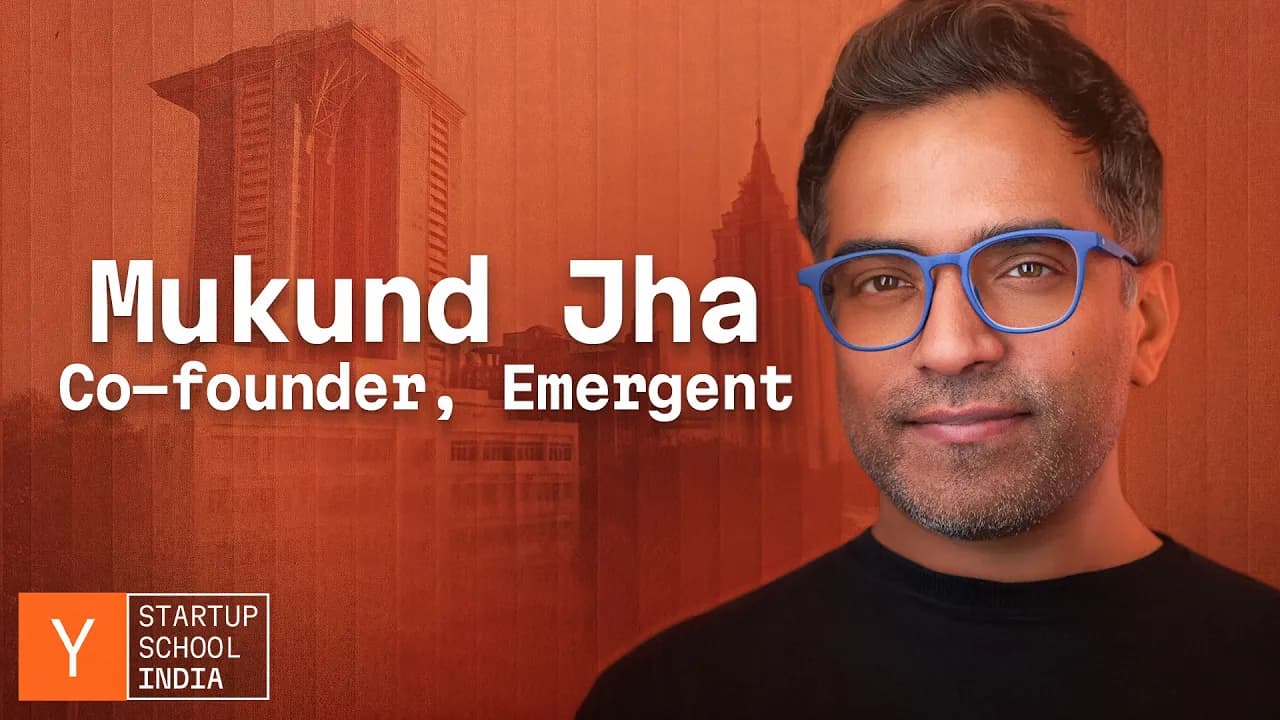
Gary absent due to jury duty. Joined by twin brothers Makund and Madav Jar, founders of Emergent, YC Summer 2024 batch. Emergent platform lets anyone build and ship production-ready software using AI agents. Fastest growing YC company: 7 million apps built in 8 months since launch.
Started programming at age 12. Both came to US for PhDs. Makund dropped out, joined Google, ran Danzo (hyperlocal quick commerce in India, managed 300 engineers, became a verb: "done"). Madav at Zenz, started deep learning team at Amazon. Watching deep learning inflection point.
Software testing biggest bottleneck in shipping fast, observed managing large team. Started late 2023. Applied to YC and pitched VCs on automating software testing; seen as too crazy.
Building testing agents revealed solving verification (testing) enables automating all software engineering. Key insight: verification loop keeps agents running longer. Pivoted early 2024 to general coding agents.
Lovable not started, Kurs very early, Devon just out. Targeted SWE-Bench benchmark (now saturated). Four-person team cracked it, built coding agents #1 on SWE-Bench in 2 months. Discovered fundamental truths about building with LMs and agents.
Intended users: engineers. Purely research company building coding agents, not product-focused. Invented multi-agent system, memory, agent-to-agent communication, scaling test-time compute. Paradigms like multi-agent orchestration, routings. "Cloud code before cloud code." Many ideas later appeared in papers 3 months later.
After coding agent success, tried enterprise route (common wisdom), spent 2-3 months; too slow. Internally used Emergent platform for tools. Saw Lovable, Bolt growing. Packaged strong coding agent for world. Launched small beta/pro pilot June 2025, took off. Now 80% users non-technical with zero programming knowledge, building apps running real businesses. Users from 190+ countries, 70-80% US/Europe.
New model generations reimagine opportunities (e.g., GPT-4 JSON parsing issue; next models solve). Opus enables long-horizon tasks, multi-agent coordination. Second mover learns from competitors, starts with different aperture/imagination. Others optimized for front-end prototyping; Emergent reimagined for production shipping.
Built end-to-end platform: code reviews, automated testing, debugging, deployment, security, hosting. Users want to ship products, not prototypes.
Entered with head-and-shoulders better product. Focused on rapid distribution: built large influencer network on TikTok, Instagram.
Thesis: users wanting serious applications. Broad marketing: "build real software," highlighted common errors from other platforms. Converted users wanting real apps.
From experience (300 engineers, Amazon deep learning), architected full systems. Others prototype quickly but hard to production (Pareto: last 20% effort).
Built own infra (Kubernetes test stack, container test tag) for agents: same infra build/deploy time minimizes issues, rapid feedback. Python backend, React frontend (vs Node-heavy); supports background jobs, async (e.g., video processing) from day one. Same stack Emergent built on exposed to users/agents.
Main agent handles routine; delegates to sub-agents (testing, design/integration search). Aggregates trajectories for long-term memory across sessions (continual learning variant). Auto-generates skills from trajectories via CI/CD, added to memory. Skills-Bench shows agents with skills outperform; human-generated skills better than agent-generated. Agent improves (e.g., calendar integration) over time.
Architected around complexity/context limits. Internally replaces Cursor for developers; hide VS Code editor/diffs from non-technical users (even technical PMs intimidated by JSON).
Started as Devon/Cursor-like for engineers, packaged for non-technical (power + simplified UX). Hard to reverse architectural choices later.
Skipped library definitions, integrations, unit test generation (next models solve). Give more autonomy to models as they improve; looser harness performs better.
Coding 20% of job; production hard. Close user understanding key. Human desires grow with models. Extract 20-30% more via harness, multiple foundation models. Expanding to distribution, growth, user management.
Software engineering positions increasing. More powerful tools spawn ideas, accelerate shipping (Jevons paradox). Roles combining (PM/designer/engineer in one). 5-6 person team work now by single person.
YC next batch applications at ycombinator.com/apply.
Prompt: app to practice podcast/job interview questions. Smart prompt engine detects mobile app, routes to mobile app builder agent (auto despite wrong tab).
Illinois user (AV setup business): full-stack intake form/lead gen, no coding background.
Design focus: balanced design/functionality via context sharing.
Norway user (sold business to PE, business developer, no programming): CRM for lawyers (lawyers struggle with spreadsheets).
A lot of CRM-related apps are being built by small businesses as a second monetization avenue. Emergent's agent asks for clarification before building to ensure it understands requirements properly. Non-technical users often don't know about API keys or how to get an OpenAI API key, so users can say 'use Emergent LLM key' without needing third-party API keys.
This feels like a good example... you just abstract that away but build it into the experience for someone who had no idea about it.
Users can be casual: 'for the first one use Emergent API key, rest assume good defaults and then go.' After handing off to the agent, users can close their laptop or use the mobile app to prompt further on the go if needed. Once done, users see a preview of the app.
Example: Practice origin story by recording answers to various questions. This is a podcast preparation app. Users can revisit answers given to the app. Many personal apps are mobile, but business apps trend toward web apps.
Demo of an actual Asana clone built internally by a QA engineer using real Emergent data. Started as curiosity; first prompt was 'clone Jira,' then iterated. Customized for Emergent's workflow: ship three times a day (morning, evening, night), QA involvement. Asana was hard to customize to work style and cost $3,000-$4,000/month in subscriptions.
This is really the world of personal software.
100% built with Emergent, no code edits. To add a feature, go to the project and prompt the agent. Useful for dogfooding as it's at the edge of complex apps, testing limits.
Internal teams building on Emergent: marketing team built complete CRM, customer support team building customer support software. People closest to the problem build fastest.
Everyone in the company uses one collaborative internal Asana clone. PM, QA, HR can add features via agent. Has testing phase, deployment phase, different versions maintained, primary owner manages. Feature requests built by agent, accepted features go to release. Not managed through Git by default; can connect GitHub. Emergent handles versioning even without GitHub connection, as non-technical users have limited GitHub knowledge.
Lean team indexes on problem-solving and ownership. Early hires from top 100 IT rankers (e.g., IT rank 1, IT rank 12). Initial hires from Dunzo. One or two people do work of larger teams: deployment (mirrors Vercel) by two people, memory by one person. People attracted to harder problems.
Team mostly in Bangalore, India office; small SF office (3-5 people). Founders split: speaker in SF/Bay Area 10 years, splits time half SF half Bangalore.
Ambition to build Google/Facebook-scale from India: abundant talent, capital. Dream big, think global from day zero. Internet penetration enables global knowledge.
Running split team (India-heavy, US/Europe users, not for Indian market): high standards in hiring/product. Everyone talks to customers 1-2x/week, does customer support. Small 12-person engineering team had one always on-call for support to build empathy from day zero. Distribution online, but customer talks bridge gaps. Launch week: speaker did support only, handled French/German via AI.
Hiring in SF and Bangalore: research, backend/front-end engineers.
Current SaaS needs to change. Headwinds: (1) SaaS workflows consumed by agents—SaaS must pivot to agent-first; (2) demand for customized software like Emergent's Asana clone. ~20% of Emergent apps are agentic, embedding Emergent agent for workflows.
Example: CRM for lawyers—agent runs workflows. Software morphing to agentic; people build agents to do more work autonomously.
Agent task horizons growing exponentially (e.g., 4.5 at 4 hours, 4.6 at 10 hours—chart of the year). Experimenting with agent swarms: multiple agents coordinate on tasks, early results exciting. By year-end: agents running 24 hours, hundreds collaborating on one task.
Building for longer missions: give agents more autonomy, ensure trajectory doesn't derail via overseeing agent monitoring. Experimenting architectures, e.g., 'continue until done' loops need strong verification loops. Focus: best verifiers via custom fine-tuning. Augment models (not compete), e.g., no GPT-4.5 alternative but verification layers.
Fundamentals same: understand customers, build close to them, compete on product. Models differ: Opus workhorse, Codex backend debugging, Gemini frontend. Leverage model spikes for best UX. Models will commoditize (similar behaviors, price competition); open source 3-6 months behind. Builders understanding users win.
7 million apps built. Users: serious business use cases/ideas. Primary: small-medium business owners on email/WhatsApp/spreadsheets, would have gone to dev shops ($500k cost) now $5k on Emergent.
Example: Christy (Alaska, clinical psychologist/sports coach for equestrian/horse riding). Built Equine app marrying psychology + horse riding insights. Couldn't find existing app, dev shop in Nova Scotia too expensive. Launched weeks ago on app store, hundreds of users.
Solopreneurs avoid hiring CTO. Success: company raised $4M on Emergent-built app.
Not just cost: nothing lost in translation vs. dev shops. Norwegian user: sole builder, knows exactly what to build; team focuses on business.
I know what I want to build—if I could just say it out loud myself I would do a better job.
Unlocks domain experts blocked by tech barriers.
Empowers agency/autonomy: start businesses at scale vs. AI replacing jobs. Unlocks human creativity, e.g., psychology + horse riding app.
In limited software world, niche apps never built; unlimited software enables niche of niches. Extension of PG's trend: post-WWII big corps → startup wave → everyone runs intersection businesses (e.g., psychology + tech + horse riding) for livelihood.
Reduces idea-reality gap, Cambrian explosion of ideas. Early innings; larger projects coming. Enables non-venture-funded passion businesses.
Keep Y Combinator in your library
Save the videos and channels worth coming back to, and find them again in one place.