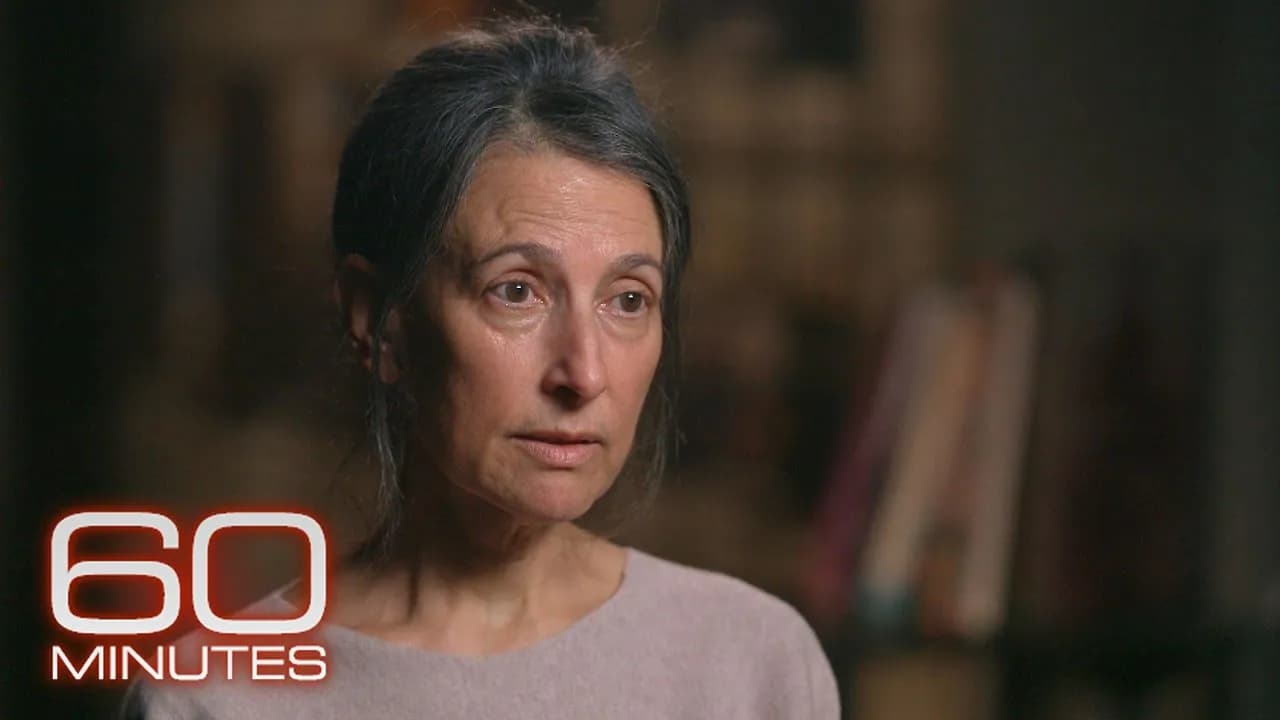
How grandparents saved family at Israeli kibbutz during Hamas Oct. 7 attack | 60 Minutes Archive
In a Nutshell
Retired general Noam Tibon and his wife drove through active combat zones and checkpoints to reach their son's kibbutz, where Amir Tibon, his wife, and their two young daughters had been trapped in a safe room for 18 hours during the Hamas attack. The grandparents rescued festival survivors along the way, killed at least one terrorist in a firefight, and joined special forces to clear houses before reaching their family at 4:00 p.m. The story highlights the complete absence of military or police response during the attack's first day, forcing civilians to act independently.
These notes were generated by AI and may contain inaccuracies.
Lesley Stahl reports on a rescue at a kibbutz near Gaza where an Israeli family faced a deadly Hamas attack. The reporting takes place in southern Israel, approximately one mile from Gaza, with audible mortar fire. This area suffered the heaviest impact from the Hamas surprise invasion and was nearly completely overrun.
Nahal Oz, a small agricultural community of approximately 500 residents, was among the first places infiltrated. Residents previously described it as "a little slice of heaven on the border of hell." Among those living there were Amir Tibon, a senior correspondent at the left-leaning newspaper Haaretz, and his wife Miri, a social worker, along with their two young children.
On Saturday morning at 6:00 a.m., the family heard the whistle of rockets and immediately ran to the safe room, which was the girls' bedroom. Every house in border communities has a room constructed of special strong concrete designed to withstand direct rocket and mortar attacks. Families typically place children to sleep in these rooms so parents can reach them quickly during sirens.
The family realized this was not a typical rocket attack when they heard automatic gunfire. They recognized the attackers were present upon hearing Arabic spoken outside. The gunfire progressed from the kibbutz fields to the neighborhood, then directly outside their window. Hamas fighters were screaming instructions to each other about how to enter houses rather than demanding residents come out.
Hamas videos show fighters shooting through the kibbutz, including footage of them leaning against the Tibon house. Ammunition was fired through the living room window, creating the impression that attackers were inside. The two girls, ages 1 and 3, remained quiet for most of the ordeal after being instructed to stay silent.
Amir began texting colleagues and quickly understood the attack's massive scale. Realizing no help was coming, he called his father Noam Tibon, a retired major general and former senior commander of Israeli paratroopers who led forces in the West Bank and at the Lebanon border. Noam and his wife Gali immediately left Tel Aviv in their jeep to rescue their family.
Noam Tibon described the situation as one where "there is no government, there is no military, only citizens." While Gali drove, Noam texted with Amir, who reported terrorists in the neighborhood and possibly inside the house. Noam instructed them to remain quiet and locked in. Amir reported that their dog was likely dead due to extensive gunfire into the house.
Gali drove at high speed until stopped at checkpoints where authorities refused to let them proceed further. The grandparents argued they needed to reach their son and granddaughters, with Noam stating they would go regardless of permission. They bypassed checkpoints by driving through fields in their jeep.
As they approached the kibbutz, the grandparents encountered scenes of burning cars and bodies on the road. They stopped to help Bar and Leor Matsner, who were fleeing the music festival massacre. The couple's car had been disabled by bullets, forcing them to hide under piles of dry leaves in a forest for 2-3 hours. After failed attempts to reach police and ambulance services, they spotted the grandparents' jeep and were rescued.
Amir could hear neighbors being dragged away. In nearby kibbutzim Be'eri and Kfar Aza, hundreds of people were slaughtered. Together with the music festival attack, these three locations represent the largest massacre of Jewish people since the Holocaust.
The grandparents encountered soldiers on the road, and one agreed to join them. Due to danger, Gali was dropped off at a roadside shelter while Noam and the soldier continued. They discovered an ambushed military jeep with killed and injured Israeli soldiers. During the ensuing firefight, Noam and the soldier killed at least one terrorist, but had to evacuate wounded soldiers to a hospital, further delaying their arrival at the kibbutz.
Amir questioned why civilians were massacred with no police or military response arriving, calling it "the biggest failure in the history of the state of Israel." During the interview in Tel Aviv, rocket fire alerts sounded, prompting the family to move underground to a shelter.
After 18 hours in the safe room without electricity or food, the family heard close gunfire exchanges. The retired general joined Israeli special forces to clear houses methodically, noting that Hamas had occupied and controlled the kibbutz. After an hour of door-to-door combat, Noam reached their house at 4:00 p.m., knocking on the safe room window and announcing his presence. The family was overcome with emotion upon hearing his voice.
Amir, Miri, and the girls are now living with the grandparents in Tel Aviv, along with their dog. Many other Nahal Oz survivors were evacuated to another kibbutz in the north. At least 10 residents were buried, with more than 10 still missing and presumed to be hostages.
Keep 60 Minutes in your library
Save the videos and channels worth coming back to, and find them again in one place.