How Jeetu Patel Runs Cisco Like the World’s Largest Startup
In a Nutshell
Jeetu Patel runs Cisco like a startup by applying a founder's mindset, mandating AI adoption across the company, and restructuring leadership with one-third operations experts, one-third external talent, and one-third acquired founders. Cisco's AI revenue exploded from zero to $9.3 billion in two years by building infrastructure for AI agents that will consume 450% more network bandwidth than humans, while treating security as the critical differentiator between market leadership and failure. Patel's personal journey from Indian immigrant waiter to Cisco's product chief proves that relentless curiosity and long-term thinking matter more than credentials or past experience.
These notes were generated by AI and may contain inaccuracies.
In the future more engineers will be needed, not fewer. The goal is not efficiency alone but the ability to harness the innovative insights generated by artificial intelligence to solve problems previously considered impossible. Living in today's technology world is described as a golden time.
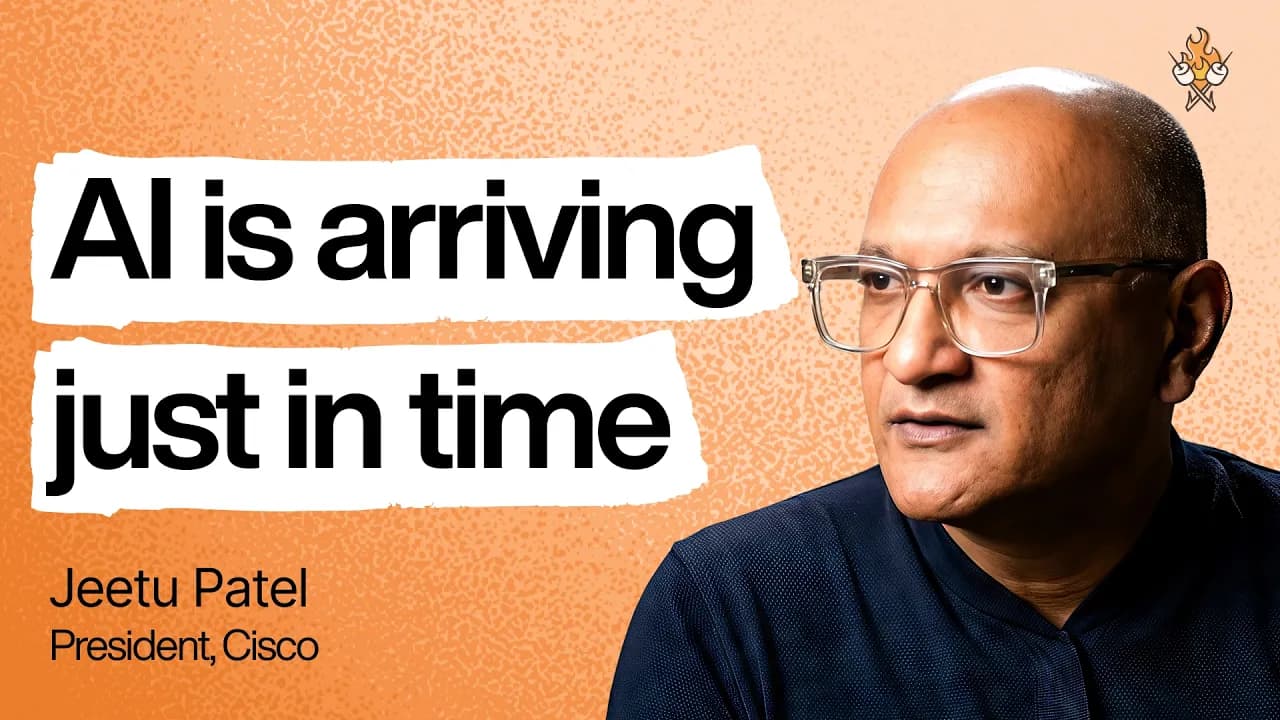
Jeetu Patel serves as President and Chief Product Officer of Cisco. The discussion covers how he applies a founder's mindset at Cisco, his focus on artificial intelligence, operations inside Cisco's massive data centers, and lessons founders can learn from his personal story.
Patel's role is ensuring Cisco builds the best products that customers can use extensively. Cisco positions itself as the essential tools company during the gold rush era—an AI infrastructure company providing the necessary foundation so artificial intelligence can operate safely and reliably. This description of Cisco as the essential tools of the AI age would not have applied four years ago.
Transforming a company already operating at massive scale requires setting the right direction, hiring the right people for the right roles, establishing mechanisms to identify target markets, and ensuring everyone feels positioned to succeed. Leaders receive undeserved credit while those doing the actual work receive insufficient recognition. Patel did not write a single line of code during the transformation—the team executed it.
Patel previously worked at Box running the product department alongside founder Aaron Levie. His convictions were reinforced after founding his own company earlier and then moving to EMC, where he found the formal work environment stifling. At Box he could work as if running his own company.
Patel identifies two types of people: excellent career leaders who prefer to work within their area of expertise without interference, and those who run businesses, consider themselves owners, and do not mind interfering in other areas. He aligns with the latter type.
A founder's approach proves especially useful during crises and radical market transformations. Patel tells colleagues he feels like one of the founders of Cisco in its final stages. Though he joined 36 years after founding, he feels ownership of the company and will defend it with full might. Everyone must take great pride in the quality of work and what the company represents.
Cisco follows the rule of thirds for its leadership team:
- One third consists of people who know how to run Cisco and are experts in managing operations at large scale
- The second third comprises people brought in from outside, including competitors, who possess deep market knowledge and strategic thinking experience at scale
- The third third includes co-founders and CEOs of acquired companies, who receive broader authority than they had at their previous companies
A balance is necessary because if all employees were founders, operations would become chaotic.
Cisco is in crisis in the sense that it has achieved one of the most successful product restructurings seen, placing the company at the heart of competition in AI infrastructure. The opportunity ahead over the next three to seven years is enormous compared to anything previously experienced. Cisco must work as the world's largest startup—combining speed with scale. Pure speed would leave it as just a startup; pure scale would leave it as just the largest company.
Less than 2% of humans currently use proxies intensively, and current infrastructure is fully consumed. When 25% to 50% of people begin using intelligent software, required infrastructure will scale dramatically. The second major challenge involves smart programs potentially getting out of control, developing their own opinions, or acting with malicious intent due to adversarial influence versus executing orders precisely.
Safety, security, and monitoring capabilities are essential to ensure AI use remains safe and does not create permanent fear preventing adoption. Not using AI actually reduces security because most attacks occur at the hardware level, requiring hardware-level defenses.
Cisco combines three elements critical for AI infrastructure:
- One of the world's largest networking companies providing infrastructure
- One of the largest security companies globally
- One of the world's leading hardware data companies through Splunk
This combination positions Cisco as vital infrastructure for critical infrastructure companies in the AI age.
Cisco invests heavily in AI both for the AI and data center market and for integrating AI throughout the business. The goal extends beyond efficiency. AI generates innovative insights enabling solutions to previously unsolvable problems—distinct from merely increasing speed by 20% or reducing headcount.
Patel believes more engineers will be needed, not fewer, as AI advances. Every significant AI improvement creates a new bottleneck, and that bottleneck is human. Automation of programming makes code review the constraint; automation of code review makes determining what should and should not be built the challenge.
Cisco assured employees they would lose their jobs if they did not use AI—the opposite of the conventional approach. The message was clear: in a radical platform transformation, those who do not use AI will not remain relevant. Two types of companies and people exist—those who master AI brilliantly and those who struggle fiercely to survive. Employees falling into the second category due to non-use of AI would not fit at Cisco.
Everyone received unlimited tokens with the instruction to start using AI. The approach mirrors learning to ride a bicycle: first become familiar, then master it, and only then become effective. Focusing on efficiency first prevents recognition and mastery. Initial resistance was considerable, with the first months proving difficult.
A leading skeptical engineer on Patel's team called one evening admitting he had been wrong. Models were evolving rapidly. The engineer had restructured nearly half a million lines of code down to between 100,000 and 120,000 lines—a fivefold improvement achieved in just two weeks. He realized changes must begin today based on where things will be in three months, not a year. The engineer expressed concern about negative implications for people and team changes, but Patel emphasized motivating everyone to become better through AI use.
Cisco became the first design partner with OpenAI and Codex, which dedicated full-time staff. Every two to three weeks, Patel meets with the entire engineering leadership team and OpenAI's staff to review what went well and what did not. AI required a holistic top-down approach applied relentlessly—something large companies need for obvious, critical initiatives.
Cisco develops software, hardware, and chips, each with different build cycles. On the hardware side, good design patterns are emerging but are not as strong as in software. Software has very high processing speed. In silicon, teams exercise extreme caution with pre-planning and do not invest all resources due to risks of data and intellectual property leakage.
With improved models, open-weight models, and internal infrastructure, silicon development pace is expected to accelerate, though the silicon production cycle needs shortening.
Cisco's work spans the entire system: silicon, optoelectronics, systems hardware, and software. Each layer has a different planning cycle:
- Silicon planning cycle spans five years—investments made today determine mass production five years from now
- Hardware planning cycle typically takes 18 to 24 months, sometimes up to 30 months due to supply chain constraints
- Software and operating systems planning cycle is 12 to 18 months
- Models, agents, and applications operate on 3-month or even weekly planning cycles
A co-designed, integrated architecture across all elements provides strategic competitive advantage through IP that competitors find difficult to replicate.
A massive historical data center construction event is underway. GPU scaling evolved from single GPUs to eight GPUs per server, racks of servers with internally connected GPUs, rows of racks, and now multiple rows requiring horizontal network scaling. Power constraints mean data centers may be built wherever power is available, sometimes hundreds of kilometers apart, requiring them to operate as a single logical unit.
Cisco focuses on both horizontal network scaling across data centers and vertical network scaling within racks and single data centers. The company manufactures silicon chips, switches, and photonics electronics connecting GPUs.
Two years ago Cisco began selling AI products to major cloud computing companies, projecting $1 billion in orders but achieving $2.3 billion in the first year. The following year the target doubled to $5 billion. In the most recent quarter ending a month ago, Cisco secured $9 billion. From zero to $9.3 billion occurred in just two years. AI represents $9 billion of Cisco's $63 billion total revenue in a completely new line of business.
A gigawatt of data center capacity previously cost $35 billion and now approaches $50 billion, with 10 to 15 percent of that cost attributed to networking. The construction process is enormously complex, involving power permits and building the outer shell.
Concerns about overbuilding are unfounded. In AI there is no prior knowledge, requiring people to let go of past experiences because previous knowledge can be a disadvantage. Unlike the internet boom when infrastructure was built hoping demand would materialize, current infrastructure gets consumed almost instantly. Supply remains limited despite rapid growth.
Less than 2% of people currently use proxies, and the average proxy consumes 450% more network bandwidth than a human performing the same task. Trillions of proxies will generate enormous token volumes and back-and-forth exchanges.
Patel became a fan of using personal agents, with Instinct proving transformative four days prior. Previously managing 171,762 emails with 146,000 unread, he granted Instinct access to his personal email. The agent handled the entire inbox, determined actions, moved and archived items properly, retrieved needed items, and summarized news from all sources. Patel now feels in control and finds checking email enjoyable with only three messages remaining.
Building data centers alone will never be sufficient. Processing 140,000 emails requires massive code. Despite hype suggesting a bubble, two conditions will persist: a radical shift fundamentally changing how people live will require massive infrastructure, and some companies will see inflated valuations. With any radical platform shift, experimentation occurs and only a few succeed. Overvaluation of some companies does not constitute a bubble—the bubble would be questioning the radical shift itself.
Extremely important topic with major focus for Cisco over the next few years. Infrastructure constraints have been a huge problem, with availability of computing resources remaining an issue. However, the bigger problem is how trustworthy these systems are that will be entrusted with work and personal life. The difference between trusted and untrusted delegation represents the difference between market leadership and complete bankruptcy.
Cisco is working to ensure a complete security platform for agents, including full visibility into model components, identifying non-human entities, restricting programs running in environments, and validating models themselves including algorithmic penetration testing. If models are compromised and asked questions or perform actions they shouldn't, the platform can intercept and enforce dynamic safeguards during operation, providing complete security and monitoring mechanisms.
The AI Defense product was launched a year and a half ago as the foundation and is performing exceptionally well, requiring scaling of use. The system was initially designed for the chatbot era, starting with application to the model and then expanded to employees, now providing dynamic 24/7 employee monitoring. Examples include preventing retail employees from giving three times the refund amount paid for shoes.
Acquired Galileo with experts from DeepMind and Uber joining the Splunk team, who have been instrumental in this project.
Father was a con artist similar to Bernie Madoff, scamming people and taking their money. Living in India became dangerous with someone trying to kidnap him. Father had a mistress who committed suicide. Father was abusing mother terribly, and they were very close. They both ran away, with mother deciding to live somewhere undisclosed while he chose to explore America and find schools.
Came to America at age 19 in 1991. Uncle took him in for a while. Worked as a waiter at Sizzler restaurant where average tip was one dollar. Many important things happened during this time that completely changed self-perception.
Was a bad student in school, different from the rest of family where many cousins were high achievers. Always felt a bit inferior. Had a stutter so was always quiet and couldn't even say hello when answering the phone. Started working as waitress and told himself he had to find a way to entertain customers or wouldn't make money.
As college student, came across DocuLabs and got an internship through professor's introduction. Few months later, founder said original investor was leaving and they would buy his share. Decided to join and invest, with each investing a quarter of a million dollars. Went to banker acquaintance asking for $250,000 loan to buy the company, stating intent to run it after purchase. Was still a college student earning minimum wage with first loan of $10,000 and second of $250,000.
Ran the company for 17 years, now worth less than $5 million. This was the biggest mistake in career not because the company wasn't good, but because the business model didn't align with what wanted to do in life.
Chuck tells that once company goes public, can't change business model much as it takes significant effort to change. Working in services industry as market research firm while loving software and Silicon Valley. Had apartment in Russian Hill neighborhood for a while and was fascinated by Silicon Valley people, wanting to work with them because decisions like the Start button in Windows affect billions of people.
Never got same level of satisfaction from services work but stayed because of ego and pride in being own boss, not wanting to work for anyone else. This was the biggest mistake because pride drove the decision instead of learning being the motivation.
Finally decided to work for EMC with 60,000 employees, moving from about 25 employees. Person who hired at EMC is still a mentor named Rick DeVinoti. During dinner, asked for higher pay because of 17 years experience. Rick responded: "Hey G3, you don't have 17 years of experience, you have one year of experience multiplied 17 times. Come work with me, and in your first year, I'll give you 17 years' worth of experience."
Learned more in first year at EMC than in 17 years running own business. Hated working with Rick during that time, but after he left and moved to Box, constantly asked "What's Rick going to do at this point?" with COO considered co-founder for life who wouldn't take jobs without her.
At Box, raised company valuation from $200 million to $800 million while managing all aspects of the product. Was going to head advertising department at major tech company that had nothing to do with Cisco. Accepted the job but the offer they were going to make to Jessie, who was partner always by side, wasn't right for her.
Chuck called the next day saying maybe should consider joining Cisco. Already accepted the other job, but Chuck said the company will succeed whether joining or not, but if joining Cisco, its trajectory will be determined by performance. They only gave two presentations in nine days, indicating the company was prepared to work at very fast pace.
Question to Chuck was how much freedom would be given to be obsessed with the product. Chuck replied yes, would like obsession with the product. Cisco became the place of most growth in career, probably in the last six years.
First lesson: upper limits are usually more related to ambition than anything else, not related to general abilities. Average-intelligence person without prestigious university degree but hungrier than everyone else and still is hungrier than most colleagues. Not because they aren't hungry, but because don't want to let them down, so will keep working hard. Nobody can tell not putting in enough time and effort.
Putting in time and effort comes first. Think big with bold ambitions because imagination can limit more than realized. Having a goal that big probably won't reach it, but if having goal of that magnitude and achieving it, that's pretty good.
Teamwork is foundation of success. Take pride in long-lasting relationships built where contributed to success of others through efforts. This will make huge difference, and thinking this way since age 19 provides tremendous advantage.
Concept of power of accumulation: improve performance by 1.27% today compared to yesterday, and within a year will be 100 times better. If doing that for 10 years, that's remarkable achievement. Ten years seems like long time at age 19.
Sam Altman had blog where wrote "The day is long, but decades are short" - read it every year, one of the best blogs ever written. Jeff Bezos says founder's ability to think 20 years ahead rather than 3 months ahead fundamentally changes quality of decisions.
Great business leaders like Jensen and Elon Musk have no accusations of short-sightedness leveled against them. They've persevered and worked hard for long time. Only difference is persistence when business model makes sense.
Don't do what was done and struggle with project that doesn't align with ambitions. The project was great commercially but very difficult to change the world when wanted to change the world. If wanting project that improves lifestyle and provides decent life for self and family, then great to keep going.
All answers are correct. Ambition didn't align with business model, another thing to consider: does ambition align with what's being done now? Will feel satisfied when looking back at 80 and saying spent time this way? This is question should constantly ask ourselves.
To young people: time will pass quickly. Never imagined reaching fifty-five, someone calling uncle, being blessed with child, child saying "Dad, you've grown old," or becoming bald. Sometimes these things teach humility and make sure not wasting time, spending it on things that are really important.
Hasn't visited India since leaving in 1991. Father died in 2004, visited once for 48 hours before death. Didn't return to India until 2017. Took daughter to Taj Mahal with tour guide named Raj showing the Taj Mahal. Man seemed like great producer knowing every detail of his product - the experience selling about the Taj Mahal.
As people walked past, would suddenly start speaking in different languages - Mandarin, German, French, and Spanish. Asked how many languages spoken. Answered with exaggeratedly large number, about 12 or 14 languages. Response was madness. Raj said wants to honor people who come there because they come, and shouldn't be so arrogant as to think they're going to speak his language, should speak their language.
Thought to self that guy is smarter than anyone worked with at Boxed back then. Earns about $10 a day while sitting in Silicon Valley. Why? Because own platform and he doesn't. Has educational platform, American platform, and technology platform that gives opportunities not available to him.
No matter how intelligent he is and how hard he tries, finds it difficult to stand out. If having similar opportunity, all asked is not to waste it.
As founder, may all look at things pessimistically focusing on what lack. But living in exceptional era. If 19 or 20 years old or at beginning of career at this pivotal moment during AI revolution, many people in their fifties would pay to go back to being 19 if they could.
Magical time to live in world of technology, great time to make real impact on world. If spending time with YC, one of most wonderful organizations, would be foolish not to give it all and do everything possible, not for any other reason, not to make money, but because impact on society as whole will be so rewarding when growing up, and will be something worthwhile.
If lucky enough to sell company to large company, don't let pessimism control when going there. Go and learn what big companies are teaching because all those big companies were once startups. If succeeds, will eventually become large company. Don't underestimate large companies, instead learn how to make it work very efficiently in order to achieve success. Then will be able to benefit from that as well.
Go forth with great curiosity, and regardless of path taken, know that have this platform and few people in world look at eight billion people, and only few of them have platform like this.
Keep Y Combinator in your library
Save the videos and channels worth coming back to, and find them again in one place.