How Nuclear Will Unlock Energy Abundance with Valar Atomics Founder Isaiah Taylor
In a Nutshell
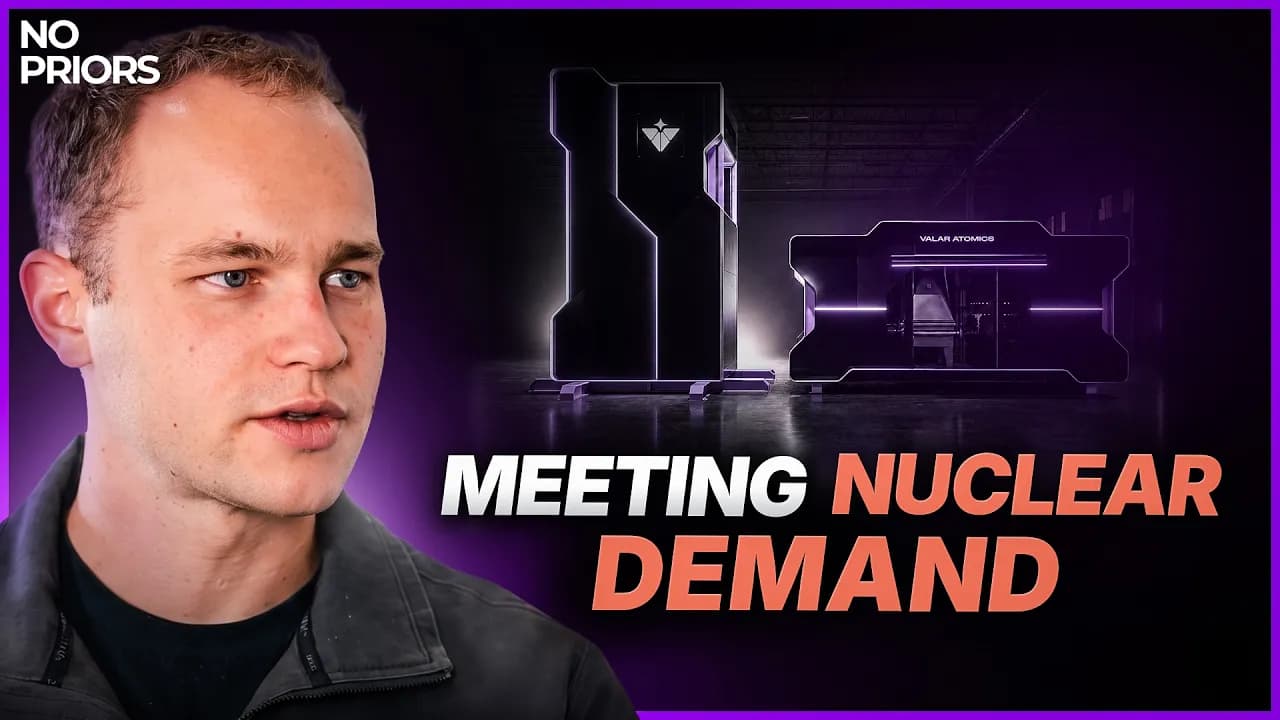
Valar Atomics achieved the first advanced reactor to generate power in the US since 2000 by building and operating the W-250 reactor under DOE authority, demonstrating that nuclear power is a hardware execution problem rather than a design or simulation challenge. The company uses a simple TRISO-fueled graphite-moderated helium-cooled architecture with modular concrete construction to enable rapid iteration, targeting a "tick rate" of new reactors every few minutes through vertical integration and in-house manufacturing of components that traditionally cost 100x more. The core thesis is that making energy 10 times cheaper through mass manufacturing of simpler reactors will unlock hyper-technoindustrialism where everything becomes essentially free.
These notes were generated by AI and may contain inaccuracies.
Valar Atomics achieved the first ever AI chip powered by a nuclear reactor. The company completed the first TRISO reactor to turn on in over 50 years in the United States. Energy demand in the United States is largely driven by AI compute needs.
Energy is a commodity where demand is set by the price. If energy can be made cheaper, demand will follow. SpaceX faced similar skepticism about hitting their current production numbers when they started.
Most of the nuclear industry focuses on modeling and simulation rather than hardware iteration and hardware execution. The industry is not focused on building the simplest and safest reactor that allows scaling. Valar Atomics has demonstrated hardware iteration capability.
Valar Atomics is making nuclear reactors built for planetary scale. Nuclear fission technology originated in the 1940s, but reactors have never been built at mass scale. The company aims to create reactors that are more manufactured than constructed, extremely safe, and capable of making energy 10 times cheaper for humanity.
Isaiah Taylor does not have the credentialed decades of nuclear research background typically required in the space. His great-grandfather was a nuclear physicist on the Manhattan Project, and both his great-grandfather and great-grandmother worked in the secret city during World War II. He grew up thinking about nuclear as incredible technology and always wanted to build thousands of machines since age six.
Taylor initially thought nuclear was a totally solved problem. He realized in a specific afternoon that the United States actually stopped building reactors in the 1970s. This realization was very disorienting, and he began obsessively trying to understand why. He concluded in high school that the problem was unsolved and spent 10 years waiting for someone else to solve it at the required pace and scale.
The United States stopped building reactors due to Three Mile Island. In that incident, the reactor lost the ability to cool, and in traditional lightwater reactors, cooling must continue even after shutdown. The cooling system failed, causing core meltdown. Nobody died, nobody was injured, and there was no radiation dose to the public, but the optics and PR situation was mismanaged.
After Three Mile Island, public interest in nuclear declined. The United States shifted from being skilled at large-scale civil infrastructure (bridges, roads, power plants, dams, highway systems) to advanced manufacturing. Nuclear needs to shift from civil infrastructure construction to manufacturing methods.
SMRs (Small Modular Reactors) represent the manufacturing approach, but previous efforts missed that hardware iteration is required. Valar Atomics believes in SMRs and manufactured reactors but emphasizes that iteration must occur through turning plants on, achieving cold critical states, and taking successive steps driven by hardware.
A chicken-and-egg problem existed where data is needed to go to regulators, but running a plant is required to get data. The nuclear industry outside Valar Atomics is mostly a modeling and simulation industry producing paper reactors with precise predictions of theoretical behavior.
Congress originally intended two pathways for nuclear: the NRC (Nuclear Regulatory Commission) for large-scale commercial deployment of mature systems, and the DOE (Department of Energy) for testing. The DOE originated as ERDA (Energy Research and Development Agency) from the Atomic Energy Commission, split into separate agencies for commercial deployment and testing.
The Trump administration activated the testing pathway through Executive Order 14301, calling for three advanced reactors to go critical on American soil by July 4th. The reactor behind the team was turned on under DOE authority via this executive order.
The team is currently making 100 kW while splitting 10 to the 17 atoms per second. The control room was flown from Hawthorne on C-17s, marking the first time an entire plant including control room was transported this way.
In a couple of days, the team will perform a scram by pressing the big red button, dropping control rods and introducing boron carbide into the core. Boron is a strong neutron absorber, stopping the reaction by absorbing neutrons.
In traditional reactors, decay heat continues at 5-6% of previous power even after shutdown due to recently split atoms continuing decay chains. Without continued cooling, this heat builds up causing meltdown, as occurred at Fukushima and Three Mile Island.
The team will scram the reactor and immediately turn off all electrical supply, the circulator, and the RCCS pump. They previously demonstrated in Hawthorne with electrical simulators using 15 city blocks worth of LA power that the RCCS panels enter passive circulation mode, removing decay heat through natural circulation with no moving parts over two days.
Nuclear energy is empirically the safest form of energy when measuring power generated versus deaths, even safer than solar when accounting for roof installation fatalities. Traditional nuclear focuses on reducing the odds of accidents, while advanced reactors focus on reducing consequences by making plants intrinsically safe regardless of what fails.
The safety basis assumes everything in the plant has failed and verifies no radiation dose to workers or the public occurs. This physics-based approach depends on core geometry and materials, with TRISO being crucial. Site security still protects against compromise, but the design ensures safety even if security fails.
Helium circulator reliability and heat exchanger issues between main helium loop and secondary power conversion loop have been problems in past designs. Moisture management is critical since graphite is hydrophilic and slowly releases moisture over several hundred hours of operation.
Helium is inert with no chemistry occurring except moisture removal from graphite blocks. Unlike water-based reactors requiring careful steam management, helium is a simple chemical working fluid, though it requires more pumping power due to lower density.
Valar Atomics distinguishes between nuclear companies that view nuclear as a hardware execution problem versus those that see it as a design problem. Valar believes nuclear is fundamentally a hardware and execution challenge focused on building reactors, operating them effectively, and scaling production from one to ten to one hundred to one thousand units. The company argues that companies fixated on creating the most sophisticated designs with perfect efficiency often create unnecessary complexity using rare materials and requiring non-existent supply chains.
Valar advocates for the simplest, cheapest, and safest reactor that can be manufactured at massive scale rather than pursuing maximum efficiency. The company believes making thousands of simpler reactors will produce cheaper energy than fewer complex reactors, even if individual units have slightly lower performance. The goal is making energy 10 times cheaper for humanity through continuous iteration and improvement.
Valar Atomics is approaching its three-year mark. The company achieved first criticality in November with a cold criticality, followed by making power for the first time with the W-250 reactor. The company measures progress through "tick rate" - the time between reactor activations, inspired by video game terminology. The timeline shows 2 years and 4 months from Delaware filing to first atom split, then 7 months to the second activation, with goals to reduce this to minutes and achieve new reactor turn-ons every few minutes.
Nuclear economics are driven by how quickly and cheaply plants can be produced rather than fuel costs, as uranium is inexpensive. The focus on iteration and scale through tick rate improvements is central to achieving cost reductions.
The W-250 represents the first advanced reactor to make power by a startup, the first advanced reactor built outside a national laboratory, and the fifth new nuclear device to generate power in the United States since 2000. Valar is the only private company founded since nuclear fission's discovery to produce nuclear power. The company applies startup methodology to nuclear fission with a new team attacking the technology from first principles, unlike traditional 100-150 year old utilities, defense contractors, and large engineering corporations.
The modular citadel is a bioshield made of 78 inches of pre-cast concrete blocks manufactured in Valar's Salt Lake City factory with capacity for 3,000 identical blocks annually. The blocks arrive by truck and are placed by crane, reducing construction time from 3 months to 42 hours. The blocks feature a tortuous path design with sine wave curves on seams to prevent straight-line radiation leakage, eliminating the need for grout or mechanical fasteners.
A seismic frame was added despite engineering calculations indicating it wasn't necessary according to Utah State building code requirements. The entire citadel structure has no fastening between blocks.
Valar's exceptional pace stems from three factors: obsession with simplicity through ruthless deletion of complexity and unnecessary parts, selection of a tricofueled graphite-moderated helium-cooled reactor architecture that is among the safest known designs, and careful team building focused on extreme agency and bias to action. The team includes people from outside nuclear who built hard things elsewhere, combined with nuclear veterans who left due to industry slowness and were recruited back for execution opportunities.
While grateful for AI industry partnerships including Nvidia, Valar views energy demand as fundamentally price-driven. Cheaper energy creates its own demand, with the company believing it has an infinite market as energy becomes progressively less expensive. Current AI-driven power demand represents a tailwind, but the fundamental strategy focuses on making energy cheaper to induce demand.
Valar demonstrated the first AI chip powered by a nuclear reactor using an Nvidia Blackwell system directly connected to their reactor. The nuclearbite.com website is hosted directly from the reactor, showing real-time uranium atom splits required for page delivery. Merchandise sales are only available through this reactor-hosted site, with exclusivity ending when the reactor shuts down.
Major compute buyers expect no nuclear scale delivery until 2031-2032, relying on diesel generators, solar, and batteries in the interim. Valar believes this timeline reflects the nuclear industry's focus on modeling and simulation rather than hardware iteration. The company emphasizes that exponential curves are counterintuitive, and companies with the wrong mindset focused on design rather than hardware execution won't achieve scale by 2035.
Valar invented a new concrete grade for the modular citadel requiring high density for gamma ray blocking, structural strength for self-stacking blocks, and appropriate atomic composition to avoid nuclear waste activation. Two young engineers (ages 23 and 21) conducted a "rock hunt" across the United States, collecting and analyzing rock samples through acid dissolution and spectroscopy to develop the required concrete formulation.
Valar's competitive advantage includes willingness to verticalize any necessary component for scale, including areas previously considered impossible. The company has demonstrated this capability in concrete production and other areas. While preferring commoditized components where possible, Valar will tackle any supply chain constraints that prevent scaling, including regulatory challenges, fuel supply chains, and instrumentation systems.
Standard reactor control electronics boxes cost $450,000 each, while reactor protection system boxes were quoted at $5 million. Valar accepted the higher cost for initial units to maintain development speed but is developing in-house alternatives to reduce these costs significantly. The reactor protection system operates without human input as a self-deterministic machine with three voting sections to determine plant safety status.
The plant safety system uses three different sections that vote against itself to determine if the plant is in a safe state or not. If two of them vote that the plant is not in a safe state, it shuts down. The team was quoted about $5 million for this system and told it would take about two and a half years to build. After haggling with the vendor for about two months trying to convince them to go faster, the team decided to build their own RPS. Joe, who runs instrumentation and control, a Brown dropout with strong electronics expertise, brought together five team members. Six weeks later they had a working RPS that cost about $400,000.
Everywhere in nuclear there are fake costs from an industry that is anemic and doesn't know how to build anything anymore. When the vendor realized the team was going to build it themselves because they couldn't accept a two-year timeline, they freaked out and started telling everybody in the industry that Valar Atomics was an unsafe company that's going to kill people. They contacted all the expert call companies and volunteered to do expert calls on Valar, with their CTO ranting about how Valar was the worst company on earth because the $5 million system could be made for a couple hundred grand with a team of 5 in weeks.
The more you look at nuclear, the more it's like this everywhere - a fake industry that has not been building anything for 40 years and charging 100x margin on the little bit they have been building. But if you take it from first principles with smart people willing to build it yourself, the plant runs. The physics work and it should be possible, and if it's possible to do it faster, the best people and capital will come.
The traditional plan for a nuclear startup is to do engineering, design, and customer work, then assemble a paper package attractive enough to get debt financing or project financing. Isaiah believed this was possible 10 years ago, but after watching it fail repeatedly in other startups, decided not to pursue that path. The unique advantage the United States has is a risk-on equity capital environment. The risk being asked of investors is technology execution risk, not physics risk, and venture capital in the United States is the best at underwriting tech risk.
This is not about physics or science but mechanical engineering, thermal hydraulics, instrumentation, and manufacturing methods - complicated but significantly less complicated than a rocket engine. The fundamental edge is having a cap table that's risk-on about this, willing to build reactors on equity balance sheet to prove it years ahead of competitors who are still trying to convince risk-averse financiers. After five reactors, project finance and debt become options, creating an enormous moat.
The decision to build plants independently and bring customers to them stems from watching startups try to get deals done for too long with too many parties involved. While they could go to a hyperscaler wanting a gigawatt of power, they could also just put a gigawatt on the ground at their own timing and pace, which will be faster than anyone else. The question flips around: if there's a gigawatt of power with land and fiber, someone will put a data center there. In the long term they may do deals where dedicated customers want their own gigasite for hyperclusters, but it'll be driven by speed - going to customers who want delivery in a year rather than those thinking about it in three to four years.
The real thing nuclear is missing is scale deployment - its Ford moment, Toyota moment, SpaceX moment. The gigasite strategy allows building with conviction and knowing load will follow.
The primary objectives are speed and scale, given safety. The most irreplaceable attribute of a company is its internal pace, called tick rate - a metric designed around going critical in new systems. This is the hardest thing to replicate and must start from the first day of the company, coming from the CEO with the first five team members having it deep in their bones. The first 20 team members must have it, trained to look for it when hiring.
Even with that setup, the CEO must constantly go around the organization speeding things up, going "war mode" on things going slow. They'll set up a physical war room and ask how to turn a six-month timeline into a four-week timeline, maybe hitting eight weeks but not six months. There is no autopilot for this - you have to push. The motivation comes from knowing the physics are here and energy will be a thousand times cheaper, and it's up to the team whether that happens in future decades or centuries.
Energy is the fundamental input to the quality of human life. Humanity's progression from one standard of living to the next has always been unlocked by cheaper energy. When moving from a solar-powered agrarian world where human muscles were essentially solar-powered through eating plants or animals, life was really hard. The move to underground hydrocarbons created a massive explosion of quality of living with heat, AC, cars, and even aluminum becoming a structural metal instead of a precious metal used for jewelry.
The goal is not pretty cheap energy but insanely cheap energy unlocked by nuclear. While the specifics are fundamentally unpredictable, transportation is particularly exciting - the limits on visiting family frequently come down to having squeezed as much out of jet fuel as possible, and it's hard to imagine jet fuel getting 10 times cheaper. With energy 10 times cheaper, visiting across the country could become a weekend activity.
Isaiah coined the term "hyper-technoindustrialism" for basically everything becoming free. A thought experiment illustrates this: a microphone factory has three inputs - people assembling, input materials including machines, and energy. With AI, the human input element converts to energy as robots replace people picking up objects, with humans coordinating hundreds of robots instead. The trade-off increases energy consumption.
Physical inputs and machines also came from factories, which themselves consumed energy, machines, and people. Applying the same analysis repeatedly reveals energy as the fundamental input. When AI and robotics enable semi-autonomous manufacturing, energy becomes the cost of all things - the cost of buying something becomes the cost of energy used to make it. Making energy 10 times cheaper repeatedly makes everything essentially free, which is essential for exploring stars and setting up places to live on Mars.
Keep No Priors: AI, Machine Learning, Tech, & Startups in your library
Save the videos and channels worth coming back to, and find them again in one place.