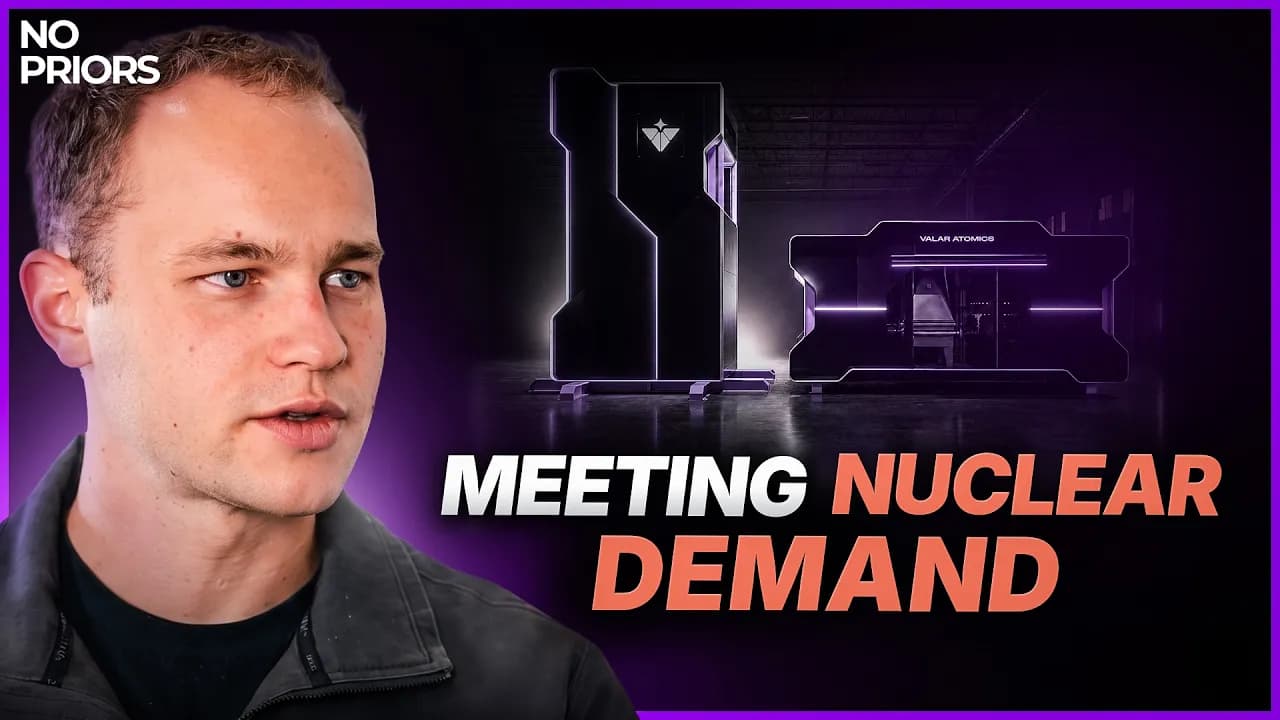
How Nuclear Will Unlock Energy Abundance with Valar Atomics Founder Isaiah Taylor
In a Nutshell
Valar Atomics built and turned on the first advanced reactor by a startup, powering an Nvidia Blackwell AI chip and demonstrating passive safety by shutting off all cooling systems with no meltdown risk. The company rejects traditional nuclear's modeling-first, civil-infrastructure approach in favor of rapid hardware iteration and manufacturing-scale production of simple, cheap TRISO-fueled reactors. Their core thesis is that energy cost is the fundamental limiter of human progress, and only extreme execution speed—measured as "tick rate"—can deliver the 10x cheaper energy needed for AI-scale compute and hyper-technoindustrial abundance.
These notes were generated by AI and may contain inaccuracies.
Valar Atomics achieved the first advanced reactor to ever make power by a startup. They powered the first ever AI chip by a nuclear reactor and turned on the first TRISO reactor in over 50 years in the United States. The premise of Valor stems from increasing power demands in the United States, largely driven by AI compute. Energy is a commodity where demand is set by price; making energy cheaper creates demand. Most of the nuclear industry focuses on modeling and simulation rather than hardware iteration, execution, and building the simplest and safest reactor for scale. Valor demonstrated hardware iteration capability.
Valor Atomics is building nuclear reactors for planetary scale at their Utah nuclear facility in San Rafael. The goal is to make energy 10 times cheaper for humanity through reactors that are more manufactured than constructed and extremely safe. Nuclear fission technology originated in the 1940s but has never achieved mass scale production like a Ford or Tesla moment.
Isaiah Taylor, founder and CEO of Valor Atomics, does not have traditional nuclear research credentials. His great-grandfather was a nuclear physicist on the Manhattan Project, and both great-grandparents worked in the secret city during World War II. Taylor grew up viewing nuclear as incredible technology and always wanted to build thousands of machines. He initially viewed nuclear as a solved problem but realized it was entirely unsolved after the industry stopped building reactors in the 1970s. This realization came during a specific afternoon when he questioned why nobody had told him about the halt in reactor construction.
The US stopped building reactors after the Three Mile Island incident, where the cooling system failed leading to core meltdown. No one died, no one was injured, and there was no radiation dose to the public. The incident was an optics and PR situation that was mismanaged, causing public fear. Even 15-20 years ago, people recognized that reactors could be built safely with learnings incorporated into new designs. However, the US had shifted from being skilled at large-scale civil infrastructure to advanced manufacturing.
Taylor's key realization was that rebooting nuclear for the atomic energy century would not resemble 1960s civil infrastructure projects. The shift needed to move from civil infrastructure construction to manufacturing production of more complicated and functional equipment. Small modular reactors represent this manufacturing approach, but what was missing was pursuing the model through hardware iteration by actually turning plants on.
A chicken-and-egg problem existed where data was needed for regulators, but running a plant was required to get data. The nuclear industry outside Valor is mostly a modeling and simulation industry producing precise paper reactors. Congress originally intended two pathways: the NRC for large-scale commercial deployment of mature systems and the Department of Energy for testing. The DOE originated as ERDA, the Energy Research and Development Agency, spun out of the Atomic Energy Commission. This testing pathway has been available in legislation for 40 years but largely unused except for specific government programs.
The reactor was turned on under Executive Order 14301, which called for three advanced reactors to go critical on American soil by July 4th. The reactor operates under Department of Energy authority. The facility is currently making 100 kW while splitting 10 to the 17 atoms per second. The control room was transported from Hawthorne on C-17 aircraft, representing the first time an entire plant including control room was flown.
One reactor operator controls the plant with a senior reactor operator providing oversight. A scram drops control rods introducing boron carbide into the core. Boron absorbs neutrons, stopping the reaction by preventing enough neutrons to maintain criticality.
After shutdown in traditional light water reactors, decay heat from recently split atoms continues at 5-6% of previous power levels. Without continued cooling, meltdown occurs as seen at Fukushima and Three Mile Island. Traditional plants run cooling systems for about 24 hours after shutdown with extensive redundancies.
Valor will demonstrate passive safety by scramming the reactor then turning off all electrical supply, the circulator, and the RCCS pump. After holding the plant at full power for 72 hours, they will shut off all safety systems and observe. Previous electrical simulation tests in Hawthorne showed the RCCS panels entering passive circulation mode where water boils, steam condenses, and natural circulation removes decay heat over two days with zero operator input, no moving parts, and no electrical control.
Nuclear is empirically the safest form of energy when measuring power generated versus deaths, safer than solar when accounting for installation deaths. Traditional nuclear reduces risk by lowering odds of accidents through engineering. Valor reduces risk by lowering consequences, designing so that even if everything fails, the plant remains safe. Their safety basis assumes every system has failed and verifies no radiation dose reaches workers or the public. This is achieved through core geometry and materials rather than relying on operator control or engineering redundancies.
The helium circulator and heat exchanger between the main helium loop and secondary power conversion loop have caused issues in past designs. Moisture in graphite presents challenges since graphite is hydrophilic. The helium purification system condenses moisture out and stores it externally. Several hundred hours of operation are needed to slowly leach moisture from graphite block centers. Helium is inert with minimal chemistry occurring, unlike water-based reactors that require careful steam management. Helium's lower density requires more pumping power but enables simpler plant fundamentals.
Valor Atomics believes nuclear is fundamentally a hardware execution problem rather than a design problem. The company focuses on building reactors, turning them on, operating them well, and producing them at scale from one to ten to one hundred to one thousand units. The alternative approach of creating the most beautiful and sophisticated designs leads to excessive complexity, rare materials, and nonexistent supply chains that must be established just to get the reactor running.
The company compares its approach to the Toyota Camry problem rather than making Lamborghinis. The goal is a simple, cheap, and safe reactor that can be manufactured in tens of thousands of units. While more complicated reactors may achieve slightly better performance, the simpler design wins on cost through volume production. Valor aims to make energy ten times cheaper for humanity and continue improving that metric indefinitely.
The company is just under three years old. Valor went critical in November with its first cold criticality, and made power for the first time a few days before the recording with the W-250 reactor. The company tracks progress through tick rate, a metric borrowed from video games measuring the time between changes in game state. For Valor, this measures the time from founding to first atom split, to the second, third, and fourth splits.
The goal is to reduce tick rate as much as possible, eventually reaching a new reactor turning on every few minutes. The first milestone from filing in Delaware to first atom split took 2 years and 4 months. The time from Project Nova's first atom split to the second time was approximately 7 months. Nuclear economics are driven by how quickly and cheaply plants can be produced, since uranium fuel is inexpensive. Iteration and scale, driven by tick rate, determine success.
The W-250 is the first advanced reactor to make power by a startup and the first advanced reactor built outside a national laboratory. It is the fifth new nuclear device to make power in the United States since 2000. Valor is the only private company founded since the discovery of nuclear fission that has made nuclear power. All other companies that previously made power were 100- to 150-year-old utilities, defense contractors, or large engineering corporations that performed limited fundamental R&D.
The modular citadel is a bioshield made of 78 inches of concrete that allows people to stand near the reactor without receiving unhealthy radiation doses. The concrete consists of pre-cast blocks manufactured at Valor's Citadel factory in Salt Lake City, which has capacity to produce 3,000 identical blocks per year. Blocks arrive on trucks and are placed by crane.
The design features a tortuous path at seams where concrete follows a sine wave pattern on both horizontal and vertical edges, including corners. This prevents any straight path for gamma rays or neutrons to escape. Unlike traditional approaches that use grout to seal blocks, these blocks are simply stacked with no mechanical fasteners, bolts, or screws. A seismic frame was added despite engineering calculations indicating it was unnecessary per Utah State building code. The approach reduced bioshield construction from 3 months to 42 hours of stacking time.
Valor's pace exceeds any other nuclear company globally. The company achieves this through obsession with simplicity, ruthlessly deleting complexity, parts, and systems where unnecessary. The architecture is a TRISO-fueled graphite-moderated helium-cooled reactor, which is among the safest designs humanity knows how to build. Lower consequence enables greater scaling speed.
The team was built with extreme agency and bias to action. Many team members come from outside nuclear and had never seen a reactor before joining, but had experience building hard things in the real world. The company also recruits people who left nuclear because it was too slow, then convinces them to return. Traditional nuclear hires are filtered for those who want to build reactors and turn them on rather than do science or write papers.
Energy demand is set by price. Reducing price increases demand, and this relationship holds indefinitely. Energy is the only scarce and irreversible resource in the universe. Making energy at 1 cent induces demand by enabling new applications; making it at a tenth of a cent induces even more. The AI compute demand tailwinds are helpful, as is increased public awareness of power's importance, but making energy cheaper fundamentally induces demand.
Valor powered the first AI chip directly connected to a nuclear reactor using an Nvidia Blackwell system. The nuclearbite.com website is hosted directly on the nuclear reactor, with the page indicating exactly how many uranium atoms were split to deliver it. The site is the only place to purchase Valor merch, and it requires billing in the physical world. The website goes offline when the reactor turns off, creating exclusivity.
Big buyers of compute and power predict nuclear cannot deliver at scale until 2031-2032, expecting to rely on diesel generators, solar, and batteries until then. Valor believes these buyers underestimate exponential curves, which are counterintuitive. Most nuclear companies function as modeling and simulation operations rather than hardware execution companies. Even by 2035, many companies will not reach scale due to incorrect mindsets focused on design rather than hardware iteration and execution.
Valor invented its own concrete grade requiring high density to block gamma rays, strength for self-stacking blocks without rebar, and an atomic mix that prevents activation into nuclear waste. Two engineers aged 23 and 21 collected rock samples nationwide over three weeks in a project called the rock hunt. Samples underwent acid dissolution and spectroscopy analysis to determine exact composition. Industry veterans who had written about such an approach since the 1980s contacted the company saying they had never seen it executed.
Valor verticalizes any component necessary for scale, including areas repeatedly described as impossible. The company assembled talent to solve concrete, regulatory, fuel supply chain, instrumentation, and shielding challenges internally rather than outsourcing. The team views these traditionally difficult areas as opportunities to build mastery and competitive advantage. The company does not aim to verticalize everything permanently and would prefer commoditized components where possible, but attacks any bottleneck ruthlessly.
The control skid contains analog-to-digital electronics boxes with signal amplifiers and rectifiers that convert detector signals for the control room. Each of three boxes cost $450,000, totaling $1.5 million. The reactor protection system (RPS) box, which functions as the reactor's brain with three sections that vote to determine safe state without human input, was bid at $5 million. These inflated component costs illustrate where nuclear expenses originate and where Valor gains advantage through internal development.
The Reactor Protection System (RPS) uses three independent sections that vote on whether the plant is in a safe state. If two sections determine the plant is unsafe, the system shuts down. A vendor quoted $5 million with a two-and-a-half-year timeline. After two months of negotiations to accelerate the schedule, the team decided to build their own RPS. Joe, who leads instrumentation and control and is a Brown dropout with strong electronics expertise, assembled five team members. They completed a working RPS in six weeks at a cost of approximately $400,000.
This experience revealed systemic issues across the nuclear industry: inflated costs from an industry that has not built new plants in 40 years and charges extreme margins on existing work. When the vendor learned Valar Atomics was building the system internally, they contacted industry experts and investor platforms to claim the company was unsafe. The vendor's CTO participated in expert calls disparaging the company, viewing the in-house development as a direct threat to their $5 million product.
The nuclear sector exhibits widespread artificial cost structures due to decades without meaningful construction activity. Vendors charge approximately 100x margins on components they have not recently manufactured. Applying first-principles reasoning with technically capable teams and willingness to build internally produces dramatically lower costs and functional results, enabling the plant to operate.
Physics demonstrates that nuclear energy is viable. When execution is possible at higher speed, top engineering talent and capital follow. The best people are attracted to environments where technical problems are solved rapidly rather than delayed by legacy processes.
Traditional nuclear startup approaches involve creating engineering designs, customer letters of intent, and partnership documentation to attract debt or project financing. This model was observed failing repeatedly across multiple companies. Valar Atomics deliberately rejected this path from inception.
The United States offers a distinctive risk-on equity capital environment. Venture capital excels at underwriting technical risk, which is the core challenge here. The relevant risks involve mechanical engineering, thermal hydraulics, instrumentation, and manufacturing methods rather than fundamental physics. These domains are complex but significantly less demanding than rocket engine development.
By accepting equity capital willing to fund reactor construction directly on the balance sheet, the company can demonstrate operational reactors years ahead of competitors still seeking project finance. After five reactors are built and proven, project finance and debt become available options. Early demonstration creates a substantial competitive moat that is difficult for later entrants to overcome.
Rather than negotiating dedicated power purchase agreements with hyperscalers before construction, the company builds gigawatt-scale capacity independently on its own timeline. This approach eliminates coordination delays with multiple stakeholders including site selection, permitting, and financing parties. A gigawatt facility with available land and fiber connectivity will attract data center operators. The strategy prioritizes speed: power is placed on the ground faster than any competitor, after which load follows.
Longer term, dedicated customer arrangements for hyperclusters remain possible, but will be pursued only with customers demanding rapid delivery rather than multi-year planning cycles. Speed and scale represent the fundamental constraints nuclear has historically failed to address. The missing element is a Ford, Toyota, or SpaceX-style realization that deployment velocity is the critical variable.
The most difficult organizational attribute to replicate is internal pace, referred to as tick rate. This metric measures how quickly new systems reach criticality and applies across industries. In software contexts, it might manifest as continuous integration builds per hour.
Tick rate must be established on day one by the CEO and the first five team members. It must be embedded in the first 20 team members and become a hiring criterion. The CEO personally drives acceleration by identifying slow processes and establishing focused war rooms to compress timelines. A six-month task might be targeted for four weeks, potentially landing at eight weeks, but never remaining at the original duration.
No automatic system sustains organizational speed. Continuous intervention from leadership is required. The underlying motivation is that physics permits energy costs to drop by a factor of one thousand through nuclear fission. The timeline for achieving this outcome, whether decades or centuries, depends entirely on execution speed.
Energy functions as the fundamental input determining quality of human life. Historical transitions in living standards have consistently been enabled by reductions in energy cost. Agrarian societies operated on solar-powered biological systems through photosynthesis, resulting in extremely difficult living conditions. The shift to hydrocarbon energy produced rapid improvements including climate control, transportation access, and material abundance.
Aluminum exemplifies this relationship. Prior to cheap electricity enabling electrolysis, aluminum was treated as a precious metal used for royal jewelry. Once energy costs dropped sufficiently, aluminum became a common structural material. Current living standards rest entirely on the ability to produce relatively inexpensive energy from hydrocarbons. Nuclear fission offers the next step: energy that is not merely cheap but dramatically cheaper than current levels.
Transportation costs are constrained by jet fuel economics that have limited further efficiency gains. Tenfold reductions in energy cost would enable substantially more frequent long-distance travel. A cross-country trip that currently requires careful planning could become routine weekend activity.
Hyper-technoindustrialism describes a state where physical goods approach zero marginal cost. In manufacturing, three inputs currently exist: human labor, physical materials and machines, and energy. AI and robotics convert human labor into energy consumption by substituting robotic systems. Tracing material and machine inputs recursively reveals that all originate from prior manufacturing steps ultimately driven by energy. Therefore, energy becomes the sole fundamental cost driver.
When semi-autonomous manufacturing is achieved through AI and robotics, the price of any physical object equals the energy required to produce it. Repeated tenfold reductions in energy cost translate directly into broad affordability of manufactured goods. This outcome is necessary for ambitious projects such as establishing human presence on Mars and conducting large-scale space exploration, both of which require vast quantities of physical infrastructure at dramatically lower cost than current economics permit.
Keep No Priors: AI, Machine Learning, Tech, & Startups in your library
Save the videos and channels worth coming back to, and find them again in one place.