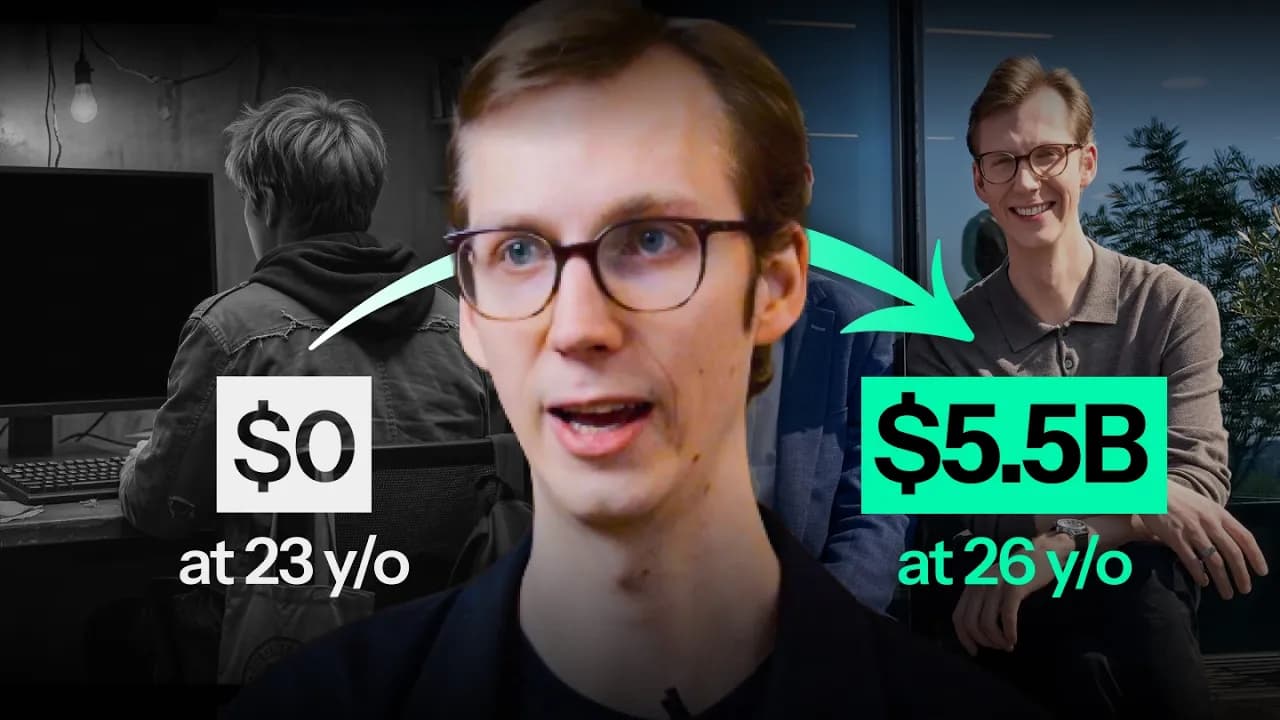
How Photoroom Trained Themselves To Dream Bigger
In a Nutshell
YC trains founders to think 10x bigger by surrounding them with people already at that scale, turning vague billion-dollar dreams into concrete 10-billion-dollar roadmaps. PhotoRoom grew 10x by narrowing from video+photo to e-commerce photos, showing depth—not breadth—drives outsized results. Ambition is a skill that compounds: set extreme targets, cut projects to their V0, and filter for people who default to global, because the goals you declare are the ones you hit.
These notes were generated by AI and may contain inaccuracies.
Focusing helped PhotoRoom in the beginning. Initially they started doing video and photo and focused 10x on photo and grew 10x. Then they focused on e-commerce photo and grew 10x again. Being deep is actually a great way to achieve ambition. Do not confound depth with ambition.
PhotoRoom gives e-commerce businesses AI visual to grow and sell. The company has 300 million downloads, 20 million active users, and counts the biggest e-commerce companies in the world including Amazon, Uber, DoorDash, and Decathlon as customers using PhotoRoom to edit their visuals to sell more on the internet. Gary Tan said at the YC retreat that PhotoRoom is the biggest YC company with an HQ in Europe.
When the founders came out of YC, they came out with much more ambition and had in their mind that it could become what it's become today and probably can become 10x bigger. Before YC, the ambition was like a dream that you're looking from afar. YC made the ambition more concrete because the people you're talking to are at the scale you're looking at. Having conversations with someone who's built a 10 billion dollar company makes that scale look closer.
Before YC, founders would tell friends they wanted a 1 billion dollar company but it was not concrete, there was no path, no playbook. After YC, the scale changed from "it's not going to be 1 billion, it's going to be at least 10 billion." YC changes the scale at which you can dream and realistically dream.
One founder did YC in summer 14 and had to train many times to be able to say naturally "obviously a 1 billion dollar company" because American teams said it so naturally. The French founder was listening to all these American teams and preparing with their co-founder for the question of how big could it get.
When the Front founder got into YC and walked into the first dinner, partner Kevin Hale asked what they were doing. They said they were the CEO of Front, and Kevin said Front was one of the coolest companies in the batch. The founder was convinced he was talking about another company because they were so unsure about everything they were doing. Fast forward 3 months later at the end of batch talk, Sam Altman said out of the 110 companies in the batch, only five of them will still be alive in 5 years. The founder thought they would be one of them.
Demo Day was the first batch to be remote. PhotoRoom was literally pitching from Paris and did zero to 1 million during the batch, making them the fastest growing company of the batch. The founder thought that if there's a 5% rate of the batch becoming a unicorn and they're on top of the batch, there's no reason they can't do it.
Ambition reset happens continuously, not just during the 3-month program. YC partners continue to meet with founders after the program and YC runs events after that. Meeting other founders at these events resets ambition because they grow much faster. At a YC retreat in California, founders were talking about satellites they are deploying in space, with one having six and another having eight. The benchmark is set by meeting people like this, and this is even more true for newest companies whose growth curves at demo day are very impressive.
European founders are scared of ambition or selling big ideas due to cultural reasons. In European countries, when you talk about the big idea, someone will laugh at you or try to find the bad things that could happen. In the US, people would say "that's an amazing idea" and by default it's encouraging, which pushes you much more towards trying. There's also the value of failure - in some countries failure is not great, whereas in other countries missing teaches you things and can lead to job offers.
When a problem is tough to solve, it's not necessarily harder to solve it, so it's ambitious to find that. Ambitious problems attract more talented people. PhotoRoom was founded around the idea that you really want to work with smart ambitious people, and that pulls you higher. If you don't have a hard, tough, ambitious problem, it's going to be very difficult to hire smarter people than you.
It's not always important to be ambitious. When friends say they want to launch a company, founders ask them to choose between two options: Option A where the company is working decently well, struggling a little bit to get money, not growing as fast as you want, but working on a project you're deeply passionate about that's aligned with your belief; versus Option B where the company is growing super fast, not exactly the thing you had in mind at the beginning, but growing with growing pains. If you pick option A, ambition may not be needed if you're living your passion. But if you're signing up for the classic startup VC model, you're here for growth and your investors and employees are here for growth. If you do not have the ambition to get it as big as possible, you're going to miss out on the necessary criteria of a classic startup.
Taking VC money and signing up for a venture-backed company is a one-way door decision. The moment you do this, you sign up for more growth every year, and that dictates so many things about how you're going to operate your company.
For equal skills, American people are so much more ambitious. A French engineer told them they weren't going to join because the team was too strong and they would fail. An American engineer who was clearly overconfident said they would join and wanted to be two levels above what was offered as compensation. The French engineer didn't join despite having the skill, and the American engineer joined two levels up and is now set up for failure. The balance is probably what's best.
To become more ambitious, surround yourself with ambitious people. If you hear a friend telling you something probably won't work or 1 million is too high, block them. List all your options and do a thought exercise: with a magic wand and no constraints at all, what's the level just above your decent aim, what's the level 10x above that, and what's the level with full control as king of the universe. Force yourself to aim higher because it's ingrained in the system to aim lower or have doubts.
PhotoRoom grew very fast to 1 million and then to 20 million of ARR. At an offsite with 10 people, they said they were going to aim at 20 million when they were at a few millions of ARR, and everyone in the room said it wasn't possible. One year later they were there. If they had said 8 million, they would have been at 8 million. The power of setting the bar high means the goals you set yourself end up happening.
The goals you set yourself end up happening. Looking at marathon times, there's a spike at 2:30 and 3 hours because people say they're going to do 2:30 or 3 hours. With targets, you can say here's the goal and then walk back from there. Worst case you end up lower than the goal but at least you would have been higher than not setting an ambitious goal. YC partner Nico says shoot for the stars, worst case you land on the moon and that's good enough. Sam Altman gave a talk saying just add a zero to whatever success metric you have in mind.
To find ambitious people, consider that if you don't want to be global, you're not going to be ambitious enough. PhotoRoom speaks deliberately English in the Paris office, and the founders only speak English on WhatsApp. This was a tremendous filter of people who want to build a global company. If you enter PhotoRoom and say you don't really want to speak English, then two French people speaking French with each other doesn't make sense if you want to dominate and be the leader of the world.
It's important to align with whoever you're working with on what success metric you're here for and how big you want to aim. There's often a disconnect where one person might be interested in the mission and fine if it doesn't go big, while another wants the world or nothing. This disconnect can slow down the company and create frustration. Some people might be here for a stable job, not worrying too much and enjoying their weekend, while others are excited about creating a product that has a big impact. In the US they say they want to make a dent in the universe. This mindset is perfectly fine, but you need to understand it will require trade-offs and compromises.
To keep ambition alive, rank all projects by asking if this works out perfectly, how much revenue it is going to bring. Looking back at things you've worked on is important - if your company is not growing as expected, look back and say you worked on a project for 3 months and the result wasn't what you expected in terms of impact, then ask what went wrong and what piece in the decision chain didn't go well so next time you won't make that mistake.
What's the V0 of a project? Most of the time 50% of projects fail and don't have the impact you expect. The key to trying more projects is reducing the time for each project. What can you get from that to understand and learn if this project is going to be successful? Always catch what matters - what's the V0 of that? Otherwise people might spend 3 months on a project when with AI you can do it in 3 days. Cutting down to what's the V0 is very important to optimize for impact.
Olivier Pomel, who owns a 50 billion dollar company, says one learning is always learn how to go faster even in the age of AI. Going as fast as you can applies to small startups but also to much larger companies.
When you get into YC, you have group office hours every other week with maybe eight other companies. After a few weeks, the exercise is to explain how your business is going to lead to 100 million of ARR. Doing this exercise when you're super early forces you to think about how big your market can be and what's the most ambitious version of what you're building. The thought exercise of doing something leads to great outcomes. Another example is when you have a project you want to pursue, ask the team if you had half of the resources, what would you do to still achieve this goal, and that creates creative thinking that leads to better outcomes.
One thing that really helped in the beginning at PhotoRoom was focusing. Initially they started doing video and photo and focused 10x on photo and grew 10x. Then they focused on e-commerce photo and grew 10x again. Do not misinterpret depth with ambition. Being deep is actually a great way to achieve ambition.
You're going to have some doubts because you grew up in an environment that was not naturally pushing ambition, so you're going to have to force yourself to be more ambitious. Using the tricks discussed will help you aim higher. The thing to keep in mind is that you're going to have some doubts, and it's very useful to erase those doubts. You will have them for sure, but just set them aside. If you listen to doubts too much, you may end up forgetting to be ambitious. Anyone can really create a big company. Matt was sitting in the same spot 12 years ago at Startup School at Stanford. The seats are there and you can be ambitious and do it.
Keep Y Combinator in your library
Save the videos and channels worth coming back to, and find them again in one place.