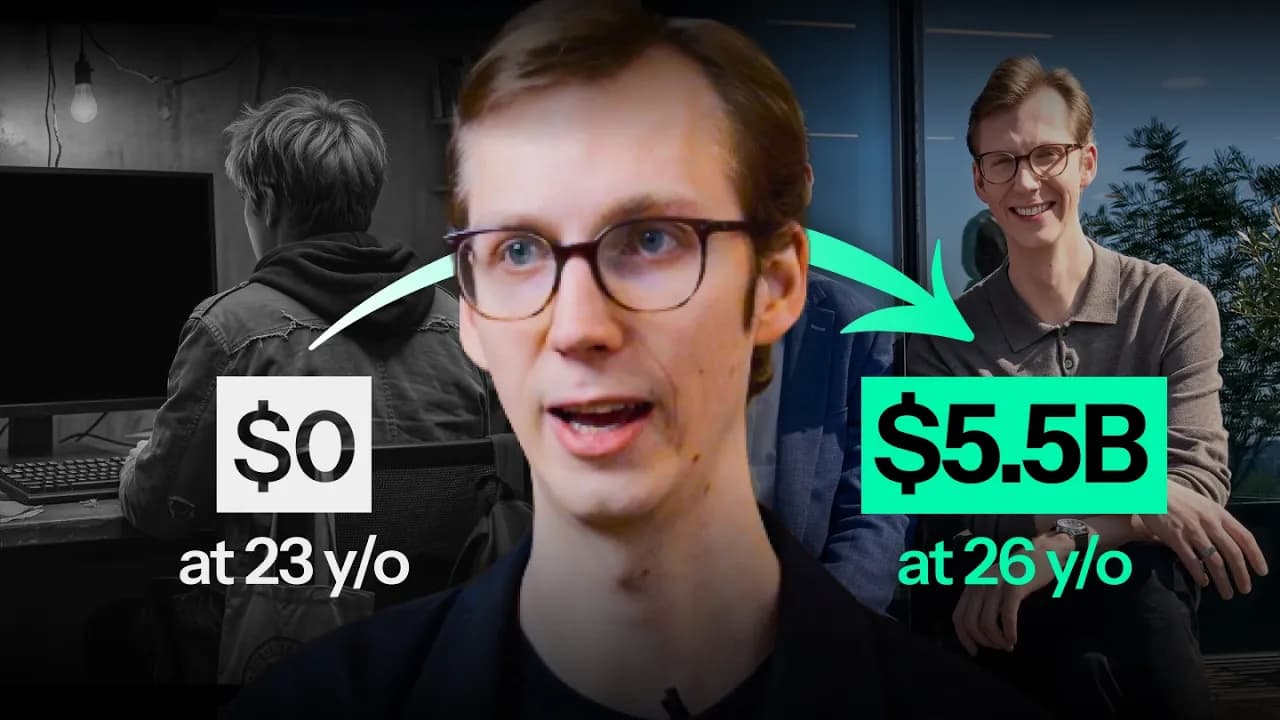
Max Junestrand: You Need The Willingness To Learn Faster Than Anyone Else
In a Nutshell
Max Junestrand dropped out of college after GPT-3.5 to build Legora, an agentic legal AI platform that grew from $1M to $100M ARR in under two years by prioritizing speed, customer feedback, and a hyper-competitive culture over domain expertise or early perfection. The team succeeded by cold-outreaching lawyers for deep market learning, freezing sales to rebuild the product around a clear manifesto, and relentlessly hiring for high-growth potential rather than pedigree. Their core lesson: the willingness to learn faster than anyone else, combined with an obsessive focus on execution and culture, beats traditional advantages in winner-take-most markets.
These notes were generated by AI and may contain inaccuracies.
Legora's YC journey started with a rejection. In YC they teach the two sentence description. Legora is the agentic operating system for lawyers and it handles complex legal work from start to finish so lawyers can achieve more than ever before. Over 3% of all the world's lawyers are now active users of Legora.
When starting to look at the legal industry, it felt like one of the biggest opportunities to apply large language models to solve real problems. The software they were up against looked like it had been built in the '90s. As software engineers, they had been spoiled with great software because software engineers love to build for each other and for themselves. But in the legal industry, the software used to look outdated.
Legora has grown into a global brand, putting celebrities like Jude Law at the New York Wall Street. The most favorite Slack channel is customer love, where customers post things they truly feel like they couldn't have achieved without the system. Sales calls are mined for quotes. A parent asked at one of the tournaments how work and golf travel are juggled - one word, Legora. Never has the path between an idea and execute been so short. If Legora went away tomorrow, one customer would go back to coaching high school basketball.
When going into YC in October 2024, they were questioned about selling and working in the legal industry because it is such a conservative business that had never been lenient to software before. From the time entering YC of October 2024 until the end of quarter, they grew from $1 million to $100 million in ARR, starting from just three engineers in Sweden to a company of over 750 people all over the world. The fact that this was done starting from Europe adds another dimension to the achievement.
The Legora story almost didn't happen and it didn't start with Max Junestrand. It started with a lawyer, a physicist, an engineer, and a psychologist back in 2020, before GPT, before AI was cool. They started a company called Judelica. They observed that law school students were going into their internships basically to summarize court cases. With the early models from Google called BERT, they started to explore what this space could be and what was possible to build.
Max Junestrand's story started in the Swedish archipelago at an island. He met his two co-founders at a volleyball game. Startup founder stories can come from many different places. When meeting August and SIGA, they showed a demo of the product they had built. The group chat looked like they gave a demo of the project. With GPT-3.5 they had built a very simple product that could explain what a stock option agreement really meant. They started with that, and the co-founder Sega said he was glad Max wanted to help out, and Max ended up helping out a little bit more than just that.
When GPT-3.5 came, that was the internet moment of their generation. Max dropped out of college and never finished his master thesis because the opportunity cost of not building had become too large. But when starting out, it wasn't obvious they were going to be a success.
To learn about what the legal industry was, what it meant, how lawyers actually worked, they came up with the plan of cold emailing lawyers on their emails found on their websites and writing to them on LinkedIn asking for a lunch where they could learn more about their different practice areas. They offered to pay their hourly fee to have lunch with them. Many took them up on that offer. Many didn't make them pay for the hour and many even paid for the lunch.
Once they had their feet under themselves, they approached one of the largest law firms in the Nordics named Manheimer Swartling. Just two years before that, their managing partner had gone on TV and said that AI back when they were starting to use it was really more artificial than intelligence. They had to work really hard to change the perception of what both technology and what AI could be in the area of law.
In law, you are not paid when things go right, you are punished when things go wrong. Many of the initial AI solutions in the space had required immense amount of training. You had to bring a lot of use cases and examples just to get very little results. When GPT-3.5 came, that really changed the story. With Manheimer and Swartling, they ended up moving into their offices and working really close with them.
The warm welcome at this event was quite different from the first time interacting with YC. They applied in May of 2023 with a promise of being able to query all legal documents using large language models. When coming to the interview, one of the first questions asked was what type of lawyers are you serving? Not very knowledgeable about the legal space yet, the response was "What do you mean? Are there different type of lawyers?" That did not land very well with the YC partners at the time. Tom Bloomfield started laughing in the interview when they gave that response and they knew they were cooked. But that also gave them the perseverance and the drive to continue.
With a lot of letdown, the day after they did not work but the day after that they got back to building. Two months later they got accepted under a new name and with a different platform. They had done their homework. From Sweden, the idea of getting accepted into Y Combinator felt like they were going to Mount Olympus, going to dine with the gods, and going to get to work with other startup founders who came from all of the great tech companies.
Once at Y Combinator, they realized they actually knew a lot more than they thought they did. There is a screenshot taken after doing the video call after the second YC interview when they knew that things had gone a lot better than the first time.
After getting accepted into Y Combinator, they moved into the law firm Manheimer Swartling. It was the biggest law firm in the Nordics, but they had no real clue about how to work with software and how to work with technology. They ended up getting a conference room with no real windows where the AC would turn off at about 5:00 p.m., but it was really close to the Coke fridge. At about 6 p.m. every day, one of the engineers would go up, grab the door, and start waving it back and forth to get more oxygen into the room. Those conference chairs still made an imprint on all of their backs.
Three years later, in the car with two more screens, they make the move from the conference room of a law firm to their first real office.
One of the key takeaways from this entire experience is that first off, they quickly learned not to take no for an answer. Also the power of simply reaching out and asking for help. One big lesson from these first three years of building Legora has been that it is very powerful to be a person and to be a company that others want to see succeed and that others want to help.
They came to San Francisco, got a room at an Airbnb up in Bernal Heights and started building. During YC, they grew from zero to a million dollars in ARR. They also learned the hard way that working across San Francisco and Europe took a big toll on the team. Max bought an influencer ring light that he put on his laptop. The reason he had that ring light was because he was doing sales calls between 1:00 a.m. in the morning to 10:00 a.m. in the morning every single day in San Francisco to Europe because that was where their initial customer base was.
After a rocket trajectory during YC, which now two years later is slow compared to what some of the companies are doing, they set off to fundraise. This was Max's first time fundraising. He had no idea what to expect, but they had lined up 80 investor meetings in a week and a half. There were European investors and American investors. The main takeaway from that experience was that you need to become a really good storyteller in order to drive interest and to get people on your team. It was also a very different experience talking to some of the European investors versus some of the American investors. In the US they think more about what can go right rather than what could possibly go wrong.
They ended up working with a venture firm called Benchmark. There is a picture of Chaan, their partner, when they had signed the term sheet. Max remembers negotiating that term sheet on his desk with a computer opened going on decimals in the Excel to determine the exact number of shares. They ended up investing $9.51 million.
Following that investment, Redpoint pre-letter series A just three weeks later. They started to run into a challenge. They had about $35 million on the bank. They were 10 people in the team. There was actually a month following that that they made more money from interest rates on those 35 million than they did from customers. That is not a very good sign when you have become a bank.
Going into their first board meeting, they had Chathan and Redpoint and it was Max and his co-founders. They made a very hard decision, which was to freeze their sales motion. Because when you work with lawyers, you only really get one chance to get it right. If you show up and the product doesn't work or if the lag in the system is too high or if the system goes down when there's too much traffic on your Azure instance, you are toast.
After that six-month sales freeze was when they really started ripping. That's where you see that curve from $1 million to $100 million really starting. What happened at the start of that was turning from a small startup looking for PMF to really establishing what their business and what their product was going to be.
In the very early days at Legora, the way that they would decide what to build was by voting. They would make democratic votes in the entire team. For anyone who has built software before, if you have too many chefs in the kitchen, that typically does not make one very good dish. That was exactly what was going on. They were working on too many features. They had to rebuild everything for the product launch that they were going to have after the summer, after the sales freeze. They had to build a platform where it was adaptable to foundations that were constantly changing both with the underlying models but also with the frameworks that they were using to build agentic workflows like LangChain etc.
In October of 2024, they wrote down what they would call the Legora product manifesto. This was basically gathering everything they had learned, putting it into one very simple document that they shared with the entire 25-person team back then and that they would rally the troops around. At the time, they were doing about $1.3 million in annual recurring revenue, and many of their competitors were doing 10 times that with products that only had one of these features. One of the earliest questions they got from YC was when will you move to the United States? When will you make the jump?
It was off the back of this product refocus that they were able to not only compete out the competition on product but build enough momentum to make the jump over to the US and start to compete for the biggest logos in their markets.
As engineers and as tech people, they often overemphasize the reliance on product and on the tech. But if there's anything learned in these past three years, it's that it's all about the people. Building product is one thing, but building a company is a very different thing. They made many early mistakes around this.
One of the hiring patterns that they had to unlearn was looking for fancy logos on resumes or what they like to call y-intercept. If you think about somebody's skill curve, it might start out really high, but if they don't have a good trajectory upwards, they are going to have a really hard time working in a company that is scaling exponentially. Instead, they started to look for people like themselves who wanted to work insanely hard with a very high growth potential. They doubled down on that talent over and over again. Their top seller today is 23 years old and he sold more than $10 million worth of Legora. He had no sales background. He jumped out of university. By continuously doubling down on that type of talent, they have built a very unique culture at Legora.
One of those things has been about bringing and building cultural fit. Up until the point where they were around 500 people, Max interviewed every single candidate outside of engineering. Now he interviews every director and upwards. But what they have done is set the cultural foundation in the business where it self-selects for itself. They have three values at Legora: Lean in, fight for excellence, and grow together. Together they make LFG. Let's go. That also sends a signal to leaders and others who join the company who are coming from more established backgrounds where joining a company where the values includes profanity quickly tells them what this is about.
Another very complex cultural thing starting a company in Scandinavia is something called Jante or the law of Jante. This is very foreign to American friends. In Swedish culture this basically means that you should not think that you are somebody or you are not more important than anybody else, and your ideas are not better than anybody else's. A part of this humility is good and it supports a culture where the best ideas win and where people earlier in their careers feel empowered to speak up. But it's very hard to build one of the fastest growing enterprise companies in the world if you think that you aren't somebody or if you don't think that you are better than anybody else. They have had to really create a nice cocktail of US, European and Asian culture all in one to create a global company that is Legora today.
Building a strong company culture is the best guarantee to attract and keep the best people. Another way that company culture gets expressed at Legora is through articles like the one that ended up in Sifted. For them there is only winning. Everything else is losing in a winner takes all market or winner takes most market and the company has to run like there is no place for number two. It would be fair to say that when Legora was founded, it really had no reason to exist. They were one of many legal AI companies. But because of this mentality and because of not feeling like they're safe even though they have achieved extraordinary numbers by any normal measures, they continue acting like professional swimmers who are looking down in their lane while the competition is looking sideways at what they're doing.
At Legora they have had to build a culture to really support that ambition. Starting years behind some of their biggest competition and having to build this intensity in a country where most people want to go for fika at 3:00 p.m. which means having a cinnamon bun and a coffee or go home at 5. One of the ways that has been done is to create cultural values and cultural moments that really distinguish them from many others. In Swedish there is a saying you can wake up with a taste of blood because you're so excited about something. Max was doing an article in Swedish and used that saying and didn't know that the interviewer was going to release that article in English. When this came out it got lots of fun reactions. One of them was is Legora made up of vampires. The second one was you guys need to floss better. Many good ideas, but this has now turned into the word blue smoke internally, which means they just keep going at it.
Part of having their HQ in Stockholm has worked to help them keep this. Everybody globally from the company makes their onboarding in Stockholm, which is a lot nicer in summer than in the winter. But that has created the same vibe in any Legora office regardless of where you walk in all over the world. One great example of this was they had a very big law firm in the US that their competition was working with. But that law firm had a specific problem around being able to draft certain types of documents based on incoming term sheets. Their competition had promised that they were going to solve that problem for them. And they hadn't. One of their US-based engineers, legal engineers, lawyers, learned about this use case, got on a flight to Stockholm, spent a week with their engineers, solved the problem in Sweden, and then went back to the US and delivered it to the customer. The Swedish base has become one of Legora's real superpowers.
Three years in is a little bit smaller than the scale of other speakers on stage. Most of what actually mattered in the company and in Legora so far did not revolve around signing a big client or closing a new round of financing or opening a new big office in Manhattan. It happened in a windowless room without much oxygen or on a call on the way to the airport, a Slack channel at 2:00 a.m. trying to fix a bug before a big presentation on Monday. Nobody puts that in a pitch deck, but that is what makes the company. You shouldn't wait around for those big moments. You have to love the hustle.
Even though they started in a small law firm in Sweden, Max was born in the Swedish archipelago with a class of 10 other people. He thought he had a big plan for his life and he was going to go to McKinsey after school. But when GPT-3.5 dropped, they truly made that into their thing and they captured what they believe to be their generation's internet moment. You can just do things. Legora and Max are living proof of that.
A question was asked about being three founders who were not lawyers and starting the best legal AI company in the world. Does domain expertise not matter that much anymore? There's a story of a Swedish VC who was very bullish on doing the pre-seed of Legora but they ended up not doing it because they did not have any lawyers in the team. Max met one of the partners from there at the airport quite recently and they were very bitter. Legora turned out to be the lesson for them that perhaps domain expertise is not what you need to succeed. You need a willingness to learn about the market which they did very early by exposing themselves and spending lots of time with lawyers as much as they possibly could. But domain expertise is not needed. It probably depends on the market that you're going after. Maybe if you're building in quantum computing or in fusion that's a good idea but legal was easy enough for them to pick up as they went along.
There was a question about what gave confidence to build a legal AI product on a model that wasn't good enough. The tribal knowledge when they got started was that you have to fine-tune a model. In 2023-2022 that was really the name of the game. Bloomberg spent millions and millions building a Bloomberg law model. Their view was partly because they didn't have enough money and partly because they truly believe that the models will keep improving. By just betting that the models will keep improving and what you should be focused on is how can you deliver the value that the models generate to your market. That was the crux for them. Even with the first generation of ChatGPT that was unusable in law partly because the model wasn't good enough but partly because it actually didn't support private conversations, European data hosting. The first sales pitch was basically "we are like ChatGPT but we are compliant in Europe." That was the pitch that was not a very strong pitch. ChatGPT would figure out how to do that later on, but at the time it was good enough. They recognized that you don't have to build for the world over here like you need to build for the world today and maybe like one step ahead. It's kind of like this ladder where you should maximize the opportunity now, make sure that you get really good relationships with your customers and so that you can also have that conversation with them because if everybody's betting on this exponential uplift in model capability, the Legora platform will continue delivering more and more value. They have built 1% of all the software that they will build over the company's history and probably the product will look very different from what it does today a few years down the line.
A question was asked about being not attached to one specific model and being able to work with many different models. The transcript ends mid-question about whether the view has been updated based on recent news about models.
Applications require different models depending on the use case. Customer support optimizes for speed of turnaround, latency to the customer, and cost per solved ticket. Previously, Finn charged $1 per solved customer ticket. In contrast, law requires maximum intelligence because the fraction of token spend or software spend compared to human expertise is tiny. Complex litigation demands throwing the most computational resources at the problem.
Lora has two distinct user groups: one requesting the ability to loop complex models on problems for extended periods with high LLM costs, and another seeking access to cheaper open source models. The optimal approach lies somewhere between these extremes.
One core competency that should be developed is the ability to evaluate use cases, which enables effective routing decisions. Lora hired many lawyers who split their time between customer-facing work and building use cases for their evaluation framework. The frontier of cost versus intelligence tradeoffs remains uncertain. Compute reliability is critical when serving a global legal clientele whose clients depend on system availability.
LoraBench was developed over three years and released publicly the previous Friday. Previously, only OpenAI and Anthropic models were available in their system. The expanded model landscape revealed that SpaceX and Grok performed among the best on their benchmarks, particularly given the cost. Lora lacks a data processing agreement with these providers but will begin offering them to customers.
Some customers, particularly banks and big law firms, have strong preferences against Chinese models.
Max's father had two companies during the dot-com boom that both went to zero after raising excessive venture capital. His father also ran a boat business in the archipelago during Max's upbringing. Max speaks with his father daily or every other day, and his father has served as an advisor, including creating PowerPoint presentations for major customer pitches when resources were stretched.
Max has always been highly competitive, having played Dota 2 more than attending school. Building a company represents the ultimate arena where one either leaves victorious, defeated, or okay. McKinsey was initially considered as a way to learn more about the world and develop work ethic. An internship provided some of that experience during studies.
The emergence of GPT created a pivotal moment. Pre-GPT, startup ideas seemed limited and uninteresting. Small companies gained significant advantages over large ones. Microsoft Copilot struggled for an extended period despite lawyers already working in Word and Outlook, creating an opportunity for Lora to build substantial value.
The amount of learning is a function of the discomfort one is willing to endure. When starting Lora, Max was super introverted and uncomfortable talking to customers, preferring to code. Separating ways with employees for the first time proved extremely difficult. Startups enable learning more in a short time than other environments. Previous startup work experience before founding Lora provided valuable preparation.
When starting, the team prioritized selecting a space over identifying a specific problem. Legal AI was obviously going to be significant, though the exact implementation was uncertain. The approach involved marching in the general direction and figuring out details along the way. The alternative involves finding a specific problem, solving it clearly, generating ROI, then expanding from that foundation.
Every employee at Lora is competitive and self-selects into the culture. Monthly goals are transparent to everyone. Quarterly goal-setting becomes necessary at scale. Early on with three founders, there were no formal goals—just maximizing daily outcomes. At 750 people, better planning and internal communication became essential. Communication is what breaks when scaling.
Engineering teams demonstrate drive to build the best products and features. Tabular review functionality stacks up favorably against market alternatives. Even engineers on vacation in Stockholm during July remain more productive than ever, taking time off while coding on problems they want to win.
Competition should be expressed as a team sport with a winning or losing together strategy. Big wins are celebrated collectively, while losses are mourned together before immediately planning how to flip the situation or execute a turnaround. The team operates in solution mode rather than blame mode, which has been a significant momentum driver.
Lora was initially chasing other legal AI companies that were larger. Now much bigger, the question arises whether becoming the largest will impact motivation. The approach involves either selecting another competitor to surpass or focusing on being better than yesterday's performance. Competitors serve as useful rallying points without becoming over-focus areas, preventing side questing and maintaining unified focus.
Ambition is learnable. The best method involves surrounding oneself with highly ambitious peers. During final high school years, Max was lazy, played video games extensively, and didn't work hard, not understanding the world's scale. The first two college years followed the same pattern until a new ambitious friend group transformed his approach, leading from zero internships to eight jobs in one year.
YC provides this peer effect where exposure to ambitious founders increases individual ambition. Lora has developed this culture internally where Max doesn't feel like the boss but rather a peer in the running team. The CFO challenges the marketing team to greater ambition. The entire company operates in a forward-leaning manner, with ambition spiraling throughout all levels rather than just the top.
Big idols and leading companies provide inspiration. Early on, Spotify and Klarna represented the biggest Stockholm tech success stories. Lora achieved a larger market cap than Klarna, though they view themselves as having completed zero to one and one to ten, with ten to one hundred still ahead.
Storytelling ranks as the most critical CEO skill, significantly underappreciated initially. The CEO must sell the company to themselves, employees, investors, and customers. Working extremely hard without believing in one's own story becomes nearly impossible. Learning storytelling through exposure proves valuable, though formal methods remain unclear.
Technical skills remain essential, particularly the velocity of iterating on customer feedback. Even at thousand-person scale, customer problems get dumped into product channels with questions about turnaround speed. Avoiding excessive zigzagging while building toward the vision remains important. Speed versus incumbent competition continues as a superpower that should be leaned into.
Technical skills encompass building systems at scale. AI code generation doesn't excuse poor software engineering fundamentals. Lora continues hiring many software engineers. The most interesting problems include transitioning from reactive to proactive agents. Previously, users gave Lora prompts or instructions for execution. Now Lora connects to different context pieces, and triggers initiate autonomous actions. Sales team contracts route to Lora agents that work in parallel, escalating to lawyers when needed or executing contracts automatically. Data rooms connect to agents that automatically organize and produce due diligence reports.
This represents the unlock for one lawyer producing outcomes equivalent to a team of ten lawyers. Additional scale challenges include spending millions on OCR and document parsing, representing real engineering problems at larger scales.
Growing from zero to $100 million ARR in 18 months by April required the job to change significantly. The current phase involves building and hiring executive teams. Most prior work qualifies someone for this responsibility, with each mini-game earned through success in the previous one. Company needs must come before personal ego. Re-qualification for the CEO role happens quarterly as the company and challenges evolve. Running a sales team at $1 million ARR differs vastly from $150 million ARR.
Success requires enjoying learning new things and accepting that building the executive team becomes the most important job. Networks of people who have done it before prove valuable. Few people have scaled companies at Lora's speed. Many incoming executives come from SaaS backgrounds with triple-triple-double-double growth patterns, where 40% year-over-year growth represents excellent performance. Lora's growth compresses these timelines significantly, requiring brutal prioritization and understanding where personal competitive edges lie.
Upon landing in Stockholm in late April, all advertisements featured Lora with Jude Law. The campaign originated from a marketing agency pitch to redo famous legal scenes like "You can't handle the truth" with lawyers using Lora, or having movies about lawyers end in a minute with Lora's assistance. The idea evolved to working with actors, then specifically Jude Law as AI-powered law.
Hollywood's anti-AI sentiment made initial outreach seem unserious—a Swedish AI company wanting to work with Jude Law for billboards and campaigns. Persistence through nagging, learned from Max's father, eventually secured agreement. Jude Law's condition was selecting his own script writer and cinematographer—an SNL script director and Oppenheimer cinematographer. The production excluded Lora team members from the set, resulting in magical productions that expanded brand awareness beyond legal audiences.
Keep Y Combinator in your library
Save the videos and channels worth coming back to, and find them again in one place.