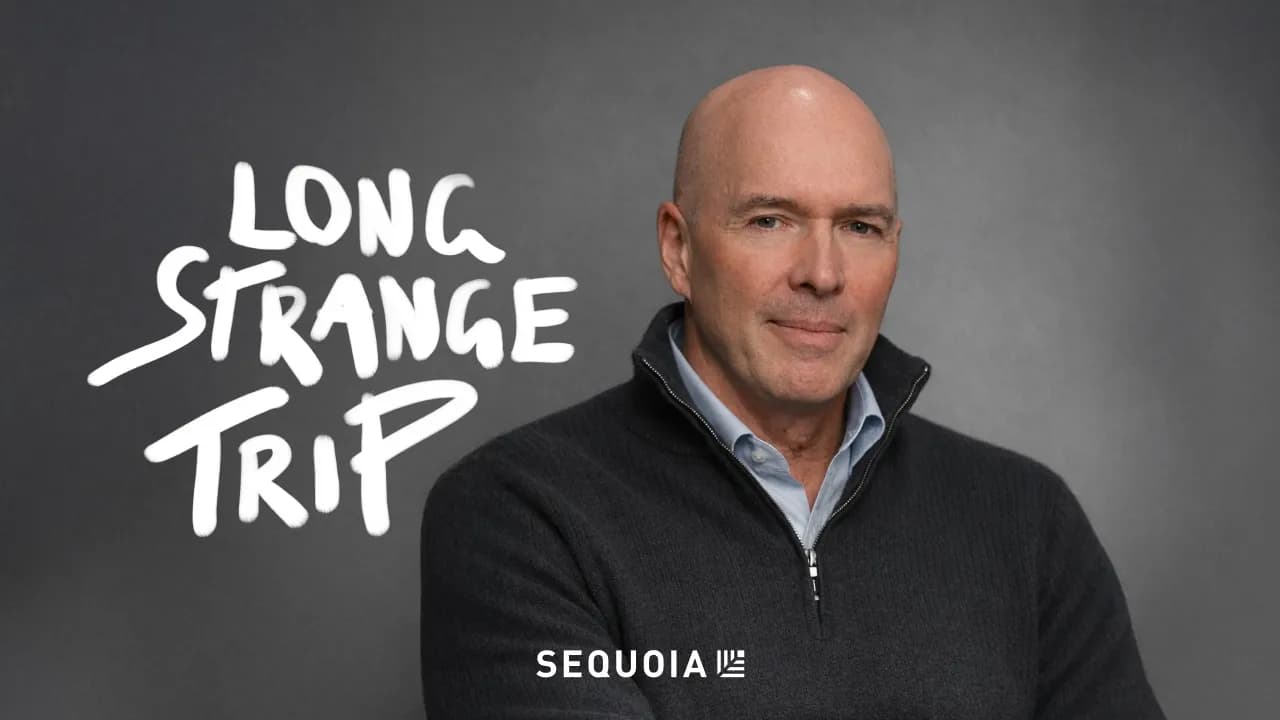
How to Dominate for Decades | Doug Leone, Sequoia Capital
In a Nutshell
Doug Leone stays relevant by repeatedly shedding his ego, starting from zero, and using fear as fuel—every return to work begins with admitting he knows nothing. His edge comes from obsessive self-criticism, trusting founders over spreadsheets, and holding investments until they return the entire fund, not selling early. He distills venture success to two unbreakable rules: back only outliers with heart and clarity, then build trust that lasts a year so you can push hard when founders need it most.
These notes were generated by AI and may contain inaccuracies.
Doug Leone discusses the question of how and why people dominate for decades. His partner in India stated there are many roads to heaven, meaning many ways to dominate. Examples include Steve Jobs and Jensen Huang, who are more linear cases where individuals find themselves in the middle of a hurricane and keep going as the world changes.
The more interesting question is how to dominate when you have to remake yourself over and over again. Leone believes the why stems from a deep and secure need to remain relevant and prove to yourself that you're not getting old and out of date. Looking back on his career, each time he remade himself was done out of fear of being gone rather than a vision of greatness. Even at age 69, he still has that fear and requested the interview focus on tomorrow rather than yesterday.
The how requires being willing to let go of your ego and assume you know nothing each time, starting at the bottom. When Leone returned to Sequoia, he was given the title of chairman, but told investors it's bullshit - he's really a low-level analyst who has to prove himself. After 90 days of calibration following vacation, he told partners he feels good for nothing and that AI has gotten further away from him than when he started. He told a partner that if nine months from now, one year since returning, he feels just as irrelevant, he'll take himself out.
Leone's relationship with fear involves turning it into a tailwind. Throughout his life, he's felt lots of fear and always faced it head on as a challenge. He was afraid of public speaking and made sure to become the best at it. He was afraid of heights and worked on sailboats, going up 96-foot masts. He had a root canal drilled without Novocaine to test if he was a real badass or a fake one. He used the trick of thinking what it must be like to go to war and lose an arm or two legs - pain with consequences - versus his pain with no consequences. He became a puddle of sweat but didn't move.
Leone worked on sailboats during high school and college, located in a country club. Across the water were rich kids being lifeguards, talking to girls, having the times of their lives at ages 16-17. Meanwhile, he was crawling in sailboats, running wires, sweating, working overtime. He said, "I'm going to get those fuckers later." He did get them later.
The insight is to use negative experiences as motivators without becoming an asshole later in life. Leone's need to get back at the rich kids ended around age 50. It took about 30 years to overcome that weakness because it was a false narrative - those weren't bad kids. The more important point is what you do with your kids. Giving them everything means they won't have the drive that comes from hunger. You have to inject some misery into your kids' lives so they have that hunger.
Drive can come from many sources. A partner who grew up with means had drive from competing with his twin brother - they attended the same college as wide receivers on opposite sides of the field. A son-in-law is driven because he cannot stand cheese since his older brother loves eating it. At a Sequoia session, partners shared vignettes that made them who they are. One partner cried sharing that a girl on a bus at age 11-12 said "Boy, you're fat," and 30-40 years later he still wakes up at 4:00 to work out.
Leone's vignette was the beach club experience, being ridiculed in high school because he couldn't speak English, being made fun of in classrooms, being called "pasta" in high school - all things he endured as an immigrant when he wasn't strong enough, then tried to overcome while remaining a good human being.
Leone realized material things don't make him happy. He sold his fancy cars at a great discount and shed assets on purpose to simplify his life. He wanted to enjoy the little things and focus on family and friends. He still has toys but doesn't want to sound like he's living like a monk.
Returning to work was not the easiest move, and three months in he's quite miserable at Sequoia because he feels good for nothing. When building during his first decades, work always felt like an overwhelming challenge he didn't know how to conquer, and he felt that until stopping at age 65.
Failure was never an option in Leone's life - he had no plan B. When made a partner at Sequoia, he was down to zero money and actually homeless for a week, sleeping in his car and showering at 3000 Sand Hill Road. He went through a divorce at age 30 and gave his ex-wife everything, living on his $400 monthly car allowance. He was the only homeless partner Sequoia has ever had.
Leone retired at 65 because he didn't found Sequoia - he was a hired gun, and it seemed right to get out of the way and let the next generation have their turns. Don Valentine stepped away around age 63. Leone chose a successor (Ruaf) and stepped down from 10 boards. He founded a biotech company but wasn't busy because all his companies were working. He took drum, guitar, and piano lessons for a year before feeling he would lose his mind. When Ruaf stepped down and Pat and Alfred took over, they weren't the kings Leone chose. Thirty days into it, they came to his house and asked if he'd like to come back.
They agreed Leone would attend partners meetings, be in the inner circle, help spot crucible moments, and make a couple investments. He wanted to do nothing for 90 days to get calibrated. On day 91, he's panicked. The world is changing dramatically through AI, and after 90 days he feels further away than when he started. He saw a memo about a startup wanting to raise money without anything at a $10 billion pre-money valuation.
Leone has three investment heuristics: Would I put my kids' money into it? If I only make 20 investments in my life, is this one of the 20? Can I return the whole fund with this investment? If an investment doesn't pass these three, he won't make it. The reason for the 20 is he only wants the outliers that return 100 times the money - the ones that drive tremendous returns. His best performing investments always surprise on the upside, never on the downside. Every venture investor has made the mistake of selling winners too early. He mentioned owning 20% of Nvidia and 10% of Google.
Apple and Cisco represent some of Sequoia's biggest ownership positions in major companies. The firm owned a quarter of Cisco Systems at one point. The conversation notes that sometimes the best financial decisions aren't financial at all, referencing Sam Walton who gave away his wealth before it accumulated to his children, though it would now be worth half a trillion dollars if still held in one person's name.
Nick Sleep's quote captures a key philosophy: the best investors aren't investors at all—they're entrepreneurs who never sold. This mindset prioritizes long-term holding over financial optimization.
Doug Leone explains his approach to board service: he's interested in building the business of a company rather than shaping its technology. He notes that founders, especially younger ones in their early twenties, are engineers who understand their domain deeply. If a VC needs to help shape the product, the company is in trouble. However, VCs can contribute to business aspects like selling shares, market analysis, product marketing, messaging, demand generation, lead generation, revenues, support, and accounting.
Leone seeks founders who are "outliers" with high IQ, irreverent attitudes, and strong opinions. He values founders who don't change their minds based on the last person they spoke to. The ideal founder has spent months obsessed with a problem, waking up thinking about solutions, with crystal-clear vision and unstoppable drive.
When building a company, founders need to recruit the first ten engineers and identify the first salesperson. Since established talent won't join startups, the focus must be on identifying up-and-comers in sales and marketing. Sequoia excels at helping navigate these early hiring challenges.
David Velez exemplifies the ideal founder partnership. Originally an associate at Sequoia hired out of Stanford Business School, Velez moved to Brazil for a potential office opening that never materialized. After two investments in Brazil yielded no real engineering talent, Sequoia decided against opening the office. Velez had a vision for a credit card business in Brazil despite knowing nothing about financial services or being from Brazil. He possessed "a heart of gold" and "a heart of a lion"—driven, unstoppable, and fundamentally good.
Velez called Leone at dinner at Epic Roasthouse with a million-dollar commitment, asking what to do next. Leone took the call from the men's room and provided psychological support rather than operational advice. Velez didn't miss a beat for the first several years. Nubank grew to be worth $60 billion.
Leone emphasizes that zero-to-one creation is "black magic" that founders handle—VCs cannot contribute to this stage. If a VC could do it, they'd be founders themselves. The goal is to retain founders in companies as long as possible because losing the founder means losing the company's soul.
Companies experience multiple "refounding" moments. Meta might have disappeared without Instagram, which Zuckerberg bought on a weekend after Sequoia closed its investment on a Thursday. Apple's refounding under Steve Jobs represents another example. Nvidia underwent a complete refounding by Jensen Huang, transforming from a graphics chip company through GPU development into an AI company.
Michael Moritz's memos and reports were exceptionally well-written. His updated book on Apple provides insight into Steve Jobs' rare psychology. Moritz described turnarounds in technology as "doubly difficult" and "almost unheard of," noting Jobs' first turnaround involved a co-founder while the second was done alone.
A quote from Zero to One captures a pattern among successful people: they find value in unexpected places by thinking about business from first principles rather than formulas.
Jensen Huang tortures himself into greatness, waking up and asking why he "sucks so much." This self-imposed pressure creates a model others follow. Leone confirms he has tortured himself his whole life and describes himself as "a miserable soul on the inside" who carries a positive external vibe.
David Ogilvy's concept of being "divinely discontent" describes great people who are never satisfied. Leone notes he is "always a little unhappy" with instincts toward unhappiness, though he finds reprieve with family, grandchildren, and friends on the golf course.
Leone emphasizes that venture capital is not a game—70% of Sequoia's capital comes from nonprofits and charities. When running Sequoia, he insisted on proper terminology: it's a business helping founders build great companies for great returns for limited partners.
Don Valentine stepped down around age 58-60 in 1993. He communicated his succession decision through a yellow sheet of paper written in green pen, listing Mike Moritz at 1.1, Doug Leone at 1.1, and others at 1.0 for carry distribution. There was no conversation—just the note.
Despite his genius, Valentine made mistakes including selling Cisco shares for a $90 million gain when a quarter ownership would have been worth half a trillion at peak. He also pushed for ServiceNow distributions that left a 10x on the table.
After an aggressive presentation, Valentine left a note: "Doug - not fit to listen to founders." This became Leone's review, teaching him that founders are the most important people in the business—founder first, client second, firm third.
When others wanted Leone out of Sequoia for being "insufferable," Valentine advocated giving him more time, saving his career.
Most of Leone's friends are from high school, college, or even earlier in Italy—not from the tech world. He recently visited a friend who is a cop at the Genoa airport. He maintains normalcy by having no handlers or personal assistants, cooking and cleaning for himself.
Leone describes his main skill as a "sniffer"—the ability to walk into a room and know what everybody is thinking and what they want to hear. This has helped him avoid losing investments for 30 years, though others have beaten him on price. He also prides himself on being "a very good soul."
Sequoia's hiring criteria evolved from a complicated spec to a simple one: hyper-competitive people with a heart of gold who do the right thing when it's highly inconvenient and walk through walls ethically.
Mike Moritz described candidates as "half pages" or "full pages." Half-page candidates yield nothing to write after 30 minutes. Full-page candidates make an hour fly by with endless material. David Velez was a full-page candidate—Leone interviewed him, and by the time Velez reached his car, Mike Moritz called to pull him back for another interview.
Doug Leone describes how founders from similar backgrounds often blend together indistinguishably, but exceptional individuals stand out immediately. Within one hour of meeting David Veles, Leone knew he was the right hire.
Fred Luddy of ServiceNow was older when he pitched, but distinguished himself by openly discussing everything that was wrong with the company. He demonstrated complete clarity of product by simplifying workflow to its most basic form - the simple back-and-forth of requests and responses between people.
Leone expresses admiration for Israeli founders, noting their toughness from living with constant missile threats. They are direct, smart, and trustworthy. Many come from Unit 8200, an elite Israeli government intelligence unit. One notable founder was formerly a spy in Iran and now runs a cybersecurity company.
Israeli founders engage in no-holds-barred conversations that may appear confrontational but are actually productive. These discussions lead quickly to outcomes and agreements, typically within 15 minutes, without taking anything personally.
Trust-building begins with fear. Leone jokes with founders asking how much equity Sequoia wants, saying they start happy at 100% but can negotiate from there. This intentional humor reduces nervousness. The process starts by explaining they don't want to screw up the company, then demonstrating business knowledge, and finally helping when founders are in trouble.
Trust takes approximately one year to develop. When founders are down, help without exploiting the situation. When their ego is high from beating quarterly targets, that's when to push harder. The first sign of trust-building often comes via email when founders ask their first real question.
Leone created Sequoia's core principles: performance and teamwork as the foundation, with eight additional tenets that only matter if the first two exist. Later he realized he forgot the "zeroth" principle: trust. With trust, organizations can fly and make decisions extremely quickly.
Trust requires both knowledge and intention. You can trust someone's intentions but not their competence, or trust their skills but not their intentions. Leone taught his partners to understand both components when evaluating trust.
Leone had dinner with Charlie Munger at his house before Munger died at age 99. Munger shared a story from the Enron collapse where he and Buffett wired hundreds of millions of dollars based purely on trust in a relationship, without even an email confirmation, and made billions risk-free.
Leone finds the old-school merchant banking approach appealing, where handshakes and verbal agreements carry more weight than written contracts. He emphasizes that term sheets are not worth the paper they're written on, but once signed, both parties must honor them even if better offers come later.
When a company received a higher offer three days after signing a term sheet, Leone argued against taking it. His fiduciary duty extends beyond maximizing price to maintaining a clean company culture and doing business correctly.
Despite his intimidating appearance - round head, deep voice, bald - Leone describes himself as default trusting by nature. He has never been cheated in business and will work harder than anyone to help others, finding personal satisfaction in being dependable.
During his 26 years running Sequoia, Leone viewed himself as working for all the partners rather than the other way around. He would tell them they had it backwards - he works for them, and his decisions are meant to help everyone win.
On day 91 of his new role, Leone participates in Monday MIT (Most Important Thing) meetings where everyone shares their weekly priorities. His MIT is "scourging" - aggressively networking and calling contacts to find exceptional investment opportunities, aiming for 20-30 lifetime investments.
Finding investments is harder now because the most interesting companies are founded by 23-year-olds, and Leone lacks a natural network among that age group. He was previously embedded in deal flow from his own generation.
Leone emphasizes that venture capitalists who primarily network with other VCs miss the real opportunities. Young founders identify entirely different people than previous generations, making it essential to stay connected to actual founders rather than other investors.
Leone describes his drive as an uncontrollable obsession rather than traditional hustle. Since childhood, he's had a compulsion to read and work that doesn't feel like effort. This intrinsic motivation sustains him through exhaustion, making the work feel like love rather than obligation.
Brad Jacobs helped Leone shift from negative self-criticism to generative drive. Jacobs taught him that the harsh inner voice that got him to his current level no longer serves him - his drive should come from loving what he does rather than being mean to himself.
Rather than dwelling on successes, Leone constantly thinks about opportunities he let slip and mistakes he made as an investor. He believes he could have done much better for the venture community despite his accomplishments.
Founders should architect their boards the same way they architect products, not like picking someone up at a bar. A board is a lifetime mate for 5-7 years. The goal is finding complementary skill sets and temperaments, which initially creates discomfort but leads to learning.
Common board construction mistakes include selecting members based solely on who volunteers, choosing engineers when the founder is already technical, or picking inexperienced people. Leone categorizes VCs as 30% incompetent, 40% "no-ops" who nod along without adding value, and only 20-30% who actually know what they're doing.
Many board members aren't truly present because they're managing their firm's expectations - needing wins, exits, or status. This creates a situation where founders get the "shadow" of what the partner thinks their firm wants rather than genuine guidance.
The best boards don't have arguments but put real issues on the table for supportive conversations aimed at finding answers founders need. At Sequoia partner meetings, they sometimes take 5-10 minute breaks to cool down, then return to reach consensus with no further discussion afterward.
Ed Catmull shared that Steve Jobs fired two Pixar board members during the company's public company years because they always agreed with him and served no purpose. Jobs wanted genuine disagreement, not just people who would rubber-stamp his decisions.
Giving honest feedback is an art form requiring the right timing, tone, words, and examples. Instead of directly telling a founder their VP of sales is terrible, Leone suggests introducing them to successful VPs of sales so they can gauge themselves and realize the gap independently - similar to the concept of inception where people must believe ideas are their own.
Doug Leone prefers direct feedback over the compliment sandwich approach. He recalls hearing venture capitalist Jim Brier turn down an investment and noted that founders walked away thinking they had won the lottery, contrasting this with his own direct style. Leone's phone conversations typically last 3-4 minutes at most, often shorter at around 30 seconds.
Leone describes himself as right on the line according to Myers-Briggs, not liking to meet new people in general. He admits that when meeting someone new, his initial thought is "fuck another asshole I got to meet." While extroverts find energy from meeting new people, Leone finds it exhausting and can only "turn the charm gene on" temporarily before returning home depleted.
Leone applies Charlie Munger's opportunity cost framework to social decisions, preferring to deepen relationships with his five true friends rather than spend two hours with someone new. However, he acknowledges that putting himself out there and meeting new people makes him happier long-term, feeling more well-rounded despite the emotional risks involved.
Leone maintains pure business relationships with most founders and does not socialize with their spouses. His closest founder relationship is with Valz, whom he hired as an associate, creating a paternal-son dynamic.
Leone discusses venture firms that had successful runs but eventually dissolved. Cross Point Ventures had a strong 7-year run before partners left. TVI (Technology Venture Investments) was notable for Dave Marquardt being on Microsoft's board as the only venture investor the year before Microsoft went public, when the company was doing $140 million in revenue and $38 million in profit. They purchased 995,000 shares for $1 million.
Leone shares an anecdote about one of the world's best entrepreneurs whose father made a single investment that generated $40 billion, demonstrating that exceptional returns can come from minimal activity.
Mike Moritz taught Leone how to listen to exact words, timing, and adjectives to understand people. Leone learned to pay attention to whether founders use "I" versus "we" when describing situations. He recalls thinking "fuck that, you can't sell me shit" during presentations while maintaining a grin, based on the language used.
Mike Moritz changed memo formatting at Sequoia from "from" first to "to" first, putting the recipient ahead of the sender. This taught Leone about avoiding egocentric communication patterns.
Despite their difficult co-head relationship, Leone acknowledges Moritz's exceptional ability to envision what companies could achieve if everything goes right. He describes this as Moritz's greatest strength, noting the spectacular companies Moritz invested in.
The interviewer expresses confidence that Leone will continue in venture capital a year from now and suggests revisiting the conversation.
Keep David Senra in your library
Save the videos and channels worth coming back to, and find them again in one place.