From the Super Bowl to Private Equity: How Steve Young Wins at Everything
In a Nutshell
Steve Young built success in both football and private equity by rejecting transactional thinking for the "law of love"—where genuine partnerships create abundance rather than zero-sum outcomes. His father's grit philosophy and mentors like Bill Walsh taught him to embrace challenges directly, seek vulnerability in others, and build teams around shared experiences and mutual investment. The core principle: success without fulfillment is failure, and the secret to living fully is giving yourself to others' healing rather than chasing credit or returns.
These notes were generated by AI and may contain inaccuracies.
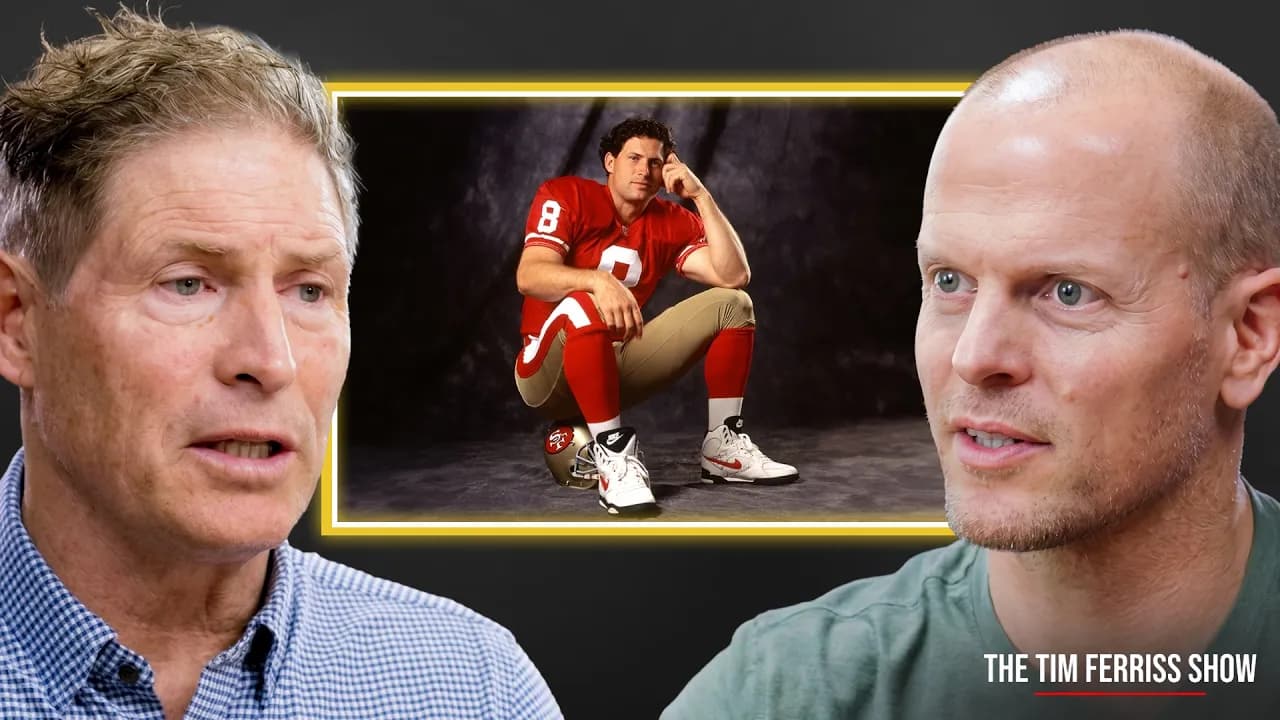
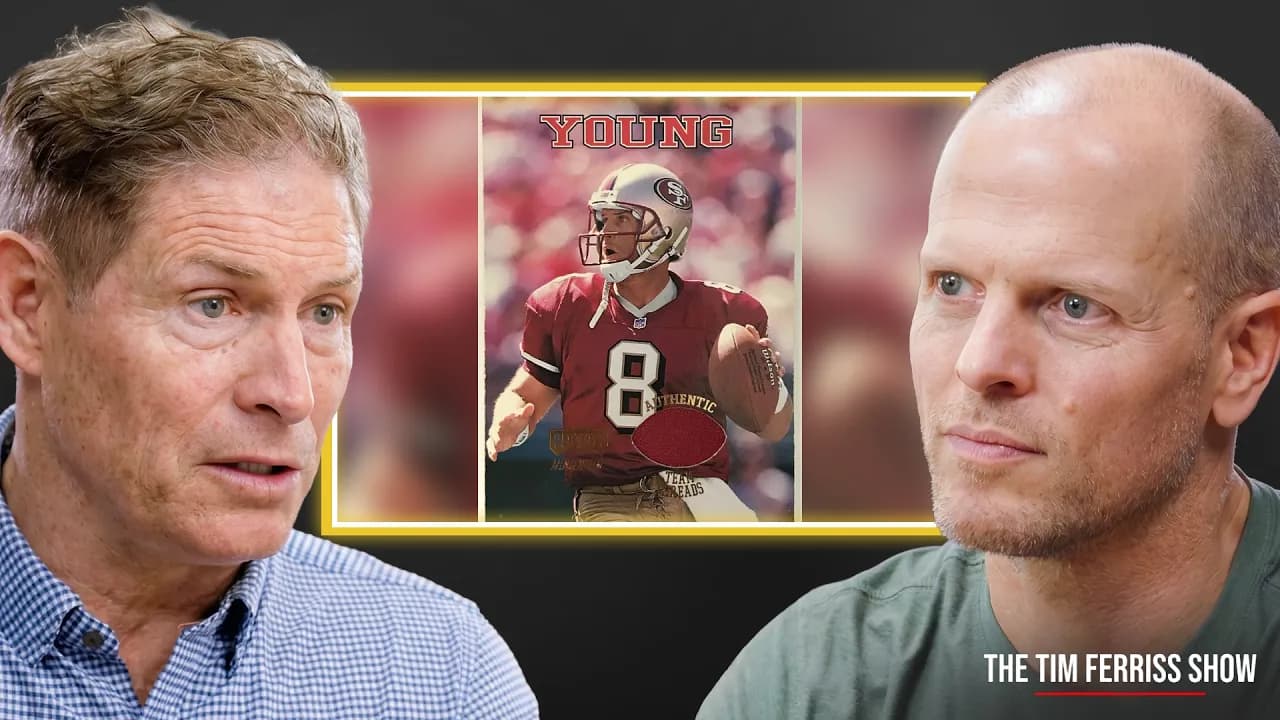
Tony Robbins introduces Steve Young from Celane, Idaho, noting his recent eye surgery. Young is described as one of the rare individuals who reached the pinnacle of two completely different worlds: football and private equity. He is a three-time Super Bowl champion, Super Bowl MVP, and member of the Pro Football Hall of Fame. After his football career, Young co-founded HGC, one of the nation's leading middle market private equity firms, where he has been responsible for hundreds of investments and tens of billions of dollars in transaction value.
Young shares a story about Bill Walsh at the beginning of training camp, emphasizing that winning comes from shared common experiences and love for each other. He observes that great athletes and business titans share common characteristics. The conversation emphasizes that great investors are "gut investors" who make decisions based on fundamental principles beyond spreadsheets.
Young notes that the private equity industry tends to attract transactional people. He views partnerships as a way out of this transactional mindset, emphasizing the importance of making sure both parties feel like it's a true partnership where one plus one equals more than two. He warns that if people aren't careful, they will define the most sacred parts of their life in transaction, and transaction will rot because it's self-interested.
Young stresses that a belief is a poor substitute for an experience. He talks about the need to start crawling with no shortcuts, and the real question becomes how to give someone the experience of doing something unselfish and feeling the rewards that come from it. He notes that fame, money, and notoriety change people's rootedness at nearly a 100% hit rate.
When asked about pivotal decisions that shaped his career, Young shares his father's advice that he likes "third and 10" - a football metaphor for difficult situations. Young initially disagreed, but later understood that third and 10 finds you. He describes his foundational response as always being to climb to it, to grit it, and to go through challenges rather than around them. He acknowledges that any career, whether good or great, is built on work ethic, toughness, and grit.
Young's father, nicknamed "Grit," shaped his approach to commitment. When Young was an 18-year-old considering quitting college football, his father told him he could quit but couldn't come home. This wasn't rejection as a human or father, but a metaphorical stance that once you choose a path, you're in. His father never pushed specific activities but insisted that once chosen, you follow through. This philosophy was consistent throughout Young's upbringing - whether it was practice, sports, or other commitments.
At BYU, Young was eighth string quarterback with none of the promises made being kept. People didn't know his name, and he considered transferring to North Carolina or Syracuse. His father's response remained consistent: you chose it, you're in. Young emphasizes that the simplest part of success is doing the uncomfortable things long enough to master them.
Young discusses signing with the USFL's LA Express, a risky decision that seemed obvious at the time due to a giant contract. He chose to play rather than sit behind Kenny Anderson in Cincinnati, preferring to be coached by John Hadl and Sid Gillman. He valued being on the field where he could iterate in real time rather than just watch. This decision shaped his approach to investment opportunities today.
Young explains that no great investment decision is without risk. The gut instinct comes from fundamental principles grounded in what matters for growth. He uses the same principle: being willing to take risks because it allows finding the full measure of oneself or the entity. He emphasizes that this gut reaction is rooted in something fundamental that you know is important.
Young provides an example of an investment in Integrity, an insurance marketing business in Norfolk, Nebraska. The founders were going to invite hundreds of partners to join them. Young evaluated their rootedness - how they responded in abundance rather than transaction, even during price negotiations. He noticed they consistently thought about how decisions work out for everybody. This business became huge and thriving because of this value-oriented approach.
Young warns that fame, money, and notoriety change people's rootedness at nearly a 100% hit rate. He wants to back people who won't change their values - who remain value-oriented, moral, and make good decisions regardless of how big and powerful they become.
Young shares advice from Roger Staubach, his childhood hero, who told him to "run" - meaning to leave the game purposefully because it will never leave you. Another mentor, Bob Gay, warned about falling off a cliff - going from being world-renowned at something to being great at nothing the next day. Young describes this as falling off a cliff and becoming "a bag of bones" the next morning, requiring humility to start crawling again.
Young frames career transitions as a hero's journey requiring humility, vulnerability, and facing trials and challenges. He notes there are some shortcuts due to previous greatness, but the fundamental truth is that everyone must go through this journey. He emphasizes that the hero's journey isn't about wild success but about actually journeying through the process.
Young's transition story began in the 49ers locker room during Silicon Valley's explosion in the late 90s. Brian Maxwell, founder of PowerBar, invited him to join the board. There he met Larry Sonsini and Warren Hellman, Silicon Valley icons. Bob Gay became a mentor through philanthropy connections. These three men turned Young from law to business, recognizing his EQ, people skills, and ability to see potential in others like a great coach.
Young reflects on coaches who saw potential in him that he didn't see in himself, starting with Jack Schlaggel when he was eight years old. At BYU, coach LaVell Edwards pulled him aside during spring ball when he was third string and said, "You're going to be great." Despite Young's skepticism given his eighth-string status six months earlier, this investment in him proved meaningful when Young threw three interceptions in the first half against Georgia, and Edwards calmly reassured him he was going to be great.
Young describes how an early coach invested in him by seeing his full potential, which helped him recognize his own capacity despite a difficult start with three interceptions. The coach's belief enabled Young to step into his authentic self rather than being called down or doubted. This experience became foundational to Young's approach to business and life.
Young emphasizes that certain people possess a rare ability to see others in their full human capacity—whether in academics, personality, intellectual ability, or other areas. These "angels" or coaches can perceive future possibilities and communicate that vision in a way that others can absorb and act upon. Young internalized this belief from his coach, working his way into accepting that the coach "could be right," which generated lasting confidence.
Young actively tries to pay this forward by stopping to see people, even briefly, and offering them a sense of investment and encouragement—whether the validation is small or significant.
Tony asks whether Young had already developed his identity while sitting behind Joe Montana, or if another mentor sustained him during that period. Young acknowledges his humility as a gift that drives his work ethic and depth of caring.
Young describes himself as an "oddity"—a quarterback who ran around rather than staying in the pocket, and a left-hander at a time when the prototype favored right-handed pocket passers. His initial offensive coordinator at BYU refused to coach a lefty and left after Young's freshman year. When a new coach, Ted Toler, asked why Young wasn't playing quarterback, Young explained it was because he was left-handed. Toler responded, "What does that matter?" and helped Young return to the quarterback position.
Young notes the statistical anomaly: 10% of humanity is left-handed, but less than 1% of quarterbacks are left-handed. He observes there is only one left-handed quarterback in the Hall of Fame (Kenny Stabler), suggesting an underlying bias.
Before joining the 49ers, Young was with Tampa Bay and given unusual permission by the owner to choose his destination. Bill Walsh called and reframed Young's perceived liabilities as assets: "Everybody thinks that being a lefty and running around is a negative. I think it's a huge positive. It's gonna be the differentiator and you're gonna be one of the greats in the game." While Young did not fully internalize this belief at the time—he was unsure he could even play in the league—it planted a seed.
Walsh provided not only vision but also the offensive system, play-calling, and talent around Young to demonstrate what was possible. Young emphasizes that "nobody does it alone" and that seeing one's full measure requires substantial help from others.
Young discusses the concept of "emotional athletes"—individuals who can hold vulnerability, excellence, and kindness simultaneously. When evaluating founders, CEOs, management teams, or potential hires, Young first looks for openness to critical feedback and growth. He describes a "spidey sense" for detecting whether someone acknowledges they don't know everything and actively seeks improvement.
This quality is fundamental because without investment in growth, people become "topped out" and struggle to iterate effectively. In business and life, iteration is essential, sometimes rapidly. Those who cannot iterate merely double down on existing templates until the approach stops working.
Young highlights George Roberts as an example of someone who maintains a learning mindset at age 82, always asking what's next and how to improve. Vulnerability and kindness typically accompany each other. However, Young notes this quality can erode over time as people become powerful and lazy, shifting from using vulnerability as a tool to wielding everything as a weapon. Sustaining vulnerability throughout one's career is a significant achievement.
Chris asks how HGC distinguishes genuine partnership from transactions merely labeled as partnerships, ensuring both parties experience authentic collaboration where one plus one equals more than two.
Young responds by describing the "entropic nature of life"—everything tends toward decay and death. Life is fundamentally transactional, hitting people constantly with the need to work, eat, and survive. Private equity can easily default to zero-sum transactional thinking unless intentionally resisted.
Young founded his firm in 2008 because he believed private equity was broken—reduced to spreadsheets and "science projects" with people removed from the equation. He contrasts this with late 1980s and early 1990s private equity at firms like KKR and Bain Capital, where partners sat across tables, invested and reinvested together, and developed strategic vision collaboratively.
Young looks for partners who at least intend to move beyond transaction. While acknowledging everyone has attributional tendencies and wants credit, he seeks people willing to say the words and hold the intent to look beyond zero-sum games. When people consistently come together, look each other in the eye, solve problems collaboratively, and build trust, abundance can emerge even from the transactional world of private equity.
Young's firm has built a culture where people vote with their feet to go the extra distance in relationships rather than defaulting to transaction. Even team members who are naturally transactional recognize the benefit and richness of this approach.
Limited partners appreciate that returns have been generated in a way that adds value, grows businesses, creates jobs, and develops people—not just through financial engineering. While dollars matter, the value created beyond financial returns is equally significant. After 15 years of being considered antithetical to private equity norms, this philosophy now resonates with many in the industry who are intentionally elevating their approach.
Young notes that business owners selling companies today rarely want only the last dollar; most care about mission, family, and legacy.
Young connects his philosophy to his experience with three Super Bowl championship teams. Bill Walsh's foundational team meeting speech emphasized that the 49ers would win not because of specific plays or defenses, but because of "shared common experiences and an element of love for each other." Walsh described scenarios like being in Green Bay, down by four with a minute left, no timeouts, freezing rain, wind, and 80,000 opposing fans—situations where relationship, not just knowing names on jerseys, would determine outcomes.
Young identifies that the 49ers' success was fundamentally about relationships and selflessness, not just the West Coast offense, quarterbacks, or players like Jerry Rice. Great organizations subsume individual self-interest into the collective good—not as socialism, but as a recognition of how humans can work together.
Bill Walsh's book The Score Takes Care of Itself articulates that great values, relationships, and cultural underpinnings mean the scoreboard takes care of itself—you don't need to focus on it directly. Young's book on the law of love, written for fellow members of the LDS community, applies similar principles to religious life: relationships with heaven can become transactional ("I'll sacrifice if I get credit"), but true religion requires selfless love rather than self-interest.
Young argues that transaction, being self-interested, will eventually rot and cannot be perpetual. If one believes in a durable spirit that lives on, it must be nourished from a perpetual rather than transactional source. The law of love provides a paradigm for shifting definitions of sacred things—marriage, family, religion, business—away from transactional frameworks that inevitably decay.
Young has tested this principle across football, private equity, marriage, family, and religion, finding the law of love undefeated. He describes it as leaving self-interest behind to find the "sublime beautiful space of selfless love." When people encounter someone operating from genuine selflessness, it registers differently—it feels impactful and masterful.
Young references a recent conversation with Tony about the distinction between working to be happy versus being happy. The law of love involves being present, feeling and appreciating the day, relinquishing control, and being submissive to a higher power. In that space, people can be seen in a more abundant, beautiful way.
Tony responds that across all his abilities—negotiation, audience building, football—the common thread is love. Unconditional love, caring about something more than oneself, and serving something beyond oneself connects people at the deepest level, transcending physical separation and accessing a spiritual dimension that levels differences.
Success without fulfillment is the ultimate failure. The conversation emphasizes that suffering arises when people become so busy executing tasks that they forget to connect with and appreciate the present moment—the people, environment, and breath available right now. In investments and private equity, it's easy to descend to the transaction level, but staying there prevents genuine fulfillment.
The speaker acknowledges that living the richest, fullest life means giving all of yourself, leaving nothing behind except the love shared with others. The desire for credit and transactional thinking exists in everyone, but the intent and aspiration toward selfless love matters over time. Every morning should begin with a focus on leaving the harbor with a bull's-eye in the area of selfless love, looking for small ways to help others heal.
Private equity tends to attract transactional, self-focused individuals. The challenge lies in building selfless thinking into people in their twenties and thirties who are simultaneously trying to build families, grow, and accomplish goals. The speaker uses football coaching analogies, explaining that building a team means focusing on making individuals the best they can be in order to benefit the overall team.
Transaction-based thinking is actually developmental—it's how values are taught to children through rewards and consequences like Santa Claus. However, the speaker questions whether this remains the optimal approach even for children. The nature of transactions involves give-and-take dynamics that need explicit explanation, particularly for young people who find non-transactional concepts non-intuitive.
When speaking to twenty-year-olds, a common question emerges: how can discussions about legacy be meaningful to someone who doesn't know if they'll accomplish anything? The response reframes legacy as how much healing one brings to humanity, suggesting that twenty-year-olds actually have a full lifetime to build this legacy rather than being on the "other side" of it.
Life is inherently transactional and rational, but the concept of selfless love adds an irrational dimension that the speaker owns as such. Young minds can recognize this irrationality while understanding why it feels odd. The speaker believes this perspective is rooted in truth despite its esoteric nature.
This generation of young people represents the first that has said they don't care about getting more as long as it's fair, making them ready for conversations about selfless love. The challenge lies in finding language that resonates with this group.
The system builds transactional private equity professionals who arrive ready with financial engineering skills. However, the firm seeks more than these technical inputs. Some professionals have left because they wanted to focus solely on deals and found the emphasis on relationships and healing too soft or weird.
Belief is a poor substitute for experience. The real question becomes how to give people experiences where they do something unselfish and feel the rewards that come from it. Once people experience the dopamine hit from the spiritual side of life rather than just the transactional side, they develop an internal drive that motivation cannot provide.
The ultimate irony is spiritually true and applies to football as well: in losing yourself while seeking someone else's healing, you actually receive everything needed. When someone is solely interested in another's healing, that's how they receive the bounty. The true secret of living is giving.
Everyone listening should test the principle that the true secret of living is giving. This has been tested by science, and the truth is available for people to chew on and think about. The speaker tells his children about this philosophy, noting that his seventeen-year-old is just now considering reading his book after ten years.
When evaluating investment opportunities, the challenge lies in differentiating between genuine trends and crowd-following behavior that creates bubbles. The speaker's firm solved this through their founding approach to partnership investing.
The firm decided against becoming asset managers because raising increasing amounts of capital—from one billion to ten billion to seventy billion—means leaving behind the expertise required for middle-market investments. The business purchased at one billion AUM differs fundamentally from one purchased at ten billion, requiring new skills rather than scalable expertise.
Instead of scaling as asset managers, the firm makes money through co-investment, with their funds sized at one billion, one billion four, four billion, and now three billion adjusted for inflation. They committed from the beginning to being the largest investor as an LP back into the GP, eating their own cooking and folding their scars and experience back into repeated execution.
The speaker's father taught that dreams represent less than 1% chance while plans represent 80% chance. Dreams are vital but must be paired with plans. The father emphasized never having a time without a dream and never having a time without a plan, requiring both throughout life.
When the speaker reached the NFL, his father immediately asked about the plan for the rest of his life beyond the average 3.5-year career. Dreams can become plans when actually achieved, but this requires honest assessment of risk levels. Being all-in on a dream with less than 1% chance means acknowledging the high-risk, high-reward nature while maintaining the plan.
The best leaders hold creative tension between seemingly incompatible elements—being risk-takers while remaining fundamentalists. Bill Walsh exemplified this by demanding both the best football team that would punch opponents while emphasizing love and relationships. Creative tension differs from toxic tension and represents where the best outcomes emerge.
The common thread among Hall of Fame athletes, coaches, world-class entrepreneurs, and investors is their willingness to engage in creative tension. They work within their strengths while recognizing limitations, taking risks while maintaining fundamentals. Great partnerships like George Roberts and Henry Kravis succeeded because they trusted each other and believed they had a better approach, making their endeavors feel fundamental rather than merely aspirational.
Even after significant accomplishments, the journey of growth continues. The speaker describes finding a wellspring through life experiences and becoming aspirational and intentional about selfless love, remaining in the process of discovery alongside others.
Keep Tony Robbins in your library
Save the videos and channels worth coming back to, and find them again in one place.