Inside The Democratic Party Civil War - Ezra Klein
In a Nutshell
Ezra Klein argues that algorithmic social media is destroying independent thought, political virtue, and human attention by turning everyone into attention-maximizers trapped in purity spirals and performative outrage. The core solution is deliberate "backstage" protection—maintaining private space, reading physical books, and cultivating embodied intuition—while rejecting both the left's dismissal of personal agency and the right's embrace of vice over self-mastery. AI accelerates this problem by offering frictionless productivity that atrophies real thinking, so the priority is building regulation around existing systems while preserving distinctly human capacities for sustained attention and feeling.
These notes were generated by AI and may contain inaccuracies.
Ezra Klein discusses the experience of being profiled in the media, including being called an "unlikely thirst trap." He notes that profiles are never meant to be entirely positive or entirely negative, as their purpose is to generate energy and interest. Klein mentions a rumor about adjusting his podcast lighting to appear less attractive, which he confirms is false.
Klein emphasizes the importance of maintaining independence of mind for doing good work. He explains that seeing oneself in the third person is dangerous because good work requires independence of mind, time alone reading books, and thinking. When the world's idea of you enters your head, it acts as poison. This principle applies not only to profiled individuals but to everyone with social media profiles maintaining a constant front stage.
Klein advises journalists experiencing press attention to be intentional about maintaining a backstage. He expresses concern about streamers who put large portions of their lives online, leaving little private space, and believes this will cause significant psychological damage to many people.
Klein recommends Gary Shteyngart's book Super Sad True Love Story as prophetic, written 10-15 years ago. The novel depicts a world of streamers, America coming apart, public raiding of personal lives, and a culture where physical books are considered uncool. Klein observes that society has built the dystopia science fiction writers warned against across multiple dimensions simultaneously.
Klein describes his approach to protecting his backstage by keeping significant quiet time and not attending many events. He references Lena Dunham's book Fame Sucks, which discusses how everything creates more of itself and circuits consume time.
His work structure involves bringing out three main outputs per week: two podcast episodes and one column. He organizes his week around these three pieces and increasingly cuts out activities not directly feeding into them, his children, family, deep friendships, personal care, and time.
Klein introduces Mary Harrington's concept of a "digital hijab," a deliberate practice of covering parts of oneself that one does not want the world to see. Harrington shared an example of finishing a race and considering posting a selfie, then recognizing the split between what was for herself versus what was for the internet.
Destiny describes himself as a private person by disposition. Early advice from friends helped him keep his personal life private, and he believes once that door opens, reversing it becomes very difficult. He notes that opening personal life leads to snowballing interest in dating, alignments, and other details.
Destiny's strategy involves being intentionally boring with his personal life as a prophylactic measure. People move on to more easily consumable content. He accepts not being at the top of attention lists compared to figures like Destiny, Hasan, Nick Fuentes, or Huberman, whose private lives receive more public scrutiny.
Destiny limits exposure to algorithms and does not tweet. Even posting clips on Instagram creates noticeable pull and desire for engagement. He cites mid-century media theorists Marshall McLuhan, Neil Postman, and Walter Ong, whose core idea is that every medium changes the user rather than the user simply consuming content.
McLuhan's concept states that the content of a medium serves as a juicy steak thrown to distract the watchdog of the mind. While users believe they are choosing content, the medium itself changes their expectations for how ideas should feel, look, and how long they should be.
Klein warns that algorithmic platforms create constant rankings that generate feelings of needing to compete. People enter local maximums that become long-term minimums or degradations. Optimizing heavily for competitiveness on platforms like X degrades thinking patterns over time, ultimately harming long-term work quality.
Maintaining a career requiring sustained interestingness demands intentionality similar to an athlete avoiding injury and burnout.
Klein references Dostoevsky and Nietzsche, who wrote by hand in the first part of their careers and on typewriters later. Their sentences became shorter and punchier, and their thoughts occurred differently because the medium changed their writing style. This demonstrates bidirectional influence: absorbing information differently through platforms and outputting through them creates deranging effects.
Klein proposes developing a better politics of attention. He draws on an academic paper suggesting attention should be understood as a public good or collective resource subject to tragedy of the commons problems. When everyone has access to a shared resource like a grazing field, individuals maximize their use until the resource is exhausted.
Collective attention faces similar dynamics. Competition for attention grows increasingly aggressive. Political emails and text messages have become louder, incorporating siren emojis and framing everything as an emergency or the end of the world.
Klein describes X (formerly Twitter) as gain-of-function research for takes, where everyone competes to transform normal takes into something with viral contagion. Occasionally this succeeds too well, allowing the content to escape and destroy lives. The collective effect makes attention irritable, short, and constantly shifting.
Klein recommends Neil Postman's Amusing Ourselves to Death. Postman addresses criticism that his critique of television ignores quality content like Sesame Street. He responds that he does not worry about obvious trash on television because everyone recognizes it as such. The concern lies with content like Sesame Street, which subtly changes expectations by teaching that education should be entertainment.
Modern politics requires politicians to be attentionally capable, able to earn attention in ways previously unnecessary. Examples include Zora Neale Hurston, Spencer Pratt, Graham Platner, Donald Trump, and James Talerico. In competitive races, being a somewhat boring talker focused on policy delivery and constituent relationships is no longer sufficient. Aura has become necessary.
Klein describes Keir Starmer as the equivalent of a ham sandwich in terms of political charisma.
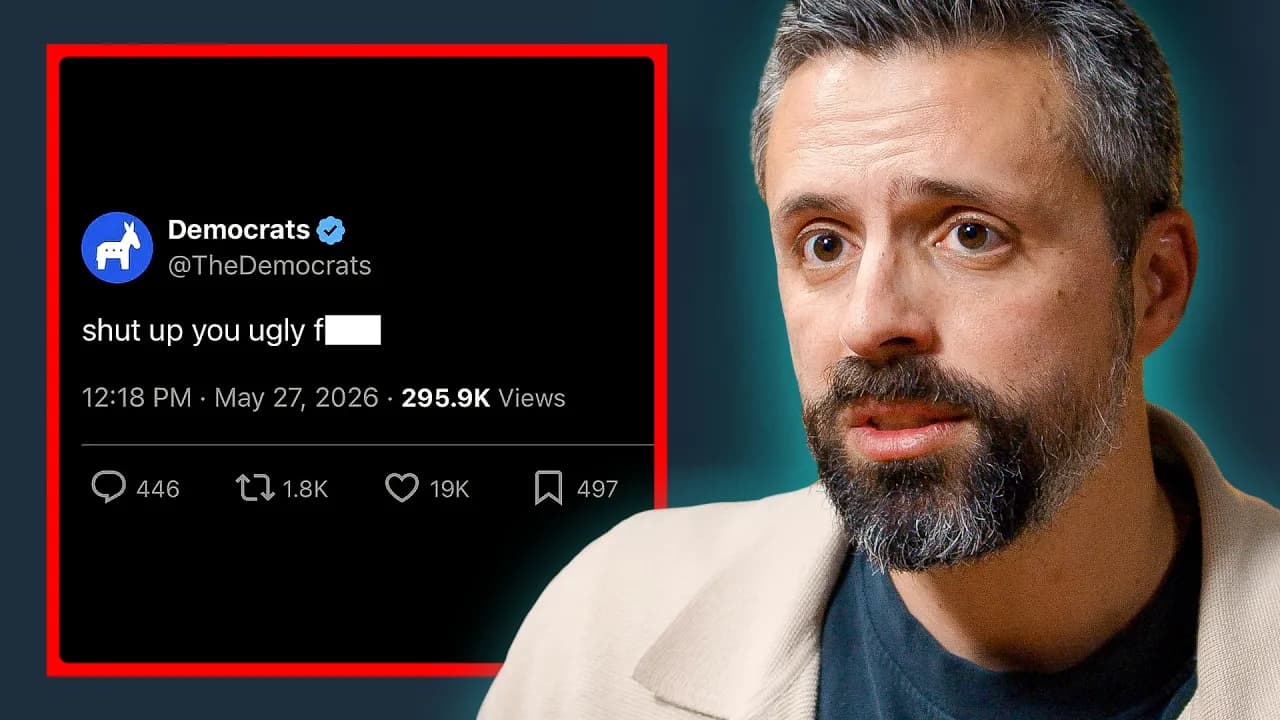
The Democratic National Committee's official account replied "Shut up, you ugly fuck" to Stephen Miller after Miller commented on the Democrats nominating their first transgender Senate candidate in Texas. The tweet received at least 50 million views and 300,000 likes. Klein notes this represents a shift in what political communication sounds like.
Klein identifies Donald Trump as a first mover in shifting people's sense of appropriate political communication. When institutions tweet like normal, sober stalwarts, the content appears boring. Barack Obama's Twitter account is cited as not particularly effective in this new environment.
The medium changes expectations, changes the people who succeed, and changes what succeeds. The Democratic National Committee's tweet exemplifies a tragedy of the commons problem in attention, where extreme voices gain notice in a cacophony.
James Talerico is described as an incredibly decent person in politics who treats people on both sides with respect. Stephen Miller, as deputy chief of staff, responded to Talerico's primary win by emphasizing Paxton's status as the first transgender candidate rather than engaging substantively.
Klein argues this represents degradation of the entire system. The gleeful rejection of behavioral norms previously reflecting self-discipline appears in Trump and Miller's approach. Politicians historically maintained discipline against unleashing on disliked individuals in destructive ways.
Klein discusses masculinist philosophies on the right, including Bronze Age Pervert and Rad Nationalist. These visions emphasize primitivism and a desire to rediscover stereotypically testosterone-soaked, competitive, dominance-oriented, aggressive masculinity. They view modern man as warped and constrained into soft, cooperative shapes against natural instincts.
Notably absent from these philosophies is emphasis on self-mastery and self-discipline as fundamental dimensions of humanity. Self-discipline is often portrayed negatively as evidence of modernity warping people into attenuated shapes suited to feminized liberal democracy.
Klein predicts a swing back toward desire for political virtue and social virtue demonstrated in leaders. Everything creates its opposite in politics. The emerging version of statesman-like decorum will still need to possess aura and sexiness.
Beto O'Rourke demonstrated appeal by talking through progressive Christianity in a language of morality and virtue that people found exciting, a register not commonly heard from Democrats. O'Rourke raised more money than any Senate candidate in the country based on this approach.
Klein observes that people are seeing what happens when behavior conforms to algorithmic media demands. While some feel excited by this, most dislike it. Even Trump supporters often dislike how the system feels.
The comparison is made to McDonald's: enticing in the moment but leaving one feeling poorly afterward. Repeated exposure leads to system rejection.
Arthur Brooks stated that breaking addictive cycles requires getting mad as a first step, based on aggregated evidence across addiction types. This involves recognizing being at the mercy of porn, drugs, alcohol, or phone scrolling.
Klein wonders at what point people become bored with the evolutionary arms race of bullshittery online. The Democratic National Committee's tweet style will generate diminishing returns as audiences become desensitized, requiring escalation to maintain attention.
Ezra Klein states he does not see himself as at the center of a Democratic civil war, though online discourse makes it appear that way. He attributes this perception to the fact that few people can speak across multiple sides of the debate. Klein describes the Democratic Party as having a major debate over its identity and direction.
The book Abundance, co-authored with Derek Thompson, became a central text in arguments between the populist and liberal wings of the party, even though the actual arguments in the book were different from how it was used. The book focused on how liberalism has made it difficult to build in places where Democrats govern, such as New York and California, where building homes and clean energy has been challenging.
Texas builds more homes and more clean energy than blue states, not because of stronger support for affordable housing or climate policy, but because the state has created structures that make building easier. Climate tech entrepreneurs with Californian politics report being able to complete projects in Texas and Arizona that they cannot get done in California.
The book was embraced by the people it was criticizing, including Gavin Newsom, who now frequently discusses Democrats needing to be a party of abundance and references a liberalism that builds. Barack Obama has also discussed the book. The insurgent wing of the party reacted against it, viewing abundance as representing Obamaism and the establishment side keeping power.
Klein argues most of the fight is artificial. Zohran Mamdani released a housing plan focused on making building easier by cutting bureaucracy and red tape. In Los Angeles, Democratic Socialist Nithya Raman is running against Mayor Karen Bass and has been taping in overgrown fields that the city is suing to prevent from becoming affordable housing. The New Democrats congressional caucus released plans about building more clean energy and creating clean energy abundance.
Online discourse creates factional and angry fights that do not reflect the actual difficulties in implementing these ideas. The real challenges are practical rather than ideological, and there is also a technology side to abundance that has become harder due to AI developments since the book was written.
Klein notes the right has collapsed purity down to a single dimension: loyalty to Donald Trump. This allows acceptance of a wide range of views as long as individuals remain loyal and speak positively about Trump personally. The left lacks a single leader and therefore has a plurality of ways people can get in trouble.
The single ordinating principle on the right is fracturing as loyalty to Trump becomes more complicated than during the 2024 election, with issues like the war in Iran creating new tests. MAGA figures like Marjorie Taylor Greene and Thomas Massie, who supported election-related positions, have been pushed out over other disagreements.
The broad left has an agenda with multiple factions maintaining a platform, orientation, and set of ideas that function as loyalty tests, including positions on Medicare for All, billionaires, and wokeness. This creates a more cohesive coalition but makes it harder to welcome new people into it.
Klein discusses the cultural left and online discourse dynamics. He notes that the right allows dissent against Trump while still being seen as part of the right, but questions whether the left has equivalent ballast for internal dissent.
Klein argues that whoever dominates Twitter pays for it three to four years later. Progressives dominated Twitter in 2020 and convinced themselves of wild ideas that later hurt them in 2024, with Kamala Harris facing attacks over statements made years earlier. James Talarico faces attacks from Ken Paxton over comments made three or four years ago, such as statements about God being non-binary.
After Elon Musk purchased Twitter and rebranded it as X, the right gained dominance and is now attached to figures like Nick Fuentes and more conspiratorial versions of Tucker Carlson. Klein predicts this will hurt Republicans in two to three years when the consequences emerge.
Klein emphasizes that these dynamics cannot be separated from algorithmic social media, which shapes fast rises and falls in coalitional purity and extreme ideas. People become consumed talking to their own side and lose perspective on where others actually stand.
The most dangerous aspect is not the ideas themselves but failing to do the political work to make ideas legible to others or win sufficient support. Instead of doing politics, people engage in posting, which creates energy for hating the other side but represents a weak form of politics.
Politics requires constant balancing of disagreement and endless pluralism in a liberal democracy. Posting optimizes for one side and attention rather than persuasion.
People get into one-up dynamics to prove purity within online environments. Mondaire Jones had to disown statements made on Twitter years earlier when running for mayor, including claims that the NYPD is anti-queer. Many left politicians are now having to acknowledge that 2020 was a period when they said things that were out of the mainstream.
This optimization for specific echo chambers creates an arms race for attention. When statements are later viewed outside that context, such as in statewide ads in places like El Paso, they appear disconnected from median voter concerns.
Klein states his politics have not fundamentally changed. He identifies as a liberal in the American tradition with goals including universal health care, economic egalitarianism, and enabling people to live flourishing lives.
He emphasizes the traditional liberal belief that making a fractious, complex, multi-ethnic democracy function requires not just policies but political virtues that keep conflict constructive rather than destructive.
Klein is more open to political compromise than many on the left and supports Democrats running different candidates in different places, including candidates more conservative than himself. He believes disagreement is real and that people often fail to credit how different others are from themselves.
He argues that winning working-class voters in West Virginia requires understanding contexts that people in New York City, Austin, or Los Angeles cannot easily comprehend. Joe Manchin was the Democratic MVP for winning statewide in West Virginia despite having politics Klein finds irksome.
Klein believes it is important for Democrats to win Iowa and be competitive in places like Nebraska. In 2010, Democrats held both Senate seats in West Virginia, which is now unimaginable.
He advocates for a big tent that includes figures like Zephyr Teachout alongside more moderate Democrats like Rob Sand, who is running for governor in Iowa on getting rid of the two-party system. Sand begins town halls by having attendees clap for Republicans, Democrats, and independents, then leads them in the pledge of allegiance or singing the Star Spangled Banner together.
Klein takes more seriously than before the importance of building political stability, viewing it as an achievement that many countries lack or have lost. He believes Democrats cannot break the political system and must think about what kinds of politics can restore it.
He opposes seeing a doom loop of vice and venality because even winning that way breaks the system. Winning virtuously matters because a working, peaceful politics is necessary to achieve other goals.
Klein does not believe a perfect Democratic candidate for 2028 exists or is known yet. He remains an admirer of Barack Obama, who contained the country's contradictions and combined two forms of moral imagination: policy imagination exemplified by achieving universal health care through Obamacare, and political imagination that made people feel politics could be different despite racial divides and the divisions of the Bush years.
The tragedy of Obamaism is that while Obama passed much of his policy agenda, the country's divisions and the feeling of politics became worse rather than better. No one has yet answered how to resuscitate the political imagination side of Obamaism without seeming naive or clichéd.
Ezra Klein identifies four Democrats who have figured out how to earn and wield attention in the current media ecosystem: Gavin Newsom, AOC, Buttigieg, and Jon Ossoff. Ossoff is the senator from Georgia facing re-election. Klein argues that attention has become its own competency in politics, and candidates who cannot break through on their own cannot compete at the highest levels.
Klein contrasts how Republicans are under-formed by institutions and Democrats are over-formed by them. Republicans in the Trump era are too contemptuous of institutional authority and norms. Democrats often reflect the institutions they rise through, speaking like bureaucracies. Keir Starmer speaks like he is the government and feels like a bureaucracy.
Klein argues this institutional optimization worked when candidates needed to impress local editorial boards at small-town newspapers, but no longer works in the current media environment. Candidates need to feel honest and authentic and talk like real people. People can sense inauthenticity before they can sense anything else about a candidate.
The word deregulation gets used by both Elon Musk and Klein but means different things. Klein explains that the term creates a semantic problem where one team's project rides the slipstream of another. The distinction comes down to goals: deregulation means removing rules, but whether removing rules is good or bad depends entirely on the specific rule and the objective.
Klein considers Musk a tragedy, describing him as a genius and the most capable industrialist of the time whose companies were built on public-private partnerships. Tesla was built on government subsidies and tax credits. There would be no electric vehicle market without government money, and Tesla would have gone under without an Obama-era loan guarantee. SpaceX depends on NASA contracts.
Musk was previously a Democrat in semi-good standing and pro-Obama. Klein argues Musk radicalized after spending too much time online and getting Twitter brained. Twitter has been particularly bad for the way Musk thinks. His information environment is deeply toxic.
Klein describes a world where Musk joined the Trump administration to increase state capacity by chainsawing through government rules with the goal of enabling more space work and more effective battery research. Instead, Musk cuts indiscriminately. Klein mentions friends who received layoff notices via email reading Dear first name last name, you have been terminated for cause.
Klein argues the government often imposes too many rules on itself, making it hard to act. He cites Zohran Mamdani's Block by Block housing plan, which removes rules required when New York puts money into building affordable housing. Using public money triggers government rules that make construction much more expensive due to higher building standards, wage standards, and environmental standards.
These standards may be good individually, but they make affordable housing two to four times more expensive than market-rate housing. The taxpayer gets a bad deal and not enough affordable housing gets built. Klein cites a Washington D.C. example where affordable housing units cost $1.2 million per unit. In one build, the same developer built affordable units costing around $800,000 next to market-rate units costing around $400,000.
The first sentence of Klein's book on abundance asks what we need more of and how we get it. The abundance debate separates people based on what they want more of. Klein wants more green energy. Donald Trump does not. Trump's deregulation of coal and oil is not an abundance win because he is trying to achieve something Klein does not support, and Trump has made it harder to build wind and solar.
Klein rejects the idea that deregulation is owned by the right or regulation is owned by the left. The right regulates things all the time and the left deregulates things. Treating these as partisan ownership shuts off thought.
Klein states that abundance is not about rolling back red tape everywhere. On AI, he believes more regulation is needed. He has covered AI leaders including Demis Hassabis, Sam Altman, and Dario Amodei since GPT-2. He does not want power concentrating with AI companies.
Klein notes that some AI leaders say they do not want power concentrating with them, though their actions do not always match. Sam Altman at OpenAI seemed more pro-regulation a couple years ago than current practice suggests. Greg Brockman as president has helped fund a super PAC dumping money against candidates who want to regulate AI. Companies come to hearings saying they want to be regulated, but oppose actual regulation efforts.
Klein believes in much stronger money and politics regulations and supports amending the US Constitution to say money is not speech. Money should not be as protected when spent on politics.
Klein describes AI as a five-layer cake, citing Jensen Huang of Nvidia. There is an energy level, a chips level, and infrastructure needed. For the US to remain AI competitive or dominant, infrastructure must be built correctly. To avoid making the data center buildout an energetic disaster, it should create a modern grid and move toward an electro state rather than a petro state.
Klein is writing about what the public wants from AI and what public goods should be pursued. Currently, conversations focus on what to prevent AI from doing rather than what to achieve with it. Corporations are spending heavily on compute and restructuring to make their problems legible to AI systems.
For AI to solve a problem, two conditions are needed: money behind the problem because compute is costly, and the problem must be legible to the system. AlphaFold succeeded because the Protein Data Bank provided the cleanest scientific database with high-quality structured data on every mapped protein structure.
Klein argues many problems have this shape but require creating the data for machine learning to work on. Government has often not done this work.
Klein proposes the IRS could have an LLM that does taxes with citizens since the IRS knows income amounts and the tax code. Most people would not need to pay accountants. An AI could act as a concierge for anything government can do, given it knows the person's situation and government capabilities. Government is currently very hard to navigate, but underlying data and systems must be made legible for AI to learn.
Drug discovery and energy are other areas with similar potential. On orphan diseases, which affect small populations and lack research money unlike diabetes, AI could help because it can combine approaches from different fields and work tirelessly on labor-intensive tasks.
Klein references a mathematician discussing an AI solving an Erdos theorem. The AI combined approaches from fields not typically applied to that theorem and performed labor-intensive work the mathematician had considered but skipped due to effort required. It did not invent a new field but performed clever, labor-intensive synthesis.
Klein proposes the federal government could use Operation Warp Speed-style commitments for orphan diseases: if a company solves one, the government will buy it and distribute at low cost. The government could also clean up regulatory systems and create better databases. This would create a prize system and advanced market commitment where the public rewards cures and makes them cheap.
Klein believes in AI harms and has discussed existential risk for years, but argues a theory of AI goods is also needed. The private market is investing heavily in what AI can solve, but the public sector only thinks about prevention.
Klein references Nick Bostrom's Superintelligence from around 2014-2015 and Bostrom's later book on what happens if AI goes right. Klein has a different view on approaching AI than some in the effective altruism community.
He argues you cannot solve a problem whose shape you do not know, so mechanistic interpretability research should continue, citing Chris Olah at Anthropic. But the AI conversation focuses heavily on speculative scenarios like mass automation with no jobs, recursive superintelligence, and overnight loss of control.
Klein states that if recursive superintelligence takes control overnight as in the AI 2027 scenario, there is little to do but hope for the best. He does not think this will happen that quickly. The political system needs to regulate existing systems at the frontier through constant testing rather than endlessly debating speculative scenarios it cannot respond to until they arrive.
Klein has argued with effective altruist friends that the capability to wield power is more than intelligence. The world is full of friction. The superintelligence scenario assumes the system becomes recursively improving, super powerful, and never makes a mistake on its way to taking over a world it does not understand.
Klein notes Donald Trump is not the smartest person but has an incredible animalistic instinct for power and others' weakness, and has made many mistakes. He references Dwarkesh Patel's Substack making a similar point, possibly referencing Stalin as an example of someone wielding power without being the world's greatest genius.
Klein is skeptical of how easily intelligence and information translate into power. He argues against being forced to forever counter the absolute worst thought experiment, as that allows speculators to outmatch regulators indefinitely.
Regulators should be increasing their competency by actually dealing with AI in the present moment. You get better at things by doing them. The most dangerous AI isn't the smartest one, it's the canniest one. The AI safety debate has been caught in thinking about the future for too long and not in the present. The fears around AI are serious and not to be dismissed. There needs to be a balance between taking those fears seriously while working on present-day systems rather than remaining in hypothetical territory.
AI is now here with quite powerful systems getting more powerful all the time. Congress needs to build more capable institutions with expertise on regulating AI that are able to hire some of the best people because the market for AI researchers is more expensive than current civil service rules allow for competition. The focus should be on getting hands dirty making what exists work well and creating goods that can give AI a safer direction.
The conversation from 2015 to 2020 involved primarily philosophers. The current AI discussion now includes math graduates, computer science experts, programmers, futurists, and technologists. The field has moved beyond being as hypothetical and theoretical as possible to something where the rubber has met the road, requiring policymakers to get involved.
The view is not dismissive of the possibility of future AIs beyond our control or the possibility of mass automation. The point is that it is long past time to start working on the systems that exist now as regulators and stop debating hypotheticals. There is no way to stop the hypothetical. Eliezer Yudkowsky's argument is to shut it all down. His view is that there is a 98% chance that if superintelligence is created, humanity is in serious trouble. However, shutting it all down is not going to happen. The question becomes how to bring the system under democratic control given current realities.
Coordination power would be the starting point. Three or four buckets of action are proposed. First, put a lot more money into public evaluation capabilities than is currently being invested. The Trump and Musk administration gutted a bunch of that funding. Public evaluation capabilities need to be made incredibly strong. The Biden administration was trying to move in this direction.
Second, start doing a lot of regulating AI around kids because there is actually a fair amount of consensus on that issue. There should be care about running this experiment on children. The idea of kids growing up with a bunch of AI buddies and lovers raises concerns about how it will affect people's sense of how relationships should work when they have those experiences before real relationships.
One speaker described being a very lonely kid who was bullied a lot and was a smart nerdy kid. The question arises about what it would have meant if instead of having to fight through that and find best friends and figure things out by working with the friction the world gave, there had been an option to disappear into frictionless digital relationships, friends, tutors, and lovers. That possibility is considered quite scary.
There should be a public goods agenda for AI. There are harms that can begin being looked at now in the way AI is used and what it is given autonomy and power over, specifically when human beings need to be in the loop. There is pretty good thinking on safety already. One smart idea not in the AI 2027 document is that AI should always have to keep a legible chain of reasoning notepad in English. The moment AI systems start coming up with their own languages, there is no capacity to see how they are reasoning. The goal is not to make the black box too black boxy.
There are arguments about whether Anthropic should be doing certain things. A fair number of restrictions on how AI can be used for surveillance and for kill chain questions are considered wise. Surveillance is a particular worry. There is opposition in a macro way to using AI to create the panopticon. In a micro way, machine learning tools being used to make the lives of workers measured and miserable are considered inimical to human flourishing.
Amazon and delivery drivers are cited as examples where eye tracking software and other tools track how productive workers are. It is like having somebody always watching to make sure workers are never slacking off. Using machines to turn people into machines is inimical to human flourishing. Politics and AI need to push harder on what human flourishing actually means, what it means to be a human being in the age of AI, what it means to learn like a human being, and what human dignity means.
People are already feeling a thought entropy effect where capacity to actually think properly is being degraded, described as lifting with an exoskeleton suit on. Pema Chödrön talks about sitting with uncertainty instead of running from it. AI is in a sense the most powerful uncertainty killer ever built because it provides instant answers straight away so there is never a need to wonder again.
Before the internet, there was friction even in search. Going on Google to look for something involved questions about how reliable a particular forum or poster was, whether they had an agenda, whether a website had a security certificate, or having to scroll and scan documents. Now the experience is equivalent to refined NASA ready-to-eat dehydrated reconstituted food that can be squeezed from a toothpaste tube into the mouth.
The simplest advice given to college students asking about AI is to read books and paper. There should be a practice of cultivating sustained attention without reaching to resolve every question that occurs in the mind that books create. Books are often thought of as a technology of information that downloads information into the head. But they are a technology of thinking and a scaffold for thinking.
When reading a book on paper without distracting every two seconds, connections are being made in the mind. The value of a book is not just the information in it but what happens in the mind when reading it. There is strong concern about degrading attention in schools. Human beings need to cultivate healthy forms of attention. One of AI's seductions, even for smart agentic people, is the constant feeling and simulacra of productivity it gives.
When reading something and looking it up, it all feels very productive because of constant information back and forth. AI is used for research and things are learned from it. The position is not that of a pure hater. However, if time is not spent thinking and reading away from screens, something atrophies that will not come back. A worry about many smart people is that AI makes them feel superhuman while making them less than human. Some people who use AI a lot more have work that is not getting better but getting worse.
People have agents running on their behalf and come in the morning to a huge summary of everything prepared. The question is what about reading a physical newspaper instead of absorbing tons of book reports from AIs. Where is the space? Where is the mind? The ghost of productivity and the illusion of productivity is something to fight hard against in this era. Even prior to AI, sitting on a laptop or iPad and flicking back and forth to news, email, and social media poses as information but is all distraction wearing productivity's clothing.
Vigilance is required against this because deeper productivity often does not look or even feel like productivity. It is taking a walk and having an idea. It is the second hour reading an actually pleasurable good book in a coffee shop. These are deeply human experiences. Books worked and rooms are festooned with them when wanting rooms to look smart because books are associated with intelligence. They are not about what is in the book but about the way people who read books are trained to think and attend. That will ultimately make someone much better at using AI.
One of the best questions asked during an annual review a couple of years ago was what is thought to be productive that is not, and what is not thought to be productive but actually is. Examples include going for a walk without AirPods in, driving without consuming anything such as music or podcasts, going for a walk, and dinner with friends which is massively productive and hugely productive. Coming home with five new ideas or feeling a little more peaceful or having listened to someone else entertain or get new perspective or not having thought about personal problems occurs. The space created between thinking about personal problems by hearing somebody else extemporaneously think about their problems leads to thinking about someone else's problems for a bit.
Things that are not productive but were thought to be include sitting at a desk when not working with a laptop open thinking productivity might be picked up, Slack almost ever, and being on calls when not needed such as just checking in calls. These have all the trappings of something that looks like progress and productivity but when thinking about what actually happened at the end, it is almost never anything productive. Lying in a hammock is unusually productive.
Travel is huge. Care should be taken with the language of productivity because the point is not to do things in service of productivity. The absolute best thing for productivity is going to a coffee shop or some beautiful space where the aesthetic richness of the space is meaningful and reading paper books for a long enough time to get into a state where the mind has settled on that being what it is doing. That is considered the most important thing done for work. Walking without listening to or reading things on the subway anymore, just sitting there, is practiced. It is amazing how much comes from sitting there staring forward, though it feels weird now on the subway.
Aesthetics count for a lot. Taking breaks in general is important. Staring at a screen endlessly is bad. It is good when done intentionally and for long enough. Many problems on columns that had been worked on for hours or days at a keyboard were solved by just leaving. Creativity cannot be white knuckled. The gym is obvious for getting ideas. Showers are mentioned. The point being drawn out of the creativity space and product company space is that space needs to be made to be a human being and do human being things.
AI is going to be better at being a machine than humans will be at being machines. Trying to make oneself into a better machine like everybody thinks using AI as a prosthetic leads to the lesson from McLuhan and Postman that eventually AI is going to be using people as a prosthetic, or more specifically the organization that pays for both the person and the AI is going to be making the person a prosthetic of the AI in the same way Amazon has made people into prosthetics of the boxes they pick up in the delivery vans they drive. Trying to be as little like a machine as possible or at least create big spaces where not acting as a machine is going to be really important.
If choosing between putting kids in a school at the cutting edge of using AI like an alpha school or putting them in a school like St. John's University that is all paper and pens, the choice would be the paper and pens school. AI will be out there. What needs to be developed is the ability to be a human being. One of the dangers whenever excitement about a new technology occurs is over-adopting it in a thoughtless way. Then the technology colonizes minds and there is no realization of how much has been lost attentionally, in terms of independence, and in terms of depth. Basic advice includes taking breaks and taking a walk. It is the sort of advice a mom would happily give. A Nietzsche line is referenced about begging a friend to sleep well and go for more walks, which is always a solution.
There is a challenge around encouraging people on both sides to better themselves, perhaps with some aversion to self-determination and personal development traditionally coming from the left but maybe also now from the right. The left talks a lot about structural barriers for women. The question is whether the left has an equally serious account of what is going wrong for men. At the moment, it does not. It knows it does not and is beginning to try to think about what to do about that. People like Gavin Newsom are taking that a lot more seriously.
A very damaging thing that happened on the left, called liberalism to be more precise, is that it began to see individualistic explanations as excuses for structural dysfunction. It became hostile to any politics or moral structure that was also about self-improvement. That is a betrayal of the long history of liberalism which has always been about self-cultivation, referencing Kant, John Stuart Mill, Frederick Douglass, MLK, FDR, and Lincoln. When giving up on that, one of the fundamental drives is given up. A society should take seriously all the ways in which structures oppress and coerce and impede people's flourishing and also create space for people to use their agency and their energy and their will to flourish. Both sides are needed: the vision of the just society and the vision of the flourishing self-cultivating person.
The left became hostile to this and particularly hostile when it was male-coded. When coded in the way self-help is for women, more therapeutically and more relationally, it went down easily. Esther Perel and Brené Brown have more of a vision in that space. In the male space, where it is a little more testosteroney, when associated with Joe Rogan and Modern Wisdom and Jordan Peterson, there was pushback because some of those people had very aggressive right-wing politics. These things got linked together and instead of saying how to take the impulse that is clearly making Jordan Peterson into an international phenomenon and answer it constructively, there was a rejection of it.
The left discarded self-agency entirely because it rejected the structural inequalities people are facing by saying there are things that can be done to pull oneself up by bootstraps. The way Peterson and Douglas Murray operated seemed to involve thinking about virtue, myth, and ideas, though overthought. What came after was Andrew Tate and Nick Fuentes who have no real concept of virtue. Somehow the right pushed towards vice. The left gave up on virtue and the right rejected it. This is not about the left and right in general because lots of normal people on both sides are raising kids, loving partners, doing jobs, volunteering in communities, and going to church. But at the apex of the attention economy, an algorithmic dimension may be at play.
The left became quite hostile to ideas of individual cultivation, viewing it as using privilege. The right moved in a way where it became about vice maxing. The most extreme version of this is that if Jordan Peterson had not had his time away, had not done the God pivot, and had continued doing clean your room and pick yourself up by bootstraps, that would probably have curtailed a lot of the vacuum that other voices got sucked into. There is a big cohort of largely men, largely young men, who have increasingly grown up in fatherless homes, which is a problem the left should be very concerned about. They are looking for a patriarch figure, looking for someone to tell them how to become something, the equivalent of dad how do I shave or how do I talk to this girl in school, but life-wide. If that market is opened up but then removed from, it is just going to suck in anybody that can service it, perhaps not at the level the first mover had been able to do.
It has been fascinating to see this conversation unfold because everybody is talking out of both sides of their mouth. One of the big criticisms of most pro-male advocates and people on the right is that men's mental health is not taken seriously until it affects women or other people. Lip service is paid but there are not many therapeutic models that speak to men in the way they want to be spoken to with regards to understanding their desire for progress and conquering mastery, and providing solutions they can move forward on as opposed to just come in here and talk about feelings. The issue is framed as being a defective woman as opposed to a man who needs assistance moving forward linearly.
The same group of people who say that is a big deal and claim to be advocates for men will happily mock a guy who opens up about his emotions on the internet. If seeing a video of a guy crying or really struggling or down on his luck, there is not the sort of camaraderie that is claimed should be there. It is a huge hypocrisy. Men are good and Tom Golden's substack identifies this. Guys will not help other guys that are struggling emotionally in that sort of way whilst saying that men's mental health needs to be taken more seriously. It is the equivalent of not putting money where the mouth is. On the left there is complete denial of self-agency, of sovereignty, of modern men being made to pay for the sins that their grandfathers benefited
Discussions about the problems facing men and boys often trigger accusations of misogyny, rebranded patriarchy concerns, or fears that such conversations represent a gateway to more pernicious views. These reactions make productive progress difficult, as speakers feel they must repeatedly acknowledge prior issues before addressing current concerns.
The intense gendered social media dynamics and identitarian conflicts of a few years ago appear to be diminishing. While such content can still be found online, it no longer represents the dominant zeitgeist. Prominent figures including Gavin Newsom and Ryan Holiday are engaging these conversations productively. Barack Obama made an earlier pivot toward addressing young men's issues through his post-presidential work.
Studies on sex differences continue to draw socialization-based explanations in comment sections. Research showing single women spend 200% more time on housework than single men living alone is frequently attributed to social conditioning rather than evolutionary psychology factors. Similarly, findings that men benefit from two guys' nights out per week for optimal mental health receive responses dismissing them as patriarchal complaints or signs of immaturity.
Comment sections should not be treated as representative of broader cultural reactions. The actual conversation among political figures and journalists shows the problems of men doing poorly is now widely acknowledged, with Richard Reeves' book receiving significant attention. The Democratic Party considered spending tens of millions of dollars addressing men's issues, indicating the topic has moved beyond simple dismissals of toxic masculinity.
While identifying problems facing men and boys faces less resistance than before, proposing concrete solutions still generates pushback. The distinction between recognizing issues and implementing remedies remains contentious. Algorithmic media has distorted perceptions of public opinion, causing tastemakers and elites to align with what appeared to be widespread sentiment that was actually amplified buzz rather than representative views.
Men are stronger and more aggressive due to testosterone, making self-mastery and constructive channeling of impulses foundational to healthy masculinity. Any vision of masculinity that simply removes shackles without addressing these realities appears incomplete. Parents raising boys recognize the necessity of helping them direct aggressive impulses productively.
Gavin Newsom demonstrates sensitivity to the politics of the moment. His book Young Man in a Hurry presents an unusually substantive politician's work that confronts questions of maleness directly and explicitly.
Dividing issues into strictly male and female problems misses unifying questions about how humans can continue being human amid technological change. Modern education is poorly built for boys according to Richard Reeves, though the competition between humans and machines may open pathways to discuss innate human qualities that would have been harder to address five years ago.
Young men departed from the Democratic coalition in 2024 partly because they did not feel included among groups considered underprivileged or underserved. A list of thirteen such communities omitted men. Affinity group politics carries inherent risks, as groups organized around identity can exclude those not fitting the categories.
An internal compass and trusted backstage advisors provide guidance when facing criticism. Aggressive algorithmic media hygiene prevents overexposure to reactive commentary. Critique often functions as in-group disciplining, and apostates face particular hostility from both political sides. Former allies who shift positions receive more intense criticism than consistent opponents.
When significant criticism emerges, inviting critics onto the show allows direct engagement and clarification of agreements and disagreements. Collecting criticism for later review during high-energy morning hours rather than receiving it piecemeal through phone notifications during personal time enables more thoughtful integration. Discipline is required to avoid both overwhelm and complete shutdown when processing feedback.
The claim that better information leads to better politics requires updating to account for information environments. More information does not automatically produce better outcomes when algorithmic sorting shapes what reaches audiences. The abundance agenda demonstrates that intellectual arguments can shift political discourse, moving from demand-side redistribution focus to supply-side discussions about creating more housing and deploying green technology at scale.
AI developments, creating a liberalism capable of competing with illiberalism, and coverage of Israel-Palestine represent key attention areas. Work balances news responsiveness, longer-range intellectual efforts, and conversations with novelists and meditators focused on building a more beautiful and humane world. Constant recalibration prevents overemphasis on any single domain.
Algorithms increasingly determine what people attend to, reducing space for intuition. Print newspapers allowed serendipitous discovery of unexpected topics. Bodily signals provide guidance during conversations, with physical responses like skin prickling indicating productive directions more reliably than pre-written question documents. Teaching instinct and taste remains difficult because these capacities resist scalable instruction.
Personal taste and intuition are not scalable and will be different and idiosyncratic for every person. Yet developing these capacities is one of the most important things to cultivate. The primacy of this skill can be taught and explained to others.
Scrolling creates disconnection from the body. Moving from a physical book to a phone reveals a tangible difference in embodiment. Reading print keeps people more connected to their physical presence, while digital interfaces turn people into a brain in a vat. While technology is not entirely negative, developing intuition and taste requires cultivating the ability to listen to what is happening inside oneself through meditation, movement practice, and other methods.
More meta training in attention and mind is needed. The current era is over-torqued on information and needs to push harder on the art of thinking and the art of feeling.
Facts don't care about your feelings. Facts don't care about anything. They're fact. But you should care about your feelings. Feelings are very intelligent.
The dismissal of feelings is a mistake. Being in touch with the way things feel provides access to intelligence that AI cannot replicate. This capacity needs to be cultivated.
Modern rationalism, with its focus on science and optimizing thinking tools while dismissing religion, story, mythology, narrative, and personification, leads people to reject what feels most real to them. Facts and figures are less compelling than stories of affected individuals. Attempting to reverse engineer virtue from first principles is difficult and clunky. Embodied responses provide clearer guidance, such as knowing when behavior did not feel good rather than requiring proof on a whiteboard.
The demand will be for people to feel more.
Pema Chödrön's work emphasizes tolerating feelings that people do not want to tolerate. Being in touch with feelings is important not always because those feelings should be followed, but because life is often driven by embodied contractions that go unnoticed. When these contractions are not recognized, people follow them unthinkingly.
The world often violates what feels true. Information enables good judgments, but without awareness of internal information, people are more easily moved by unexamined feelings. Awareness of discomfort allows people to sit with it rather than react to it automatically. Getting better at listening to one's own body enables recognizing when something needs to be sat through rather than reacted to.
Keep Chris Williamson in your library
Save the videos and channels worth coming back to, and find them again in one place.