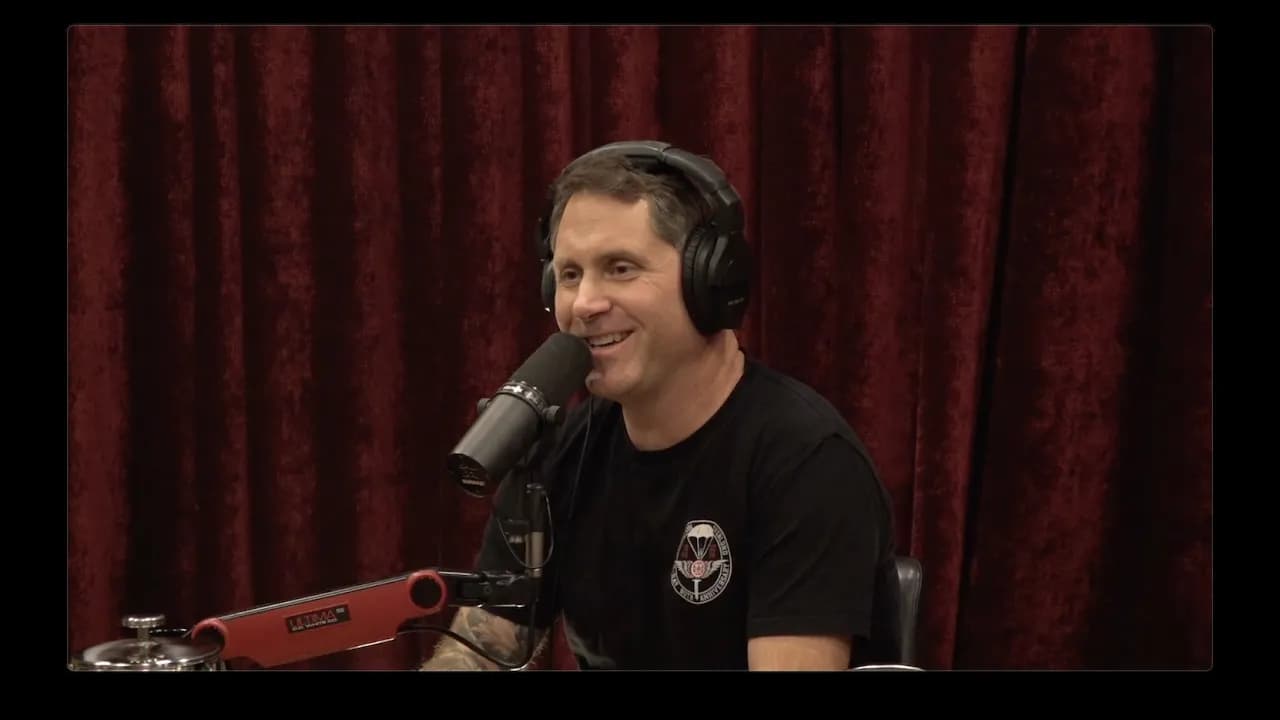
Joe Rogan Experience #2569 - Bill Thompson
In a Nutshell
Joe Rogan and Bill Thompson explore how hunting activates ancient neural circuitry for tribal survival, adrenaline management, and personal testing, while Thompson shares military-derived mental frameworks like STAB (Steady position, Trigger squeeze, Aiming, Breathing) and the Serenity Prayer to maintain focus under extreme pressure. They argue modern society lacks structured coming-of-age experiences, with hunting serving as an effective substitute that builds mental resilience through voluntary hardship and pressure management. The conversation extends to broader themes of unconscious wisdom, Jungian psychology, addiction patterns, and skepticism about AI sentience while predicting AI will democratize business creation and improve quality of life through reduced costs.
These notes were generated by AI and may contain inaccuracies.
Joe Rogan and Bill Thompson discuss the Tesla Roadster concept car that appears to fly over other vehicles. They confirm the footage is 100% real based on eyewitness accounts. The vehicle is described as a test model or concept car that likely won't reach general public release. Concerns about legality of flying cars over traffic are raised. People who paid $250,000 for the Roadster in 2017 received a completely different design than originally expected.
The new Roadster features Lamborghini-style doors and appears to incorporate flying capabilities. Thompson notes the design resembles a Lamborghini from the 1990s, specifically comparing it to a Countach. The original Roadster design is preferred by both speakers as it looked more like a modern supercar, while the new version is described as looking like "a Lamborghini had a baby with a Cybertruck."
Thompson references an existing race car technology using a fan underneath the car that creates suction to glue the vehicle to the ground. This car achieves insane lap times due to perfect handling and is a one-seater hypercar. The technology was first demonstrated on this type of vehicle, which can literally hold its entire body weight through suction alone.
Discussion covers vehicle weight considerations, with the McMurtry (or similar hypercar) estimated at close to 2,000 pounds. Carbon fiber construction is mentioned as a factor in weight reduction. Thompson compares this to lightweight Porsche restorations from the 1960s and 1970s that achieved weights under 2,000 pounds through extensive stripping and fiberglass panel replacements.
The concept that lighter cars provide the most visceral driving experience and connection to the road is discussed. Heavier vehicles can achieve greater performance numbers but lose the tactile feedback. Thompson's Tesla is estimated at 4,000 pounds, while the Cybertruck is described as even heavier due to its cold stamp steel construction.
Thompson ordered a Cybertruck but cancelled the order after hearing about issues and bugs being reported by early owners. He initially loved the distinctive look and found himself smiling every time he saw one. He mentions being a Ford owner with a Ford Tremor truck and ultimately decided against the Cybertruck purchase, though acknowledges later models may have resolved early issues.
The new Roadster is claimed to achieve 0-60 mph in under one second, with test results showing approximately 0.89 seconds. Top speed is stated as over 300 miles per hour, described as half the speed of sound. Thompson expresses concern about the physical effects of such extreme acceleration.
Thompson emphasizes that the feeling of driving matters more than raw speed for non-professional drivers. He recommends the Ford Mustang GT as the best value performance car, citing his sister's husband who raced Mustangs and converted a 1971 Mach 1 into an alcohol-fueled funny car. The visceral connection and mechanical engagement of driving are highlighted as the primary appeal.
Thompson describes military driving courses from his time in a high-risk officer pipeline program, including training with rally car instructors on trail turns, on-road and off-road navigation. Training scenarios included having a bag over the head removed at checkpoints where participants had to react to operational scenarios under pressure, including navigating serpentine courses in reverse while under simulated fire.
Key driving principles learned include: planting the left foot, standing up, steering backwards, and navigating serpentine courses in reverse. The importance of keeping tires in contact with the road, using brakes to frontload weight, drawing straight lines through courses, and minimizing steering input are emphasized. Over-steering and the Fast and Furious-style drifting techniques are explicitly discouraged.
Thompson draws parallels between driving, archery, and long-distance shooting, noting that the key to accuracy is often the opposite of initial instincts. In archery and shooting, pulling the trigger more slowly and allowing shots to surprise the shooter produces more accurate results than anticipated shots. The concept of "command trigger" shooting versus surprise release is discussed, with examples of top archers who successfully use both techniques.
The discussion covers how pressure affects performance across disciplines. Thompson argues that overcoming pressure isn't about specific techniques but about developing mental resilience through repeated exposure to high-pressure situations. He suggests that people who regularly deal with pressure can perform better across various domains.
Thompson mentions his company Spartan Forge and an archery competition where engineer Evan Freed defeated professional archer Levi Morgan in a company tournament. This is presented as evidence that mental factors and pressure management can override technical skill differences in specific moments.
The concept that rules and techniques are often invented by individuals to rationalize their own struggles is discussed. Thompson emphasizes that what works is determined by trying methods and observing results, rather than following prescribed rules. The example of Cam Haynes using a command shot technique successfully despite conventional wisdom favoring surprise releases is cited.
Thompson describes his practice of harvesting 2-3 does before pursuing bucks during whitetail season to maintain composure. He notes that even after 25 years of hunting, he still experiences adrenaline responses, particularly after releasing arrows. The discussion covers how professional hunters on YouTube can be observed shaking when drawing their bows despite decades of experience.
The speakers discuss how hunting taps into evolutionary wiring that rewards successful pursuit with endorphins and good feelings, as this historically meant survival and feeding one's family. Fishing is mentioned as another activity that triggers similar responses, with Thompson noting his daughter's excitement when catching her first fish at age five.
When people engage in mob behavior like smashing windows or destroying property, they are tapping into ancient tribal warfare circuitry. This behavior would be nearly impossible for an individual acting alone, but becomes natural when surrounded by a group experiencing the same heightened state. The chanting, marching, and screaming create a collective experience where violence emerges as people surrender to the tribal instinct that historically ensured survival through group conflict.
The same neural circuitry activated during mob violence is also engaged during hunting activities. Fishing provides a baseline excitement that gets multiplied significantly when hunting larger game like elk with archery equipment. The highs and lows experienced during elk hunting are described as being off the charts compared to other activities.
A 12-year-old public land whitetail buck in north central Pennsylvania, known locally as "the monarch," was estimated at 170 inches. The hunter had tracked this specific animal for three years and invested significant time pursuing it during the rut. Despite thermals initially working against the chosen hunting location, the hunter repositioned to the front of the mountain where thermals would be favorable.
The hunter was still on the ground when the buck appeared pushing a doe into a ditch. At 35 yards, the hunter achieved a double-lung shot on the monarch buck. The adrenaline response lasted approximately 25 minutes afterward, preventing the hunter from even calling for assistance to drag the animal. This reaction was attributed to the combination of three years of anticipation and the sudden realization of achieving a long-sought goal.
The hunter learned the acronym STAB (Steady position, Trigger squeeze, Aiming, Breathing) during military training. When at full draw, the hunter silently repeats this sequence to maintain focus and eliminate panic. The breathing technique involves taking a full breath and exhaling completely before the slow trigger pull. This systematic approach transforms potentially chaotic high-pressure moments into controlled, focused actions.
Joel Turner's methodology emphasizes closed-loop thinking during archery shots. An open-loop action, like swinging a baseball bat, cannot be stopped once initiated. A closed-loop action, like writing, allows stopping at any moment. The archery shot can become an open-loop problem when the archer loses control and flinches, resulting in significant accuracy loss. Turner's approach involves talking through the entire shot sequence to maintain closed-loop control and prevent the shot from getting away from the shooter.
Turner's background as a SWAT team member exposed him to hostage situations requiring precise shooting under extreme pressure. His understanding of psychology and mental processes in life-or-death scenarios informed his teaching methodology. The same mental discipline required for hostage rescue situations applies to archery performance under hunting pressure.
Many people experience anxiety attacks because their minds develop runaway thought patterns without developed strategies for intervention. The inability to recognize when thinking is becoming destructive prevents individuals from talking themselves down from escalating stress. Without personal methods for stopping mental escalation and achieving peace of mind, people remain vulnerable to stress responses when situations become difficult.
The serenity prayer learned from attending AA meetings with an alcoholic mother became a foundational coping mechanism: "God grant me the serenity to accept the things I cannot change, courage to change the things I can, and wisdom to know the difference." This framework enables focus only on controllable factors while releasing concern over uncontrollable outcomes. This approach proved particularly valuable during military operations in Iraq, Afghanistan, Philippines, and Africa, where the focus remained on actionable steps rather than overwhelming circumstances.
Modern lack of resilience stems partly from insufficient exposure to high-pressure situations that reveal character under stress. Without deliberately choosing difficult challenges, people become anxious about minor issues and lack the mental toughness developed through voluntary hardship. The internet amplifies consequences of failure, as confrontations that once remained private now become permanent public records.
A group hunting practice involves fasting for 2-4 days while hunting, with a locked cooler containing food that remains inaccessible until an animal is harvested. The wives hold the combination to the Yeti cooler, requiring photographic proof of a successful harvest before access is granted. This practice creates intense community bonding when someone finally succeeds, producing profound emotional responses to basic food access after extended fasting periods.
Hunting success activates ancient survival reward systems that provide deeper satisfaction than digital content consumption. The experience of shooting an elk at 60 yards and watching it fall represents a fundamentally different category of happiness - a body-level satisfaction built into human DNA rather than the temporary pleasure derived from Instagram videos or similar digital stimuli.
Annual trips to North Dakota to drive beet trucks during harvest provided completion satisfaction absent from software development work. The ability to point to three completed fields at the end of a day created a sense of accomplishment that technical work rarely provides, since software projects are never truly finished. Physical labor with clear endpoints serves as an effective anxiety management strategy.
The hunting application is designed to maximize bandwidth between user and information while minimizing interaction time. The goal is to provide necessary scouting information efficiently so users can focus on actual hunting rather than phone interaction. A thermal mapping feature under development allows users to model scent movement on mountainsides based on temperature, wind speed, canopy cover, and historical weather data, addressing a critical knowledge gap for both whitetail and elk hunters.
Morning thermals flow down mountains when air is cold, reversing as ground heats and air rises. Animals below a hunter will immediately detect scent carried downslope, necessitating approach from below to avoid detection. Studies demonstrate whitetail deer can detect scent from three-quarters of a mile away, highlighting the critical importance of understanding thermal dynamics for successful hunting approaches.
Hunting is far more complex than most people realize, especially for those who think it's easy. Both bow hunting and rifle hunting present significant challenges. Rifle hunting allows shots from 300 yards away, but it remains difficult due to vast territories and the sheer size of mountain landscapes. The comparison to boxing being slightly easier than MMA illustrates that both activities are genuinely hard, particularly when performed at a high level.
When Joe first started hunting in 2012 with Steve Vanella, he immediately recognized the depth of knowledge required. The activity involves layer upon layer of complexity that takes years to master. Even with success, much of it comes from working with excellent guides, handling pressure well, and maintaining physical fitness. Using a jiu-jitsu belt analogy, Joe estimates his skill level as a high purple belt or possibly brown belt, but acknowledges he is not at black belt level.
Hunting with Cam Haynes reveals how much more there is to learn. After 12 years of hunting together, Cam continues to teach new approaches and situational awareness every time they hunt. These insights include understanding animal behavior patterns, anticipating movements, and strategic positioning that only comes from making hunting the primary focus of one's life.
Around June each year, hunting begins to dominate Joe's thoughts despite other commitments. The anticipation builds as he watches leaves change while driving, constantly thinking about being in the trees during September. This mental preparation reflects the deep engagement required for serious hunting.
Using a thermal mapping model has revealed why deer use specific routes in mountain hunting spots. Wise whitetail bucks understand that thermals funnel from approximately 320 degrees into particular locations based on predominant wind patterns. This knowledge allows bucks to assess entire mountains before stepping foot on them, detecting hot does, hunters, or other significant factors through scent alone.
The goal of developing hunting-related technology is to encourage people to experience hunting directly. Hunting serves as an effective coming-of-age mechanism, particularly for young men aged 14-15, where the experience of killing and eating an animal together provides a transition into manhood. While this works for women as well, the focus on young men addresses the loss of traditional coming-of-age rites present in Native American tribes, Viking culture, and other societies throughout history.
Modern society has largely eliminated structured coming-of-age experiences, leading to problems where people remain untested throughout their lives. The military served this function for Joe, providing the testing and growth that many now lack. This absence contributes to the cloud of uncertainty many people carry, stemming from never truly understanding their capabilities or how to expand them.
Being tested reveals personal limitations and creates opportunities for growth. Through martial arts starting at age 15, Joe learned that pressure and difficult situations are beneficial rather than harmful. These experiences provide self-knowledge and demonstrate that challenges represent blessings rather than obstacles.
Plato, whose name meant "broad" or "broad shoulders" due to his wrestling ability, emphasized that going through life without understanding the full potential of the human body represents one of life's worst outcomes. This includes both understanding physical capabilities and recognizing how one behaves when under pressure.
Joe participated in a high-risk SERE (Survive, Evade, Resist, Escape) course lasting approximately 4-6 weeks. The training included picking handcuffs, escaping from trunks and houses, improvising firearms, and dressing small game. The course involved two weeks of specific skill training followed by operational scenarios where participants were pursued by professionals.
During the evasion phase, Joe covered 12-13 miles through the Appalachian Mountains while sleeping on the ground. After being placed in a trunk handcuffed and zip-tied, he had to defeat restraints and evade capture. The scenario included interactions with local authorities who were informed of the exercise.
On day three of evasion, after several days without eating, Joe encountered what appeared to be hikers on the Appalachian Trail. He had a brief conversation, watched them enter an open-faced cabin, and started a fire nearby. The next morning, no footprints, logs, or evidence of the people remained. During debriefing with a monitoring doctor, Joe learned this type of hallucination was common among participants due to dehydration, lack of food, stress, and sleep deprivation.
Ketone IQ provides the benefits of ketones without requiring fasting. The supplement delivers the same super fuel the body produces during fasting, supporting focus and mental clarity. Available at CVS nationwide with the first shot free.
Advanced beings with interstellar or interdimensional travel capabilities would likely possess technology to appear indistinguishable from humans. Simple perception manipulation would be trivial compared to gravity drives capable of instantaneous galaxy-to-galaxy transport. Human perception is already easily manipulated, as demonstrated by optical illusions like the Cornsweet illusion and the faces-vase illusion.
Dreams likely serve an evolutionary purpose beyond random neural firing. Memory consolidation occurs during specific sleep stages, which explains why sleep deprivation immediately affects memory. Dreams may provide access to millions of years of learned lessons stored in what Carl Jung termed the collective unconscious.
Intuitive feelings about people, such as immediately getting "the ick" from someone's presence, likely represent evolutionary heuristics developed over millions of years. These responses draw from ancestral experiences without conscious access to the underlying pattern recognition.
While researching chaos theory to impress his mathematician wife who attended Johns Hopkins, Joe discovered Jordan Peterson's early YouTube content about chaos and order. This led to extensive study of Carl Jung's work, including the collective unconscious and The Red Book, fundamentally changing his understanding of dreams and their significance.
Documenting dreams with a Jungian psychologist revealed consistent patterns where dreams addressed current life problems and suggested solutions. This evolutionary function allows access to accumulated wisdom beyond individual experience, whether interpreted as collective unconscious, divine communication, or transcendent reality.
The story of an innocent man sentenced to death who maintains a collection of disciples, teaches profound truths, dies and is reborn, and becomes a fisher of men represents the Christ narrative. However, this same story structure appears in The Shawshank Redemption, demonstrating how certain archetypal stories resonate across different media because they address fundamental human experiences of suffering, death, and rebirth.
Great art often emerges from the artist's compulsion to tell stories without fully understanding their deeper significance. The unconscious recognition of universal patterns explains why certain stories and media resonate strongly even when their deeper meaning remains unclear to the conscious mind.
Stephen King wrote some of his best books while heavily intoxicated. He does not remember writing Cujo at all. During the period from 1981 to 1985, while deeply dependent on alcohol and cocaine, he produced some of his strongest work including The Shining, Pet Sematary, and The Tommyknockers. King consumed alcohol, cocaine, Valium, Xanax, marijuana, and even mouthwash during this era. He has openly discussed in his book On Writing how he would stuff cotton swabs in his nose to stop cocaine-induced nosebleeds from dripping onto his typewriter.
The unconscious writing state allowed King to get out of his own way and tap into something deeper. Creative people frequently discuss this phenomenon of entering a zone where the work flows without conscious interference.
The hypnagogic state refers to being half-awake while sleep-deprived. Salvador Dali used this technique, and it has been employed by intelligent people throughout history. Sleep deprivation can induce strange visions and access to unconscious material.
The writers on NewsRadio would deliberately stay awake until 3:00 AM and write scripts until 6:00 or 7:00 AM. They would arrive at table reads still awake from the previous night. This sleep deprivation put them in a delirious state that produced hilarious, absurd scenarios and lines. They were purposely inducing this altered state without using drugs.
Diving into unconsciousness represents a heroic action. It involves going into the mud and the abyss to pull out something of value. This connects to the biblical phrase about becoming fishers of men, meaning diving into the water to retrieve something valuable that feeds others.
The classic hero story follows a pattern: the hero is defeated at the beginning, goes through a transformational period in an unsavory environment, and then returns to set order and make things right. Examples include Star Wars where the character trains in the swamp, and Thor: Ragnarok where Thor enters an upside-down world and must fight the Hulk.
Carl Jung proposed that dreams provide input and corrective measures, revealing which archetype a person is acting out. Once someone starts setting their life in order and acting like a better person, the need for dreams diminishes because the corrective feedback is no longer required.
Dreams serve as a balancing function for the conscious mind. If someone's waking mind is overly rigid, hyper-rational, or arrogant, dreams supply emotional, vulnerable, or contradictory imagery to restore equilibrium. Jung viewed dreams as spontaneous self-betrayal in symbolic form, showing where someone truly stands psychologically without ego filters.
The more someone becomes a whole person and engages in self-realization, the less utility dreams have, resulting in fewer dreams. However, when dreams do occur, they become denser with multiple problems stacked on top of each other.
A recent dream involved being on a train surrounded by rough, biker-looking men who mocked and challenged the dreamer. A woman appeared who initially refused to help, stating that the dreamer needed to learn the rules independently. When gunshots erupted, the dreamer protected her, after which she began explaining the train world.
The dreamer fought another man named Bill who had an old biker beard. After putting him in an Americana and compound fracturing his elbow, the woman explained that submission required acceptance from both parties. The fight continued with an arm bar that broke the opponent's other arm.
After getting off the train, the dreamer's wife expressed a desire to board it to test herself. The dreamer warned her against it, then woke up.
The train represented the legal system with its own language, direction, inertia, and gravity that cannot be controlled. The dream indicated that the dreamer needed to learn the justice system to be ready for the fight, and that the real opponent was not external but internal.
The anima represents a compensatory function for men. Men must first become hard, disagreeable, and capable of fighting and testing themselves before integrating feminine features. A grandfather figure must develop masculine traits before becoming emotionally available with grandchildren.
In the movie Logan, the character must integrate his anima, represented by a young female clone who initially cannot speak. As she integrates with Logan, she gains logos and begins speaking English. Only after this integration can Logan defeat his shadow self, the animalistic Wolverine who also cannot speak.
The movie follows a pattern where Logan travels from a chaotic desert wasteland north to a garden-like place, integrating parts of himself before being crucified by his shadow self, allowing a new integrated version to live freely in Canada.
Despite being engineering-minded and scientifically oriented, the value of unconscious material cannot be dismissed. Authors like Eric Neumann, Carl Jung, Sigmund Freud, and Alfred Adler wrote about the perseverance of the human soul under extraordinary circumstances, and their insights contributed to current understanding.
Dream states contain something undefinable and strange. While mapping the territory may be impossible, the material remains useful even if it cannot be fully explained or structured.
At age 16, a single mushroom experience led to an updating of the system and deeper self-understanding. Military service and security clearance requirements prevented further experimentation. Veterans who have used ayahuasca in South America have reported throwing away antidepressants and experiencing improvement afterward.
Psychedelic experiences follow the pattern of diving into unconsciousness and being judged by that world. Some people return better, some broken, and some overcook themselves.
Nicotine functions as a nootropic that focuses the world without producing a high feeling. It helps with thinking and zeroing in on problems. The user started with mint Skoal during long convoys in Iraq, then switched to nicotine pouches after gum damage occurred.
The user takes breaks from nicotine, switching to non-nicotine alternatives like On! for two to three weeks. Withdrawal is manageable without severe irritability, though some biological variation exists between individuals regarding addiction susceptibility.
Kratom comes from the Mitragyna speciosa leaf and acts as a stimulant similar to caffeine at low doses, while higher doses produce relaxation. It appears in drinks marketed as healthy options in juice shops and health food stores.
One user reported taking 10 capsules before workouts without issues, though this produced an opioid-like high that contradicted claims of sobriety. The substance has become widely available in convenience stores and gas stations.
Bill Thompson recounts confronting someone about their kratom use, recognizing it as a high that doesn't impair motor skills. He notes the substance allows normal activities like working out, cardio, weightlifting, and playing pool without the motor impairment typical of alcohol. Thompson warns that people recovering from opiates may not recognize kratom leads down the same addictive path, mentioning friends heavily addicted who consume six bottles daily.
Thompson describes coming from a family with significant addiction issues, noting he's the only family member not to go to jail or rehab. He reveals two sisters died from overdoses and a brother died by suicide. His sister Jenny passed away around four years ago, while his sister Heather, who shared his desire to leave North Dakota, became addicted to methamphetamines after stopping anti-depressants and eventually died by suicide at a rehab facility in Fort McMurray, Alberta.
Thompson criticizes the Canadian rehab facility that provided Heather with weekly meth doses as part of a harm reduction strategy. The facility's rationale was providing a clean, safe environment rather than having people use drugs on the streets. He questions this approach, asking why the goal isn't simply getting people off drugs entirely. Thompson notes this strategy appears in many cities, particularly on the West Coast and Pacific Northwest, where facilities provide drugs, money, clean needles, and crack pipes under the premise of safe access.
Thompson suggests addiction is a normal part of human behavior with evolutionary aspects, noting it allows people to become very focused on specific activities like hunting. However, this same pathway can manifest destructively through gambling, drugs, or alcohol. He shares the story of a world-class pool player who became addicted to pills after a car accident and died from overdose, noting that the same drive that made him great at pool led to his addiction.
Thompson describes how golf consumed him after someone told him he'd never be good at it due to being "too much of a gorilla." He reached a six handicap and shot par rounds, but once he achieved mastery and became better than most people, he lost interest and rarely plays now. He recognizes this pattern of becoming intensely focused on something until reaching a level of mastery, then moving on.
Thompson emphasizes that the most difficult part of learning is being a beginner, noting the benefit of realizing there's something you know nothing about and have enormous room to grow. Once something becomes familiar, improvement shifts from major discoveries to fine-tuning and slow incremental progress.
Thompson discusses bow hunting as an activity he hasn't exhausted, noting its appeal comes from the chaotic, variable nature where animals don't stand still at 20 yards. The process involves understanding thermals, sun position, animal bedding patterns, scrapes, wind direction, and avoiding scent detection. He describes his analytical approach versus his friend Johnny Stewart's instinctive "this looks good" pattern recognition method.
Thompson contrasts systematic and instinctive approaches across different disciplines, noting some people excel through detailed systems while others operate instinctively without being able to articulate their methods. He mentions George St-Pierre and Gordon Ryan as examples of high-level practitioners whose abilities exceed what can be taught or replicated even when explained.
Thompson discusses John Danaher's background as a philosophy PhD student at Columbia University who became a bouncer and then obsessed with Brazilian jiu-jitsu. Danaher arrived in the United States in 1991, started training at Renzo Gracie's academy, and became known for his systematic, first-principles approach to jiu-jitsu. He applies the Japanese concept of Kaizen - continuous improvement through never-ending cycles of refinement.
Thompson uses the Nissan GTR as an example of Kaizen in engineering, noting the car maintained the same basic design for over 20 years while being continuously refined. He applies this concept to mixed martial arts, observing the sport has evolved more in the last 33 years than in the previous 33,000 years since the UFC began in 1993. The Brazilian Gracie family was conducting vale tudo competitions in the 1940s and 1950s.
Thompson identifies the Stephan Bonnar vs. Forrest Griffin fight in The Ultimate Fighter finals on Spike TV as the watershed moment that changed martial arts forever, drawing millions of viewers and creating the modern MMA boom. He notes this single fight defined the growth of the sport in a way rarely seen in other athletic competitions.
Thompson discusses George St-Pierre moving up to middleweight around 2017, noting that GSP, who walked around at 190+ pounds and cut to 170, would be considered a large lightweight by today's standards. He mentions current welterweight contender Michael Morales, who weighs over 220 pounds, cuts to 170, and appears enormous in the octagon while remaining undefeated.
Grappling and shooting for takedowns represents one of the most energy-intensive aspects of MMA. Shooting on someone requires an explosion of energy, followed by grappling using technique and leverage against an opponent's strength, then hoisting their body up and slamming them to the ground. This can only be performed a limited number of times per fight.
Khabib Nurmagomedov demonstrated this limitation during one round against Conor McGregor at the White House fight, where he chose not to shoot for a takedown because he had burned significant energy in previous rounds. That round ended up being the one McGregor won, as Khabib recognized the need to let his body recover.
Morab stands out as extraordinary because he can maintain full blast grappling for all five rounds. His cardio should be studied in a laboratory as he is considered a real freak of nature. Very few people possess this ability, and he breaks world-class fighters like Umar Numov deep into the fifth round through his exceptional work output.
Justin Gaethje was described as having a real chance against Ilia Topuria due to his exceptional durability and experience in high-level competition. He has been through multiple trench wars, including battles with Dustin Poirier and Max Holloway, where he endured being beaten up for three rounds while exhausted, yet still had to persevere and press on.
Joe Rogan watched the White House fight from his cabin in North Dakota, which he rebuilt from the ground up. He was alone and extremely hyped watching the event, even turning away his son who came downstairs during the fight.
While in Vegas for the Patty Pimblett fight with GA, Rogan and his friend Tyler from Archery Country won approximately $1,000 playing three-card poker with a $100 starting stake. They decided to bet this money on Justin Gaethje against Patty Pimblett, who was the favorite at minus 238 odds. Rogan placed $500 and won approximately $1,500-$2,000.
For the Ilia Topuria fight, Rogan put his entire winnings back on Gaethje, who was again the underdog. This turned his initial $100 into approximately $6,000, which he used to rebuild his house, specifically paying for all the flooring upstairs with the winnings.
Rogan expressed being conflicted about gambling due to knowing many gambling addicts from his pool background. However, he argues that gambling, like alcohol consumption, comes down to personal control and recognizing what is detrimental versus positive for each individual.
He noted that gambling has been enjoyed since the beginning of time and that attempting to outlaw it would simply drive it underground. Many of his friends from the pool world are staunchly anti-gambling, but he refuses to condemn it outright.
The term "pool" originates from pooling money together to gamble on pocket billiards. Pool halls were historically gambling halls, with over a thousand such establishments in New York City alone at the turn of the 20th century.
In the 1940s, many veterans returning from war participated in a bachelor culture centered around pool halls, where men gathered to gamble, smoke, and engage in vice activities.
Three-cushion billiards is played on a table without pockets using three balls. The objective involves understanding geometry, force, and spin to contact one ball, hit three cushions, then contact the second ball, and finally return to the original ball. This differs from pocket billiards, which features six holes on the table.
Rogan witnessed his first heroin use at age 23-24 while playing pool. A world-class pool player nicknamed Buffalo Bill and Water Dog would shoot up in the bathroom, then return to play while completely zoned out on heroin for about 20 minutes before returning with massively dilated pupils.
This player competed on a difficult "gaff" table with tiny pockets (just shy of 4 inches) where he couldn't miss despite playing for $10,000 stakes. Another player, George the Greek, tried unsuccessfully to distract him by yelling about his heroin use.
Hard Times in Bellflower, California was considered the mecca of pool gambling. Filipino players would travel there, and it hosted big Sunday tournaments where anyone could participate. Rogan would regularly get destroyed by world-class players but continued attending to improve and watch high-level competition.
Years after their initial meeting in New York, Rogan encountered Water Dog at Hard Times. When Water Dog couldn't afford the $20-25 tournament entry fee, Rogan offered to pay. However, Water Dog needed a ride to obtain heroin first, which Rogan refused due to concerns about his Toyota Supra Turbo being confiscated.
Water Dog played sober in the tournament and performed poorly, appearing angry and unfocused, despite being skilled enough to potentially win the entire event.
Grant Fuhr, the Edmonton Oilers goaltender and Hockey Hall of Fame member, publicly admitted to cocaine use in 1990. He claimed the drug made the world appear slower and the puck seem like catching a beach ball, improving his goaltending performance. Rumors circulated about cocaine use among several members of the 1980s Edmonton Oilers dynasty.
Rogan lived in Plum Coulee, Manitoba for three years starting in second grade. Hockey was treated as religion, with "Hockey Night in Canada" being central to the culture. Despite his family's financial constraints, the community donated hockey gear, and the coach insisted he learn to play despite having no prior experience.
A hockey goalie discussed achieving an unconscious state for optimal performance, explaining that conscious brain activity interferes with reaction time. When having too much fun, smiling, and talking with teammates, he becomes a "conscious goalie" and gives up goals. He must maintain an unconscious state during games, only allowing himself to smile and enjoy the moment after the final buzzer.
Rogan compared this unconscious performance state to archery while bow hunting, where focus must be maintained during the process, but conscious awareness and appreciation comes afterward. He also experienced this flow state during military operations, where six months of intelligence gathering and planning culminated in operations with blood and treasure at stake.
During his military career, Rogan approached intelligence work with the mindset that the outcome of entire operations depended on his efforts. He would enter a flow state while watching operations unfold based on his intelligence work, experiencing the same addictive sense of completion he later sought to replicate in civilian life.
The framework includes four stages: unconscious incompetence, conscious incompetence, conscious competence, and unconscious competence. The progression moves from ignorance through awareness of skill gaps, to performing skills with effort, and finally achieving mastery where skills are executed effortlessly.
This cycle restarts with learning any new skill, which explains why people become addicted to learning new things. Beginning stages of learning difficult activities like bow hunting, jiu-jitsu, golf, or yoga provide significant mental benefits and prevent brain atrophy that occurs when people stop challenging themselves with new learning experiences.
When you get really good at something, you start to learn how much you don't know. It's like climbing a mountain only to discover it's a false summit and the real mountain is elsewhere. Dennis McKenna expressed this idea that as you expand the bonfire of knowledge, it highlights the surface area of ignorance. The more you learn and expand your understanding of the world, the more it reveals how much you don't know.
People who pretend they know it all are dangerous because they ignore this reality. As the bonfire of knowledge grows brighter, the more darkness is revealed to our startled eyes. This concept is attributed to Dennis McKenna, though sometimes credited to Terence McKenna.
The yin-yang approach involves keeping one foot in the competence of what you've learned and another foot in the unconscious incompetence of what you don't know. As you begin to learn these things, you almost become ashamed when you see how great you can be in certain areas.
Bill Thompson's grandmother taught him to be good for goodness sakes. As a kid he dismissed it, but in adulthood he tries to be good for no reward in itself. He now tries to do things with no expectation that the person will ever know who did it, hoping they'll walk around believing there are angels or good people in the world.
He used to do generous acts because they made him feel good, but now recognizes there's something self-centered about that motivation. The principle is to do good without inflating your ego or telling people about it.
There's knowledge within us that we don't know we've been given, possibly through genetics or soul transmission. A Chinese student conducted an experiment with moths in the caterpillar stage using a lavender scent. When the caterpillars encountered the scent, they experienced an uncomfortable vibration and avoided it. Through the transformation to moths, this knowledge was retained, and the memory was transmitted to their offspring through epigenetics.
B.F. Skinner conducted similar experiments with rats using mazes and the smell of cats. This relates to Rupert Sheldrake's work on morphic resonance, where teaching rats on the east coast to navigate a maze enables rats on the west coast to navigate it faster.
There's a framing problem with how we perceive knowledge and information. The Greeks would say the spirit of war, not meaning a physical entity but a persistent thing across all classes of humans that rules us. It's a god because it has us rather than us having it.
This connects to mob mentality and protests - the spirit that emerges in collective behavior. There's no distinction between God, the collective unconscious, or transcendent reality. It's an abyss of unknowing that we occasionally tap into and pull something out of.
Regarding the JD Vance interview, there was a mismatch in conceptualizing demons versus aliens, though both might be discussing the same thing using different lexicons. The purpose of questioning was that Vance was signaling to certain religious voters.
Long-form podcasts like this one allow people to reveal themselves over three hours in ways that short media appearances don't. Even if someone has been told not to discuss certain topics, extended conversation inevitably reveals their true nature. This is why it's valuable to have political figures like Bernie Sanders, JD Vance, Trump, and Kamala Harris on the podcast.
When someone running for high office won't sit for a long conversation about their principles and how they metabolize the world, they should be dismissed because they're not revealing themselves and are likely promoting a constructed image. This differs from Fox News appearances where candidates can read talking points for 15 minutes.
The instinct against platforming people is incorrect - if you don't like someone, you should want them platformed. Trump's interview was valuable because it showed him communicating in a non-combative situation, unlike typical media where he's either praised or taken out of context.
Trump has the ability to sum people up quickly and has remarkable comedic timing. However, there are disagreements about his approach, and it's clear that presidents don't have ultimate power - which is by design, given the checks and balances of Congress and the Senate.
Gavin Newsom is unlikely to be a presidential candidate due to being too much of a liability and too tainted in the public eye. The Democratic Party will likely choose someone less controversial.
Social media is infested with bots and completely fake stories. People make their living from engagement on platforms like X (formerly Twitter). There's enormous funding behind bot operations, with billions of dollars involved in ways that would surprise people.
Organized propaganda campaigns funded by foreign countries, intelligence agencies, or corporations should be illegal. These create the appearance of lockstep public opinion on social issues that manipulates cultural views. Individuals should only be allowed to post their own opinions, not participate in coordinated campaigns.
Social media platforms can feed users narratives that align with their existing beliefs, showing only the 10% of a politician's positions they agree with while hiding the 90% they might disagree with. Most people don't pull these threads themselves because they're busy with work and family.
This creates dangerous echo chambers where people are constantly bombarded with one-sided opinions. None of us are immune to our algorithms, and it's the best time in history for propaganda to manipulate society.
One approach to managing information overload is only looking at things that other people send rather than actively seeking content. The constant stream of negative information is a time and attention suck that wastes precious energy.
Attention and energy can be thought of as units - if you have 100 units per day and spend 30 on nonsense, you've wasted 30 precious units. Time is the only thing we can't make more of, making it essential to use time wisely.
Gambling is avoided partly because it represents throwing away time that can't be recovered. Personal time is valued at approximately $100 per hour, making financial decisions about time investments significant.
There are days intentionally set aside for doing nothing when burnt out, watching YouTube documentaries or being entertained. Time passes remarkably quickly during these periods, with five hours feeling like moments.
AI is going to transform society unlike anything that's ever happened before. Jobs are going to be eliminated on a massive scale within 10 years maximum, making the world unrecognizable.
Not all jobs will be eliminated - creative endeavors will always exist because humans need human connection. Live sports, live music, and live comedy will continue. Going to movies represents a community experience that's valuable, though comedy movies have declined in quality.
The closest thing to the 1996 comedy club experience is attending live comedy shows where people laugh together with strangers.
Comedy clubs represent one of the closest experiences to 1996 that exists today. The format requires locking phones away upon entry, eliminating concerns about recordings. People can speak freely on stage without worry, creating an environment where audience members aren't scrolling through phones during the show.
The contrast between genuine social experiences and modern technology usage is stark. Watching couples at dinner both scrolling their phones exemplifies the disconnection created by constant digital engagement. Comedy clubs provide an alternative where the focus remains entirely on shit-talking, fun, and being present with friends.
The highest-grossing films of 2019-2020 were highly digitized productions like Avengers Endgame and Avengers Infinity War, which featured extensive CGI and green screen work. These films generated over a billion dollars. However, the most successful movie per dollar spent in the most recent year was Obsession, created by a YouTube creator who was working from his basement just a few years earlier.
People are developing fatigue with highly stylized AI-generated content and will increasingly seek genuine human interaction. Regional theater houses, such as the Nutcracker performed at Christmas time at the National Theater in DC, represent the type of authentic experiences that will grow in popularity.
AI will simplify business formation by reducing the current $30,000 to $100,000 in costs associated with navigating government red tape and regulations. This will enable more people to start creative ventures like regional theater houses and craft businesses. The deflationary effect of AI will make production cheaper, with examples like Amazon potentially selling coffee tables for $1-3.
Lower income individuals living on $10,000 per year will experience significantly improved quality of life due to cheaper goods and services. People will increasingly value handmade items over mass-produced AI-generated products, similar to how wealthy individuals currently collect classic cars and handmade furniture.
In ten years, social outings may commonly involve attending regional theater productions like Hamlet rather than consuming AI-generated content. This trend will begin with higher-income individuals but will expand as more theater houses and creative businesses emerge due to reduced barriers to entry.
The optimal implementation of AI involves local, open-weighted systems that users own and control. Personal GPUs could handle training and processing locally in basements, keeping all data private rather than sending it to companies like OpenAI. This approach would allow AI to manage mundane tasks like bills and banking without external data sharing.
AI will enable people across income levels to afford quality goods and services. Those with limited economic output will still be able to live well due to reduced costs. The technology will serve as a utility similar to a water heater - essential infrastructure that operates locally without requiring corporate intermediation.
Current AI systems show no clear path toward achieving sentience. This represents a significant consideration in discussions about AI development and its long-term implications for humanity.
Spartan Forge has released two Hunt Plus updates featuring extensive UI and UX improvements along with numerous new features. The company is preparing to release thermal imaging capabilities and has implemented CarPlay integration. Growth has been substantial across multiple feature areas.
A film called "Old Soul" was produced featuring an engineer at the company who is also a gunsmith. Additional films are planned, including one about a family cabin that will involve veterans and fundraising efforts. All content is being produced for the Spartan Forge YouTube channel, with plans for a coffee table book documenting these projects.
Hoy, VPA Archery, and Azio Camo are sponsoring the film productions. VPA broadheads are noted for their exceptional performance, capable of double shoulder blade penetration on both does and bucks. The broader mission focuses on reminding hunters that the practice centers on food, tribe, and shared heritage rather than blood lust or trophy hunting.
Hunting represents engagement with fundamental human circuitry that connects people to their roots. The emphasis remains on practical outcomes like providing backstrap for family meals, with deer meat serving as a primary protein source until supplies are depleted. This represents a coming-of-age tradition that transcends mere sport or conquest.
Keep PowerfulJRE in your library
Save the videos and channels worth coming back to, and find them again in one place.