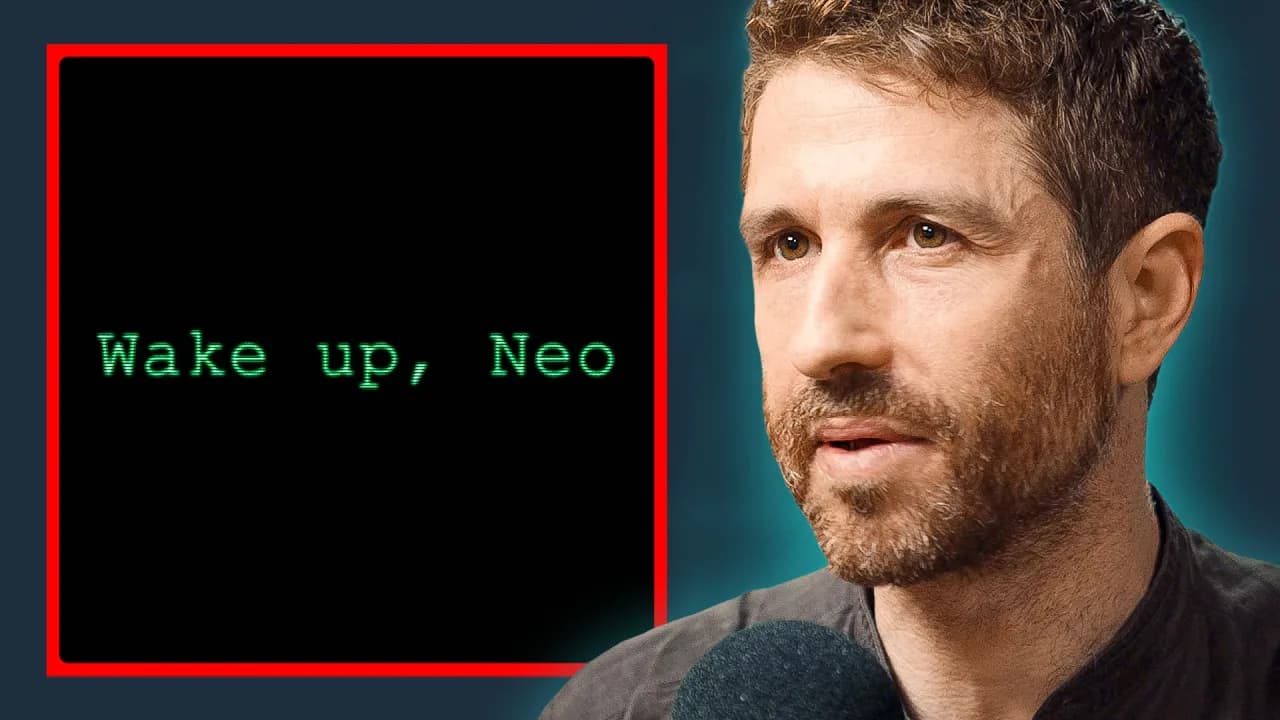
It's all over in 2 years
In a Nutshell
AI's super-exponential growth, fueled by massive data center investments rivaling the Apollo program, will render human intellectual contributions obsolete within 1-2 years, ushering in cognitive hyperabundance, AGI/ASI, and the end of compulsory labor amid converging debt cycles and the fourth industrial revolution. While non-automatable human creativity (e.g., an astronomical number of possible novels, exceeding 10^100) persists, rigorous fields like math, physics, and programming will be dominated by AI, marking the speaker's post-labor economics work as a potential final contribution. Society faces a great unraveling of norms, increasing weirdness, and rapid reinvention driven by the US-China AI race, evoking vesperence turning to extinction rage and childhood dread.
These notes were generated by AI and may contain inaccuracies.
We may be working on our final contribution. I had the visceral realization that I will be intellectually useless within a year or two. AI is on a super exponential growth curve by any reasonable accounting. Investment in AI is going up exponentially for the largest industrial buildout in human history. That is not hyperbole. The data center buildout already rivals the Apollo program, the Manhattan project, and Interstate Highway buildout, and it's only accelerating from here. Combine that with the exponential improvement of GPU hardware and model performance, and this ends in only one possible condition: cognitive hyperabundance. Call it AGI or ASI or whatever you want to call it. The material reality is that your brain and my brain will be unable to contribute in many ways.
A couple years ago, someone on Reddit coined the term vesperence, which means the wistful nostalgia for the now as you experience the ending of an era. That was sweet and romantic. I have also personally written extensively about how things will change. But it's one thing to intellectually know a truth and another entirely to feel that same truth in your bones. Here's an example. I've often told my audience for a few years now, it's going to get much worse before it gets better. I've read books like The Fourth Turning and Ray Dalio's Principles for a Changing World Order, where he studies long-term debt cycles. Both of those cycles are coming to fruition at the ramp up of the fourth industrial revolution. Every turning, every debt cycle, and every industrial revolution in history has reshaped society, often painfully. But now we're living through all three converging at once. The threats we're facing are not just financial or political. We understand recessions and job shocks. That's not new. But what is new to us is the disorientation that comes from the upending of every norm and every rule that the world is supposed to follow: go to school, get a job, buy a house, get married, have children, work, and then retire. That's a norm and it's already ending.
What has changed for me in the last few weeks is that the sensation of vesperence has shifted to something darker, like the icy ball in your chest just before the roller coaster drops. I've been sanguine about the future for most of my life, and I still am. I understand from history's perspective that technology pushes humanity through phase changes. I can't imagine what living in a world where almost everyone was a farmer was like and how disorienting it would have been to live through that change from rural to urban. Likewise, in a hundred years, people will probably look at white collar office work the way that we today look at serfdom.
Grandpa, is it true that you worked for 10 hours a day in an office just to make someone else richer and then they could fire you at any time and your healthcare was dependent on that? Isn't that like Stockholm syndrome? You are being held hostage.
There's a tension building in me and I suspect it's building in others. It's the extinction rage of being so thoroughly done with something that you just want to flip the table, smash things, and never look at it again. We as a society are so thoroughly finished with work that we're all burning out and checking out. Let's get it over with already. But the requisite ingredient for ending precarity for all time and compulsory labor for all time is automation that is capable of obviating the need for human input. And we are homo sapiens, the thinking man. I am a knowledge worker and a problem solver. Even today, AI already does most of the heavy lifting for all of my intellectual work. It takes very little imagination to conceive of what happens next. The value of my intellectual contribution drops to zero. There will be no problems for which I am better suited to solve than the machines we are building and using. Sure, we can cope with platitudes like yes, but you still get to choose which problems to solve or there's no replacement for human taste. And those are indeed copes. I've written at length about the macroeconomic reality we are facing. But the subjective reality is somewhat different. When machines are better, faster, cheaper, and safer than humans, your ability to contribute drops precipitously.
I do need to dial back the melancholy a bit. Yes, AI will soon render my problem-solving abilities moot, but there are dimensions of humanity that simply cannot be automated, and it is mathematically provable. I've done this calculation many times. How many good novels are possible to write? I won't bore you to death with the math, but the number of viable novels in English alone is absurdly astronomical. The number usually falls somewhere between 10^100 and 10^150,000 novels are possible to write depending on how you estimate it. For reference, there are only 10^80 atoms in the entire universe. And even if we turned the entire cosmos into computronium, we could only ever generate and record an infinitesimal fraction of all possible novels. And that's just novels, not poetry, film, paintings, or philosophy. This means that as a science fiction author, I will have plenty to do until the heat death of existence. Social commentary, embodied experiences, celebrity gossip, political wrangling, all of these things will stick around as long as humans are humans. And that makes me feel a little bit better.
But my work on things like post-labor economics are likely to be my final contribution to humanity, at least in terms of anything rigorous or scientific. AI models are already surpassing most mathematicians in terms of insightful intuitions. Physics and chemistry are next. The most effective computer programmers today are the 100x engineers who mostly just use AI to leverage their intuition and produce code faster. But as a former automation engineer, if all you're doing is driving the machine, it's a relatively small step before the machine is driving itself. Just last night at the time of writing, I was telling my wife that I am grateful at least to have the opportunity to be here at the beginning of this singularity or fourth industrial revolution where I have the chance to make one final contribution. If my work on post-labor economics pans out, it could meaningfully impact every single human from now on. And that's something to be proud of. And even if my work amounts to nothing, at least I had a shot at making a difference on such a scale.
But what comes next, I think, is a major contraction. Our minds and bodies evolved for hyperlocal geometries and social networks. Dunbar's number puts our maximum tribe at 150 to 250 individuals. It's exhausting to think about humanity as a whole, but the internet has shrunk the world, and I believe that AI is about to shrink it even more, though not in a way that necessarily expands our individual impact.
This part is the hardest to articulate. The world is getting weirder by the day. Like the famous interview with Terence McKenna back in the 90s, things are just going to get weirder and weirder and weirder until you don't really know what's going on. The great unraveling is underway. And once all the chips are down, we're going to be rebuilding from scratch. Just like how society reinvented itself during industrialization, we are going to be forced to reinvent ourselves very soon. My fear is that it will be faster and harder than any previous disruption. We are charting entirely new territory.
The feeling I'm left with is like when you're a little kid going to the doctor. The existential dread of getting poked and prodded and getting all your vaccine boosters. It's infantile, I know. But I have that same yearning for it to just be over, to be on the other side of it all. And I don't think it's an accident that the emotional flashback is to that of childhood. We are all powerless over the global currents that are pulling us along. I can no more influence the US and China race for AI dominance than I can stop the wind and tides. At the highest order, that singular competition is going to drive everything for the foreseeable future. And it is going to dramatically reshape every life on Earth. All we can do is hold on tight and do the best we can to steer.
Keep David Shapiro in your library
Save the videos and channels worth coming back to, and find them again in one place.