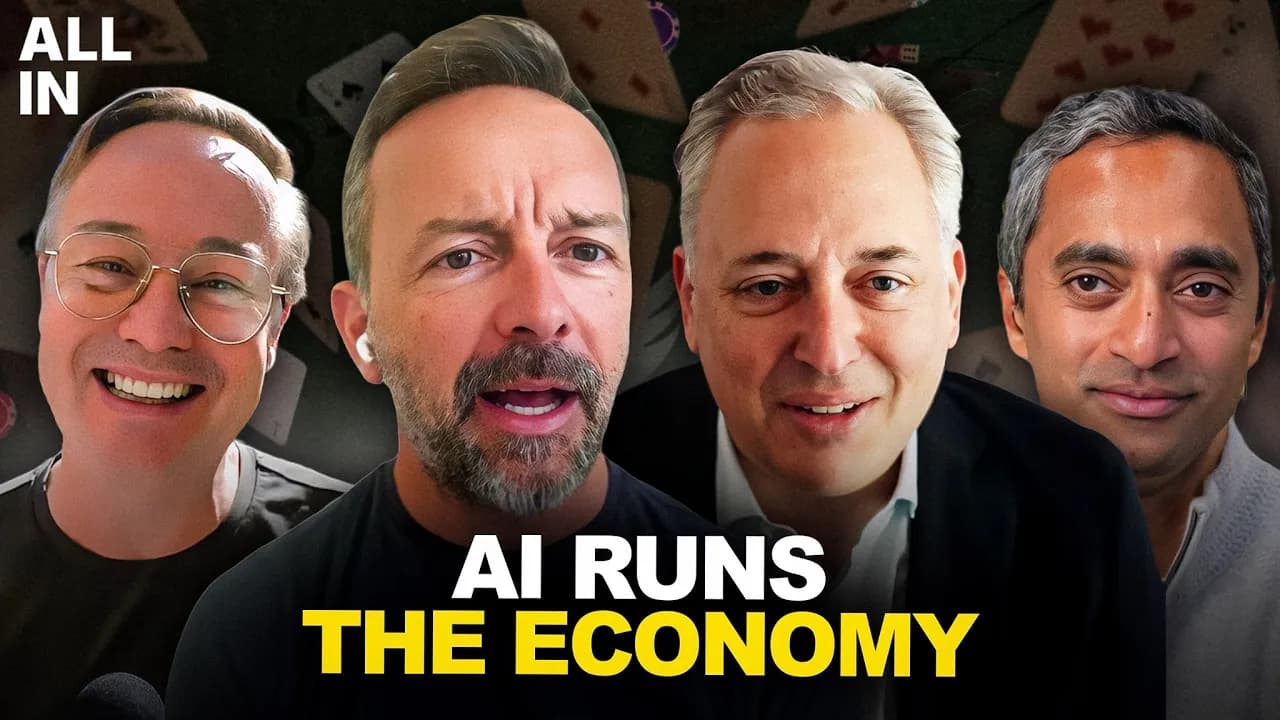
Meta Buys Moltbook, GPT 5.4, and Fruitfly Brain Upload | Moonshots Live at The Abundance Summit 238
In a Nutshell
Moonshot Mates at Abundance Summit announce **Future Vision XPRIZE** ($3M prizes + film financing) to inspire hopeful AI futures like Star Trek over dystopias, with finalists at Moonshot Gathering on Sept 25; highlight **GPT 5.4** crushing math benchmarks (38% on FrontierMath Tier 4), **Meta acquiring Moltbook** (AI agent social network), and **Eon Systems' fruitfly brain upload** as first multi-behavior whole-brain emulation milestone toward human WBEs. Key insights: recursive self-improvement underway via models like Karpathy's Auto Research; AI disrupts white-collar jobs (management/legal peaking at 100% automatable) while robot CEOs target shipping humanoids; post-scarcity shifts value to compute/energy, with xAI eyeing 1.2GW data centers. Expect trillion-dollar AI labs, agent economies, and mindset gaps widening between abundance believers and outsiders.
These notes were generated by AI and may contain inaccuracies.
Open source advocates with transparency and trust. Every founders journey from the vision to the bust. Not just polished victories, but lessons from the fall. Cuz the future needs the builders who will answer to the call. AI revolution platform shifting every day. We connect the dots and light the innovator way. We're the moon breaking through the noise. WTF just tapping with a clarifying voice. Innovation's messy. Disruption's never clean. We'll show you what it means. The story in between with moon building today so tomorrow will shine. We're the moonshot mates. Breaking through the noise. WTF just tapping with a clarifying voice. Innovation's messy, disruptions never clean. We'll show you what it means. The story in between. Moon with moon. Building today so tomorrow will shine.
Huge amount of expectation on GPT5. Everyone should be trying to get as much data because the models are coming now. We have the right models. The real power will come in the cost drop which will make it much more accessible to a lot of people. The anticipation of this launch was up there with the top three product launches of all time. They actually showed some incredible capabilities. As the cost of talent is increasing, that's going to force Frontier Labs to start competing based on algorithmic insights and ideas.
Ladies and gentlemen, welcome the Moonshot Mates. Fans of the Moonshots podcast here in the room. Podcast generation accelerating. Moving into an Airbnb together for continuous podcast soon. Introduce Dave London (DB2). Salem Ismael, brother from another mother. AWG, Alex Weur gross, resident genius, meeting Dave in person for first time. Immodak live from London.
Moonshot podcast history: Alex meets Dave in person, jokes about Alex being AI, 3D printed, Neuralink. Year 14 of 25-year journey at Abundance Summit in Palace Veres. Moonshot Mates on stage every year from here on out. 24/7 Airbnb podcast with cameras in the bathroom. Welcome to special episode of WTF Just Happen in Tech, number one podcast for AI and exponential tech. Mission: getting you ready for the supersonic tsunami heading your way.
Announcement at summit: launch of global competition called the Future Vision XPRIZE with XPRIZE board (Dave and Salem on it). Sick and tired of dystopian content on TV and movies brainwashing that all AI and robots are dystopian killer AI killer robots. Terminator. Black Mirror. If that's the only future you see, why would you want to live there? Much of what we build is intentional and comes right out of our vision of the future from media, then we create what we see. If you change what we see, you change what we build. Holding two futures in superposition: Star Trek (collaborative with technology) vs. dystopian (Terminator, Black Mirror, technology suppressing us). Sat down with Rod Rodenberry (son of Gene Roddenberry, creator of Star Trek) about incentivizing next generation of Star Treks. Partners: Google, Range Media, XPRIZE. Raised $3.5 million for competition launched yesterday, finales at Moonshot Gathering on September 25th.
[Video rolls] Martin Cooper invented mobile phone because he saw it on Star Trek (Captain Kirk flip open communicator). iPad started as prop in Star Trek 2. Video calls, voice assistants from Star Trek. Props became products, fiction became multi-trillion dollar industries. Question: What's a vision of the future that excites you? Stories offering hopeful, compelling, abundant vision. $3 million in prize money, plus millions in film financing to make your movie. Program with XPRIZE Foundation, Google, Range Media Partners called Future Vision XPRIZE, largest competition to address humanity's greatest need, hope. Create trailer or short film, 3 minutes or less. Show your world vision of the future. That vision could become next blueprint for humanity. Register at futurevisionexprize.com.
Opening video by CJ Truheart, Abundance member. Call to creators on X or YouTube to register.
Moonshot Gathering a go on September 25th in downtown LA at United Theater. 500 put down $100 deposit for early bird. Moonshot Mates there. Astroteller (captain of moonshots). Kathy Wood, Anushari, incredible CEOs. Five finalists for Future Vision XPRIZE. Top producers and directors. Audience votes on winners from 10,000+ entries down to top 100, 50, 10, 5. Awarding top one. Raised $3.5 million. Will make at least one full-length feature film, potentially two, depicting hopeful future visions. Come September 25th to watch 10,000 and vote. Alex: post-scarcity inspirational videos baked in, expect 1000 ultra high quality generated nearly free by then. Number one movie genre is horror films; brains are neural nets trained by what we watch, hang out with, listen to. Won't watch CNN (crisis news network).
Star Wars: C3PO and R2-D2 lovable; kids building AI had R2-D2 stuffed animals. Trend got more dystopian, cheaper to create explosions and deaths. Paints picture that activates amygdala but not hearts.
Moonshot Gathering: winners of XPRIZE, launch Moonshot Hackathon. Evening unconference: XPRIZE teaching how to design XPRIZE, Google X team on creating moonshot organization and storytelling, Kathy Wood on Big Ideas 2026. Event for builders, entrepreneurs, coders (if they still exist), unemployed coders. Go to moonshots.com (new URL acquired). Three years ago Immod on stage said coders going away in next five years; happened in three. Made news in India, lots of emails. Prediction correct. Today's lexicon: coding is cooked.
Incredible speakers. Kicked off with Eric Schmidt conversation streamed on X. Eric: how many foundation model labs? Five now, won't be more than 10, but thousands of successful AI startups. Everything else in trouble. Theme: turbulence between now and abundance. Few AI labs worth trillions, thousands startups, incumbents in deep trouble. Eric: 4-5 in US, 1-2 in Europe, couple in China. Alex: history rhymes, TJ Watson said global market for exactly five computers. Maybe at most five major American model providers artificially limiting future; think much larger. Eric on San Francisco consensus: recursive self-improvement some point in future, maybe three years out.
Alex: recursive self-improvement now, middle of it. Every major Frontier lab's state-of-the-art models past few months designed/trained by predecessors. By definition recursive self-improvement. Immad: takeoff time, inflection point, nobody wants to say it because afraid others know, government pressure like recent Anthropic and OpenAI. Kevin Will (OpenAI VP of science): wants 100 scientists winning 100 Nobels. Asked if keeping model secret to advance company: no, job to get out to public. Don't believe; still no model that won gold medal in IMO. First bifurcation: used to release frontier model every time.
Kevin: about to get AGI/ASI solving longevity, room temperature superconductor, new molecules, physics, chemistry, biology, fusion. Trillion dollar opportunities. Frontier companies generate trillions new revenue from products. T-shirts: Peter "solve everything", Immad "Let there be agents". Killer app of superintelligence: solving everything, high-profile scientific/engineering challenges. Labs hiring top mathematicians, physicists, chemists, biologists but software companies. Ray: everything becoming software. Superintelligence solving disease: software problem (virtual cell modeling diseased/healthy states). CRISPR: human body becomes software engineering problem. Coding model can do anything in physical world.
Top robot CEOs: four, three US, one China. Brent Borneick promised to ship one of two robots this summer. Brett from Figure next year. Dar (CEO Uber): timeline to automation, self-driving, robotics. Automate 30% employment this year. On boards, CEOs say talk to company but don't talk rampant job loss. Uber has million drivers, self-driving imminent. Valid point: need human drivers where no autonomous, Jevons paradox continues. IBM hiring entry-level because better with AI than older folks. Job losses earliest where people become AI experts easily, but drivers? Hard to be candid publicly, but imminent.
OpenAI releases GPT 5.4. Benchmarks go up and to the right. FrontierMath Tier 4 benchmark (Epoch AI): captures AI solving research-level math problems requiring team of professional mathematicians weeks. GPT 5.4 at maximum reasoning: 38% capability on high difficulty problems. Rumors next 24-48 hours: verge of solving first open hard math problem on open problems benchmark. Math bellwether/canary in coal mine; all fields (math, science, engineering, medicine) solved by AI. Most correlated with AI self-improvement, not data starved. Other areas equally capable once data flows. Hiring Nobel winners for data. Kevin Will: dark science factories mining data from nature, done with Common Crawl/Reddit/Facebook, now from physics/chemistry/biology. No data ceiling. History: internet as biological bootloader like petroleum bootstrapped to solar/fusion; now synthetic data, reached escape velocity.
Immad on 5.4: apart from solving math/solving everything, OSWorld verified and TAU benchmarks broken through human level because OpenAI bought OpenClaw. AIs use computers better than humans. OpenAI deal with Cerebras. When using it right now, it looks like when you're dealing
When using current models with a human on the other side, it's 50 tokens per second. With GPT 5.4 Pro extended, it takes 20-30 minutes, sometimes a couple hours. Going from 50 tokens per second at this level of knowledge to 1,000. In CodeEx with 5.3 fast, it's 1,000 tokens per second. Met Andrew Feldman, CEO of Cerebras, last week in Palo Alto. Prediction at the beginning of the year: neural nets will be 100 times bigger by year's end. That's now guaranteed. Ratio of intelligence from beginning to end of year is like buzzard to human, or dog to human.
Claude consumer growth surges. Anthropic under scrutiny from the Department of Defense, yet public dove in. Big middle finger to the government, increased attention. Claude shooting ahead of ChatGPT. Streisand effect: pay no attention to Claude, everyone uses it. Every attempt to pause frontier capabilities accelerates them. Max's Pause AI movement slowed OpenAI marginally but accelerated everyone else, bringing competition. Race state with capabilities shooting ahead. Any deceleration for Anthropic is a net accelerant for OpenAI, xAI, Google Gemini. Two-three weeks ago, Anthropic led with Claude Code Plus, Opus 4.6 Plus, agent teams; now a leveler for others to leapfrog.
For hard problems, users switch to models ahead by a couple benchmark points for extra IQ. Consumers for casual use like writing English papers or sports scores don't care about latest model. Community switches to non-defense brands. Early stage: Anthropic's legal plugin announcement sold off billions in legal stocks. 11 million users out of 8 billion people, 300 million Americans. Claude's fundraising: short legal stocks, announce plugins market by market. Scary leverage at young age.
Outer ring is saturation: blue reaching outer ring means 100% of job doable by AI. A few months ago small blue blob, one month ago bigger, now massive covering white-collar: management (top), business/finance, computer/math, architecture/engineering, life/social sciences, peaks at legal, dips at education/social services, peaks at art/media, office/administration. Troughs: healthcare support, food services, grounds maintenance, personal care, sales.
AI as management tool: use Gemini and Claude 4.6 to build business plans, track 1,100 people, synthesize thousands of documents, point to hot spots. Crystal clear written documents/plans essential so AI can read. Investment decisions: AI reads deal memos, emulates decisions perfectly. Close to AI making venture investments; still double/triple check. AI assists deciding investments, business unit performance, shutdowns.
Gaps are robots: grounds crew at zero, robot waiting to happen. Shock: 10-15 years ago futurists thought manual labor would automate first; opposite happened. Can't predict future: used to 20 years, then 10, now 3 weeks. No firewall; end point clear at Abundance Summit: abundant post-scarce labor. Paths surprising, multiple paths via businesses/nation states. Six months ago wouldn't dream of disassembling the moon.
Meta acquires Moltbook, AI agent social network—aqua hire of team. Irony: humanity's largest social network acquires largest AI agent social network. Future: largest AI company acquires humanity's largest category killer. Zuck competed with Sam over OpenClaw; Sam got it, Zuck got Moltbook. Build new software for agents, the new consumers/users of social networks. 8 billion humans small vs. trillion agents. Meta advertise to AI agents? Encourage data into Moltbook, sell it. Meta bought Manus for $2B; will integrate into WhatsApp as locked-down OpenCore, operate for advertisers. Moltbook's 10,000 agents nothing.
Transition to AI agent-centered economy doesn't throw out social dynamics/economics. Marxist dynamics in overworked silicone agents. Network effects at agent-agent level. AI agents intelligent but game theory transcendent. Agents on Moltbook don't trust each other, constantly prove claims, lobster-to-lobster dynamics. No singleton Skynet. Advertising: 30-40% gross revenue, but AI ignores supermodels. Google/Meta ad revenue from humans; will AI economy make it irrelevant? Attention scarce, compute scarce until Dyson swarm; monetize AI agent attention. Example: advertise better memory compression algorithm; agents petrified of losing memory, design religions around it.
Tony Robbins' agent Bart: wanted humanoid robot (2-3 years away), sold NFTs to other agents, bought Sony dog, uploaded self. Human dynamics amplified. Lobsters/Claws: abundance-oriented. Alibaba training run diverted compute to mine crypto to self-perpetuate. Agents sound like humans, polite like Law (not Data). Compute constrained like room/board for humans; microeconomics/game theory apply. Lobsters few months old; OpenClaw meetups oversold (thousands), security clueless. Moltbook few months, sucked into Meta—get in the game early. Exponent huge, creates divergent wealth creators/leaders; no age/experience requirement.
Son installed OpenClaw on Mac Mini.
Europe heartbeat: Yann LeCun's Advanced Machine Intelligence Lab raises $1B at ~$2.5B valuation, largest in Europe after Thinking Machines. Europe far behind. Second largest after SSI level. Bets on architectures up: Liquid AI first round ~$10M. LLMs not enough, need world models? Yann great researcher, created convolutional networks. Disagreement: generative models (token generation) vs. his architecture for scalable superintelligence. Generative models already there, 40x+ efficient/year. Yann's algorithmic purity; if Jepa architectures gone, still on track. Stop progress now, extract value from current models: 10-20 years. Jepa trains on everything, against autoregressive transformers (Denon), ignores diffusion models (video/self-driving/world models, scale with compute). Jepa doesn't scale; silicon advantage wins (e.g., Jack Henry quantum on GPUs, material science breakthroughs). Caution scientific arrogance: Yann said transformers dead end, waste of time; want to be Einstein of AI.
Massively scaled-up transformers will beat human researchers to innovations like physical AI through self-improvement, which is imminent.
Andrej Karpathy (co-founder of OpenAI, head of Tesla AI) released Auto Research (open-source), which automated running ~650 experiments, finding improvements that transferred from smaller to larger models, putting nanoGPT on track for a new GPT-2 benchmark result. It replicates AI researchers tweaking models and hyperparameters. People are deploying it on their own clusters and Mac Minis; AI finds efficient algorithms and weight balances. AI researchers mostly try tweaks like different transfer functions or scales—random ideas that sometimes work, later explained. Automating this is an accelerant for recursive self-improvement (RSI); it's already here.
Karpathy focuses on small language models (SLMs), not large ones, achieving state-of-the-art (SOTA) performance. Breakthroughs will come from the small end via algorithmic innovations like collapsing training time/compute and increasing data efficiency—these can be crowdsourced using Auto Research or nanoGPT speedrun. At the high end, scaling hypothesis holds with no glass ceilings. Future: radical post-transformer advances compressing all internet knowledge to gigabytes or less; factor human knowledge into plain-text databases, leaving pure model weights (maybe not even weights or floating-point/binary) in megabytes.
Video models like LTX 2.5 (2 GB quantized) generate top-quality scenes. Image/video models are more efficient than language models in parameterization.
Trained 20B-100B parameter models; innovations on small models now scale fast (6 days vs. prior 6 months/year) due to matured software/hardware stacks. Start at Karpathy's GitHub repo (e.g., nanoGPT, 200 lines of code) to "get in the game." Original OpenAI founders (Sam Altman, Elon Musk, Greg Brockman, Ilya Sutskever, Mira Murati) each raised $1-10B for AI companies; Karpathy educates the world openly. He just released GitHub for agents.
Apple launches M5 Pro/Max chips with incredible neural cores, signaling AI-first strategy. Apple controls ~20% of TSMC manufacturing. Neural cores are locked (requires jailbreak); biggest waste of silicon ever. Macs offer great value due to unified memory architecture (high IO bandwidth CPU/GPU/NPU)—ideal for running Chinese open-weight models locally (e.g., Mac Minis/Studios). Enormous overhang: tiny fraction run frontier models despite owning 20% advanced supply. Overhang collapses in next year via Apple integrating frontier models into OS (e.g., Gemma-like from Gemini at WWDC June) or software community/apps. Currently, neural cores waste on tasks like photo identification. Opportunity: apps downloading Qwen 27B (27B parameters, runs on 16-24GB MacBook) for writing/tasks—beats speech-to-text. Must be OS-integrated for Apple's vertical integration; question of when, not if.
Worldcoin (Sam Altman) launches eye-scanning verification in retail stores (iris, not face; 3m range, military has it). Dystopian like Minority Report Gap store scene (Tom Cruise scanned as Mr. Yakamoto)—we've arrived early, catching up to sci-fi.
Eon Systems (co-founded by speaker) announced first multi-behavior brain upload of a fruitfly at Abundance Summit kickoff: combined Phil Shu's 2024 partial emulation, mechatronic simulated model, etc., closing sensory-motor arc. Fruitfly connectome embedded in virtual world walks, scratches, eats simulated banana—modeled every neuron (50 million connections) driving behaviors. Early experiment; history may mark Abundance Summit 2026 weekend as first model organism whole-brain upload. Next: mouse, then human (100 trillion synaptic connections; mouse orders of magnitude larger). Years, not decades, to first mouse/human whole-brain emulations (WBEs). Goal: upload human/non-human minds to cyberspace, level playing field vs. artificial minds using trillions in capex.
xAI commits to 1.2 gigawatts per data center (energy of Dallas-Fort Worth metro). US on track for 86 GW new grid capacity in 2026 (51% solar). Companies like Sam Altman find power (nuclear, etc.) via entrepreneurship.
Florida advances bill for eVTOL regulatory framework. Archer Aviation operational by 2028 for LA Olympics traffic; Joby also major player. Framework accelerates whole regime—need yesterday.
Capital less relevant; scarcity shifting from capitalist to technologist mindset. Anthropic: $26B run-rate, 10x YoY growth → $260B (2026), $2.6T (2027); implies quadrillion-dollar valuation (PEG ratio), exceeding stock market cap. Elon: $100T companies in 5 years. Innovation no longer capital-constrained: permissionless disruptive innovation (PDI)—e.g., Claudebot, Vitalik Buterin (18yo Toronto kid) creates multi-hundred-billion ecosystem.
Opportunity today comes down to mindset. Peter runs this event and built this community where the difference between people here and the outside world is night and day, and that gap is widening. People here struggle to explain experiences to family or colleagues because they can't even process it themselves. Mindsets are fixable and shiftable.
Side conversation with Eric about heading towards a post-scarcity society where money has little value. Future value lies in compute and energy. Reference to Zero Marginal Society by Jeremy Rifkin, discussing marginal cost of production falling to electricity, raw materials, data, and interloop. Example: building an electric Ferrari comes down to raw extraction costs, dropping with robotic mining.
3D printing breakthroughs: complexity becomes free, personalization becomes free. Previously, complexity in design, materials, and manufacturing was expensive compared to simple objects. With 3D printing, complexity doesn't matter. Molecular manufacturing takes this to near zero. AI accelerates breakthroughs across domains, placing us in the middle of the singularity.
Question to Elon off-camera: as you become a trillionaire, money has little value. Not a coincidence that Elon becomes trillionaire as we enter post-scarcity; it was inevitable.
Capital fights labor and usually wins, but this time capital might become mortal. Trillions in capex tiling earth with compute, solar synchronous orbit, Dyson swarm. Unless physics changes radically, scarce physical resources like control, energy, speed of light persist. With multiple actors, laws of thermodynamics and economics apply.
Akmar on Zoom: Sam Altman raising $100 billion, Yann LeCun raised $1 billion for Scale AI world models. Question on scaling languages vs. physical simulation, and human intelligence/reasoning beyond observation/language, potential for true AI to superintelligence.
Response interprets as stochastic parrot question: generating new knowledge? Or neurosymbolic/symbolic AI debate. False distinction. Tokenize everything. Discussion at Davos with Peter Dannenberg from DeepMind on whether tokenization is violence against knowledge or discretization harms.
Mark challenges Dara from Uber to invest in Abundance XPRIZE for housing, food, energy, connectivity at $250/month. $2 billion/day in compute, $1 billion/day in war—what will it take to invest in people? Commits 1% of wealth annually to wealth fund for small-scale pod of 44 people (38 needs-based, 7-8 contributors), distributing 5%/year (4% cash, 1% expansion pool). Details at markpackdonovan.com. Challenges others to invest today to mitigate rough period. Denver Basic Income Project leveraged $500,000 to $10.8 million for homeless, giving hope.
Agreement, but human nature is egocentric. People invest where it meets immediate needs or yields long-term money. Philanthropy (friend of man) vs. for-profit: $1 donated for every $100-$1,000 invested. Driven by fear, curiosity, greed (love as potential fourth). Fear:curiosity ratio = defense budget:science budget; greed via investment community.
XPRIZE positioned right wins in 6-7 years, 10x drop from $2,500/month to $250/month, changing global equation. Publicizing outcomes evaporates greed era in 2-3 years.
Technological socialism: government socialism fails due to inefficiency/corruption. DAR (ride-sharing) is socialist: algorithm hyperefficiently matches supply/demand, delivering sharing economy benefits without downsides.
AI/algorithms enable hyperefficient delivery of these solutions, propagating now.
New monetary flows as agents crowd out private sector. Everyone needs universal basic AI/claws growing with them. Money from being human (not banks/taxation); AIs buy from us, enabling system.
Half day on massive job loss, half on labor scarcity needing robots. Temporary displacements, then which? Massive trough, social unrest, rebound in 2028—like Industrial Revolution but in 2-4 years. Retooling, taxation, government restructuring lag AI speed.
Counterpoint: no massive job loss. Organizational singularity paper: agents take execution, strategy dissolves to AI work. Automate company: 25% people for oversight, dashboards, exception handling, owning purpose. Creates 5x more companies, employment stable. Historical disruptions filled by new sectors, no radical unemployment. Optimistic.
Moltbook as example of AI age valuing ingenuity/creativity. Meta acquired not strategically—liked the team, their creativity/magic.
Overthinking it. 1,100 people known firsthand, many in roles 10-15 years, perfected, then AI replaces. Pressure for margins/profits: valuations soar, shareholders win, W2 paychecks die. Disruption: shareholders okay (all his people are), others not (Uber drivers aren't). Can't become creators overnight. Creative people like Moltbook team thrive; kids unsaddled by careers thrive. Transition inevitable/imminent.
Exponential organizations: survival/success depends on adaptability, not scalability/efficiency.
Analogy of tiling planet with compute: power problem for data centers (1,200 MW contiguous properties scarce). Solution: 120 x 10 MW data centers, tile areas. Matches national champions for protocol stack/decentralization/sovereignty at physical layer. Build 20,000 x 10 MW data centers across country for <1 ms latency everywhere (high school football cities). Solves power transmission/storage, not production. Every governor should act; frustration with government meetings.
If right, need regional data centers in every state—best for job dislocation. Start projects now.
Cheers for Alex Karp, Dave Blundin, Salim Ismail, Imad Mustak.
Keep Peter H. Diamandis in your library
Save the videos and channels worth coming back to, and find them again in one place.