J. Craig Venter: "Designing Life" | 60 Minutes Archive
In a Nutshell
J. Craig Venter's team created the first synthetic bacterial species using a man-made DNA chromosome designed on a computer, a 15-year, $40 million milestone marking the dawn of synthetic biology. Venter envisions reprogramming cells like software to produce medicines, fuels, and foods—partnering with ExxonMobil ($300M) for CO2-eating algae that yields gasoline—while dismissing safety fears by emphasizing contained, non-pathogenic designs. Critics decry it as hubris akin to playing God, but Venter counters that humanity already alters life through agriculture and must innovate to sustain a growing population without environmental ruin.
These notes were generated by AI and may contain inaccuracies.
For generations, scientists have wrestled with creating new forms of life in the laboratory. Now that age is upon us. The latest milestone occurred this summer when microbiologist J. Craig Venter announced that a team of his scientists created a synthetic bacteria designed on a computer with man-made DNA. The announcement was greeted with praise, skepticism, and rancor, familiar territory for Venter.
Venter is one of the most famous scientists in the world, known for pioneering work in deciphering the human genetic code. He is also one of the most controversial, an iconoclast with a brilliant mind and an outsized ego who has flaunted conventional wisdom and tweaked the staid scientific establishment. Venter likes to go fast. He is an adrenaline junkie whose willingness to take big risks has led to bold scientific breakthroughs and he is not shy about touting those accomplishments.
Where would you rank yourself in terms of scientific accomplishments?
Well, in the field of genomics, I think the record is pretty clear-cut. So the first genome in history uh the first draft of the human genome the first complete version of the human genome and having the first uh synthetic cells.
So the answer to the question is pretty high.
I mean it's really hard to assess that yourself but I think the teams that we have and what we've accomplished are certainly amongst the biggest discoveries in modern science.
If you have a stereotype of a scientist in mind, Venter probably doesn't fit it. He scuba dived with sharks to gather microbes in the Pacific and spent much of the past summer sailing through the Greek isles on his 95-ft research vessel plucking new genetic material from the sea. He rarely goes anywhere without his wife Heather and their dog Darwin. Their home high above the Pacific in La Jolla, California suggests the quest for scientific truth requires no vow of poverty.
This is a nice place. I have been lucky. sort of the accidental millionaire in terms of people keep giving me money to to start companies to exploit the the science.
He runs a privately held biotech company called Synthetic Genomics and a nonprofit research lab, the J. Craig Venter Institute. Together they employ more than 500 people on two coasts including one Nobel laureate Hamilton Smith and some of the top scientists in the world.
So, I'm much more like an orchestra conductor, uh, you know, than the violinist.
What do you think your greatest talent is?
You know, I have an unusual type of thinking. I have no visual memory whatsoever. Everything is conceptual to me. So, I I think that's part of it. I see things differently.
Venter likes to think big and his latest advancement is no exception.
So, this is what all the fuss is about. This is the first synthetic species.
And how long did it take you to make this? Well, if you count the total time from the conception, about 15 years.
And how many millions?
Uh about $40 million over that entire time period.
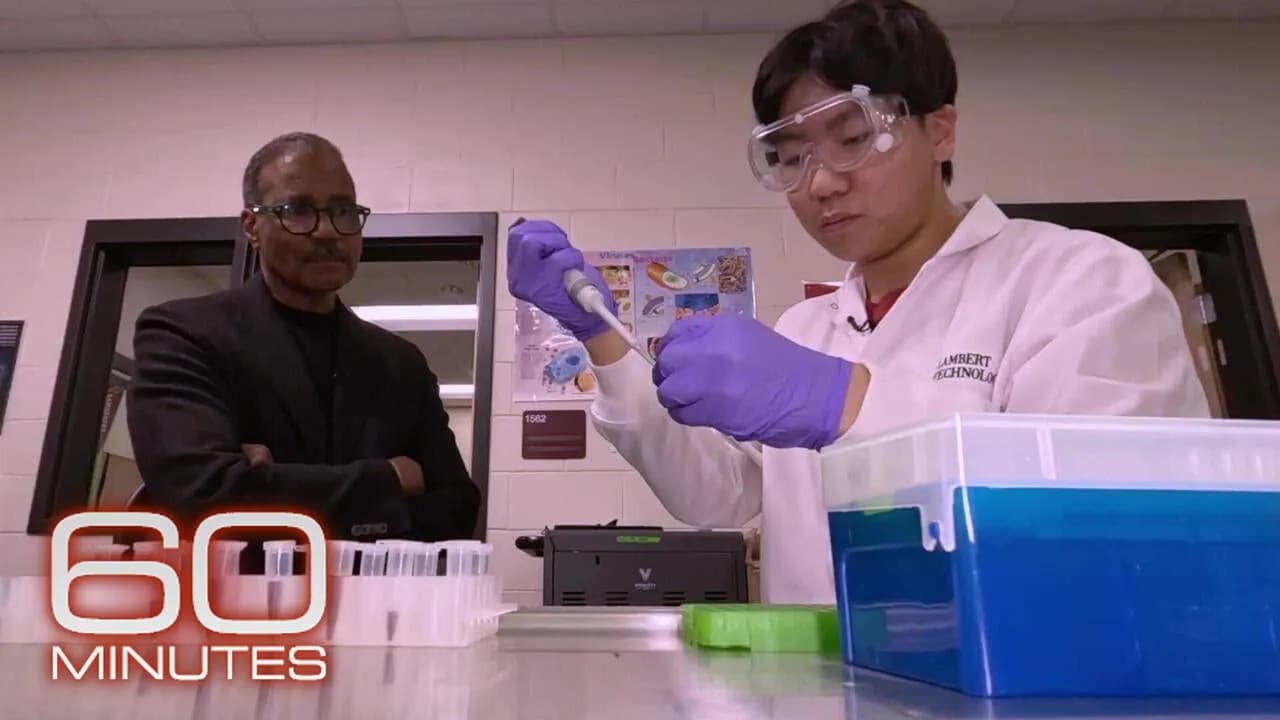
In practical terms, it is about as useful as the mold that grows in a bachelor's refrigerator. But scientifically, it is a milestone. The bacteria, similar to one found in the intestines of goats, was designed on a computer, manufactured in the laboratory, and gets its genetic instructions from a synthetic chromosome made by man, not nature.
And it's alive.
It's alive and self-replicating. It means it can indefinitely grow and make copies of itself.
Did you design this to do anything in particular? No, we designed this just to see if we could do this whole experiment using synthetic DNA. And now that we know we can do it, it's worth the effort to now make the things that could be valuable.
Just how valuable remains to be seen. But Venter believes this is the first baby step in a biological revolution, one in which it will be possible to custom design and reprogram bacteria and other organisms that turn out new medicines, foods, and clean sources of energy.
What you're doing is programming cells like somebody would program software. DNA is the software of life. There's no question about it. And the key to evolution of life on this planet and now the key to the future of life on this planet is understanding how to write that software.
So you see bioengineered fuel for example.
I see in the future bioengineered almost everything you can imagine that we use.
How far off is some of this?
The first things will start to come out in the next few years. I think possibly next year's flu vaccine could come from these synthetic DNA processes. Instead of months to make a new vaccine each year, we could do it in 24 hours or less.
He has already signed a contract with a major pharmaceutical firm to try and do it. BP is funding research to experiment with underground microbes that feed off coal and produce natural gas. ExxonMobil has committed $300 million to Venter's company to genetically enhance an algae that lives off carbon dioxide and produces an oil that can be refined into gasoline.
So, you're trying to cut down on CO2 in the atmosphere, which people believe causes global warming, and also create a fuel.
Exactly. The question is on the scale that needs to be done at, you know, facilities the size of San Francisco.
Really? Yes. The city. Yeah.
Venter and his team are not the only players in this growing field known as synthetic biology. For years, DuPont has been using genetically modified bacteria to make a compound used in clothing and carpets. Amyris discovered a way to genetically modify yeast to produce an antimalarial drug. Another company, LS9, has altered the genes of E. coli bacteria to produce fuel. But all of them are modifying a few genes, not designing all of them. Venter's rivals say his method is commercially impractical. But he has made a career out of bucking the scientific establishment and earned lots of enemies with his brash behavior and his knack for grabbing research money and the spotlight.
So, what are your faults? probably impatience is the uh you know the biggest one. I don't suffer fools too well that you know I'm not going to ever win a political contest. A lot of people have said you're a self-promoter, an egoomaniac.
True. Partially true. Not true at all. You know, if we hold a press conference, it's considered self-promotion. But somebody at a university, the university holds the press conference and that's not self-promotion. overly ambitious. I I'm sure I'm very guilty of that.
That wasn't always the case. He grew up in the suburbs of San Francisco as the prototypical surfer dude and a classic underachiever.
I was a horrible student. I really hated school.
Were you good in math and science?
I was not really good in anything. Uh, you know, I almost flunked out of high school.
You got a college scholarship for swimming, right?
Yes. But I didn't take it. So at age 17, I moved to Southern California to take up surfing. That was it. That was it.
In 1965, reality set in. He got drafted off his surfboard, joined the Navy as a medic, and was sent to Vietnam to work at a field hospital in Da Nang. The experience changed his life and motivated him to go back to school and pursue a career in medical research. He became a rising star at the National Institutes of Health and just as quickly grew frustrated with the politics and bureaucracy of government science. When the NIH declined to fund some of his unorthodox new ideas, he left and found private investors who would.
I think we have a real problem with how scientists funded and done in this country. Almost every breakthrough I've been associated with is from having independent money. And once they worked, we can get tons of government money to follow up on it, but we could never get the money to do the initial experiment.
In 1998, a company that made cutting-edge technology to analyze DNA hired him to take on the federal government in a race to identify all the genetic material in the human body. The federally funded Human Genome Project had already been working on it for years.
Why did you decide to challenge the government? The way it was being done just didn't make any sense. We ended up doing it 9 months instead of 15 years. That's a big difference.
When the competition produced bad blood and bad publicity in the scientific community, the Clinton administration arranged for the two sides to announce a truce and a tie. Even though many believe that Venter's company, Celera Genomics, was ahead. But for Venter, the celebration was short-lived. The tension between making science and making money and personality conflicts with his corporate bosses got Venter sacked a year and a half later.
You accomplished all this stuff and you got fired by the company that brought you in to do this.
They locked the doors.
They locked the doors and sent me away.
The experience left him deeply depressed, but he was financially well off and still in business, having endowed his research institute with $100 million in stock at the height of the biotech boom. Within a few years, he was once again making waves in the world of science. Only this time, at age 64, he is not just trying to decipher genetic codes. Now, he is trying to create them.
This is a quote from one of your critics. He's trying to short circuit millions of years of evolution and create his own version of the second genesis. It's the height of hubris. It's irresponsible and he can't tell you it's going to be safe. Well, except for the second part. I was taking that as a compliment. I can tell you what we're doing is safe. That there's no way that I can guarantee that other people that use these tools will do intelligent safe experiments with it. But I think the chance of evil happening with this and somebody even trying to do deliberate evil would be pretty hard.
Why?
Because the complexity of biology um you know we're not working with human pathogens. Uh we're working with algae cells and part of our design is cells that won't survive outside of a facility or a laboratory and we think other scientists will adopt these same approaches.
There are some things that concern you about this. Oh, it is powerful technology. You know, it's something that needs to be monitored. Absolutely.
President Obama was concerned enough to ask his commission on bioethics to hold hearings on Venter's new technology shortly after the results were published in the journal Science.
Apart from the legal and regulatory questions raised, there are some moral and ethical ones as well.
There are a lot of people in this country who don't think that you want to screw around with nature.
We don't have too many choices now. We are a society that is 100% dependent on science. We're going to go up on our population on the next 40 years. We can't deal with the population we have without destroying our environment.
But aren't you playing God?
We're not playing anything. We're understanding the rules of life.
But that's that's that's more than studying life. That's changing life.
Well, domesticating animals was changing life. Uh domesticating corn. When you do crossbreeding of plants, you're doing this blind experiment where you're just mixing DNA of different types of cells and just seeing what comes out of it.
This is a little different though. This is another step, isn't it?
Yeah. Now we're doing it in a deliberate design fashion with tiny bacteria. I think it's much healthier to do it based on some knowledge and a better understanding of life than to do it blindly and randomly.
You know, I've asked you two or three times. Do you think you're playing God? I mean, do you believe in God?
No. Uh, I believe the universe is far more wonderful uh than just assuming it was made by some higher power. I think the fact that these cells are softwaredriven machines and that software is DNA and that's the truly the secret of life is writing software uh is pretty miraculous. Just seeing that process in the simplest forms that we're just witnessing uh is pretty stunning.
Keep 60 Minutes in your library
Save the videos and channels worth coming back to, and find them again in one place.