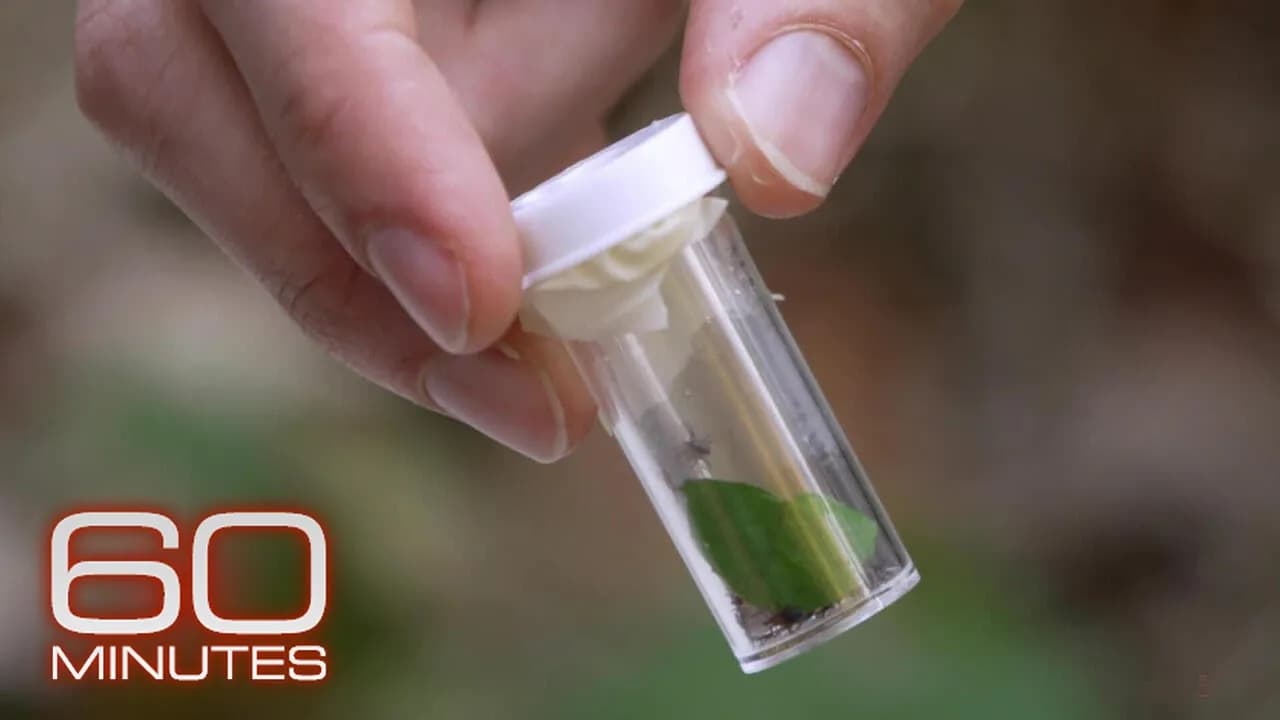
Teens may have found a new way to detect Lyme disease | 60 Minutes Archive
In a Nutshell
Lambert High School students developed a CRISPR-based test that detects Lyme disease in just two days versus the current two-week standard, with potential for a simple strip test and targeted treatment using the same technology. Their iGEM team placed in the global high school top 10—the only US team to do so—while China dominated with seven of the top 10 spots. The project highlights America’s shrinking lead in biotech as US federal funding for synthetic biology education was cut, while China made it a national priority with 120 high school iGEM teams versus 14 in the US.
These notes were generated by AI and may contain inaccuracies.
60 Minutes profile of teenagers from Lambert High School in suburban Atlanta who may have found a better way to detect and treat Lyme disease, which affects nearly half a million Americans annually. The students use CRISPR, the revolutionary gene editing technique, to compete at iGEM (International Genetically Engineered Machine), a science competition in Paris. The team competes against teams from China, which is becoming the rising power in biotechnology.
In Lambert High School's lab, Shawn Lee and classmates function as teenage genetic engineers manipulating the building blocks of life. The process involves moving samples into mixes that contain everything needed to amplify DNA. The iGEM team's project involves mapping where Lyme is most prevalent. Senior Avani Karthik, also a team captain, explains their novel CRISPR detection method: creating a guide RNA that, when recognized, activates a protein that collaterally cleaves or cuts everything around it. The work involves synthetic biology, with examples like golden rice engineered to have specific vitamins to make it more nutrient dense. The endless possibilities of synthetic biology exist as long as work remains ethically correct.
Lyme disease cases have doubled over the last decade. The teens targeted finding better detection and treatment methods, which have eluded adult scientists for decades. Lyme is transmitted by infected ticks and can cause arthritis, nerve damage, and heart problems if left untreated. A major problem is the lack of early diagnosis, with some people going years without proper identification - one person went 15 years without diagnosis. Current tests struggle to detect Lyme in the first two weeks when treatment is easiest.
The team's approach targets a protein generated by the infection. Using CRISPR and simulated blood serum, they target specific DNA strands where the protein hides, then remove extraneous genetic material to expose the protein. This enables detection through a simple kit-style test similar to COVID or pregnancy strips. The students consulted professors and stakeholders who initially warned the project might not be feasible given its ambitious scope.
For treatment, the team planned to use CRISPR instead of standard antibiotic therapy, targeting the bacteria causing Lyme disease. They built software to model optimal CRISPR use. Biotechnology teacher Kate Scherer notes the students' intelligence exceeds her ability to keep up with them. She describes their thinking as far outside conventional boundaries. Scherer warned the project was high risk, high reward and initially couldn't imagine it working, but supported their efforts.
Lambert High School has a college-level lab funded by taxpayers and donors, located in one of Georgia's most affluent, high-achieving school districts. The student body is majority Asian-American, and the iGEM team is entirely Asian-American, consisting of children of immigrants. The iGEM lab coat may be the most coveted uniform over sports achievements. Parents move to the district specifically for their children to access the iGEM program, with families relocating from around the world for biotech opportunities.
Approximately 100 students compete annually for roughly 10 spots on the iGEM team. The selection process involves submitting project proposals, taking tests, and facing interviews. Special skills like engineering or coding provide advantages. Team members must commit to extremely long work hours.
With one month remaining before competition, the team achieved significant successes. Their test strip detected Lyme as early as two days after infection, compared to two weeks with existing tests. Senior Claire Lee reported promising results in treating the disease. The goal is for doctors to use this method to identify and potentially treat Lyme disease. The students recognize their high school lab work could impact millions of people and potentially save lives.
The team raced to finish before the Paris competition, working through all-nighters to write results, code, and build a website explaining their project to iGEM judges. Previous Lambert teams won the world championship award in 2022. Students express competitive drive, with one stating they like to win.
The Atlanta students arrived in Paris at the end of October for iGEM 2025, competing against more than 400 teams, with a third being high school teams. The competition features elite synthetic biology with strong nerd culture elements. Avani Karthik, attending her third iGEM, was monitoring other teams' projects. Notable nearby projects included Great Bay from Shenzhen, China, developing a new enzyme for treating indoor mold. Other high school projects included designing crops for Mars and eye drops for cataracts.
Janet Standeven, who runs iGEM's international high school division and previously taught at Lambert where she created its iGEM program and helped win the 2022 grand prize, notes the disparity in participation: the United States has 14 high school iGEM teams while Asia has 120. Standeven's goal has been to expand synthetic biology to every school, starting with Georgia as a test bed. She left Lambert three years ago after securing federal funding to expand synthetic biology across Georgia high schools, but the Trump administration cut funding claiming it fell under DEI. A judge temporarily restored funding, though Standeven expressed uncertainty about extension beyond 2026.
Lambert presented their work on stage in Paris, explaining that Lyme is caused by the genus Borrelia and transmitted through infected tick bites. The team met judges behind closed doors, answering questions about lab work and real-world implications. Stanford Professor Drew Endy, one of iGEM's founders, started the competition because 18-year-olds wanted to work with MIT's genetic engineering program. Endy warned Congress that America's lead in biotechnology is slipping while China has made synthetic biology a national priority. He expressed profound concern about the lack of American iGEM participants and emphasized the urgent need for strong American leadership in next-generation biotechnology.
Endy inquired about delivery methods, with the team explaining plans to use lipid nanoparticles. He noted their diagnostic appeared better than anything previously seen for Lyme disease, with potential applications beyond Lyme to anything detectable in blood. Abhinav Karthik acknowledged the team was being judged on website quality and software in addition to lab work. The team hoped to finish in the top 10 out of 140 high school teams.
On the final day, Lambert was nominated in five categories but didn't win the grand prize, which went to China's Great Bay team. However, they won best software tool and finished in the high school top 10 - the only American school to achieve this ranking, alongside one team from South Korea, one from Taiwan, and seven from China.
Keep 60 Minutes in your library
Save the videos and channels worth coming back to, and find them again in one place.