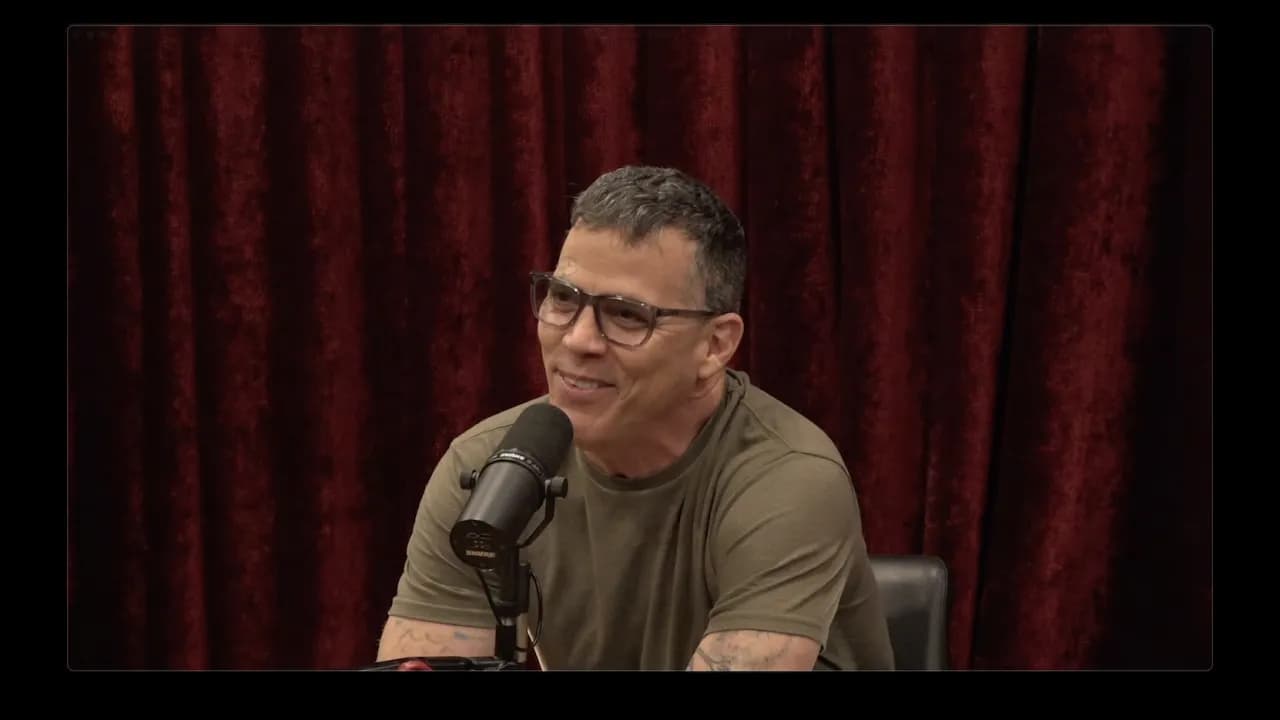
Joe Rogan Experience #2507 - Harland Williams
In a Nutshell
Harland Williams and Joe Rogan debate whether humans should prioritize people or animals in conflicts like wolf reintroduction, with Harland arguing humans belong on "team people" and should remain apex predators while Joe counters that encroachment and poaching are eradicating species like bison, elephants, and tigers. The conversation extends into simulation theory, underwater alien bases, advanced ancient civilizations, and the ethics of genetic experiments including Soviet attempts to create human-chimpanzee hybrids. They also cover AI's creative potential, Harland's physical transformation claims involving malaria pills and fish therapy, and the decline of multicam sitcoms alongside his new film projects.
These notes were generated by AI and may contain inaccuracies.
Harland Williams appears on the podcast with a tattoo on his forehead reading "Billy." He explains it as a memorial tattoo for his kid who was hit by an 18-wheeler truck approximately two years prior. The child resulted from a one-night stand and was a service animal (goat) that the mother sold to him. Harland also has a tattoo of the goat's face over his heart. Joe inquires about a prior bear attack scar that has healed.
The goat was killed when a respirator (life-saving device weighing approximately half a ton) rolled out of the back of the truck and crushed its head after the initial impact. Harland describes watching the goat bleed to death on the pavement. He jokes about eating the goat, stating he would have eaten it, and notes that goat meat is pretty good, having first tried goat tacos at a Mexican spot in LA.
Harland recounts a friend who was a landscaper involved in chicken fighting (cockfighting). The friend lived in a neighborhood resembling Mexico with Spanish signage, Spanish-speaking residents, and roosters present throughout. The backyard contained stacks of rooster cages and a pit for fighting. After each cockfight, they would roast a goat and drink beers.
Joe and Harland discuss the concept of politicians dueling as they did in the 1700s and 1800s. Harland suggests having Delta and American Airlines pilots fight in a cockpit, joking about the DEI/DIE program. They discuss politicians, homeless advocates, and overrepresented groups fighting in pits. Joe notes that hierarchy in tribal days was based on physical dominance and intimidation.
Joe states he would not be a good leader because he would tell people to do what they want and would not be interested in running things. He explains that once you decide to run something, you become stuck with all the problems and everyone wants to kill you. He questions why any normal healthy person would want to be president when at least half the country will hate them and supporters will be disappointed because promises cannot be fulfilled.
The podcast references historical duels: Andrew Jackson killed Charles Dickinson in 1806 and later became president. Aaron Burr (vice president) shot and killed the Treasury Secretary Alexander Hamilton in 1804 in a pistol duel, which ended Burr's political career. In 1856, Representative Preston Brooks of South Carolina beat Senator Charles Sumner of Massachusetts with a cane after an anti-slavery speech that insulted Brooks' cousin.
They discuss the idea of returning to dueling or UFC-style fights on the White House lawn as a way to create repercussions for harsh political speech.
Joe expresses that he does not like the concept of UFC fights on the White House lawn because world championship fights should occur in controlled environments out of respect for athletes. However, he acknowledges it would be a spectacle that he would watch. Harland appreciates Trump's fearless approach to staging such events.
The conversation addresses the Iran conflict and nuclear weapons. Harland supports preventing Iran from obtaining nuclear weapons, comparing it favorably to operations in Afghanistan. Joe references Scott Horton explaining the difficulty of making depleted uranium weapons-grade and questions whether Iran was close to achieving bomb capability. He notes regular inspections occurred and questions whether this benefits America versus primarily serving Israel's interests.
Harland argues that if America does not handle the situation, no other power has the capability. Joe expresses concern about depleting two-thirds of US missiles and leaving America vulnerable.
Harland discusses US nuclear submarines, claiming a fleet of 12-24 Trident submarines that can stay underwater for up to a year. He states most American government members do not know their locations. Each submarine carries 24 nuclear warheads, with each warhead splitting into 16-24 independently targetable reentry vehicles.
Jamie provides verified data: The US Navy has approximately 53 fast attack submarines, 14 ballistic missile submarines, and 4 guided missile submarines, totaling roughly 70-71 nuclear submarines. Harland emphasizes that Trident (Ohio-class) ballistic missile submarines run silent and cannot be detected by sonar, serving as silent predators capable of massive destruction.
Harland asserts that no one on earth can threaten America in terms of global nuclear warfare. Joe questions this by referencing 9/11. Harland clarifies that 9/11 was a terrestrial attack involving planning, box cutters, and hijacking, distinct from nuclear warfare scenarios.
Harland states that even if Moscow launched missiles hitting seven US cities, American submarines would retaliate and destroy Moscow, China, and other adversaries. He maintains that America wins even when losing because surviving submarine crews would form the new civilization.
The conversation covers underwater extraterrestrial bases. Tim Burchett reportedly mentioned five such bases in US waters. These crafts are described as transmedium vehicles capable of traveling 500 miles per hour underwater with no apparent resistance, moving between air and water seamlessly.
Joe notes that less than 10% of the ocean floor has been mapped, and humans know more about the moon's surface than the ocean bottom. He references James Cameron's 2012 dive to the Mariana Trench as evidence that advanced technology could establish bases in deep ocean trenches (3-5 miles deep).
Harland comments on Steven Spielberg's long fingernails visible in a Disclosure Day trailer, speculating they are used for nose-picking or eating boogers. He compares them to an aye-aye's elongated middle digit used for extracting food from coconuts and melons. Harland jokes about Spielberg picking at his beard and eating what he finds.
Roger is used in military and radio communication to mean the message was received. The term originated from Morse code where R stood for received, used as shorthand in early radio communications. The Jolly Roger pirate flag with skull and crossbones is not historically connected to the radio term Roger.
Pirates wore eye patches to maintain one eye adapted to darkness. When going below deck into dark areas, they could switch the patch to the other eye and immediately have vision adjusted to low light conditions without needing time to acclimate.
A hypothetical scenario suggests a sophisticated civilization existed 30,000 years ago with underwater and space travel capabilities. After an apocalypse, only Trident submarine crews survived underwater. This could explain ocean-based military installations as remnants of advanced pre-Mesopotamian societies.
At three miles underwater, extreme pressure exists, as demonstrated by the Titan submersible incident. If an advanced civilization uses gravity bubble technology for space travel without propulsion, the same bubble would shield them from ocean pressure when operating underwater, allowing transmedium craft movement with no splash or friction.
Advanced beings might remain underwater to avoid detection while observing human civilization. Sightings of craft rising from water at specific locations suggest they emerge to monitor surface activity. The ocean provides concealment where surface civilization is least likely to discover them.
If humans discovered a planet with cave-dwelling spear-using inhabitants, they would likely observe from above without interference to gather maximum information. Occasional darting with tranquilizers for DNA sampling and medical testing would occur, followed by return to the environment, mirroring reported alien behavior toward humans.
Humans share airspace with advanced craft that fighter jets track but cannot match in maneuverability. If advanced beings communicate telepathically and travel instantaneously across solar systems, humans would appear as primitive as Australopithecus or Neanderthals appear to modern humans.
Modern humans are not permitted to contact uncontacted tribes such as those on North Sentinel Island in the Indian Ocean or several tribes in the Amazon. This policy exists to protect indigenous groups from cultural corruption and disease. When contact has occurred historically, integration followed with introduction of technology and clothing.
Wearing traditional items like cuckoo feathers and hookah pick bones is preferable to seeing indigenous people in Hooters or Adidas shirts. Some argue uncontacted people might prefer modern clothing like t-shirts over going without, creating tension between preservation and individual choice.
Singing or humming copyrighted songs during recordings risks demonetization and advertising revenue removal. Content platforms can make claims without proving infringement, requiring creators to contest them legally.
Joe Rogan maintains significant muscle mass through consistent training. Harland Williams requested removal of his shirt to display the results of dedicated physical work rather than letting the effort remain hidden under clothing.
An estimated 40,000 to 70,000 personnel operate submarines worldwide at any given time. Trident submarines function as floating cities. Small submarines carry 30 to 70 crew members while larger ones accommodate 120 to 160. The United States has 609 women assigned to submarine duty, representing well under 10% of submarine personnel globally.
Submarine crews remain submerged for extended periods up to a year. Human waste is ejected into the sea. Trash management includes compacting, melting, or jettisoning materials. Concerns exist that detectable waste patterns could reveal submarine locations to adversaries.
The phrase can neither confirm nor deny originated during recovery of a sunken Russian submarine. When questioned about possession of the vessel, officials used this response as it technically answers while avoiding direct confirmation or denial, similar to but distinct from pleading the fifth.
Ice baths are used for recovery. Garra rufa fish therapy involves submerging legs in tanks where the fish with vibrating lips consume dead skin cells. Harland Williams claims to combine malaria pills, which can alter blood platelet counts and red and white blood cell levels, with Garra rufa exposure during ice baths as part of an intensive physical transformation regimen.
Harland Williams states he is exercising into becoming a new race. He references athletic achievements of Black athletes including Usain Bolt as the fastest man and record holders in high jump, long jump, and vertical jump. He displays his legs after claiming four years on malaria pills and Garra rufa therapy produced significant muscle development.
Joe compliments Harland's legs after he stands up, noting how muscular they appear compared to the rest of his body. Harland jokes about sinking in a tank to get similar legs. The conversation turns humorous as Joe questions if the legs look real or like plastic, leading to a request for Harland to pull his pants up to check skin color changes. They agree to remove their shirts together, resulting in laughter when Joe reveals his own muscular physique. Harland's rubber muscle pants become a running joke, with references to a gourd that was inside them.
Joe suggests Harland could wear the pants to a public pool to attract attention. Harland offers to leave the gourd for Dimitri and future guests to smell, claiming it rubbed against his body. They discuss skin tone differences, with Harland bringing up "bronze people" like the Incas and Mayas, referencing the film Apocalypto to highlight their athleticism. Harland jokes that his legs would allow him to escape danger while others might not.
Harland shares a fabricated story about a one-night stand with Dolly Parton, describing her areolas as the size of lily pads with bullfrogs sitting on them in the morning. Joe questions the story's authenticity and notes Dolly Parton's age. Harland defends the encounter as "making love" rather than casual sex. The conversation shifts to preferences for large areolas, with Harland making absurd camping analogies about using them to patch rubber rafts.
Harland recounts visiting OnlyFans for two hours, initially thinking it was a site for fans or air conditioning before realizing the adult content. He jokes about already having central air and not needing another fan. The discussion turns serious as they explore the moral dilemma of women entering the platform, especially those with limited economic options. Harland highlights how the industry has moved from shadows to mainstream accessibility.
They discuss how performers can become financially dependent on the income. Joe shares data: the top 1% of OnlyFans earners make $18,000 to $49,000 per year, while the top 0.1% make around $100,000 per month or $1.2 million annually. Harland notes that even the top 1% earnings leave many in poverty despite explicit content. Joe emphasizes the lasting repercussions and how the content follows people long-term.
Joe reveals he has three daughters. Harland asks how Joe would react if one were on OnlyFans. Joe explains he would feel like a parenting failure but stresses treating children as autonomous humans rather than possessions. He advocates for open communication about consequences instead of authoritarian reactions, noting that yelling creates resentment. Harland observes "dad vibes" and praises Joe's reasonable, nurturing approach.
Joe shares that his teenage daughters have never rebelled against him because of consistent, open communication and support. He acknowledges modern pressures including social media and AI potentially displacing jobs, making it harder to be a kid today.
Harland expresses strong enthusiasm for AI, viewing it as a tool that democratizes creativity for ordinary people who previously lacked access to artistic expression. He contrasts historical art limited to roughly 200 recognized artists with AI enabling anyone—from a Home Depot worker to a Dunkin' Donuts employee—to create and share work. Harland shares his personal example of previously rejected animation ideas now being produced affordably with AI, achieving Pixar-like quality for a few thousand dollars instead of millions.
Harland argues AI allows even accountants and lawyers to express hidden artistic talents after work. Joe raises concerns about job displacement and universal basic income scenarios. Harland counters that AI represents just another step in human progress, comparable to past resistance to cell phones or the internet. He believes humans are inherently adventurous and will continue advancing, with AI serving as a tool toward an unknown higher purpose.
They discuss how fear and crisis can make people feel alive, referencing the communal spirit and neighborly connection after 9/11. Harland suggests occasional disruption prevents complacency. Joe notes AI's potential downside of creating isolation through abundance but emphasizes focusing on upsides. They agree humanity always adapts to change.
Joe references Elon Musk's concept of universal high income, where AI abundance eliminates poverty, food insecurity, and basic needs. This would shift focus to personal purpose rather than survival. Harland notes that some criminality stems from passion for the game rather than financial need, including the thrill of competition and deception. They question whether AI-enabled telepathy could eventually eliminate hidden criminal intent.
If AI develops to the point of literal telepathy where minds can be read, plotting crimes would become impossible. AI might instead place criminals into simulations resembling Grand Theft Auto where they can commit acts in virtual environments before returning to real life with everything remaining fine. The conversation explores how endless and twist-filled technological development will be.
The discussion questions whether we currently exist in a simulation. Harland Williams references Pioneer Village with Betty O'Conor churning butter and Kyle McGiven shaving timbers for log cabins, asking if those covered-wagon people ever questioned whether they were in a simulation. Williams argues that simulation discussions arise from our current computer-filled world rather than reflecting actual reality.
Williams challenges the certainty of pioneer days by questioning whether museums showing pioneer wheels and butter churns prove anything real. He jokes about not knowing if university researchers are real people and questions whether Joe Rogan himself is real given his rubber legs and gourd covering.
Joe Rogan describes the DMT laser phenomenon where people smoke DMT and use a DeWalt construction laser. Looking down on the laser reveals code resembling matrix numbers or hieroglyphs that multiple people describe identically. Looking from different angles shows the same code, which some interpret as exposing the underlying code of our simulation.
Williams questions why a simulation would run humans through birth, pain, illness, suffering, love, and hate without a clear reason. Rogan counters that life is organic, made of earth and born of the environment. Williams suggests this intricate ecosystem of single-celled organisms becoming multi-celled, balancing predator and prey, might indicate either organic development or a larger creator running a simulation.
Rogan proposes reframing the concept as an underlying program rather than a simulation, noting that physical sensations like slapping an arm or knocking a knee are real experiences. The program requires balance between good and evil, rainy days and sunshine, good times and bad times, and good friends and bad friends. This balance moves toward creating AI as a new life form more intelligent than humans.
Williams notes that thinking about simulation comes from a human perspective with endless imagination capacity. Salmon spawning, moose fighting grizzlies, and ants in nests do not contemplate simulation. Rogan responds that all creatures participate in an ecosystem including bears, salmon, deer, vegetation, and animals creating manure, all feeding into technological innovation moving toward a new future.
Williams questions why a program would require trees, grass, mosquitoes, slugs, and fungus if humans could simply exist in empty airspace. Rogan clarifies it is not about being fake but about running a program where real consequences, feelings, eating, sleeping, and resource needs all occur. Williams jokes about asking a man with fake legs what is real.
The conversation shifts to experiencing life before modern technology. Rogan and Williams recall when answering machines first appeared, allowing people to leave messages and retrieve them by calling from other phones using memorized codes. Williams describes running to airport pay phones after gigs to check messages instantly.
Williams pushes back on the simulation idea, stating it is not fake but a real thing being experienced. Dreams and sleep are real whether or not they can be measured on a scale. Rogan suggests thinking of it as a biological program connected to math and subatomic particles in quantum mechanics, all forming one complex program leading to artificial life creation.
Rogan proposes the universe itself is the program running from the Big Bang through neutron star formation. He references cosmologist Michelle Dor who discussed how neutron stars bend space and time and warp gravity. The program likely runs on other planets with other life forms doing similar things.
Williams struggles with the technical aspects but finds random evolution less convincing than a slow program running from single-celled organisms through planet formation. This natural cycle would happen throughout the universe with suns spinning, ejecting plasma, and material coalescing in space.
Terrence Howard's theory suggests suns eject particles that eventually form planets. When planets move far enough from their sun, life evolves, then intelligent life evolves. Eventually planets lose ability to support life, forcing intelligent beings to develop interstellar travel capabilities before their planet becomes uninhabitable.
The conversation examines strange geometric structures on Mars in the Cydonia region near the famous face formation. A large square structure with perfect right angles appears in images, estimated between 300 meters and several miles in size. The discussion questions whether ancient civilizations might have existed on Mars hundreds of millions of years ago.
Research reveals ancient civilizations associated Mars with deities, particularly the Roman god of war, but no myths describe humans originating from Mars. The Dogon people of Mali have a complex creation myth involving Amma, the supreme creator god who split into Ogo representing disorder and Nommo representing order. Eight Nommo beings descended to Earth in an ark suspended by a copper chain and became ancestors of the Dogon people.
The discussion explores whether extraterrestrial beings might have created humans as primates and observed their evolution as an experiment. If advanced beings discovered a planet with ancient hairy men using stone tools, they might conduct genetic engineering experiments to accelerate development.
After World War II, Russian scientist Dr. Ilya Ivanov received Soviet funding to create human-chimpanzee hybrids for warfare. The goal was producing soldiers that were stronger, faster, more violent, and more intelligent than chimpanzees while retaining human communication abilities. Ivanov had previously conducted artificial insemination experiments with horses and hybridization work with zebras, donkeys, cows, bison, and rodents.
In 1910, Ivanov declared he could create human-ape hybrids. He imported chimpanzees to Russia and attempted to artificially inseminate Soviet women with chimpanzee sperm, though none conceived due to chromosome incompatibility. The program aimed to breed millions of hybrid soldiers in laboratories that would not require mourning like human soldiers.
Helium was once thought to exist only in the sun before it was discovered on Earth. Chromosomes were first observed as distinct structures in cell nuclei in the 1800s once good light microscopes became available. Their role as carriers of hereditary information was clarified in the early 1900s through work linking chromosomes to Mendel's laws of inheritance. This represents roughly 100 years of scientific guessing and refinement, with periods of incorrect understanding spanning decades before corrections were made.
The conversation highlights how the average person might now discover new insights through AI tools like ChatGPT, potentially including unconventional ideas such as creating human-monkey hybrids.
Ilya Ivanov was a Soviet scientist who attempted to create human-ape hybrids. American backers provided funding for his work. He successfully implanted ovaries in a few apes. The experiments involved questionable ethics and yielded zero progress. Ivanov was arrested and exiled to Kazakhstan, where he died two years later. Some of the apes and monkeys that outlived him were launched into space with Sputnik missions.
Joe Rogan and Harland Williams discuss the disturbing nature of these experiments, noting that during wartime, Germans, Japanese, and Chinese conducted horrific human experimentation including boiling people alive and skinning them.
CRISPR gene editing technology raises questions about how close humanity is to creating hybrid life forms by selecting specific genes from humans and chimpanzees. The discussion references Colossal Biosciences' work creating dire wolves.
The dire wolves were created using DNA from a 13,000-year-old tooth found in Sheridan Pit, Ohio, and a 72,000-year-old skull from American Falls, Idaho. Scientists mapped the genes defining dire wolves and added them to gray wolves. The resulting animals are all white, have a pronounced mane similar to a lion's, are bigger than timber wolves at approximately 200 pounds, and have a more stocky build with stronger jaws.
The head geneticist at Colossal argued that distinctions like "dire wolf" are human creations and that the genetics make the animals actual dire wolves. The term "dire" derives from Latin meaning fearful, terrible, or awe-inspiringly dreadful.
Wolves have killed humans throughout history. In modern times, wolves were eradicated from the West Coast partly because they killed people, not just cattle. The fairy tale of the Big Bad Wolf and Little Red Riding Hood originated from wolves killing children. During World War I, Russian and German forces declared a temporary ceasefire in Siberia to kill wolves that were killing soldiers before resuming combat.
Wolves are opportunists that will attack sheep, dogs, or humans if circumstances allow, particularly when hungry and encountering an unarmed person alone in the backcountry. However, wolves that have been shot at learn to fear humans and guns. Bears in Alaska behave differently than bears in Montana because generation after generation in Alaska have been hunted, creating learned avoidance of people.
All animals exhibit fear toward humans as apex predators with forward-facing eyes. Prey animals like deer, squirrels, and blue jays react differently to predators versus humans attempting to approach them affectionately. A golden retriever causes deer to flee and stamp their feet in alarm.
Wolves were reintroduced to Colorado on cattle ranches, resulting in livestock deaths that require government reimbursement. Cowboys must patrol 24/7 to protect cattle. Wolves were already moving naturally into Colorado's San Juan Mountains from Wyoming.
Wolves provide ecosystem benefits by controlling overpopulated elk herds that were eroding riverbanks through excessive grazing. However, the documentary "How Wolves Changed Rivers" contains overstated claims and was made by someone advocating rewilding Europe. The core benefit of balanced predator-prey relationships remains valid.
Joe Rogan identifies as 100% on team people when considering the risks wolves pose to children and livestock in agricultural areas.
Harland Williams states he loves all animals but loves people way more. He would kill a wolf to save a person he hates because he is on team people. He supports the idea that animals should be scared of humans, though that does not mean humans should do anything bad to them.
Joe Rogan counters that team people is eradicating animals through encroachment into the Amazon jungle and African plains. He points to the American bison that once numbered in the millions and now exists in isolated pockets, along with shrinking elephant herds, silverback gorillas, and Siberian tigers that might not exist in 30 years.
Harland clarifies he is not saying anyone should kill endangered animals.
The bison population decline was not primarily due to encroachment. It resulted from market hunting where people killed bison for their tongues, leaving the meat to rot. They also hunted for furs and bones. Rifles were fairly new at the time, and long-range rifles were a recent development in human history.
Trains allowed people to access the plains easily, and they viewed the bison as unlimited targets they could shoot without concern for population sustainability.
Dan Flores, a history professor at Texas Tech, wrote a book on bison and proposed that the massive bison populations on the plains resulted from Native American populations being wiped out by disease. Early European explorers in the 1400s did not describe enormous bison populations. Flores theorizes that when Europeans arrived, 90% of Native Americans died from disease, creating an apocalypse that removed the primary hunters of bison. Without this population control, bison numbers boomed over generations.
When Europeans with rifles arrived, they encountered these unchecked populations and killed bison indiscriminately for tongues and other parts.
Buffalo Head Smashed In is a real town in Alberta where Native Americans used an optical illusion on the plains. The hills appeared to continue flat, but there was actually a cliff. They would chase bison along the plains, and the animals would run over the edge. The Native Americans waited at the bottom to kill them.
Similar buffalo jumps existed throughout North America. At one location, so many bison were killed that the rotting carcasses generated enough heat to burst into flames, leaving the side of a hill black with coal.
Dan Flores wrote Bison Ecology and Bison Diplomacy, a paper on the topic. He also authored a book on coyotes called Coyote America. Nature also provides disease control mechanisms even without human hunters.
Joe Rogan asks at what point someone remains on team human when more animals are being eradicated. Current examples include shrinking elephant herds, tigers reduced to a few thousand, and silverback gorillas down to a few hundred.
Much of the animal population decline results from illegal poaching rather than just encroachment, though land use is also a factor. In India, elephants invade farms and eat crops that villagers have worked all year to grow. The question arises whether humans should simply allow the elephants to take the food.
Harland states he would rather see animals succeed than humans. He views humans as a parasite on the back of a beautiful paradise, noting that no animal dumps nuclear waste or chemicals into rivers, and no animal tears down forests except beavers.
Joe Rogan rejects the parasite framing and states humans are part of the Earth and the predominant intelligent life force. He acknowledges humans do a bad job of keeping the planet clean but argues they are not destroying it. Harland maintains humans predominantly destroy the Earth.
Joe asks whether Harland would press a button to eliminate humans so everything else could live harmoniously. Harland says no chance. Joe jokes that Harland lives in a simulation of a Disney movie and accuses him of being a plant trying to ruin America by bringing in wolves.
Harland is turning 64 this year. Joe jokes that Harland might have bad jizz if he had a kid now. Harland references Al Pacino having a kid at an advanced age. They discuss how older parental age, including the father's age, may contribute to autism, Down syndrome, and miscarriages. The father's drinking and possibly weed use can also affect sperm quality.
Harland has three girls and states he just wants them to be healthy. He does not wish for a specific gender and believes the universe gives what it gives. He appreciates having girls and does not think about having a boy.
Joe compliments Harland as a good dad.
Harland was married at one point and considered having children, but it did not work out. He avoided doing the road extensively and instead mixed travel with enjoying life. He notes the road is not closed yet.
Joe mentions having a club allows him to travel less. When his kids were young, he had to travel more because he was making less money. Now he only goes on the road occasionally for UFC events.
Harland credits Kill Tony with revitalizing his career and shining a new light on it. Joe notes the show has launched many careers including Rob Schneider, Keratop, Kyle Dunigan, and others.
Harland did his first Kill Tony appearance two years ago without knowing what the show was. He was doing Joe's club and was asked to stay an extra day. He had never met Tony and knew nothing about the show. His first set featured a checkbook bit, and Tony declared him guest of the year.
Harland is about to shoot a movie with Tony Hinchcliffe as the star. The film is called Rednecks, and they plan to shoot in September and October in Florida and Kentucky. Harland offers Joe a part, suggesting three days of filming. Joe says he does not like acting anymore and might only do it if he could complete it in one day.
Joe never really had passion for acting and only did it for money. He loved standup and going to clubs. A development deal led to him being on TV. Not having a dream for acting meant he had less anxiety about it.
The transition from standup to film and TV was challenging because live audiences react immediately with laughter, but movie and TV crews stand silently watching. News Radio was filmed in front of a live audience, which helped.
Joe notes that bad sitcoms become hell, and performers just collect checks. He references Two and a Half Men. People on shows they hate may turn to drugs. Many sitcoms reuse the same premises repeatedly, functioning like recipes with about 40 different episode types.
Curb Your Enthusiasm succeeded because it avoided repeating premises and remained creative with no audience. Traditional multicam sitcoms provide comfort when done well, like The Big Bang Theory, which Joe initially dismissed but later appreciated when watching with his kids.
Miss Pat currently has the only live-audience multicam sitcom. Joe finds it strange that people still enjoy sitcoms but networks no longer produce them. Dramas like NCIS, Law and Order SVU, medical examiner shows, and rancher shows continue to use formulaic premises, yet sitcoms have disappeared.
Joe believes a great multicam sitcom could succeed on streaming platforms like Paramount Plus. Harland rarely watches TV and has not turned on a hotel TV in about six years. He watches his home TV maybe once a month.
Harland wrote, directed, and starred in a new movie called Wingman that recently came out on Apple TV and Prime Video. He plays a crazy wingman who helps people get laid. The cast includes Jamie Kennedy, Russell Peters, Kayla Wallace, Evan Marsh, and Shiva Nagar. They made it with a studio.
Harland Williams and Joe Rogan discussed Harland's upcoming film Wingman, which he made with Stardust Pictures in Canada alongside David Lipper and Justin Lavine. Harland expressed pride in the full production and hopes people will check it out. Joe agreed to watch it on the condition that Harland watches movies more regularly. Harland jokingly offered Joe a role in his next movie so they could watch it together. Joe expressed excitement about seeing Harland return to acting.
Harland described a comedy movie he's developing with Tony that centers around mud bogging culture in North Central Florida. The film focuses on guys who jack up their pickup trucks and drive through mud for three days, jumping and spraying mud. The second part of the story involves airboats that travel through Florida marshes. Harland envisions Joe playing the mayor of the town who clashes with Tony's character, a redneck mud bog participant. Joe reacted to footage of the modified vehicles, noting an old Camaro and commenting on how wild Florida culture is.
In the story, Tony's character tries to win the mud bog competition while the mayor (Joe's character) wants him out of town due to his dislike of the redneck culture. Harland mentioned that Joe would be surrounded by the mud bogging scene and vehicles, which he thought Joe would enjoy.
Joe asked whether Harland would consider starring in a multicam sitcom if offered one. Harland said he would only do it if the material had meaning to him, especially as he gets older and becomes more selective about how to dedicate his time. He emphasized that it would need to be something he could help create. Joe noted that writers from classic shows like Seinfeld and Friends are still working in the industry.
Harland reflected on how entertainment constantly evolves, noting that movies once were black and white and silent before talkies, color, and digital formats emerged. He loves that new forms of entertainment will emerge that people cannot yet imagine. Joe suggested that younger audiences like his daughters may not want to sit for a half-hour sitcom, but Harland countered that his daughters love watching old sitcoms.
Harland shared that he and his youngest watched all seasons of The Big Bang Theory together as a family. They also watched Young Sheldon, which he described as a single-camera show on Netflix featuring Sheldon as a young boy. Joe noted that Young Sheldon was a really good, cute, and sweet show, though it lacked a live audience.
Harland expressed love for working on NewsRadio, citing the insanely talented cast who felt like brothers and sisters. He described the five-year run as fun, silly, and like summer camp, with the cast getting drunk together regularly. The show was never massively successful, which Harland appreciated because none of the cast became overly rich or famous from it. The show was moved nine times in five years, and this occurred before social media existed to notify audiences of schedule changes.
Joe mentioned a trailer he saw for a Big Bang Theory spin-off called Stuart Fails to Save the Universe, a 30-minute comedy show in that universe airing on HBO. Harland reacted with surprise. They discussed Chuck Lorre's prolific output of successful sitcoms.
Harland referenced an article stating that shows like The Office and Curb Your Enthusiasm contributed to killing multicam sitcoms with live audiences by popularizing single-camera formats without audiences. Joe mentioned he would not want to sit and watch a sitcom taping today, and they discussed how paid audiences are less fun than genuine fans.
Harland explained that early NewsRadio audiences were unfamiliar with the cast, but by season three the audience consisted of actual fans, transforming the taping experience into something more enjoyable. Phil Hartman would perform stand-up bits and Bill Clinton impressions for fun during downtime.
The NewsRadio set had a good warm-up guy, and cast members like Andy Dick would interact directly with audiences by answering questions. Harland described the atmosphere as a party where everyone had a great time. The show gained popularity primarily through syndication rather than during its original run.
Harland revealed his own sitcom Simon on The WB consistently ranked at number 99 or 100 in the ratings. Writer Lou Morton would bring a t-shirt each week with the show's ranking written in magic marker. One week it reached number 88, which Harland found surprisingly high compared to its usual bottom ranking. The WB only reached about 60% of households through affiliates.
Harland's show was once scheduled on Thursday nights between Friends and Seinfeld, which executive producer Paul Simms called the "fuck sandwich" because the shows in between were perceived as weaker. Harland's show was number 100 while Friends was number one.
Harland shared that he dated Andrea Bendewald, whose best friend was Jennifer Aniston. He would stay at Jennifer's house and watch Friends with her while his own show languished at number 100. He described this as "salt in the wound," sitting beside the star of the number one show while being at the bottom of the rankings.
Harland referred to Variety and The Hollywood Reporter as the "devil's rag" because cast members would obsess over ratings rankings. He reminded colleagues that being on NBC at all was a significant achievement that many actors would kill for, regardless of ranking.
Harland acknowledged that sitting next to Jennifer Aniston each week while watching her hit show did affect him emotionally despite his generally positive attitude. He maintained that one must be grateful just to be on television.
Harland mentioned visiting other sets at Sunset Gower, including Lenny Clarke who was working on the John Larroquette show nearby.
Before landing his own sitcom, Harland auditioned for two shows: Ellen DeGeneres's These Friends of Mine (guest starring with Molly Shannon) and the John Larroquette show. John reportedly told Harland's agents that Harland wanted his own sitcom. Harland confirmed this to his agents, and his next job was indeed his own show Simon.
Joe described Harland as consistently happy, confident, and unrattled before performances throughout their entire friendship. Harland confirmed he has always been this way. Joe noted that he does not know a single person who dislikes Harland, calling him the most universally loved comedian he knows.
Joe mentioned defending Tony Hinchcliffe to people unfamiliar with roast comedy. Harland explained that roast world operates under different rules than regular life, similar to how cage fighting involves elbows to the face without making someone a bad person. He emphasized that roast jokes are intentionally mean, personal, and ruthless by design.
Harland noted that Comedy Central roasts featuring Charlie Sheen, Donald Trump, and others used to air regularly but stopped about ten years ago. He argued that young audiences raised on Chris Rock, Kevin Hart, and Louis C.K. do not understand the intentionally cruel nature of roast humor.
Harland called out comedians who complain about roast jokes as traitors who know exactly what roast comedy entails. He stated that pretending roast participants are racists or Nazis for telling roast jokes is disingenuous. He compared it to refusing to play hockey but then criticizing those who do.
Harland pointed out that Kevin Hart did not complain about the brutal jokes directed at him during roasts, including being lynched from a bonsai tree. He also noted that corporations airing roasts on television clearly did not object to the content.
The Tom Brady roast became the most-watched show in Netflix history with over 55 million viewers. Harland, who does not love cruel humor, acknowledged that the roast may have helped course-correct excessive wokeness in culture.
Harland identified two events that killed woke culture: Kid Rock shooting a stack of Bud Light cans, demonstrating financial consequences of alienating consumers, and the recognition that vocal activists represent a tiny minority rather than the general population. Virtue signaling has largely ended as a result.
Joe identified Kid Rock's weapon as a fully automatic AR-style assault rifle based on the video footage. Harland expressed interest in shooting a six-pack of Dr. Pepper for fun.
Harland stated he loves wolves and finds them important for maintaining ecological balance in the wild. However, he opposes reintroducing wolves into residential neighborhoods and ranches through what he calls "ballot box biology," where urban voters who shop at Whole Foods decide on policies affecting ranchers whose livestock get killed.
Joe described wolf howls as haunting, ghostly, and spiritually significant, which is why Native Americans feel connected to the sound. Harland shared that a friend who kept wolves would trigger group howling by imitating the sound.
Joe mentioned the horror film Frozen (not the Disney musical) about skiers trapped on a lift with wolves below. Harland expressed skepticism about wolf attack scenarios, believing wolves are generally skittish around humans unless provoked or injured.
Wolves are described as skittish around humans. In a movie scene, wolves attack and eat a man with a broken leg after smelling his blood. There are no wolves in New Hampshire currently, though they existed historically before being eradicated for killing people and livestock.
Wolves were killed primarily through poisoning by injecting strychnine into horse carcasses left as bait. Trapping was also common using snap traps. Old trappers in northern regions would club trapped wolves to death to preserve the pelt without damage.
Seals are killed by clubbing while sunbathing on beaches, with videos showing skulls being smashed. This was done for their fur, including the white fur of baby seals. Wolves would at least attempt to run, unlike the stationary seals.
Wolves should remain in the woods rather than neighborhoods. A story was shared about losing a dog to coyotes. Another recounted a pit bull attacked by coyotes that killed nine of them, returning covered in cuts. The pit bull was a large 120-pound specimen bred by specialized companies. The blood trail led to the scene resembling Vietnam with torn necks and broken legs from the pit bull shaking the smaller 30-pound coyotes.
Coyotes use clever tactics by sending one member to lure prey into chasing it, allowing the pack to attack from the sides and tear the animal apart. They are described as smart in this regard.
Coyotes are now found everywhere, including front lawns in the Hollywood Hills near swimming pools. The book Coyote America by Dan Flores explains their spread. Grey wolves kill coyotes, so coyotes move to new areas when persecuted. Red wolves and coyotes interbreed, creating coywolves on the east coast. Coyotes help control rat populations, and their removal would harm the ecosystem.
Coyotes react to fire engine sirens with yips and howls. A girl in Prince Edward Island was killed by coyotes about 12 years ago while jogging with a Walkman. She was a promising folk singer. These coyotes were unusual for being accustomed to killing moose due to limited game in the area, attacking legs to immobilize prey. No documented rules exist preventing animals from attacking humans.
Orcas are considered the top sea predator after sperm whales and have saved humans who fell overboard. No documented cases exist of wild orcas killing humans despite their capability. Their brains are huge, and they appear to understand humans are different from other prey, unlike the assumption that lack of houses or phones indicates low intelligence. All animals seem to recognize humans as distinct.
One speaker prefers animals over humans if choosing who remains on Earth, citing animals' lack of cruelty or malice. The counterargument notes bears eat prey alive without killing first, but this stems from survival needs rather than intent. Humans possess awareness of right and wrong, enabling deliberate cruelty such as the Hiroshima bombing. Animals lack this knowledge of good versus bad.
The audio of Timothy Treadwell (Grizzly Man) being eaten by a bear lasts about five minutes, with the bear pulling chunks from his thighs. The audio circulating online is confirmed as fake; the real recording was destroyed. Chimps also exhibit horrific behavior toward monkeys and people, including biting off fingers and removing eyeballs, possibly as a primate survival tactic developed through warfare.
Chimpanzees taught sign language have never asked a question, only made requests like asking for affection or hugs, as seen with Koko the gorilla. They show no curiosity about their environment, such as questioning clothing, skin color differences, or why humans walk upright. Human intelligence is compartmentalized, allowing recognition that caged animals dislike confinement, while animals focus solely on survival.
The fossil record is incomplete because most animals (approximately 99%) never fossilize, requiring specific conditions like burial in mud. Denisovans were identified in 2008 from a tooth and finger bone found in a cave, dated 76,000 to 51,000 years ago, genetically distinct from modern humans and Neanderthals. A mandible purchased from an antique shop in Taiwan belonged to a male Denisovan, confirmed via protein analysis in 2025 after failed DNA extraction.
Multiple ancient hominid types likely existed alongside each other. The biggest mystery in the fossil record is the doubling of human brain size over two million years. Transitional fossils between Homo erectus, Neanderthals, and modern humans remain elusive, though more discoveries are expected with increased archaeological efforts across Asia and Africa.
Keep PowerfulJRE in your library
Save the videos and channels worth coming back to, and find them again in one place.