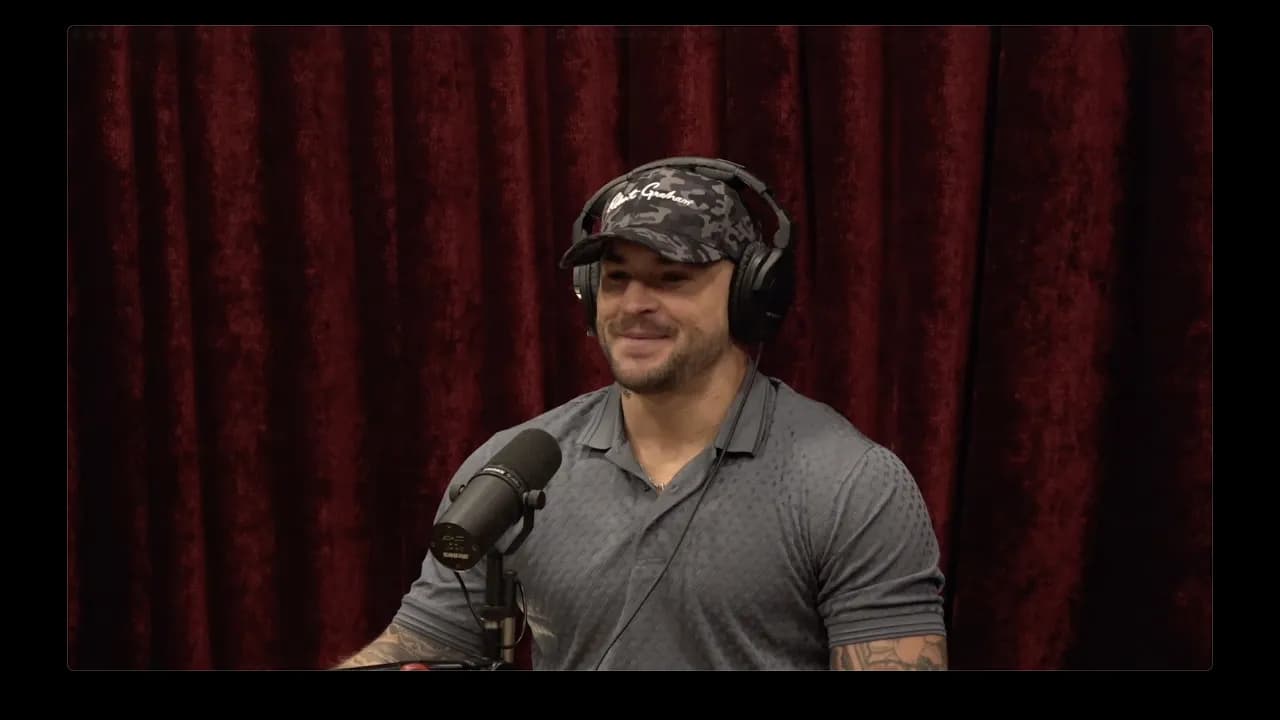
Joe Rogan Experience #2512 - Joey Diaz
In a Nutshell
Joey Diaz and Joe Rogan discuss Diaz's knee surgery recovery, pain management using supplements like DMSO, Voltarin, peptides, and CBD, and skepticism toward traditional medical interventions like cortisone shots. They cover the dangers of weight-cutting in MMA, fighter analysis for upcoming UFC bouts including Justin Gaethje, and the long-term damage from steroids as exemplified by Lyle Alzado. Diaz shares extensive personal stories about evading drug tests during probation, his criminal past in Boulder, the transformative power of stand-up comedy, and the rise of Brazilian jiu-jitsu through the UFC.
These notes were generated by AI and may contain inaccuracies.
Joey Diaz had knee surgery and was walking quickly just three days later. He walks daily at the gym and around his neighborhood but overdid it the previous day with ten loops at Newark airport. He used edibles on the plane and got ice from the flight attendant to manage the swelling.
He mentioned a cream called Voltarin or Voltran that numbs pain and feels like liquid cocaine. It is described as prescription-strength over-the-counter non-steroidal anti-inflammatory gel that penetrates the skin for joint pain, inflammation, and stiffness, commonly used for osteoarthritis and muscle aches. It should not be used for acute injuries like simple strains or bruises. Diaz rubs it on twice a day.
Joe Rogan recommended DMSO, a veterinary medication used for pain and injury, and gave Diaz a bottle. They discussed early 1970s steroids, noting that everything came from Germany. Rogan mentioned that human growth hormone was once derived from cadavers.
Human growth hormone from cadavers was used from the mid-1900s until 1985. It was discontinued after it was found to transmit prion diseases such as Creutzfeldt-Jakob disease, the same condition associated with mad cow disease and cannibalism. It has been replaced by synthetic recombinant HGH.
Lyle Alzado was one of the first US sports figures to admit using anabolic steroids. He started in 1969 and never stopped. He battled a brain tumor and died at age 43 from cancer. Alzado stated his steroid abuse directly led to his fatal illness and that he became mentally addicted. He claimed 90% of athletes he knew were using steroids. He described becoming very violent on and off the field, including chasing and beating a man after a sideswipe incident in Denver in 1979. At the end of his life he had trouble walking and remembering things. Alzado was inducted into the International Jewish Sports Hall of Fame.
Diaz and Rogan discussed bodybuilders claiming to be natural. They noted that nobody reaches extreme sizes without assistance and that freak genetics allowing someone to get very big naturally are extremely rare. Diaz mentioned the Barbarian Brothers eating 36 eggs a day.
Diaz was picked up by Yoel Romero's nephew, a judo champion, who drove him in an Uber. They spoke Spanish for 15-20 minutes. All Uber drivers in Austin were noted as Cuban.
Diaz observed a Cuban yelling at a robotaxi after being cut off. They discussed self-driving cars cutting people off and how they are not trusted. Rogan mentioned a story of a woman entering a Waymo and finding a homeless man in the back who yelled at her for paying robots.
Diaz shared his own homeless encounter in Atlantic City outside a weed store. Four muscular men in an Escalade recognized him from The Longest Yard and Rogan. A homeless man approached asking for a dollar, calling him "Mr. Football Man," and Diaz gave him ten dollars out of embarrassment.
Atlantic City outside the casinos was described as very sketchy with visible drug transactions. Diaz noted that AC is barely making money compared to Vegas and is not expected to grow significantly. The Borgata attracts Italians but the surrounding area remains rough. They recalled staying at the Borgata when it first opened.
Vegas had a head start because there were no other casinos in the country at the time. It began as a pit stop. The man who owned the Comedy Store was put in charge of Vegas, borrowed money from Chicago unions and Teamster loans connected to Jimmy Hoffa, and was later shot in the eyeball at his LA house after stealing from expenses while living lavishly. The conversation noted that cash-only operations in early Vegas led to massive cash transfers requiring armed security including Green Berets and Navy SEALs.
California charges high taxes on legal weed, reported around 39%. During the pandemic, dispensaries were deemed essential businesses but faced an additional 10% tax. Many weed stores are now closing due to oversaturation and high startup costs. In New Jersey, operators must invest millions upfront with intense competition. In Englishtown, New Jersey, four stores sit on the same block. Diaz recalled buying mushroom chocolates from a secret back room at a Trenton dispensary near the state capitol.
Diaz and Rogan visited Englewood Wellness Center in the 1990s when medical marijuana required only a loose medical excuse. They purchased THC lollipops there that were later used on Fear Factor. The operator of the store was shot inside the location.
Dave Foley's hand, previously crippled by arthritis, regained full function after using CBD. THC gummies and CBD products were praised for pain relief from martial arts training, though quality control was noted as inconsistent during the "wild west" period of legalization.
Diaz recalled eating a strong brownie before a red-eye flight to Pittsburgh causing uncontrollable leg tapping. He once had a panic attack on a plane but later took two more edibles. He uses THC before auditions and writing sessions to relax and gain new perspectives on material. He lives with natural anxiety and sometimes takes large doses when not performing.
Diaz performed an hour-long set with no prepared material after taking an edible, crediting THC for helping him get into a groove. He noted that some comedians use THC as a creative aid but warned against going on stage too impaired when it matters.
Diaz described creating anxiety by assuming he has somewhere to be at 10 a.m. When his daughter leaves for school at 7:15 a.m., he feels relief knowing he has no obligations. He makes daily lists but often abandons them after smoking. Driving into New York City is treated as a full day with no other activities planned due to traffic.
Austin traffic is considered minimal compared to the East Coast. Trips to New Jersey or New York for UFC events involve hours of driving plus additional travel for meals and activities, making the entire day consumed by logistics.
Trump receives consistent cheers at UFC events, never boos. People claiming he gets booed are distorting reality. He walks in to the American Badass song, with Kid Rock and Dana White behind him, and sometimes Tucker Carlson, creating what was described as the conservative Avengers atmosphere.
Joe and Jamie bet against the Knicks at two and a half points. DraftKings is the primary platform used for betting. Joey notes that gambling has become a nightmare with bookie busts happening regularly in Jersey and New York, including a major bust involving basketball coaches. He predicts society will pay for the gambling expansion in five years.
When Joey went to college, credit card companies like Discover, Mastercard, and Visa set up at orientation offering $250 automatic credit cards to students. Now DraftKings and FanDuel are present at these events. Joey criticizes this as targeting kids who already have student loan problems, noting more people are gambling than ever before.
Joey's friend James McCann reported on how crazy gambling is in Australia.
The fight is scheduled for Sunday. Topuria is a huge favorite at four to one or minus 426 according to Caesars. Joey notes that four to one is not enough for betting against Topuria given his legendary run knocking out three all-time greats in a row: Alexander Volkanovski, Max Holloway, and Charles Oliveira.
Gaethje is described as a tough character and Warhammer who loves battles. He previously fought in the World Series of Fighting before the UFC, where he was known for throwing himself into chaos and not fighting tactically. He would leg kick people and dive into fights without concern for safety.
Gaethje's first UFC fight against Michael Johnson was one of the craziest fights ever, with both fighters throwing themselves at each other and both getting hurt. Gaethje eventually won. He fights like a pitbull with no concern for his safety, always moving forward trying to smash opponents.
Gaethje lost early fights he could have won because he didn't temper his aggression. Once he learned to control the violence and chaos while maintaining technical violence, he went on a legendary run. He can leg kick from inside the clinch using a collar tie. He hurt Khabib with calf kicks.
Joey watched the Hagler versus Mustafa Hamsho fight. Hagler was beautiful in his prime, excellent at switching stances between southpaw and orthodox, fighting equally well in both stances. Hagler and fighters from that era didn't think about brain damage.
The card has good fights. The Ciryl Gane vs Alex Pereira fight is the closest in terms of odds at even money according to Caesars. Pereira is making his first heavyweight fight in the UFC.
Gane is very tricky, slick, and technical when standing. He moves really well for a big guy and is one of the best movers in the heavyweight division. He throws a unique twisting kick from his front leg when standing in a bladed stance, twisting it into the opponent's stomach. He scored well against Tom Aspinall on the feet before eye pokes stopped that fight.
Pereira looks good at heavyweight and appears yolked after gaining weight without dieting or depleting his body. Competing without cutting weight is a giant advantage, comparable to being allowed to take steroids. Eliminating weight cutting from MMA would result in 20% better performances overall, with fighters being healthier, more durable, and experiencing fewer one-shot knockouts.
Fighters at weigh-ins look like they have cancer or have been on GLP-1 drugs for ten years. They look dead. Anderson Silva vs Travis Lutter featured the worst weigh-in Joey ever saw, with Lutter unable to walk properly, shuffling, with cracked lips and a completely dried-out body. Fighters receive IVs after weigh-ins, though these were later banned.
Lutter was a beast and one of the first truly elite Brazilian jiu-jitsu black belts in the modern era. When he got guys to the ground, they were in real trouble. On the Ultimate Fighter, someone compared rolling with him to rolling with Ricardo Liborio.
Oliveira puts people in positions where they realize they've made a mistake. You can never be comfortable on the ground with him. He has 20 years of jiu-jitsu experience from the Chute Boxe camp, which also produced Anderson Silva, Murilo Rua, Ninja Rua, and Shogun Rua.
Minotauro Nogueira was the first fighter finishing elite guys off his back in Pride. He was coached by Omry Bet and received his black belt from Ricardo Dehla. He fought Bob Sapp, who was 350 pounds with abs. Sapp picked him up and spiked him on his head early in the fight, messing up his neck for years, but he survived and eventually caught Sapp in an armbar.
Joey finds leg locks scary and has never been able to finish them properly due to shoulder issues. Joe hasn't trained in over a year due to a knee problem that keeps swelling. He injured it hunting a year ago and also while hitting the heavy bag. He doesn't have meniscus on one part of his knee and must be careful to prevent arthritis.
New treatments include gels injected into knees to replace meniscus and stem cell therapy that regenerates cartilage from the bone. Joey's friends with knee problems only get offered cortisol shots or gel, not PRP or stem cell therapy. Joey regrets his knee surgery and would have waited for stem cell or BPC-157 treatment instead. He was fearful of needles at the time.
Joey researched pregnancy complications when his wife was pregnant and got nervous about her age and risks. He didn't research knee surgery options before the procedure because he saw the chisel and mallet and panicked afterward.
Joey received a nerve block before knee surgery that was extremely intense. He didn't faint during blood tests despite frequent blood draws. During one hungover visit, he nearly fainted from blood draws without breakfast. He received an epidural block for knee surgery and watched the procedure on his first ACL surgery, requesting to stay awake to see what was happening.
During his first ACL surgery, Joey watched them take a slice of his patella tendon with chunks of bone from the kneecap and screw it back in place. The real problem was the meniscus, which they stitched rather than removed. The tear became a bucket handle tear over time that would lock painfully. It happened during jiu-jitsu class with Eddie Bravo, who had to drive him to the doctor in his NSX.
Tucker Carlson's nicotine pouches are six milligrams. Athletic Nicotine makes three-milligram pouches that don't cause jitters. Joey likes the focus versions but sometimes swallows them by mistake.
There's a difference between taking nootropics and not taking them. Nootropics won't make you smarter, but they'll make your brain function at a better level. Ketone drinks like Ketone IQ help because the brain uses ketones for focus. People on ketogenic diets and carnivore diets report more mental clarity and focus. Eating clean makes a difference—eggs and steak alone make the brain work better because it's not processing carbs and the fog that comes with them.
Gorilla Mind is a nootropic drink from Joey's friend Derek. It's like an energy drink with caffeine and brain vitamins. Joey has a great memory with dates and can recall different situations and stories, but he doesn't remember what happened the last three years. If someone talks to him on a Monday, by Thursday he doesn't remember the conversation.
At 60 years old, Joey needs eight hours of solid sleep now. He uses a Whoop tracker and six and a half hours doesn't cut it. An hour to hour-and-15-minute nap at 2 or 3 PM also makes a difference. Joey gets up at 6 AM, puts his daughter on the bus, starts smoking weed at 9 AM, goes to the gym for boxing or PT, and by 2 PM some days he walks in, drops his bag, pees, and goes right upstairs to bed with no thought or stopping.
Creatine is really important—Joey takes 10 milligrams twice a day. It's phenomenal for memory and a really good nootropic. Joey prefers to open the container and pour the powder in his mouth, then drink water rather than using gummies. He likes putting 10 milligrams in his mouth and drinking water with it. Joe sometimes puts creatine in a smoothie with raspberries and coconut water. The best way to get an exact dose is to dry scoop it in your mouth and pour water in rather than putting it in a glass where some residue gets left behind.
Gummies are good if you forget and they're laying around—you just eat a couple. Joey doesn't know how many milligrams are in the gummies. Two gummies equal 5 milligrams. Joey also got turned on to a creatine company that has a creatine precursor—something that helps the body create creatine on its own.
Beta alanine is phenomenal for working out, though it makes your skin tingle and itch. Joey doesn't take it.
Joey was never turned on to iodine. When the first piss test came out, they said to take iodine. Joey put Clorox in his dick afterward because the iodine didn't work. He imagines when they read his piss through the test machine they'd wonder what it was.
Every morning Joey goes out, takes his cup of coffee, sits outside, thanks God, and after the second cup of coffee with a Zyn and a bong hit, his mind goes somewhere and he thinks of chunks of his life and wonders what the hell that was. He remembers when the probation officer used to come to his house to do checkups—he came like 11 times in two years and Joey never let him in. Joey would put the sheriffs outside his house for two hours, then they'd leave thinking he wasn't home. Joey tortured that guy. The probation officer could have sent Joey to prison, and Joey still would have been in prison.
After iodine, Joey tried white vinegar with a bottle of Gatorade on Monday morning—not a little vinegar, not red wine vinegar, but the real vinegar used for cleaning. Vinegar cleans you. Women wash with vinegar because it takes the smell out. They said to drink vinegar every Monday morning. It was a process—you'd get high Friday and hope to beat it by Sunday, but you knew you weren't going to beat it and they'd call you Monday. Your color is yellow, so you have to come in. You wait till 1 PM, then they call and say the colors are purple, and you realize you have five hours before the place closes at 6 PM to figure out how to stop cocaine from coming up.
Then they started taking Certo—what you put in jello to make it jiggle. It's a brand of liquid fruit pectin used as a thickening agent for homemade jams and jellies. It's also known as an internet folk remedy people use to mask drug metabolites in urine. The theory claims the fiber traps toxins in your digestive tract. Health professionals and medical studies show no scientific evidence that fruit pectin can reliably clear drugs or toxins from urine. While fiber works in the gut, it has no effect on what the kidneys filter into urine.
Nothing works. Cranberry juice doesn't work. In 1989, they didn't sell detox products. Now you can buy piss online. You need a rubber dick to take that piss. Joey had a guy who made a rubber dick. The guy couldn't start snorting coke, so he made a contraption where he filled up his son's piss in a hot water bottle, did the same thing with a douche, Scotch-taped it to his dick, and would piss and squeeze his chest. One day the thing blew up and the guy, a bank robber, got sent to jail for 30 years.
The craziest steroid evasion story Joey heard was a guy fighting who knew he was going to get a piss test and was juiced to the tits. The legend is that they inserted clean urine into his bladder through injection. Whether or not that's true, nobody knows—it was early days of the UFC when they first started drug testing people. These guys when they're that juiced up aren't getting off because if they get off, they'll have no muscle. Joey understands the extremes people go to.
Joey tried shooting fake piss. One day he was in a pool and realized when you piss in the pool, the pool cleaner cleaned all that and the pool would be green the next day. Joey took one of those chlorine cubes, smashed it up, and put it on the outside of his dick because he's uncircumcised—he'd pull the skin back and that would fall into the piss. He told the probation officer something happened last time that fucked up the machine.
Women would insert condoms filled with someone else's urine inside themselves. Some athletes would inject urine into their bladders using a catheter—that's real. There's the Whizzinator, the rubber dick device. Nothing works. When Joey was googling, it said nothing's real. He always assumed it wasn't real—you're selling this at a head shop.
The killer was when Joey used Drano. They just rob people. There's Fetish Urine—that's probably a way to sell it because you have to say it's not for human consumption. It's an actual bag of piss. One product calls it Tinkle. Fetish urine is if you just want someone to piss on you but no one's willing.
When Joey used Drano, it destroyed the machine. He put the Drano on his dick and walked up to the counter, put it on the desk, and the guy asked how it's been. Joey was looking at the thing and it started foaming and coming out of the bag. Joey was looking at it going "this better work." The guy just picked it up and threw it in the bag like when they pick it up and test it. Sometimes you leave the cup top off—that was an old trick. You leave the top off and then it spills, which buys you one extra week.
With the Drano, it started shaking at the thing like foam was coming out of the sides. Joey locked it up good. There was no oxygen. Joey put it in the thing and the guy called him a few days later saying he wrote up a thing and was taking Joey to court because Joey broke the machine—this cannot continue. They said Joey's machine sucks and broke. Then they put Joey on a hold—they weren't even going to test piss anymore. They were done. They couldn't take this mental thing.
This was when Joey was in the probation department. They were going to throw him back in community corrections for 90 days. Joey met a guy for three months—they spoke like nothing, like gentlemen. Joey would talk to him and saw him once a week. One day Joey asked what he does and the guy said he's a district attorney in Boulder named Bill Wise. Joey said he needs a beef, needs a problem—he's on probation and they won't leave him alone. What does he do to get off? Bill Wise said to just have Joey's attorney draw up a statement and he'll sign it and get Joey off probation. That was it—just a guy Joey met on the street.
Bill Wise got fired after the JonBenét Ramsey thing. He was there during the whole JonBenét Ramsey thing and everybody got fired. Bill Wise was a great dude and good to Joey. Joey told him the truth about what he did. Bill Wise asked if Joey learned from his mistake. Joey said yeah, he's here working. Bill Wise said okay, pass it over and I'll sign. Joey couldn't believe how lucky he was. He was done.
Joey's probation started in 1987 and went all the way to 1991. For a year, Joey was fucking them up with the pee thing. Then they put him back in the halfway house, and that was even worse. Joey was out of control in there—freaks, everything, freaky girls. Joey was stealing the air conditioner out of the conference room and putting it in his room. They couldn't handle Joey there either. They said Joey should just go home—they're not going to fuck with him anymore. You just wear somebody ragged and they'll let you go eventually. They'll just say you know what, it ain't worth it, you're never going to stop.
A year later, Joey had an affair with a chick that worked in that office—she had one leg. They deliver Chinese food to her. It never stopped. Joey thinks of those chunks in his life and goes what the hell was going on. He was out of control. It's 31 years and Joey still won't get back to Boulder because of the shame he endured. He won't go back because he's ashamed that Boulder was such a beautiful city and he treated it like it was Newark. Joey did what he wanted—he'd go to Kmart, hang out outside the lawnmower department, people would come out with new lawnmowers and the receipt would fly off. Joey would get that receipt and go to Longmont, get that lawnmower for $400, walk it up and say his mother bought it and he doesn't want it anymore, give them the receipt, and they'd give him $400 cash plus tax.
Joey took Toys R Us down by himself with those Jeffrey Bucks—when you bring a stolen computer in there, they won't give you cash, they'll give you Jeffrey Bucks that you have to spend in the store. Joey had a million dollars in Jeffrey Bucks. One time he was buying bicycles. Joey was an animal and feels really guilty about it today. He's thinking of booking the Fox Theater in Boulder and doing a show because Licio's is opening back up his Italian joint. They called and said they're opening back up, and Joey's thinking of doing Boulder at Fox Theater—just take his lumps, apologize, donate to something there, and call it a night because he still feels guilty about the damage he put Boulder through.
Joey got chased through the mall by security and was throwing CDs at them. He remembers the Denver Broncos were playing Cleveland in 1987, those big playoff games. Joey was at the mall one day and everybody was in the hallway looking at TVs. Joey realized nobody was minding the stores, went into Radio Shack, popped out a brand new CD player, put a quarter on it, and walked out like nothing.
When Joe first went to Boulder, he said this must have been a grocery store for Joey Diaz. It was a shame. Everybody's so peaceful and sweet, and Joey brought chaos. It was too much. When Joey was in prison, he brought chaos in there—he had his cell open, did what he wanted. To this day it's New York—you could fuck like that because that's what New York is about. Joey was a piece of shit in New York too, but he doesn't feel guilty about that. He still walks around the city now. Boulder was unique—they didn't have anything like Joey. They had no one like him.
Joey was shaking down people. Some guy kept telling Joey he saw him on A&E. In the '80s and '90s, A&E was a mafia channel. They talked about Bill whatever, talked about A&E to call the own family. This guy saw Joey one day and said hey, you're the guy that's in the witness relocation plan. This is 1989—this is way before Sammy and all those guys went in. This guy's telling Joey he's a witness relocated mafia guy. A little Italian guy saw Joey on A&E and said Joey's George the Animal something from Boston. Joey said that's not him, stop saying that—he already has problems in Boulder and this guy's telling people Joey's a witness relocated mafia guy. He pissed Joey off so much that Joey finally kicked his door down. The guy had an Italian knickknack store. Joey went in and said since Joey's George the Animal, the guy is going to give Joey $200 a week. The guy started giving Joey $200 a week for like three weeks. Then he called a sit-down with Antonio Licio. Antonio said yeah, the guy has to keep paying Joey. The guy closed up shop like three weeks later. Joey never saw him again.
Joey would snort coke at an ATM in Boulder. Next to Murphy's there's an ATM you could walk into with the door. Joey would go in there with a case of beer at night and just put coke on the metal. People would come and go ahead.
Joey can't take this back, but it was done and he can't undo it. It bothers Joey now. It makes him confused about how the hell he did this. Nobody remembers half this shit Joey is saying. Nobody ever remembers this. People are on—they moved on with their lives. They saw Joey now and go hey, that's the guy that kidnapped the guy. Joey's name was in the paper, his picture wasn't—they didn't have a picture of him, but everything else was in the paper. It's a guilt. It's a weird guilt that Joey could have done so much better there if he would have played his cards right. Joey could have graduated college as an astronaut because they were going to give him everything just because he was Cuban. They had no Spanish people at that college. They had only like eight blacks that played football. So they were doing anything to get Latinos. Joey would have been an astronaut with a GED.
Joe said if Joey wouldn't have gotten into this thing, they'd have missed this. It's good that it turned out this way. Joe asked Joey if he hadn't gotten into this thing, what would he think he'd be doing now.
Joey Diaz reflects on his path, stating that standup comedy opened up everything for him. If he hadn't pursued comedy, he doesn't know exactly what he would be doing, but he might have fought again. He loves to cook and mentions being a chef or a mason as possibilities, but he found something he genuinely enjoyed doing. The real problem would have been having a kid at a young age like 22 or 23, as many of his friends did when they got married and had children. While there's nothing wrong with that, it limits your ability to pursue dreams because you have mouths to feed.
Diaz recalls the early days of standup at age 21 when he had zero money and barely could eat. He remembers having a big jar of pennies, nickels, and dimes that he rolled up to buy a sandwich. If he had a wife and kid, he wouldn't have been able to pursue standup and would have needed to get a job instead. The same applies to taking on a mortgage—you can't just lose everything when you have financial obligations. Diaz had his car repossessed and was broke, living check to check with no money in the bank. He used to hide his car in a garage to avoid repossession.
Diaz describes pulling up to his house and not recognizing it as his own, questioning who lives there. He emphasizes the importance of this message for people with dreams or goals: he thought he would just make $100 a set and would have been fine with that if nobody bothered him. He would have accepted the beat-up car and all the hardships that came with it. When looking at his house, whether it cost $40,000 or $80 million, he recognizes he paid for it doing $15 sets at the Comedy Store.
When Diaz got into standup, he just wanted to survive—never mind houses and cars. He never dreamed of this level of success with standup and never thought he would be a person who had money. He dreamed of being funny enough to make a living in standup, but never saw the financial success part of it. He states that his house was paid for with $20 sets, $25 here, $15 there, $100 here. It adds up, but it was paid by a dream, not a job or something his family did.
Diaz explains that he just wanted to survive and be able to eat three meals and get enough gas to go to the next thing. He never even opened a bank account until he was 40 years old. He would just run on whatever money he had, put $20 in, write a bounced check, and move on. He describes having cars held together with bungee cords—one car required a bungee cord across the door as a makeshift seat belt because the door would wing open on right turns. Now he's in a car he paid for with comedy, not drugs or anything else.
Diaz emphasizes that he paid for his success without anybody's interference, doing something people told him he'd never be good at. People said he would never be on HBO with Richard Pryor and George Carlin. He compares it to telling someone you're going to run 200 miles when they say you can't even run around the block. Most of the time they're right, but if you commit to developing the endurance over 10 years, starting with running five miles in a month, then 10 miles in six months, you can achieve it.
Diaz notes that many people quit before the miracle happens. He knows many talented and funny people who disappeared. He mentions one guy from the early days of the Comedy Store who was really funny—way funnier than Diaz was. Diaz tried to help him by connecting him to his manager and telling him he was legit. The guy had personal problems, had a kid, and had legal issues. Diaz was convinced this guy was going to make it.
Diaz states that being generous is kind of selfish because you feel better when you help someone. When you're kind and try to help people, you feel better—it's good for you and good for everybody. He emphasizes that if you find someone with talent and a spark, you should help them, give them advice, give them a push, let them open for you, watch their set, and give them feedback. Diaz clarifies that he's not in the comedy business—he's in the karma business. His goal every day is to make somebody's day, whether it's a woman at the supermarket or someone he encounters.
Diaz explains that when you're doing something people enjoy, like standup sets, you change people's nights. People come to see a show, you rock the place, they leave holding their sides laughing, and they go out to eat afterwards. You change their feelings and the way they feel. The reason people love killing on stage, especially those really good at it, is that they're making other people happy. Diaz loves it when he looks at the audience and they're laughing and he laughs with them. When he starts laughing and giggling for real, that's when the audience is done—they're having fun.
Diaz discusses being blessed because he went to LA and saw people go from nothing to being in the biggest movie in Hollywood within two weeks. It's hard to explain to people in places like Jersey, where the only way out is hitting the lottery and winning a million dollars. In comedy, they saw too many people make it—one day they had nothing, the next day they're on CBS doing a show for eight years. This gives you hope. When someone makes it, you can either say "fuck that dude" or recognize that he just moved the notch up so you could get on that conveyor line. You're next because you know him and did sets with him at the store.
Diaz states that everybody thinks $10 million is going to change their life and make them a better person, but it's not. When you were broke, you used to say you can't wait to have money, but you never specified for what. Diaz never thought he would have money—his thought was just to make a living. Even when he first started with standup, it was just to make a living. He was a loser in regular society, didn't graduate college, barely got out of high school, and didn't care about school. All he cared about was drawing and martial arts.
Diaz had resigned himself to never being a successful person and had no aspirations. Joe Rogan notes that Diaz was worse off because he was in and out of jail, had no family, had felonies, and no GED. Diaz states he was set to die. He mentions an accident he had when he was 25 years old. He discusses the ICE facility by his house in Newark, New Jersey, and how when you go to jail, you lose all your rights. He explains that his sleep apnea machine wouldn't mean anything in jail because they don't care if you die there.
Diaz never thought he was going to go anywhere until comedy came around. All he wanted was $4,000 a month—in his mind, if he could make $4,000 a month, he was a millionaire. Today, $4,000 a month doesn't even get you rent. Back then, $4,000 a month was like $8,000 a month now. The goal was always just to be comfortable, and $100,000 a year was considered enough to live off comfortably.
Rogan realized early on that Diaz was going to take a different path. He remembers an agent who would get mad when Rogan took Diaz on the road, saying Diaz wasn't funny or talented. Rogan knew Diaz was different. Diaz's emergence came with the emergence of the internet and podcasts, which allowed people to see the real him. Rogan compares it to 24/7 on HBO where you see a boxer's house and his four daughters, realizing he's just a regular guy who cooks breakfast and trains, not just an animal in the cage.
Rogan and Diaz discuss Houston Alexander, the UFC fighter who was raising four girls after his wife left. Alexander was a tank who would train in the mornings then go home and cook for the kids. He knocked out Keith Jardine in a big upset. Alexander was a radio DJ, a hip-hop DJ from Omaha who was successful before fighting. Diaz always talked to him at airports and describes him as a very good guy.
Diaz didn't know how to tell his story on stage initially. After doing podcasts over the years, he got better at learning how to do it on stage. Rogan notes that Diaz figured out how to be Joey Diaz in the parking lot while on stage—the switch from struggling on stage to crushing was wild to witness. Diaz explains he was too focused on material, and at the end of the day, the material sucks because the audience has already heard it. When he went up there with just one thought and attacked it, treating the audience like they were his boys hanging out rather than doing jokes, it worked.
When Diaz first met Rogan in 1997, he was doing jokes and focusing on the material on paper. Rogan advised him not to focus on that—at 11:30 at the Comedy Store, jokes don't mean anything because the audience just saw three hours of top-notch comedy. Paul Mooney taught them how to relax by just vibing with the audience. Mooney was a real veteran who was there during the Pryor years and was respected. He was always topical and would have 10 solid minutes on whatever was in the news that day. His laid-back attitude and calmness taught Diaz how to slow down instead of rushing.
Diaz learned during auditions that if he focused on the lines, he wasn't going to book the part. He had to dip into Marlon Brando's tools—knowing who your character is rather than focusing on the words. Brando would put signs on set so he could feel more organic. Diaz references the hotel scene in The Godfather where Brando tells everyone that if his son should hang by a bolt of lightning. Behind the scenes, the script was on papers and cue cards so Brando could make it organic rather than sound like lines a writer wrote. If you know the character, you don't need the words.
Diaz and Rogan discuss the Sony series about the making of The Godfather, where people were skeptical about Marlon Brando playing the role. Brando had done Mutiny on the Bounty and wasn't directing anymore. For Apocalypse Now, he was supposed to show up at 180 pounds as a Green Beret but showed up at 400 pounds. Al Ruddy created The Longest Yard and did The Godfather. When they shot their version of The Longest Yard, Ruddy was there every Friday. Diaz describes him as a big dude with big hands who was a good guy to talk to.
Discussion about a UFC veteran who transitioned into bare knuckle boxing while maintaining a career as a DJ. The fighter won all four of his bare knuckle fights after competing in MMA boxing in 2017 and moving to bare knuckle boxing in 2023. The conversation emphasizes living life fully rather than staying home out of fear, noting that people should continue doing things instead of just wanting to do them.
Daniel Rodriguez (D-Rod), a top 15 UFC welterweight, was arrested in Tijuana after winning a fight against Kevin Holland. After celebrating in San Diego, his friends suggested going to Tijuana. He had an ounce of weed in his bag, thinking it would be fine since weed is legal in California and decriminalized in Mexico. However, bringing weed into Mexico is a federal offense for visitors, even though it's decriminalized for Mexican citizens. He spent eight months in jail and had to become a Mexican citizen to resolve the situation, now holding dual citizenship.
While incarcerated, Rodriguez trained twice a day despite poor nutrition consisting of noodles and potato chips with no protein. He lost significant weight and appeared very thin upon release. A cartel cellmate recognized him and offered protection, allowing him to keep to himself and train. Other inmates were inspired to train with him, and some showed genuine talent.
Joey Diaz first performed stand-up comedy in prison on Wednesday and Thursday nights during movies. Inmates would heckle films like PT 109, saying they didn't want to see Kennedy, and would call Diaz up to perform. He describes prison as fun once you reach your destination and create connections with others, comparing it to any other environment except you cannot leave. He notes that nobody is funnier in prison than Black people, calling them the true kings of the prison system.
Diaz took eight months to work up the courage for his first open mic at Comedy Works in Denver. He would call weekly to book and then cancel, claiming illness. His ex-wife eventually drove him there after arranging childcare, forcing him to perform. After getting off stage, he questioned how he could pursue comedy while married with a child. Three months later, his wife left him, calling him a loser, which he initially saw as a favor that allowed him to pursue his career.
Rodriguez had driven by the gym multiple times considering training but never went in despite having street fighting experience. His girlfriend eventually bought him a gym membership as a present, which finally got him to start training.
After surgery, Diaz received a handicap parking permit for six months initially, then qualified for three years of coverage. He describes the convenience of pulling right up to locations and mentions wearing a neck brace at events in Philadelphia to utilize accessible parking.
Diaz returned to boxing after surgery, starting with plans for 25 minutes across eight rounds alternating between the heavy bag and speed bag. During round six, a partner suggested hitting mitts, but a right cross caused his leg to swell. He learned to stay stationary in front of the bag instead of moving around. Physical therapy included deadlifts and wall squats with weight on the back.
Diaz prepared extensively for knee surgery by taking supplements recommended by Ways to Well, including BPC-157 and TB-500 peptides. He followed the protocol precisely. At 63 years old with a 63-year-old knee, he doesn't expect UFC-level performance but aims to walk without pain. He performs daily exercises including rolling his heel on a piece of paper 20 times, seated kicks, and using resistance bands to straighten his leg. He also uses a Bullworker for isometric exercises.
Diaz had a previous surgery at a different facility and noted the importance of pre-surgical preparation. Before his recent surgery, his acupuncturist advised asking about sanitary conditions. The doctor mentioned rumors, and on surgery day, the anesthesiologist refused to proceed due to concerns about sanitary conditions at that hospital. The procedure was rescheduled at a different facility. There were concerns about MRSA infections at the original hospital.
Diaz received a 20mg OxyContin before surgery as a precaution. He forgot he took it and found himself disoriented at a Chinese restaurant yelling for someone named Gino. The epidural was particularly uncomfortable, with one shot causing sensation in his testicles toward the bottom near the perineum area.
Discussion of radio frequency ablation, a minimally invasive outpatient procedure using heat to damage nerves carrying pain signals from the spine to the brain. The procedure takes 30-60 minutes with same-day discharge. Pain relief is not immediate and typically takes 1-3 weeks to fully settle, lasting 6-12 months though it can last several years for some patients. Nerves regenerate over time, and the procedure can be repeated. Complications are rare but include infection, bleeding, temporary numbness, and skin irritation. Success rates range from 70-85%, defined as 50% or greater reduction in lower back pain with improved physical function and reduced medication need.
Multiple cortisone shots can degrade tendons and cause joint deterioration. Diaz notes that some people repeatedly get cortisone injections without understanding the long-term damage, potentially leading to complete joint failure.
Diaz was afraid of needles for half his life, which he believes caused health issues. After starting peptide treatments, he became comfortable with needles and will now accept injections anywhere. The peptides used are administered with diabetic needles.
Back pain recovery requires being smart about treatment and consistent stretching. Much lower back pain stems from tightness that stretching can relieve. Diaz does yoga at home and mentions a yoga room at the studio with heating capability up to 105 degrees.
Diaz used a hyperbaric chamber twice a week after surgery for recovery. He notes his oxygen levels are consistently low, typically 88% and sometimes 85% upon waking. He performs breathing exercises every morning, breathing through his nose 10 times and holding. He checks oxygen levels using a pulse oximeter on his ear rather than finger for more accurate readings, a tip learned from an elderly Filipino woman in the hospital.
Diaz's blood pressure is the best it's been in 20 years. He uses a Whoop device that tracks heart rate, respiratory rate, oxygen levels, and skin temperature. His current readings show 91% oxygen while at the podcast. He previously used Whoop extensively and notes the technology has improved. Tattoos interfere with optical heart rate sensors on wearables like Garmin devices because the ink blocks the light-based reading system.
Diaz has a persistent toenail fungus he contracted in Cuba that flares periodically along with other fungal issues. He tried a Groupon treatment in Studio City involving six heat sessions using a blowtorch-like device to kill the fungus. The technician wore a mask while the burning fungus produced a smell like dead animal matter. The treatment was unsuccessful because the fungus was too deep. Oral antifungal medication requires a liver function test first, and Diaz's liver levels didn't qualify him for the treatment.
A woman with advanced Alzheimer's who couldn't speak was given five grams of psilocybin mushrooms and subsequently began singing opera and regained speech and memory. Paul Stamets, a mycologist who has appeared on the podcast multiple times, had a severe childhood stutter that disappeared after taking 10 grams of mushrooms.
Eating mushrooms occasionally makes people step outside themselves like THC does, prompting self-reflection and judgment calls on life choices. The main barrier to legalization is that mushrooms remain illegal. Colorado's 39% tax model was referenced as an example; taxing mushrooms at 100% was proposed, with the claim that people would still buy them and the government would generate substantial revenue. The taste of mushrooms is the only thing that stalls people, and many grind them and put them in capsules.
Growing mushrooms under a Joe Rogan brand was rejected because it is not legal federally. This connects to the Controlled Substances Act passed in 1970 under the Nixon administration. If that legislation had not occurred, more people would have access to psychedelics and could address personal hurdles and problems. Not everyone should use mushrooms; schizophrenic individuals could have one trip and never return. Some people have deadly allergies, such as to Brazil nuts or peanuts, but most people can consume them safely.
Four people die annually from peanuts in the US. Food allergies in general are responsible for about 100 deaths per year. Brett Weinstein's theory was discussed: aluminum in vaccines acts as an irritant that fires up the immune system alongside the dead virus, potentially causing the body to develop antibodies. Previously, vaccines contained mercury (ethyl mercury and methyl mercury), but aluminum remains. Weinstein connects the rise in vaccines to the rise in food allergies, suggesting that receiving a vaccine and then eating peanuts or other foods could trigger allergies to wheat, gluten, or animals.
An immigrant grandfather from Newark would likely mock or be confused by a peanut allergy claim. Italian bread was purchased every two days from a local bakery in Newark/Hoboken in paper bags during the 1960s and 1970s; it tasted great with butter or dipped in red pasta sauce. As a child, white bread like Wonderbread was preferred over whole wheat, which was disliked for its chunks and texture but is now favored and regular white bread is avoided.
Mussels with spicy or medium sauce are a favorite dish, often paired with an entire loaf of bread with butter or olive oil. Large mussels at Rudy's resemble a six-foot woman's anatomy in size. A Thai place in LA served huge spicy mussels. Another location required removing shoes and had excellent shrimp pate. Toy Tie on Sunset across from the comic book store was described as solid and legit.
Greenblatt's Deli next to the Laugh Factory served good food but had an incident where Ralphie May found ants on his roast beef sandwich and arm; the waiter still tried to charge for half the sandwich. The speaker ate there only a few times despite its proximity to the Laugh Factory.
The Laugh Factory felt sterile and produced more TV deals with a different kind of comedy. The Comedy Store offered three distinct rooms: the intimate Belly Room (70 people), the gritty Original Room for late-night psychopaths, and the big main room with high ceilings. Development felt better at the Store. Scott Day discouraged going to the Laugh Factory, insisting on remaining a Comedy Store comic, but the speaker performed everywhere for development.
At the Nashville comedy festival, performances occurred at the Ryman Opry theater. Old friends from the Improv attended, including Aaron Hartman (now a big peptide advocate living in Nashville) and Joel from Florida. Stories were shared about meeting Aaron in Irvine when she was pregnant and wore overalls; she was called a "sexy savage." A story was recounted about threatening to bang someone's head off the wall. Pablo fired the speaker but felt bad upon learning there was no cocaine involved. Joel started at the Miami Improv on New Year's Eve 1998/1999 when Madonna and Chris Rock attended.
The original owner at Coconut Grove liked to party and was from Cleveland; his wife won a million-dollar lottery. The spot was the nuttiest Improv. After shows, the group would get Cuban coffee and sandwiches until 2 AM, then go to a newsstand open until 5 AM that closed for one hour (5-6 AM) but allowed keeping drinks purchased beforehand. One could order eight beers before closing and resume at 6 AM.
The speaker was on a late show the week a friend (Hartman) was shot. A threesome story was shared involving a chubby woman, a hot woman, cocaine, and attempting to eat ass while watching the speaker on NBC. The chubby woman left, claiming preference for the hot woman.
Arrival in LA occurred in January 1997. The first MC spot at Irvine featured a girlfriend with prominent teeth. The head chef commented that she had the same mouth as Geena Davis. After the show, the speaker confronted him, front-kicked him in the stomach, and the chef collapsed. The next day the Improv called offering more work. The aggressor was viewed as a cute cook from Orange County who thought he was untouchable.
Early at the Store, the speaker hit a kid in the head with a microphone and fled to La Jolla. Anticipating threats, pool balls were hidden as weapons and pool cues prepared. The movie Code of Silence (Chuck Norris) was referenced, where a bag of pool cues was used; Seagal allegedly stole elements. The group appeared at a light; a pool ball was thrown at their car, causing them to flee.
Code of Silence featured Dennis Farina in an early role. Good Guys Wear Black (1978) and The Octagon were highlighted as darker early Norris films. Norris inspired many into martial arts. The speaker entered Tang Soo Do because Norris was one of the first practitioners before creating his own system. Many karate practitioners failed to become movie stars while Norris succeeded.
All 1970s martial arts films were watched, including blaxploitation entries like Three the Hard Way starring Jim Brown and Jim Kelly. After Bruce Lee's 1973 death, the genre opened further with Jet Li and others. Billy Jack was remembered for the "put this foot on the side of your face" line. White Mormon actors and others played kung fu roles. Chinese films shipped to the US featured increasingly absurd feats, such as throwing a two-ton gold object up a hill and catching it.
Bruce Lee's arrival was a sensational cultural phenomenon. The transcript cuts off mid-sentence while discussing people who think about Bruce Lee.
Chuck Norris represented the second major wave of martial arts popularity after Bruce Lee. The UFC created the third wave by popularizing Brazilian jiu-jitsu across America. Karate schools have largely shifted to serving children, while adults now pursue jiu-jitsu and other disciplines. In 1973, Wing Chun Kung Fu was the dominant martial art people studied, while judo practitioners often switched to more lucrative styles. Savate classes required travel to Brooklyn, and New York offered diverse martial arts instruction unavailable elsewhere.
Matt Serra had to travel three hours from Long Island to near Philadelphia for jiu-jitsu training on Sundays when he started. Now jiu-jitsu schools exist on nearly every corner due to the UFC's influence. Hoist Gracie's victories in the first UFC tournaments introduced Brazilian jiu-jitsu to American audiences who had never encountered it before. The sport created a generation of practitioners who know how to neutralize threats rather than simply fight.
Jiu-jitsu training emphasizes control and de-escalation over aggression. Practitioners learn to break an opponent's posture and hold them down while instructing them to relax and stop resisting. A video shows Matt Serra in Atlantic City handling a drunk aggressor by taking him down and mounting him until police arrived. Serra simply held the man in position, laughing as the individual swung helplessly beneath him.
Serra's approach demonstrates the philosophy that jiu-jitsu practitioners have nothing to prove. Rather than striking or injuring the person, he maintained control until authorities took over. The incident occurred the night before Serra's 2018 Hall of Fame induction, well after his UFC championship reign.
A friend running a YouTube cooking show received abusive comments including demands to expose herself and accusations that she couldn't cook. The harassment forced her to cancel the channel. People behave with extreme cruelty online because there are zero consequences for their actions. Commenters often post outrageous statements to provoke reactions from others and increase engagement.
Social media addiction and constant phone interaction represent a relatively new phenomenon spanning the last 20 years. This constant connectivity may be preparing society for deeper integration with electronics. The show From, created by the team behind Lost, prompted reflection about how phone addiction serves as a gateway to future technological dependence. Data centers are being constructed at massive scale, requiring nuclear power and consuming enormous amounts of water, often located in remote desert areas.
Younger generations struggle to maintain attention through full-length films, often pausing and resuming viewing the following day. An experiment watching Scarface revealed generational differences in interpretation. Joey's daughter appreciated the film initially due to its Cuban-American representation but became disturbed by the violence toward women depicted in the story. She noted that the portrayal gave men a different attitude and connected it to the cocaine era of the 1980s. The characters depicted were not representative of typical Cubans but rather criminals expelled from Cuba during the Mariel boatlift.
Cuba faces severe shortages of power and gasoline after the United States cut off Venezuelan oil supplies. Videos circulating on social media show Cubans performing bodyweight workouts in dilapidated facilities with broken pipes. The country is approaching a critical juncture as fuel supplies from Venezuela dwindle. The Trump administration indicted former Cuban President Raul Castro in connection with the 1996 downing of two planes that killed four people. This legal action may signal preparation for direct intervention.
Cuba has endured earthquakes, including one described as the largest in over 150 years. The population faces daily propaganda through bullhorns claiming progress toward victory while citizens suffer from malnutrition and disease. Reports indicate the Cuban government has begun distributing weapons to civilians in preparation for a potential U.S. invasion. This creates the risk that armed citizens might turn against the government instead.
Joey contacted his sister in Cuba offering financial support and a path out of the country. She declined, citing her marriage to a Fidel loyalist and unwillingness to leave. Many Cubans remain ideologically committed despite hardships. Those who flee Cuba may have an expedited path to U.S. citizenship as refugees from a communist regime.
Cuba in the 1950s operated as a mob-controlled destination offering gambling, prostitution, and vice. Hollywood celebrities including Rock Hudson traveled there for privacy unavailable in the United States. The revolution ended this era, prompting many casino operators to relocate to Las Vegas. Frank Mir's father worked as a casino dealer in Cuba before moving to Nevada when operations closed.
The Havana Mob by T.J. English documents how organized crime controlled Cuba through figures like Meyer Lansky before losing everything to the revolution. The mafia recruited Sam Giancana and Santo Trafficante to assassinate Fidel Castro using methods including poison pills, hoping to reclaim their lucrative operations. President Kennedy's refusal to provide air support during the Bay of Pigs invasion angered the mob, who had helped him win the presidency. Robert Kennedy's Operation Mongoose represented a parallel CIA effort to eliminate Castro after the revolution succeeded.
The discussion covers how people viewed the Cuban Revolution, with the perception that mob figures had taken over the country. Castro entered Cuba after Batista's regime, which was considered no better than what followed. Castro initially positioned himself to replace Batista but became a communist, leading to the shutdown of casinos upon taking power. This angered the Italians who had interests there, and they returned expecting the situation to be temporary while hoping someone would eliminate Castro.
The group believed the United States would invade, but when that did not happen as expected, the Italian community continued monitoring the situation for years.
Joey's mother described how Italian food differed in Cuba during the 1950s. Pizzas featured lobster and fresh shrimp from the ocean, which she preferred over American versions. She noted the pizza in the United States was not the same. Modern pizza variations in New York now include calamari, while Jersey locations add items like a pound of ziti on a single slice.
Italian delis on the East Coast stand out for their distinctive smell of cheese and olives. Pizza places in Jersey have expanded offerings significantly. When Joey moved down south, he limited himself to one slice of pizza per week due to concerns about weight gain. Since knee surgery, he has been ordering from a specific place that his friends consider the best they have tried, featuring thin crust, sweet red sauce, and extra cheese that gets burned slightly.
East Coast pizza preparation differs from West Coast attempts, which come close but lack something essential. The same applies to Italian sandwiches, where East Coast versions surpass what is available elsewhere.
Giovani sends shipments including salamis, dried meats, incredible cheese, and cookies. East Coast Italian food has no comparison. Steve and Angelo also maintain high standards in their preparations.
Kovo Steakhouse is now operating as a steakhouse. Asteria in Mar received multiple visits over three weeks. On one occasion, the restaurant refused service at 5 to 9 despite having no customers, citing closing time before 9:00. The bar features a male bartender and a blonde server, and the spot can become packed. A Spanish employee there is noted positively.
Asteria offered stuffed shells with lobster meat, providing five in a tray. The chef prepares items off-menu, including Italian fried rice made with risotto, lobster, and shrimp. A new restaurant opening allows sampling of new creations. A cheesesteak uses semolina bread with seeds. Nothing compares to East Coast Italian food.
The episode concludes with thanks and Joey Diaz sharing upcoming dates. He performs August 7th and 8th at Oceans Casino in Atlantic City, New Jersey. Chicago is scheduled for November 5th. JoeyDiaz.com is mentioned as a possible source for details, though its status is uncertain. People are directed to find him through other means.
The governor, Mikey Cheryl, is mentioned in connection with the Atlantic City shows. Joey notes liking her despite being a Democrat, which is unexpected. A restaurant conversation referenced Jack Chidarel losing by 400,000 votes in an attempt to run as a Republican in Jersey, where Democrats have held power consistently.
A previous podcast with Joe Pone is referenced positively. Pone is described as a good dude and savage with a crazy life. He is identified as the real Donnie Brasco who infiltrated the Bananas family deeply. The family never recovered from the infiltration. Even after his identity as a cop was revealed, some members respected his effectiveness, with one stating he won and beat them.
Keep PowerfulJRE in your library
Save the videos and channels worth coming back to, and find them again in one place.