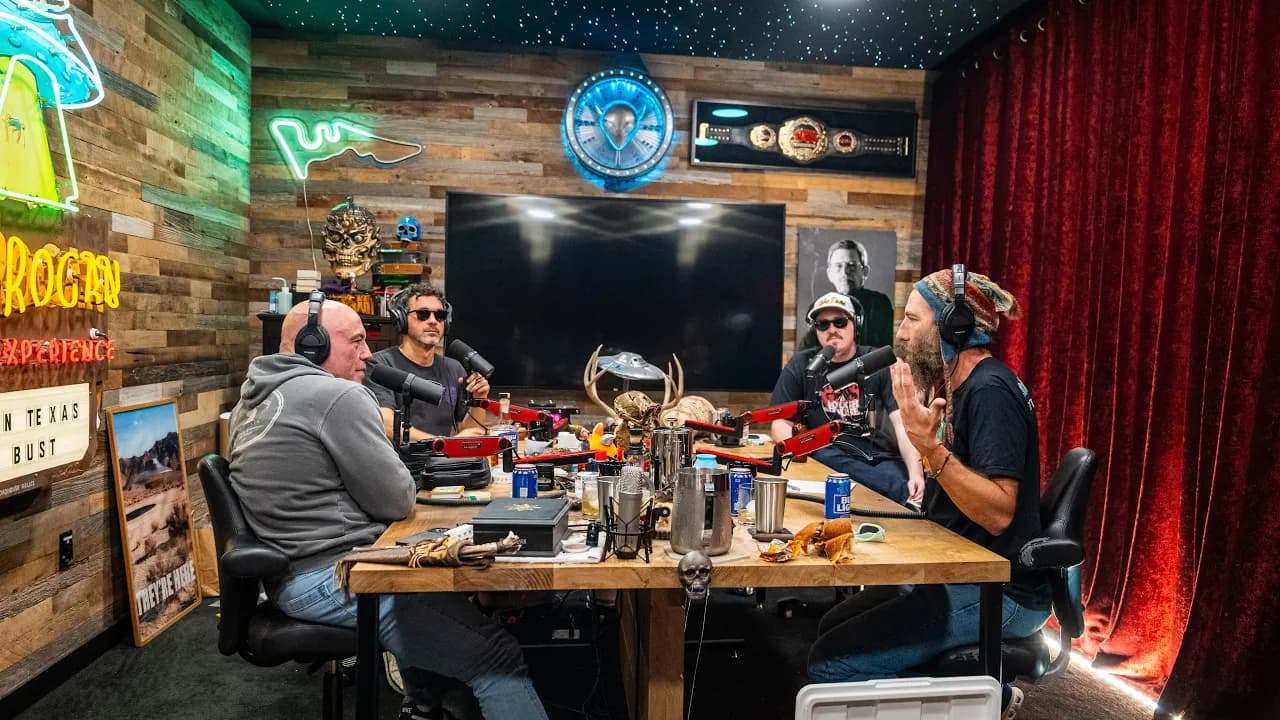
Joe Rogan Experience #2514 - Cameron Hanes
In a Nutshell
Joe Rogan and Cameron Hanes defend public lands against a last-minute Senate amendment that would open 45 million roadless acres to development, urging listeners to call senators at 202-224-3121. Hanes addresses accusations of cheating after winning his age group in the Eugene Marathon while using BPC-157 for a prior injury, arguing the substance provided no performance benefit and that regular runners shouldn't face Olympic-level testing standards. They also criticize government waste, corporate subsidies, and nonprofit hospital profiteering while emphasizing consistent training, mental toughness, and rejecting negativity from social media.
These notes were generated by AI and may contain inaccuracies.
Joe Rogan and Cameron Hanes discuss their socks during the podcast. Hanes brought only one pair of socks and no underwear on the trip. Rogan mentions having done similar before and washing socks in the sink with hotel shampoo then wearing them wet. The weather in DC is noted as muggy for the upcoming UFC event.
Fighters are working out outside in heavy, muggy air. Rogan recalls visiting the Olympic training center in Colorado Springs as a kid. A canopy covers the UFC cage due to weather concerns. Rogan mentions being more worried about a terrorist attack than lightning but acknowledges he probably should be more concerned about lightning.
Rogan has friends who have been hit by lightning, including Remy who experienced hearing issues afterward. Hanes describes being on Diamond Peak with his son Tanner when a storm approached. Tanner's trekking poles began ticking with electricity. They descended immediately. Kids below had hair standing up from static electricity. A man in Florida died from "blue sky lightning" that jumped several miles from a storm.
Florida leads the US in lightning fatalities with 12 deaths and 76 strikes per square mile.
Rogan describes body cam footage of a man running from police who enters water and gets killed by an alligator. The discussion compares being shot versus alligator attack, noting the prolonged suffering from being rolled and dragged underwater. Another video shows a man who lost his arm to an alligator but survived three days in the swamp. He described fighting for his life and being dragged under three times.
Hanes went alligator hunting and has a mounted alligator head. Alligators are vastly overpopulated in Florida and need to be controlled. Bow hunting is possible but sketchy - requires hitting them right behind the head to brain them, approximately 20 yards away with a fixed blade.
Hanes mentions a three-legged bear that survived despite the injury. Animals rarely get infections compared to humans. During elk hunting at Toahone, they found an elk with a back leg filled with pus from being stabbed by another bull during the rut. The back leg is typically targeted when bulls turn to flee.
Bulls break antlers from fighting force. When bulls fight and one gets hit with an arrow between the ribs without hitting vital organs, they barely react initially, comparing it to a fly landing before eventually becoming woozy.
The group watches body cam footage of the alligator attack. The man was swimming away when the alligator attacked. Another story involves a man jumping off a bridge during a high-speed chase and landing on an alligator.
Hanes visited the Everglades three years ago and saw 15-30 alligators. The area is dense, hot, and muggy with alligators everywhere. Fresh water in Florida is filled with alligators. Disney World checks their water regularly after a child was killed by an alligator years ago.
Hanes lived in Gainesville, Florida from ages 11-13 in the late 1970s. Alligators were endangered then and couldn't be killed. A neighbor's dog was taken by an alligator at Lake Alice. People fed alligators marshmallows at docks. Alligators were later hunted nearly to extinction for shoes.
Alligator shoes were popular in the 1970s, especially among pool hall patrons. "Gator boots" were considered stylish with suits. Rogan distinguishes between alligator boots and dress shoes.
Rogan apologizes to Ric Flair who was scammed by someone pretending to represent the podcast and requesting bank information. Similar scams targeted Tim Dillon claiming to be from the Amy Poehler show. Pat McAfee's show was nearly used in a scam attempt. Rogan confirms legitimate podcast invitations don't require bank information.
Hanes brought bear meat and offers to share elk meat with friends and family only. Rogan notes Hanes has extensive notes prepared for the conversation.
Hanes has a gold tooth that started as a joke. He had broken a tooth in high school playing basketball when it hit a girl he was kissing. He had a composite tooth replaced multiple times. A recent dentist visit led to the tooth being removed for a supposed cavity that didn't exist. A dental technician's husband makes gold teeth, leading Hanes to get one temporarily that has now been months.
Joe and Cameron discuss gold teeth as a unique feature. Joe mentions having one crown and a cracked tooth that requires another crown, planning to get a gold one in the back so it only shows when smiling. He notes that he laughs a lot and lives a happy life.
Joe discusses keeping his foot on the gas with the podcast despite its success. He explains feeling fortunate for the opportunity and responsible for maintaining it, noting that people are addicted to the variety of guests including scientists, athletes, fighters, and diverse perspectives. He emphasizes resetting every day by acknowledging how lucky he is rather than viewing work as a burden.
Joe has maintained the number one podcast position for six or seven years. He states he will continue doing his best until the wheels fall off. He compares this to bow hunting, where once you've earned respect in a position, others will try to take it, and the attitude should be to work harder rather than coast.
Joe recounts telling someone "Good luck with that" when challenged to a race, treating it dismissively like a five-year-old's threat. He explains that confidence comes from being further along in something than anyone else. He argues that trying to take someone else's spot is a negative motivation that wastes energy, and that energy should instead be used to celebrate inspiring people and analyze what they do well.
Joe admits he was 100% a hater as a kid, especially toward fighters in his weight division. He now recognizes that comparing yourself negatively to others and finding flaws in them is a waste of energy that could be used to invest in becoming better.
Cameron agrees that energy is a critical resource to protect. He notes that Joe's positive attitude and approach to drawing out information attracts guests who want to appear on the show. People seek out content that gives hope rather than constant negativity about how everything is messed up.
Joe mentions getting into podcasting early in 2009 when few people were doing it, allowing him to hone his craft for years before gaining significant attention. He acknowledges that starting now would make it much harder to reach the top given there are now seven or eight million podcasts.
Joe emphasizes that everything comes down to reps - archery, pool, martial arts, and podcasting all require repeated practice and focused experience. He notes that Sean Ryan's podcast has taken a darker tone recently, covering government issues, Israel, Epstein, and other topics that can leave listeners feeling hopeless.
Joe explains that being a comedian provides a safety net and allows for a layer of conversation involving talking shit - saying things that aren't serious but are funny among friends. Without this ability to joke around, conversations remain stuck in serious territory. He notes that focusing only on the bad of the world is a trap that messes with your head.
Joe keeps notes on his desk reminding him to "Stay positive" and "Be nice" because he can easily lose his mind when dwelling on issues like the Epstein files, JFK assassination, and Charlie Kirk's shooting. He mentions being pissed that promised revelations after the election haven't materialized.
Joe discusses the Iran situation, noting the first bombing seemed unclear in purpose, and the second bombing was concerning. He observes that people who support Israel above everything else are happy about the actions, while America First advocates and those wanting no new wars are upset. He wishes he understood Iranian politics and military structure better, noting their layered control system where replacements are ready when leaders are removed.
Joe mentions avoiding Instagram and Twitter for the last few months, feeling much healthier as a result. He describes Instagram funneling him content featuring schizophrenic individuals with bizarre claims, including one who believes she's JFK's granddaughter with gold in a basement and another who thinks everyone is a man. He also mentions watching street fights, pranks, jokes, and pets on social media.
Joe recalls breaking his phone in Hawaii while bow hunting for Axis deer on Lanai, resulting in three days without a phone that were among the happiest of his life. He acknowledges phones are useful for taking pictures of cool stuff, capturing memories, and answering questions instantly via Siri or Perplexity.
Joe compares social media to a bowl of soup with pieces of meat but mostly shit - occasionally getting interesting science stories or James Webb telescope discoveries, but mostly dealing with cooks, crazy people, grifters, and divisive content. He concludes it's not worth consuming.
Cameron brought bear meat, noting that many people incorrectly believe black bear is not edible. He mentions having a grizzly cooler full of various items. He references Casey Brooks, who killed a world record elk scoring 486, nearly reaching 500. Cameron brought Chilean chili from Casey Brooks to sprinkle on steaks when cooking.
Cameron mentions learning to make a female elk call last year but admits being terrible at using tube calls. He references Bo Brooks, Casey's son, who is a really good elk caller. Cameron brought elk meat processed by Ronnie in Portland, Oregon, which Joe describes as fantastic.
Cameron Hanes brought bear jerky and sausage made from bear meat to the studio. The jerky is described as excellent, and the breakfast sausage is also praised for its quality. Hanes brought rendered bear fat for cooking, noting its dark color. Joe Rogan has previously used bear fat to cook steaks and notes it provides a different flavor profile compared to beef tallow. Bear fat from animals harvested in the spring reacts differently during rendering and sausage making because the bears have recently come out of hibernation.
Hanes watched videos of bear being smoked for 24 hours at bear camp. The meat was prepared as a whole back ham on a Traeger grill after marinating for four days, followed by 20 hours of slow cooking. The result was described as incredible meat. Historical context is provided that settlers in earlier times would eat bear meat and primarily kill deer for hides, as bear was considered superior meat. Public perception that bear meat is not good is attributed to cultural influences including Yogi Bear and Smokey the Bear.
Rogan sent a video showing a mountain lion in someone's backyard in Santa Monica. The discussion addresses a wildlife bridge being constructed for mountain lions at a cost exceeding $100 million. Rogan expresses opposition to the project and suggests equipping vehicles with large grills to manage mountain lion populations that threaten pets. The mountain lion population in California is described as unmanaged and excessive. The housing density surrounding the mountain lion sighting is highlighted as evidence of problematic wildlife management policies.
Hanes wore a shirt referencing Teddy Roosevelt's conservation stance. A bill originally focused on wildfire management has been amended by Senator Mike Lee to include provisions opening 45 million acres of roadless areas. Critics argue the stated rationale about wildfire access is pretextual and the actual goal is resource extraction. The National Forest Service already has $10 billion in deferred road maintenance. Statistics indicate 85-90% of fires start within a half mile of roads, and 90% of fires are human-caused.
Previous attempts to sell public land used different justifications including surplus acreage and affordable housing. Research clarifies that while some Utah politicians who are LDS members have proposed selling federal land, this is a political movement rather than official church doctrine. LDS teachings actually advocate for stewardship and protection of public lands. Utah has 42% of its land managed by the Bureau of Land Management.
Ninety-nine percent of Americans oppose repealing the roadless rule. The discussion emphasizes that biologists should make decisions about hunting and wildlife management rather than politicians or ballot box measures. The roadless rule amendment was added as a last-minute provision without public input. Rogan and Hanes advocate for the position of not losing a single acre of public land, noting that once public land is transferred or sold, it cannot be recovered.
Hunters, hikers, fishers, and other outdoor recreationists previously united to defeat attempts to sell public land. The current strategy of attaching controversial provisions to unrelated bills is described as wearing down opposition through repeated fights. Multiple simultaneous controversies including Epstein files, UFO disclosure, and the UFC White House event are viewed as deliberate distractions preventing focused opposition to the roadless rule.
Rogan agrees with Bryce Mitchell's position that the White House should not host sporting events. Concerns focus on fighter safety and career implications. Outdoor conditions including rain, thunderstorms, bugs, humidity, and temperature would affect grappling performance and endurance. Sweat makes wrist control and submissions more difficult. Historical references are made to fighters soaking in baby oil to reduce grip. Rogan states he would never schedule a world championship fight outdoors if running the UFC.
The event is acknowledged as potentially historic and visually compelling. Dana White is credited with consistently pursuing ambitious venue concepts, referencing the Sphere event in Las Vegas. There is discussion that Trump may want to leave the octagon at the White House after the event. A lawsuit attempting to prevent the event is mentioned but expected to fail.
Rogan expresses strong interest in the Justin Gaethje versus Ilia Topuria fight despite preferring an indoor venue. Topuria's career progression is analyzed through watching his complete UFC record. He entered the UFC already skilled but continued improving significantly. His last three knockouts came against Max Holloway, Charles Oliveira, and Alexander Volkanovski, representing some of the greatest featherweights in history. This resume is described as one of the greatest of all time. Reports indicate CBS will not air the White House event, requiring Paramount Plus for viewing.
Dana White stated that Paramount+ would not televise UFC events because they plan to tell America's story from the first fight to the last. The programming will begin with European settlers arriving and giving smallpox to Native Americans, followed by depictions of buffalo populations, wagon trains, and conflicts. The narrative will also cover the period when Mexico owned Texas starting around 1821, and the purchase of Alaska for roughly fifty dollars.
Trump has been visited multiple times and described as a fun person to be around when he likes someone. He genuinely loves America and wants to improve the White House, including plans to build a ballroom. No president has ever been universally loved. Current frustrations stem from policies that appear contrary to what people voted for, including border protection, American manufacturing, and America First trade policies.
Political pressure forces compromises with pharmaceutical companies, oil companies, and the military. RFK has faced ongoing battles with these interests. Progress has been made with peptides and eliminating unnecessary food dyes, but glyphosate was lost as a major issue. An upcoming podcast guest will discuss glyphosate, including its potential impact on immune systems and whether it contributes to gluten allergies, bromates, pesticides, and herbicides. Iowa serves as a hotspot for glyphosate use and cancer rates.
DDT spraying created the same paralytic symptoms as polio. A woman named Suzanne Humphreys wrote a book called "Dissolving Illusions" documenting how DDT was sprayed behind cars in streets where children played. Animals including horses and cows also became paralyzed from DDT poisoning despite polio not spreading to animals. Between 95-99% of polio cases are asymptomatic.
Joe Rogan previously covered chemtrails on "Joe Rogan Questions Everything." Normal contrails form from hot jet engines passing through cool wet air, but some planes appear to spray substances. Dubai experienced flooding potentially linked to cloud seeding, and Abu Dhabi conducts weekly cloud seeding. Bill Gates has discussed spraying reflective particles in the atmosphere to block the sun, raising concerns about unintended consequences like triggering an ice age.
The roadless rule protects 45 million acres of public land. The phone number to call senators is 202-243-121 to request the roadless rule be kept intact. This issue previously succeeded with the message "not one acre." The current administration removed 31 laws protecting public land. A $1.7 billion no-bid contract was awarded to build a wall in Big Bend National Park in Texas.
Six former Big Bend National Park superintendents wrote a letter urging against the project. The wall project bypasses environmental laws for border protection, though the park sees only about 10,000 legal crossings per year and a very small number of unauthorized crossings. The border follows the Rio Grande with the Boquillas port of entry being the only legal crossing inside the park. Most border crossings occur in Arizona rather than Big Bend.
Border wall contracts totaling over $19.4 billion in six months have gone primarily to Bernard and Fiser. A lawsuit claims contracts were awarded without genuine competitive bidding. The streamlined process bypasses 31 laws and removes checks and balances for public spending. Public land provides mental health benefits and access to nature for people who cannot afford other recreation.
The roadless rule was originally bipartisan. Mike Lee added language that created division, with nine Republican senators voting with Democrats. The bill now requires 60% of the full Senate vote to pass. Lobbyists pressure senators when switchboards are overwhelmed with calls. Trump previously removed public land language from the "big beautiful bill" to get it passed. The current fight centers on preventing sale of public lands for affordable housing development.
Cameron Hanes discussed being invited to the White House for Veterans Day but declined because he disagreed with certain policies including the war in Iran. He stated he didn't want to be used in photos to suggest support for positions he opposed. Hanes emphasized that while he voted for Trump believing he was the better option, he maintains the right as a citizen to disagree with specific policies without agreeing lockstep with the person he voted for.
Hanes appeared on a podcast with Benji Backer discussing public land protection. Following the episode, Trump signed an executive order regarding public land, but Hanes described it as purely theatrical with no actual actions taken afterward. He characterized it as a photo opportunity designed to generate press clippings rather than produce meaningful change or protection for public lands.
The conversation addressed how financial incentives drive political decisions, including massive contracts for border walls and military drones. When following the money behind certain policies, Hanes noted it becomes clear why politicians push specific agendas. He mentioned a local politician who stated they needed to call Israel to secure funding for even a local election campaign.
Jamie pulled up information showing the Citizens United Supreme Court decision occurred in 2010, which vastly increased the role of big money in politics by treating corporations like persons and enabling super PACs to take unlimited contributions from wealthy donors. The ruling allowed dark money from groups that don't fully disclose donors to explode, reducing transparency in political campaigns. Ruth Bader Ginsburg reportedly called it the worst ruling of her time on the court. Overwhelming majorities of Americans have consistently disapproved of the ruling, with at least 22 states and hundreds of cities voting to support a constitutional amendment to overturn it.
Hanes explained Oregon functions as a testing ground for progressive policies. The IP28 initiative was presented to voters simply as stopping animal cruelty to gather the required 117,000 signatures. However, the actual provisions would ban fishing, hunting, and raising animals including backyard chickens. The initiative would make breeding animals for ranching purposes illegal by equating it to rape or sexual assault since animals cannot consent. This would effectively eliminate ranching in Oregon by making it impossible to produce meat locally, forcing consumers to buy from other states at higher prices.
Hanes argued the government prefers consumers who are dependent rather than self-sufficient. Eliminating ranchers, hunting, and fishing removes the need for guns and the ability to provide one's own food. He referenced the concept that people will own nothing and be happy, with smart cities designed to make individuals reliant on government-provided resources. Environmental extremists pushing these initiatives are often paid organizers whose full-time job is advocacy, while ranchers working full-time lack the capacity to organize against such efforts.
Most nonprofits were characterized as scams where the primary function becomes sustaining the organization itself, with the majority of funds going to overhead, infrastructure, and staff salaries rather than the stated charitable purpose. Nonprofit hospitals were highlighted as particularly profitable. In 2023, nonprofit hospitals generated $1.3 trillion in total revenues. They received $38 billion in taxpayer benefits in 2021, including $11.5 billion from tax exemptions. A study of nearly 1,500 nonprofit hospitals found 86% provided little or no charity care. CEO compensation at these institutions reaches approximately $4.5 million annually while nurses earn around $70,000. One New York hospital executive paid himself $15.3 million per year. True charitable hospitals like St. Jude and Shriners exist but represent a small minority of the sector.
Discussion of major corporations receiving substantial government subsidies while their CEOs earn high salaries, with examples including $50 billion in subsidies and CEOs making $15.3 million annually. The conversation highlights systemic fraud across various sectors, including daycare centers in Minnesota and hospice care centers in California where entire motels were converted into fake nonprofit offices to siphon money. Elon Musk described the fraud discovered through DOGE investigations as impossible to fully describe.
The Pentagon has never passed a single audit despite massive budgets, and the national debt stands at $39 trillion. The point is made that this debt could theoretically be addressed through printing money, but maintaining the debt provides greater control over the system.
Dan Gates and Howell are credited with successful efforts in Colorado to fight anti-hunting initiatives. Initiative 302 is highlighted as a key effort to establish hunting and fishing as constitutional rights in Colorado, serving as a potential model for other states if successful. The importance of political education and savvy is emphasized to counter organized efforts against public lands and hunting access.
Credit is given to Ryan Callahan from Backcountry Hunters and Anglers, Senator Martin Heinrich of New Mexico, and Ron Wyden of Oregon for their efforts protecting public lands against selloff initiatives. These individuals are recognized for fighting against the energy and resource committee's money-driven approaches, advocating for those who enjoy outdoor recreation in the mountains.
Cameron Hanes won his age category in the Oregon Marathon but faced criticism for taking BPC-157, a banned substance used to treat a broken foot injury. The injury occurred on June 16, 2024, when Hanes suffered a Jones fracture on the outside of his foot during a race, shredding a ligament and breaking off a piece of bone.
Rather than undergoing surgery with uncertain outcomes that might require multiple procedures, Hanes opted for stem cell treatment and a single BPC-157 injection in November 2024. The bone eventually fused naturally despite continued running, and the foot has now healed completely.
Hanes ran 2:39:11 at the Eugene Marathon, one of the fastest times ever recorded for a 58-year-old. This represents a 10-minute improvement over his previous best times. His historical marathon times include 2:50 in the New York Marathon in 2006 alongside Lance Armstrong, and similar times in Boston in 2008.
The performance is contextualized by decades of running experience beginning at age 5, with 53 years of consistent training. Hanes retired three years ago, enabling better sleep, recovery protocols including sauna and cold plunges, and $2,000 monthly investment in massage and bodywork.
Hanes describes shifting from high-mileage running without specific training stimulus to incorporating track work and structured exercises. The concept of providing proper stimulus for performance improvement is emphasized, including 100-meter strides and specific pace work.
Sleep deprivation was historically normalized with Hanes working 10-hour days while running 20+ miles daily, often sleeping only 2-3 hours. This approach limited performance potential despite maintaining high output levels.
The discussion covers the complexity of USADA banned substance lists, including peptides, pseudoephedrine, and ADHD medications requiring therapeutic use exemptions. Contamination risks in over-the-counter supplements are highlighted, with examples of athletes failing tests due to batch variations in products like Ketone IQ.
Therapeutic use exemptions allow legitimate medical treatments like testosterone replacement therapy for older athletes, though the system has abuse potential. The distinction between regular runners and elite competitors is proposed, noting that the Eugene Marathon with 9,000 participants does not conduct drug testing.
Age-grading calculations suggest Hanes' 2:39:11 performance at age 58 would project to approximately 2:10-2:12 in his prime, which would have been Olympic-winning pace. The conversation addresses whether regular citizens should be held to Olympic athlete testing standards, with Hanes positioning himself as willing to be tested and transparent about substances used to avoid surgery.
Cameron Hanes reviewed waivers for the Eugene Marathon and Coca-Con 250 races. The waivers address liability and insurance matters but contain no mention of USATF, drug testing, or any performance-related requirements.
BPC-157 is not a performance-enhancing substance. It helps heal soft tissue injuries and supports recovery from injuries. The substance was taken two years prior to the Eugene Marathon, making it impossible for the compound to remain in his system during the current race.
Hanes has been called a liar, a cheater, a doper, and accused of stealing. The criticism represents the same pattern applied to successful outliers who face accusations rather than recognition for their achievements. Hanes ran a marathon a day while maintaining an eight-hour job, and Rogan was present during that period and encouraged him to quit the job out of concern for his well-being.
Rogan discussed the balance between mental toughness and recognizing when rest is necessary. Willpower enables breakthroughs that others cannot achieve, but it can also lead to permanent injury. Hanes demonstrated extreme willpower by training with no sleep, which Rogan witnessed directly.
Rogan referenced David Goggins as another individual with similar capacity. UFC fighters including Israel Adesanya and Tony Ferguson, known for exceptional endurance, struggled to keep pace with Goggins during training sessions. Goggins trains in silence without music or external motivation.
The accuser holds ideological opposition to hunting and maintains vegan beliefs. Rogan noted that most people who purchase plants participate in large-scale monocrop agriculture, which causes death to countless creatures, including massive bee populations required for almonds and avocados.
Both individuals push themselves to their physical limits. Rogan suggested the critic might benefit from consuming animal protein.
Hanes maintains friendships with individuals holding opposing political and dietary views. He focuses on shared interests such as mountains, running, and pushing physical limits rather than requiring 100% alignment on all issues. He has friends across the liberal spectrum with no impact on those relationships.
BPC-157 is banned for Olympians but remains legal for regular individuals. Hanes stated he does not care about rules that do not apply to him. He referenced his previous role as a buyer for 20 years, where he followed laws and regulations daily when they affected his work.
USATF rules state that sanctioned events must include specific language in published materials regarding drug testing. The waivers Hanes signed never contained this required language. Hanes stated that if the waivers had included a link to standards or explicitly stated participants must follow website rules, he would have reviewed them.
Hanes has never won prize money or competed on a national team. If he pursued elite competition, he would learn all applicable rules regarding permitted substances. THC remains prohibited on competition day, though it stays in the system for extended periods. Hanes noted that testing cannot easily determine whether someone consumed THC the morning of a race or the previous day.
Rogan referenced Nick Diaz testing positive for THC after defeating Takanori Gomi. The Nevada State Athletic Commission threshold for a positive test is 50 nanograms, while Diaz tested at 175. The commission chair stated the level was a factor in performance. Rogan noted Diaz's toughness existed independently of any substance use.
The BPC-157 was taken for a broken foot in November 2022. It has no performance-enhancing effect two years later beyond the initial healing benefit. Rogan characterized the accusations as coming from a hater. Hanes admitted to previous stem cell treatment and TRT use during the exchange.
Hanes stated he is not competing in an elite field or attempting to win his age category. He admitted the substance use truthfully while noting that others lie about their own usage.
A significant percentage of athletes take peptides to heal injuries. Training at high intensity for fast marathon times increases injury risk. Rogan referenced the concept that all criticism stems from unmet needs. The accuser is an elite athlete whose recognition is limited, and Hanes's popularity and competitive times create friction.
The accuser also criticized CJ Trueit, who runs in jeans and maintains significant muscle mass. Trueit won the world pull-up challenge, completing thousands of pull-ups in 24 hours and sustaining severe hand damage. Rogan stated that discrediting Trueit's marathon performance after such an achievement is foolish.
Terms like "cheater" and "doper" function similarly to labels such as "racist" or "Nazi" by shutting down further discussion. Hanes noted that the accusations taint his reputation despite occurring years ago. He does not take EPO and has limited knowledge of performance-enhancing drugs. He discontinued TRT because he performs better with lower testosterone levels, which aligns with observations about female athletes excelling with lower testosterone and higher estrogen.
Hanes has a prescription for testosterone that remains partially unused. He stated that individuals using substances as performance enhancers would not leave them sitting unused.
Hanes currently weighs 152 pounds, down from the 180s when Rogan first met him. He previously lifted weights and ran approximately five miles daily. He shifted focus to extreme endurance while maintaining functional strength for hunting tasks such as carrying heavy loads.
Rogan noted the performance difference when adding a 25-pound weight vest during workouts. Hanes referenced weighing 192-193 pounds during a previous hunt and feeling significantly lighter compared to his current 202 pounds.
Hanes stated that competitors at Olympic trials qualifiers typically weigh under 140 pounds. The course record holder at Eugene weighed 135 pounds at 6'1". The current marathon world record holder weighs 115 pounds. The physical requirements involve a large engine in a minimal body.
Rogan stated that Hanes is among the most honest individuals he has encountered and works extremely hard specifically to avoid needing to lie. Hanes offered to discuss the situation directly with the accuser on the Keep Hammering Collective platform.
Rogan discussed how people construct narratives about individuals they do not know personally, then attack those constructed versions rather than the actual person. This pattern appears in contexts including war and religion. Powerful keywords enable garnering support without requiring defense.
Hanes attributed increased peptide and TRT usage partly to declining trust in conventional healthcare. Difficulties accessing doctors, prescription-focused medical visits, and COVID vaccine messaging contributed to people seeking alternatives. Wellness clinics emerged offering blood panels, identifying deficiencies, and focusing on optimization rather than treating illness. People report feeling better under this approach compared to traditional medical experiences.
The conversation addresses how doctors prioritize writing prescriptions over exploring alternative options. A hospital video highlighted how the medical system operates differently than patient interests might suggest. This explains why waste occurs and why treatments like peptides could potentially bypass surgery. The sport of ultra running needs to evolve and embrace these changing approaches because most participants are regular people working full-time jobs rather than elites or Olympians.
Congratulations were given on a successful bear hunt that yielded two large bears named John and Jen from the Rivet family. Plans were mentioned to visit next year. The location features bears with no natural predators other than grizzlies, requiring population control because they devastate moose, deer, and elk populations by killing calves. These bears are ruthless, opportunistic hunters that even eat each other.
In Alaska, authorities fly helicopters to shoot bears because populations are too high and not enough are being killed through normal means. This wipes out ungulate populations. The public generally doesn't know about these management practices, often viewing bears through the lens of cartoon characters like Yogi and Boo Boo. A trip to Alberta was suggested to see the reality of bear populations.
A grizzly encounter story was shared from a previous trip where the group quickly left the area upon sighting one. Grizzly hunting has stopped in certain areas due to high numbers. When grizzlies approach bait sites, hunters must leave immediately, especially when sitting on the ground. Hunting needs to resume in British Columbia where the law change created a disaster with grizzly overpopulation.
Critics from urban areas without wildlife encounters engage in ballot box biology, attempting to outlaw trophy hunting by characterizing hunters as cruel individuals seeking to shoot animals for their hides or prove masculinity. The distinction between bear hunting and deer or elk hunting was questioned since the meat is consumed either way. A story was shared about a daughter mentioning bear as her favorite food at school after being served bear candy, a sweet and sour preparation made with brown sugar.
Jen prepares excellent bear stir fry. Mountain Ops freeze-dried meals were discussed as an option for incorporating bear meat. The process involves dehydrating meat and vacuum sealing portions for camp use, which is considered the best approach for eating clean in the mountains.
What you consume for calories matters significantly during ultras and physical performance. Mountain Ops freeze-dried chicken Alfredo was praised as quality calories for long hunts. Electrolytes made a substantial difference when using Element in water during hunts. Element is consumed first thing in the morning, especially important for someone running daily who experiences heavy sweating leading to skin sores from wet clothing.
Extended running causes skin sores where wet shirts sit against the skin. Some runners experience nipple damage requiring protection. A running pack is used to hold the shirt in place. Starting the day with electrolytes or even sea salt in water helps maintain mineral balance and supports higher performance levels throughout the day.
The conversation concluded with a call to contact senators at 202-224-3121 regarding keeping the roadless rule intact. Criticism was directed at Mike Lee regarding this issue.
Keep PowerfulJRE in your library
Save the videos and channels worth coming back to, and find them again in one place.