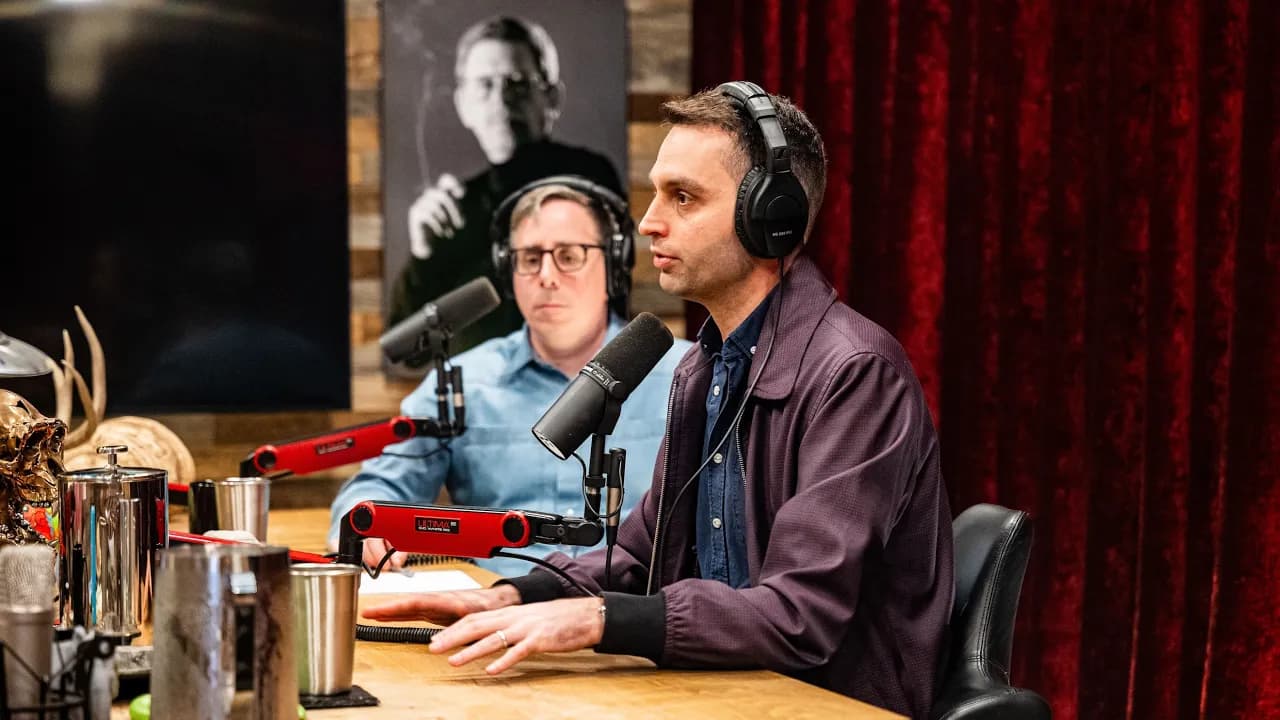
Joe Rogan Experience #2522 - Tony Hinchcliffe
In a Nutshell
Joe Rogan and Tony Hinchcliffe discuss the extreme complexity of semiconductor manufacturing machines, the near-impossibility of rebuilding modern civilization from scratch, and how foreign aid and nonprofits function as self-serving businesses. They examine the decline of major cities, media manipulation of narratives, and how outrage culture has changed comedy reception. The conversation covers combat sports techniques, celebrity financial mismanagement, and Tony's experiences with controversial jokes at high-profile events.
These notes were generated by AI and may contain inaccuracies.
Joe mentions the world seems back at war officially. He references bombings in Lebanon and American bases, noting an agreement with Iran did not last. He prefers to avoid paying attention to these events and instead distracts himself with science and space content.
Joe watched a documentary on how semiconductor chips are made. He describes an extremely complex machine used in the process and plans to share it with Jamie. The machine is considered one of the most complex in the world, involving stacking atoms to create high-end chips. Joe contrasts this advanced science with their podcast discussions about unrelated topics.
Joe plays a video segment explaining a machine that manufactures chips for computers and AI. The video describes a thought experiment: imagine being shrunk to the size of an ant with a laser strong enough to melt metal. A tiny droplet of molten tin the size of a white blood cell is shot at 250 km per hour, and the task is to hit it three times in 20 microseconds.
The machine hits 50,000 tin droplets every second, heating each to over 220,000 Kelvin—roughly 40 times hotter than the surface of the sun. It performs 150,000 laser shots per second without missing. The machine contains mirrors that are among the smoothest objects in the universe; scaled to Earth's size, the largest bump would be no thicker than a playing card. It can overlay chip layers with accuracy within five atoms while parts accelerate at over 20 Gs. Only one company in the world can build this machine, which was long considered impossible.
Tony explains that chips are produced on large sheets containing 30 to 50 units. Each is tested, and quality determines the final product: the best chips become i9 processors, while slightly lower-performing ones become i7 processors. All originate from the same sheet, with the highest-grade chips sold at premium prices. Joe suggests the Samsung chip factory issues likely involved producing more lower-quality chips than desired.
They discuss a scenario where only people in the room survive. They estimate needing several thousand regular people to avoid inbreeding issues similar to those affecting English royalty. Starting over, individuals would function at a basic prepper level, like survivors from a plane crash. Joe states it would take infinity to rebuild current technology because each invention relies on thousands of prior geniuses building foundational steps. Distractions like sudden wealth or relationships could set progress back 100-200 years.
Joe notes many seek flaws in Elon Musk's work rather than appreciating living in an extraordinary time. He addresses narratives claiming US aid cuts have caused deaths in underfunded hospitals. While acknowledging potential negative impacts, he highlights that much aid funding involves fraud. He questions the premise of sending tax money abroad, suggesting it is not pure charity and often benefits those profiting from the system.
Joe describes foreign aid and many nonprofits as businesses wrapped in virtue. Participants may start with good intentions but become entrenched in systems offering high salaries and overhead costs. He cites the LA fire aid, where over $100 million went to approximately 200 different nonprofits, much of which covered employee salaries, rent, and operations rather than direct relief.
Joe references Mike Benz's explanations that the Agency for International Development funds activities beyond traditional aid, including subversive rap bands intended to destabilize governments, rebel groups, and newspapers. He discusses theories that gangster rap in the 1980s was promoted by government or intelligence factions to increase crime, fill private prisons, and justify stricter laws.
They observe that rap music is currently absent from charts, coinciding with pauses in US aid. Joe questions whether mumble rap represents an intentional effort to promote less articulate artists. He finds much of it inaudible and speculates it may be designed to reduce intelligence in listeners.
Tony asks about cough syrup use. Joe recalls taking Nyquil in the 1990s during illness and experiencing intense relaxation from the warmth and comfort. He recognized the danger of enjoying it too much, especially given its 25% alcohol content plus other ingredients. The original formula included ephedrine before changes in the mid-2000s removed pseudoephedrine due to methamphetamine production concerns. They clarify that standard Nyquil does not contain codeine; lean typically involves adding codeine to cough syrup.
Joe describes receiving morphine via a patient-controlled drip after knee surgery, noting the limit on button presses. Tony shares his experience at Austin Dental Spa, where laughing gas creates a state of relaxed honesty. During one procedure, he asked the dentist why he did not pursue becoming a "real doctor," later recognizing the comment as potentially offensive but noting dental professionals are accustomed to such statements induced by the gas.
Tony recounts needing a root canal after an old plastic filling cracked, leading to infection. Upon removal, pus and a horrific smell emerged. He notes that dental infections can become septic and fatal if untreated. He describes using water flossers after brushing and observing debris that would otherwise remain between teeth.
Tony's dentist attributes the sharp rise in cavities to increased sugar consumption, particularly sugary sodas and candy. High fructose corn syrup is considered equally or more problematic than cane sugar due to differences in bodily absorption. Natural sugar sources like Hawaiian pineapples deliver sweetness with lower acidity.
Tony's friend Anthony from Hawaii brought white Hawaiian pineapples and coconuts. These fruits have higher sugar but much lower acidity than typical varieties, creating a distinct taste. Tony notes the challenge of obtaining such high-quality natural produce outside their native regions.
White pineapples, also known as sugarloaf or white jade pineapples, are a highly prized rare variety grown in Hawaii. They feature creamy white flesh with practically no acidity and a complex, completely edible core.
A friend described as a real free spirit visited Hawaii, got a one-way ticket, and stayed. He is currently spending a week and a half in Youngstown visiting family and friends. The best hotel option in Youngstown is actually in Pennsylvania, about 50 minutes away. The DoubleTree downtown is in an area of absolute chaos.
Youngstown was the murder capital of America per capita in 1990, 1991, and 1996. The city earned the title four-time defending champion murder capital of America. During developmental years growing up there, police sirens or ambulance sirens could be heard almost constantly. The north side was the most dilapidated part of Youngstown.
Sixty years ago, Youngstown was called Crime Town, USA. There were 75 bombings and 11 killings in a decade during the mob days. The city was known as Bomb Town, and a Youngstown tuneup referred to a car bomb. Someone tried to kill the actual prosecutor and DA, which brought the FBI down on the perpetrators.
Working at an Italian restaurant right out of high school, firsthand observation of mall developers and huge moguls meeting with politicians, congressmen, and local officials in quiet corners. This was before cell phones, when businesses had to be bugged to gather information. Being involved in big-time business required being connected with the Teamsters and Longshoremen.
Friends had no-show jobs where they were simply given money. One friend had a union no-show job at the Javits Center in New York. The Sopranos depicted these real no-show construction jobs. Unions would make agreements to receive a certain number of jobs beyond what actually existed.
A 2000 New Republic publication listed the chief of police, outgoing prosecutor, sheriff, county engineer, local police force members, city law director, several defense attorneys, politicians, judges, and a former assistant US attorney as controlled by the mob. Youngstown has approximately 25,000 white people currently.
Growing up watching pro wrestling and being obsessed with Goodfellas, A Bronx Tale, and The Godfather shaped views of humanity and life. Moving to LA from Youngstown brought surprise at how peaceful it seemed compared to expectations from Tupac songs.
Grandparents' house in New Jersey was bought in the 1940s in what was an entirely Italian neighborhood. Real estate agents practiced blockbusting by going door to door warning that Black people were moving in and pressuring sales. The grandfather refused to sell. The neighborhood later saw Spanish-speaking residents including Dominicans move in after Black residents left. In 1991, while living there, the DEA smashed down the next-door neighbor's door; the resident was selling crack and had an Audi parked in the driveway.
Italian neighborhoods being taken over by new immigrant groups follows a cycle seen in mob-run cities like Youngstown, Chicago, and Detroit. Italians who came in the early 20th century were poor and came for labor. As they moved up and into suburbs, new immigrants moved into the formerly low-income Italian and Irish neighborhoods.
Boxing reflects similar immigration cycles. Early 20th century had many Jewish fighters like Slapsie Maxie Rosenbloom. Later came Italian fighters including Rocky Marciano, Rocky Graziano, and Jake LaMotta. Puerto Ricans and fighters from other backgrounds followed. Roberto Duran came from a very poor, violent part of Panama.
Youngstown is known for boxing. Kelly Pavlik has appeared on the podcast and was described as a beast. His fight with Jermain Taylor featured a dramatic comeback after being dropped, with Pavlik rocking Taylor in the corner.
Boots Ennis fought Zas in a fight watched recently. Ennis beat Zas for the most part but got rocked in the third round. Zas was dropped badly in the second round but showed tremendous heart by coming back. Ennis stopped Zas in the seventh or eighth round. The third round was described as incredible.
Ilia Topuria's close-range strength in the clinch is scary. Chael Sonnen's quote was referenced: if you try to win by knockout and fail, you won't win a decision. Topuria had Justin Gaethje hurt but Gaethje's durability allowed him to survive. Topuria stopped Gaethje in the fourth round. Gaethje stated in the post-fight interview that when Topuria is fresh, his skills are unmatched.
Max Holloway caught Brian Ortega with a jump spinning back kick to the face in the last seconds of the first round, breaking Ortega's nose. This changed the fight dynamics. Ortega was already pressing and appeared to have a slight advantage before the kick. Holloway is a clever fighter who switches stances and moves constantly. The spinning back kick had not been featured much in his previous fights.
Ilia Topuria's nose was likely broken in round two against Gaethje. Gaethje caught him with uppercuts during collar-tie exchanges. Justin does a move where he collar ties and throws an uppercut in tight, turning opponents slightly before throwing.
An X-ray of Frankie Edgar's nose shows it is destroyed. He gets zero air through his nose despite having the best cardio on the planet. Edgar refuses to get it fixed because it would require a year off from fighting.
Fixing a fighter's nose carries risks. If re-broken in a subsequent fight, reconstruction may require taking pieces of rib and grafting bone. The graft may not take, leading to infection. A bone infection on the face could require nose removal.
MMA is the most exciting sport to watch because fighters risk their lives, health, and bones. Boxing is tamer by comparison with fewer weapons, fewer options, and more padding. There are no chokeouts in boxing.
A fighter named Rusev put a Russian or Ukrainian opponent to sleep with a rear naked choke. The opponent looked dead lying there. The choke was described as nasty and dark. Memes emerged from the moment along with the WNBA girl pointing meme.
WNBA players throw each other to the ground and jab each other in the eyes. They also travel constantly, taking four or five steps without calls. Double dribbles occur frequently. The NBA has a technically different rule involving a gather step that is manipulated during referee training sessions.
The NBA rule on traveling has evolved to allow movements that would be called traveling in high school and college. The desire for exciting basketball conflicts with strict enforcement of traditional rules. Michael Jordan would leap from the free throw line, which does not look real in videos.
Jordan was possessed by his desire to win and would do things that made observers wonder how a person could fly. He did not make his high school varsity team as a freshman. Most freshmen do not make varsity because they are not developed yet.
Some parents in Texas keep their kids back a year so they will be bigger as freshmen. This is more acceptable in football where there may be professional aspirations, but less so in wrestling where there is no money and a 16-year-old could be in ninth grade.
The physical difference between ages 17 and 19 is massive in wrestling. At 17, many athletes are still developing, while by 19 they have reached near full man strength with two additional years of training and testosterone. This creates significant competitive advantages when older athletes face younger opponents in the same weight class.
Tony Hinchcliffe shared his own wrestling experience starting as a sophomore after being humiliated in a locker room headlock incident. He began wrestling in the park with friends and quickly realized the gap between his karate training and actual wrestling conditioning.
Wrestling practice reveals what real conditioning feels like. Sessions include running stairs, fireman's carries around the mat, push-ups and sit-ups until exhaustion, and nonstop live drills. One drill involved escaping from the bottom position against much larger opponents for training purposes.
Tony recalled being a 103-pound wrestler forced to escape from a 235-250 pound teammate during drills. The weight disparity and constant pressure made basic movement nearly impossible, demonstrating the raw physical hierarchy within weight classes.
Wrestling serves as the foundational skill in mixed martial arts. Advanced wrestling ability consistently neutralizes other fighting styles and creates psychological pressure that compounds over time. Examples include Hamzah Chimaev's dominant wrestling against Dricus du Plessis, where he repeatedly took the former champion down and locked him in crucifix positions.
Khabib Nurmagomedov's control was highlighted as the pinnacle of wrestling dominance. His signature position involved trapping opponents' legs with his own while maintaining top pressure, preventing any effective posture or escape attempts.
Khabib's effectiveness came from keeping his knees off the ground while maintaining heavy hip pressure. This positioning made escape nearly impossible as opponents absorbed repeated unanswered strikes while unable to move. The psychological impact of being trapped on the mat facing the logos while the clock ticks was described as deeply demoralizing.
Even when fighters attempted to stand, Khabib would immediately chase and drag them back down. The energy expenditure required to get up often left fighters exhausted and vulnerable to immediate takedowns.
Referees should only stand fighters up after fouls, not for entertainment purposes. Allowing fighters to maintain dominant positions rewards strategy and energy management. The rope-a-dope strategy used by Muhammad Ali against George Foreman was cited as an example of legitimate tactical patience that would be ruined by forced stand-ups.
A proposed rule change would have fighters resume each round in the exact position where the previous round ended. This would eliminate the artificial advantage given to strikers who benefit from resets they did not earn.
Rankings should be the primary factor in determining fight matchups rather than entertainment value alone. Tony expressed that if he ran the UFC, he would prioritize merit-based matchmaking even if it reduced excitement, though he acknowledged this approach might not be commercially viable.
The White House UFC event reached an estimated 30+ million viewers on Paramount alone, with total viewership across platforms potentially reaching 150 million. The flyover jets and overall spectacle created genuine nervousness even among experienced participants. The event demonstrated how combat sports can generate massive cultural moments that transcend typical viewership.
A planned White House Correspondents Dinner scheduled for July 24th was canceled following a security incident. A substitute teacher reportedly reached the first level of security screening and fired shots, striking a Secret Service agent in a bulletproof vest. The dinner may be rescheduled at the Waldorf Astoria once enhanced security measures are implemented.
Shane Gillis performed his Trump impression and Adam Ray performed Biden during a Kill Tony episode recorded right after the first presidential debate. The timing made the political impressions particularly relevant. During the show, Gillis as Trump remarked about the number of handicapped guests, then reacted with visible discomfort when the next contestant revealed deformed arms.
Gillis's facial expressions were noted as one of his greatest comedic weapons, becoming even more effective when performing as Trump. His impression was described as the best Trump impression available due to both technical accuracy and the quality of accompanying material.
Shane Gillis was initially reluctant to participate in a roast of Kevin Hart but ultimately performed and helped create significant controversy. The event was informally referred to as a "roast of black excellence," highlighting inconsistencies in what types of racial commentary are socially acceptable. Cain Velasquez's "Brown Pride" tattoo was contrasted with the backlash Sean Strickland received for posting about "White Pride."
Gillis was described as consistently funny in everyday settings, comparable to Mike Tyson in his prime for the way he lands unexpected comedic hits through small reactions and observations.
Sean Strickland posted an Instagram picture as world champion with white pride on his chest next to Cain Velasquez as champion with brown pride. People would lose their minds over that imagery. Strickland is described as a wild boy who showed up at a UFC event despite being banned and got arrested by six cops in bulletproof vests. He was the only American world champion at the time of a UFC event at the White House before Justin won, but was told he couldn't come because he talks too much about Israel and Epstein stuff.
Tony suggested that when Strickland retires from fighting, he should do a podcast. Strickland said he couldn't sit there every day talking to people for hours, but Tony clarified he doesn't have to do that format - just share his opinions on things. When Strickland lets his whole stick down and gives his opinions, he's a very smart guy, not stupid at all, and would get better at podcasting over time. He's entertaining as hell.
Josh Hocket is described as the most entertaining American fighter. People were upset when he said Michelle Obama's a man at the White House, but that's what he's doing on purpose - wearing an American flag bandana, coming out to a Hulk Hogan song, wearing sunglasses during interviews. He said the exact same thing about Michelle Obama being a man in a previous interview with Tony. That's how he ends his interviews, trying to get people to talk about him.
All of it would be nothing if he couldn't fight. The real excitement is in the pre-fight stuff. At the post-fight interview press conference, he did a Kill Tony minute where he purposefully bombed with corny, bad jokes, saying "Man, tough crowd" and trying different jokes. He was being hilarious by strategically trying to be funny but not being funny, trolling and getting attention while he can actually fight.
Hocket talked a lot of shit about Alex Pereira. Pereira lost to Serial Gon and might be done, though fighters often say that after a loss and come back when offered money. A potential matchup between Pereira and Josh Hocket as co-main on a New Year's Eve card was discussed. Hocket would make fun of Pereira's headdress and face makeup.
Pereira was dominant at 185 and 205 but the extra weight at heavyweight may not have been the right move. Working out with a 25-pound weight vest shows how much harder everything becomes. At 185, Pereira probably weighed 220-226 on fight night. At 205, he got into the 230s. At 251, he looked like he was carrying unnecessary weight, particularly in his ass. Being 20 pounds lighter might preserve his speed and movement while maintaining his crazy knockout power.
Serial Gon is in his prime with no heavyweight like him - nobody moves like him. He's extremely accurate and agile for a heavyweight. Basketball is a great place to start if you're a big athlete wanting to learn combat sports, especially striking, because of all the direction changes, spinning, moving, and plyometrics involved. Jordan's jump would translate to a flying knee from 14 feet away.
Serial Gon started out playing basketball. He's in France, which doesn't have wrestling in high school or college. He learned wrestling after becoming an elite world-class Muay Thai fighter, and his grappling has come up in big ways, though he's primarily a striker.
When Jon fought Serial Gon, Jon got him to the ground and submitted him quickly. Francis beat him too by getting a hold of him, with most of the fight on the ground. Francis defended his world title with a blown-out ACL and had big knee pads on. It's a shame Francis isn't in the UFC because the best heavyweight, the lineal heavyweight champion, isn't fighting for the UFC. Tony tried to make a fight between Francis and Jon happen but doesn't think it will occur.
Francis is 38, which is different as a heavyweight. Heavyweights turn 40 in September, and unless you're Bernard Hopkins, fighting at world-class level in your 40s is unheard of.
Bernard Hopkins fought Kelly Pavlik and outboxed him badly when Hopkins was 43 years old against a 26-year-old at 170 pounds. Hopkins fought at world-class level until age 50. After Hopkins beat Pavlik, Pavlik won his next two fights then had a bad staph infection and allergic reaction to antibiotics that nearly killed him. Pavlik eventually fought again against light middleweight champion Sergio Martinez and lost by unanimous 12-round decision. Martinez was a bad dude who came on strong in late rounds.
There's only so many wars a fighter has in them. The really clever guys are the ones who don't get hit much. Melick Taylor versus Julio Cesar Chavez is an example where Chavez put it on Taylor, dropped him in the final moments, and Richard Steele stopped it with one second to go despite Taylor being ahead on the scorecards. The real story was the damage Chavez put on Taylor, who was never the same again.
Tony went down a Maidana rabbit hole. Maidana was an animal who fought everybody and was one of the few guys to really rock Floyd Mayweather, knocking his tooth out and wearing it around a chain on a necklace. Maidana dropped Broner when Broner was in his prime.
Floyd is 49 and reportedly made $750 million but is now broke. The lifestyle was all about showing wealth - wearing diamonds everywhere, buying crazy watches, bringing 30 watches on 30-day vacations including an $18 million watch. He opens suitcases filled with millions of dollars in diamond-encrusted Patek Philippes. The problem is you can only do that for so long. Having one $18 million watch is one thing, but having multiple watches costing millions each, plus four or five Rolls-Royces at half a million each and 10 Ferraris, adds up to 50-60 million in watches and cars alone.
Tyson talks openly about spending hundreds of millions of dollars. A super documentary about how Floyd spent the money would be valuable, similar to the 30 for 30 "Broke" about NFL players.
Nicolas Cage went from a $150 million fortune to being $6 million in debt in the late 2000s without officially filing for bankruptcy. He cleared his debts by relentlessly taking on movie roles including direct-to-video films and selling off real estate and assets. He spent money on crazy things like two snakes for $455,000 (equivalent to $276,000 in 2005), T-Rex skulls, crazy pieces of art, and old historical things.
Nicolas Cage's first film credit was in 1982's Fast Times at Ridgemont High as Nicholas Coppola. Valley Girl in 1983 was another early credit before he changed his name because he didn't want to be connected to his uncle Francis Ford Coppola. Raising Arizona was a big hit and is a Coen Brothers movie. The Coen Brothers make out-there, hilarious movies.
Kingpin by the Farrelly Brothers is an unbelievable, funny movie. The scene where Woody Harrelson is throwing up in the toilet while a woman talks about him eating her ass to pay his rent stands out. Woody's range is incredible. In Kingpin, they primed all the actors to get really excited when Bill Murray throws three strikes in a row, saying it might take a while. Bill Murray actually threw three strikes in a row on the first attempt and everybody went crazy for real.
Woody Harrelson is a freak who sneaks up in so many great things. He's in No Country for Old Men, coming in halfway through with all these other greats and crushing it without even being promoted.
Woody Harrelson is described as a freak of nature and an exceptional actor. A clip of him playing LBJ was particularly impressive, with the performance being so good it kept the viewer awake instead of falling asleep. Harrelson is characterized as a super nice, chill person who hangs out in the green room like everyone else. He doesn't have a phone and requires going through his wife to reach him, which insulates him from nonsense. He grows his own weed, makes his own tequila, eats live food, laughs, and enjoys life. He and Makana have a TV show coming out on Apple TV where they play brothers.
Tony Hinchcliffe expressed surprise that discussions about his roast material lasted so long. He was similarly surprised by reactions to the Pang Dang bit and the Trump rally material. He noted that the Kevin Hart roast was the appropriate time and place for edgy jokes. At the Tom Brady roast, he performed a George Floyd joke. He also did a Kyle Rittenhouse joke, which some people found offensive when taken out of context.
Hinchcliffe explained his strategy at the Kevin Hart roast: because there were many performers and allotted time constraints, he delivered more jokes per minute than usual, creating a rapid-fire sequence rather than milking applause breaks. He described himself as a heal in wrestling terms—someone who doesn't expect the audience to like 100% of his jokes. He performed a Charlie Kirk joke during the set, noting that Kevin Hart has more gunfire at his merch table than Charlie Kirk. Many comedians who expressed offense weren't in attendance at the roast.
Tiffany Haddish handled media questions about the roast perfectly, refusing to be baited. Cheryl Underwood was also mentioned positively—she worked with Joe Rogan in Montreal in the early 2000s and was described as a monster on stage, clutching her purse while absolutely killing it.
Lonnie Love stated the roast was exhausting and edgy, specifically referencing the George Floyd joke. Tiffany Haddish responded that the show should have been shorter, noting she had to use the bathroom and missed the George Floyd joke entirely. She pointed out that critics voicing offense were comedians who weren't invited to the event.
The conversation addressed how outrage functions as a commodity with engagement value. Hinchcliffe noted there was no ruckus at the actual roast—everyone was high-fiving and laughing. The controversy only emerged later when people left and saw online reactions. He mentioned that at his 3:00 PM set at a half-filled Madison Square Garden before Trump's 8:00 PM arrival, everyone was thrilled with his performance. The Puerto Rico joke later became a news story despite the positive in-person reception.
Hinchcliffe was positioned after the national anthem at the Trump rally, followed by a "Make America Great Again" speech. The venue wasn't miked or lit for standup comedy, yet the audience was laughing and having a good time. He noted that standup works best when performed where people are doing standup, and that the Madison Square Garden set worked in-house despite the unusual circumstances.
Rogan explained that Hinchcliffe's fame rose organically through Kill Tony's YouTube clips and moments like Shane Gillis and Kyle Dunnigan appearances, without promotional campaigns. After the Madison Square Garden controversy in 2024, media attention intensified. Hinchcliffe noted that if a clean comedian like Nate Bargatze or Jim Gaffigan had said the same material, it would have been considered crazy, but his saying it was normal.
The discussion covered how comedy was historically understood as saying outrageous things that weren't genuinely meant, similar to how Bob Marley didn't actually shoot the sheriff. Louis C.K. was cited as a left-wing progressive who said offensive things on purpose because they were funny, and audiences understood this. Around 2016, coinciding with social media prominence, people began treating comedy as genuine statements rather than material. Some people online are described as mentally ill, constantly arguing and seeking hot takes for engagement.
Comedians who engage in constant online conflict were noted as having poor careers compared to contemporaries and struggling with mental health issues, pharmaceuticals, and therapy. Online outrage doesn't convert to sold tickets or career growth. Hinchcliffe referenced the Mencia situation, stating that even though he believed it was the right action, he wouldn't do it again due to the overwhelming negativity and darkness it created. He told his agents they were making a mistake aligning with someone who would be in jail in any other industry.
The conversation explored the distinction between stealing and being inspired by creative work. Radiohead's Creep required giving songwriting credits to The Hollies' The Air That I Breathe. Lana Del Rey was accused of ripping off Creep with Get Free. Bittersweet Symphony by The Verve had to relinquish all royalties to The Rolling Stones after sampling The Last Time. Elvis Presley's career was inspired by Black musicians. The Gorillaz used a preset demo button on a toy keyboard for the backbone of Clint Eastwood. The point emphasized was that creativity builds on previous inventions and influences rather than occurring in a vacuum.
Hinchcliffe noted that the Puerto Rico joke at the Trump rally was a small portion of a much longer joke he had been performing during the pandemic. He left out tags from the longer version that might have protected him from criticism. Rogan had warned him years earlier that the joke would be problematic. Comedy is described as an art form best experienced live in person rather than through clips, as stated by Doug Stanhope—everything done on TV serves to get people to clubs where the real fun happens.
Engaging in online conflict was characterized as creating negative energy that harms mental health. Rogan recommended spending time on positive energy activities like having fun and making people laugh rather than dwelling on negativity. Twitter/X was described as now functioning primarily as news, making it difficult to absorb without becoming angry at a constant stream of abominations. The algorithm shows positive content like police chases gone wrong and UFC highlights, but surrounding content is problematic.
Hinchcliffe describes watching CNN coverage of a recent State of the Union address while staying at a hotel in DC. The coverage focused on claims of racism, accusations that the president caused deaths of black people, and assertions that America was failing and had become the laughing stock of the world.
Fox News featured a counterpoint person debating the panel, unlike CNN where panelists were in complete agreement. Hinchcliffe found the Fox debate stressful to watch. He also briefly watched MSNBC and described all cable news as overwhelming.
Hinchcliffe switched to Silence of the Lambs on cable television to calm down and found it coincidentally playing during the Buffalo Bill scene where a girl is kept in a well. He fell asleep within five minutes, noting the dark content provided relief compared to the news.
Hinchcliffe notes that Fox News still features debate between opposing viewpoints, while CNN has one person, Scott Jennings, who regularly takes criticism from the rest of the panel. Joe Rogan describes Jennings as a war hero taking bullets daily and suggests he probably has months to live.
Hinchcliffe recalls when CNN featured more varied programming including Anthony Bourdain's travel and food show that explored different cultures and communities. He notes the network shifted toward outrage-focused content over time.
Discussion of Bari Weiss potentially running CNN and CBS News under the same ownership. Hinchcliffe notes that people already don't trust or take CNN seriously.
X has become a primary news source because people can't trust traditional media. Hinchcliffe references Tim Dillon's podcast where New York Times reporters claimed there was no evidence Jeffrey Epstein was connected to intelligence agencies.
Hinchcliffe recommends watching Mike Benz episodes that detail Epstein's intelligence connections, describing the evidence as making it almost impossible that Epstein wasn't involved with intelligence agencies.
Traditional media outlets avoid covering stories about early vaccine safety signals, Fauci's pressure on scientists regarding gain of function research, and Tulsi Gabbard's speech accusing Fauci of lying to Congress. They can only report news they're approved to cover.
X contains significant misinformation including mislabeled videos from wrong years or locations, AI-generated content, and bot activity. Hinchcliffe describes feeling poisoned after engaging with the platform but also feels irresponsible avoiding it.
Hinchcliffe argues that Trump calling media fake news was counterproductive because it made the concept sound like a partisan talking point. People dismiss the idea of fake news simply because Trump said it.
No one faced consequences for promoting the Russiagate story. The same people who pushed that narrative continue appearing on television as commentators.
The pandemic served as a major redpilling event for many people, particularly those who were forced to take vaccines for work or travel and experienced adverse effects.
Hinchcliffe describes being considered a skinny guy in Austin but labeled a racist Nazi in LA. He notes different geographic areas have distinct mentalities about political and social issues.
Comedy roasts and media invented claims that Hinchcliffe and Shane Gillis accepted money to perform in Saudi Arabia. Both comedians actually turned down the offers. Netflix clipped footage from Kill Tony and used it with a caption making it appear Hinchcliffe was guilty.
Chelsea Handler attended dinner at Jeffrey Epstein's house along with Woody Allen. She reportedly told Allen she was upset with him. Hinchcliffe notes the hypocrisy in criticizing comedians for Saudi shows while ignoring other controversial associations.
Jessica Kirson performed at the Riyadh Comedy Festival and donated her fee to the Human Rights Campaign. Hinchcliffe notes the money goes to organizational payroll rather than directly addressing issues like homelessness.
Hinchcliffe argues that audiences in Saudi Arabia are regular citizens who don't otherwise get to see American standup comedy live. Comedy, like music and literature, can change perspectives and win hearts and minds by showing shared human interests.
Heavyweight left-wing MMA media doesn't criticize Saudi Arabia hosting boxing matches to the same degree they criticize comedians performing there.
Tom Segura responded to criticism by posting a photo of a Ferrari with the caption thanks Saudi Arabia, choosing not to engage with the controversy.
Hinchcliffe mentions not wanting to go straight from a Trump rally to Saudi Arabia. He also dislikes the 16-hour flights required to travel there.
Hinchcliffe suggests people try not engaging with social media arguments for a month to see how much better they feel. He notes some people make a living as paid posters focused on generating engagement.
Gavin Newsom receives intense negative responses in comments on his social media posts. Hinchcliffe questions how he remains unaffected by the constant attacks.
Hinchcliffe describes visiting California cities and observing decline. San Diego and Huntington Beach retain some common sense and happiness, but major cities show widespread problems. Comedians observe this through travel and interactions beyond just performing shows.
The drive from LAX to West Hollywood and Beverly Hills passes numerous empty buildings available for lease. The Obama Presidential Center in Chicago is mentioned as looking like something from Blade Runner.
Hinchcliffe likes brutalist architecture featuring concrete with large glass windows. He considered buying such a house in the Hollywood Hills above the Comedy Store but found the location too close to the street with insufficient backyard space for dogs.
A house Hinchcliffe looked at had a state-of-the-art security system. The owner was shot in the neck two weeks after Hinchcliffe viewed the property.
Hinchcliffe admires the Oakley Founders House in the Hollywood Hills, describing it as an ideal home for someone who is single and wealthy. The property is valued at 210 million dollars.
Tony describes loving houses with striking modern designs, particularly a circular one, and mentions trying to find pictures of Kanye's concrete house. He appreciates the aesthetic from photos but notes he wouldn't want to live in one long-term, preferring a log house instead. The conversation turns to Pauly Shore's home in the Hollywood Hills, purchased with MTV money and recently remodeled. The house sits at the very top of the hill, making it difficult for robbers to reach and escape from, which provides natural security.
Joe went down a YouTube rabbit hole watching street racers, focusing on a famous driver known as "really slow" (R Y L S L O). This individual drives a black Corvette with over 1,000 horsepower and has a setup allowing him to shut off his lights. He baits cops and then disappears during high-speed runs. The car features a 3D camera on the back that provides a view of the vehicle, and he uses night vision when operating in "ghost mode" with headlights off. His license plate reads "We'll run" and is fake. The driver employs voice changers in interviews, uses VPNs and proxies to hide his identity online, and is believed to operate in the Dallas area. Videos show police in 300-horsepower Crown Victorias unable to catch him, with one incident where a cop loses control and crashes into another car while attempting to navigate cones.
The discussion covers extreme car modifications, including Calvo Vipers built in Texas capable of reaching 2,000 horsepower. Joe notes the inherent danger of these street racing activities, particularly the risk of fatalities if the racer runs red lights or collides with others engaging in similar behavior.
Joe shifts to discussing Kanye's ongoing shows as a historical moment in art. Kanye is doing pop-up stadium performances announced only a week or two in advance, with no traditional promotion. The venues fill to capacity, and even mayors or governors attempting to stop the shows end up promoting them through their objections. Tony attended a show in Tampa and describes the production as the greatest he has ever seen, surpassing Pink Floyd's state-of-the-art live shows. The stage features an inflatable globe structure that Kanye enters through the crowd. A lift inside the globe takes him up, and he wears a tether for safety. The performance lasts two and a half hours with no breaks or standard audience acknowledgments until the very end, when Kanye states, "It's all about love. I love you guys. Thanks for sticking with me all these years when all these people said this."
Tony brought a friend who was not particularly a rap fan to the show, and the experience converted him into a diehard Kanye supporter. Kanye has an extensive catalog of hits and maintains nonstop momentum between songs, with some beats flowing into others. On his new album, a keyboardist performs a solo using a wind instrument, giving Kanye roughly a minute and a half to rest after an hour and a half of continuous performance. As the greatest producer in the industry, Kanye controls every sound element. Tony contrasts this with typical rap concerts and notes that Kanye's braggadocious style resonates with fans who appreciate self-confident artists like Nas, Biggie, Tupac, and classic 90s hip-hop.
A psychological analysis Tony encountered suggests that people who dislike Kanye's self-aggrandizing lyrics may be insecure, while fans who connect with the message believe in themselves. Tony enjoys 90s hip-hop bravado and finds it an amazing art form when executed with strong lyrics and delivery. The conversation touches on the decline of big rock and roll bands compared to when they were younger, noting that rock was dominant and rap fans often kept their interest somewhat private. Tony mentions recently acquiring Roy Orbison's "Pretty Woman" on vinyl and appreciating deeper cuts beyond radio hits.
Tony references Pink Floyd's longer, more experimental tracks like the 11-minute "Shine On You Crazy Diamond" and the 17-minute "Echoes," which blend bluesy, jazzy, and dynamic elements. Record executives historically pushed back against lengthy songs with unconventional structures, as seen with Lynyrd Skynyrd's "Freebird" (beginning too slow) and Led Zeppelin's "Whole Lotta Love" (featuring a minute and a half of unusual sounds and cymbals).
Tony recounts a scene from the Queen biopic (Bohemian Rhapsody) where record executives objected to the nearly 8-minute "Bohemian Rhapsody" for being too slow, featuring gibberish lyrics, and opening with piano. The band countered by pointing to Pink Floyd's "Dark Side of the Moon" on the wall, highlighting how experimental albums succeeded despite similar objections. The discussion covers the famous "Dark Side of the Moon" syncing with "The Wizard of Oz," which Roger Waters has called coincidental. Tony finds the alignment evidence of simulation or bizarre synchronicity, noting the perfect lyrical and visual matches, such as the moment the character falls off a structure coinciding with chaotic music.
Joe congratulates Tony on his success, noting he is "killing it" and handling criticism while continuing to improve his material. Tony mentions working out new jokes on Tuesdays and Wednesdays at the Mothership.
Keep PowerfulJRE in your library
Save the videos and channels worth coming back to, and find them again in one place.