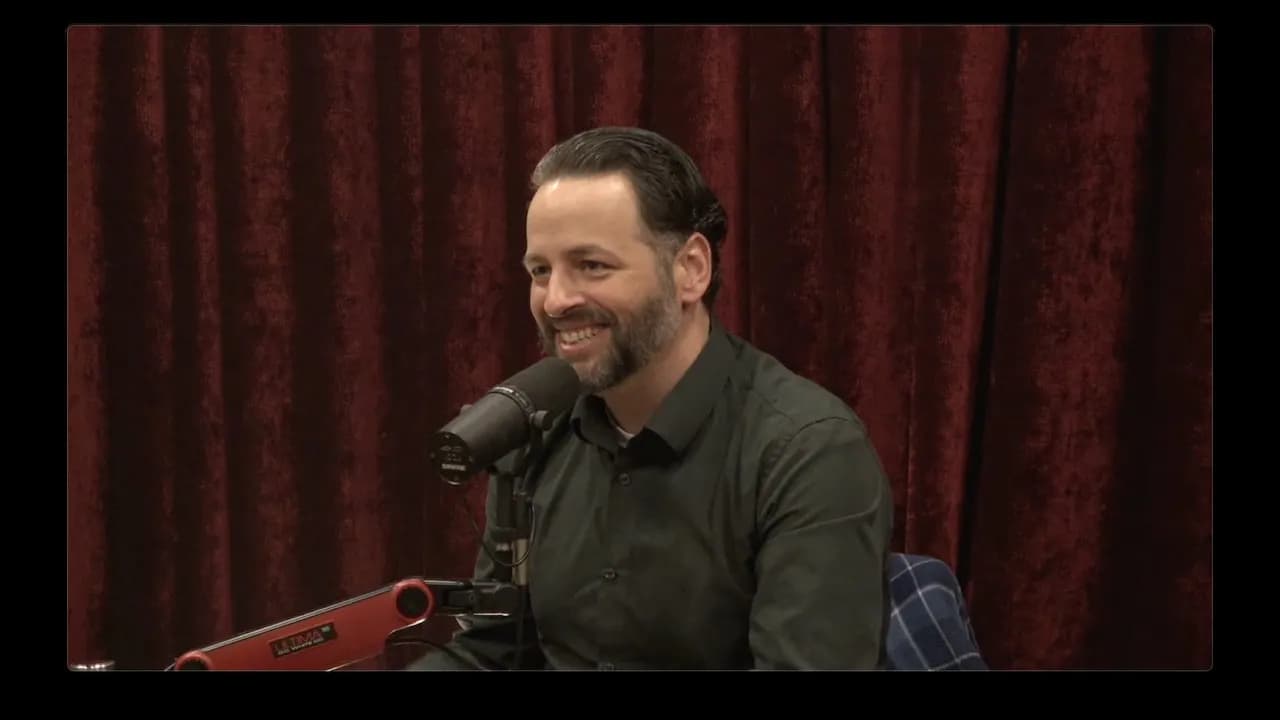
Joe Rogan Experience #2526 - JD Vance
In a Nutshell
JD Vance argues that 40 years of offshoring, open borders, and corporate dominance have destroyed working-class bargaining power and made the American dream unattainable, driving young people toward socialism. He advocates for voter ID, immigration restriction, stronger worker institutions, and a Christian middle-way economic approach that preserves private property while giving workers real ownership and participation. On foreign policy, Vance defends Trump's negotiation strategy with Iran over indefinite military action, while stressing that US interests must take priority over foreign influence operations.
These notes were generated by AI and may contain inaccuracies.
The conversation begins with a recap of the UFC event held at the White House on June 14th. Rogan notes it was one of the craziest experiences of his life, and Vance agrees it took him about two weeks to process that it actually happened. Vance describes his daily experience in the West Wing watching an eight-story structure being built on the south lawn, initially struggling to comprehend what he was seeing until realizing it was the UFC event setup.
The weather around the event was a significant concern. A storm threatened to delay the fights until 10:30 p.m., which would have forced Vance to stay up until 4:00 a.m. before flying to New York the next day for his book tour. The storm ultimately diverted. The humidity and heat in mid-June in DC made the conditions challenging. Justin Gaethje mentioned the air felt very thick during his fight.
June 14th was both the president's birthday and Vance's 12th wedding anniversary. Vance's wife, who was 39 weeks pregnant at the time, chose not to attend due to the heat and length of the event. The Ellipse held approximately 85,000 people outside the main seating area of 3,000, creating a unique audio experience where cheers from the outer crowd arrived with a delay, similar to a wave effect.
Every fight on the card ended in a knockout or stoppage, totaling seven stoppages. Rogan notes this was unusual compared to typical cards. The final fight between Ilia Topuria and Justin Gaethje was stopped when Gaethje's knee buckled after appearing to slip initially. There was discussion between Gaethje and Max Holloway before the referee intervened. Earlier in the card, the Topuria vs. Gaethje fight was paused due to a vision issue with Gaethje's right eye rather than a concussion.
Rogan mentions seeing Gachi at the White House recently and asking if he was done fighting. His mother answered affirmatively on his behalf. Rogan speculates that a life-changing financial offer could bring him back for one more fight. The conversation touches on the physical demands of fighting, noting that fighters often compete with concussions and may not remember entire rounds.
Vance observes that UFC has culturally replaced boxing as the premier combat sport. In high school, heavyweight boxing title fights generated significant excitement, but now UFC events dominate. Rogan explains that UFC cards feature more exciting fights throughout the night, with the venue remaining packed from early prelims through the main event. Boxing events often see attendees arrive only for the main event. UFC offers more ways to win, more dynamic action, and more stars across weight classes.
This was Rogan's first live UFC event, which happened to be at the White House. He was surprised by how fighters escaped armbar attempts that appeared fight-ending. In the Josh Hokit vs. Derrick Lewis fight, Hokit secured an armbar but failed to finish it properly. Rogan explains the correct technique: elevating hips with heavy leg curls to create space and bend the arm backward, or pulling the arm to the side of the hip. Hokit kept his hips down with the arm flat to the chest, which prevented the break.
Hokit repeatedly states that Michelle Obama is a man, which generated significant media attention following the White House event. Vance notes his communications team was most concerned about questions regarding this comment during his book tour media appearances. Vance finds the disproportionate reaction surprising, arguing that an amped-up fighter making an outrageous comment after a fight should not dominate national news. He describes Hokit as creating a pro wrestling-style bad guy persona to maximize attention, complete with Hulk Hogan's entrance music, sunglasses, and an American flag bandana.
Vance criticizes the economy built around generating reactions, noting many responses are performative for clicks, likes, and views. Social media has shifted discourse from genuine conversations to reactive takes. He argues that when someone tells a joke that is not funny, the appropriate response is to not laugh and move on, rather than building an industry around outrage. Rogan recalls advising Tony Hinchcliffe that a particular joke about Puerto Rico would get him in trouble, comparing Hinchcliffe's style to a comedy version of Josh Hokit.
Hinchcliffe is described as a roaster who intentionally tries to ruffle feathers and piss people off. He is a huge pro wrestling fan who enjoys playing the heel. Rogan notes that Puerto Ricans generally have a strong culture of joking and giving each other a hard time. Hinchcliffe moved to Austin with Rogan six years ago. Both express satisfaction with the decision, observing that California continues to deteriorate.
Vance discusses the concern from five or six years ago that blue state transplants moving to Austin would fundamentally change its politics and culture. He argues this has not occurred because many who moved did so precisely because their previous locations had become untenable. Rogan notes that friends stuck in California due to family or business obligations hate living there. U-Haul pricing is cited as a real indicator of state health, with higher costs to leave California than to enter it.
California's population dynamics have reversed for the first time, with more people moving out than in. Rogan recalls moving there in 1994 and experiencing consistent population growth and worsening traffic until his departure. He loved the weather, lifestyle, and people but attributes the decline to politics. Vance's wife is from San Diego, and he expresses heartbreak over Los Angeles, noting its beautiful architecture and unique vibe contrasted with Skid Row, which has grown from 50 to 55 blocks.
Vance recounts an experience attending a Christmas party at his wife's former litigation firm in downtown Los Angeles. The firm provided convoluted directions specifically to avoid Skid Row at night. Following Google Maps led directly through the area. The party venue featured fancy food and wine behind armed guards and massive walls, which Vance compared to the US embassy in Port-au-Prince, Haiti, with extreme security and privilege inside contrasting with squalor outside.
Large population centers like Los Angeles and New York are almost always run by Democrats. The Los Angeles mayoral primary raised serious concerns about election integrity. Spencer Pratt was in second place behind Karen Bass, but Nithia Ramen overtook him through mail-in ballots. The mail-in ballots also passed a tax hike in a state already having the highest taxes, with voters effectively saying they don't pay enough taxes.
There was direct evidence of recruiting homeless people by giving them cigarettes and cash to use their addresses for mail-in ballots. The pattern was suspicious because the third-place candidate performed disproportionately better in mail-in ballots than the first and second place candidates, kicking the Republican out of the race entirely and eliminating a real general election in California.
Republicans have a coolness problem. Democrats appear more charismatic and cool in cultural centers. Pop stars, rock stars, and actors in cultural hubs tend to lean left, influencing young people who move to these population centers. Republicans attracted to right-of-center politics often prefer suburbs and single-family homes, leading to cultural self-segregation.
California represents a core part of the American dream and should not be abandoned to Democrats despite its deep corruption. The state is making it structurally impossible for the opposing side to win.
Mail-in ballots should be restricted to invalids who cannot leave their homes, military personnel, and people serving overseas. The expansion during COVID created major problems. In Pennsylvania, a rural voter sued arguing that mail-in ballots and ballot harvesting in Philadelphia and Pittsburgh created disparate impact, undercounting rural votes. The court acknowledged the issue was real but ruled it was a political problem, not a judicial remedy.
Voter ID should be required. California prohibits showing ID, and attempting to require it can result in prosecution. This contradicts earlier requirements for vaccine IDs to enter grocery stores or restaurants. Voter ID solves mail-in ballot problems by confirming real identification attached to each vote. Democrats claim voter ID is racist, implying Black and Hispanic people cannot obtain IDs at the DMV, which is itself racist. Polling shows Black Americans support voter ID at the same rate as white Americans.
JD Vance offered that if Democrats don't believe cheating occurs, they should support voter ID and the issue would be dropped. The Save America Act includes voter ID requirements. A Senate majority would support it, but Senate procedural rules block passage. Budget items require 50 votes while non-budget items need 60 votes. Senators refuse to treat voter ID as a 50-vote budget item despite no constitutional requirement for this distinction.
Kathy Hochul claimed Black people in inner cities don't know what computers are. Many Democratic talking points presume their own voters are idiots. Gavin Newsom told a 95% Black audience that he wasn't very smart like them. Republicans generally presume their voters are adults. Biden had two brain surgeries in 1988 to repair intracranial aneurysms and made a full recovery according to medical professionals.
Kamala Harris was the least popular vice president, frequently making controversial statements. She supported taxpayer-funded sex changes for illegal aliens. The 2020 debate included a question about taxpayer-funded Medicare for illegal aliens. The Democratic Party in 2020 was taken over by radicals on a 90-10 issue.
Middle-class Black Americans form the core Democratic voting block. They tend to be socially moderate to conservative and economically populist. They oppose tax breaks for major corporations and oppose transitioning children. Biden was one of the few candidates who could hold together the reasonable middle-class Black vote with the far left of the party.
Biden eating ice cream created poor optics. During the Iowa State Fair, a sign reading "Eat the corn dogs, you coward" appeared at Vivek Ramaswamy's event. Political figures must be careful with optics around eating bananas, corn dogs, and certain popsicles.
Joe Rogan and JD Vance discuss how both parties are often defined by their worst examples, such as Patriot Front on the right and Antifa on the left. Vance notes the stark difference between reasonable Democrats and their more extreme counterparts.
Rogan references James Talarico, a Christian who was in seminary, arguing against mandating the Ten Commandments in public schools. Talarico believes this approach forces religion on others and will push people away from Christianity rather than attract them. Vance acknowledges Talarico's credentials but disagrees with the assessment.
Vance argues that freedom of religion is itself a Christian contribution to Western civilization, rooted in recognizing individual dignity. He maintains that displaying the Ten Commandments does not constitute forcing religion on anyone, noting that public spaces like the Supreme Court already include various historical, cultural, and religious documents including references to Moses.
Rogan questions whether displaying only Christian content in public schools is fair to students of other faiths like Hindus or Muslims. Vance responds that the Ten Commandments represent an important cultural element of Western civilization, noting that eight of the ten commandments are principles most people would agree with regardless of religious belief.
Vance points out that America was founded by people heavily influenced by Christian culture, even if not all were practicing Christians. He argues that exposure to the Ten Commandments represents cultural education rather than religious coercion.
Rogan distinguishes between a teacher voluntarily displaying religious content and government mandates requiring such displays. Talarico's position, as presented, is that mandated displays cross the line into promotion rather than mere exposure.
Vance counters that Christianity is the majority religion in the United States and was extraordinarily influential in shaping constitutional principles. He emphasizes that displaying the Ten Commandments does not require students to read or write them repeatedly—it is simply exposure to an idea.
Vance argues that for the past 30-40 years, the balance has tilted toward removing religion entirely from the public square. He references Chief Justice William Rehnquist's observation that pushing religion out of public life effectively establishes secularism as the state religion.
Vance states he would not be offended if his children saw religious texts from other faiths in classrooms and would view it as a learning experience. He supports exposure to different ideas while maintaining one's own faith.
Vance argues that religious people should not be prohibited from expressing their faith in public spaces. He supports local communities, such as a 95% Christian town, being allowed to display nativity scenes during Christmas. He notes that such displays were previously prohibited under earlier legal interpretations.
Vance describes living his faith through example rather than preaching, trying to make people curious about what motivates him without forcing beliefs on others.
Rogan references a June 26 report about Bible stories becoming required reading in Texas public schools. Vance acknowledges this represents a different level than simply displaying the Ten Commandments and understands why such mandates concern some observers.
Rogan describes a military briefing where a non-commissioned officer allegedly told troops that bombing Iran was part of God's divine plan to bring about Armageddon and Jesus's return, with President Trump anointed by Jesus to light the signal fire. Vance states he had not previously heard this report.
Vance emphasizes that war is never a good thing, even when necessary, and that grinning about conflict is inappropriate. He stresses the importance of humility in the face of God's plan, noting that Christians should not assume God has taken their side in conflicts.
Vance suggests the story may have been misreported by media, noting his general skepticism of press accounts. He acknowledges the possibility of both extreme Christian nationalists in positions of authority and media misrepresentation of events.
Vance states the goal of U.S. policy toward Iran is preventing the country from obtaining nuclear weapons. He describes both short-term objectives—destroying existing nuclear sites—and long-term challenges, noting that building nuclear weapons is expensive but not impossible, with information available on YouTube.
Vance explains that as Vice President, his role is to provide the best advice possible to the President and then work to implement decisions once made, rather than publicly second-guessing policy.
Vance describes two elements within the Iranian system: hardliners who want to bring about apocalyptic scenarios involving the 12th imam, and pragmatists. He explains that the ceasefire agreement aimed to open the Strait of Hormuz, stop violence, and begin negotiations on long-term nuclear issues in exchange for economic and sanctions relief.
Following the ceasefire, 20 million barrels of oil per day began flowing through the Strait of Hormuz, causing oil prices to drop significantly. This development caused hardliners in Iran to panic about losing their leverage point.
After signing the memorandum of understanding, Iranian forces attacked several ships. The United States responded by striking the attackers and destroying facilities used to launch attacks on shipping. Iran then returned to negotiations, acknowledging they should not have targeted vessels. Negotiations continued for several more days until hardliners in the Iranian system reacted strongly against the increased oil flow through the Strait of Hormuz, declaring their intent to shut down the waterway due to fears of losing leverage.
Pragmatists within Iran viewed the hardliner response as a mistake and advocated for continued talks. The current approach involves using economic leverage points, carrots and sticks, engagement with pragmatists, and military responses to acts of violence. This multi-pronged strategy aims to achieve a better trajectory in the negotiations.
Despite ongoing shooting incidents, Iran's nuclear program has been destroyed. The Strait of Hormuz is not operating at full pre-war traffic levels, but sufficient oil and gas is flowing to prevent a worldwide energy crisis. All developments are occurring within the broader context of nuclear program negotiations.
Mike Pence and other superhawks have attacked the deal and attempted to derail negotiations. When asked what their alternative proposal is, they advocate for indefinite bombing. This approach lacks a clear objective. Bombing facilities can destroy infrastructure, but it cannot prevent a determined individual from firing cheap drones at ships in the Strait of Hormuz.
The Strait of Hormuz is a narrow waterway carrying approximately 25% of the world's energy supply. A single person with $100,000 could purchase drones on the black market and position themselves on an island to attack ships. While some ship captains would continue through, the United States can assist by shooting down drones and missiles to facilitate traffic flow. However, the ease of launching attacks means negotiation remains necessary alongside military measures.
The presidential approach uses military force when connected to specific objectives, such as responding to attacks on ships by striking the facilities used to launch those attacks. Military action is not open-ended or indefinite. The goal is to use military power as one tool among many, including diplomacy, to solve problems rather than bombing indefinitely until something good happens.
Some hawks want the military campaign to continue indefinitely without identifying what they are trying to accomplish. Two potential unstated outcomes emerge: first, a complete regime change in Iran to topple the clerics and install a friendlier government. Historical experience with regime change through US military intervention has been poor. The Iranian people would need to rise up themselves; the United States will not send 150,000 ground troops to accomplish regime change on behalf of another population.
A second potential outcome is the Libya model. After the Obama administration's decision to kill Gaddafi, Libya became a failed state, triggering a refugee crisis with people pouring into Europe, Asia, and Africa, along with increased violence and terrorism. Some appear to desire similar outcomes in Iran. However, having 94 million desperate people flooding into Europe and the United States while creating terrorist infrastructure worldwide does not serve US interests. Every previous instance of this approach has produced refugee crises, spikes in terrorism, and civilian deaths.
Critics claimed the deal involved $300 billion in concessions to Iran for rebuilding. This argument misrepresents the actual agreement. The Trump 2024 coalition was historic, winning seven states and bringing together hawks, foreign war opponents, and diverse voices including supporters of Mark Levin alongside those like Tucker Carlson. Within this coalition, hawkish elements have attacked negotiation efforts and accused Trump of betrayal for pursuing diplomatic solutions.
The memorandum of understanding was developed not only with Iran but also with Gulf Arab states. These states approached the US stating that if Iran demonstrated willingness to genuinely change its behavior, they would like to invest in rebuilding the Iranian economy. The key question was whether the United States would release sanctions to enable UAE, Saudi Arabia, and other countries to invest in Iran if Iran changed how it treated Gulf Arab countries.
The US position was that this would represent a victory: if Iran's regional enemies saw sufficient behavioral change to warrant investment, that would constitute a win-win outcome. The memorandum includes language stating that if Iran meets all obligations, other countries will be permitted to invest in Iran. No US money is involved. The $300 billion figure was fabricated by hawks to politically undermine the negotiation.
American public opinion supports reaching a final resolution. Americans oppose long-term, open-ended regime change wars in the Middle East but accept military use for discrete objectives. Well-funded efforts have attempted to tank negotiations and shift public opinion against the deal.
Opposition to negotiations stems from multiple sources. Some individuals are influenced by defense contractors. Certain elements within the Israeli government oppose the deal. A Times article from the previous day reported that some American influencers are being paid to attack the deal by a former Trump campaign person who was himself paid by elements within the Israeli government. Additional factors include pure political ideology favoring the view that military power can accomplish any objective through indefinite bombing.
Opponents have used social media posts, leaks to reporters, and obsessive attacks claiming negotiations with Iran should not occur and the military campaign should continue indefinitely. Personal attacks have included accusations that the Vice President is influenced by Qatar, foreign governments, or takes marching orders from Tucker Carlson. The actual objective being pursued is a settlement achieving US goals: Iran without a nuclear weapon and free flow of oil and gas.
Foreign governments, including Israel and Qatar, routinely attempt to influence the United States. This is considered normal. The concern arises when American leadership allows foreign influence to affect their judgment and advocacy. A literal foreign influence campaign has been funded to tank the negotiation, with recipients attacking the Vice President through dishonest methods.
Accusations of antisemitism have been made, including claims of insulting the Jewish religion. No compelling argument has been presented to support these accusations. Public opinion data shows Israel is losing the battle for American public opinion, a fact Donald Trump has acknowledged publicly. Young Republicans approach this issue differently than Republicans over age 65.
The position advocated is that Israel should be treated as a normal ally like France or the United Kingdom. Disagreements will occur alongside agreements, and interests will sometimes align and sometimes diverge. This normal relationship based on shared interests has been attacked as anti-Israel or antisemitic.
Israel attempts to influence American politics, as do other countries. Israel is more effective than most at this influence. A country of 9 million people will naturally seek to persuade a nation of 330 million. Concerns exist about spying on American politicians, funding, and whether politicians prioritize Israel or the United States. The core issue is that foreign influence operations manipulate American public opinion to achieve desired outcomes.
Beyond reasonable doubt, elements within the Israeli government have attempted to shift US policy away from the negotiation strategy toward continuing the military campaign indefinitely, without a defined objective. This includes efforts to manipulate American public opinion. Good relationships exist with some Israeli officials, including the ambassador to the United States, who are not part of these efforts.
Countries will attempt influence operations as a matter of course. The responsibility lies with American leaders to resist allowing such operations to affect their judgment. The focus must remain on what serves the best interests of the United States of America.
Donald Trump independently believes Iran should not have a nuclear weapon, separate from Israeli influence. He was willing to take military action, including the initial bombing in June of the previous year referred to as Midnight Hammer. The president would have continued the most recent campaign even without Israeli influence.
Claims that Donald Trump was blackmailed into the Iran campaign are false. Decision-making has been observed directly. Whether one agrees or disagrees with the negotiation strategy or the decision to launch the Epic Fury campaign, the notion of blackmail does not align with how decisions are actually made.
The Epstein files were supposed to be released but faced significant resistance, leading many to suspect that powerful individuals involved in the files were using their influence to affect government decisions. JD Vance acknowledges that the communications around the release were mishandled, though he rejects the idea that the administration was hiding evidence or being blackmailed. Pam Bondi had stated the client list was on her desk, and binders were presented publicly, but these largely contained documents that had already been released previously.
Vance believes Bondi was responding to the political moment and overstated what the administration had in its possession. The effect was to make people mistrust the entire effort. He notes that Donald Trump could have killed the legislation to release the files but instead chose to release them, despite Democratic accusations.
The original investigation of Jeffrey Epstein occurred in 2007-2008 under Alex Acosta, who dropped the federal charges. Epstein was prosecuted on a local matter instead. The original warrant was narrow in scope and not designed to investigate a broader conspiracy. Anything that existed from the 1980s through 2006-2007 that was not captured in that investigation was likely lost.
Vance states that six million documents were eventually collected, with approximately three million being responsive to the Epstein estate. All were released except for limited redactions required by courts to protect victims. He maintains there is no credible evidence that Trump engaged in wrongdoing with minors.
Vance believes there was likely a broader conspiracy. One theory is that Epstein used the sex ring to blackmail rich and powerful people, possibly on behalf of American or foreign intelligence agencies. A second theory involves Epstein's relationship with Les Wexner, the wealthiest person in Ohio. Epstein served as Wexner's tax advisor, identifying tax strategies that may have been illegitimate and could have been used for blackmail or influence.
Vance notes that Epstein was also a sick individual who built relationships with rich and powerful people who lacked moral judgment about his character. He points out that Trump was the person who reported Epstein to the Palm Beach police and kicked him out of Mar-a-Lago.
Vance explains that distinguishing between victims and co-conspirators proved difficult. Some individuals listed as victims were also listed as co-conspirators in the documents. The concern was that some victims may have been incentivized to recruit more girls. DOJ attempted to make these judgments and release as much information as possible.
Vance criticizes Representative Ro Khanna for becoming vocal about the Epstein files only after Trump became president, noting Khanna did not seem concerned during the Biden administration.
Epstein was clearly trying to contact influential people and bring them together on his island. He was also attempting to connect with scientists, which may explain his purchase of a ranch in New Mexico. His money came partly from providing suspect tax advice and setting up tax schemes for wealthy individuals.
Epstein was funding numerous scientists and was connected to academia and social media companies. He knew people across the political spectrum in America, including both Republicans and Democrats. His connections to Israeli intelligence were primarily to left-of-center elements rather than right-of-center elements.
The period from the 1990s to 2007 represented the peak of Epstein's power, before he had been caught in a sex abuse scandal. Vance argues that the black hole of the Epstein saga is the lack of evidence from this era. The 2007 prosecution was deliberately narrow and would not have captured evidence of a broader operation. If documents connecting Epstein directly to intelligence agencies existed, they would not exist in 2026.
Vance describes having effectively unlimited access to information as Vice President. The constraint is not gatekeepers denying access but rather the overwhelming day-to-day responsibilities of the role, including calling senators, meeting with staff, and negotiating foreign policy. He has repeatedly stated he would look into the UFO issue but has not yet found the time.
He notes that many people in the current administration are interested in the UFO question, but nothing has changed since Biden left office, which makes him less optimistic that significant discoveries will be made.
Vance has stated he believes some UFO phenomena could be demons. He argues that if beings appear human-like but are not human, possess effectively infinite powers, and conduct experiments on humans, there is historical precedent across religions to call such entities demons rather than aliens. He distinguishes this from hyper-rationalism and affirms belief in God and the supernatural.
Rogan describes the Travis Walton case from the 1970s, where Walton was allegedly taken aboard a spaceship, healed, and communicated with telepathically. Vance responds that extra-powerful beings communicating telepathically and helping people would be consistent with angels rather than demons.
Vance uses the analogy that to a dog, there is no meaningful difference between its owner and God, because the owner can turn on lights, make food appear, and move rapidly across space. Similarly, if an advanced civilization possessed technology indistinguishable from magic, humans would perceive them as angels or demons.
Rogan notes that humans are more complex than chimpanzees and could develop technology indistinguishable from magic within a million years if civilization survives. Vance agrees that angels and demons could simply be hyper-evolved advanced civilizations from elsewhere. He maintains that from a biblical perspective, there remains a significant distinction between demons and hyper-intelligent beings from another location.
The conversation explores whether demons, angels, and hyper-intelligent extraterrestrial species must be mutually exclusive concepts. Both speakers agree that metaphysically, space aliens from outside Earth and celestial beings like angels and demons could represent two separate phenomena. One could be true without the other. If a space alien with superhuman technology arrives on Earth with malicious intent, distinguishing it from a demon becomes conceptually difficult. The distinction between a malicious ghost and a demon is raised as another example of how human beings might misidentify phenomena based on their cultural and social context in 2026.
Special access programs, crash retrieval operations, and declassified videos showing unusual phenomena are discussed. David Grusch and others have referenced crash retrieval programs. Videos released publicly show objects with flight characteristics difficult to explain through known physics and aeronautical engineering. One example is Commander David Fravor's encounter, where an object descended from 50,000 feet to sea level in roughly one second. Ryan Graves reported that after fighter jet equipment upgrades in 2014, pilots observed objects remaining motionless in 120-knot winds, appearing as black cubes inside spheres. The discussion emphasizes keeping an open mind without claiming definitive knowledge of what the phenomena represent.
The How Put Off story from the Bush administration is referenced, describing a scenario where thought leaders from various disciplines were asked to compile pros and cons of disclosure with numerical values assessing impacts on society, religion, government, and economy. The exercise reportedly showed more cons than pros, leading to non-disclosure. The documentary The Age of Disclosure is mentioned, featuring intelligence officers and government personnel arguing that long-running programs involved misappropriation of funds and lying to Congress. Mass amnesty has been proposed as necessary to uncover the truth, though concerns remain that some misappropriated funds may have gone to unauthorized places.
Skepticism centers on the competence required to maintain secrecy around physical extraterrestrial remains. The argument is that in an era of ubiquitous tiny cameras and recording devices, hiding such evidence would be extremely difficult. Top-secret facilities like those at Area 51 use security measures including vehicle searches and signal detection, yet the fundamental doubt persists that literal space alien remains could remain completely hidden. The Jackie Gleason story is referenced as anecdotal evidence that has circulated. Vance states he has not yet seen evidence of extraterrestrial remains but remains fascinated by the flight pattern data in existing videos.
Vance discusses his remaining two and a half years as Vice President and expresses willingness to investigate claims of recovered remains. The question arises whether a vice president could simply disclose such information or would receive briefings on the implications of disclosure. Vance acknowledges he is not skilled at lying and that this might affect whether certain information would be shared with him. He states he would want to know the truth and believes the world wants to know, as it would fundamentally change understanding of what it means to be a living organism.
Eric Weinstein's argument is presented that the distinction between a space alien and a human being with super-advanced technology may be semantic. If a new physics framework beyond Newtonian and Einsteinian models allows travel faster than light speed, the beings could be human descendants from a different planet, a Mars colony, or even humans from the future engaging in time travel. This perspective suggests the phenomena could represent human beings operating with technology that appears divine from a 2026 perspective.
The conversation addresses the difficulty of maintaining human biology outside Earth's gravity. DNA and cellular function appear to degrade in low-gravity environments, as evidenced by astronauts returning from the International Space Station after three to six months showing significant physical deterioration. Conventional propulsion to Mars would require approximately two years of travel each way, creating a four-year exposure period that could prove fatal. Manipulation of spacetime rather than traditional propulsion is suggested as a potential solution that could maintain a contained Earth-like environment during travel.
The Democratic Socialists of America are criticized for rejecting ice cream at events and for promoting policies such as freezing rents and confiscating property from landlords. These ideas are characterized as the initial steps toward the totalitarian outcomes seen in historical communist regimes, including North Korea. The core argument is that communism requires seizure of the means of production, and because the most powerful means of production is the human mind, the ideology inevitably leads to totalitarianism and loss of individual motivation.
Vance references his book Communion: Finding My Way Back to Faith, distinguishing it from Whitley Strieber's book of the same title about aliens. The book discusses a Christian approach to political economy that balances concerns about extreme wealth inequality with the necessity of private property rights protected by the state. This third way differs from both hardcore libertarian free-market ideology and socialism. The discussion references Charlie Kirk's final interview with Tucker Carlson, where Kirk argued that without giving young people ownership, a stake in the future, and a sense of the American dream, they will turn toward socialist solutions in a perceived zero-sum environment.
The offshoring of American factories and manufacturing to low-wage foreign workers was a bad deal for American workers. The Trump administration has begun reversing that trend, which is one of its best policy achievements. Housing costs have stabilized over the last year and a half partly because of reduced immigration, which decreased demand on the limited housing supply.
Unless young Americans have a pathway to own property and participate in the economy, socialism becomes the inevitable outcome. The revulsion to socialism is justified, but there needs to be more thinking about how the current situation was created in the first place. Without fixing the underlying economic conditions and returning to a more Christian understanding of economics, socialism will remain the alternative.
A young engineer making more than 75-90% of her peers stated that owning a house and raising a family without constant worry now feels like an unachievable objective compared to what her parents' generation experienced. Another friend from a South Indian immigrant family described growing up in Oceanside, California, where his childhood friends were children of enlisted Marines. Today, houses on that same street cost over a million dollars, which most Marine officers cannot afford.
Socialism is the wrong solution, but it becomes the alternative when people feel the system is rigged and the American dream is unattainable. The experiment of offshoring industrial jobs, becoming a services and finance economy, and allowing Wall Street to buy every asset has created a generation attracted to socialism.
Young people fear AI will make their education and specific jobs irrelevant. A tech CEO compared the AI transition to the industrial revolution, which displaced jobs but also created new ones. The greater concern is not mass unemployment but extreme inequality, similar to the robber baron era, which led to fascism and communism in Europe and the United States.
Pope Leo XIII's late 19th-century encyclical argued for a middle way between child factory labor and socialism during industrial churn. The solution involves giving workers a say in economic decisions and normal people power within the system. The fundamental challenge with AI is ensuring wealth creation does not concentrate among a small segment, which historically leads to communism.
Private sector unions have largely disappeared in the United States. The United States and Britain weathered the industrial revolution better than other Western countries partly due to strong religious institutions and strong worker participation institutions. Hollywood studios once worked organically with community groups and churches to develop content that spoke to their communities.
Giving workers a real seat at the bargaining table is essential. The Trump administration has been accused of being too pro-labor for Republicans, but unions may prevent communism if they provide workers genuine representation, despite some unions having serious problems.
Hyper-monopolistic companies that dominate entire sectors threaten democracy because voting loses meaning when corporations exceed government power. Teddy Roosevelt addressed steel trusts that were more powerful than the government. Reigning in such power is necessary to give normal people real participation. AI poses the risk of a single hyper-monopolist dominating the space, influencing government and nonprofits while cutting out ordinary people.
Private sector labor unions have low participation rates partly because they are 20th-century institutions that need updating for the 21st century. Orin Cass proposes shifting from zero-sum conflict between companies and unions toward more cooperative models, similar to successful European examples where unions negotiate with greater breadth and flexibility.
Current U.S. labor law sets a narrow floor of negotiable items, limiting what unions can address. This reduces worker incentive to join. In some European countries, unions can negotiate arrangements where junior employees earn below minimum wage in exchange for job training and better benefits, effectively turning companies into educational institutions for the first years of employment. Such arrangements are effectively illegal in the United States.
Flooding the country with low-wage immigrants reduces native workers' bargaining power because corporations choose cheaper labor over paying higher wages to American workers. This is a consistent finding in economics literature. Immigration hawks understand that restricting low-wage immigration forces corporations to pay native workers more.
A hotel chain executive expressed frustration at efforts to stop illegal immigration because native workers demand higher wages than migrants. The New York Times reported Apple chose Asian manufacturing partly because American workers wanted to go home and have dinner with their families, while Foxconn workers in China worked 72-hour weeks, slept four to a bedroom, and required suicide nets around factory buildings.
The United States has become a shell corporation after 40 years of bipartisan policy failures. The country does not manufacture enough domestically and lacks self-reliance. Workers lack bargaining power. The Biden administration's 9% inflation was severe, but the Trump administration has maintained much lower inflation. Recent CPI data showed deflation and falling gas prices following the Iran conflict.
Without fixing these structural problems, the country risks electing a socialist president. The narrative that stopping immigration is cruel or racist must change. The previous administration opened the border, facilitated crossings, provided Medicaid, Social Security, disability benefits, hotel stays, and phones, then relocated people to blue states.
The census counts non-citizens, which redistributes congressional seats away from areas with lower illegal immigration. Caesar Chavez, a founding figure in the American workers' rights movement, was a hardcore immigration restrictionist because he recognized that bosses would import low-wage immigrants to compete against and drive down his workers' wages.
The DSA claims to care about workers' wages but functions as an open borders organization. Corporations prioritize open borders more than any other policy the DSA supports. The actual result of DSA policy is flooding the country with low-wage immigrants, which destroys the middle class. The United States has run this experiment for decades and now has a much weaker middle class than before it began.
Republicans face a persistent narrative that they are cruel and anti-worker or anti-lower-middle-class. This narrative requires better messaging to counter. Anyone who cares about community safety wants to empower good cops rather than enable police brutality. Anyone who cares about law and order wants violent criminals in jail rather than closing prisons. Anyone who cares about wages and safety wants border control.
Anybody who actually cares about the safety of your community is going to care about not empowering police brutality, but empowering the good cops to do what they need to do. Anybody who cares about law and order is going to want to throw violent criminals in jail, not close down the prison. Anybody who cares about your wages and your safety is going to want to control the border.
Republicans are not perfect and internal disagreements exist, but the party currently pursues better policies regarding home safety, wages, and keeping more of one's money. Cities that do not enforce crime laws, do not enforce immigration laws, and provide sanctuary status experience repeated disasters. Voting for a new person to implement the same failed approach is irrational. The results have been catastrophic year after year and continue to worsen.
The Republican Party under Trump's leadership is significantly more working-class and middle-class than it was twenty years ago. These demographic shifts are occurring, though they take time. Public safety represents one of America's core promises: every man, woman, and child, rich or poor, Black or White, deserves public safety.
Rich people have always been able to afford security guards to protect against theft or kidnapping. America democratized public safety so that every person can keep their property, avoid being stolen from, and walk their neighborhood at night without being mugged. The left has made working people less safe over the last several years. Working-class neighborhoods experienced higher rates of violence and carjackings during the Biden administration. This outcome is not a coincidence.
The conversation concludes with a brief exchange about discussing religion, faith, and the Ten Commandments on a future appearance. The episode ends with thanks and closing music.
Keep PowerfulJRE in your library
Save the videos and channels worth coming back to, and find them again in one place.