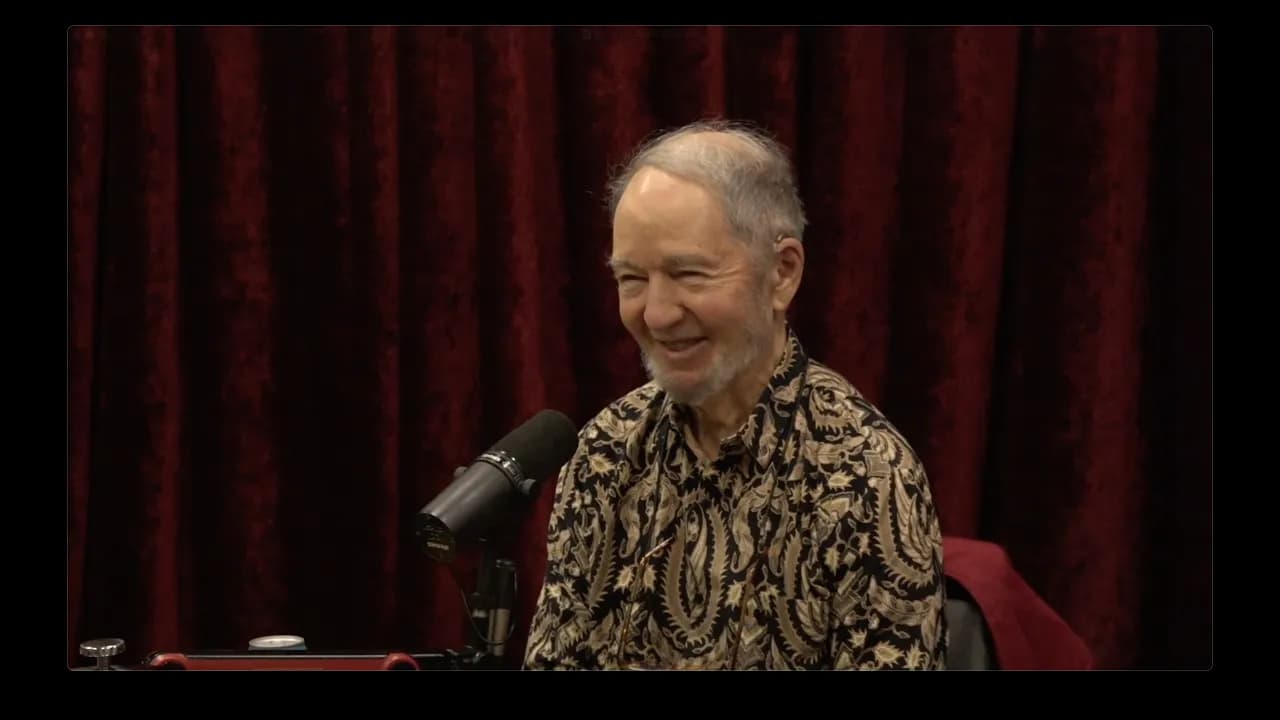
Joe Rogan Experience #2547 - Daniel Everett
In a Nutshell
Daniel Everett's 30+ years among the Pirahã overturned core linguistic theory by showing their language lacks recursion, numbers, colors, and other supposedly universal features, directly challenging Noam Chomsky's framework and earning him accusations of fraud from Chomsky himself. His missionary work failed completely—he converted zero Pirahã to Christianity because they demanded evidence he couldn't provide, leading Everett to lose his faith entirely as he realized their evidence-based worldview was more rigorous than his own. The Pirahã maintain exceptional quality of life with minimal work, no religious framework, and remarkable resilience, proving that hunter-gatherer existence without modern amenities can produce greater contentment than Western religious or material culture.
These notes were generated by AI and may contain inaccuracies.
Daniel Everett had a unique life trajectory that began with selling LSD outside a Jimi Hendrix concert in 1968. He encountered a former high school acquaintance and his sister, which led to a relationship with the sister who had been raised in Brazil as a missionary. This connection eventually drew him into Christianity despite coming from a non-religious family. His father, a heavy drinker and construction worker, was initially unhappy about the transformation, preferring Everett's previous lifestyle.
Everett's conversion was rapid rather than gradual. He attended Bible school, earned an undergraduate degree in Bible and theology, and became an ordained minister in the Wesleyan church. He preached on street corners and was very active in religious activities. The transition from selling drugs to becoming a missionary represented his form of rebellion against his upbringing.
The path to missionary work required extensive preparation. Everett completed four years of college studying Bible and theology, followed by linguistics training from the missionary organization, specifically to become a Bible translator. Additional preparation included jungle survival training in southern Mexico's Chiapas region, lasting nearly four months.
The training culminated in a survival hike where trainees were left alone in the jungle for approximately a week or more—Everett's experience lasted about 10 days. Participants received minimal supplies: a machete, a quart of water, and a small container with 10-15 matches. They had to construct shelter, find water from vines, identify edible plants, and maintain a fire. The training was designed as a final examination with no monitoring during the survival period.
During survival training, Everett learned to identify water-bearing vines, create fishing implements from sharpened sticks and fishing line, and recognize edible versus poisonous plants. He successfully caught two small fish approximately three inches long. He also constructed a bow and arrow using only his machete.
Fire management proved critical—participants had to locate dry materials to start fires despite wet conditions, then gradually introduce wet wood once the fire was established. The fire had to be maintained continuously, requiring significant time spent gathering firewood. Everett experienced nocturnal wildlife encounters, hearing heavy footsteps around his camp that he suspected might be jaguars.
Everett learned about jaguars' size (up to 400 pounds) and hunting behavior, noting they rank as the third largest cat species after lions and tigers, often hunting in pairs. He encountered a story from the Bonawa people about a hunter who survived a jaguar attack using a seven-to-eight-foot blow gun. The jaguar attacked while the hunter was positioned with the blow gun as defense, eventually stabbing the animal with a poisoned arrow before shooting it.
The Paha people hunt jaguars only when they pose danger to community members. Everett consumed jaguar meat, describing it as stringy and tough, similar to monkey meat. He noted the importance of Tabasco sauce for making such game palatable.
The Paha do not preserve meat through smoking, salting, or drying except when trading with Brazilian boats. They practice immediate sharing of resources, encapsulated in the phrase about preserving meat "in the belly of my brother." This sharing system eliminates the need for food storage.
The Paha inhabit an area along the Maici River with no other human settlements for nearly 300 miles. The river, while not appearing on many Brazilian maps, measures several hundred yards across and reaches depths of 75-100 feet during rainy season, historically providing abundant fish and game.
Approximately 10 years ago, Brazilian government dam construction on other rivers significantly affected the Maici River's water levels. The dams caused water levels to drop dramatically during dry seasons, allowing people to walk across areas previously too deep to see the bottom. This environmental change eliminated most fish from the river, forcing the Paha to travel much farther for hunting and disrupting their traditional self-sufficient lifestyle.
The loss of traditional food sources has led some Paha to relocate to areas near Brazilian settlements and attempt integration, including learning Portuguese—a significant departure from their previous isolation.
Everett was assigned to the Paha in 1976 through Wycliffe Bible Translators, making his first trip in December 1977. The organization chose him because the Paha language is unrelated to any known living language, presenting a significant linguistic challenge.
Prior to arrival, limited documentation existed: Portuguese explorers in 1784 provided descriptive information, a German explorer in 1821 created a word list, and in 1920 a German-Brazilian anthropologist compiled a larger vocabulary. These sources lacked tone markings, crucial since Paha is a tonal language.
Paha's tonal nature creates meaning distinctions through pitch patterns. Examples include "mi" (friend) versus "magi" (enemy), and "u ch" (me) versus "ch" (anus). Incorrect tones could lead to embarrassing misunderstandings. Everett had to develop sensitivity to these tonal distinctions, which differ significantly from European language patterns.
On his first day, Everett began systematic language documentation by pointing at objects and recording responses. He used sticks and other items to elicit vocabulary, noting both the words and contextual phrases. His linguistic training in phonetics enabled him to transcribe the sounds of the world's languages.
Everett arrived by plane landing on the river and entered the village without prior contact. He distributed candy to children and brought tobacco, knowing the Paha's preference for chewing tobacco. His solitary arrival and non-threatening demeanor helped establish initial acceptance. The Paha had prior experience with river boats bringing clothes, though they often remained naked when such visits were infrequent.
Daniel Everett brought tobacco in a long horn, approximately 8-9 feet long, rolled up tightly and wrapped in latex. He would cut pieces off for the Pirahã who helped him, and also traded candy and canned food for fish and other goods.
Everett initially stayed 10 days alone to assess the situation before bringing his family. When they returned, they stayed a full year. His children were ages 9, 6, and 3 at the time. Both older daughters learned to speak the Pirahã language fairly quickly.
The decision to bring young children to the jungle was based on Everett's Christian faith at the time, believing God would protect them. The family suffered multiple health crises: his son contracted meningitis, his two daughters and Everett himself all got malaria. Years later, Everett was treated at University Hospital San Diego for all three strains of South American malaria simultaneously. He cannot donate blood due to malaria remaining in his system.
Everett's wife nearly died from malaria, dropping from 115 pounds to 76 pounds. The doctor informed him she would die that night with no means to keep her alive. She received blood transfusions and straight quinine, which caused days of constant retching and agony. She ultimately survived.
During a malaria outbreak affecting his wife and daughter, Everett needed to evacuate by boat but had no vessel and no knowledge of the route out. A Catholic priest visiting to observe Protestant missionary activities loaned his narrow aluminum canoe with a six-horsepower Johnson motor. The priest remained in the jungle while Everett's family took his boat.
Everett spent the entire year of 1980 in the village, and from 1977 to 2013 returned for three to six months annually. He contracted illnesses including typhoid fever on each visit, and experienced snake attacks and other dangers.
Everett translated the New Testament from Greek to Pirahã while referencing English and Portuguese simultaneously. The Pirahã questioned his beliefs about Jesus. Describing concepts like desert proved difficult since these had no equivalent in their environment.
The Pirahã language lacks words for colors, directions (no left or right), numbers, and has no concept of God. When Everett first arrived, he assumed all languages contained these elements. They express quantities only as "a lot" or "a little."
Noam Chomsky claimed all languages are built on recursion—the ability to embed units within units of the same type (e.g., "truck driver" or "John said that Bill spoke"). Everett's findings that Pirahã lacks recursion challenged this theory, which Chomsky based on limited language knowledge rather than comprehensive fieldwork.
The claims proved highly controversial. Everett faced accusations of racism, with one Brazilian follower of Chomsky writing to the Brazilian Indian Agency claiming Everett was trying to "reduce the Pirahã to primates." Everett noted the logical trap: if Chomsky's theory requires all languages to have X, and Pirahã lacks X, then either Chomsky is wrong or the Pirahã aren't human.
Approximately 8,000 separate languages exist globally, with data available on only about 1,200. Australian Aboriginal languages demonstrate similar variation, with neighboring groups sometimes unable to communicate despite proximity.
Everett argued that Homo erectus possessed language capabilities, citing their seafaring abilities and complex accomplishments. An archaeologist at the University of Liverpool contacted him after reading his work, and together they published a paper. This colleague later discovered the oldest known wooden structure—500,000 years old—built by Homo erectus in Zambia, featuring interlocking pieces.
Modern human brain sizes average 1,200 cubic centimeters for men and 950-1,000 cubic centimeters for women. Homo erectus had brain sizes of 950-1,000 cubic centimeters. Brain size measurements are obtained by filling skulls with sand. Despite similar brain sizes to modern humans, men are not more intelligent than women, indicating brain size alone does not determine intelligence.
Experiments showed that building boats requires language capability. A linguist published research on "how much language does it take to build a boat?" Homo erectus colonies on islands never connected by land required seafaring vessels capable of carrying water and approximately 20 people, necessitating community organization rather than individual survival.
NASA studies determined that 500 people represent the minimum required to establish a viable colony, ensuring genetic diversity and avoiding inbreeding.
Everett initially believed the Bible "cover to cover, even the covers" during his missionary period.
Everett's initial proposal appeared in Current Anthropology while he was at the Max Planck Institute for Evolutionary Anthropology in Germany. A German reporter from Der Spiegel interviewed him after speaking with Svante Pääbo (who later won the Nobel Prize for decoding the Neanderthal genome). The story gained coverage including a New Yorker profile.
Rather than proposing experiments to test the claims, many linguists accused Everett of lying for publicity. MIT, Stanford, and Columbia researchers conducted well-designed experiments that supported Everett's findings, but critics dismissed results by claiming the researchers disliked Chomsky.
Chomsky wrote Everett "really nasty emails" and gave interviews calling him a "charlatan" and stating his contributions were "nothing, nothing, nothing." Everett challenged Chomsky to debate at the Linguistic Society of America, offering to be proven wrong publicly.
Everett previously admired Chomsky's early work, particularly Aspects of the Theory of Syntax and American Power and the New Mandarins, both published in the same year. Chomsky wrote letters of recommendation for Everett's first US job and tenure promotion at the University of Pittsburgh.
When Chomsky planned travel to Brazil, Everett invited him to visit the Pirahã and ask any questions directly. Chomsky declined, stating he doesn't do fieldwork.
Everett observed how intellectual authority, especially pre-internet, can distort perception of one's standing, with colleagues providing constant affirmation and creating environments where ego overrides curiosity about contradictory evidence.
When Everett first presented his observations about the Pirahã language to Chomsky in 1984 at MIT, Chomsky found the claims intriguing and wondered about their theoretical consequences. His initial reaction was open-minded, with one of his PhD students noting that Chomsky was "really got known thinking about what this" meant. However, after Chomsky made his proclamation that all languages must have recursion, Everett's observations became unacceptable to Chomsky's framework, and Everett himself became "an idiot" in Chomsky's view.
Everett had idolized Chomsky at the beginning of his linguistic career. He maintained a good relationship with Chomsky for years, exchanging emails and having regular meetings whenever Everett visited MIT. Chomsky always made time to talk with him. However, after Chomsky's public denunciation, their relationship deteriorated. When Everett wrote a condolence letter after Chomsky's wife Carol died, Chomsky responded warmly, but then publicly called Everett a "charlatan" in a São Paulo newspaper. Their final exchange involved Everett telling Chomsky he should be ashamed, and Chomsky responding that Everett should be ashamed for saying things that "can't be right."
Tom Wolfe's final book, Kingdom of Speech, covered two major controversies: Darwin versus Alfred Russel Wallace, and Everett versus Chomsky. Wolfe contacted Everett weekly while writing to verify details, and was shocked by how the Chomsky controversy unfolded. Wolfe held some incorrect ideas about language origins but accurately documented this linguistic controversy.
Everett observes that intelligence provides no antidote for stupidity, noting that people can be both intelligent and subject to human flaws, particularly when ego is involved. The Chomsky controversy exemplifies how even the brightest minds remain vulnerable to ego-driven behavior.
Despite decades of effort, Everett converted zero Pirahã to Christianity. The Pirahã rejected his claims because they did not meet their high standard of evidence. They maintain an extremely rigorous approach to accepting new information.
The Pirahã recognize three major types of entities besides humans, with different types of humans distinguished by appearance. Everett, being white, was initially asked if he had blood and whether Americans die. At age 45, his gray hair led the Pirahã to describe him as "almost about to fall to the ground," suggesting they thought he was near death.
Fast mouths represent one category of non-human entities. They speak in high-pitched falsetto voices, go naked, and are sexually promiscuous. When a German reporter requested to see a fast mouth, a Pirahã man walked into the jungle, returned naked speaking in falsetto, and attempted to hump the reporter. After Everett explained the reporter was uncomfortable, the same man returned clothed and denied having seen any fast mouth, claiming he had been away.
The Pirahã concept of identity constancy is fundamentally different from Western understanding. They deny having memory of events that occurred under previous names, claiming "I wasn't here" when asked about actions performed under old identities. Name changes occur frequently - children receive new names for different life phases, while adults may adopt new names after unexplained or traumatic experiences in the jungle. The word spreads through the community, and individuals become completely unresponsive to their former names.
No Pirahã has been killed by jaguars during Everett's nearly 50 years of contact, though many have been attacked. One man carrying a 60-pound basket of Brazil nuts was attacked by a jaguar that grabbed his basket instead of him. He shot the jaguar with an arrow, and the Pirahã report that jaguars shot with arrows focus on removing the arrow rather than attacking the shooter, allowing time for additional arrows to be fired.
When Everett first arrived, the Pirahã population was under 200. It has since grown to 700-800 people due to improved medical assistance. Everett and his wife provided medical care for 20 years.
After Everett translated much of the Gospel of Luke and showed film strips depicting Jesus, one Pirahã man returned the next day reporting that Jesus had visited their village across the river. According to the man's account, Jesus had a three-foot penis and attempted to have sex with all the women. The women subsequently refused to hear more about Jesus. Everett interprets this as the Pirahã's way of rejecting Christianity through their cultural framework.
The Pirahã questioned Everett about his religious claims, asking why only Americans seemed to believe in Jesus and why Everett continued discussing someone he had never seen and whose existence no living person could verify. They noted that Everett's father had never seen Jesus either, making his testimony equally unreliable as evidence.
Everett's faith began eroding through two parallel processes: his engagement with serious linguistic science and his deepening relationships with the Pirahã. He realized the Pirahã were more intelligent than he had initially assumed, better able to predict his behavior than he could predict theirs. Their questions about evidence and their observation that Christianity appeared to be an American cultural practice forced him to examine his own beliefs more critically.
Everett found that the Pirahã exhibited higher quality of life than any Christians he had encountered, including missionaries. An MIT PhD student visiting the village described them as potentially "the happiest people in the world," noting their frequent smiling and laughing. Everett observed they possessed the contentment and life satisfaction that Christianity claims to provide, but already demonstrated these qualities without Christian belief.
Everett applied scientific reasoning to religious claims and found them wanting. He noted the absence of statistical relevance in faith healing anecdotes and referenced his Bible school teacher's observation that faith healers never begin with amputees. The biblical accounts of Jesus raising people from the dead suggested that genuine healers should demonstrate similar capabilities, yet no such demonstrations occur. Everett concluded he could not reasonably ask the Pirahã to accept beliefs he could not adequately defend against their objections.
Flood narratives appear across many ancient religions and may record actual historical catastrophes. When driving through the mountains from Imperial Valley, California to San Diego, a line of white stones near the mountain tops was once interpreted as evidence of a great flood. Such experiences demonstrate how beliefs can originate from simple observations and evolve into accepted truth over time.
Translating ancient texts from languages no longer spoken creates significant interpretive difficulties. Religious belief systems provide value by offering moral scaffolding and life structure, with many true Christians who follow Jesus Christ's teachings being among the nicest people encountered. However, literal interpretations of stories like Adam and Eve create logical problems regarding human origins and population growth.
Evolution provides clear explanations for human origins, unlike literal interpretations of Adam and Eve. Even as a child, questions arose about biblical stories, such as why God would ask Adam "Where are you?" if he knows everything. Similar interpretive challenges exist in paleoanthropology, where determining the number of Homo species that existed remains speculative despite advances in DNA analysis by researchers like Svante Pääbo.
Science operates as a community effort to approach truth through good guesses, rigorous testing, and willingness to admit errors. Every scientist recognizes this process, though it proves difficult in practice. Fundamentalist Christian beliefs create additional challenges by requiring acceptance of miracles and resurrection while demanding proof for other claims.
The Bible condones slavery in multiple passages, reflecting the cultural context of its time. Mark Twain's observation that religion began when "the first con man made the first sucker" highlights how religious texts contain elements that modern readers find problematic. Noah's Ark stories raise practical questions about disease transmission, animal distribution, and survival logistics that believers often address with "I don't know how God did it."
The Epic of Gilgamesh contains flood narratives that mirror Noah's Ark stories, suggesting some historical catastrophe likely occurred. It's intellectually dishonest to claim all religious assertions are false when evidence for actual events may exist. Personal transformation through religious belief provides the strongest evidence for many believers, though this raises questions about whether religious people demonstrate superior moral behavior compared to non-believers.
Working construction as a union hod carrier in 1968 for a Christian contractor revealed discrepancies between claimed beliefs and actual behavior. The contractor paid $8.25 per hour according to union requirements but wrote down only four hours worked while requiring eight hours of labor, effectively cheating on taxes. Similar inconsistencies appeared repeatedly among people claiming religious faith, including the challenge of following Jesus's commandments, which affect thoughts rather than just actions.
Subsistence lifestyles among hunter-gatherers prove highly compatible with happiness, peace, and meaning. The Pirahã people work approximately 15-20 hours per week gathering food, spending remaining time around fires telling jokes, talking, and playing with children. The documentary "Happy People" about Siberian hunters and trappers shows similar patterns of contentment through basic subsistence living.
Pirahã people lack modern sanitation facilities, using sticks or leaves instead of toilet paper. They accept death as a natural end without creating elaborate afterlife stories to reduce fear. Their lifestyle involves frequent injuries from snakes, machetes, arrows, and thorns, yet they demonstrate remarkable toughness. A woman stung by a wasp on her face during conversation simply removed the stinger and continued talking without interruption.
The Pirahã have an expression meaning "he wants to be hard," referring to deliberately sleeping less, going hungry intentionally, and seeking challenging situations to build toughness. This voluntary resilience development proves essential for jungle survival. Their feet develop thick calluses and splayed toes from barefoot living, with even small children developing callused buttocks from scooting rather than crawling.
Pirahã parenting differs significantly from Western approaches, with adults refusing to hit children even when babies cry through the night. They view such behavior as natural rather than requiring correction. This contrasts with some Christian interpretations of "spare the rod and spoil the child," highlighting how different cultures develop distinct approaches to child-rearing and discipline.
Before river problems affected their fishing, approximately 70% of the Pirahã diet consisted of fish, jungle nuts, and naturally occurring foods. Their hunter-gatherer diet proves healthier than agricultural diets, with no cavities found among any Pirahã when examined by a dentist approximately 25 years ago. Introduction of sugar cane and government-supplied rice led to widespread tooth decay and weight gain, demonstrating the health consequences of dietary changes.
When introduced to soda, Pirahã people consume it rapidly and completely, calling it "sweet water." Similar patterns occur with sugar and other introduced substances. However, they lack developed addictions to substances like tobacco because these items appear only occasionally rather than continuously. All major addiction issues trace back to Western world introductions.
The transition from Christian belief occurred gradually, with serious doubts beginning approximately five to six years into missionary work around 1982-1983. The final announcement of no longer being Christian occurred in 2001, triggered partly by Christian support for the Iraq War. The process involved initial doubt, prayer for strengthened belief, study of apologetic literature, and eventual recognition that the belief system no longer worked.
Declaring loss of faith resulted in immediate divorce and unemployment, as missionary income depended on continued belief. Additional marital tensions included returning to listening to rock music after years of abstinence and socializing with Brazilian friends involving alcohol consumption. The wife attributed all relationship problems to declining faith rather than addressing them as separate issues.
Graduating first in class from Bible school provided extensive biblical knowledge that proved useful when facing reconversion attempts. The position maintains that biblical interpretations aren't necessarily wrong for others, but the framework simply doesn't work personally. The decision involves living according to personal judgment rather than external religious authority.
The Pirahã people demonstrate remarkable resilience when facing hardship. During storms in the Amazon rainy season, when houses blow over due to their semi-nomadic hunter-gatherer lifestyle, their reaction is to laugh as if it's the funniest thing that ever happened. They simply relocate to other huts, sleep on the ground near fires, or seek shelter with others, then rebuild the next day. Nothing except immediate threats from outside or animals causes them to lose their composure, and even then, their response is calculated defense rather than emotional reaction.
The Pirahã distinguish between killing out of necessity and murder. Every man and boy can shoot accurately at 50 yards with arrows, making them highly capable in violence, yet they avoid it at all costs. Their culture actively discourages squabbles and anger. The closest concept to sin among the Pirahã is anger - they do not raise voices in anger or hit others. When a drunk Pirahã man shot his brother's dog with a shotgun, the brother responded by saying he wouldn't hurt his brother because he loved him more than the dog, demonstrating their preference for avoiding violence even in the face of significant loss.
The Pirahã have punishment only when actions threaten village survival. A teenager was paid in alcohol and a new shotgun to kill someone living up the river. This was seen as an existential threat because it could bring police or soldiers. Rather than hurt him, they banished him from the village. He died about two months later, as it's nearly impossible to survive alone in the jungle without community support.
The surrounding area contains significant violence. Brazilian boat travelers often appear like pirates with knife-fight scars. Everett was warned against punching someone because they would respond with weapons rather than fair fighting. The Pirahã's avoidance of violence appears wise given their superior capabilities without guns.
The Pirahã have no concept of God watching over them or eternal punishment in hell, yet maintain moral behavior without these motivators. They show no fear of death or the unknown. They are highly curious about their environment, pointing out satellites and asking questions about them, though they reject supernatural explanations.
The Pirahã believe in spirits including Igagá, which involves shapeshifting between humans and jaguars. They may see a man and a jaguar and conclude they are the same entity. This shapeshifting belief is common even among Brazilians in the Amazon. When they reported seeing Igagá, they appeared to be seeing something Everett could not perceive - possibly a jaguar they interpreted as the spirit.
The Pirahã demonstrate superior pattern recognition in their environment. They can identify specific causes of branch movement in trees (wind, monkey, or snake) where Everett only notices general movement. They interpret bubbles in the river as indicating rocks, alligators, or other creatures underneath. These abilities result from growing up learning to interpret their world, not supernatural senses. Everett notes they function like special needs persons in the jungle, requiring constant protection.
The Pirahã use spirits like Uiai (with long teeth) and naked high-voiced entities to explain experiences they cannot otherwise understand. This parallels how science creates theoretical entities to explain observations. Their spirit concepts represent a form of reducing the unexplained to the explainable using available resources.
The Pirahã use absolute directions based on rivers rather than relative directions like north, south, east, west. When taken to Porto Velho for medical treatment, a man with cirrhosis walked 30 miles back to Everett's house using only the river as reference point. People using absolute directions prove better at finding their way in new places than those using relative directions.
Before reservation demarcation, Brazilian boats traded jungle products for sugarcane rum (cachaça). The Pirahã did not understand health consequences of regular alcohol consumption since infrequent drinking posed no problems for hunter-gatherers. Everett's warnings about alcohol causing liver problems were dismissed because they knew many drinkers who remained healthy. A man with cirrhosis refused to stay in the hospital, preferring to die with his people rather than remain alone in the city.
The Pirahã have no worship practices or supernatural purpose for life. Their purpose is contributing to the community while alive, learned through observation rather than explicit teaching. This community-focused existence appears appealing but requires skills and acceptance of harsh conditions that most outsiders cannot sustain.
Everett considered staying permanently in his early years but realized his children deserved wider experiences. As a single person, he might have integrated fully, though he acknowledges his outdoor skills would never match Pirahã standards - they begin using bows and arrows at age two and achieve unmatched proficiency by teenage years.
Bows are made from bright red wood called piranha food (piranha food) that grows near river edges. The wood is shaped to approximately 2 inches wide, 1.5 inches thick, and 7 feet long. Women create bowstrings from tree bark strands, representing collaboration between genders. Men provide wood, feathers, and shafts while women create strings that tie everything together. The Pirahã arrows are notably long.
Pirahã arrows are quite long. The bow is very powerful with noticeable thickness in the string. They eat a lot of monkeys. Everett asked a Pirahã if monkeys look like people. The response was "No, they're covered in hair. You're not covered in hair." Everett observed skinned monkeys in a Brazilian's kerosene refrigerator that looked more human than live monkeys. When asked whether monkeys are more like people or dogs, the response was "They're like dogs. They're much more like dogs than they are like us."
The favorite part of any animal is the brains because brains contain a lot of saturated fat. Everett was making a sandwich with mustard on his first day in the village. A Pirahã woman heard the sound of the mustard bottle and called it "bird shit stuff." She was simultaneously sucking the brains out of a cooked rat. Everett noted this as a great example for an introductory anthropology class showing how different cultures perceive foods.
Prion diseases come from animals eating the same animal, like mad cow disease from cows eating cow neural tissue. Everett is unaware of any diseases passed by eating monkey brains. The Pirahã eat any animal's brains without apparent issue. They prefer fish heads and make big stews from them, eating brains and eyeballs. They love all internal organs.
Brazilian churrascarias serve heart, liver, and kidney. Authentic Brazilian churrascarias serve chicken hearts. Everett's Mexican brother-in-law insisted Everett's sister learn to make menudo with tripe and organ meat. Pickled pig's feet were popular when Everett was a kid. Wolves prioritize eating the liver as the alpha in the pack.
Everett ate monkey but not the brains because they weren't offered. He would have eaten them if offered. He tried chicha, a fermented beverage made from chewed and spit-out corn among the Tzeltal people in Chiapas, Mexico. He drank it to fit in despite hating the taste, then spent the night with things coming out both ends. His blood pressure dropped to 60 over 40 and he had to be flown out on a mule to an airstrip.
Monkey meat is tough. Everett uses a pressure cooker over a fire to cook it until falling off the bone. He removes the meat, adds manioc meal, and covers it with Tabasco sauce. When seeing the monkey body going into the pressure cooker, it looks like a baby, but once cooked and separated from bones, it's just meat. After extended time in the jungle, any meat sounds good.
Everett worked with the Wari' people and co-wrote a 540-page grammar of their language. They practiced cannibalism until 1962, including both endocannibalism (eating their own dead relatives) and exocannibalism (eating enemies). For endocannibalism, relatives were called from surrounding villages. Bodies might sit for three days in the Amazon sun. The body was roasted over a grill, cut into chunks, and eaten with toothpicks. Everything was consumed including bones and brains. The purpose was to give relatives eternal life so they live in you and you live in somebody else.
Exocannibalism involved chopping enemies like animals, grilling the meat, and throwing bones into the forest. Some Native Americans practiced similar endocannibalism. The Brazilian government and missionaries stopped the practice in 1962. Everett's missionary friend who worked with the Wari' from the 1950s believes they still practice it when no outsiders are present.
Pirahã have undergone rapid inculturation into Brazilian society since the 1980s. Recent photos and videos show them dressing differently and speaking some Portuguese. Everett's ex-wife continues missionary work among them. She is a New Testament first-century Christian in her faith, unafraid in life-threatening situations. Her belief is "I'm immortal until my task is done. God will protect me until he's done with me."
Everett's ex-wife opposes "helicopter science" where researchers spend short time with indigenous groups and produce untested claims. Everett has seen ridiculous doctoral dissertations written about the Pirahã. Learning Pirahã requires watching people carefully because you can't ask "what is this?" until you know how to ask that question. Everett initially translated the Gospel of Mark using English-based grammar and thought it was successful, but the Pirahã couldn't understand it when read in large sections.
It takes a year to get fluent in a language like Pirahã. Many people writing about Amazonian languages cannot speak them or speak very little. Without fluency, researchers cannot ask about subtle meaning differences. Field research should be descriptive rather than theoretically motivated. Everett initially thought a Pirahã consultant wasn't giving him the data he wanted, then realized the consultant was giving exactly what was needed and Everett didn't understand it yet.
Everett gives demonstrations where he learns basic facts about a new language's grammar and vocabulary within 20-30 minutes. He explains to audiences that what appears magical is actually the result of daily intensive work for two years. There are no shortcuts to achieving fluency in languages with no common language for translation. Methods exist for learning languages where there's no shared language between researcher and speakers.
Funding for linguistic fieldwork often comes from churches rather than traditional sources like the National Science Foundation, Brazilian National Science Foundation, or British equivalent. While these organizations have provided funding, the bulk of research support came from missionary work where churches provided financial backing over many years. Churches frequently question why converts haven't been made, and some congregations have reacted negatively to presentations showing indigenous people without clothes, with one Texas church audience walking out because the missionary hadn't taught the Pirahã to wear clothing.
Christian audiences sometimes demand missionaries teach indigenous people to wear clothes based on biblical interpretations about Adam and Eve's shame, but this concept doesn't apply to the Pirahã where modesty has no connection to clothing. The Pirahã wear loincloths primarily to prevent sticks from poking sensitive areas rather than for modesty. Women's breasts are viewed as non-erotic, comparable to elbows, with nursing mothers commonly continuing conversations without covering themselves.
The National Science Foundation typically provides only one year of funding for language studies, rejecting requests for five-year grants despite the need for extended immersion to properly learn languages. This creates significant barriers for researchers who recognize that one year isn't sufficient for thorough linguistic understanding.
There are approximately 5,000 linguists worldwide working on 8,000 languages, but only a small percentage engage in extensive fieldwork. Most prefer theoretical work like Chomsky's approach, analyzing language properties from their desks rather than conducting field research. Even linguists who grew up in indigenous communities, like Everett's son, often transition away from demanding fieldwork to database analysis and statistical generalizations.
Languages are disappearing at a rate of about one every two weeks, with information permanently lost when communities switch to dominant languages like Portuguese. However, new languages continuously emerge when groups stop communicating with each other, as occurred when Latin diverged into French, Romanian, and other languages, or when Germanic evolved into English. British and American English continue diverging despite media influence maintaining some connection.
Over a thousand tribes exist where no researchers have visited, with several thousand more lacking scientific study of their languages or cultures. These isolated groups likely possess completely different linguistic systems and cultural frameworks unknown to the outside world.
Each language functions as a library containing unique environmental knowledge that disappears when communities adopt dominant languages. The Pirahã know specific names for every plant and animal species in their environment rather than using generic terms like "tree." A study of Amazonian bird classification revealed they categorize birds by diet rather than anatomy, providing practical knowledge for hunting and tracking that vanishes with language loss.
Modern PhD students often avoid extended fieldwork commitments, preferring immediate employment over spending three to four years in remote locations. University professorships offer relatively comfortable positions compared to manual labor like operating jackhammers, though fieldwork demands remain significant. Anthropologists appear more willing to undertake extended immersion than linguists, with more fluent speakers found among anthropologists.
Effective language acquisition during fieldwork requires dedicating the first six months primarily to learning without extensive note-taking. A practical approach involves learning ten new words daily using a spiral notebook, then practicing sentences and learning from corrections when native speakers laugh at mistakes. Learning sensitive vocabulary like terms for genitals requires building close friendships, as demonstrated when a Pirahã man used his naked son to teach body part terminology and explained how names change with puberty.
Everett's book "Don't Sleep, There Are Snakes" documents his experiences, with the title phrase representing what the Pirahã say to each other before going to bed each night.
Keep PowerfulJRE in your library
Save the videos and channels worth coming back to, and find them again in one place.