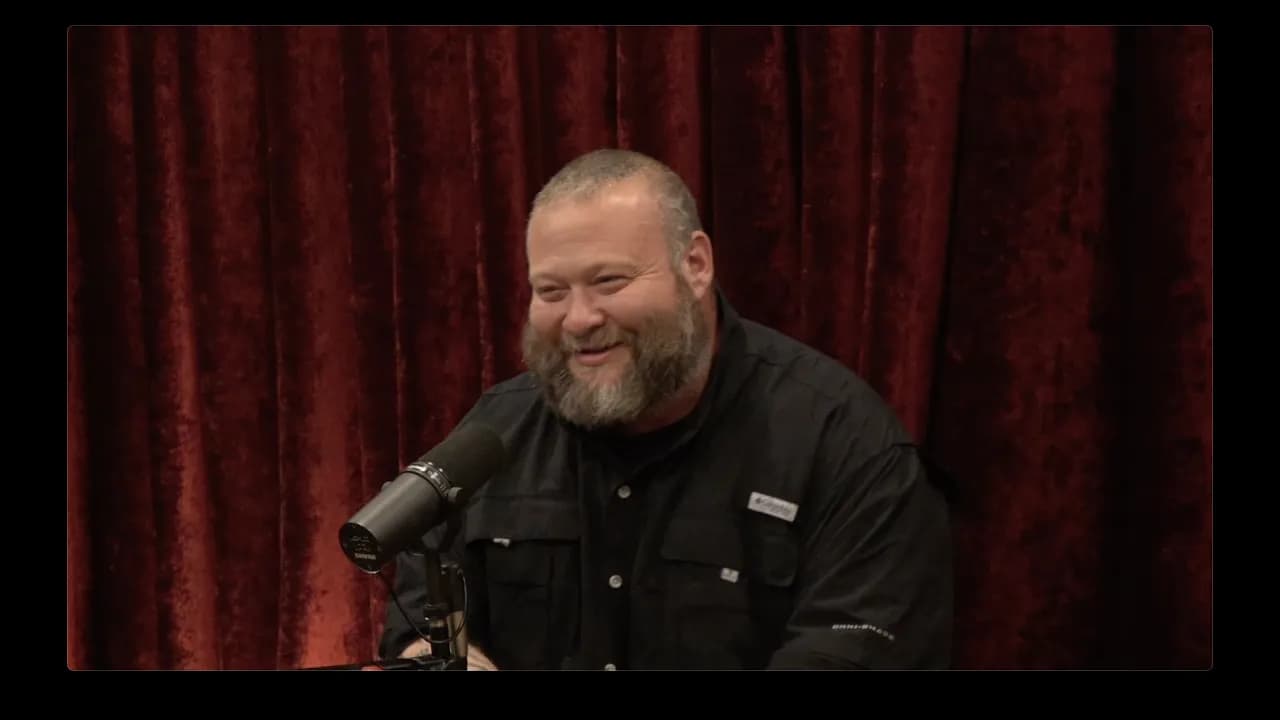
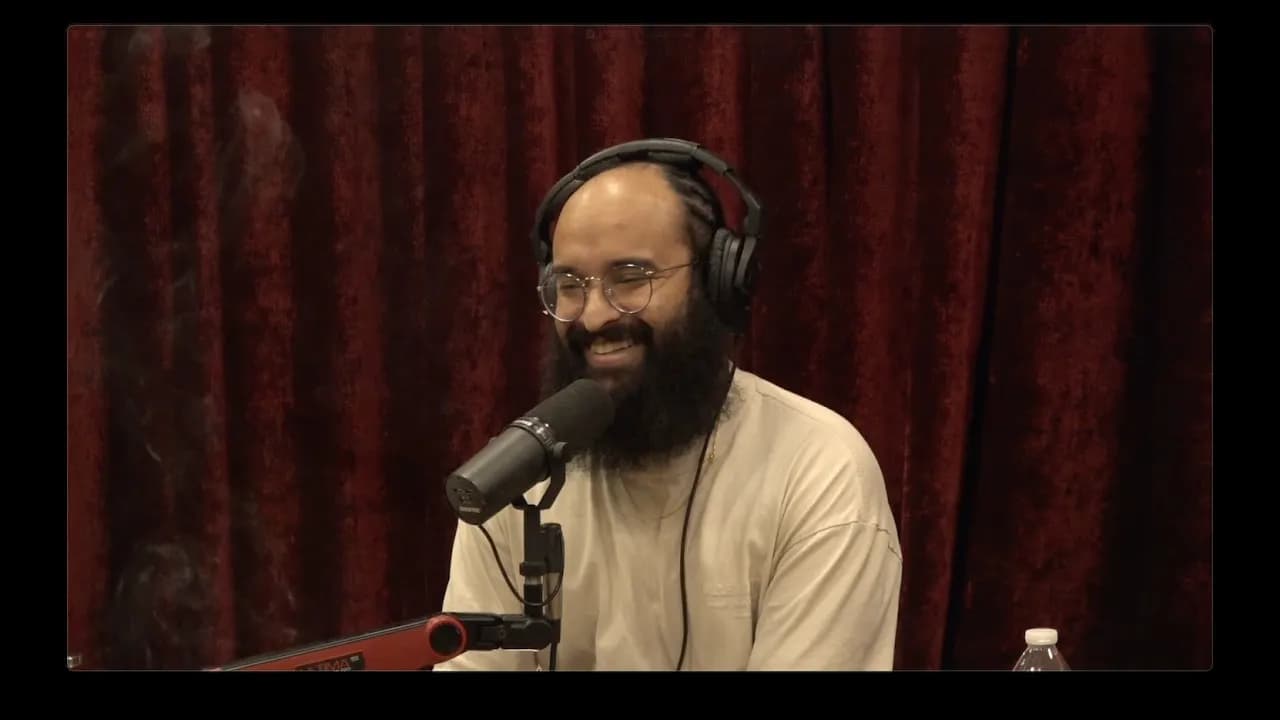
Joe Rogan Experience #2557 - Yakov Smirnoff
In a Nutshell
Yakov Smirnoff's comedy career collapsed when the Soviet Union fell in 1991 because his act was tied to Cold War material, forcing him to reinvent himself through education and relationship-focused comedy. He earned psychology degrees from UPenn and Pepperdine while developing a needs-based framework for relationships, drawing from Dr. Willard Harley's research showing men and women have completely different emotional needs. Now 75 with a one-year-old child, Smirnoff is touring again with family-friendly stand-up after 33 years in Branson, having rebuilt his career by understanding that meeting a partner's specific needs maintains laughter and connection in relationships.
These notes were generated by AI and may contain inaccuracies.
Yakov Smirnoff brought a photo of a mural he painted at ground zero. He mentioned sending a Paul Harvey radio segment about the mural to the show, but copyright concerns prevented playback.
Smirnoff expressed nervousness being on the podcast, citing admiration for Rogan's career longevity and voice transition. Rogan reassured him that much of success is dumb luck combined with persistence.
When the Soviet Union collapsed, Smirnoff's career ended abruptly. David Letterman featured him at number one on a top 10 list of things that would change, with the entry stating Yakov Smirnoff would be out of work. Within six months, all contracts in Las Vegas, Atlantic City, Reno, and Tahoe were not renewed. Clubs stopped booking him despite having quality material.
Smirnoff compared his situation to a John F. Kennedy impersonator whose career ended after the assassination, noting he was so closely associated with the Soviet Union that his relevance vanished.
Before the collapse, Smirnoff helped President Reagan write jokes for speeches during Moscow visits. He described being a joke supplier for the White House while his career was ascending.
After two years of unemployment following the Soviet collapse, Smirnoff moved to Branson, Missouri. Willie Nelson suggested the move during a Farm Aid concert where Smirnoff co-hosted, noting that Branson audiences would appreciate his family-friendly humor.
In March 1993, Smirnoff visited Branson and observed shows by Soji Tabuchi (Japanese fiddle player) and Andy Williams drawing 2,000 people for matinee performances. He rented a small theater in May and initially drew only 17 people to his first show.
To attract audiences, Smirnoff created "Yak in a Box," serving his mother's breakfast recipes in the showroom before shows. He performed two shows daily - breakfast and dinner. Within a year, average attendance reached 400 people per show. Bus tours began discovering him, leading to purchasing a 2,000-seat theater.
Smirnoff reduced his schedule to approximately 30 shows per year, down from 400 shows annually when building his audience and income.
Before social media, once a narrative established that Smirnoff was finished due to the Soviet collapse, there was no way to demonstrate ongoing performances. The cancellation occurred without scandal - simply association with a defunct regime.
Smirnoff viewed the career collapse as forcing evolution from a one-note act focused on Soviet Union material. He realized his humor needed to address different topics as the Cold War ended.
The Soviet collapse coincided with Smirnoff's divorce. He began examining why laughter disappears in relationships, noting that attorneys are the only ones laughing during divorce proceedings. He started using his comedy shows as a laboratory to study relationship dynamics.
Smirnoff asked audiences about laughter in early relationships versus later stages. He discovered universal patterns: everyone remembers laughter during honeymoon phases, and no one pursues second dates without laughter on first dates.
To explain divorce to his young children, Smirnoff used magnets to demonstrate attraction and repulsion. When things go well, magnets attract; when relationships deteriorate, they repel.
While performing in Branson, Smirnoff earned a master's degree in psychology from University of Pennsylvania and a doctorate from Pepperdine University. He scheduled weekend travel for in-person classes around his performance schedule.
Smirnoff identified parallels between comedy and relationships: comedians gauge audience connection through laughter, meeting audience needs with setups before delivering punchlines. In relationships, the same principle applies - meeting needs creates connection.
Drawing from Abraham Maslow's hierarchy of needs, Smirnoff explained that successful businesses identify and meet customer needs. Apple develops products people don't know they need but cannot live without.
Smirnoff shifted focus from Cold War between countries to understanding dynamics between couples. He emphasizes that men and women have different needs, and anticipating a partner's needs maintains love and laughter.
Smirnoff referenced Dr. Willard Harley's book "His Needs, Her Needs," which identified ten emotional needs and surveyed divorcing couples. Research revealed that men's top five needs differed completely from women's top five needs.
Women's top needs: affection, conversation, openness and honesty, family commitment, and financial support.
Men's top needs: sexual fulfillment, admiration, attractive spouse, recreational companion, and domestic support.
Smirnoff conducts audience surveys during shows asking men if they would like to hear their wives express admiration for their efforts. He notes that while not all men applaud (due to fear of judgment), the need for admiration remains significant. Women want to be loved for who they are rather than acknowledged for what they do.
When a partner begins to succeed, resentment can emerge if the other person is not growing at the same pace. One comedian's girlfriend experienced this when her career took off while his stagnated, leading to insults and emotional distance. The relationship ended because he could not be happy for her success. Discussing potential reactions to success at the beginning of relationships helps establish expectations, though character flaws often only reveal themselves under real pressure.
Yakov created a painting called the tree of love to understand his role in relationships after his first marriage failed due to role confusion. His first marriage to an American woman began well, but he subconsciously replicated his parents' dynamic where his strong mother led and his creative father followed. This script led to him expecting his wife to take charge in the relationship while he was commanding on stage.
Yakov wanted to become a strong man capable of giving a woman freedom to be creative and bring children without worry. In his first marriage, he presented as commanding on stage with 2,000-3,000 people but became passive in the relationship, telling his wife "I do and I didn't do it." It took 20 years of education and self-work to understand who he wanted to become to attract a partner seeking that role.
When the Soviet Union collapsed, Yakov's career disappeared along with his first marriage. He chose to pursue education and self-improvement rather than remain defeated. At age 75, he now has a one-year-old child after marrying seven years ago. He spent approximately 20 years single, working through Tony Robbins trainings to become the strong person he wanted to be, moving beyond his father's more passive nature.
Yakov met his wife Olivia from Ukraine during a trip to show his grown children his hometown of Odessa. After forgetting his passport and staying an extra day, he observed women in a park during lunchtime and decided to pursue finding a wife systematically. He hired three different introduction agencies simultaneously and conducted 51 dates over two weeks, eating three meals daily with different women.
Through his 51 dates, Yakov developed criteria based on his education: he looked for women whose fathers provided positive masculine energy. If women came from abusive or problematic father relationships, they would not trust his energy. He could often determine compatibility within seconds through initial interactions like handshakes, though he still had to complete meals with incompatible dates.
When agency meetings failed, Yakov organized a seminar in Kiev on relationships and laughter, positioning himself as an American professor teaching the course. The strategy targeted women interested in relationship education rather than those seeking to escape Ukraine through marriage agencies. These women were less likely to be in "masculine energy" hunting mode.
Olivia was recommended to promote the seminar and became Yakov's future wife. Their connection developed gradually despite the age difference. He invited her to America and proposed during a hot air balloon ride on her birthday, with a large banner reading "Will you marry me?" on the ground below. Since she could not read English initially, she needed to see the ring before responding.
Ukraine has tension between western Ukrainian-speaking regions and Russian-speaking areas, though both sides generally coexist without major conflict. Yakov's wife primarily speaks Russian.
Yakov started performing comedy at age 15 in the Soviet Union during the 1960s. The communist party controlled entertainment, approving only two comedians for radio and television. Arcadi Reichen was the main government-approved comedian whose monologues were broadcast through speakers in every apartment for propaganda purposes.
Yakov recorded Reichen's approved monologues on a large tape recorder and memorized them to perform at school clubs. Since the material was already government-approved, he could perform without additional scrutiny. This experience confirmed his desire to pursue comedy professionally.
After military service, Yakov performed comedy during holidays and special events. He later worked on Soviet cruise ships in the Black Sea at ages 20-21, earning payment and a cabin. Previously, he had lived in a communal apartment with nine families sharing space until age 26, with no phone access.
Cruise ship work introduced Yakov to tourists from Germany, Britain, America, Australia, and Yugoslavia. Despite being forbidden from talking to foreigners, his performances led the captain to request his continued presence, offering special privileges typically reserved for valuable performers.
The cruise director explained that capitalist companies provide perks to talented individuals, leading Yakov to realize that in capitalist systems, talent translates to better treatment and opportunities. This concept fundamentally changed his worldview compared to the Soviet system.
Yakov's father secretly listened to Voice of America broadcasts at night despite jamming attempts during daytime hours. The broadcasts represented hope and possibility, mentioning the Statue of Liberty and opportunities in America. Yakov's mother feared discovery and discouraged any discussion of leaving the Soviet Union.
After experiencing the cruise ships and capitalist environment, Yakov suggested the family try to leave the Soviet Union. His father supported the decision despite knowing it would mean social ostracization and difficulties. The family applied for visas during the Jimmy Carter administration when grain trade negotiations created opportunities for emigration in exchange for wheat shipments.
Yakov's experience demonstrates why centralized government control over resource distribution leads to corruption and power consolidation. Communist systems concentrate power among elites while creating bread lines for citizens. The solution requires combining capitalist freedom with genuine empathy and philanthropy rather than government redistribution schemes.
Yakov views himself as a poster child for the American dream. The American flag represents hope for people from all backgrounds rather than any particular political administration or ideology. The flag symbolizes the melting pot concept where people from everywhere can find opportunity, regardless of race, ethnicity, or origin.
Yakov arrived in America in 1977 and worked as a bar boy at Ginger's Hotel in the Catskills. He saw performers including Freddy Roman and Eddie Fisher while learning English. He later encountered Red Skelton in Atlantic City performances.
Stand-up comedy as currently practiced in dedicated clubs emerged in the 1960s. The art form represents a relatively new development in entertainment history compared to older variety formats.
Standup comedy as an art form is very new in terms of human history. A big part of early standup development was the Catskills region, where people from New York and Pennsylvania would go for summer vacations. Comedians would book themselves at these resorts, creating a major circuit for performers.
Yakov decided he needed to learn English since he didn't speak it upon arrival. His plan was to become a bartender because in cruise ships the bar was in the same proximity as the stage, allowing him to talk to people individually. He collected $200 and attended a makeshift school on Fifth Avenue in New York for two weeks to get a degree in mixology.
His first job was at a restaurant called Monks in Lincoln Center, where he dressed as a monk in a French restaurant and didn't have to speak as a waiter. The school then recommended him for a bar boy position at Gingers Hotel in the Catskills.
When Yakov walked into Gingers Hotel, he saw a beautiful bar with 18 bartenders and a 2,000-seat theater. He immediately decided he wanted to work there regardless of pay. He quit his previous job at Monks, with his manager telling him, "It's America. You should take the opportunity."
Yakov is his real first name, while Pocus is his last name. People couldn't pronounce his name at the bar, often asking for "spirnov," which inspired him to adopt "Smirnoff" as his stage name. He notes that Yaks sounds like jokes, and Smirnoff makes people happy.
Many performers in show business changed their names to sound more appealing, though Arnold Schwarzenegger was one of the first to keep his original name regardless of spelling or pronunciation difficulties.
Yakov worked at the Catskills for about seven or eight months. He was learning English while translating jokes and testing them on audiences and customers. If they laughed, he knew he was understood; if they didn't laugh or he didn't get a tip, the joke wasn't working.
He started as a bar boy bringing ice and mixing piña coladas, then became a bartender. He asked Barry Wise, the manager of the main room, if he could try his comedy. Wise said he couldn't perform in the main room but could do a couple of minutes in the lobby during afternoon Simon Says games with older people.
During his first standup attempt in the lobby, a woman appeared to be having a seizure, which Yakov initially thought was laughter. People told him he was "killing," though he thought they meant literally. This experience gave him confidence despite the confusion.
He later performed at Catch a Rising Star in New York, which wasn't very successful. While working as a shipping manager at Greeting Bells, a woman offered to arrange a meeting with Ted Bergman, the executive producer of Three's Company in Hollywood.
Yakov bought a 10-day ticket to Hollywood with plans to become a star and return to New York to buy a Fifth Avenue apartment for his parents. He naively believed that since Bergman was the executive producer of Three's Company, he would put him in the show immediately.
Bergman wanted to see him perform but couldn't make it to the Comedy Store open mic. While walking on Sunset Boulevard after his set, Chrissy, Mitzi Shore's secretary, ran after him to congratulate him because Mitzi liked his performance.
Yakov had no idea who he was talking to when sitting with Mitzi Shore in the booth next to the original room at the Comedy Store. She told him he was very funny and that there was always a place for good and different performers in Los Angeles. When he mentioned needing to return to New York for his parents, she asked what his father did and offered to give him a carpentry job.
She also offered him a room in her house on Crest Hill for $120 a month. The next day, he watched a show featuring Harris Peet introducing Robin Williams, followed by Billy Crystal, David Letterman, and Richard Pryor.
Yakov worked as a carpenter helping his father while Mitzi gradually gave him performance opportunities. His main job involved going to her house to buy and install doorknobs that Paulie would remove and throw away to prevent Mitzi from walking in on him smoking pot.
He was relentless about learning English, isolating himself from Russian speakers except his parents. He would only speak English with everyone else.
Robin Williams got him a part in Moscow on the Hudson, which started filming in 1982 and came out in 1984. He did seven episodes of Night Court but couldn't get on The Tonight Show because producer Jim McCauley didn't think Johnny Carson would like him.
Mitzi would have an annual showcase for McCauley, who would repeatedly say Carson wouldn't like Yakov. On year six, McCauley told him he'd get on the show "when hell freezes over."
Yakov got a Miller Lite commercial that became very popular during the Super Bowl. Carson saw the commercial and asked McCauley why they didn't have him on the show. Mitzi called Yakov in Raleigh, North Carolina, to tell him McCauley now wanted him on immediately.
His initial reaction was to tell McCauley to "shove it," but he did the show anyway. Carson liked him and called him over to the couch, which was a big deal at the time. Yakov told Carson, "In America you have things we never had in Russia like policeman have warning shots," which made Carson almost fall off his chair.
Yakov did six or seven Tonight Show episodes. Being on Carson was a huge deal because there were only three channels at the time, and 30 million people watched the show. If you were good on The Tonight Show, you could perform at clubs across the country with the "as seen on The Tonight Show" credit.
Yakov offered to do a skit as an interpreter with Reagan and a Gorbachev lookalike, which was well-received.
While playing at the Comedy Cafe in Washington DC, the chief editor of the Washington Times invited Yakov to dinner with President and Nancy Reagan. When arriving at the house, there were two helicopters hovering and FBI agents everywhere. Security initially stopped them, but when they shone a light on Yakov, the agent recognized him from the Miller Lite commercial and let them in.
Reagan immediately connected with Yakov and started telling Russian jokes. Their relationship led to Dana Carvey calling him to write jokes for Reagan's speech at Moscow University.
Yakov felt the original speech was talking down to Soviet leaders and rewrote portions to put them on equal footing. He was concerned they would become defensive and offended by the condescending tone. The revised approach was better received by the Soviet leaders.
Mitzi used to tell him that he and Reagan changed the world, though he felt he was just telling jokes. Reagan asked him how he would deal with Gorbachev, saying Yakov was qualified because he had lived there for 26 years.
Yakov considers his ability to adjust one of his strong skills. When coming through Italy, they were kept for three months to check documents and ensure they weren't Communist Party members or spies. The Soviet Union only allowed them to exchange $100 per person for three months of survival in a foreign country.
They discovered that condoms were expensive in Italy but cheap in the Soviet Union with no restrictions on quantity. Yakov filled half a suitcase with condoms, which his mother carried through customs. They sold them at open markets on weekends, with his mother using a sign in Italian saying "If you don't want to have a kid like this" while pointing at him.
In Rome, Yakov would go to a movie theater where for a dollar you could watch English-speaking movies all day. A couple helped him practice English - the girl from Belgium and the guy from Washington DC. They would meet at coffee shops to talk.
When asked what he wanted to accomplish in America, he didn't know anything about the country yet.
Yakov Smirnoff was told the most successful comedians perform in Las Vegas. Five years later, he performed at the Tropicana Hotel with Murray Lanston, the unknown comic.
The Gong Show featured comedians with varying levels of talent, where performers could be gonged off stage. Joe Rogan noted it was an early version of Kill Tony in many ways. The show was brought back multiple times, including in 2008 and 2017, with David Tell hosting the 2008 revival.
Joe Rogan mentioned Fear Factor has had three different versions, with the latest featuring Johnny Knoxville. Yakov is currently on tour at comedy clubs across the country, with Atlanta as the next stop. His tour information is available at yakov.com.
Yakov described his Kill Tony appearance as great despite his G-rated show contrasting with the show's style. Tony was respectful and made Yakov feel like a super legend. Yakov has been doing comedy for 60 years.
Joe Rogan first met Yakov at the Comedy Store approximately 15 years ago. Yakov dropped in to see what young comedians were doing and perform standup. They hung out in the green room with Joey Diaz and others. Joe remembered Yakov as really funny and cool.
Yakov's goal last year was to go to small clubs and develop an hour of totally current material. He talks about relationships and having a one-year-old in his life. He enjoys watching audience reactions, particularly how couples connect during his relationship material.
Nate Bargatze helped Yakov realize there was a need for family-friendly humor. Nate's audiences include grandmothers, grandchildren, parents, and 10-year-old children. Joe noted Nate made the most money ever doing standup last year, selling the most tickets and performing stadium shows twice in one night, including 3 p.m. shows.
Brian Regan was cited as another example of squeaky clean, unbelievably talented comedy. Joe emphasized that comedy doesn't have to be clean or dirty - it just needs to be funny. The Comedy Mothership gets labeled as extreme anti-woke, but audiences simply enjoy the performances.
Joe explained that comedy done correctly comes from the performer's perspective, whether that's Nate Bargatze, David Tell, Joey Diaz, or Brian Holtzman. Different styles like Brian Holtzman's death metal comedy or Leanne Morgan's clean southern humor can all succeed. Netflix embraced Leanne Morgan's clean southern humor, leading to touring and concerts.
Comedy clubs offer unpredictable variety - audiences might get Run DMC or AC/DC style performances. Yakov wants to do one hour of straight comedy without storytelling elements.
A young comedian told Yakov he was a one-man show rather than a stand-up comedian because his act was more storytelling than punchline-focused. ChatGPT confirmed this assessment. Yakov spent a year rewriting his material to be punchline-focused and became a stand-up comedian again.
Yakov draws inspiration from Argus Hamilton, who continues performing in LA and always has great lines about current news. Argus runs 10 miles daily even in his 70s. Yakov recalled Argus arriving at the Comedy Store in running shoes after completing his daily run.
When Yakov lived in the Comedy Store house, Andrew Dice Clay taught him English. The house was a party location where Sam Kinison would hang out. Andrew Dice Clay and Sam Kinison would scream at each other as a joke. Yakov suggested they go to the Comedy Store to scream, leading to Sam Kinison's first stage appearance where he performed his screaming act.
Robin Williams and Richard Pryor would do drugs at the house. Yakov would wake up to find mirrors with white powder residue on tables. Being naive, he thought they were eating donuts off the mirrors and would clean them up, asking why they didn't use plates.
Sam Kinison arrived at the Comedy Store around 1979, later than Yakov. He appeared on Letterman in 1985 and had an HBO special in 1986 that significantly boosted his career.
Joe Rogan first learned about Sam Kinison through a female volleyball player at the Boston Athletic Club where he worked as a trainer. She performed Kinison's bit about homosexual necrophiliacs in the parking lot. This was Joe's introduction to Kinison's comedy style in 1986 when Joe was 19 years old.
Joe was heavily invested in martial arts and wanted to compete. His friends encouraged him to try comedy, though he initially thought his humor was too crazy for normal audiences. Steve Graham convinced him to do an open mic, where Joe realized everyone starts poorly at comedy, similar to martial arts.
In 1988, Boston comedians talked about the Comedy Store as Mecca. Richard Pryor, Sam Kinison, David Letterman, and Bill Hicks (who was a doorman) all came from the store. When Joe first got on a television show, he flew to LA for a pilot and visited the store for the first time.
Joe met Mitzi Shore in 1994 after doing a pilot that became the sitcom Hard Ball, where he played a crazy star player who crashed his Lamborghini. He spent nights at the Comedy Store, became a non-paid regular, and performed after scheduled shows around midnight.
Getting passed by Mitzi Shore was more important to Joe than getting a sitcom. He felt he could actually make a living doing comedy. The sitcom paid well but wasn't as exciting as live comedy audiences. News Radio was a better show experience.
Joe considers Mitzi Shore the most important figure in comedy outside of comedians themselves. She was a mentor and curator of what she called a mental health asylum, joking that the inmates were running the asylum. The Comedy Mothership bar is named Mitzi's as a tribute.
The original name consideration was The Asylum as a nod to Mitzi. Ron White was the first to move to Austin and noted its central location for travel. Joe's UFO obsession led to the name Mothership instead.
Mitzi suffered from a neurological condition later in life. She nurtured many comedians but sometimes gave terrible advice, including trying to change Joey Diaz's name to Fat Baby on lineups for a couple years.
Mitzi knew there was something unique happening at the Comedy Store that was necessary in the comedy world. Comedians felt at home there. Harris Peet told Joe that performing elsewhere was fine, but coming back to the store was like coming home to the island of broken toys.
Mitzi Shore specialized in developing raw comics rather than those already established. Jerry Seinfeld was rejected because he was already developed, which she found uninteresting. She preferred taking people when they were really raw and shaping them into performers. Her notable projects included Rosanne, Denver, and Jim Carrey among many others.
Mitzi had specific techniques for testing potential comics. She would take young comics she saw promise in and schedule them after the biggest names who were killing it on stage. This was the same approach she used with Richard Pryor and Robin Williams, putting new talent after established performers.
Mitzi Shore was considered a unique and important person in comedy. Yakov attended her funeral where her son Peter asked him to be one of the pallbearers. He felt this was a full circle moment, noting she gave him his life in a way that changed his entire trajectory.
The Mothership comedy club attempts to capture the spirit of what Mitzi was trying to do at the Comedy Store. The approach welcomes "weirdos" - creating an environment that embraces unconventional performers and audiences.
The Mothership's small room is described as having the feel of the original Comedy Store room combined with the Belly Room. The big room at the Mothership is compared to the original room combined with the main room at the Comedy Store.
Yakov helped build the Belly Room at the Comedy Store. Kill Tony started in the Belly Room. The room was structurally concerning - during Roast Battle events, the ceiling would visibly move when packed beyond its 70-80 person capacity.
A regular Comedy Store patron known as Heavenly Light dressed as Jesus and was a fixture at the club. He was genuinely nice and became part of the venue's unique atmosphere, though he never performed stand-up. His presence exemplified the unusual, crazy people who gravitated to the Comedy Store.
The Comedy Store attracted completely schizophrenic individuals who would wander into the parking lot and engage comedians in conversation. Brody Stevens had one such person on his show, highlighting how unusual the venue was.
Joe considered buying Crest House at one point but decided against it due to his dog Frank Sinatra being an escape artist. The property had a small backyard on a hill, which wasn't adequate for the dog's exercise needs. Joe believes dogs require either a big yard or daily exercise outings.
Yakov lived at Crest House in a small room while Andrew Dice Clay lived downstairs. Andrew taught Yakov how to date women and would playfully torment him about having to go downstairs when Yakov had female visitors.
During his time at Crest House, Andrew Dice Clay's act was very clean, featuring impressions of Elvis, John Travolta, and Sylvester Stallone. He was considered a clean-cut performer at that time.
Tom Wilson, known for playing Biff in Back to the Future, also lived at Crest House. He was described as more clean-cut compared to Andrew Dice Clay.
Andrew Dice Clay advised Yakov to buy a ring to make breaking up with a girlfriend easier. Yakov purchased what he thought was a regular ring, but Tom Wilson identified it as an engagement ring. Tom warned him not to listen to Andrew, stating "Andrew is not a representative of the human race."
While working for Mitzi Shore at minimum wage, Yakov saved money and lived with other comedians who had a two-car garage with no cars. A friend suggested they borrow money to buy two Mercedes in Germany, sell one, and essentially get one for free.
Yakov successfully executed the Mercedes plan despite complications, bringing two cars back from Germany and selling one. While other comedians slept until noon without transportation, he had two Mercedes in the garage.
Yakov was hired for Bob Monkhouse's show, described as England's version of Johnny Carson. He received 10,000 pounds in cash for the appearance and used the money to buy a Rolls-Royce, which he shipped to America.
Despite owning a Mercedes 450SL and Rolls-Royce, Yakov lived in a $120 per month room. A realtor approached him while he was polishing his Rolls-Royce, and he mentioned wanting a 5,000 square foot house with an acre of land and LA views for $150,000.
The realtor found a property a block from Mitzi Shore's house with similar structure. The house had been owned by comedian Lenny Bruce and later by character actor Seymour Cassel, who lost it due to drug issues. The property was completely destroyed with flooding in the basement and broken windows.
To complete the house purchase, Yakov needed Seymour Cassel's signature on paperwork. The attorney revealed Cassel was in jail. Yakov visited him with $500, and Cassel agreed to sign for $50 because inmates weren't allowed more than that amount in jail.
Yakov eventually sold the house when moving to Pacific Palisades after his daughter was born, then had to sell again at a loss when relocating to Branson, where he owned a theater for 33 years.
Yakov attended Nate Bargatze's show in Florida's Hertz Arena with 12,000 people. Bargatze invited him to perform, and the audience reaction made Yakov feel like he was back in the 1980s. He performed eight minutes and received an enthusiastic response.
Yakov came to Austin for the Moon Tower Festival. Adam Eget got him a spot, where he met Tony Hinchcliffe, who invited him to be a guest judge on Kill Tony. Yakov was traveling to Europe with family at the time but agreed to appear at the end of August.
A year and a half ago at the Nashville Comedy Festival, Yakov performed 15 minutes at the Ryman Auditorium in the middle of a show featuring Nate Bargatze's opener. The crowd gave him a standing ovation, which he found emotionally moving.
Yakov believes he can still offer something valuable to family audiences who might learn from or laugh with him. He acknowledges the challenge of performing for younger comedians after 33 years in Branson's environment.
After graduating from Pepperdine, Yakov went to the Comedy and Magic Club wearing his cap and gown. Jay Leno questioned his doctorate pursuit, arguing that comedy is simply writing jokes, telling jokes, and picking up checks. Yakov felt there was more to comedy's potential.
Joe Rogan agrees that comedy serves a deeper purpose beyond entertainment. He describes laughter as "medicine" and "a lubricant" in relationships, comparing it to oil in an engine - essential for proper functioning.
Yakov agreed to perform a set during Joe's show. His website is yakov.com, and his next scheduled show was in Atlanta that weekend. Additional tour dates included the Punchline in Sacramento, Cobb's in San Francisco, and Comedy Works in Greenville.
Keep PowerfulJRE in your library
Save the videos and channels worth coming back to, and find them again in one place.