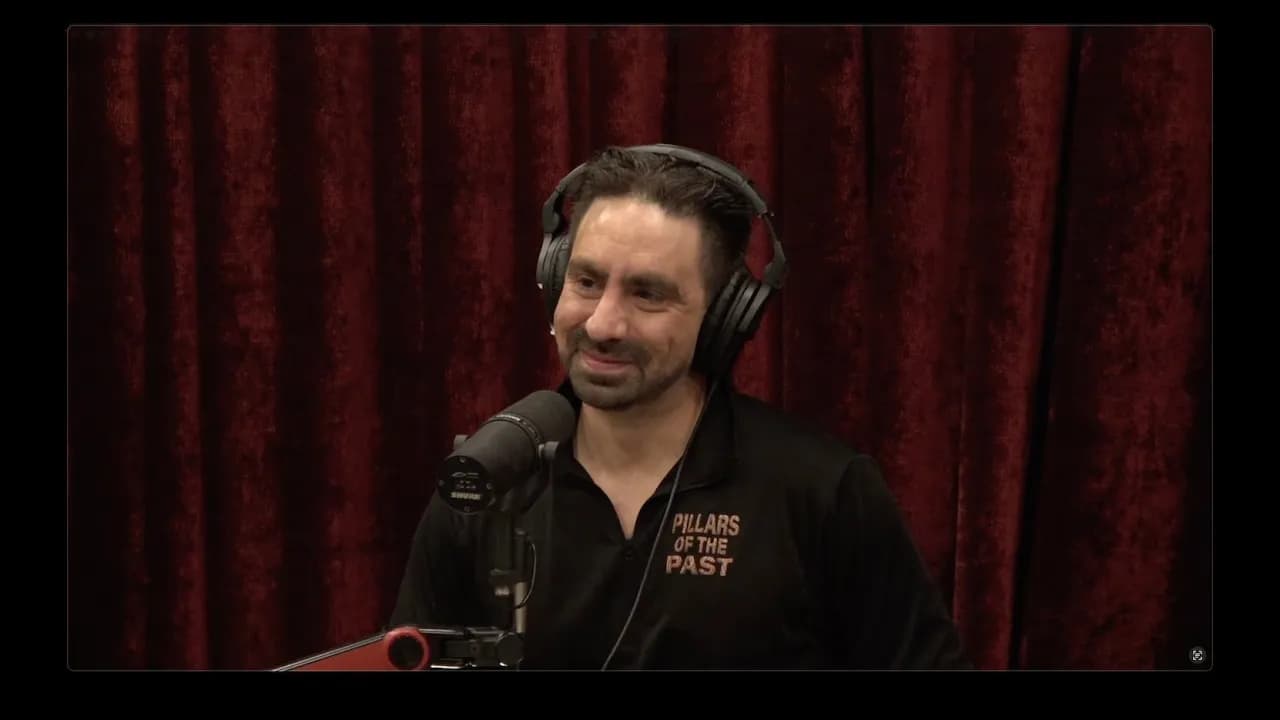
Joe Rogan Experience #2563 - Dan Richards
In a Nutshell
The core message centers on evidence that advanced ancient civilizations existed thousands of years earlier than mainstream archaeology acknowledges, with South American cultures like Paracas demonstrating sophisticated genetic manipulation, skull modification, and megalithic construction. Dan Richards argues that systematic suppression of archaeological evidence—including disappearing elongated skulls, redacted records, and destroyed burial sites—stems from academic gatekeeping and financial motives rather than legitimate scientific concerns. The discussion ties these findings to broader patterns of information control, from the destruction of Mount Coffin to restricted areas in the Grand Canyon, suggesting that uncomfortable discoveries about human origins and capabilities are being actively hidden.
These notes were generated by AI and may contain inaccuracies.
Dan Richards brought a Smithsonian pamphlet on elongated skulls, clarifying these examples are from Washington State and Oregon, not Peru. The majority of elongated skulls in recorded history come from Washington State and Oregon. When Lewis and Clark reached the Columbia River after passing the Cascade Mountains, all Native Americans west of the Cascades practiced artificial skull modification.
The book title "The Chinook Sign of Freedom" refers to the practice where artificially modified skulls indicated free status. Those without modified skulls were considered slaves. Chief Conley, who met Lewis and Clark during their expedition and was as famous as Sacagawea was 100 years ago, had an artificially elongated skull. He attributed his intellect to the skull modification.
Neanderthal brain cases differ significantly from human ones, with the difference concentrated in the back. Chiari malformation type one occurs when the base of the cerebellum falls into the spinal cord, causing migraines and other issues. Scientists suggest this condition may have originated from incompatibility between Neanderthal and human brain case skulls. Neanderthal skulls are wider in the back where motor skills, smell, sight, and hearing are located.
Neanderthals likely possessed exceptional athletic ability, motor skills, and visual capability due to larger eye sockets. Their frontal lobes were smaller than modern humans', affecting thought processing and decision-making. They had barrel-like chests and required no exercise to maintain impressive physiques.
A researcher proposed Neanderthals as gorilla-like super predators with enhanced night vision, suggesting they were infinitely stronger than humans. Genetic evidence contradicts these sensationalist claims. Neanderthals had larger skull capacity than modern humans.
Dolphins have cerebral cortexes approximately 40% larger than humans. The question arises whether this represents greater intelligence that cannot manipulate the environment, leading humans to dismiss it. Dolphins cannot manipulate fire underwater, limiting technological development. Their intellect may be directed toward social and hunting skills.
Female dolphins are promiscuous to prevent males from killing cubs they might have fathered. Male dolphins kill cubs to force females to breed again. Chimpanzees and bears exhibit similar behavior. Bears eat cubs both to force breeding and for food. Bears are cannibals that enter dens to pull out and eat cubs. They tear prey apart and eat animals while still alive.
Anthropomorphification refers to humanizing animals. Bears can be trained for circus performances but remain brutal in the wild. They function like giant wild dogs with no regard for other creatures.
Recent discoveries include Denisovans and Homo floresiensis ("hobbit people" from Flores Island). Denisovans were taller than modern humans with larger heads similar to Neanderthals. A gene variant found in Neanderthals and Denisovans increases polyactyly (multiple fingers/toes), cranial deformations, and other traits. Research from 2023 documents these genetic connections.
A Brazilian family has members with six fingers and six toes, which they report provides advantages like better ball handling and guitar playing. In South America, genetic deformations were historically honored. Evidence suggests active breeding of different bloodlines together in South America.
People with extra appendages appear otherwise normal, creating situations where additional fingers would take time to notice. The phenomenon resembles AI glitches in the Matrix, where people have additional appendages.
Six-fingered individuals would have advantages as goalies due to greater hand width and coverage. Guitar players note the extra stretch and reach allows accessing additional frets. Jimi Hendrix played left-handed and upside down. Stevie Ray Vaughan performed on a $15,000 Stratocaster by standing on the horns and rocking the neck.
During a concert at Antone's during lockdown, the entire crew and everyone backstage got carbon monoxide poisoning. One crew member had CO after the show. Rogan did not get CO, possibly due to being something he wanted to discuss.
Scientific literacy was weaponized with "trust the science" messaging about vaccines. The average peer review time for vaccine testing is about 10 years. A vaccine developed in a year and a half hasn't followed proper scientific steps. Science is defined as a method and way of thinking, not an end result. Carl Sagan described science as "a way of skeptically interrogating the universe." There was significant money involved in the rushed process, and other treatment methods existed.
Rogan's personal physicians faced criticism for his approach. His documented practices include working out, taking vitamins, cold plunges, and hyperbaric chambers. Despite surviving COVID without vaccination, the narrative focused on vaccine hesitancy rather than considering alternative successful approaches. People with vaccine ingredient allergies like Aaron Rodgers were not offered alternative strategies.
Fauci hearings were not widely known among supporters until specifically mentioned. People avoid information that contradicts their established views. When wrong about something, the proper response is acknowledging the error.
Flint Dibble, an archaeologist, criticized claims about Easter Island having food stuffs from both South America and Asia dating back a thousand years. He later acknowledged the evidence was accurate but didn't mention the Easter Island connection. Graham Hancock faces accusations of racism for proposing advanced pre-existing civilizations, despite these being human ancestors of local populations.
Baalbek has no written records of its massive trilithon construction despite Romans documenting everything through scribes. The argument isn't about race but about the absence of documentation for structures supposedly built by cultures known for extensive record-keeping. Atlantis may be a catch-all term for a lost globe-spanning civilization.
GSP has been officially confirmed to appear at an event called "The Quest for Ancient Civilizations." Tickets are available online. The event lineup includes topics that align with discussions about pyramids, comedy, and martial arts. Randall Carlson has a history in hip-hop from the late 1980s.
The conversation examines skulls with artificial cranial deformation found in Peru and China. Some skulls originally thought to be from archaic humans like Cro-Magnon or Neanderthal were later identified as artificially modified. The discussion explores whether head modification was done to resemble existing populations.
Chiari malformation appears in CT scans showing the brain extending downward, potentially caused by interbreeding between Neanderthal/Denisovan populations and modern humans. This mismatch between brain size and skull capacity creates constant pressure. Historical practices of drilling holes in skulls or elongating the back of the skull may have been attempts to relieve this pressure across generations.
Wormian bones appear at the back of skulls under stress or lack of equilibrium. When pronounced, these are called Inca bones due to their prevalence in Inca territory. Similar patterns appear in Easter Island, the Pacific Northwest, and Asia. Neanderthal skulls also show this characteristic.
South American Paracas culture displays multiple genetic variations including polydactyly, elongated skulls, and trepanation. Different bloodlines were likely intermingled, creating both problematic and honored genetic variations.
Dental dysplasia causes fang-like teeth growth in children, often accompanied by cleft lip. This condition appears in Moche culture depictions of "jaguar people." These dental features don't appear in other known human primate specimens. Some ancient skulls show rows of teeth, though authenticity remains uncertain.
Mount Coffin in Longview, Washington contained approximately 3,000 elongated skulls from above-ground burials. Only nobility received burial there, requiring elongated skulls for freeborn status. Lieutenant Charles Wilkes, whose father belonged to the Skull and Bones Society in England, witnessed these burials. After his departure, a campfire destroyed the site and all skulls disappeared.
Tello received $300 annually for skull preservation in Paracas. Rockefeller made an unexpected trip to Peru and paid $3,000 for four grave bundles - ten times Tello's annual compensation. These bundles were reportedly displayed at the Metropolitan Museum and the American Museum of Natural History, though no photographs or drawings exist. The four bundles selected from approximately 300 available represent the finest specimens.
Skulls continue disappearing from museum shelves. Historical maps of artificial cranial deformation show more geographic locations than recent peer-reviewed versions. Ancient Hawaiian populations had approximately 8.9% elongated skulls among prehistoric remains, though this receives little attention.
Prehistoric Hawaiian remains date to roughly 1,000 years ago. The practice of cranial deformation appears worldwide, supporting theories about brain size and skull base relationships.
The Candellabra of the Andes remains visible 12 miles out to sea and may represent bloodline mingling. Paracas textiles show figures appearing to transfer something through the tops of their heads, resembling DMT experiences. Three-fingered and three-toed figures appear consistently in these textiles.
South American genetic manipulation likely created both natural deformities and artificial modifications. The combination explains extreme skull shapes in the region. Bulbous skulls represent the most common cranial deformation type. Some Peruvian skulls show significantly larger brain capacity than typical human specimens, with enormous eye sockets.
Some skulls lack the sagittal suture present in modern humans. These specimens may reside in private collections, particularly in Gilded Age mansions in Newport, Rhode Island. Articles documenting Rockefeller's skull purchases disappear from the internet within weeks.
Official explanations cite indigenous beliefs about souls residing in skulls, yet this justification applies inconsistently across cultures. The Pacific Rim supposedly follows uniform policies while Pennsylvania communities with differing beliefs coexist without such restrictions. The cover-up appears driven by European rather than indigenous interests.
Moche society considered cleft lips and six fingers as holy characteristics. Jaguar babies with these features were presented in ceremonies. Trophy skulls with cleft lips exist, with the only known example featuring this condition. Deformations were considered sacred, leading to temple placement for affected individuals.
South American cultures wore skulls on belts without shrinking them, drilling holes for attachment. Young women aged 13-16 appear frequently among discovered trophy skulls. Aztec mass ritual sacrifice created resentment among neighboring peoples, facilitating Cortez's alliances.
Spanish colonizers burned Mesoamerican codices, destroying historical records. A handful survived, including documents about Teotihuacan's construction purchased by the Mexican government for $250,000 from a family holding them for 500 years.
Dan Richards discovered websites selling ancient skulls from Asia, including ones with glued tusks and horns. Some skulls appeared to be human child trophy skulls, while others had headphones attached. Richards found recreated skulls on Etsy that people were making as replicas.
Richards noted that some of these skulls had hair lips, which can result from mingling Neanderthal or Denisovan DNA with human DNA, causing facial deformations.
Early 20th century diacrinized trophy skulls were available for purchase online with names and origins listed. Richards discussed Chief Connley, a Chinook leader who was friendly to white settlers and married his daughters to fur trappers. British collectors decapitated his body after death and shipped his skull to England, carving "Chief Conley" on the back.
Richards believes the elongated Paracas skulls represent a different species of human. He points to the Paracas Candelabra, a massive geoglyph only visible from the sky, and the "family tree" textile as evidence of genetic engineering. The Candelabra symbol appears on Easter Island skulls as well, including a "birdman" variant.
Genetic deformations like hydrocephalus appear more frequently in Paracas populations when Denisovan or Neanderthal DNA is present. South American populations show higher instances of cleft palates, polydactyly, and wormian bones, which are called "Inca bones" for this reason.
The episode featured a BetterHelp advertisement discussing mental health stigma around men being providers. Six million men suffer from depression annually in the US, often undiagnosed due to stigmas. BetterHelp offers online therapy with a 4.9 app store rating, and listeners can get 10% off their first month at betterhelp.com/jre.
The three-fingered, three-toed monster skulls from Peru, carbon dated to 12,200 years ago, raise questions about their authenticity. Richards noted that the white clay covering and mummified tissue would make modern recreation extremely difficult. The GLI3 gene variant found in Denisovan and Neanderthal DNA causes extra ribs, extra vertebrae, skull misshapenness, dental abnormalities, and sometimes extra fingers when introduced to mice.
Richards initially doubted the Smithsonian had giant bones but changed his mind after research. In the 1930s, Als Hyda, a Hungarian medical doctor turned anthropologist, systematically debunked giant bone findings, claiming they were mismeasured. He had a vested interest in proving white superiority through skeletal measurements.
In 1959, Dr. Don Doo of the Carnegie Museum discovered a 7-foot-3-inch skeleton in an Adena mound. Despite clear documentation of the height calculation, the findings were dismissed as merely "in-ground measurements" without proper analysis, and the skeleton disappeared from records.
Denisovans were significantly larger than modern humans, possibly six inches taller on average. Richards discussed whether ancient giants might have been Denisovans, noting the range of human heights today from five feet to nine feet. Sultan Kosen of Turkey, standing 8 feet 2.8 inches in 2011, represents the tallest recorded person without apparent gigantism.
Not all giant reports include six fingers and six toes - some accounts mention two rows of teeth instead. Richards found approximately a dozen solid accounts from respected anthropologists and scientists who documented giant bones, rather than just farmer reports.
Richards argued that archaeology cannot be considered true science because it lacks replicability. Unlike chemistry where hydrogen and oxygen consistently produce water, archaeological finds cannot be replicated by others. He compared archaeology to theology, where findings are either believed or not believed.
While archaeologists use scientific methods like carbon dating, the core discovery process itself is not replicable. This becomes particularly problematic with unique finds like the Antikythera mechanism, where acceptance often depends on whether the discovery aligns with existing worldviews.
Archaeology has a significant divide between those who claim absolute certainty in their interpretations and those who acknowledge the inherent guesswork involved. The latter group recognizes that while they apply scientific methods where possible, they cannot definitively claim their results are purely scientific due to the extensive speculation required. This becomes problematic when archaeologists invoke frameworks like Clovis first, using their supposed scientific authority to dismiss contradictory evidence.
There's documented history of archaeologists attacking those who present evidence contradicting established narratives. During debates, when confronted with examples of this behavior, the response is often that it's merely "an academic debate." Historical examples include an archaeologist who previously claimed no people existed in the Americas before 3,000 years ago, and Wikipedia pages that still reference how presenting earlier dates for American settlement would destroy careers. This pattern of professional destruction for challenging established timelines has repeated throughout archaeological history.
The resistance to alternative perspectives often stems from ego and the desire to maintain authority over information. When independent researchers like Graham Hancock achieve commercial success with their work, it creates significant ego damage for academics who have spent years studying the same subjects but with different constraints. Independent researchers operate without the funding requirements, approval processes, and tenure pressures that limit academic work.
Independent researchers like Jimmy Corsetti, Luke Caverns, and Ben Van Kirkwood can freely explore locations and develop expertise without institutional constraints. The information about the Old Kingdom and other ancient civilizations is publicly available for anyone to study with sufficient dedication. The issue isn't necessarily laziness among academics, but rather that they're not as obsessively focused on these topics as independent researchers.
When Jimmy Corsetti suggested the Nephilim might relate to Denisovans or Neanderthals before their height was known, archaeologists dismissed the idea by noting both species were shorter than humans. A more constructive approach would be to direct that curiosity toward gigantopithecus and other taller archaic hominids, channeling the researcher's passion rather than dismissing it. This represents genuine science communication versus gatekeeping.
Humanity lacks evidence for all humans who have lived throughout history, possessing only a tiny fraction of fossilized remains, especially from ancient periods. This fundamental limitation should guide all research approaches. New discoveries of human species continue to emerge, suggesting the possibility of finding additional bones in places like Siberian caves that could reveal entirely new human types.
Michael Button's work highlights that anatomically modern humans existed hundreds of thousands of years ago. This raises questions about why civilization, complex thinking, tool making, and technology would only emerge in recent centuries when the same species existed much earlier. Natural processes like weathering and earth absorption could eliminate evidence of earlier achievements, making the absence of evidence an unreliable argument against earlier civilizations.
Isaac Newton died of mercury poisoning due to his alchemical experiments. In today's climate, his political and religious views (denying the trinity, practicing alchemy) would likely lead to dismissal of his scientific contributions, preventing the development of gravity theory and calculus. This illustrates how contemporary standards might exclude valuable contributions based on personal beliefs rather than scientific merit.
Research shows value in engaging with people who disagree on 80% of issues if they bring honest data to discussions. Carl Christian Rafn from the 1880s provides an example - despite his problematic views that Native Americans couldn't create rock glyphs, his research led to the discovery that Norse people visited America before Columbus. While his reasoning was flawed, the honest research produced real data that advanced understanding.
Critics often connect Atlantis research to racism because white supremacists historically used the theory to claim white racial superiority. However, this connection ignores that Graham Hancock, Ben Van Kirkwood, and similar researchers make no such claims. The argument that discussing Atlantis encourages racism is flawed, as white supremacists co-opt various topics including statistics on poverty and crime. The comparison to Pepe the Frog shows how any symbol or topic can be appropriated by extremists.
During election cycles, pressure comes from friends and fans to endorse political positions. The response is that discussing ancient history doesn't involve modern politics, and there's no obligation to endorse political candidates. The expectation that public figures must align with specific political positions reflects a tribal mentality where people believe the world would improve if everyone thought identically.
Social media enables everyone to express opinions, but this doesn't mean all opinions are equally valid or should be absorbed. The spectrum of ideas must be allowed, even when some perspectives are fiercely disagreed with. The proper response to bad ideas is offering better perspectives rather than attempting to silence dissent, particularly regarding complex topics like ancient history.
The Society for American Archaeology's original bylaws stated their intention was to cultivate better relationships between interested amateurs and professional archaeologists while offering help when requested. Current practices have abandoned both goals, damaging relationships between amateurs and professionals to the point where they can no longer communicate effectively.
Professional jealousy appears when interested amateurs gain prominence and generate income through YouTube views and supporter funding. Academics who invested years in education may resent that independent researchers earn money from topics they studied. The original bylaws suggested offering help to amateurs, but instead professionals provide unsolicited criticism.
When archaeologists wrote to Netflix about Graham Hancock's show, their first complaint was that he discussed archaeologists without listening to them, rather than identifying factual errors. The letter listed three problems: not listening to archaeologists, being wrong, and promoting white supremacy. This ordering revealed ego as the primary concern rather than accuracy.
The claim that Atlantis theories originated with Ignatius Donnelly in 1882 ignores earlier French-American theorists who proposed Maya connections to Atlantis. While Donnelly held views considered racist by modern standards, he was also a liberal feminist and abolitionist. The selective focus on problematic historical figures while ignoring others with similar views reveals inconsistent application of standards.
The three biblical races theory (Semitic, Hamitic, and Aryan) derives from the story of Noah's sons after the flood. When Noah became drunk and naked, his sons' reactions led to curses and blessings that were later used to justify racial hierarchies. However, connecting all ancient civilization theories to one problematic historical figure is illogical when evidence exists globally across multiple cultures including Baloch, Maya, and Egyptian civilizations.
The question isn't whether every civilization has been discovered, as archaeologists acknowledge undiscovered civilizations exist. The real issue is the timeline - evidence suggests activity at least 12,000 years ago, disrupting conventional chronologies. Structures like Göbekli Tepe raise questions about why hunter-gatherers would construct elaborate monuments without building houses, and what tools they used for such work.
Archaeologist Hugh Newman conducts archaeoastronomy work at Göbekli Tepe. The site faces covering for tourism protection, though questions remain about how covering protects stone structures and whether exposing more sites might generate greater tourism revenue. The decision-making process appears to involve different priorities than maximizing archaeological exposure.
Zahi Hawass appears to cultivate a controversial persona to drive tourism, emphasizing that certain tourists (Japanese, American, Chinese, German) are preferred over others, and that "new age people" will visit regardless of political situations. This strategy of creating controversy to attract visitors who want to investigate claims mirrors approaches seen with other site managers like Lee Clare at Göbekli Tepe.
Lee Clare, the archaeologist in charge of Göbekli Tepe, engages in daily antagonistic Twitter behavior toward independent researchers. This pattern of creating conflict may serve to generate interest in the site, as controversy creates the perception that something is being hidden, driving people to visit and investigate for themselves.
Concerns exist about skeletons that were originally reported as discovered but later claimed not to exist, particularly in sarcophagi. The control of archaeological narratives becomes crucial when evidence appears and disappears from official records, suggesting deliberate narrative management beyond simple tourism strategies.
Wealthy individuals would pay enormous amounts for skeletons, including Saudi Arabian buyers seeking Egyptian mummies for their homes. People historically ate mummies and held mummy unwrapping parties at their homes. Elongated skulls likely ended up in similar private collections.
Scientists examined elongated skulls extensively, including those without sagittal sutures showing enormous brain capacity and large eye sockets. The question arises whether such artifacts would be given to museums or kept private. John Reeves in Alaska experienced issues where bones taken for study were never returned, prompting him to require researchers to conduct work in Alaska at his dedicated scientific research building.
The Baghdad battery was seized by government agents at the beginning of the 2000s. The device may have been used for separating metals rather than generating electricity. Using mine runoff containing gold, silver, copper, iron, and nickel as electrolyte, the copper electrode would accumulate gold, copper, and silver deposits while other materials settled at the bottom. Testing involved dropping a copper coin and metal nail into such a puddle, observing gold buildup within two days. This theory explains the absence of residue inside the device.
Mummy powder was sold as medicine from the 12th century to the 18th century, with mummy sellers operating on streets in 1875. The practice became so popular that authentic mummies became scarce, leading to widespread forgery of mummy bodies. Some doctors preferred fresh meat and blood over dry mummies, believing the long-dead lacked vitality. Napoleon brought mummies back from Egypt.
In 1834, surgeon Thomas Pedigrew performed a public mummy unwrapping at the Royal College of Surgeons. Initially presented as medical research, these events evolved into entertainment for wealthy audiences seeking thrilling displays. Strong drink fueled appreciative crowds at both private homes and learned society theaters.
The sudden death of Lord Carnarvon following the Tutankhamun discovery fueled curse narratives. Eating mummies was considered grave defilement that might invoke curses. Voodoo was discussed as functioning through belief systems, where hexes work on those who believe in them.
The black market for antiquities smuggling, including mummies, generates approximately $3 billion annually. This trade resembles the illegal rhino horn market, where rarity drives demand among wealthy collectors seeking exclusive items. The Rockefeller Archaeological Museum in Jerusalem housed 60,000 artifacts dating back 2 million years, including a nearly complete 100,000-year-old skeleton and another reported as Noah from 6,500 years ago.
The Dead Sea Scrolls were initially housed at the Rockefeller Archaeological Museum before moving after Israel's formation. The copper scroll, discovered in Cave 3, differs from other parchment scrolls as it contains no literary content but serves as a treasure map listing 64 locations where gold and silver items were buried. Composed of copper mixed with 1% tin, the metal had converted to brittle oxide over centuries. A facsimile is now displayed at the Jordan Museum.
World navels (axis mundi) represent connections between underworld, earth, and heavens, including Yggdrasil, Cusco, the Wailing Wall, and the oracle at Delphi. These sites served as societal centers. Easter Island contains a world navel despite its remote location in the Polynesian Empire. Lowered sea levels would have connected Easter Island to a series of islands, positioning it as an empire center rather than an isolated outpost.
Cartels in South America engage in the $3 billion antiquities trade, selling artifacts for millions. Luke Caverns witnessed armed guards preventing access to archaeological sites. The Mexican government purchased the Cotahuasi mummies for $250,000, though this amount represents significant value locally. Families holding artifacts for 500 years may face coercion to sell.
Websites sell ancient Peruvian art with provenance documentation, such as a mask from a 1938 archaeologist collection priced at $4,850. A recent Egyptian bronze cobra from 664-30 BCE sold for $2,000 from a private New York City Egyptologist collection. Provenance determines legal sale eligibility, with artifacts acquired before certain cutoff dates remaining marketable. A gold wing deity pendant was listed at $67,000, while a gold standing shaman (89% gold, 148 grams) required price inquiry.
Ancient Peruvian artifacts from 500-158 BCE feature figures with multiple fingers (seven or eight), trophy skulls or cups with faces, and monkey-like figures atop heads. The gold shaman pendant appears hollow to reduce weight. Questions arise whether such iconography represents spiritual visions, team mascots, or purely aesthetic designs. The Paracas culture produced textiles over 2,000 years old depicting dancing figures with feathers, demonstrating extraordinary artistic skill.
The Paracas culture performed brain surgeries, created the Nazca Lines visible from the air, modified skulls, built megalithic structures, and produced exceptional textiles. Their Paracas Condor symbol was visible 12 miles out to sea, serving as a navigational landmark. DNA evidence indicates genetic connections between Easter Island and Peru, with people traveling in both directions. The culture practiced intentional skull elongation, possibly representing an evolutionary strategy combining intelligence with enhanced sensory capabilities from archaic lineages.
The oldest known elongated skulls date to approximately 10,000 BCE, immediately following the Younger Dryas impact. South America appears to have suffered less impact from this cataclysm compared to North America, Europe, and Asia. Africa remained relatively unscathed according to megafauna evidence. This suggests advanced civilization may have persisted in South America after being destroyed elsewhere, with the Paracas people representing survivors of earlier megalithic builders.
The Inca were performing skull trepanation procedures with an 80% survival rate by the time the Spanish arrived. This is significantly better than American Civil War doctors who had only a 40% survival rate when performing similar procedures. The Inca surgeons were drilling holes in heads to relieve pressure from brain swelling caused by head trauma. Many Civil War musket ball wounds that didn't kill outright would cause water on the brain, requiring pressure relief through drilling.
Modern populations in Peru don't show larger heads or elongated skulls because the practice is now illegal. If cranial deformation was partially natural rather than purely cultural manipulation, evolution would have gradually reduced the pronounced deformations over time. Modern people still have Tiarai malformations, as evidenced by recent CAT scans showing the same condition. Some individuals with extreme brain size issues would have died off naturally, and there may have been Inca-style clan warfare that eliminated certain genetic lines.
Around a thousand years ago, cliff dwellers across the region suddenly moved into cliff dwellings for approximately 100 years before emerging again. This pattern suggests warfare, as tribes of about 5,000 people split into smaller bands of 500, 200, or as few as 50 people. The Hila Cliff Dwellings housed only about 60 people, indicating a significant population reduction from the original settlements of around a thousand.
Archaeological papers about the Hila Cliff Dwellings show extensive redaction of information about artifacts found, similar to black bars on the Epstein list. The stated reason is to prevent people from digging up sites, but this explanation is inconsistent because some sites listed as undug are not redacted while others are. This pattern appears throughout the Southwest, not just at isolated sites.
The most mundane explanation is black market sales of valuable artifacts to wealthy collectors like Rockefeller. When information is redacted, there's no need to explain where artifacts went. This represents a straightforward profit motive rather than more complex conspiracies.
Dan Richards notes that information about elongated skulls disappears from sources - links in videos become inaccessible within weeks. Google searches for the island of Newi elongated skulls return results claiming it never happened, despite expedition records. This appears to be systematic hiding of information. The psychology behind this suppression may relate to people's belief systems about human origins, similar to how science historically fought between gradualism and catastrophism based on biblical preconceptions.
Meetings with pastors allegedly discussed imminent disclosure that would be disturbing to religious people, possibly involving evidence of human genetic engineering. The speculation suggests religion itself may have been created by extraterrestrials to control humanity. While the idea of alien-created religion seems unlikely, the concept of genetic engineering aligns with known human practices like eugenics programs and current genetic engineering of animals, including bringing back the dire wolf.
The most likely explanation for missing items like wallets is human action rather than dogs or aliens. This same reasoning applies to archaeological mysteries - out-of-place artifacts might be sold rather than hidden by conspiracy. However, the genetic engineering hypothesis is considered more plausible than alien-created religion.
The concept of pyramids as chemical purification plants aligns with the idea that an advanced civilization setting up operations would first establish ways to produce necessary chemicals using local materials. The land of chem interpretation suggests practical industrial purposes rather than purely ceremonial functions.
The Great Pyramid was supposedly built in 28 years according to Herodotus's written records. This timeline seems impossible given the millions of stones involved and the complexity of planning, geometry, and construction knowledge required. The maze of Sakara mentioned by Herodotus is disregarded by those who accept his 28-year timeline.
The Yang Shang Quarry in China was abandoned in the 14th century. The massive stones there still show the characteristic nubs found on megalithic structures worldwide. The nubs appear to have been cut on purpose as part of a plan, but the project was abandoned because the stones were deemed too large to move. Some of these stones remain carved directly into the bedrock, never having been moved.
Elongated head practices continued in France until World War I. Baby bonnets were tied to the left side, partly for fashion and partly for protection. Historical evidence suggests these practices may have originated as protection against spirits believed to enter through the head and kill children. The practice wasn't intentionally designed to reshape heads but resulted in cranial deformation anyway. Modern experts disagree about whether these skulls had increased capacity.
The Nazca lines represent drawings visible only from the sky, raising questions about their purpose and the nature of the society that created them. Peru contains multiple anomalies suggesting a spectacularly unusual ancient civilization.
Mount Coffin was a basalt formation that appeared partially modified and contained approximately 3,000 burials. The Portland Star and Cement Company purchased and mined away the entire formation in the early 1900s. The Daughters of the American Revolution attempted to buy it but failed. Local legends claimed significant treasure was removed during the mining operation.
R.A. Long, a lumber baron and Freemason, built Long View, Washington as a planned city with pyramid-shaped floor plans and streets laid out according to pyramid geometry. The four main pyramid arcs were paved with gravel from Mount Coffin. Long's statue originally faced the rising sun and depicted a girl handing him roses, including the 13th rose with apparent Freemason symbolism. The town layout included a focal star pattern extending from the pyramid center.
Laws against destroying Native American mounds and sites already existed when Long purchased Mount Coffin gravel. The burial mound was considered sacred by local tribes, and its destruction for road paving represents appropriation of indigenous spiritual sites for personal use.
HP Lovecraft quote: "I don't need to believe in Santa Claus to know that people exchange gifts on December 25th. I can still follow your craziness even if I'm not crazy." Paracas, Peru contains the largest concentration of elongated skulls in history. Simple math shows 3,000 burials were reported with 3,000 elongated skulls. To be buried in Paracas required noble status, which required skull modification. Archaeologists argue there is no proof despite this statistical correlation.
A section of the Grand Canyon is restricted with explanations varying between "too dangerous" or "Native American sacred site" depending on who is asked. The restricted area coincides with the location where a 1909 newspaper story claimed discovery of an ancient underground city. The restriction is notable because the entire canyon would presumably be sacred to Native Americans, yet this specific area receives special protection.
In 1909, G.E. Kincaid claimed to discover a nearly inaccessible cave citadel in the Grand Canyon. The April 5, 1909 newspaper article described hundreds of rooms, mummies in a crypt, copper and gold vessels, strange writing, a Buddha-like idol, granaries, and space for up to 50,000 inhabitants. Professor S.A. Jordan and the Smithsonian were allegedly investigating. The inhabitants were claimed to have originated in Egypt or the Orient. The story is officially regarded as a period tall tale with no known physical evidence, cave complex, field notes, photographs, maps, or peer-reviewed reports.
Jason Colavito is identified as a professional debunker whose name appears on Graham Hancock's list of top ten critics. If Colavito encounters evidence contradicting his narrative, he will not report it. The absence of documented Smithsonian projects matching the 1909 claims is noted, though this does not address whether any investigation occurred.
If an immense cavern with 50,000 inhabitants, Egyptian hieroglyphs, mummies, and sarcophagi were discovered, the question arises whether such a find would be hidden. Mainstream archaeologists face career risks for challenging established narratives. Flint Dibble's response to being called out as a liar resulted in the metallurgist who supported earlier dating claims being pressured to retract statements. Archaeologists who posit earlier dating for American populations face career destruction according to Wikipedia documentation.
Madam Blavatsky was a turn-of-the-century figure during the mesmerism era who conducted séances. Critics place the speaker in the same category as Blavatsky when he challenges mainstream archaeological narratives.
The involvement of the Pentagon and Blackhawk helicopters to prevent hikers from accessing the restricted Grand Canyon area suggests something significant exists there. Alternative explanations include a possible military base. The speaker references being in Sedona where night vision goggles revealed lights emerging from clouds over "Secret Mountain," with local reports indicating such phenomena occur regularly.
Sedona attracts New Age people due to its reputation for energy vortices. A woman in the 1980s or 1990s claimed to discover additional vortices, though notably all her discoveries were approximately 50 feet from the highway, while the three established vortices are located in remote desert areas. Housing costs in Sedona exceed commercial rent on main streets, creating workforce shortages as minimum wage workers cannot afford to live there.
A YouTuber who investigated the Grand Canyon was reportedly hit by a drunk driver and killed. His videos accumulated four million views in two years. He used Google Earth to identify locations then physically visited them. One video showed what appeared to be cliff dwellings in the Grand Canyon, though similar structures exist elsewhere and are not considered discoveries.
Approximately 1,000 hidden caves exist in the Grand Canyon area, with around 335 officially recorded. Most are strictly off limits to the public. Legal visits are available at Grand Canyon Caverns near Peach Springs, Arizona, which offers public tours of the largest dry caverns in the United States. The restricted area discussed is at the mouth of the Colorado River.
During World War II, nuclear facilities were deliberately placed on the opposite side of the country from Washington D.C. The Hanford nuclear site in Washington state contains extensive nuclear storage facilities. Nuclear testing occurred in deserts rather than near eastern population centers to avoid radiation affecting populated areas.
If aliens exist and work with governments, they would likely only engage with the United States, Russia, and China as major powers. The speaker expresses skepticism about alien visitation but notes that if interstellar travel is achieved by another species, humanity would be attractive due to being one of few intelligent species in a largely dead universe.
Humanity faces a 20-year window before potential self-destruction versus a 100-year timeline for interstellar travel capability. A 20-year-old with a million dollars can purchase CRISPR technology. The fruit fly brain experiment involved placing a fly brain in a computer physics engine, enabling it to play Beat Saber and Doom. The book "I Have No Mouth, and I Must Scream" depicts aliens genetically manipulating humans into blob-like forms.
Humanity represents a hybrid of evolved species maintaining tribal primitive behavior alongside incredible innovation lust. The question arises whether violence and weapons development represents accelerated evolution. If aliens genetically manipulated humans, certain assumptions follow: space-faring species must be curious, social, and godlike in capability. Only one example of intelligence evolution exists on Earth.
Dolphins, orcas, and whales represent additional intelligence examples beyond humans. However, measuring their intelligence proves difficult. Raccoons demonstrate superior environmental manipulation compared to dolphins because such skills are necessary in their terrestrial environment. The question becomes whether marine mammals developed alternative capabilities like superior communication rather than tool use.
The tension between individual happiness versus species advancement is examined. People on the autism spectrum are noted as potentially happier than neurotypical individuals. When individuals contribute new knowledge or inventions, they experience satisfaction from advancing human understanding. This suggests a subconscious desire to contribute to collective human knowledge.
Bird flocks and fish schools demonstrate coordinated behavior that may indicate some form of group mind. Human mobs exhibit similar coordinated behavior. This phenomenon may result from pheromones and chemicals rather than metaphysical causes. Water dowsing works according to well drillers who use it professionally despite scientific skepticism. Police officers recognize "full moon fever" as a real phenomenon despite statistical dismissal.
Older tube televisions emitted electromagnetic fields from high voltage flyback transformers and magnetic deflection systems operating at 15-16 kHz horizontal scan frequency. Children and young adults hear these high frequencies. The sensation of electromagnetic fields from operating televisions was reportedly detectable when entering rooms. Dowsing rods move when approaching water sources according to practitioners, though scientific studies remain skeptical. Science requires dowsing to work for all practitioners rather than testing skilled individuals.
Children and younger adults demonstrate greater sensitivity to electromagnetic fields, particularly from older television sets and transformers. These individuals could detect when a TV was running without visual confirmation, possibly sensing static charge. This heightened sensitivity may relate to why children and younger people report seeing ghosts more frequently than adults.
Modern electronic devices lack the transformers found in older equipment, making them less detectable through this mechanism. The speaker notes that people may lose this sensitivity over time as they age.
Psychology is not considered a true science because it relies on self-reported data, which cannot be verified objectively. The speaker questions whether Epstein would have disclosed his activities to a therapist, highlighting the fundamental flaw in self-reported psychological assessment.
While psychology contains some scientific elements, all human understanding filters through psychological and cultural lenses. The speaker references the hundred-year debate between gradualism and catastrophism as an example of how scientific interpretation depends on prevailing cultural frameworks.
Contemporary social issues, particularly racism and social programs, have become integrated into scientific discourse in ways the speaker finds inappropriate. The speaker recalls encountering an article about "feminist math," which they found absurd and antithetical to scientific principles.
The scientific method exists specifically to remove individual biases through replicability. When experiments cannot be replicated across different researchers, the methodology itself is called into question.
Racial difference data is often dismissed as racist when presented, yet the data contradicts white supremacist narratives since Asian populations consistently outperform others. The speaker notes that those openly racist tend to embrace such data when it supports their views.
The speaker argues that attempts to apply Marxist frameworks to social rather than economic domains create what they term "social Marxism," leading to competitive victimhood dynamics and what they call the "oppression Olympics."
Statistical data indicates that 95% of individuals shot by police are men. The speaker presents a comparative analysis: white men are approximately 20 times more likely to be wrongly shot by police than black women. Donald Trump statistically faces higher risk of wrongful police shooting than Kamala Harris.
The speaker argues that police threat perception varies by demographic - officers feel more threatened by men than women, and by black individuals than white individuals. However, they contend this reflects a combination of racism, personal experience, and local factors rather than pure racial animus alone.
The speaker identifies a cultural pattern where individuals gain social currency through recognizing oppression and signaling virtue about issues others supposedly ignore. This includes land acknowledgments and public admissions of privilege.
The speaker describes this as attempting to be good people while simultaneously positioning others as morally deficient. They reference a Kansas University statement about feeling guilty for occupying indigenous land, noting the institution made no actual effort to return the property.
The speaker attended a South by Southwest premiere of "The Age of Disclosure," a documentary about potential alien invasion, where organizers felt compelled to acknowledge indigenous land claims before screening. The speaker found this ironic given the documentary's subject matter about invasion and displacement.
They note that institutions making land acknowledgments rarely follow through with actual repatriation of land or even return of indigenous remains as required by 1990 legislation.
The Quest for Ancient Civilizations Conference is scheduled for October 16th through 18th at ACL Live in Austin, Texas. Confirmed speakers include Randall Carlson, Billy Carson, Kurt Metzger, Duncan Trussell, and David Childress.
The speaker expresses strong opposition to AI-generated content in their work, specifically rejecting AI videos, AI clipping, AI thumbnails, and AI communication with followers. When approached by a production team requiring AI tools, the speaker declined their services.
The speaker notes their physical appearance was altered by AI processing during the conversation, making them appear significantly different from their actual appearance.
Keep PowerfulJRE in your library
Save the videos and channels worth coming back to, and find them again in one place.