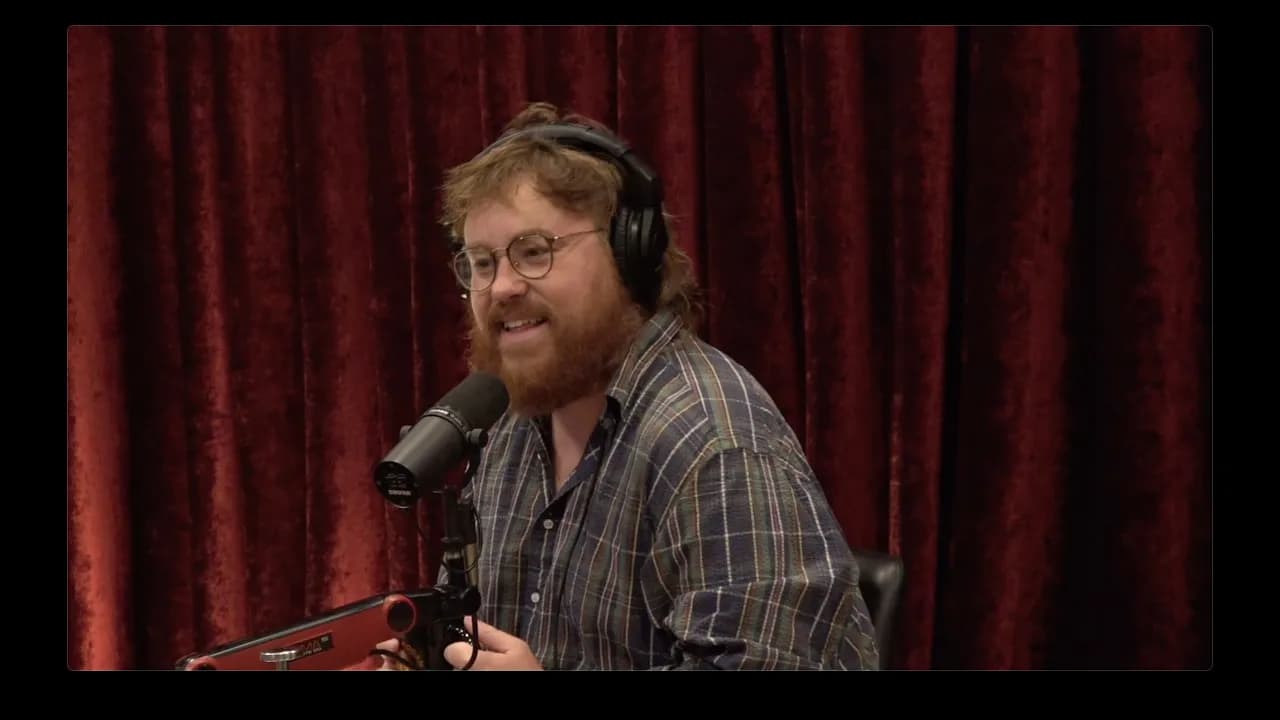
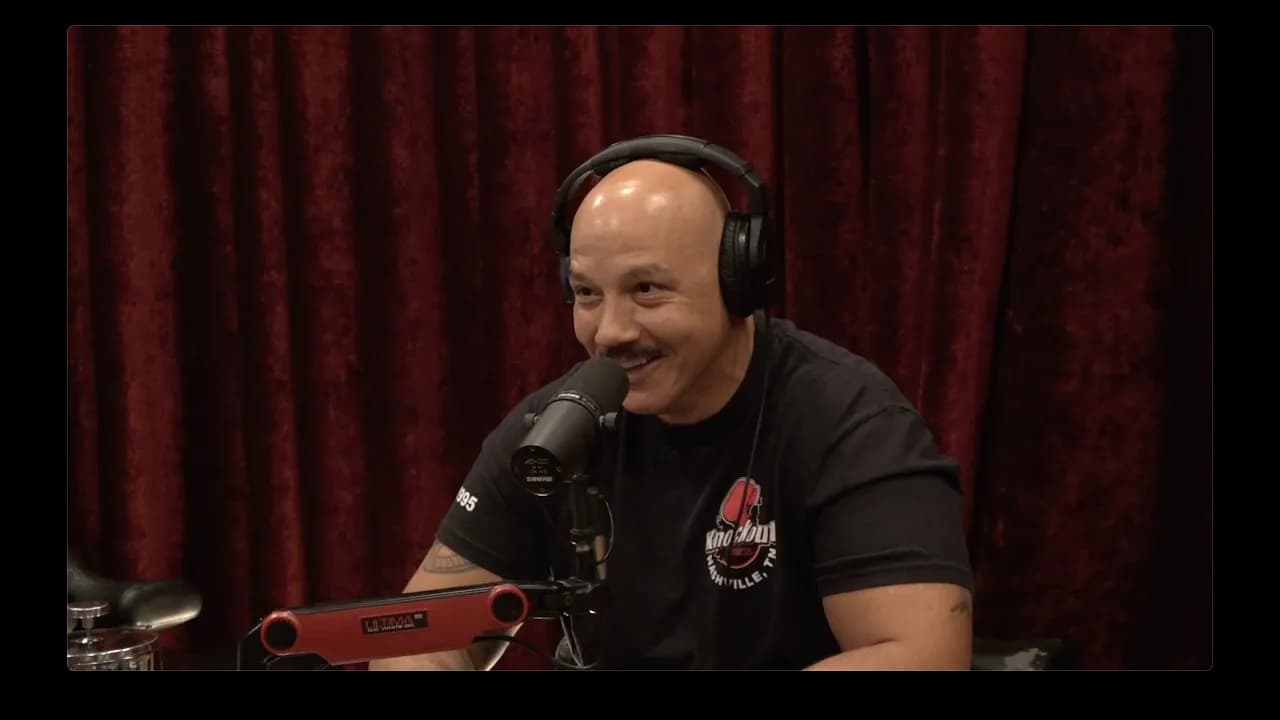
Joe Rogan Experience #2572 - Colum Tyrrell
In a Nutshell
Joe Rogan and comedian Colum Tyrrell discuss the dark side of modern society through topics ranging from gambling addiction and drug legalization to gender transition policies allowing biological males in women's prisons. They cover Kanye's anti-Semitic spiral and childhood trauma confession, pharmaceutical advertising's corrupt influence on media, and the decline of mainstream news credibility with younger audiences. The conversation also explores hunting's role in wildlife conservation, the therapeutic value of nature, and how media desensitization through constant exposure to death and violence affects mental health.
These notes were generated by AI and may contain inaccuracies.
Joe Rogan welcomes comedian Colum Tyrrell to the podcast. Tyrrell was so nervous about his recent comedy special that he barely thought about the podcast appearance, which worked as a distraction from the pressure.
Rogan explains that appearing on the podcast is nerve-wracking for first-timers, but after a few appearances it becomes casual. Tyrrell notes the global scale of the show makes it intimidating, and both hosts try not to think about the audience size.
Tyrrell mentions a viral video where women were asked whether Lindy Clancy or Sydney Sweeney had a worse impact on women in society, with respondents choosing Sweeney. Rogan and Tyrrell discuss how some women seem to want to "peck each other to death" when another woman succeeds. They note Sweeney's fame largely stems from her physical appearance, particularly her breasts.
Rogan defends Sweeney's acting ability, mentioning her work in Euphoria. The hosts agree she's attractive but not in the traditional catwalk or Victoria's Secret model sense, which may contribute to her appeal. They discuss how women often want to be the most attractive person in a room, and when someone like Sweeney enters, everyone notices.
The conversation turns to Sweeney's advertising work, including a sports gambling commercial where she had footballs over her breasts. Rogan finds it interesting that she's promoting gambling apps.
Tyrrell explains that gambling has always been legal in Ireland, traditionally through physical bookies attached to pubs where people would write out betting slips. He notes the problem with modern gambling is the combination of phones and gambling apps.
Rogan argues that gambling should remain legal, comparing it to alcohol and drug legalization. He believes responsible adults should be able to place reasonable bets without the government micromanaging society into a "nanny state." He shares his personal experience living in a pool hall from ages 23-25 and knowing legitimate gambling addicts who would bet on anything.
The hosts discuss drug legalization, with Rogan suggesting people should be able to buy real drugs from liquor stores to avoid fentanyl overdoses. Tyrrell notes the danger element is part of what makes drugs exciting for some people.
The conversation shifts to varying state alcohol laws across America. Tyrrell lives in New Jersey where certain alcohol purchases are restricted. Rogan mentions Massachusetts blue laws that prevented Sunday alcohol sales, forcing residents to drive to New Hampshire. They discuss how these laws created workarounds like buying in bulk on Saturday.
Rogan emphasizes the importance of teaching young people impulse control and discipline. He acknowledges some people have genetic predispositions to addiction, but believes many issues stem from self-control problems. He argues that gambling can be a harmless form of entertainment for responsible people.
Tyrrell reads about Texas blue laws that historically restricted Sunday sales of electronics, clothing, furniture, footwear, musical instruments, recordings, toys, tools, and lawnmowers. These laws were repealed in 1985. The hosts find it absurd that people couldn't buy shoes or toys on Sunday.
Current Texas law prohibits liquor sales from package stores on Sundays, though beer and wine are available at grocery stores starting at 10 a.m. Restaurants can serve alcohol with food starting at 10 a.m. on Sundays. The hosts discuss the "one chicken wing minimum" loophole some bars use.
Tyrrell describes Irish drinking culture, including lines forming outside liquor stores at 9 a.m. on Sundays waiting for opening, and "early houses" - bars with special licenses allowing 6-7 a.m. openings, often near ports for fishermen coming off shifts.
Tyrrell explains he moved to New York because of the city's constant activity and opportunity to find one's "tribe" regardless of interests. He notes some decline in 24-hour dining options post-COVID.
Tyrrell started comedy in Ireland two years before moving to America in 2014. The Irish scene is small with few purpose-built clubs, mostly rooms above bars. Crowds are intense - crushing feels euphoric while bombing is brutal. He mentions Tommy Tiernan as Ireland's biggest comedy export who faced cancellation in 2006 for a joke about Hitler.
Tiernan had international success in Canada, Australia, and America with a Comedy Central special before the controversy ended his touring career. He returned to Ireland and now hosts "The Tommy Tiernan Show," a surprise guest format where he interviews people he doesn't know beforehand.
The episode includes a sponsorship segment for Farmer's Dog, which partners with the USO K9 program to support military families and their therapy dogs. The company is feeding 250 dogs belonging to military families for America's 250th birthday.
The hosts discuss Kanye's recent embrace of anti-Semitism, noting the contrast with Tiernan's 2006 cancellation. They mention Kanye's diamond-encrusted swastika and his song "Cousins" about childhood sexual experiences with his cousin. The song was released April 21, 2025, as part of an unreleased album called "Cuck" and was later removed from streaming platforms.
Tyrrell notes Kanye's cousin is serving a life sentence for murdering a pregnant woman at age 17. Kanye has publicly discussed taking the blame for his cousin's murder charge and showing him pornography when the cousin was six years old.
American rapper David Blunts served as the main songwriter for the Kanye West song "Cousins." West originally declined Blunts' offer to turn the song into a proper release, but later changed his mind. Blunts became reluctant to write the song and attempted to procrastinate by sending West different songs for the album, but eventually decided to record it as a demo in his living room due to West's persistence. Blunts wrote the song over a beat downloaded from YouTube because his main producers were asleep. The song took approximately 20 minutes to complete. According to producer Chucky Beats, he was unaware that West used Blunts' song "10 Perks," which he co-wrote and produced, until a YouTube commenter told him about the exposure.
Kanye West posted: "The song is called Cousins about my cousin that's locked in jail for killing a pregnant lady a few years ago. I told him we after I told him we wouldn't look at dirty magazines together anymore. Perhaps in my self-centered mess, I felt it was my fault that I showed him those dirty magazines in New Six and then we acted out what we saw. My dad had Playboy magazines, but the magazines I found on top of my mom's closet were different. My ma name is Ye, and I sucked my cousin's dick until I was 14."
The discussion notes this occurred from ages six to 14, representing a significant period of sexual abuse. The speakers note that writing about trauma can be freeing and therapeutic, similar to how journaling helps with PTSD.
Kanye West has synesthesia, a neurological condition where auditory input such as music or sound triggers involuntary visual experiences like seeing colors, shapes, or patterns. When he hears songs, it's comparable to experiencing psychedelic effects. The speakers observe that his words seem barely contained inside his mouth when speaking, with a creative storm inside his brain constantly producing ideas.
Despite attempts to cancel Kanye West for controversial statements, he continues selling out large stadiums. Adidas backed away from their sponsorship, which cost them billions of dollars. West had claimed that Jews control everything, and the resulting controversy led to his bank accounts being controlled or frozen. The speakers note the irony that the cancellation attempt proved his point about Jewish influence in certain industries rather than disproving it.
The conversation explores Jewish cultural identity, noting that Jewish people are very invested in their identity. In New York, individuals with traditional Jewish appearance (curls, traditional dress) hand out Torahs and ask people if they're Jewish. The speakers discuss how Jewish people can have varied appearances - ranging from red hair to darker features - making it difficult to identify someone as Jewish by appearance alone, unlike other ethnic groups where physical characteristics are more distinctive.
The speakers suggest the "sneaky Jew" stereotype originates from the difficulty in identifying Jewish people by appearance, as they can blend into various populations. They contrast this with individuals like Ari Shaffir, whose Jewish features are immediately recognizable. The conversation turns to plastic surgery, noting that nose jobs can disrupt facial symmetry and the golden ratio, making someone appear unnatural when proportions don't match the rest of their facial structure.
The speakers express concern about plastic surgery outcomes, particularly the fear of procedures going wrong and resulting in unnatural appearances like rubber-like facial movement or disproportionate features. They discuss how young people getting Botox and fillers may face complications later in life, with some individuals requiring surgical removal of fillers that involves opening the face and extracting the substances.
Kris Jenner appears significantly younger than her actual age (approximately 69), which the speakers attribute to professional cosmetic work. They note that her television appearance may involve filters and that her real appearance differs from what appears on camera. The conversation contrasts this with Caitlyn Jenner, whose appearance is described as deteriorating, with unkempt hair and an unsettling presence.
The speakers discuss whether Caitlyn Jenner had bottom surgery, noting uncertainty about this. They observe that Caitlyn maintains a masculine walking style despite other physical changes. The conversation explores the adjustment required after such procedures, comparing it to the adaptation period after having a tooth removed. The speakers note that post-surgical care involves dilation procedures and specific cleaning instructions.
The speakers reference a podcast sponsorship with Fleshlight sex toys and describe the maintenance required, noting the unpleasant cleaning process. One speaker received a custom-molded sex toy as a gift from a porn star who had it created from her own anatomy. The conversation touches on the contrast between the entertainment value of such products and the practical maintenance requirements.
The speakers discuss autogynephilia, defined as arousal from the idea of pretending to be a woman, where individuals remain attracted to women but become sexually aroused by the concept of being female. They note that modern social acceptance allows such individuals to express these feelings publicly rather than confining them to private settings. The conversation explores how some individuals may use transgender identification to access spaces like women's prisons without traditional requirements.
California has housed 47 biological males in women's prisons based solely on self-identification, with some incidents of pregnancy occurring. New Jersey has similar policies where self-identification as a woman grants access to female facilities. The speakers argue there's no effective test to distinguish between individuals with genuine gender dysphoria and those exploiting loopholes for predatory purposes.
Colum Tyrrell discusses how his Irish accent has softened due to living in America and limited exposure to other Irish speakers. His wife is American, and his podcast work involves American guests, contributing to accent changes. When returning to Ireland, locals notice the softened accent and sometimes call him a fraud. The accent returns when surrounded by Irish speakers but fades again in American contexts.
Tyrrell typically visits Ireland twice yearly but had no trips planned for the current year, with four trips booked for the following year including shows in Dublin, Limerick, and Cork. He notes having a larger American audience due to his career development through shows like Legion of Skanks and connections with comedians like Ari Shaffir, resulting in less Irish audience exposure.
Tyrrell's father, named Aiden, was known for his anger during Tyrrell's childhood, earning the nickname "Raging Aiden" from his friends. The father worked as a plumber and was often stressed about finances. After retirement, he transformed into a gentle person who gardens and sends photos of flowers. Tyrrell notes this pattern where parents become kinder once children are grown and independent.
At ages 17-18, Tyrrell and friends were drinking at his house before a concert when his father came home angry from work. After someone made a joke, the father threw their beers into the street and ordered everyone out. He later called one friend back only to yell at him again. The speakers suggest job stress contributed to the father's behavior.
The conversation references Henry David Thoreau's quote: "Most men lead lives of quiet desperation." The speakers discuss how many people work difficult jobs they hate, barely making ends meet, and reach age 60 realizing they've wasted their lives. They note this particularly affects men working brutal jobs while struggling financially.
Waffle House locations are described as places where fights occur frequently, with the odds of witnessing a brawl being very high. The speakers note that staff appear to be among the saddest humans, exhausted from their work. The restaurant never closes, making it a destination for people who have made poor choices or are out late. The environment attracts aggressive individuals, particularly during late hours.
Tyrrell describes Dublin nightlife where nightclubs closed at 4:00 AM, and staying out until closing was standard practice. Going home early at 2:00 AM was considered unusual. The culture emphasized drinking until the bars closed, with no option to leave before last call.
Ancient societies often consumed beer as their primary beverage, with people remaining constantly drunk or buzzed throughout the day. Historical accounts describe populations that drank beer exclusively, functioning in a perpetual state of mild intoxication. At the Guinness Brewery in Dublin, coopers who crafted barrels had unlimited free Guinness access, often consuming 12 pints daily during work hours before continuing at the pub afterward. Workers began drinking at age 12, consuming six pints daily from that young age. Irish drinking culture allowed entry to pubs at 15 for girls and 16 for boys despite the legal age being 18.
A Netflix drama series about the Guinness family features questionable Irish accents that sound inauthentic. The show is loosely based on a specific generation of the Guinness family and has been compared to Peaky Blinders in style. The series portrays family dynamics and business operations during a period when Ireland was under British control.
Irish conversation culture involves rapid emotional shifts between laughter and crying, with people embracing discussions of misery and hardship. This pattern manifests in casual dinner conversations where family members share graphic details about strangers' misfortunes, including deaths and tragedies. The cultural tendency toward discussing suffering may trace back to historical trauma like the famine, creating a pattern of feeding on misery as entertainment.
The British government controlled Ireland in the 1800s and implemented policies that pushed Catholic populations onto inferior land suitable only for potato cultivation. When potato blight occurred between 1845-1852, it destroyed the primary food source for the Catholic population. Meanwhile, Ireland continued producing other food crops that were exported to Britain while the Irish starved. Between 1845 and 1852, approximately 1 million people died from starvation and disease, while roughly 2 million immigrated between 1845 and 1855.
The famine resulted from a combination of factors: dependence on a single crop, British land policies that relegated Catholics to poor soil, and the export of available food to Britain. Some genetic research suggests that descendants of famine survivors may carry genes allowing more efficient calorie storage and potentially increased longevity.
Irish support for Palestine stems from historical identification with oppressed populations and a cultural tendency to support underdogs. This perspective developed from Ireland's own experience with British colonization and displacement from ancestral lands.
Current Israeli politics show a shift toward more hardline positions, with recent elections featuring candidates more extreme than Netanyahu on military matters. A new candidate named Eisenkot emerged as more hawkish than Netanyahu, supporting overwhelming force including against civilian infrastructure. Election turnout was notably low at 16%, possibly reflecting diaspora voting patterns with many Israeli citizens living abroad.
Rick Springfield performed for troops in Vietnam at age 18 and was involved in combat situations where he may have killed Viet Cong fighters. The experience continues to affect him decades later. Vietnam combat involved extreme psychological stress from jungle warfare, tunnel systems, and the constant threat of ambush by fighters familiar with the terrain.
The Gulf of Tonkin incident was a fabricated event used to justify American escalation in Vietnam. The claimed attack on an American warship never occurred. Jim Morrison's father was allegedly involved in perpetrating this false flag operation. The war's premise was based on this manufactured incident, leading to widespread disillusionment among veterans who returned to find the conflict lacked legitimate justification.
The 1960s counterculture movement featured numerous figures with connections to military intelligence agencies. The book "Weird Scenes Inside the Canyon" explores how many counterculture icons had ties to intelligence operations. This has led to conspiracy theories suggesting the CIA orchestrated aspects of the cultural revolution to destabilize society, though questions remain about how such agencies could manufacture genuine artistic talent like Jim Morrison and The Doors.
Smart devices and connected TVs potentially use microphones to gather data for advertising purposes. Terms of service agreements often grant extensive data access, including the ability for apps like TikTok to access other devices on the same network. This raises significant privacy concerns about data collection and surveillance through everyday consumer devices.
Recent ownership changes at CNN involve Israel supporters acquiring the network, raising questions about potential shifts in coverage. Mainstream media consumption patterns show older demographics relying on traditional news sources that present consistent talking points across different networks, creating echo chambers for aging populations concerned about various threats.
Old liberals become violently angry when confronted with facts. Old conservatives live in a state of fear about immigration. Both groups are in a state of fear because they know the end is near and their health is declining. They still believe TV is truth because they were raised on the idea that news is truth.
SkyDance owns HBO, MTV, Nickelodeon, Paramount Plus, TBS, Smithsonian, TNT, Warner Brothers, Adult Swim, Cartoon Network, Country Music Channel, Food Network, Golf Channel, DC Comics, and Eurosport. The speaker expressed a desire to own all those media properties.
Young people are completely tuned out from mainstream media. The speaker finds it embarrassing that a 20-year-old would watch CNN. Jimmy Carr mentioned his father recognizing that music on news programs signals "breaking news." Networks hire movie directors and use dramatic graphics to make news seem more important. News networks have an obligation to advertisers to say certain things, making the whole enterprise fraudulent.
The United States and New Zealand are the only two countries that allow pharmaceutical advertising on television. Networks receive primary advertising revenue from pharmaceutical companies and therefore do not criticize them. The real purpose of pharmaceutical ads is to protect drug companies from media scrutiny rather than to sell specific drugs. If someone needs medication, they should ask their doctor rather than respond to impulse advertising.
A person involved in pharmaceutical regulations stated that Perdue Pharma was not operating uniquely in the industry - every pharmaceutical company follows the same unethical practices. Perdue Pharma's problem was that they addicted entire communities to the point where crime became visible, whereas medications like Xanax can cause widespread addiction without generating the same visible social disruption.
Jordan Peterson became addicted to Xanax and required a full year of medical detox in Russia involving induced coma. He disappeared from public view during this period. Since returning, he seems more damaged, possibly due to health issues and the pressure of sudden fame.
Jordan Peterson was a 40-something Toronto psychology professor who suddenly found himself giving sold-out lectures to tens of thousands of people worldwide. He never sought this level of attention. The constant misrepresentation of his views as right-wing, racist, xenophobic, transphobic, and homophobic creates an exhausting existence where every conversation becomes a controversial argument.
One benefit of podcasting, especially as a comedian, is the ability to have varied guests - one day discussing serious topics, the next day someone claiming to have met Bigfoot.
The speaker loves being an ultimate tourist and getting photos with mascots. Last summer's trip included Montana, North Dakota, South Dakota, and Idaho, which was described as possibly the most beautiful place in America. The Black Hills and Black Forest Mountains near Rapid City were particularly noted for their beauty.
Joe Rogan and Duncan Trussell did a deep dive on Bigfoot hunters for the show "Joe Rogan Questions Everything" around 2011-2012. They met people who claimed to have encountered Bigfoot. The Pacific Northwest is the hub for Bigfoot sightings, though there is also significant methamphetamine and heroin use in the area. A map of Bigfoot sightings shows a concentration in Texas near Austin.
Bears often walk upright, which may account for many Bigfoot sightings. Dense tree cover in the Pacific Northwest creates conditions where shadows and movement can be easily misinterpreted. The speaker once mistook a squirrel for a wolf in Alberta due to the dense forest environment.
The speaker is planning an eight-day solo hike through the Thoroughfare in South Yellowstone, a 40-mile area from any road in grizzly, wolf, elk, and moose country. They have already started solo hiking and find it therapeutic, providing complete disconnection from distractions and an empty mental state after about 20 minutes of marching.
For solo hiking, the speaker needs to purchase a Garmin inReach satellite communicator, bear spray, and other safety equipment. They have watched numerous vlogs of people in these areas and believe that being smart and safe prevents problems.
Being in the woods is naturally therapeutic because it represents humanity's natural environment. Cities create disconnection from nature, which may contribute to anxiety and mental distress. The simplicity of outdoor life, without phone signals, provides mental clarity.
Hunting tags are distributed based on biologist population estimates to maintain healthy animal numbers. Some areas require waiting periods of up to 20 years for tags, while others offer over-the-counter tags. Nevada elk tags are particularly difficult to obtain and represent a "tag of a lifetime" due to the giant elk population.
Native American reservations operate under their own laws independent of United States government regulations. In Canada, First Nations people have different hunting and fishing rights than non-indigenous people, including the ability to catch unlimited fish and use spotlights for night hunting.
Moose are extremely dangerous and will kill humans by stomping them to death, particularly females protecting calves. They weigh approximately 1,800 pounds and are faster than humans. The speaker wants to see a moose from a safe distance but has no desire to get close enough to be attacked.
The Instagram page "Turons of Yellowstone" documents tourists being attacked by bison. One viral video showed an elderly man being thrown into the air by a bison after trying to get a selfie. The speaker questions how many deaths result from people attempting selfies with dangerous animals.
When someone gets pushed in front of a train, people typically respond with "wasn't me." It happens infrequently enough that you're not nervous about it, but you know it's a possibility. People don't stand right at the edge and peek out. There's a confident feeling that someone's not going to shove someone in front of a train, with the assumption that they know better. They probably try to do vulnerable people, like little Asian ladies, who would be the easiest targets.
New York subway statistics: 20 to 25 people are pushed onto the tracks per year. These figures represent people pushed onto the tracks, not necessarily people struck or killed by a train. Some victims escape before the train arrives. In a December 24 Brooklyn case, the victim climbed back onto the platform seconds before an incoming train.
Global statistics: There are 425 deaths linked to selfies over 49 countries since 2011. The question of how many get reported remains, since if a guy falls off a mountain, it's difficult to determine how he fell off. One documented case involved a man who was caught killing his wife in India. They were getting photos and he kept going a little further, but he didn't realize people were up on another cliff who could see it. He ran over and shoved her off, with people watching from afar.
Specific selfie death cases: Oscar Otto Aguilar died accidentally shooting himself while posing for a selfie with a loaded handgun in Mexico City. Another disputed example involves Japanese tourist Hayito Ua, who was widely reported to have died falling on stairs while taking a selfie at the Taj Mahal's royal gate. An eyewitness described a selfie-related fall, but a police official stated the postmortem found a heart attack.
The argument is that if someone falls off a cliff because they're taking a selfie, it's the head wound that kills them, not the selfie itself. The selfie led to the situation, but the actual cause of death might be different. This could evolve into being caught while live streaming, where someone has a heart attack when realizing they're falling and freaks out.
At age 14, there was an incident involving giant cement sewer pipes where a crane attachment would lift up the pipes. While climbing on this thing, it fell and hit on the back of the head, leaving a scar. The impact was so hard that consciousness grayed out. The person thought they were dying and had to go to the hospital with blood everywhere. The 1980s approach was essentially "you're okay, you're not dead" - they just said to toughen up. The scar is significant, and if the impact had been slightly different, it could have been fatal.
Travel through Southeast Asia included Thailand, Vietnam, and Laos, which operates on a tubing economy where people get in tubes and float down a river from bar to bar. The tubing experience involves seven-year-old boys with water bottles full of water on ropes who swing them with incredible accuracy to pull people in. The local talent is remarkable because people learn just one thing since they can stand.
One location had a cliff to jump off landing on a big inflatable cushion about 20 feet wide. After jumping and falling off, another person jumped on it and it rotated, trapping someone underneath. After initial panic, the response was to relax and not panic, swimming down and eventually coming up to find everyone worried. People have died there, and the activity was eventually shut down.
Before the internet, people would die and it would only be a local story. The problem with society today is being inundated by bad news from the whole world - 8 billion people worth of bad news. The amount of people seen dying through screens versus what has actually been seen in real life is a big problem, and it's desensitizing young people.
Video games were thought to desensitize young people, with blood splattering everywhere while having fun. Faces of Death was a collection of VHS tapes from the 1980s showing people dying, including a famous case of Bud Dwyer who put a .44 Magnum in his mouth and blew his brains out in front of everybody. Dwyer was facing 55 years due to political persecution related to refusing a travel voucher for Governor Dick Thornburgh's wife for a trip to Europe. The speech lasted nearly 30 minutes before he committed suicide.
Rotten.com was the previous generation's version, with exposure to extreme content at very young ages. Society might be better with some walls in place, as seeing certain content shapes worldview with information that's not necessary.
Big Bend National Park in South Texas is one of the darkest regions, a designated dark sky place where all lights go off. The Chisos Mountains area is incredibly beautiful with tarantulas walking around during mating season. The group sat out at night watching the sunset and stars come out, sitting for seven hours in Tommy Bahama chairs. They did a little LSD and looked at the stars all night, describing it as one of the most insane things ever done.
After the experience, it felt like never having truly seen the sky until going out there. The sky was unrecognizable because there were so many stars. A friend brought a huge telescope and they were able to see Saturn's rings in detail through the telescope while on acid.
The quietness meant hearing someone from not far away in their tent in the middle of the night. The group was denied that image in cities, creating a disconnect with the universe. The Milky Way was visible along with little clusters of stars never seen before. The reason you can't see it is all light pollution.
At the KEK Observatory on the Big Island of Hawaii, driving through the clouds to reach the observatory, then popping through the clouds to magnificent skies. Caught one night with no moon out, which is ideal, with the sky littered with stars. It seemed like being on an organic spaceship, not Earth, but rather a convertible spaceship flying through the universe.
Returning to city stars feels inadequate - just a couple little dots. The tradeoff has allowed much to be accomplished but disconnected from place in the universe. It's very humbling and important to put everything into perspective, seeing the stars and recognizing this is just one puny little galaxy among hundreds of billions of galaxies in an infinite universe.
During the stargazing session at 2:00 in the morning with tents everywhere and complete quiet, comedian Mike Rainey announced he was going to bed. After getting into his tent, the YMCA song suddenly blared out from his phone, which had no signal but had the song as one of the last things on his timeline. The loudest, most embarrassing gayest song echoed through the mountains, causing everyone to laugh for 25 minutes while trying not to disturb other tents.
The Village People performed at one of the inauguration after-parties. The original members from the 1970s when they were all alive represented some gay orgy thing. The YMCA song became both a gay anthem and the anthem of the Trump administration, with Trump going out and doing a little dancing to it.
Nicki Minaj has become a big Trump supporter, which seems odd. Trump brought her out saying she got a great ass, telling her to show them and having her do a little spin for the crowd. The suggestion is he might be going for a third term with Nicki Minaj's ass as vice president.
Trump wrote a lengthy screed on Truth Social after Bill Maher suggested Trump was losing support in the polls. The letter called Maher a "complete and total loser" and criticized Maher's low-rated HBO show. Trump referenced Chuck Leella, who worked on The Apprentice as a gopher and later became a friend of Maher's. Leella repeatedly asked Trump to meet with Maher and appear on his show.
Trump stated he agreed to two meetings at the White House after becoming president but never agreed to do Maher's show. He claimed Maher was "very nervous" at the first meeting and asked for a drink, appearing insecure with a bruised eye and nose area. Trump described the White House as "a very seductive and beautiful place" after his renovations.
Trump disputed Maher's statements about his approval ratings, citing a CNN poll showing 98-99% Republican support. He claimed CNN also named him the most influential president of the last century and the most popular person in Republican Party history with 53% support, compared to Ronald Reagan at 18% and Abraham Lincoln at 8%. Trump accused Maher of using a "laughter machine" during the show.
Trump referenced his 98% endorsement record in the House and 100% in the Senate. He denied building a swimming pool in the White House briefing room and stated he was considering moving the press to a different location.
Trump accused Maher of lying about illegal voters in California, claiming 20,000 were found in recent days with potential for over 1 million total. He attacked Maher's base as "losers" and "people who don't like working." Trump stated he would never watch Maher's show again, calling it "fake news."
The letter ended with Trump telling Maher not to call anymore and to tell Chuck Leella to stop calling. Trump had 4,640 retruths at the time of the discussion.
Trump's net worth increased from an estimated $2.7 billion to $4.1 billion since winning the 2024 election, bringing his total to approximately $6.4 billion. The increase was attributed to cryptocurrency ventures. A federal civil lawsuit filed October 20, 2022 alleges Trump unlawfully benefited from UAE-linked World Liberty Financial transactions, including a $500 million purchase of a 49% stake by an entity backed by UAE national security adviser Shik Taknun bin Zed al-Nah, and a $2 billion purchase of World Liberty USD1 stable coin by an Abu Dhabi investment fund.
The lawsuit alleges unconstitutional foreign emoluments and seeks disclosure and return of allegedly unlawful profits.
Memecoins function similarly to Hunter Biden's artwork sales, where people pay inflated prices for items to legally transfer money. The process involves initial investors putting real money into a coin, then others buying in. Foreign entities can purchase large amounts of the coin, allowing the recipient to pull money out legally. The hosts discussed how this creates a legal loophole for transferring money while appearing as legitimate cryptocurrency investments.
Trump making money from crypto is not automatically illegal while president, but particular details could be unlawful if they involve bribery or prohibited benefits from foreign governments. The president has an exemption written into law that does not automatically create the same statutory violation as for other executive branch officials, though it's not a blanket exemption from anti-corruption law or the Constitution.
There are concerns that after the midterms, military action against Iran could resume. Multiple presidents were pressured to bomb Iran, including Obama and Biden, but none proceeded. The hosts discussed how the military-industrial complex influences politicians and policy due to the massive financial incentives involved in weapons sales. Trump campaigned on no more wars, which resonated with supporters who are now disappointed by continued military involvement.
The hosts noted the situation in Iran appears unresolved and doesn't look good on a world scale for America to be unable to resolve conflicts with smaller nations.
Colum Tyrrell is planning a September trip to Alaska for bear photography and camping. The salmon run will be over by then, so they will be catching salmon in a different section rather than the jumping areas. Limited spaces are available at the location, with cabins costing around $700 per night or tent camping near the bears for $12 per night. Tyrrell plans to take the tent option for the more authentic experience, noting that the bears are so well-fed they have no interest in humans.
Tyrrell discusses a person on Instagram known as Grizzly Guy who runs shows called Endless Venture, traveling worldwide to observe wildlife. The group visited Botswana where lions are so well-fed they won't attack humans. The guide gets into a non-threatening position, makes a call like an injured animal, and the pride slowly spreads out following the leader. They stare at each other for about five minutes before the lion eventually lies down, leaving the group surrounded by lions in the Okavango Delta. The group camps overnight and must keep fires burning continuously, with someone waking hourly to prevent elephants from trampling the camp.
Tyrrell developed his interest in nature through birding, which he finds enjoyable despite some social stigma. He notes that the biggest market for high-end binoculars is birders, followed by hunters. He explains the similarities between tracking birds with cameras and tracking animals with guns, involving knowledge of calls, wind directions, and other environmental factors. Birds are accessible in gardens, making it easy to recognize species and calls. Tyrrell uses an AI camera bird feeder at his in-laws' house in New Jersey near wooded areas, which identifies birds and sends photos to his phone. He maintains a list of birds he has seen and recalls photographing a hummingbird that shouldn't have been in the area.
Joe Rogan mentions that eagles are as common as pigeons in Alaska. Tyrrell saw eagles in Montana while fishing and captured videos of them snatching fish from the water. He expresses interest in seeing a mountain lion but acknowledges the danger, noting that seeing one might mean it's too late. Rogan has seen mountain lions in California, specifically in Montecito near Santa Barbara, where one ran across the street in a residential area. They discuss mountain lion vocalizations, which are described as very strange and potentially sounding like a man screaming in pain. Foxes also make unusual nighttime sounds.
Tyrrell has never been hunting but is planning a trip to Ireland with his cousin Cathal Rowan, a YouTuber with the channel Kronone who hunts deer. Rowan uses a large tripod setup for his shots. Ireland historically had the Irish elk, the largest deer species ever, with fossilized antlers found that are larger than any moose. Ireland also had bears that were killed off before documentation began, with carved bear bones discovered. Wolves were eliminated from Ireland and later reintroduced in certain regions where they won't impact farmland significantly.
Colorado reintroduced wolves near Aspen, with some dropped on a friend's ranch that doesn't run livestock but is connected to other ranches that do. The wolves are now killing cattle and calves. During World War I, German and Russian forces had a ceasefire to hunt wolves that were attacking soldiers and feeding on the fallen. The wolves had moved into populated areas from forests in Lithuania and Bohemia due to war displacement. Multiple New York newspapers in 1917, including the New York Times, reported the story of adversaries negotiating an armistice to address the wolf problem.
Rogan recounts a story from his friend who was elk hunting and accidentally shot near a wolf den. The wolves surrounded them, and they killed three wolves (two with a bow, one with a rifle) before the pack retreated. Another friend, John Dudley, has discussed similar encounters and keeps wolf skulls. Tyrrell asks about bow hunting distances, and Rogan explains he has taken shots at 80 yards using a rangefinder and calibrated bow sight. Bow hunting is described as exponentially more difficult than rifle hunting because you must get much closer to the animal.
Rogan shows a photo of a mule deer he shot in Montana at 250 yards with a rifle alongside Steve Rinella. He explains that while rifles are difficult to shoot accurately, bows are significantly harder. For rifle shots beyond 100 yards, stabilization becomes essential using tripods, shooting sticks, or prone positions with the rifle resting on a pack. Muzzle brakes reduce recoil but make shots much louder, and Rogan mentions friends who lost hearing from muzzle brake shots. Suppressors (often called silencers) reduce sound output without eliminating it entirely.
Tyrrell discusses hunting ethics, noting that in Ireland without wolves, deer either freeze or starve to death, often becoming scrawny with worn-down teeth. In Utah, 70% of mule deer populations died from winter die-offs two years ago. When human intervention isn't needed for population control, predators like wolves typically kill animals in prolonged, brutal ways rather than quick deaths. The transcript ends mid-sentence discussing how humans manage wildlife populations in areas without natural predators.
Hunting serves as population control in areas with few natural predators, preventing disease, starvation, and overpopulation. A percentage of money spent on hunting tags and sporting goods equipment funds wildlife conservation. The Pitman-Robertson Wildlife Restoration Act of 1937 places an excise tax on firearms, ammunition, and archery equipment to fund state-level wildlife conservation, habitat restoration, and hunter safety programs. The tax rates include 11% on sporting firearms, ammunition, and archery equipment, and 10% on handguns.
This funding pays for game wardens, wildlife biologists, population studies, and tracking programs including collaring wolves and monitoring deer migration patterns. Hunters are the number one contributor to wildlife conservation in the United States.
Hunters tend to be more environmentally conscious than non-hunters because they spend significant time outdoors and understand the importance of leaving no trace. They value keeping hunting areas wild and pure. Finding trash like water bottles, beer cans, or used condoms in the wilderness is particularly disappointing to responsible hunters.
Regular generates between $800 million and $1.2 billion annually. While originally pushed by sportsmen, data shows roughly 73-74% of revenue now comes from non-hunters purchasing firearms and ammunition for recreational shooting, home defense, or collecting. This occurs because more people own handguns than participate in hunting.
America's national parks and public land systems are considered among the country's greatest assets. The funding from excise taxes ensures these lands have proper patrolling to prevent poaching, which remains a significant problem. Without this system, public lands would lack oversight and protection.
A real mountain lion was spotted in Utah while driving back from a hunting trip with friend Colton. Utah's mountains are considered some of the most beautiful places to visit.
Hunting requires being in serious physical condition, with daily walks of 8-10 miles through mountainous terrain. After harvesting an elk, quartering and carrying it out presents extreme physical challenges. One hind quarter alone can weigh approximately 100 pounds, requiring multiple people to help carry even short distances uphill on loose dirt at steep angles.
The Exo Mountain pack is specifically designed for these demanding pack-out situations.
Hunting creates a fundamentally different relationship with food. When eating elk steak or roast, the hunter remembers the entire process: the arrow release, the sound of impact on the rib cage, quartering the animal, carrying it out, and the hours of practice shooting the bow.
This connection contrasts sharply with purchasing meat at grocery stores. The feeling after a successful hunt and bringing meat home compares to the satisfaction of completing a challenging workout.
Industrial farming practices involving massive warehouses packed with animals should have been prevented. This system creates dependency that makes change difficult for cities. The ethics of factory farming versus hunting are debatable, with some arguing that industrial animal agriculture is less ethical than hunting.
While potentially persuadable to avoid unethical food sources, veganism presents significant nutritional challenges. Obtaining all essential amino acids and B12 requires careful planning and supplementation. The difficulty of maintaining proper nutrition on a vegan diet is substantial.
Monocrop agriculture kills millions of birds, rodents, rabbits, and groundhogs annually. Large monocrop farms kill enormous quantities of animals yearly. Pesticides and farming equipment including combines also kill countless insects and animals during food production.
Growing vegetables in a personal garden creates an exceptional sense of satisfaction. Making a salad from homegrown peppers, tomatoes, and herbs provides a feeling unmatched by store-bought produce. Sharing homegrown food with family represents one of life's purest experiences.
Killing on stage and feeding family vegetables grown in the yard represent the two great goals in life. The feeling of making a crowd laugh represents a unique high that most people never experience. The ability to regularly achieve this feeling is considered extremely fortunate.
New material development involves periods of uncertainty where comedians don't know where bits are heading. Some bits work immediately while others require extensive refinement. Getting trapped in original bit structures creates problems, requiring comedians to abandon familiar phrasing and restart from the beginning.
Repetition can make material feel scripted rather than conversational. Intentionally changing delivery even when it slightly weakens a joke can elevate the experience by maintaining authenticity.
Patrice O'Neal was highly improvisational and loose in his approach. His material maintained different vibes and delivery methods across performances while covering similar topics. He could present points in seemingly dumb ways that remained genuinely insightful.
Patrice O'Neal would likely have become one of the biggest podcasters if he had lived longer. His intelligence and conversational ability would have translated exceptionally well to the podcast format.
The Opie and Anthony show functioned similarly to modern podcasts, allowing comedians to run wild without structure. Regulars included Vos, Jimmy Norton, Burr, Ari, and others. The show lacked predetermined structure, creating authentic conversation.
Howard Stern maintains more structured interviews with predetermined questions, unlike the freeform approach of Opie and Anthony.
The podcast conversation between Joe Rogan and Colum Tyrrell had no predetermined topics. They met for the first time the previous night but didn't discuss any planned subjects for the show. Initial expectations about discussing topics like the Ark of the Covenant being guarded by Ethiopians didn't materialize.
Anthony Cumia contributes historical references and knowledge that adds depth to conversations. The show's approach of letting discussions develop naturally influenced modern podcast formats.
Older podcast styles allowed topics to develop slowly without urgency, with hosts spending an hour and a half on single subjects. This contrasts with current podcasting's tendency toward rapid topic changes.
A recent Kill Tony appearance generated significant feedback, including outreach from relatives who hadn't been in contact for years. The show reached a massive audience compared to other performances.
Jeremy Clarkson attended a Monday night show and was described as hanging out casually in the green room.
Years before starting standup, Colum Tyrrell heckled Jimmy Carr during a Q&A at a theater in Ireland. After asking for a photo, Carr mocked his accent, prompting Tyrrell to respond that Carr's "fat head might not fit in the photo." This led to Carr delivering a cutting response that had strangers grabbing Tyrrell and calling him an idiot.
At age 16, the goal was to write an hour of material and immediately do a special like comedians seen on TV, without understanding the development process between writing and performing. After writing material one night and finding it unfunny the next, the attempt was abandoned until years later when open mics were discovered as the missing step in the process.
The special "Bells and Whistles" was filmed at New York Comedy Club and is available on YouTube. A new bit about a caveman fighting with his wife is currently being developed.
Keep PowerfulJRE in your library
Save the videos and channels worth coming back to, and find them again in one place.