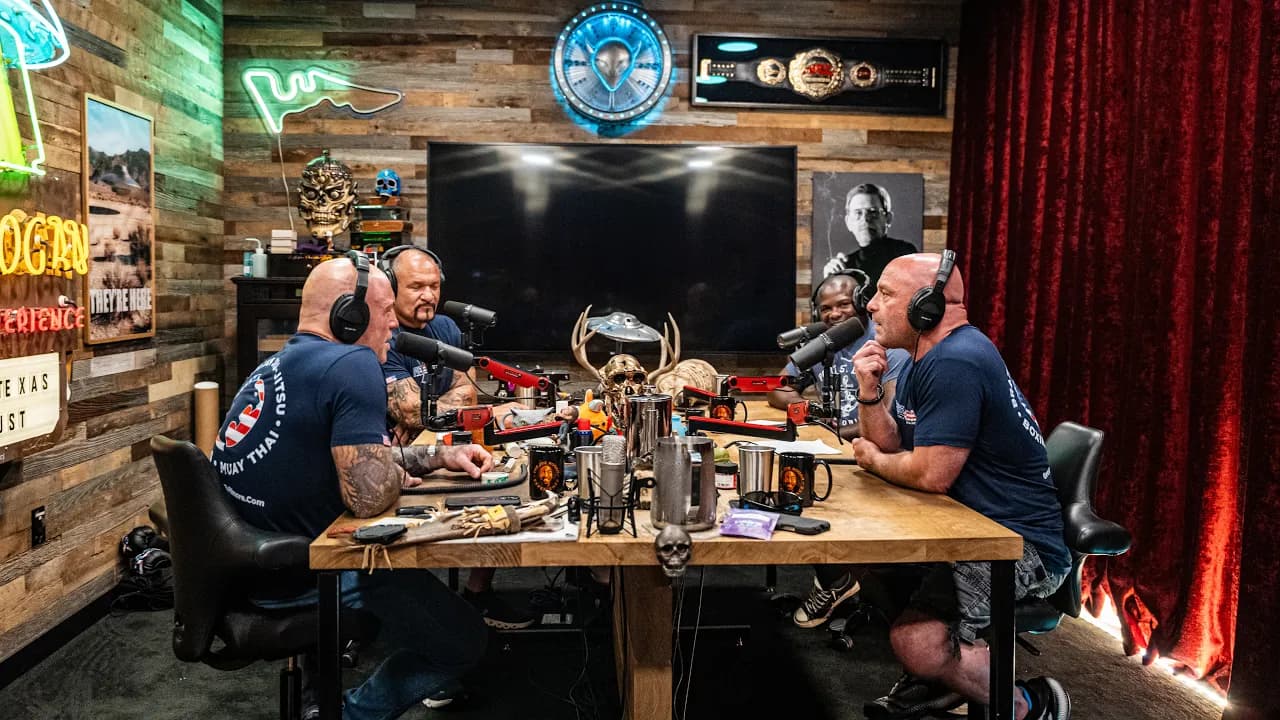
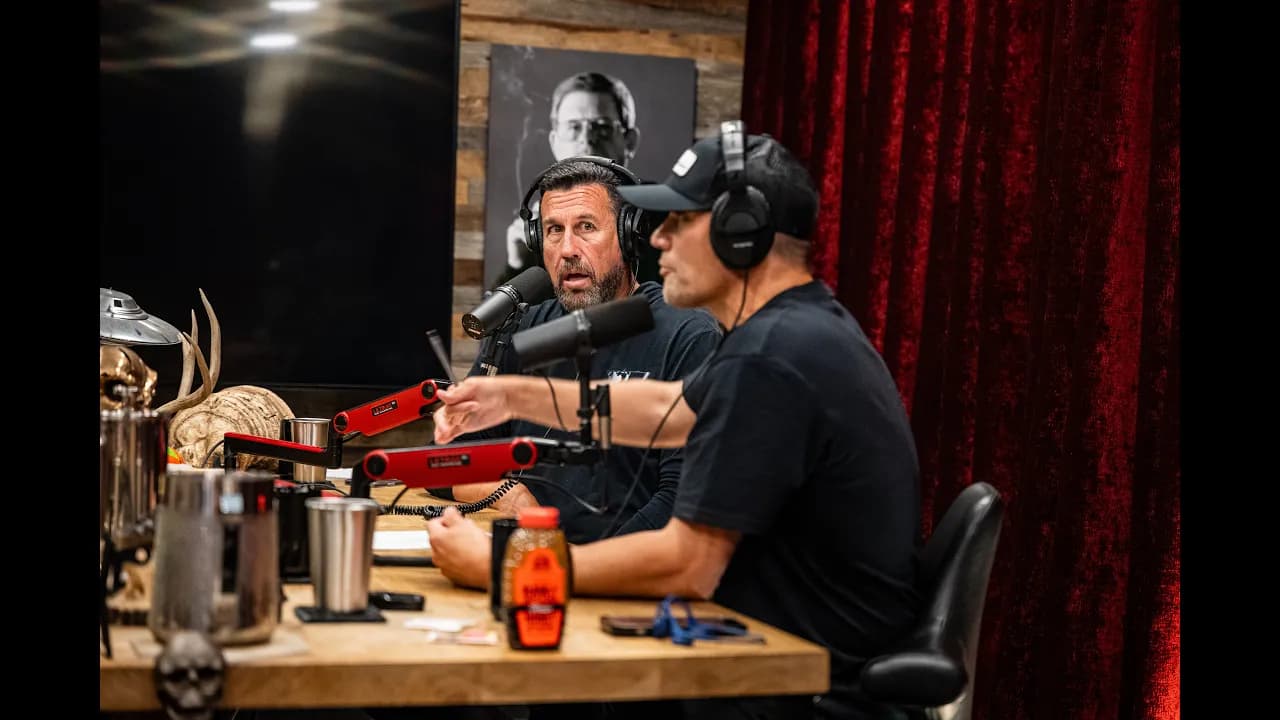
JRE MMA Show #183 with Rico Verhoeven
In a Nutshell
Rico Verhoeven was robbed in his boxing debut against undisputed heavyweight champion Oleksandr Usyk—winning 10 rounds on Rogan's card before a controversial early stoppage despite no concussion symptoms, with all pro boxers and commentators agreeing the fight was stopped unjustly. The fight itself was a massive success story: Verhoeven, the greatest heavyweight kickboxer ever, nearly pulled off the biggest upset in boxing history with only one prior pro boxing match by using his size, pace, and smothering pressure against a cruiserweight moving up. Verhoeven, now a free agent at 37 in the "winter of his career," wants the Usyk rematch as unfinished business and is fielding offers from boxing's biggest organizations while considering MMA options like Francis Ngannou.
These notes were generated by AI and may contain inaccuracies.
Joe Rogan and Rico Verhoeven discuss when they last appeared together on the podcast, determining it was episode number 71, approximately 7-8 years ago.
Rogan immediately addresses the fight with Usyk as one of the craziest things he's seen in combat sports. Verhoeven had one professional boxing match prior to this fight. Rogan emphasizes that Verhoeven is arguably the greatest kickboxer of all time fighting arguably the greatest boxer in the heavyweight division.
Verhoeven won 10 rounds according to Rogan, who states the judges' scoring was questionable with one judge having Verhoeven up by one round and the others scoring it a draw.
Verhoeven describes the stoppage as feeling unjust and that it seemed like officials were looking for a way to stop the fight. He notes that all professional boxers and commentators saw the fight the way he experienced it, but the scorecards showed a completely different fight.
Rogan states that if the fight had gone to the scorecards and Verhoeven lost the decision, it would have been a crime. Verhoeven explains that losing is one thing, but the injustice of the situation makes it much harder to accept.
Rogan highlights that Verhoeven has been the heavyweight champion of kickboxing for approximately a decade, which is remarkable given how difficult it is to stay at the top of the heavyweight division. He mentions specific wars Verhoeven has been through, including the Jamal Ben Sadi fight.
Rogan suggests that terrible judging is almost worse when it's incompetence rather than corruption, as having people who don't understand what they're watching make decisions that affect careers is fundamentally unfair.
Rogan recommends seriously considering alternative scoring systems. He notes that Glory has five judges rather than three, which he believes is the right number since three is too few. With five judges, the odds increase that the majority will get the scoring correct.
Verhoeven draws a parallel to the World Cup, noting that even soccer uses VAR technology where multiple people review decisions. He suggests there should be a mechanism to overturn referee mistakes in real time.
Verhoeven reveals that he appealed the stoppage and the appeal was upheld on every point they raised - they established he was stopped after the bell, the doctor confirmed he wasn't disorientated and had no concussion symptoms. However, the decision was never overturned.
Rogan questions how an overturn would work, noting that going to the judges' scorecards might have resulted in a majority draw, and questions whether knockdowns in the final round would have been counted.
Rogan points out that this was the most competitive fight of Usyk's career as heavyweight champion, yet there's no discussion of a rematch. Instead, they're talking about Deontay Wilder, who Rogan notes is not the same fighter he was in 2019.
Verhoeven explains that before the fight, the conversation was about fighting the winner of Dubois vs Wardley and then potentially Tyson Fury again. He believes Usyk saw this fight was harder than expected and chose a different route.
Verhoeven states he doesn't want a rematch just to have a rematch, but believes it makes sense because there's a story within it - it's unfinished business. He describes it as a real live Rocky story.
At this point in his career, in what he calls the fall or winter of his athletic career, Verhoeven wants to do big fights that make sense. Rogan agrees that from a promoter's perspective, nothing makes more sense than that rematch.
Rogan gives respect to Deontay Wilder as one of the greatest knockout artists in heavyweight history, but acknowledges he's not the same fighter anymore. He notes that Wilder is now 40 years old.
Rogan emphasizes that Verhoeven just had a crazy performance that the whole world saw, and if any fight warrants a rematch, it's that one. The rematch would be gigantic and represent the ultimate Rocky story.
Rogan describes watching the fight on the edge of his seat, immediately noting how huge Verhoeven looked compared to Usyk. He points out that Usyk is a cruiserweight who put on weight to move up, and could still make cruiserweight if he wanted to.
Rogan notes Verhoeven's experience, world championship level experience, and how calm and relaxed he looked throughout the fight. He mentions that commentators were questioning how long Verhoeven could maintain his pace, not understanding his cardio capabilities.
Verhoeven states that Alistair Overeem was also commentating and knew about his cardio because Verhoeven lives in the gym. He emphasizes that he loves training and will never lose on cardio because that would mean losing to himself.
Rogan notes that Verhoeven is an anomaly among 260-pound men, as very few guys his size can push the pace he maintained. He credits Usyk for finally catching and rocking Verhoeven but maintains the fight was stopped too quickly.
Rogan suggests the stoppage was either incompetence or corruption, and tends to think it's corruption. He believes judges want to keep judging fights and maintain favor with promoters, noting that the money is in Usyk as the big star in the heavyweight division.
Rogan points out that judges wouldn't want a guy coming from a different sport with only one professional boxing match making the biggest upset in boxing history.
Rogan acknowledges that Verhoeven was the perfect guy to execute this strategy because of his pace, size, and ability to maintain an insane pace for 12 rounds. Verhoeven explains that the game plan was super smart - they did something Usyk hadn't seen before despite fighting the best boxers in the world.
The strategy was based on recognizing that heavyweight boxers were trying to outbox a cruiserweight, which doesn't make sense since Usyk is lighter, smaller, and faster. Instead of trying to outbox him technically, they needed a super strong game plan.
Verhoeven reveals the crazy story of how he got the opportunity. It started with the Canelo Crawford fight when Jason Statham, a good friend, was in Vegas. Verhoeven texted him about the fight, and Statham told him he needed to be in boxing.
Statham had seen Verhoeven's eight-man tournament and came to his fights. When Verhoeven said he thought he could do pretty good in boxing, Statham said he would throw it out there and see what happens.
The next morning while Verhoeven was on the treadmill, Statham called saying he put Verhoeven's name out there, showed videos, and people were going crazy wanting him. A few days later, they called offering a fight with Anthony Joshua.
At the time, Verhoeven was on the set of Roadhouse 2, so they had to combine everything with his trainer coming in during takes for pad work. The deal came around October/November for a February fight, giving him about 10 good weeks to train.
Verhoeven finished the movie in December, but Joshua got an offer to fight Jake Paul for a crazy amount of money. Joshua chose to do that fight first, then the Rico fight. After the Jake Paul fight, they pushed the fight from February to March, which Verhoeven welcomed as more time to transition into boxing.
Two weeks later, Joshua's tragic car accident in Africa killed two of his friends, derailing the situation. Verhoeven had a training plan scheduled in Spain but continued training regardless.
At the end of training camp, they discussed whether to wait for Joshua or fight someone else. Verhoeven wanted to fight since he was already training. They considered Usyk as an option, and Verhoeven suggested it made sense as the top dog - undisputed kickboxing champion versus the undisputed boxing champion.
When Verhoeven pitched the idea of undisputed versus undisputed, there was initial silence, then they said they loved it. Two weeks later, they went to Usyk who also loved the idea. Verhoeven gives big credit to Usyk for taking the fight outside the box when he had hundreds of options.
Verhoeven also thanks Turkish for setting up the whole thing and Jason Statham for getting him into the conversation. After a one-minute FaceTime call, they got the deal done, and it became a title fight.
When the fight was announced as a world title fight, the boxing world went crazy questioning how this guy could fight for a world title. Verhoeven notes that boxing fans aren't into MMA and definitely not into kickboxing, so they had no clue who he was or what he'd done.
The WBC has a Muay Thai department, so for them it made sense given Verhoeven's credentials in kickboxing.
Rogan expresses frustration that kickboxing doesn't get the love it deserves in America despite casual MMA fans loving standup fighting. He notes the irony that Americans don't win much in MMA either, yet still embrace international stars like Alex Pereira and Islam Makhachev.
Rogan believes if someone like Zuffa promoted kickboxing with the same publicity machine as the UFC, it would be gigantic. He notes that kickboxing or Muay Thai is the most exciting standup sport in the world.
Rogan mentions he discovered Alex Pereira through watching Glory and knew he would be special when he came to the UFC. He notes that Glory tried in America on Spike TV with the Last Man Standing tournament in Los Angeles, which Rogan attended, but it never caught on.
Verhoeven explains that after the last few years, Glory has been focused more in Europe, particularly the Netherlands. Rogan mentions ONE FC is doing kickboxing but notes they're more Asian-based with fighters from Thailand and Japan.
Both agree that storytelling is where the strength lies in big fights and organizations. Verhoeven notes that Glory lacked experience in storytelling - explaining where fighters come from and their backgrounds rather than just showing guys who throw punches and kicks.
Rogan explains how the UFC uses Embedded series and countdown shows to build up fights, showing fighters training, eating, cutting weight, doing press, and revealing the person behind the fighter. He believes this approach would make kickboxing gigantic if implemented properly.
Rico prefers the ring over the cage for combat sports, noting that the cage allows fighters to use it to get back up by pulling themselves against it and makes it easier to take people down. The ring makes takedowns more difficult, which benefits his fighting style.
Rico has only one professional MMA fight. After vacating his kickboxing belt, he became a free agent and explored different opportunities, including discussions about fighting Derrick Lewis in MMA. He had already accomplished everything needed in his division and wanted to pursue bigger crossover events.
Rico vacated his belt because he had cleaned out the division and wanted to pursue crossover events. Within his organization, management issues prevented the crossover events from materializing. He left the organization and had conversations with UFC, but ultimately received an offer that made more sense financially.
The offer that made more sense was the Anthony Joshua fight, which was a one-fight contract. Rico is now a free agent again after that bout. There was immediate discussion about a rematch with Joshua right after the fight, with Turkish officials stating "You're going to fight this guy again" as the first thing said.
Ajit Kabya, the WBC interim champion, also wanted his shot at Joshua. The post-fight scene was chaotic. Rico waited six weeks before watching the fight back because it still hurts. He questions what the referee wanted him to do differently - move around or punch back - noting that he has been behind in multiple world title fights and always comes out on top.
Rico emphasizes his conditioning allows him to bounce back quickly, and there have been multiple times where opponents tried to empty the tank to finish him but he never went anywhere. He believes the referee should have known he would continue and should have let the fight go to give fans the 12th round.
Open scoring showed the fight was even after eight rounds according to trainer Peter Fury, despite Rico feeling he was winning. This forced him to keep pushing aggressively rather than potentially coasting to a decision. The commentators were also surprised by the scoring.
Rico identifies one mistake he made - walking straight into Joshua's uppercut while swinging. This is the only thing he focuses on when reviewing the fight, not what Joshua did well. He had been warned during preparation not to do this, but did it at that exact moment. He feels he gave them the opportunity to make that call by making that mistake.
Rico had a similar experience with the Jamal Ben Sadik fight where he got an eye injury. He focuses only on his mistake rather than acknowledging his resilience. He believes his skill set is so developed that he shouldn't get into trouble that requires showing his never-give-up mentality.
After the fight, Rico cried in his hotel room like "a big baby," devastated about being so close to shocking the world. He acknowledges it still hurts badly.
Joe Rogan and Rico discuss the judging controversy, with Rogan suggesting either corruption or incompetence. They explore ways to improve transparency, including having more judges like Glory does (five judges) and creating an app for recognized experts like top trainers and commentators to judge fights for comparison.
Rico notes that all professional trainers and commentators saw the fight differently than the judges. They discuss how corruption might not be conscious - judges may know who the promoter wants to win because Usyk is positioned for bigger fights like Tyson Fury or Deontay Wilder.
The Deontay Wilder vs Alexander Usyk fight is not officially signed yet, though December was mentioned as a target date. Rico questions whether Usyk actually wants that fight, noting it would be a really tough matchup.
Two weeks before the Usyk fight, Rico was approached about an MMA fight against Francis Ngannou on the MVP card. The deal kept improving with better terms, but Rico chose to honor his commitment to the Joshua fight. He believes the Ngannou fight will still be available later.
Rico notes he has been boxing alongside kickboxing for 15 years and worked with Peter Fury for a long time. He respects the difference between working with kickboxers versus fighting arguably the greatest heavyweight of all time.
During the fight around round five or six, Rico found himself out-jabbing Usyk and thought to himself "am I out jabbing the champ?" His trainer Dennis encouraged him to keep doing what he was doing because he was winning rounds.
Rico and Peter Fury analyzed Usyk's fights extensively. They noticed that nobody moves to the left against southpaws because it walks into the power hand. They developed a strategy to move left to get away from Usyk's strong arm and use Rico's size advantage to smother him.
Most of Usyk's previous opponents were bigger than him but couldn't use their size effectively. Rico's strategy of getting close and smothering allowed him to use his mass and thickness as a factor, pushing Usyk around in ways others hadn't.
Rico's approach was to throw multiple punches to close distance rather than trying to knock Usyk out immediately. He planned that the first hit might come on punch six or later, focusing on volume and getting close before adding power.
Rico worked with Tyson Fury when starting with Peter Fury. He also trained with Ajit Kabya and Peter San during camps. For the Usyk preparation, they used Moses Jelly (a big southpaw) and James Branch (a 90kg southpaw) as sparring partners to simulate Usyk's style.
At 37 years old, Rico feels the kickboxing chapter is done and wants to start a new chapter in boxing. There are no big kickboxing fights that compare to fighting for a world championship in boxing.
After the Joshua fight, Rico is receiving offers from the biggest organizations worldwide. He believes he's in the "winter of his career" and is looking at big fights only. He has no set timeline for retirement.
Rico performed better than expected against Joshua and many believe he was getting shafted in the scoring and stoppage. This makes him very marketable. The Joshua rematch is considered one of the biggest fights in heavyweight boxing, alongside Tyson Fury vs Anthony Joshua.
Usyk vacated his belts because he does not want to deal with mandatory fights and prefers to call his own shots after his accomplishments. Fighting Verhoeven was a voluntary defense rather than a mandatory fight, which aligned with Usyk's preference for doing things on his own terms.
There is discussion that Usyk may be looking at Deontay Wilder as a softer option for a big spectacular knockout to ride into the sunset. However, this fight would not generate the big money grab that a more significant matchup would produce. Usyk is a legend who should be able to make the most money possible, but the Wilder fight might be too hard for him to pursue.
Wilder is described as the greatest one-punch knockout artist in the history of sport, with crazy power that can finish opponents even in the 10th round with one shot. He knocked out Ortiz with a punch to the top of the head. However, at 40 years old in the twilight of his career, he hasn't looked good in recent years.
Verhoeven has been given all options for future fights, including MMA, but is leaning towards boxing because he has been enjoying it so much. He came from kickboxing starting at six years old and doing it for over 30 years, then transitioned to boxing, which required rewiring everything he knew.
The heavyweight division is where the real money is in boxing and has always been the baddest division. After Verhoeven's performance against Usyk, there are many options available to him, though his first preference is still working with His Excellency's organization because they gave him the opportunity.
Fighting in front of the pyramids was an insane experience. During the camp, Verhoeven's mother passed away, and while cleaning out her house, they found pictures of her from 30 years prior in front of the pyramids. Verhoeven made the same pictures his mother made 30 years before, creating a full circle moment with goosebumps.
The communication from the organizers was always straightforward and they don't say too much. The first thing Verhoeven received was a WhatsApp picture with the message "We're thinking about this location." After seeing the pyramids image, they sent a video showing it would be outside, which was mindblowing. Verhoeven compared it to the Rumble in the Jungle, but clarified he was only referring to the location, not putting himself in the same category as Ali and Foreman.
Verhoeven was asked to do certain choreography for the event. He agreed to punch the ground, which would cause it to crack open and turn on the pyramids for the first time that evening. When he performed this, he turned around and saw the ground cracking open with lights shining onto the pyramids, creating a goosebump moment.
It was Verhoeven's first time at the pyramids. When running to the ring during his entrance, there were five or six small steps. Instead of taking them fast, he decided to jump down, landing harder than expected but continuing to run. The cameraman later told him he almost missed the moment because Verhoeven jumped so quickly.
The fight was held outside with a temperature of about 20 degrees Celsius (68 degrees Fahrenheit), which was perfect weather. The experience felt no different than other fights despite the spectacular location.
Verhoeven has had approximately 75 kickboxing fights, which provided a huge advantage. Many boxing fans initially questioned what he was doing in a boxing match with only one professional boxing fight, but after the performance, many famous boxers apologized and acknowledged they didn't know what he was capable of.
The biggest advantage in the fight came from the stance adjustment. In kickboxing, fighters stay square on, but Peter Fury had been telling Verhoeven for years to get more on the side. As a kickboxer, this was difficult because opponents would kick the leg off if the stance changed. The six-month preparation period was needed to get the proper boxing stance down, and in the fight, the stance became instinctive.
Fighting Usyk was on another level compared to other opportunities, including the potential Anthony Joshua fight. The experience made Verhoeven even better, having been in there with the best guy ever. The strategy of creating constant chaos with moving hands and forward movement worked well against Usyk, who typically controls fights by giving opponents too much to think about.
Verhoeven believes the biggest difference in conditioning comes from mental coping when feeling tired. When he starts feeling fatigue, he knows his opponent is feeling it too because of how hard he works to be in the best shape. He works incredibly hard but doesn't necessarily train harder than other top guys, making it more of a mental advantage.
Verhoeven does a full body workout three times a week with high reps. He does 20 reps per exercise, moving between different muscle groups with only 30 seconds rest between exercises. The pace is incredibly high, and the entire training takes 35-40 minutes maximum. He focuses on endurance rather than maximum strength, not caring about 300-pound bench presses since he's already big and any punch carries 260 pounds behind it.
The approach emphasizes getting stronger at the same weight by increasing reps from 20 to 22 to 24 while maintaining the same weight. This combination of strength and fitness has worked throughout the years. Verhoeven uses heart rate monitors and does both interval running and endurance running, primarily on a special treadmill with a balloon system that allows taking weight off the joints, which he started using after ACL surgery three years ago.
Three years ago, Verhoeven had ACL surgery along with a bucket handle meniscus tear. He was not allowed to put too much pressure on it for the first six weeks. He had the same injury Joe Rogan experienced, and they both had the meniscus stitched rather than removed. Removing the meniscus would cause problems within 10 years, especially for someone as heavy and big as Verhoeven.
Verhoeven uses cold plunges every morning, sauna work, red light therapy four to five times a week, and a hyperbaric chamber three to four days a week when possible. He emphasizes that you can't get out of shape because once you do, getting back becomes extremely difficult. Bernard Hopkins is cited as an example of someone who performed at a world championship level at 50 years old due to discipline and never getting out of shape.
Training provides dedicated personal time focused on mental health and physical development. This represents an escape from work responsibilities, family obligations, and daily tasks. During gym sessions, phones can be turned off, music can be played, and complete focus can be directed toward body and mental health improvement. The post-workout effects include reduced anxiety, decreased pressure, and increased endorphin release.
Many people develop an aversion to the initial effort required for training. Once the initial resistance is overcome, the physical and mental benefits become immediately apparent. Discipline remains the most important factor, but momentum becomes equally significant after establishing several consecutive good days, which reduces the difficulty of maintaining discipline.
Cold plunges, performed multiple times weekly or daily, demonstrate the same principle as training. Even on days when motivation is lacking, discipline ensures completion of the activity. Performing difficult tasks on days when motivation is absent makes all other days easier by comparison.
Emotional pain from personal losses has historically been converted into physical training intensity. This approach was used during preparation periods, including when the mother passed away in February and during the Ben Sadi fight when the father passed away. The same pattern applies to relationship difficulties and general life challenges. Current efforts focus on developing healthier coping mechanisms rather than using emotional pain as fuel for athletic performance.
Achieving excellence at the highest level requires obsession, which makes maintaining perfect balance nearly impossible. The focus should shift toward developing healthy coping mechanisms alongside athletic excellence rather than attempting to achieve perfect life balance.
Four to five weeks after the mother's February passing, the funeral was watched for the first time to process the experience. The goal is to develop the ability to integrate emotions rather than immediately converting them into athletic fuel. This represents a healthier approach to emotional processing beyond the competitive environment.
Recognizing unhealthy emotional suppression patterns provides significant advantages for transitioning from competitive fighting to retirement. Many fighters at the highest level struggle with stepping away from the glory, excitement, and chaos of competition. Finding new passions becomes crucial for successful transitions.
Acting emerged as a new passion through work with Jake Gyllenhaal, Dave Bautista, and Eldis Hodge. These collaborations provided realizations about using personal emotions constructively in performance rather than suppressing them. The acting environment allows transformation of emotional experiences into positive outcomes on camera.
Completed films include Den of Thieves, Den of Thieves 2 with Gerard Butler and O'Shea Jackson Jr., and Roadhouse. Ongoing discussions with Jason Statham focus on potential collaborations, with Statham expressing interest in specific character types that avoid death scenes.
Statham's background as a world-class diver and martial arts enthusiast informs his approach to potential collaborations. Visits to sets and fights provide mutual learning opportunities between the athletic and entertainment worlds.
Bautista demonstrated exceptional acting range beyond typical athlete-to-actor transitions, particularly in Glass Onion (Knives Out sequel). His ability to portray human depth rather than stereotypical brute characters shows significant acting versatility. He continues maintaining physical conditioning at 240 pounds while demonstrating dramatic weight loss for roles.
Current focus remains on completing fighting career before accepting new acting roles. A clean four-month preparation period is required for major fights, making simultaneous movie and fight camp scheduling impractical. Previous Roadhouse filming coincided with the Anthony Joshua fight opportunity, but current career stage provides more negotiating flexibility.
Previous UFC discussions regarding a potential Derrick Lewis fight were declined due to significant financial disparity compared to boxing opportunities. The financial gap has increased, making UFC participation unlikely without substantial compensation alignment.
Aspinall represents a close training partner with nearly 10 years of shared training history. The eye poke incident during his heavyweight title fight was defended as an unavoidable response to a legitimate foul rather than a strategic stoppage. Aspinall's eye injuries required two subsequent surgeries.
Gane's eye poke incidents appear to stem from instinctive reactions rather than intentional fouls. His basketball background contributes to exceptional movement capabilities at 250 pounds. The natural hand position required by UFC gloves creates vulnerability to eye pokes when fighters attempt to frame off opponents.
UFC gloves require fighters to pull fabric down to create a fist, whereas alternative designs maintain curved hand positions as the natural resting state. Trevor Whitman's Onyx Sports gloves represent one such alternative that may reduce eye poke incidents. The recommendation for keeping fingers extended becomes difficult to maintain during defensive movements.
Gane demonstrates extraordinary footwork and movement, remaining difficult to hit throughout fights. His only losses came via submission to Jon Jones and grappling against Francis Ngannou, without being significantly staggered by strikes.
Aspinall possesses exceptional blitz capabilities and distance-covering ability with one-punch knockout power. His explosive movement and all-around skill set enable potential success across boxing, kickboxing, and MMA formats.
Fan criticism of Aspinall's eye poke stoppage was considered unfair given the severity of the foul. The incident represented a legitimate foul rather than damage from legal strikes, warranting fight termination.
Boxing presents the most financially viable path forward, particularly with Eddie Hearn's management through Matchroom providing substantial promotional support. Fighters who generate significant viewership deserve enhanced compensation structures.
Alalshikh's approach includes creating previously unlikely matchups through substantial financial incentives. His willingness to pursue unconventional fight concepts, such as the Francis Ngannou versus Tyson Fury bout, demonstrates innovative matchmaking strategies.
Terrence Crawford's move up two weight classes against Canelo Alvarez represented an extraordinary achievement. Crawford's year-long preparation included strategic weight management without excessive cutting, potentially contributing to improved physical performance. The fight demonstrated that skill and preparation can overcome size disadvantages.
A rematch represents the appropriate resolution given the controversial nature and scoring issues of the previous bout. Madison Square Garden and Las Vegas remain bucket list venues, with MSG holding particular iconic status for world championship fights.
Alalshikh's decision to host a fight at Time Square exemplifies his approach of pursuing seemingly impossible concepts. The substantial financial resources available enable execution of unconventional venue and matchup ideas.
Boxing and MMA need cross-promotion to create the biggest fights, and organizations like the UFC succeed by forcing top fighters to compete against each other. At the highest levels, athletes like Conor McGregor earn comparable paydays, but the system requires better incentives to attract elite athletes who might otherwise choose basketball or other sports. The challenge remains that kickboxing offers limited financial opportunities compared to other combat disciplines.
The PFL-MVP merger represents an exciting development for combat sports, as competition benefits fighters by providing more options. The PFL already features world-class athletes, though it needs greater public recognition since casual fans remain unfamiliar with the organization beyond the UFC brand. Combat sports have reached unprecedented popularity across boxing, MMA, and kickboxing, with the first Ultimate Fighter season in 2005 marking MMA's mainstream breakthrough through the Stephan Bonner vs. Forrest Griffin fight.
Social media and influencers like Jake Paul are bringing new audiences to combat sports. Organizations could potentially showcase talents like Ramon Dekkers to American audiences, who would recognize his extraordinary abilities. Holland serves as the epicenter of world championship kickboxing, producing legends including Rob Kaman, Ernesto Hoost, Peter Aerts, Ramon Dekkers, Badr Hari, and Melvin Manhoef.
Holland's small size facilitates intelligence exchange among fighters who regularly spar across different gyms, accelerating skill development compared to larger countries where cross-training requires extensive travel. This same accessibility explains why pay-per-view never succeeded in Holland—fans prefer driving to live events rather than paying for broadcasts. Kickboxing ranks as the second most popular sport in the Netherlands after soccer, despite the country's relatively small population of 17-18 million people.
While Holland dominated kickboxing for 25 years, public recognition surged in the last decade through fighters like Rico Verhoeven and Badr Hari. Previously considered somewhat underground, the sport gained mainstream acceptance. The explosion in popularity led to regulatory changes requiring formal diplomas and certificates for kickboxing instructors, ending the era when anyone could claim teaching credentials.
Dutch fighters traveled to Thailand to study Muay Thai techniques and brought this knowledge back to the Netherlands. The country's compact size enabled rapid information exchange between practitioners, while the physical culture and mentality contributed to success. Despite Ramon Dekkers not being a large fighter, he competed against much bigger Thai opponents in brutal Muay Thai matches featuring elbows.
Dekkers possessed explosive boxing skills and an aggressive style that overwhelmed opponents. His fights demonstrated total commitment to damage, with every technique executed at maximum power. His ankle deteriorated severely from repeated impact against blocks and elbows, yet he continued competing with extensive taping. Dekkers died young, highlighting the physical toll of elite combat sports participation.
Most fighters maintain their prime for approximately nine years, making Verhoeven's 12-year dominance exceptional. Fighters have limited career windows and cannot compete at elite levels into their 50s or 60s. The next generation needs transparent, fair systems with proper compensation to build generational wealth through combat sports careers.
Creating compelling backstories around fighters—revealing them as fathers, chess players, or community members—builds audience investment and humanizes athletes. Glory's approach focused solely on competitive matchups without narrative development. Verhoeven was offered the role of running Glory as its promoter but declined due to time constraints, recognizing Dana White's exceptional work ethic and the full-time demands of promotion.
ONE Championship features elite lighter-weight fighters, particularly from Dagestan, including undefeated Azatbek Utemisov at 135 pounds. Fighters like Magomedov in the PFL demonstrate similar Dagestani striking styles with question mark kicks and technical front kicks. ONE Championship dominates Asian markets but hasn't gained American traction, while both ONE and Glory have invested heavily without achieving mainstream U.S. success.
Dana White's entry into boxing brings substantial financial investment and attention that benefits the entire combat sports ecosystem. While MMA fighters express interest in boxing opportunities, concerns exist about fighters like Max Holloway taking time away from MMA careers. Conor McGregor's Floyd Mayweather preparation required a full year of dedicated boxing training, and returning to MMA proved challenging due to lost grappling and kickboxing timing.
Calf kicks emerged as devastating techniques after long being overlooked, with Alex Pereira demonstrating exceptional execution through minimal telegraphing. Japanese fighter Yukinori Yusa excels at inside and outside calf kicks from his Kyokushin background. While highly effective, calf kicks cause long-term damage that persists beyond immediate fights, though their proven effectiveness ensures they remain legal techniques.
Side kicks targeting the knee pose greater long-term injury risks than calf kicks, as demonstrated in the Khalil Rountree vs. Modestas Bukauskas fight where Rountree's leg was severely damaged. Jon Jones vs. Thiago Santos saw Santos require knee surgery on both legs from oblique kicks and side kicks to the knees. Ian Garry suffered ongoing knee issues after an oblique kick from Shavkat Rakhmonov.
The conversation addresses concerns about knee injuries in combat sports, particularly those involving meniscus tears and ACL/MCL damage. Joe Rogan expresses worry that certain techniques could permanently end careers with a single strike. A fight involving Khalil Roundtree is referenced as an example where a knee injury appeared potentially career-ending due to the severity of the impact.
The discussion highlights that fighters have a limited number of years to compete, and losing an entire year to recovery from one technique seems disproportionate. There's acknowledgment that while fighters should learn to defend against dangerous moves, the risk of permanent damage from a single kick raises questions about rule modifications.
Rogan notes his exceptional memory for combat sports details but acknowledges it can be selective, focused primarily on fighting-related information.
The conversation turns to knees to the head of grounded opponents. Rogan argues against allowing these techniques, comparing them to stomping which has already been banned. He believes if an opponent is curled up in a fetal position holding on, the fighter should be allowed to knee them in the head rather than being forced to adjust position.
The counterargument emphasizes that knees to the head represent a legitimate technique that shouldn't be restricted.
A significant discussion emerges about how fighting environments affect rule considerations. In a ring, soccer kicks and knees to the head make more sense because fighters can move and escape through the ropes. The cage creates a trapped environment where these techniques become more dangerous and potentially unnecessary.
Karate Combat's approach is suggested as potentially optimal, though the ramp/bowl design creates stumbling issues at the edges. The cage is described as a "physical wall" that doesn't help fighters get up, unlike a ring's ropes.
Fighters are now incorporating cage-specific training, including kettlebell getups against walls to simulate getting up from the ground in cage positions. This represents adaptation to the environmental constraints of cage fighting.
The Bernard Hopkins vs Joe Smith Jr. fight is cited as an example where a fighter fell through the ropes and landed on his head, ending the fight. The suggestion is made that rings should have pads around the perimeter and larger aprons to prevent such accidents rather than hoping fighters don't fall.
Despite the practical concerns, the cage format has psychological appeal - the concept of being "locked up" with nowhere to go creates a compelling atmosphere. The UFC's association with cage fighting has become so ingrained that "UFC equals cage" in most people's minds.
The conversation explores how each combat sport has its own purity: boxing showcases elite striking without leg kicks or elbows, kickboxing has its own distinct elements, and MMA combines everything. Each format offers something unique that wouldn't be visible if other techniques were allowed.
Rogan mentions the UFC's new Brazilian jiu-jitsu matches as an interesting development in expanding their combat sports portfolio.
Dana White's involvement in slap fighting is discussed, with Rogan expressing amazement at fighters standing still to take punches rather than moving or slipping. The format is acknowledged as entertaining but fundamentally different from traditional combat sports.
Rogan describes developing a genuine appreciation for boxing as an art after experiencing it firsthand. The 12-round format allows for strategic development and adjustments throughout the fight, contrasting with the faster pace of kickboxing championship fights.
The Beterbiev fight is referenced as an example where a fighter appeared to be losing early but made adjustments to secure victory later, demonstrating the artistic element of boxing strategy.
Mayweather's prime is described as extraordinary - standing directly in front of opponents while barely getting hit, rather than running or moving extensively. His defensive positioning is highlighted as exceptional.
Canelo Alvarez's improvement after fighting Mayweather is noted, particularly in head movement. The concept of "getting the rub" from fighting elite competition is discussed - the idea that fighting top-level opponents imparts skills and experience regardless of the outcome.
The conversation concludes with discussion of a potential rematch with Usyk. Previous conversations occurred about a week to week and a half prior, focusing on general next steps rather than specific negotiations. The importance of both parties agreeing to the rematch is emphasized.
The substantial financial requirements for securing high-level boxing matches are acknowledged, with references to bringing significant money to negotiations.
Verhoeven's career is recognized as extraordinary, with acknowledgment of his status as potentially the greatest heavyweight kickboxer of all time. The appreciation is noted as particularly meaningful coming from someone with deep knowledge across combat sports organizations and history.
Keep PowerfulJRE in your library
Save the videos and channels worth coming back to, and find them again in one place.