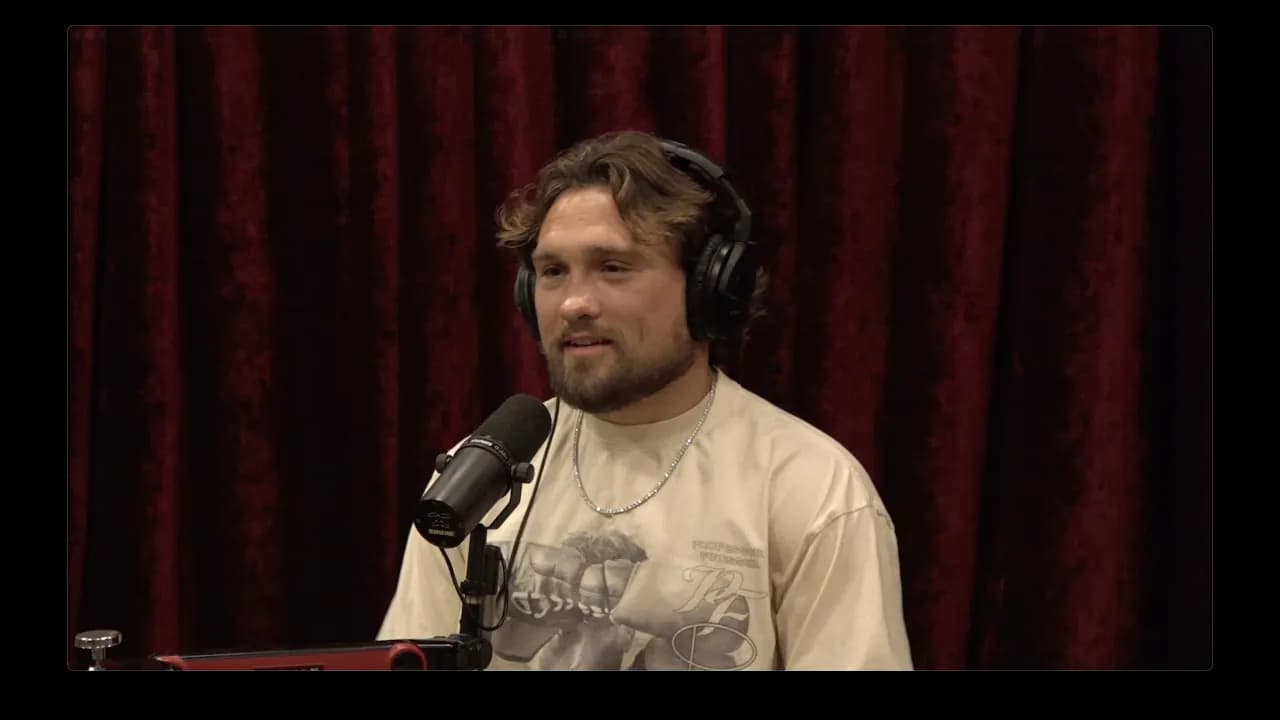
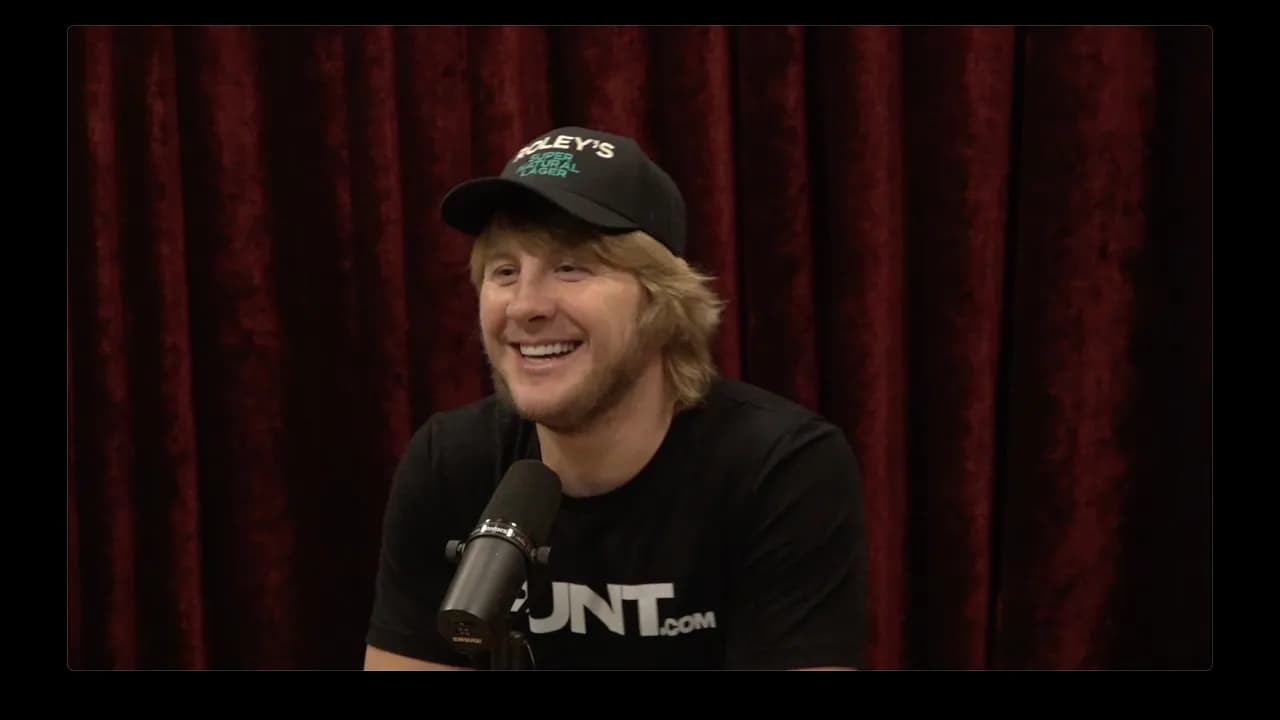
JRE MMA Show #189 with Tommy McMillen
In a Nutshell
Tommy McMillen describes his rise from Great Falls, Montana to the UFC, emphasizing how proper nutrition, recovery work, and mental resilience transformed his career after years of poor habits and injuries. He details surviving an overdose, his weight-cutting methods, and why his chaotic fighting style and trash-talking persona are calculated business strategies. The core message is that fighting saved his life by providing structure and purpose, and that success requires treating yourself like a business while developing an "unbeatable mindset" through adversity.
These notes were generated by AI and may contain inaccuracies.
Tommy McMillen brought a custom lunchbox packaging for his upcoming weed strain called Tommy Montana that will include edibles. Joe Rogan commented on the quality of the packaging design.
Sugar Sean's suggestion that he should start his next fight with a two-point deduction was discussed. The group examined the eye poke incident from the Sir Gan vs Hoke fight, noting that no point was taken despite the severity. The eye poke was described as deliberate - extending the hand toward an opponent's eyes rather than an accidental contact during a dive. This was compared to fence grabbing as an intentional foul deserving of a point deduction.
Aspenall's situation was cited as an example of how multiple eye pokes can end careers, noting he required four surgeries and had to relinquish his heavyweight championship belt due to fouls.
Hoke was described as a forward pressure, smothering fighter who creates chaos. Sir Gan was characterized as a counter striker who moves well, blitzes in, and maintains safety. When Hoke applied chaos, Sir Gan's instinct to extend his hand was counterproductive. The fight was called one of the most entertaining heavyweight fights in UFC history and ranked among the top 10 heavyweight fights of all time.
The conversation referenced Pride-era fights including Ggera vs Fedor and Fedor vs Crocop as examples of historically chaotic heavyweight bouts outside the UFC.
Sir Gan showed impressive adaptation in rounds 4 and 5, catching a second wind, kicking more frequently, and landing good knees to the body. His kick-heavy style was countered by Hoke's strategy of constant forward pressure that prevented Sir Gan from planting and firing kicks. Sir Gan's preferred technical striking on the outside with time to set up explosive movements was disrupted by Hoke's smothering style.
Hoke's performance against Sir Gan and Pereira highlighted Jon Jones' greatness, as Jones previously made Sir Gan look similarly ineffective. Hoke was noted as potentially being able to compete at middleweight, though his pace works particularly well at heavyweight where no one can match it. Comparisons were made to Kane Velasquez's preposterous cardio in his prime.
Hoke achieved a heavyweight title fight in one year with only 11 professional fights total. His trash talk was defended as strategic self-promotion that achieved his goal. Outside his persona, Hoke was described as very smart and normal, with his public behavior being a calculated act to gain attention.
The discussion explored how fighters like Hoke and Patty the Batty use silly personas to trick opponents into underestimating them. Once the cage closes, the silliness disappears and the fighter becomes intensely focused and aggressive.
The referee's failure to stop the action for the eye poke was criticized. The referee has authority to pause action, call time, and review fouls. Previous rules prevented resuming fights after stoppages, but current rules allow this. Taking a point from Sir Gan would have resulted in a draw rather than his one-point victory.
Tommy began wrestling at age three in Great Falls, Montana, despite being too young for the four-to-six-year-old division. His father, a coach, allowed him to participate. He described a love-hate relationship with wrestling but recognized it kept him out of trouble.
Tommy's father had children young - his older sister at age 15, Tommy at 17, and his younger brother at 19. The family lived with grandparents while the father worked multiple jobs including plumbing and grocery bagging, then boxed at night under Todd Foster, an Olympic boxer from Montana. Tommy witnessed his father's fights and decided fighting was his path to financial success.
After quitting boxing, Tommy's father opened one of the first MMA gyms in Great Falls when Tommy was in third grade. Tommy trained there with his father and young adults, being the only child involved since MMA wasn't established in Montana at the time.
The Montana MMA community was extremely small. Tommy recalled seeing Tim at local fights and recognizing his standout presence among fighters and coaches. Tommy followed Tim's career through the small Montana scene.
Tommy moved to Arizona in 2017, following the path established by Suge who had moved there earlier and shown dramatic improvement. Tim had paved the way for Montana fighters by moving to Arizona first. Tommy lived with Suge after packing his belongings into an old Honda Accord with no air conditioning.
When Tommy first moved in with Suge, Suge had approximately 7-8K Instagram followers. Both drove beat-up cars without air conditioning. Tommy witnessed Suge's car breaking down on the way to practice during an Arizona summer. He has since watched Suge achieve everything he set out to accomplish, culminating in becoming a world champion.
Suge won his Contender Series fight with a walk-off knockout that was particularly memorable because Snoop Dogg provided commentary and went crazy during the finish. This was reportedly the only Contender Series event Snoop commentated on.
O'Malley did not do a fight camp for one of his early fights and weighed in at 135 pounds without putting any weight back on after weigh-ins. The fight was against Alfred, a tough and game opponent. O'Malley went out and got a highlight-reel knockout despite appearing tiny in his body frame due to not rehydrating properly. This performance demonstrated that he rises to the occasion under pressure.
Tommy moved in with Suga when Suga was going through health-related changes and was vegan at the time. Tommy had previously eaten at gas stations his whole life and had no concept of dieting or healthy eating. He would cut weight for wrestling in the worst possible way by eating whatever he wanted. Suga once called him out for eating a block of cheese and a bag of Sour Patch Kids for dinner, which Tommy realized was why his back was hurting and he couldn't train. Tommy had toaster strudels in the freezer and maintained the worst diet possible, not understanding nutrition's importance at all.
Tommy took notes from Suga and Tim about eating healthy and learned how to be more disciplined like a true martial artist. This is when he noticed changes in his fights, camps, and performances. Young fighters can get away with poor nutrition, but as you age, you cannot get away with it as much. The body accumulates minor injuries that do not heal properly when not given the right nutrients over time.
Nutrition is gigantic and critical for energy levels. Fighters should be taking vitamins and paying attention to what they eat. The people who do not focus on nutrition have one more thing that will trip them up. Everyone is busted up from training when they enter a fight, but the goal is to be as close to 100% as possible through proper nutrition.
Suga was vegan for quite a while, though it was more of a vegetarian diet since he occasionally ate eggs. He was on a kick of reading health information and growing from it. Eventually, he introduced red meat back into his diet, including steaks, and felt the difference. He now eats all types of meat and has put on significant mass since his Contender Series appearance. Tommy noted that Suga looked very thin at 135 pounds compared to his current physique.
Suga has such a good counter, particularly pulling back and countering with the right hand. Being athletic helps with this technique. It is possible to be a vegan fighter if extremely careful with supplementation, but it is not considered optimal. Some fighters like Terrance Crawford do not eat red meat, though this approach seems questionable given the physical demands of the sport.
Steak is considered the best thing in the world for nutrition. Tommy eats game meat when he can access it, which is easier in Montana where friends hunt. His grandpa hunted, and his dad hunted a little bit. Tommy never got heavily into hunting because hunter safety courses conflicted with wrestling season, and he was disciplined about focusing only on wrestling during that time.
Tommy's favorite place to hunt in the US is Utah, where he has been going for 10-11 years. Utah is beautiful with mountain lions, moose, and bears visible. Arizona also has amazing hunting land, particularly the Apache reservations, which have some of the best elk hunting in the world. San Carlos reservation has massive mountainous areas with huge elk. Tommy wants to get into hunting when he finishes fighting and has more time.
Archery hunting is more exciting and challenging than rifle hunting. Shooting an elk with a bow creates a completely different experience that is more difficult and more rewarding. Tommy would want to pursue archery hunting specifically.
Tommy's first amateur fight was at a local hotel show for Fight Force. He beat his opponent in the first round on a Friday night. The promoter, Tero Bracken from Fusion Fight League, approached him that same night about fighting the next night in Lewistown, two hours away, due to a last-minute dropout. Tommy accepted because Tim Welch was headlining that card, and Tommy wanted to fight in front of Tim to demonstrate his seriousness about moving to Arizona.
Tommy fought twice in two nights on back-to-back Friday and Saturday. He partied all night after the Friday fight, got only two hours of sleep, then drove to Lewistown with his girlfriend at the time. Despite feeling terrible, he broke his opponent's orbital bone in the second fight against a tough Native American kid. After the fight, he approached Tim Welch and mentioned fighting twice in two nights while trying to get connected for training in Arizona.
Tommy believed he would become a UFC world champion from Great Falls, Montana, where nobody knew about MMA. He thought that if he could not beat amateur opponents while hungover, he would not make it to the UFC. This was his mentality at the time before moving in with Suga and Tim and learning about proper health habits.
During wrestling season, Tommy was more dialed in and did not party as much because he wanted to win state titles. The better version of himself always emerged during wrestling season when he was more disciplined.
The mind is the most important weapon in fighting. Some fighters perform at 60% of their ability when the lights come on despite dominating in the gym. Others who are tough and scrappy in practice become animals when the lights turn on. Some guys rise to the occasion while others fold under pressure.
Horiguchi demonstrated the mental aspect by making a crazy choice to weigh in on cereal and risk getting hit while coming in, eating punches while trying to move his head and land his own strikes. This represents the mind as a weapon. Not everybody can perform at that level because it is extremely difficult.
One-on-one wrestling helps people learn how to compete mentally. Horiguchi went into his fight mentally prepared to walk down a bigger, more athletic opponent with huge power, accepting that he had to go to a crazy place to break his opponent. Not many people can mentally accept and truly believe they will do something that dangerous.
Charles Oliveira is one of the most impressive examples because he used to fold in fights. Somewhere along the line, possibly when he had his first child, he made the decision that he was never going to fold again and would march through opponents. He became one of the best ever after this mental shift.
At the UFC level, fighters need to have the mentality that they are down to die when they sign contracts. Everyone is crazy if they are not actually committed to that level. The mental aspect is crucial because fighters are going in front of crowds to face trained killers who have been preparing to take them out.
The Justin Gaethje vs. Ilia Topuria fight in the second round demonstrated mental toughness, as many fighters would have folded when getting hit with body shots. Topuria's left hook to the body is perfect, and his boxing technique is among the best in the UFC. Gaethje outdogged Topuria mentally despite Topuria appearing sharper and more skilled on paper.
Gaethje has been in crazy wars throughout his career, including against Dustin Poirier, Tony Ferguson, and Michael Johnson in his UFC debut. These experiences from the beginning of his career, including his IFL days, contributed to his mental preparation and ability to perform under pressure.
Ilia Topuria's approach was characterized as full steam ahead with a wild style that broke people through sheer aggression. His leg kicks from collar tie positions were noted as particularly powerful and unusual. Unlike fighters who had been through multiple back-and-forth battles, Ilia had only one significant rough moment in the UFC against Jai Herbert at lightweight, where he was rocked by a perfect left high kick but recovered to secure a finish.
Gage (Gaethje) was described as significantly bigger than Ilia, being a large 155-pound fighter while Ilia is not. The discussion emphasized that Ilia would likely be better suited at 145 pounds. At 155, there's a substantial difference - fighters who can't make 145 are cutting minimally to 155 and remain huge. Modern weight cutting practices were highlighted, with Morales cited as an example coming in at 170 pounds while walking around at 220 pounds. Many 155-pound fighters blow up over 200 pounds.
The matchup between Ilia and Paddy Pimblett was identified as the big money fight and the smart next move. Concerns were raised about the difficulty for Ilia to bounce back stylistically. Paddy was described as a big man who can eat punches, wear on opponents, and possesses underrated grappling ability. His performance against Benoît was specifically mentioned as evidence of his grappling skill.
Paddy's size advantage was emphasized - he's tall, long, and thick at 155 pounds. His ability to go five chaotic rounds against Gaethje, who breaks many fighters, demonstrated his durability. Gaethje was acknowledged as underappreciated despite his skill level.
Gaethje's title win on the White House lawn was described as surreal, with all odds against him. Ilia's pre-fight confidence was noted, including his comments to Trump questioning why he'd want Gaethje to fight him. Reports of Ilia having a celebration party the night before the fight were discussed, though this approach had worked against Oliveira and Volkanovski.
Ilia's approach was critiqued - he wanted to knock Gaethje out rather than potentially outpointing him with superior boxing over five rounds. A key mistake was identified: jumping on Gaethje after the body shot instead of staying at distance. The discussion referenced Sean O'Malley's approach of backing up with hands up, suggesting this could have led to a different outcome.
The conversation highlighted fighting as the craziest sport because outcomes can change dramatically from one wrong decision. The comparison was made to gambling with the highest stakes in the world.
Fighting was described as incomparable to any other sport or experience, with no drug or feeling matching the sensation of fighting in an arena full of people against another killer.
McMillen fought Marwan Rhiki, who entered with a 9-0 record and 8 knockouts. Despite Rhiki being cracked in previous fights, McMillen viewed him as dangerous rather than lucky, noting his ability to battle back from bad positions and finish opponents. McMillen mentally prepared for the fight knowing his perceived weakness was knockout power, and anticipated needing to dig deep.
McMillen won the first round by outstriking Rhiki but lost the second after getting too comfortable and being caught with a left hook. He won the third round decisively. Despite the opportunity to take Rhiki down in the third round to secure the win, McMillen chose to stand and bang, dropping him instead.
McMillen's approach of choosing to stand and strike rather than taking the safe route was highlighted as a reason for his popularity. Friends texted after the fight calling him insane, noting this chaotic style is what audiences love to watch.
McMillen mentioned fighting Alberto Montes seven weeks prior, where he broke the world record for most significant strikes in a three-round fight. He partied for two weeks afterward before having five weeks to prepare for Rhiki.
After the Montes fight, McMillen got on the mic calling for a Mexican fighter on September 12th in Arizona, his second home. He felt compelled to fight there to give fans what they paid for, despite the main event pulling out.
Rhiki had originally called McMillen out after a win in Australia, creating the foundation for their matchup. The UFC pairing them together created significant buzz, with McMillen recognizing it would be a sick fight with good buildup.
The fight stole the show at weigh-ins with more views than other segments. McMillen walked out to Mötley Crüe's "Girls, Girls, Girls." The chaotic nature came from both fighters being game counter-strikers who put themselves in danger.
McMillen admitted to partying for two weeks after the Montes fight but claimed he remained in good shape from that camp. He typically walks around at 185-190 pounds, getting as high as 190. His weight cutting process was detailed: waking up at 162 pounds on Thursday, getting down to 157 through the day, then losing the final 11 pounds through hot tub and sauna work.
McMillen prefers hot tub and bath methods over sauna, having used this approach throughout his wrestling career. A study was referenced showing hot baths may be better for recovery response than saunas. The source of water pulled during hot tub sessions was noted as potentially less draining than sauna sessions.
Ethan Ewing's approach of using a lower-temperature sauna (160s) for longer periods was discussed as an alternative to extreme heat (195 degrees), which can be overly weakening. McMillen experienced an overly hot hot tub at the Performance Institute during his debut weight cut, noting that temperature significantly affects mental difficulty even when water loss remains the same.
Tommy McMillen described how he prepared for the David McGuyan fight by recognizing the opponent was a tough undefeated Armenian Russian grappler. He quit smoking and drinking for that fight and got locked in. He realized the level he's reaching requires consistent improvement with each camp.
McMillen explained his approach to each fight camp involves getting more dialed in, going sober longer, and becoming more disciplined. He acknowledged being known as a wild party kid who has been partying since fifth grade, but clarified he's actually partying less than before and getting more disciplined with each fight.
When asked if he thinks he'll ever stop partying completely, McMillen said probably not. He works hard through brutal fight camps, dieting, and suffering, and feels he needs to enjoy life after all that work. He believes he can balance it better and will keep trying to figure it out.
McMillen discussed the recent story about him overdosing. He explained he was in the middle of a packed club, not the bathroom, when he had mixed substances and possibly had a bad batch. His body gave out, he started choking, and became unresponsive. He received two Narcan doses, was taken to the hospital for an IV, and was unconscious for 6-7 hours from around 11 PM to 5 AM.
He acknowledged that when really drunk and faded, his judgment goes down and he might make poor decisions about substances. He doesn't remember getting to the club that night or much of what happened.
McMillen mentioned his girlfriend doesn't do drugs and isn't much of a partier, which has been the best influence in his life. She's made him want to make better decisions and be a better version of himself, though it didn't prevent the recent incident.
The incident happened on a Saturday but didn't get out initially. McMillen didn't tell his parents because he thought it would stay under the radar. When TMZ released the story four days later on Wednesday, his parents found out through friends and his old wrestling coach sending messages asking if he was alive. He felt bad that they discovered it through the news rather than him telling them directly.
Joe Rogan noted that Narcan is very effective and McMillen was fortunate to survive. McMillen acknowledged it's scary and that people think it's a wakeup call, but clarified the misconception that he's partying more than ever - he's actually partying less than before.
Rogan warned McMillen to stay away from pills, noting that even real OxyContin and Oxycodone can ruin lives, but fake cartel pills with fentanyl are extremely dangerous. The amount of fentanyl needed to kill someone is tiny - smaller than what fits next to a penny. Doing coke today carries similar risks.
McMillen shared that Great Falls, Montana, where he's from, is one of the meth capitals of the world and has significant fentanyl-laced substance problems.
McMillen described Great Falls as a place where dreams go to die, with no sense of direction or ambition among many residents. He loves the supportive people but said even friends who moved away can only handle being back for a couple days. He attributes his partying habits to growing up there.
McMillen shared that he used to go to bed pissed off in third grade because he wasn't old enough to fight in the UFC. He hated seeing people struggle financially and believed his path to success and financial freedom was through the UFC. Partying starting in fifth grade was the only thing that shut off his brain and let him enjoy life like a normal kid, as he hated school since second grade.
He acknowledged that living in a place without hope can lead to alcoholism and drug addiction. MMA has saved his life by giving him purpose and focus. He obsesses over fighting and needs something to focus on, which is why he fought seven weeks after his previous fight.
McMillen mentioned having three banger fights in five months, including one that broke a world record and the Marwan fight which ranks among the top two fights of the year. He wishes he could fight every weekend but acknowledges the physical toll - after his last fight his jaw, nose, foot, and hands were all banged up.
McMillen doesn't do as much recovery work as he should. He does cold plunges regularly but doesn't use hyperbaric chambers much. He's buying a house soon and plans to set up his garage with a full recovery setup including Monster Energy mats and some bags for training. He wants to be close to Red Hawk Academy in Peoria, which is 25 minutes from Scottsdale.
McMillen previously lived in Scottsdale where he partied a lot and had to drive to the gym, which made him unhappy. Moving to a condo next to the gym improved his life significantly. The gym has its own recovery spot, a Java house with recovery drinks, coffees, and gourmet organic food.
McMillen discussed getting advice from a high-level UFC person about having someone around who doesn't party as much but can keep an eye on him without being annoying - essentially a chaperone who lets him enjoy himself but prevents trouble. Rogan emphasized thinking of himself as a business with massive upside that could be derailed by bad decisions.
McMillen signed with Gambdom, SteveWillDoIt's online sports betting company, for a $100k a month gambling deal involving rep motion pouches. He also has ownership in the pouches and is launching PEPs PPS, a peptide and supplement company. The ingredients include guana seed extract, caffeine, alpha GPC, theanine, B12, and ginseng.
McMillen acknowledged he needs to handle business better outside of fighting, as he's been MIA dealing with business matters and can't manage partnerships effectively while partying heavily.
McMillen shared he had a pinched sciatic nerve for over two years that caused numbness and pain in his foot and big toe during any workout. He avoided back surgery and finally resolved it through extensive hip flexor stretching over about a year.
For his Contender Series fight against Dave McGoy (Armenian Truskin's cousin), he couldn't grapple for a year and a half leading up to the fight due to the injury but never doubted himself mentally. He saw it as a test of his belief in himself.
Tommy describes going through a very difficult period where he couldn't train properly for two years, getting hurt at every practice and barely making it through fights. This experience made him extremely grateful for being healthy now and able to work hard in camps. He credits his trainer, who is a doctor with degrees in kinesiology, sports science, and chiropractic work, for helping him through this period. His trainer was actually Tommy's first athlete and is not much older than him.
The therapy regimen included daily needle work, cupping, and electrical stimulation with batteries attached to needles to break up tissue. However, Tommy found that stretching his hip flexors for two hours a day was ultimately what fixed his back issues. He notes that bad backs and pinched sciatic nerves are common injuries in the sport, possibly due to grappling.
Tommy has an abnormal back condition where his spine doesn't curve out at the bottom - it's flat, which puts extra pressure on his hip flexors and back. He learned this from X-rays, though he forgot the medical term for the condition. This structural issue made his back problems particularly severe.
Tommy emphasizes that stretching is simple and accessible - it's not like gaining 30 pounds of muscle or getting taller. He shares an anecdote about trying to show a pro fighter a stretch, only to be told "I can't do that, I'm not flexible," which Tommy found silly since flexibility can be developed through consistent stretching. He recommends the stretch where you sit on your heels, fall backwards on your knees, which opens up the hip flexors significantly and was the main stretch that fixed his back issues.
Tommy was supposed to appear on Contender Series in September 2024 but blew out his shoulder. Since he wasn't in the UFC at the time, he was able to use peptides to fix the injury, specifically mentioning the "Wolverine stack." He describes the peptides as making him feel better than ever - sleeping well, everything dialed in, and his shoulder pain disappearing.
Tommy is passionate about stretching, supplements, and peptides for injury healing. He argues that peptides should be allowed in the UFC since fighters are constantly throwing their bodies at each other and clashing bones. He believes anything that helps heal injuries faster should be permitted, as it keeps fighters closer to 100% capacity and could potentially prolong careers.
Tommy and Joe discuss the push to make peptides legal through compounding pharmacies, crediting Robert F. Kennedy Jr. for this effort. They note that legitimate compounding pharmacies provide regulated peptides with an incredible safety profile. The amount of adverse effects reported from peptides like BPC-157 is tiny, and reactions are often anxiety or breathing issues that could stem from other causes.
They emphasize the danger of black market peptides versus regulated options, comparing it to taking unknown pills at a club. Tommy takes BPC-157 and TB-500 daily, the same stack he used for his shoulder injury.
Joe mentions that Jeff Novitzky, former head of the UFC's anti-doping program who caught Lance Armstrong, supports allowing peptides. They discuss how testosterone use was previously unregulated during the "Vitor days" when fighters were "juiced to the tits," creating an exciting but dangerous environment where fighters could self-administer excessive amounts.
Tommy notes the night-and-day difference from the Wolverine stack, including improvements in sleep, mentality, mood, and overall feeling like a machine.
Tommy uses red light therapy at a local spa near his gym in Peoria that offers cold plunges, compression therapy, hot tubs, and saunas. He notices his back and lingering shoulder issues feel better with consistent red light use, waking up feeling looser. He aims for at least twice weekly sessions, noting consistency is key similar to taking vitamins.
Joe introduces the reverse hyper machine, invented by Louis Simmons of Westside Barbell, which provides active decompression while strengthening the spine, hamstrings, and glutes. As the weight swings down, it decompresses the spine, and on the upswing, it strengthens the muscles. Louis Simmons created it after doctors recommended spinal fusion following a back injury.
Joe recommends the Teeter Dex (specifically the Dex 2) as superior to ankle-hanging inversion tables because it doesn't involve the legs tensing up. Users hang from their hips and can slowly relax, pop, and stretch the back. He has one at his house and swears by combining the reverse hyper for active decompression and strengthening with the Teeter Dex.
Tommy mentions his trainer has him do reverse hyper exercises regularly due to his bad back, though he didn't know what it was called before.
Tommy wishes he had started injury prevention earlier in his career, as he now tries to preach this to younger fighters at Red Hawk Academy. He notes how fighters feel great when young, then suddenly problems start accumulating, especially in MMA. However, he acknowledges his earlier lifestyle of partying and eating gas station food wasn't conducive to injury prevention.
Tommy describes his training approach as having no balance during camp - he's 100,000% locked in on fighting, his regimen, and recovery. This intensity can drive him insane but results in feeling like a machine in the cage. He plans to invest in home recovery equipment like red light beds and hyperbaric chambers now that he has more money.
Joe suggests a red light bed and hyperbaric chamber at home would be huge investments, noting how hyperbaric oxygen therapy saturates the body with oxygen.
Tommy gets massages but not as frequently as he should. He mentions he doesn't even do them once a week, partly because there's too much fun to be had and too many training demands competing for time.
Outside of fighting, Tommy's main activities are partying, streaming, and creating content. He's been doing more content creation lately, including with Stevewilldoit, who Tommy notes is actually very health-conscious and sober despite public perception. They've been traveling to football games and UFC events making content.
Tommy loves poker and gambling, describing gambling, fighting, and partying as the three best things. He's planning to stream more, including potentially live streaming training sessions, though he hasn't done this yet due to time and resource constraints.
They discuss two schools of thought on streaming training: it could make fighters more intense knowing people are watching, or it could expose injuries that can't be hidden. Tommy isn't concerned about people watching practice but acknowledges injury exposure as a legitimate concern. They suggest potentially not streaming during fight camp or recording sessions to upload later if injured.
Joe notes the smart approach of fighters like Tim and Sugar, Kamaru Usman, and Cejudo who create their own content rather than relying on others. He mentions how MMA fans are hungry for content throughout the week, not just on weekends.
Tommy explains he tends to disappear after fights, especially after his last one when he was too beat up from fighting three times in five months. He likes to get off his phone and not be reachable, but eventually wants to return to content creation.
They discuss how social media can become a time suck, with people losing hours without realizing it. Tommy used to gamble on UFC fights before it was illegal in the early 2000s when information was scarce, but as a UFC fighter he can no longer bet on fights, which has reduced his fight-watching enjoyment.
They recount being with Dana White and Stevewilldoit when both placed million-dollar hands.
They both bet million-dollar hands of Baccarat, each putting a million in cash on the table. The speaker was shocked watching the action since he was new to that level of gambling. Both players hit and each won a million dollars. Dana White was asked if it was the biggest hand he'd gambled, and he confirmed it was but mentioned he'd done it before.
Dana White was playing blackjack the night before a UFC event and was down $600,000 when the speaker arrived. He ended up winning, but the session went until six o'clock in the morning. The speaker notes that gamblers often go through significant suffering before getting a big win, going far down before coming back.
The speaker acknowledges that for some people gambling is a real problem, and many believe it shouldn't be legal. However, he argues that people should be able to do whatever they want, drawing a parallel to drinking which ruins more lives than gambling. He believes if society accepts drinking, there's no reason to ban gambling, though he recognizes it can be problematic for some individuals.
During the first years of the UFC, the speaker describes it as "stealing money" because bookmakers didn't understand the sport. Fighters coming over from Japan created situations where bookmakers had no information about competitors. This created betting opportunities for those who watched Pride or participated in forums and understood the talent levels. Some elite fighters slipped through the cracks and were undervalued by bookmakers.
Around 2002-2003, the speaker stopped gambling before the UFC implemented a ban, concerned it might affect his commentary. The UFC's decision to ban gambling stemmed from an FBI investigation into potential fight-fixing, with concerns that people might take dives or know about injuries in advance to place bets.
The speaker mentions he would have bet on a fighter's money line recently if he could still gamble, believing strongly in that competitor despite the outcome.
The speaker discusses his appreciation for a fighter known for controversial behavior, mentioning Instagram interactions and weigh-in poses that generated significant attention. He finds the fighter entertaining and believes he understands the business better than most. The speaker notes that what some call "cringy" behavior has become funnier over time, suggesting the fighter knows exactly what he's doing.
The controversial fighter's approach generated huge numbers, trending like Conor McGregor numbers. The attention paid to this single fighter made casual viewers tune in, which is the goal - creating engagement from people who wouldn't normally watch every fight. The strategy forces viewers to take sides rather than remain ambivalent.
The speaker respects fighters who talk trash and put themselves in front of the public, acknowledging that losing after talking becomes worse. He notes many fighters aren't willing to gamble their reputation that way, but the risk-reward is significant when it works. He finds it natural to talk trash because opponents are trying to take his paycheck and momentum.
During his last fight against Marwan, the speaker engaged in significant trash talk throughout the week. At weigh-ins, he threw a Twinkie at Marwan's coach after being shoved in a hallway. When entering the cage, Marwan was visibly angry from the psychological warfare, while the speaker remained emotionally detached, viewing it as entertainment rather than genuine animosity.
Before fighting Alberto Montes, the speaker studied how Montes preferred shaking hands and staying humble at weigh-ins. He deliberately made it a war and forced Montes to engage in trash talk, which was outside his comfort zone. This approach made Montes fight off emotion while the speaker remained detached, treating it like a video game.
The speaker believes MMA is perfect for his personality type, providing the structure and consequences needed to stay focused. Without fighting, he might have problems with partying. MMA forces sobriety because there's always another dangerous opponent to face, providing the external motivation needed to maintain discipline.
The speaker acknowledges needing significant excitement in life, suggesting a regular job might lead to destructive behavior for entertainment. Joe Rogan discusses genetic memory, referencing a 10-year-old Japanese student named Joe Nagai who proved butterfly memories survive metamorphosis and can be inherited by offspring. This research suggests fears like arachnophobia might be genetically inherited from ancestors' experiences.
The speaker jokes about having "carne genes" that make him put on weight easily compared to training partners who stay lean regardless of diet. He hopes he has some warrior genetics from Irish ancestry.
From a young age, the speaker had delusional confidence that fighting would be his career path, ignoring school because he was just waiting to turn 18 and fight professionally. At 28 years old, he reflects on how long it's taken to reach elite levels.
The speaker went pro around age 21, finishing his debut opponent in the first round against a 3-0 D1 wrestler. He was already beating UFC fighters in the gym and believed he belonged at that level. However, COVID shut down the regional scene for two and a half years, followed by a year-long foot injury that required dealing with rather than surgery due to financial constraints.
During COVID, the speaker continued training full-time in Arizona despite having no fights available. He moved there specifically to become a UFC fighter and maintained his training regimen even when the lab shut down and sessions moved to warehouses.
Moving to Arizona at 18 with a broken Honda Civic and no financial support forced the speaker to find ways to support his training. These experiences taught him about life and made him a better person outside the cage, preparing him to handle future success.
After finally getting on Contender Series, the speaker suffered another shoulder injury a week and a half before his scheduled UFC debut, tearing his labrum and separating his AC joint. Each setback initially seemed devastating but ultimately contributed to his mental fortitude.
The speaker developed a mindset where he recognizes adversity as beneficial while experiencing it, knowing from past experience that challenges always work out in his favor. This perspective transforms difficult situations into fuel for growth rather than sources of despair.
Getting into the UFC at 28 rather than 21-22 worked out favorably, as the speaker is still approaching his prime and has learned significantly more than if he'd entered earlier without the character-building experiences.
During fight week against Marwan, the 24-year-old opponent claimed he'd be a double champion by the speaker's age, having gone pro only a year and a half earlier. The speaker recognized this as revealing Marwan hadn't faced the same level of adversity, giving him confidence that his experience with hardship would prove decisive.
The speaker emphasizes that believing adversity will ultimately benefit you allows you to make that outcome real. Most people struggle to see current difficulties as future advantages, but maintaining this perspective during challenging times enables personal growth and resilience.
Despite MMA appearing to be an individual sport, the speaker credits Suge and Tim for teaching him how to process adversity with an open mind. Their guidance helped him connect mental dots and develop a stoic approach to challenges.
The speaker believes his desire to become the most dominant and entertaining UFC fighter required going through significant challenges to forge the necessary mentality. He views life's tests as preparation for achieving his goals rather than random obstacles.
There's an immense amount of power in belief. People think it's woo woo and that it's not really that much of a factor. A lot of people think of it as only people that are successful think that because it worked out for them and that your mindset doesn't really matter and it's like there's a bunch of random things that happen in life. You create a certain amount of reality. You certainly affect it and change it with your attitude about it. You can take that mindset and put it into anything in life.
The unbeatable mindset alone works. When hearing Gary Vee talk about how things happening to you are happening for you and how to use it, a pattern emerges where everyone that's successful in their respective field are all saying the same thing. It worked in a sense.
The problem is it's not the only thing. Having that warrior mentality, that killer go all-in mentality is a giant weapon but it's not the only weapon. If a guy's way better than you skillfully it doesn't matter. The movie The Secret had a lot of people believing you could manifest your future with vision boards and thinking about things all the time. But it was because they were talking to people that had gone through it and had made it and they go, "I did this and I imagined this and it happened" and then it became this thing about manifesting your future.
The biggest part of it is work. Being able to put in the work and also realizing and adjusting when you feel like shit, knowing that these moments of adversity you're going to grow from. It's not just this one thing, this ability to sort of manifest your reality. There's a lot of things involved. Having a vision and having a powerful positive mindset is very beneficial but it's not the only thing.
Everyone's tools are different. Not being the most fastest twitchiest, not having the fastest twitch muscle, not being the craziest athlete - there are people with way better genetics. But one thing that can be controlled is work ethic, the ability to look at something wanted and to just go insane saying "I'm going to die working for this before I ever give up on it." That's something that has always been there and it's got to where it is now.
Winning state freshman year started out on JV wrestling because the coach's kid that was a state champ too was older and in the same weight class. All year the mindset was to win state. Dad was the only one that believed it. Nobody really thought winning state was going to happen. Was on JV losing JV tournaments. Then battled that kid off for varsity spot later in the year. Halfway through season beat him and got the varsity spot. He drops down a weight class. Now on varsity, still not doing that good. People think going into state and maybe taking sixth, seventh at best.
Ended up having a good state tournament, got first place, won state when no one else believed. Probably shouldn't have on paper looked like the more skilled person, but put in the work. Freshman year, knowing behind, knowing not the most skilled, had seniors in weight that were better. Would wake up, run before school, run to CrossFit gym because there's not much in Montana, no personal trainer, just doing CrossFit at the local gym. Run to CrossFit as a freshman, do CrossFit before school, go to school, then go to wrestling practice after school, which was two to three-hour grinding practices. Then go to MMA practice after that because dad was coaching MMA. So doing three and just went insane that year.
Even at divisions the week before state, took fourth at the half, not even favored to win. Went into the state tournament and put it together and won. That unlocked something - "Holy shit, I can do things that no one thought I was going to do. Nobody. I did it just because I just went insane to it and outworked everybody."
When going to national tournaments as a young kid traveling in high school, started to win and do way better. But before that, growing up as a kid, doing pretty good at state then going to national tournaments and getting ass kicked. Looking at these kids and their dads they're with. These kids were like young Jack kids. Realizing that was the difference - being tough and working hard, but these kids were eating right, knew what they were doing, training for national tournaments, eating right for weeks at a time. Their dads are very strict.
Dad was always really busy working. So grew up with a lot of own freedom. Taking, eating Doritos, nachos from a gas station. That's one thing to try to be more disciplined nowadays, especially during camp. Looking back at it, that's where just didn't know. That's why those kids were kind of just a little bit better when going to those national tournaments. Got everything but these kids are just on that different level.
That's the difference. They probably were working as hard. But eating better, being more disciplined. Having someone looking out for them. But there's something that comes from having someone not look out for you too, where you develop your own ability to push through things. There's a giant benefit in that too, to be self-driven. To be the type of guy that decides for yourself that you're going to get up in the morning and run to CrossFit before wrestling practice when no one's telling you to do that. Just that alone.
It was crazy. It was a cool experience. Wrestling high school is so fun. It was good times. In the right line of work. There's some people you talk to, you go, "Man, maybe this guy should sell real estate or do something else. This isn't for him." But this is exactly for this.
Don't just don't think fighting saved life. Don't think would be alive today if didn't fight. Fighting's definitely got to where at. That's just why putting on the fights done. Owe this sport and this game whole life. It's got to where at. It's got beautiful blessings in life, good people around. It's just every good thing in life has come from fighting people in a cage. Just dumb it down head, just show up and fight people. If just all got to do.
No fight offer currently. Wanted to go fight in December originally planned because knowing if get out of camp just going to be partying being a little bit wild. Wanted to turn around fight in December but coach and management team, Tim and management team, were all like no. They've never told no before. Even when turned around fought Marwin 7 weeks later they knew was partying for two weeks, took on five weeks notice. They never told no. Damn, it's a pretty tough fight. But they didn't told no. If Tim tells no to something, management, will listen because knowing need those kind of people in life because will do whatever.
Was just so banged up after last fight. Had injuries coming in from the July fight before Marwin and then recracked nose and jaw. Just so needed to take some time off and take a break. Definitely want to on the road to getting back into that fight. Body's healthier than it's ever been. Been training the past few weeks, even before what happened last week. Still been training.
Tried to do sober November because went so hard in October, Halloween. Was going to do sober November. Went sober at beginning of November. That happened November 7th. So think a week was sober. "Oh, hell yeah. I'm sober." Then had local fights in Arizona and all guys fought and was at the fights. Started sipping at the fights. Next thing wake up in the goddamn hospital. "I should have did sober November." Been sober since then too. By sober still smoke weed, always smoke weed so don't count that. But sober meaning drinking because when get drunk is when start making decisions.
Right now kind of just dialing it back on that and getting to the point where should be able to take a fight here soon. That's what trying to do. Get weight down a little bit. Once weight gets to where want, will call up UFC and be like, "Hey, let's run it." Itching to fight. It's a hard battle to not be and just need that fight booked. Need to just love it. It's what need. Hopefully soon.
Division is so stacked. Big reason why did a lot to get here. Not only want to do it for self, but can go on one of the most entertaining runs the UFC's ever seen. People deserve that. People that love the sport as much as do, they deserve that. Don't want to get to where at and fumble the ball. Know what doing. It definitely was a good little eye opener, some things that need to change. Need a little wakeup call. But future is so bright. In terms of marketability, can't be more marketable. In a perfect position right now.
Love the UFC. Love the UFC. Hunter, Dana, Sean Shelby, all them boys. Job's so sick. So lucky. That's another thing. Would feel like an idiot if just threw it all away. This is so sick. In the right line of work.
Don't have anybody in head. The sense to that is the first time calling out a name and mentioning someone's name is going to be when wanting top 15 spot. Right now feeling getting better every fight at an extreme level just from debut because fighting in the UFC is just a different level. Learn quick. Learning how to the experience when walking out, the feelings, how to adapt to them better, to be more calm in there when it starts. Getting better at it every time. Ready. Could fight a top 15 guy and have a top 15 spot, but almost just want to once get to the top 15, can't be as active. There's only so far you can go to the top and almost kind of want to get a few couple more fights in to just keep getting that experience before calling top 15 shot because when get to the top 15, going to be fighting for a belt quick after that. Probably won't call, don't have any names in mind right now, but after think would say one or two more. Want to call out a guy in the top 15 and that's when will mention someone's name.
Very smart about not being able to fight as often once get into the top 15 and really need that to get prepared for a title shot. That's the only worry. Everyone wants to because seen all the people talking like the Mazda Dolls and all and Biz being talked about, "Oh, let's put him against this guy top 15." Believe can beat him and do that, but then where go from there? The kind of kid that not going to be in the top 15, just gatekeep for a long time. They're going to send up. That's the problem with being so marketable is could get fast-tracked to a title shot before the preparation's done. Development is so important. Just like to fight. When get up to that level, just can't fight as often. The fights won't happen as often. There's two higher level guys. Everyone's got more money. It's not going to be able to fight as often. At the point when unranked, can just kind of fight and want to keep just fighting as many times as can. Keep putting on these performances for everybody and then when get to the top 15 call somebody out.
Keep PowerfulJRE in your library
Save the videos and channels worth coming back to, and find them again in one place.