JRE MMA Show #188 with Paddy Pimblett
In a Nutshell
Paddy Pimblett covers his ongoing feud with Ilia Topuria, his path through the lightweight division, and his vision for fighting at Anfield Stadium. He details his early training background, Cage Warriors experience, and critiques of weight cutting, MMA rules, and controversial decisions. The conversation spans food preferences, training methods, and analysis of current UFC matchups including potential fights with Topuria and Gaethje.
These notes were generated by AI and may contain inaccuracies.
Joe Rogan notes that the Liverpool accent is particularly thick and mentions a previous fight event where subtitles were provided for the opponent whose first language is English, but subtitles were not provided for Paddy Pimblett. Rogan states he can understand the accent from his visits to England.
Paddy expresses pride in his Liverpool accent and states he wouldn't change it for anything.
Paddy states that he arrived in America just that Sunday night. He mentions that portion sizes in America are great and that Coca-Cola is his favorite drink, specifically Cherry Coca-Cola or Mexican Coke in a glass bottle. He notes that waiters bring refills and he feels obligated to drink them.
Paddy states the heaviest he has gotten is around 210 pounds, but he was fat at that point. He notes that this weight gain only occurs in America, and his highest weight after fighting Justin Gaethje was 205 pounds. He mentions that after dieting for a week, he drops back to 195 pounds due to salt and sugar in his body.
Joe states that American food tastes great but is essentially poison, filled with sugar and preservatives that create addiction. Paddy mentions that he likes Ruffles chips but isn't big on American snacks. He believes chocolate bars are better in the UK and notes that some American chocolate isn't real chocolate, being made in a lab.
Paddy mentions he doesn't like dark chocolate, preferring Boneville brand. He describes eating Skippy peanut butter with chocolate bars by breaking chocolate into the jar and scooping it out. Joe mentions doing the same with Nutella.
Paddy states he is not attending the UFC at Madison Square Garden, instead filming an advertisement with Meta at the PI Apex the previous day. He plans to fly home that night, arriving at 10:00 a.m. the next day, then flying to Dubai on Thursday for a family holiday with his wife and kids. He mentions he might watch a teammate fight while there.
Paddy recalls getting stuck in the Maldives for an extra 5 days due to regional events affecting flights through Abu Dhabi. He had to cancel a planned Dubai trip in April and went to Tenerife instead.
Paddy states he has only been to one Madison Square Garden UFC event, when Rose Namajunas beat Zhang Weili and Kamaru Usman fought Colby Covington, around the time of his 2021 debut. He expresses wanting to fight there before retiring, despite New York taxes being heavy.
Joe mentions that buildings have memory, particularly Madison Square Garden. Paddy states he will fight there 1 million percent. When asked about his number one fight location, Paddy says Anfield, Liverpool's stadium, stating it would be next level.
Paddy states he gets taxed twice - once in America and again in the UK. He expresses frustration at being taxed on money earned abroad. He prefers fighting in Vegas where taxes are lower, and would love to fight in Abu Dhabi where taxes are low or nonexistent.
Joe states New York acts as a massive vacuum cleaner of money, but Madison Square Garden remains special due to its history.
Paddy states he could fight at Anfield, but the UFC doesn't like doing stadiums, especially with English weather. Joe suggests putting a roof over the octagon or giving spectators umbrellas. They discuss that June or July would work since football season ends in May, and July in Liverpool would be ideal.
Paddy states he's waiting for his next matchup, noting the division is in a mad situation depending on Justin Gaethje's plans. He mentions that before Alexander Volkanovski beat Ilia Topuria, there was talk about Arman Tsarukyan deserving a title shot, but now there's discussion about Volkanovski fighting Gaethje.
Paddy notes that if Volkanovski fights Gaethje, both will likely retire, opening up two divisions. He mentions Charles Oliveira still has the BMF title and would be in the mix if he beats Lopez. The big money fight would be Paddy versus Ilia Topuria, even without a belt.
Joe mentions rewatching Paddy's fight with Justin Gaethje, noting it was closer than people remember. He discusses the experience gained from that fight and the Peruvian necktie submission against Benoit Saint Denis.
Paddy states he calls it the "pad tie" and had never done that specific submission before, executing it on the fly. He had practiced a Peruvian necktie with Paul four weeks before the fight. Paul later joked that all their preparation could have been replaced by just practicing guillotines.
Paddy states he knew Saint Denis wouldn't tap, predicting he would go unconscious. He expresses respect for Saint Denis going out on his shield and felt bad seeing videos of him emotional after the fight. He notes Saint Denis is a hard man who has done the same to others and will likely do it again.
Paddy mentions Saint Denis's next fight against Salgid, describing him as exceptional. He states the 155-pound division is currently one of the greatest periods in its history.
Paddy states the lightweight division has always been the most watched and exciting because it's closer to average human weight, with more elite athletes from kickboxing and wrestling backgrounds entering MMA. He started training in 2010, noting it's been more than half his life.
Paddy's first discipline was MMA, starting at the same gym he still trains at. He walked into a kids' class at 15 and immediately wrapped a guillotine on someone without being shown the technique, having learned it from watching television.
He mentions doing a couple of grappling tournaments first, winning some kids' divisions, then having his first fight two months after turning 16.
Paddy describes his first amateur MMA fight that came together on just a week's notice. He was 16 fighting a 24-year-old. The rules at the time allowed knees to the head on the ground but not standing, with no elbows permitted. The only other restrictions were no twisting leg locks and no heel hooks, though knee bars and straight ankle locks were allowed. He won that fight by decision and immediately knew this was what he wanted to do with his life.
Paddy highlights the strength of England's MMA scene, particularly at his gym where kids as young as six, seven, and eight train jiu-jitsu and MMA every night. They also have 14- to 17-year-olds training with the pro team who are IMAF World and European champions, with some having already accumulated 15-20 fights before turning 17.
Paddy calls Cage Warriors the best show in Europe by a mile. He explains that if you want to get into the UFC from Europe, you need to compete on Cage Warriors. Most of his teammates fight on the promotion, with 10-12 pros scheduled across two nights in Manchester at the end of the month. The shows air on UFC Fight Pass.
Paddy emphasizes the crucial difference between Cage Warriors and other European promotions. While fighters on other shows can build records like 10-0, 11-0, or 12-0 against "taxi drivers" and opponents who "don't deserve to be in the cage," Cage Warriors provides legitimate tests in every fight. He notes that he lost more fights in Cage Warriors than in the UFC, but those losses came against quality competition that prepared him for UFC-level opponents.
Paddy lists several Cage Warriors fighters who made it to the UFC and stayed signed, including himself, Christian Leroy Duncan, Lonnie Cavana (former Cage Warriors world champion), Luke Riley, and others. He mentions Nathan Fletcher, who was cut but will likely return, and Adam Coen and Connor Wilson as future UFC prospects. He estimates that about 80% of fighters who come from Cage Warriors to the UFC stay signed.
Paddy mentions Cage Warriors is expanding to Spain next year. He discusses a welterweight nicknamed "Mo" or "Modo" who was the main event on a recent show. The fighter is Spanish with a 9-1 record and is expected to win the promotion's belt and get signed to the UFC.
The feud started when Giga Chikadze got cut from the UFC. Paddy was 22 at the time and immature, tweeting that Giga looked like a "fake Russian" because of his beard and shaved head. When Giga took offense, Paddy escalated by saying "Shut up, just because you get terrorized by Russians." Paddy explains that in Liverpool slang, "terrorized" simply means being bullied or picked on, not referring to actual war. However, Ilia Topuria interpreted this as Paddy referencing the Russia-Georgia conflict, which Paddy claims he knew nothing about at the time.
Paddy later spoke with Giga Chikadze at a UFC show and explained he had no idea about the Russia-Georgia war. Giga was understanding and said many people didn't know about it. Paddy contrasts this with Ilia Topuria's continued references to the incident, including mentions of "kids getting bombed."
Paddy believes Ilia used his profile to get bigger when no one knew who Paddy was. He claims Ilia took a short-notice fight against Charles Oliveira at lightweight (when Ilia was a featherweight title contender) specifically to be on the same show as Paddy and try to confront him. Joe Rogan disagrees, suggesting Ilia took the fight because it was a good opportunity and he wanted to stay active.
Paddy describes a confrontation at a hotel where he went downstairs to warm up his eggs in the microwave. As he was eating them, Ilia came out of double doors with about 14 people. Ilia approached him, said something, and half-swung at him. Paddy moved out of the way, picked up a hand sanitizer bottle, and threw it at Ilia. A table got pushed, people were shouting, and one of Ilia's team members tried to run around the side before being grabbed. Paddy notes it was fortunate his teammates weren't there, as it could have escalated into a full-scale brawl.
The next time Paddy and Ilia saw each other was at a press conference when Paddy fought Jared Gordon and Ilia fought Bryce Mitchell. Paddy was out for a year after injuring himself in the Gordon fight. He acknowledges that Ilia built up quickly during that time but maintains Ilia wouldn't have gained attention as fast without using Paddy's name for clout.
Paddy respects Ilia Topuria's skill set as elite and brilliant but doesn't respect him as a person. He questions Ilia's national identity, noting Ilia was born in Germany, walks out with a Spanish flag, but claims Georgian descent. Paddy argues you can't claim to represent three different countries and should "pick one."
Paddy believes the fight between him and Ilia Topuria has to happen and has been years in the making. He loves fights where people count him out and notes that after watching his and Ilia's performances against Justin Gaethje, nobody should count him out at 155 pounds.
Paddy describes how he transforms from being loose and silly during his ring entrance—dancing and having fun with the crowd—to becoming completely focused once inside the octagon. He explains that when he enters the cage, only two people matter: his opponent who's trying to kill him, and the referee who decides when the fight ends. Everyone else in the world of seven or eight billion people becomes irrelevant.
Paddy says this ability to be loose but then super serious has always been part of him. As an amateur, he walked out to rap music for his first 14 fights (going 9-0 amateur, then 4-1 pro). After losses, he switched to dance music because he loved partying. Around 8-1 in his pro career, someone made him a custom song combining two different tracks, which he's kept ever since.
Paddy shares a story about Rory MacDonald having bizarre walkout music that confused everyone. It turned out Rory had changed his phone number, and the UFC was texting his old number asking what music he wanted. The person who inherited Rory's old number was a UFC fan who pretended to be Rory and selected crazy songs for four fights. Rory never complained about the music because he doesn't care about such details.
Paddy recounts an amateur fight against someone from a rival gym where they changed his walkout song from Eminem's "Go to Sleep" to "Sandstorm" or similar. His coach Paul told him not to worry about it and just go out and win, which he did.
Paddy and Joe discuss how psychological aspects of MMA are huge factors. When fighters genuinely hate each other, they train harder and get more hyped, but also experience more anxiety. They cite Jose Aldo vs. Conor McGregor as an example, noting Aldo was emotionally compromised by the time he entered the cage, unlike his calm, assassin-like approach against Chad Mendes.
Paddy's favorite Ultimate Fighter seasons are the Rampage vs. Rashad season and the one with Chael Sonnen vs. Wanderlei Silva and Bisping vs. Mayhem Miller. He mentions that the first MMA DVD his parents bought him was season four with Nate Diaz, who beat Manny Gamburyan in the final. He notes that good seasons feature people who genuinely hate each other and will fight each other.
Paddy discusses Michael Chandler sitting out for two years waiting for a Conor McGregor fight. He believes Chandler made a mistake, arguing that at 37 years old, you can't take two years off. Even if Chandler was doing it for the McGregor payday, Paddy thinks he would have gotten that fight anyway and should have stayed active.
Paddy was surprised when Michael Chandler shot for a takedown in their first minute or two of fighting, as he expected Chandler to try to take him off his feet with strikes like he does with everyone else. He had told DC before the fight that he could take Chandler down, despite DC laughing at the idea given Chandler's Division I wrestling background.
Paddy Pimblett loves sparring twice a week and punching people in the face. He doesn't understand fighters like Max Holloway who don't spar much. He believes sparring is essential for timing and understanding what actually works in fights, as pad work doesn't always translate to live sparring. He notes that Holloway had to spar for the fight against Gathje.
Sean Strickland spars constantly. Alex Pereira also spars constantly, including video footage of him sparring a bare knuckle fighter the week of a fight. Paddy's coaches won't let him spar closer than the Tuesday before a fight, which is 10 days out. They discussed Olivera getting a cut while sparring the week before his second fight against Islam.
Olivera comes from Chute Boxe, described as a "mad dog gym" with a history of killers including Anderson Silva, Ninja, Shogun, and Vanderlei. Rafael Cordeiro is praised as a phenomenal elite coach. Paddy used to love watching Shogun.
Both speakers agree the UFC should have some Pride rules, specifically allowing knees to the head on the ground and kicks on the floor, but not stomps. Paddy sent this idea to a group chat with Matt Serra, John Row, and Dean Thomas for their podcast "Protect Your Neck."
Paddy argues knees to the head on the ground are legitimate moves, especially when not near the cage. He believes stalling and resting shouldn't be allowed in positions where it would never happen in a real fight. He gives the example of a guy in turtle position with head and arm control, where knees to the head would be game over.
Mark Coleman used to do knees from side control in Pride. Side control would completely change if knees to the head were legal, as currently it's hard to get submissions from side control. Paddy believes knees to the head and soccer kicks should be legal, but not stomps because the head has nowhere to go.
Soccer kicks are different from stomps because the head has somewhere to go when kicked. In early Pride, referees would determine if someone was clear for a soccer kick, sometimes requiring the fighter to be near the cage. Paddy only opposes soccer kicks and stomps when someone is trapped against the cage.
Melvin Manhoef had many fights in Liverpool at the Olympia. He was a monster who would come out with a dog collar on, dancing around. He was one of the first fighters to finish people with leg kicks and knocked out Mark Hunt with one punch as a middleweight at 185 pounds against Hunt at 270 pounds.
Melvin was from Mike's gym in Holland, known for producing ferocious assassins like Badr Hari. His fights were chaos with no decisions - someone was going to sleep. He fought with gladiator shorts, dancing, looking like he couldn't wait to fight.
Sakuraba's knees were destroyed by the time he fought Melvin Manhoef, wrapped like a mummy with athletic tape. He had no ligaments, cartilage, or meniscus left, fighting on adrenaline and samurai spirit. They discussed why Sakuraba was made to fight Wanderlei Silva four times.
By the time Melvin reached Bellator and Strikeforce, Robbie Lawler knocked him out. His fighting style was do or die with no room for decisions. Paddy would love to fight under rules where rounds continue until someone finishes.
Josh Barnett suggested on Ariel Helwani's show that five-minute rounds are too short, referencing Pride's 10-minute rounds and two five-minute rounds. Paddy thinks all rounds should be the same length, and suggests title fights could be three 10-minute rounds.
The worst stand-up in MMA history occurred when a referee stood up a fighter with a body triangle and back control. Dan Miragliotta is described as a nice guy but made a terrible call. Paddy's coach Paul said if that happened to him, he would have gotten kicked out of the arena.
When someone has back control with a body triangle, it takes half a second for the opponent to move their neck or arm for the choke. The fighter should be given opportunity to work. Even if not finishing, the fighter was active with 50 punches from that position.
Michael Chandler is great on the mic and starts talking economic theory on podcasts. Paddy was drinking with friends when Chandler beat Beneil Dariush and they were hoping Chandler would mention him as next. The fight never materialized.
Chandler figured out that talking trash was effective later in his career. He beat good guys early but Paddy couldn't remember specific names. Ortega beat Chandler at some point.
Paddy bet on an accumulator with six fights where Aldo was the last leg against someone, and Aldo got finished. Aldo is still considered elite even after struggling to make 145 pounds and moving down to 135 pounds, staying competitive at the lower weight.
Aldo's last fight was against Amir Albazi in a close fight that many thought he won. His fight against Chad Mendes in Brazil was memorable as he ran out of the cage into the crowd dancing with fans.
Aldo struggled to make 145 pounds but was elite at 135 pounds, one fight away from a title shot. Frankie Edgar didn't cut weight during his prime, which may explain his durability and conditioning.
Edgar's comeback against Gray Maynard was insane. Maynard was an elite wrestler with crazy power and good boxing skills who put it on Edgar early. Edgar got rocked in both fights but came back to stop Maynard.
Paddy walks around much heavier than 155 pounds. He weighed in at 156 pounds, then was 170 two hours later, 185-190 the next morning after eating, and 193-194 with a tracksuit on.
After fights, Paddy eats candy but clarifies he only had a handful, not the whole kilo bag that people assumed. Elite endurance athletes like Courtney Dauwalter eat candy and drink beer during ultramarathons.
Courtney Dauwalter won a 250-mile race and was eight hours ahead of the second-place male finisher. She drinks beer and eats candy during races. In one race, she fell, cracked her head, went half-blind, kept falling, but still finished the race.
Cam Haynes does ultramarathons and is described as a complete psychopath. A gym member has run every day for 1,400 days, doing 10-15-20 miles daily. Tony Ferguson trained with David Goggins before fighting Paddy.
Tony did a weight cut four weeks before fighting someone named "Katy" when the original fight was cancelled, then had to do another weight cut six weeks later for the Paddy fight. Doing two weight cuts in six weeks likely affected his performance.
Paddy starts dieting 8-10 weeks out because he likes to eat. The actual weight cut in the bath is manageable, but the dieting period is the sacrifice. Hot baths are apparently better than saunas because water has nowhere to go. Epsom salts in hot baths help with magnesium absorption.
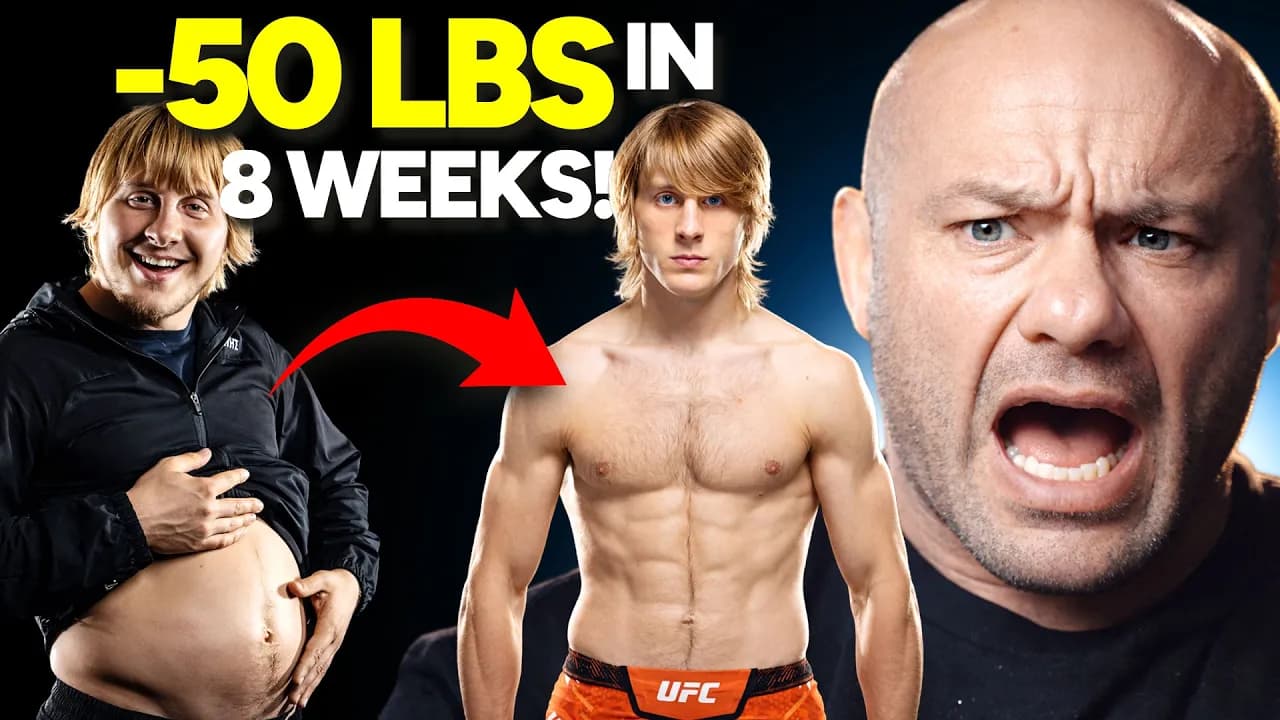
When fighting for the Cage Warriors featherweight title against Julian Rosa, Paddy was at a rave four weeks before the fight, drinking and eating crisps. He weighed 87 kilos and needed to be 65.8 kilos with only 25-26 days to make weight, cutting 21-22 kilos.
Paddy cut 8.4 kilos (17-18 pounds) overnight before the Rosa fight. He was on 1,500 calories a day and struggled through workouts. Under current judging criteria emphasizing control wrestling, he believes Rosa would have won that fight instead of him.
Paddy won the Rosa fight with takedowns in the first or second round after getting dropped, but gassed after round three. Under current criteria, Rosa would have won rounds four and five. Paddy has told Rosa he would have won under today's rules.
Most people thought Jared won that fight. It was close, and looking at the fighters' careers afterwards shows how one fight changes so much. There have been times in history where questionable decisions altered careers dramatically.
Taba and Khabib was another fight many thought Taba won, though the speaker rewatched it and felt the decision was rightful, though not by a large margin.
The Dominic Reyes and Jon Jones fight stands out as a major controversial decision. The speaker watched it multiple times and believes Dominic won. Dominic went on a four-fight losing streak after that loss, which literally altered his career trajectory. The speaker notes that Reyes is a very resilient fighter and recently had a brilliant finish against Makanov, who is described as a beast.
Reyes and Paul Costa would be a great fight at 205, described as a real scrap. Paul Costa is a beast at 205, and the speaker questions how he ever made 180 pounds. Yoel Romero is equally confusing in terms of weight cutting, as the speaker stood next to him weighing 200 pounds and wondered how Romero ever made 185.
Robert Whittaker said kicking Yoel Romero felt like hitting steel, and he was the only guy who ever hit someone with a calf kick and came out second best. The kick hurt Whittaker's leg. Romero was like a boogeyman and didn't start MMA until his late 30s, with his first MMA fight around age 35 or 36. He had a bare knuckle boxing match against his dad and won, though the speaker doesn't watch bare knuckle boxing enough to have an opinion.
At 50 years old, Romero remains shredded with amazing endurance, explosiveness, and movement, defying time and aging at half speed. Even if he returned to the UFC, he'd be a nightmare for 80% of the 185-pound roster. At 205, Romero remains dangerous, and when he fought Israel Adesanya, he realized Adesanya likes opponents to come after him to counter, so Romero stood a round away from winning that fight.
The speaker has concerns about Bo Nickal wrestling Rafael Fiziev at RAF 16. Nickal is one of the top contenders in the middleweight division, and there's a real possibility of blowing out a knee. The speaker wouldn't do any grappling or wrestling exhibitions because freak accidents happen, and they're an MMA fighter first and foremost. Cub Swanson did a grappling match and blew out his ACL.
Doing exhibitions gives away part of your game that you won't be able to surprise people with. The speaker is focused on being a UFC champion and won't do other things. These exhibitions are good for publicity for fighters like Arman Tsarukyan, who needs the publicity because he's not well-liked.
The speaker finds Arman Tsarukyan's situation very odd - he's a child of a rich man who grew up wealthy, doesn't need to fight, yet remains world-class. However, the speaker didn't think Tsarukyan looked good in his recent fight despite the first-round knockout. Huie tightened up his takedowns training with Volk, and Tsarukyan has gotten much better since working with him.
The BSD fight exposed that Tsarukyan's grappling was at a level requiring incredible work to reach top guys. BSD absolutely mauled him on the ground, which wasn't competitive grappling exchanges. This exposure gives opponents a blueprint for how to beat him, especially elite grapplers who will look to replicate that dominance.
The question is how much better a 34 or 32-year-old can get at grappling when fighting world-class competition. Jon Jones taking Ciryl Gane down and submitting him in the first round raises questions about whether Gane can ever reach a point where Jones can't do that to him. If Jones decides to return for one more fight after potential Cro-Hook matchup, he'd get a world title fight, and Gane knows Jones took him down easily just a few years ago in 2023.
Jones got Gane down immediately, cinched him down with full control and got his neck. It was quite quick, though the speaker thought Gane tapped quickly because the front choke hurt badly. Jones is left-handed and gets that left arm on the chin, head cranking with all his leverage and length. Jones is weirdly strong from years of grappling.
The speaker was talking to a respected friend who thinks Josh Hook will win against Ciryl Gane. The speaker finds Gane one of the biggest puzzles in the heavyweight division. A Hook victory would be bad for the sport. Hook is described as a crazy wanker who plays crazy, and the speaker hates the acting and trying to be something you're not instead of being yourself.
Colby Covington does similar acting, but the difference is he remains himself. Behind the scenes, Covington is one of the nicest men, which contrasts with his on-camera persona. The UFC has an issue with guys who win but aren't exciting, and Covington was about to get cut before his fight against Damian Maia in Brazil. The speaker is against cutting fighters who win but are considered boring, citing Evloev who never finished anybody but still got a title fight and is very skillful to watch.
People used to call GSP boring, which the speaker finds insane given his fight IQ was off the charts. GSP didn't wrestle in high school or college yet became the best wrestler in the division, which other wrestlers hate because they want to claim division one credentials. GSP would just double-leg people for fun.
GSP is super friendly and would never be guessed as one of the baddest cage fighters. The speaker met him at a cage in Manchester and found him polite, quiet, and respectful. GSP had a switch where he'd get locked in and focused inside the cage. He had a great team with Firas Zahabi and John Danaher, who would pay sparring partners more money to try to knock him out to prepare him for chaotic situations.
Big gyms offer unlimited sparring partners and different styles, but lack team cohesion. The speaker wouldn't fight any teammates like George Danis, Luke Riley, or Adam Cullen. The perfect scenario would be winning the lightweight belt, defending it, then vacating for George to fight for it while moving up to welterweight. The speaker spends more time with training partners than their actual brother.
Rashad Evans and Jon Jones trained together as friends, but when Jones stepped in for Rashad to fight Shogun and won the title, it became a giant issue because Rashad thought they would never fight each other. No one in the speaker's gym would ever fight someone else from the gym.
Training partners know each other inside out from hours of training together. The speaker has trained at the same gym since age 15 with the same head coach Paul Reed and coach Ella Samson, never having different coaches. Conor McGregor had a wise statement about reserving judgment on who a man is until rolling with him, because there's no bullshit in rolling.
Khabib's gym has a dominant force of discipline from the head guy who forces this ethic throughout the gym. It's not a coincidence that so many elite guys come from that gym, and they don't fight each other either.
The UFC signed Usman Nurmagomedov, who the speaker considers world championship caliber. This adds another lightweight contender alongside the speaker, Arman, and Charles Oliveira, who looked good against Max Holloway.
Charles Oliveira shut down Max Holloway in a way the speaker didn't see coming. Diego Lopes is an animal with an iron chin that looks like you could hit him with a bat. The speaker thinks Oliveira will probably do the same thing to Lopes that he did to Holloway.
Diego is really good on the ground. He almost submitted a couple of times. Scrambling is great, like he scrambles positions. Scrambling, conditioning, and strength are factors. He's also a very big 145 who really belonged in 155. Charles Oliveira will be bigger than him though.
Charles started at 145 as well. Against Max Holloway, Charles would get into the clinch and Max looked in trouble. Charles just raged on him and Max couldn't do anything. No one's ever done that to Max before.
Max is ranked fourth. At this time in his career, he might want to fight Conor McGregor because it's a money fight. Max probably only has a few fights left in him.
Conor did a bare knuckle fight thing in Glasgow. He was hammered at the press conference, talking crazy. He was cracking open a Guinness or his own forge style stout. He wasn't drinking Guinness though, he was drinking his own.
"Unless you're a world caliber fighter. You've got one more fight." Conor mentioned his eyes and questioned who would fight him. He said it has to be Holloway. He referenced doing the thing again and the guy didn't engage once, calling for the stoppage of the fight. He imagined saying yes and jumping the fence, claiming he won. Conor said he has done it on one leg and the opponent wasn't coming near him. He found it shocking and heartbreaking and is still dealing with it. He wants to fight Holloway in November, three months away, and is over surgery. He's done this injury before and returned within nine months, so nine months would be pre-summer.
"Now might be a jackass. Someone might something might happen. I don't know. But a fighter that fights me, put some respect on my name. If you're not a world champion fighter, if you've not got world accolades to your name, don't even utter my name. Cuz if you're a national champion, if you're a regional champion, if you've done up, got a few likes, go yourself. Don't mention my name unless you're a world caliber fighter."
In his prime, particularly the Eddie Alvarez fight when he was in the Matrix, it was one of the greatest performances. He would have beat anyone that night. He was on fire. Many factors led to his slide, with the big one being the fight with Floyd Mayweather. He shouldn't have done that fight. The $100 million was a lot of money, but it was hard to get out of bed when wearing silk pajamas, though Floyd did it.
Floyd had debt to pay and blows all his money, then runs out and needs to fight again. They're talking about him fighting Brian Garcia, which is crazy. He's 50 years old. If he could somehow be competitive with Ryan Garcia, that would be something.
Manny Pacquiao is still fighting. He was in Congress or something big, a senator. He's still boxing and playing pool every day. He plays pool and chess at the same time. He has a pool hall in his compound filled with people. He plays professional level pool and gambles on chess and pool. While his opponent's playing, he moves the chessboard and people come over for autographs on boxing gloves and pool cues.
Chess is a tough game with a long learning curve. If you're a competitive person, you'll get lost in chess and start taking lessons and reading books, dedicating three or four hours every day to it. Jiu-jitsu is like chess if you're drowning. There's way more ways you can move in jiu-jitsu. In chess, you get a chance to think about positions, but in jiu-jitsu, you go one way because they knew you were going to go that way, then you go another way and they knew that too, and then you have to escape but that's already blocked.
Jiu-jitsu is constantly evolving and changing. If someone's got a weird game and does something you haven't seen before, it can be infinite with always new moves. There's always a new answer to a position. The sport is never ending.
Due to MMA, rolling without strikes doesn't happen much anymore. When rolling, gloves are worn showing strikes, the big 8 oz ones. The problem is it limits certain things, but if just doing jiu-jitsu with no gloves on, people show moves but don't move. When you have a glove on and are punching someone in the face, they're going to move.
This relates to knees to the head of a grounded opponent - certain things aren't realistic. When people go for leg locks and someone's head is right there, in jiu-jitsu it's crazy because that would be a knockout in reality.
If someone tries to heel hook in a fight, the response would be to punch them in the face repeatedly rather than tap. Ian Freeman against Frank Mir saw Freeman pound out Mir when he was going for the heel hook. That was the first UFC event in England. Ian Freeman's daughter is in the UFC now. She was on the Contender show and was Cage Warriors champion. She's the first ever father-daughter to be Cage Warriors champion. Frank Mir's daughter is fighting too, but she lost on the Contender Series.
Kennedy Freeman will be bigger than Frank Mir's daughter. Cage Warriors has had featherweight in the past, but there's no featherweight title. They have 115, 125, 135. The UFC doesn't have a featherweight champion anymore, though there aren't that many women at that weight.
Kayla Harrison's fight with Amanda Nunes this weekend - Kayla really shouldn't be fighting at 135. She's so big and strong and has to kill herself to get to 135. She barely made it for the last fight against Julianna Pena. She's only made it twice so far - her debut and the title fight. When you meet her in real life, she's a strong woman with bigger shoulders than some men. She's thick and has bigger arms. She was meant to fight Amanda in January when the other fighter fought Justin.
When Kayla steps into the cage, she weighs at least 155, possibly 165-170. The UFC DM'd asking who would win the fight, but the response was uncertainty. Amanda hasn't fought in quite a while, so there's concern about ring rust, but she's the greatest of all time and so experienced she might lock right in. It's been about 18 months since Kayla's last fight, plus the big neck surgery with a disc replaced.
On the standup, Amanda has such an advantage. In the Cyborg fight, Amanda knocked out Cyborg, who was a destroyer. Cyborg still hasn't been knocked out since - Amanda is the only person who's ever knocked her out. Amanda has hammers and is more than willing to slug it out. She wasn't scared of Cyborg.
Some people just have weird power. A friend's ex-girlfriend hit a punching machine harder than guys and could knock someone out with one punch. Even pound for pound, the hardest punch experienced was by a mate who's a boxer fighting for a world title next weekend - Brandon Day. He hit with a shot that made the head look at the wall and come back. He fights at 52 kilos.
Ferrari Hobby calls it the touch of death. Damen Penas is a middleweight guy who fought on the same card. Luke is like that too - harder than Gage when hitting with 4 oz gloves. It's because of his timing from fighting Thai since he was five or six years old, then boxing from 12 to 16. He's always done striking and his timing is everything - accurate and precise.
McGregor is mentioned in this context. Bone structure is a factor - certain things about how some people are built makes them hit harder. Gage mashed the face but didn't hit that hard and never hurt. The right hand after the eye poke and the ground and pound hit more than the actual shot. A lovely punch to the chest was thrown in that sequence.
In the UFC, no one has hit that hard. The best punch was in the debut when hit but not rocked - the head moved but a step back was taken and a shot was thrown. After that, not much was taken until the Jared fight. Underestimation happened going in thinking it would be an easy win without worrying. Jared came in with a great game plan and had a very good left hook, which was always gotten caught with before working on it.
Jared had fought a former teammate who won a decision, and that person used to get ripped in the gym, so the assumption was Jared wouldn't get near. MMA math doesn't work. Training was done right but the mindset was it would be easy. An ankle injury occurred a minute in but the easy win mindset continued. The ankle needed inner ligament reconstruction, outer ligament reconstruction, and something done to the LCL - three surgeries in one.
That's why there was a year out. There's a big naughty scar on the ankle like a Halloween scar with a line and dots on the outside. Walking properly wasn't possible for months with a big boot and crutches. Terrible depression followed because of watching television all day with frustrations with nowhere to go. Everyone thought Jared won and was hating.
Nothing could be done - couldn't do push-ups, couldn't train for three months. Pain pills like tramadol were taken. Ankles are tricky joints. Fighting Tony the next year at the same December event wasn't certain because of the ankle. They said they didn't know if fighting would be possible in 2023.
Rehabilitation took until July to start sparring again - six months from end of January, February. Marriage happened in May, getting the boot off a week before. Walking outside and throwing the boot in the bin was celebrated. Back to training started with just boxing and being careful with movements, not doing anything else, then gradually working everything in.
The first sparring session back was with Liam Giddens, a former Cage Warriors world champ now fighting in PFL. In the third round, gassing occurred after not sparring in six months while he walked forward punching. Paul was told they might have to pull him out because he was tired, but Paul said he wasn't going to be the one taking the brunt of that.
Rehabilitation was done on the knee but should have been more. In the past three years, growing up has happened, with having kids playing a big part. Even at 27 or 28, it was still like being 12 in the head. Being young without a regular job as a fighter allows being a wild person who's good at this wild thing and can kind of be a kid.
The discussion addresses eye pokes in MMA and how they should be officiated, beginning with the controversial fight between Tom and Silan where Silan made Tom vacate his belt. The handling of the incident drew criticism, particularly the notion that someone with fingers driven knuckle-deep into their eyeballs could continue fighting. The conversation emphasizes that eye pokes are terrible and should be treated as non-negotiable fouls, with a second eye poke resulting in disqualification.
The rules around eye pokes require that a warning given in the back serves as the only warning, and any subsequent eye poke should result in immediate disqualification. Extending hands toward someone's face is described as an obvious move that some fighters execute on purpose. While most eye pokes are accidental, there are fighters who deliberately target the eyes.
A specific incident involving Priscilla Kashwera and Jillian Murphy is examined where Kashwera stuck her thumb deep into Murphy's eye while being choked, then pushed her away. This is characterized as a straight disqualification and a blatant foul that could ruin someone's career. The incident happened twice during the fight. Chris Dion is mentioned as the referee who should have intervened. Murphy was already losing and getting strangled when the fouls occurred, and she had wound up tapping.
The long-term consequences of eye pokes are discussed, with Aspenol having had three or four surgeries following such incidents, raising questions about whether he will ever fight again. Eye pokes are considered worse than what Paul Daly did, who never fought in the UFC again after taking a swing after a fight that he missed.
The discussion covers how some fighters intentionally commit fouls like eye pokes and low blows. Derrick Lewis has admitted to intentionally hitting opponents in the nuts to catch a break when tired. The recommendation is for immediate one-point deductions for eye pokes since they could cause blindness, unlike low blows which fighters can recover from.
A visual examination of a fighter's mouthpiece occurs, with speculation about whether it's a chewed-up mouthpiece with a tab or something else entirely. The piece appears to fall when the fighter opens his mouth, suggesting it doesn't fit properly. The coaches should have addressed this issue.
Paddy Pimblett recounts his fight against Justin, describing how Justin poked him in the eye in the first round without receiving a deduction, then poked him again in the second round and dropped him, winning the round through ground and pound. In the replay, Justin claimed Paddy hit him in the eye, but nothing happened. In the fourth round, Justin kneed Paddy in the balls against the cage and continued hitting him without consequence. Everything that could have gone wrong did go wrong that night.
The fight outcome is described as destiny for Justin to beat Paddy at the White House. Paddy predicted Justin would beat Ilia when everyone else laughed at him, including during a conversation with DC at the Champions League final in Budapest. He believed Justin would "out dog" Ilia. The point is made that no man is unbeatable and that everyone is beatable.
The importance of not emptying the gas tank completely is emphasized, as fighters must be measured in their output. Paddy's Ferguson fight is referenced where after a year off due to injury, he put everything into the first round after dropping Ferguson, but Ferguson survived and began putting pressure on him in the third round. Paddy got the takedown and maintained control to win.
In the third round against Justin, Ilia showed visible fatigue with slower movement and inability to get out of the way. Justin had predicted this would happen, telling Ilia that after getting out of the second round, Ilia would realize Justin was still there despite promises to finish by round two. Ilia's skin doesn't get cut up easily, and he moves well with shots, taking them with movement and falling back with strikes.
Ilia is considered too small for 155 pounds and not a natural 155er. When compared to bigger 155-pound fighters like Paddy and Benoit Saint-Denis, Ilia appears significantly smaller. Hoofy towers over him. Ilia wears shoes with six-inch heels to press conferences, which is described as sad.
Fight scheduling discussions include potential returns around April, with interest in fighting in Miami again due to the great weather and people. Brooklyn in April at the Barclays Center is mentioned as another possibility, though Miami is preferred. Peter Luger Steakhouse in Brooklyn is recommended as a legendary establishment since the 1800s that serves perfectly cooked steaks with butter.
The importance of meat in meals is emphasized, with confusion about vegan diets in MMA. At minimum, competitors should eat eggs. Supernatural Logger beer is discussed, which has 89 calories, 4.4% alcohol, and contains B vitamins including B3, B5, B6, and B9, along with magnesium and potassium.
Canadian beers are noted for being heavy with some reaching 9% alcohol. Japanese beers can reach 14% alcohol, and business culture in Japan involves heavy drinking to assess character before conducting business deals.
Paddy maintains friendships with people he's known since nursery and primary school, with a close group of eight or nine friends he's known since ages five or six. His mother's house is a ten-minute walk from his current home.
Being recognized in public leads to frequent photo requests, but this is viewed positively as it indicates success. Most people who approach are nice, and those who don't like someone typically avoid them. No one has ever approached Paddy trying to start a fight since he became known.
Liverpool's small size means everyone knows everyone or knows someone who knows them, keeping people humble and preventing them from forgetting their roots. Anfield Stadium holds around 60,000 people normally, potentially 70,000 with floor seats added.
Bruce Springsteen and Elton John concerts at Anfield are mentioned, with Elton John seen three times in one summer including Chicago and Glastonbury. The stadium has covered stands, so umbrellas would only be needed for floor seats and front rows.
Real Madrid's Bernabeu Stadium is larger than Anfield and has a roof. The discussion includes a system for grass management with multiple layers that can be raised and traded out, featuring watering systems underneath.
A vision for MMA suggests fighting in giant fields without cages, using red lines to mark boundaries instead, allowing everyone to see everything clearly.
The conversation explores an innovative stadium concept with a piston system that lifts grass from underground storage. The system allows for a UFC event setup by moving the grass field to the side, revealing a solid floor underneath. The venue also features a roof, making it a unique location for combat sports events. The idea was described as unprecedented and requiring significant resources to execute.
The demands of traveling to UFC events became overwhelming, with approximately 23 to 24 weeks per year spent attending fights. This level of travel was described as unsustainable, particularly when the podcast had just started gaining momentum.
The discussion touches on the unique atmosphere that would develop at a large stadium event like Taylor Swift's concert, noting the synchronized menstrual cycles phenomenon among large groups of women. The conversation shifts to comparing the atmosphere on the field versus in the stands, with particular attention to the potential for Scousers (Liverpool fans) to dominate the Bernabeu in Spain.
The Irish fans' takeover of Las Vegas during Conor McGregor's fights was described as unprecedented. During the McGregor vs. Aldo fight at Mandalay Bay, Irish fans completely dominated the casino and surrounding areas. The corridor between the shark exhibit and reef area was filled with Irish chanting and singing. One particularly memorable moment involved an Irish fan climbing into an elevator with Joe Rogan and enthusiastically declaring him a legend while refusing to leave.
Scousers (people from Liverpool) are noted as being more culturally similar to Irish people than other English regions, due to their port's proximity to Ireland. This connection suggests that many Scousers likely have Irish ancestry, which explains the strong cultural affinity with Conor McGregor's personality and fighting style.
Joe Rogan, who started working for the UFC in 1997, stated he had never seen anything like McGregor's impact on the sport. McGregor changed the game by bringing mainstream attention to MMA, with casual fans who knew nothing about the sport asking about "this Irish guy." He is credited with elevating the sport's profile alongside other transformative figures like Ronda Rousey and Chuck Liddell.
The greatest weigh-in/press conference moment discussed was Khabib's interaction before fighting Conor McGregor. With a big smile, Khabib declared "I'm going to smash your boy" while saying "Alhamdulillah" repeatedly. Despite the Irish fans' negative reaction, Khabib maintained his composure and delivered on his promise. This moment was highlighted as legendary and characteristic of his disciplined approach.
The conversation distinguishes between two types of exceptional drive: Khabib's madness being rooted in discipline and determination, while McGregor's madness was described as being completely "off the rails" and wild. Both approaches led to exceptional performance in different ways.
Texas recently passed laws banning THC products, which was described as backwards compared to other states like California, Colorado, and New York where cannabis is legal. This legislation was noted as potentially costing Texas politically.
The discussion covers several upcoming fights, with particular focus on Ciryl Gane versus Alexander Volkov. Gane is described as having super technical striking and being one of the best athletes in the sport, with an 8.5-inch reach advantage (84" vs 75.5"). The conversation notes Gane's only losses came against Jon Jones and Francis Ngannou.
Johnny Walker should have competed at heavyweight his entire career rather than cutting weight to 205 pounds. At 6'6" and naturally larger, his athleticism at 265 pounds is expected to surprise many opponents. The extra weight should improve his durability and chin, as evidenced by his ability to absorb significant strikes from Waldo Cortes Acosta.
Gane's striking is described as technically superior with lethal combinations. He's noted for being very difficult to hit cleanly, though he was briefly hurt by Tai Tuivasa. His reach advantage and technical precision make him a unique challenge at heavyweight.
The possibility of Gane moving down to 205 pounds is discussed, with the consensus that he could easily cut 30 pounds given his current build. However, there's debate about whether being a lighter, faster heavyweight provides advantages until facing other athletic heavyweights like Cain Velasquez.
The Blaydes vs. Aspinall fight was described as one of the greatest heavyweight fights ever. The viewing experience was particularly notable as UK viewers often watch events the following morning to avoid spoilers, creating a unique tension when watching such high-level competition.
This matchup features a significant 5-inch height difference, with Prohaska being 6'6" as a middleweight with world-class kickboxing skills. Kara-France would need to close distance effectively to utilize grappling, while Prohaska benefits from Glover Teixeira's coaching approach of developing grappling skills to complement striking ability.
Prohaska's UFC debut against undefeated prospect Abdul Razak Alhassan was highlighted as a coming-out party. Despite Alhassan's reputation and training at Extreme Couture, Prohaska's superior striking and height advantage proved decisive. The fight demonstrated how a good MMA striker with wrestling background can dominate through technical striking efficiency.
The discussion addresses the fine line between toughness and being "too tough for your own good." Examples include fighters continuing despite significant damage like broken orbital bones, with references to Michael Bisping fighting 11 times in the UFC with vision in only one eye after memorizing eye charts.
A strong debate emerges about fight stoppages, with one fighter expressing the mentality of continuing "until every last breath" and refusing to have fights stopped. This gladiator-like approach is contrasted with the perspective of having loved ones potentially stop fights to prevent permanent damage.
The concept of modified UFC rules is explored, including 30-minute single-round fights with no stand-ups, knees to the head (when not against the cage), and soccer kicks allowed outside a designated red zone near the cage. Another suggestion involves starting each round in the same position where the previous round ended.
The value of high-volume takedown attempts is questioned, with the argument that attempting 25 takedowns indicates poor control rather than dominance. The preference is for fewer, more decisive takedowns with sustained control, as demonstrated by Islam Makhachev's approach against JDM.
Petr Yan is described as one of the best strikers in MMA with elite, phenomenal striking ability. He employs sneaky techniques like throwing left hooks behind left kicks and tends to take the first round to figure out opponents before adjusting his strategy.
The physical toll of fighting four times in one year is acknowledged as extremely demanding. The conversation covers recovery from minor injuries and the ideal timing for potential December fights, with camp planning extending into Thailand training sessions.
Detailed camp planning includes training in Thailand near Bang Tao with daily sessions, returning home by late January to begin intensive February-March preparation. The lighter body composition from Thailand training versus American training is noted as beneficial for making weight.
Paddy described how fight announcements frequently occur with short notice. Before the Chandler fight, he received notification before Christmas but didn't fight until April, with nothing announced by February. Chandler preferred May or June dates. Paddy pushed for the April 12th date specifically because his child's first birthday fell on the 17th, wanting to spend time with his kids afterward.
The fight against Gage was similarly uncertain due to the Ilia situation, with the fight announced during an NFL game in mid-November, giving only eight weeks of preparation. For the BSD fight, Paddy mentioned wanting to fight at International Fight Week during Luke's fight in London when Dana asked him directly. The fight was confirmed in April, providing about 10 weeks of notice.
Paddy trains every day regardless of fight status, even with a current injury. He maintains strength and conditioning twice weekly, training five mornings in the gym for two hours each session. His strength work includes squats, deadlifts, bench press, and plyometrics, with cardio added once weekly.
Paul Reed serves as Paddy's nutritionist and weight-cutting coach, managing all food preparation, calorie counting, and sodium levels. Reed works with the entire fight team and numerous boxers, establishing himself as the premier weight-cutting specialist in the UK through his scientific approach.
During the last camp, Reed identified that Paddy had gained 4-6 kilograms of muscle mass between the Gaethje fight and six weeks before the BSD fight, essentially performing an unintentional dirty bulk while maintaining daily training, creatine supplementation, and twice-weekly lifting. They adjusted the diet by reducing protein and increasing carbohydrates to shed the excess muscle weight.
Despite the muscle loss, Paddy reported feeling stronger during the buildup and believed he was in the best shape of his career. Three weeks before the fight, he weighed approximately 84 kilograms (185 pounds), about 30 pounds over the weight limit, but the systematic approach worked effectively.
Paddy emphasized that Reed's methods are entirely research-based rather than intuitive. Every adjustment has scientific backing, contrasting with previous approaches that lacked systematic methodology.
During a conversation in Philadelphia, Paddy described an amusing situation where his friend Allen, a former Eagles player weighing 265 pounds who had never attended a UFC event, sat next to Ian Garry (ranked #2 welterweight) without recognizing him. They spent significant time discussing the fight before Allen learned Garry's identity.
Paddy praised Sean Brady as one of the coolest and funniest people he's met, noting Brady's visits to their Manchester gym. During a gym night out at Jenny's bar in Liverpool, Brady joined them despite Paddy drinking only water. They later took Brady on an Anfield tour, where a video shows Paddy lighting a cigarette for him.
Paddy highlighted Procházka's devastating knee to the body technique, which he sets up by measuring opponents with low kicks and punches before stepping in with the knee. This technique was notably effective against former champion JDM. Procházka's approach includes throwing off-speed punches and kicks while constantly reading opponents.
Procházka lived in Thailand for 5-6 years, accumulating over 100 fights during that period, fighting weekly as his primary income source. This constant competition developed his exceptional comfort and relaxation in the cage.
Shavkat Rakhmonov has been out nearly two years with a knee injury from an oblique kick by Ian Garry. The discussion covered whether such kicks should be banned, with Paddy arguing against prohibition, comparing them to other fight risks. However, concerns were raised about career-ending potential, referencing Thiago Santos' fight against Jon Jones and Khalil Rountree's injury against Modestas Bukauskas.
The 12-6 elbow ban was attributed to commission members witnessing karate practitioners breaking bricks, leading to the perception that such strikes were too dangerous. Paddy noted Jon Jones would likely be undefeated without this rule, though he acknowledged the Dominic Reyes fight as potentially going to Reyes in the first three rounds.
Paddy identified the Shogun vs. Machida decision as potentially the worst he's witnessed live, noting Shogun's dominant performance. The rematch saw Shogun return angry and perform better.
Paddy's early MMA influences included Big Nog from Pride, particularly his fight against Bob Sapp where he absorbed two headbutts and secured an armbar victory. Rampage Jackson was another favorite. His introduction to MMA came at age 14 watching Diego Sanchez vs. Clay Guida at a youth club.
The Mark Coleman vs. Clay Guida fight was discussed, noting the 50-pound weight difference with Coleman as a former UFC heavyweight champion fighting an 185-pound Guida. The arm break and Coleman's post-fight reaction were highlighted.
Paddy's first live main event was Vitor Belfort vs. Rich Franklin at UFC 103, after which he joined a gym two weeks later.
The conversation concluded with acknowledgment of Paddy's accomplishments and future potential, with anticipation for potential April fights depending on lightweight division developments.
Keep PowerfulJRE in your library
Save the videos and channels worth coming back to, and find them again in one place.