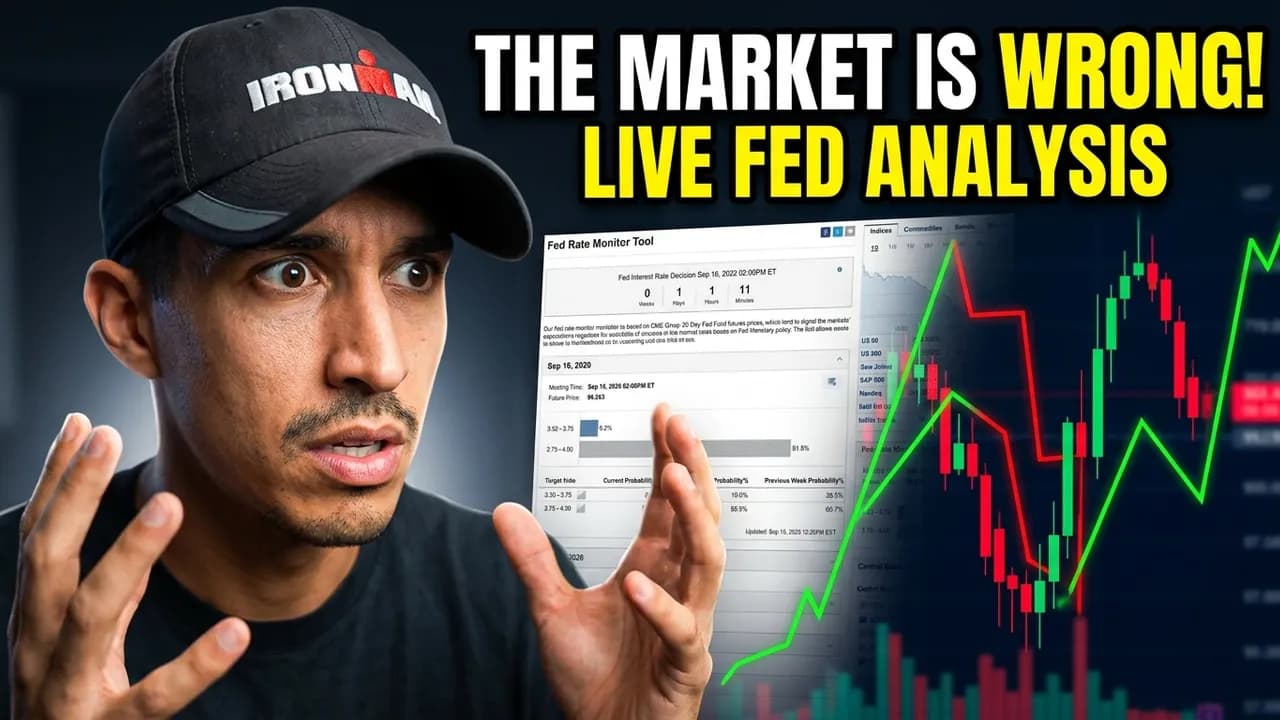
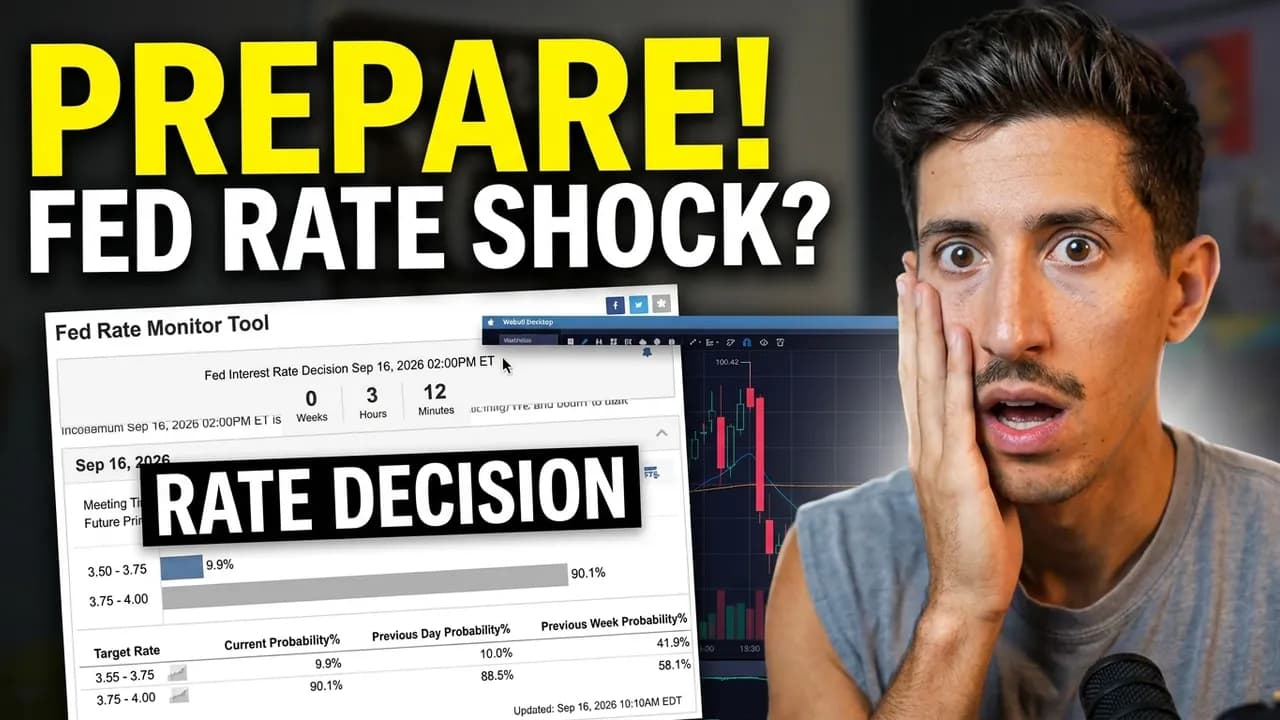
LIVE NOW: FOMC RATE DECISION & PRESS CONFERENCE 2026
In a Nutshell
The trader closed positions for $14k+ profit (MSTR short $9k+, Dell $2.6k, INTC $480) and avoided pre-FOMC trades due to unpredictability. The Fed hiked rates 25bps to 4%, but markets barely reacted and remained up 0.72% as the decision was largely priced in. Core strategy emphasizes maintaining stable income before trading, using small position sizes to manage risk, and focusing on price action over fundamentals when trading momentum names like CoreWeave and NanoNuclear despite questionable business models.
These notes were generated by AI and may contain inaccuracies.
The presenter has all positions fully closed and is waiting for the market to react rather than attempting to predict outcomes before the rate decision. The focus is on observing market behavior after the rate decision and press conference rather than taking trades beforehand.
Positions closed for the day include:
- Dell Technologies: $2,600 profit
- Intel (INTC): $480 profit from a small position
- MicroStrategy (MSTR): $9,000+ profit from yesterday's short, plus $2,400 profit today
The presenter explains the decision to avoid trades before the FOMC report:
- Cannot predict the future
- High probability exists that the Federal Reserve will raise rates
- However, markets are considered among the most irrational ever seen
- President Trump's tendency to tweet and manipulate markets adds uncertainty
- Multiple red flags exist including inflation, bond market concerns, oil concerns, Iran concerns, housing concerns, and labor market concerns
- Markets are trading near all-time highs despite these concerns
The presenter maintains:
- A rate hike would be welcomed to see markets drop
- Ready to short if needed
- Also prepared to buy dips on quality companies
- Acknowledges markets are historically more bullish than bearish
Key advice for new traders:
- Stability is essential; had a stable job until age 20-21
- Do not depend on trading income to stay afloat, as this leads to irrational decisions
- Trading has a learning curve and takes time to master
- Best approach: maintain a normal job with expenses covered, then learn trading on the side
- Test the market with small dollar amounts to determine if trading is suitable
- Large positions without experience can lead to quick discouragement
- Learn Plan Profit (LPP) team members can watch live trading sessions
- Link provided in video description for joining
- Flash sale on Investing Pro software: 55% off for 22 hours, bringing cost to less than $9/month
- NASDAQ up 0.7% pre-decision
- Economic calendar shows rate decision expected at 25 basis points hike or below
- 30-minute gap between rate decision and press conference
DJT (Trump's media company) analyzed:
- Strong descending pattern with lower highs and lower lows
- 12% downside according to Investing Pro
- Loses $1 billion annually with negative PE ratio
- Fundamentally terrible business but can thrive in irrational markets
- High-risk, high-reward momentum play
- Federal Reserve raised interest rates by 25 basis points (4% rate)
- Initial reaction shows markets dropping
- Coinbase, crypto-related stocks, and HUD showing significant declines
- Dell Technologies holding relatively well
- Marvel, SanDisk, and MU showing pullbacks
- Tesla relatively unaffected
- Kevin Warsh noted for not bending to Trump pressure
- Markets largely priced in the rate hike
- Bitcoin showing minimal movement
- Markets up 0.72% on the day despite the hike
- Irrational times supporting irrational valuations
- Position size should match risk tolerance
- Large positions create excessive stress when trades go against you
- Small positions allow for clearer thinking and less emotional pressure
- $12,000 short position taken in MSTR as a light position relative to normal trading size
- Initiated 100-share short at $12,000 position size
- Added 100 more shares to the short
- Later trimmed 100 shares while remaining profitable
- Position kept small due to uncertainty around press conference volatility
- Price action prioritized over indicators
- MACD not heavily relied upon
- RSI considered acceptable as reference
- Support and resistance levels identified on NASDAQ
- Overbought reversal pattern noted but considered risky before press conference
- Negative commenter banned from chat
- Emphasizes focus on personal trading approach rather than pleasing everyone
- Acknowledges being human and not perfect
- Values audience engagement with thousands watching live
- Current support and resistance levels identified
- Middle ground between levels creates uncertainty
- Both buying dips and shorting carry risk in current range
- 15 minutes remaining until FOMC press conference
- Oil declining rather than pushing higher
- Gold (GLD) also down
- CoreWeave analysis: 19% upside per Investing Pro but negative PE ratio, losing billions annually
- Speculative nature of CoreWeave noted but pattern analysis emphasized over fundamental criticism
CoreWeave has shown resilience during sell-offs, consistently attempting to recover. The stock is approaching an oversold support range based on previous and recent lows. Using the Webull platform's risk-reward calculator, a potential upside of 3% with a three-to-one ratio was identified. A trade setup was calculated with an entry at $86 and exit at $104, yielding a 2.25-to-1 risk-reward ratio. For 100 shares at $8,600, potential profit could reach $1,800. The analysis emphasizes that a stock can perform well on good price momentum and story even if fundamentals are questionable. The speaker concludes CoreWeave is oversold enough that shorting presents greater risk than buying.
Robinhood stock began dropping following the FOMC rate decision announcement. The analyst notes that crypto-related assets like Robinhood do not thrive when rates are higher. A fair value assessment showed 34% downside potential at $68 per share, while the stock traded at $104 with a PE ratio of 45 times earnings. Revenue growth has occurred, but net income has not progressed. Historical analysis shows Robinhood revenue declined during post-pandemic market downturns. The stock is viewed as overbought with 18-30% pullback potential, particularly vulnerable if Bitcoin and markets decline due to its speculative nature.
NanoNuclear Energy experienced a recent downturn with 20% upside based on fair value. The company shows a negative P/E ratio, indicating ongoing losses, and remains a pre-revenue company. Its core reactor business has no expected first power until 2030, with worsening EPS forecasts. The stock previously reached highs of $60 per share, representing over a billion-dollar valuation at that point. The analysis characterizes it as a momentum play with a compelling story but lacking fundamental support. The speaker notes that similar nuclear energy companies like Oklo faded after initial runs. The conclusion is that NNE represents a sell rather than a buy opportunity.
The NASDAQ market tested lows following the rate decision announcement, with MSTR also testing its lows on the oversold side. The speaker closed an MSTR short position. Market consolidation was observed with volatility present but no new daily highs or lows established. The focus during Kevin Warsh's press conference centered on whether the Fed is open to additional rate hikes or if this represents a one-and-done decision.
The FOMC raised the federal funds rate target range by 25 basis points to 3.75-4.00%. The committee maintains its policy of ample reserves in the banking system. Economic activity is expanding solidly despite elevated uncertainty from geopolitical developments. Domestic spending remains resilient with strong productivity growth and robust capital investment. Job gains have kept pace with workforce growth, unemployment rate stable at approximately 4.1%. Inflation remains elevated, with the decision aimed at supporting a timelier return to the 2% goal.
New hiring, private sector earnings, and business capital investment have all improved in recent months. Credit flows remain robust, particularly for businesses. Financial conditions are not considered restrictive. The labor market shows a 4.1% jobless rate with increasing job openings and weekly hours. Unemployment claims on a four-week moving average align with full employment levels. Inflation has exceeded target for over five years, with 12-month PCE prices around 3.6%, core PCE at 3.2%, and CPI at 2.4%.
The committee determined that the standard for action—confidence that underlying inflation is moving clearly and at sufficient speed toward the 2% objective—has not been satisfied. The unanimous vote reflects resolve to achieve price stability. The decision removes accommodation to ensure credit and financial conditions align with mandate objectives. Median projections show real GDP rising 2.3% this year and 2.4% next year, with total PCE inflation at 3.7% declining to 2.3% next year. The unemployment rate is expected to hold at 4.1%, with the appropriate federal funds rate at 4.1% through year-end and next year.
When asked about rate hike effectiveness given supply-side energy constraints, Warsh emphasized that while individual prices cannot be controlled, the Fed can prevent relative price changes from broadening into second and third-order effects. Regarding sequence of hikes, Warsh stated the decision was based on observed data rather than forward guidance. The Fed assessed that the economy has strengthened, inflation trends have not meaningfully improved, and geopolitical risks have increased since the July meeting. The decision was characterized as market-assessed rather than market-led, with financial conditions not viewed as restrictive following the rate increase.
Chairman Warsh stated he does not like data dependence. Victoria Guido from Politico asked about the intense market focus on August CPI data heading into the meeting. Warsh responded that he was not waiting breathlessly on any particular data point, whether retail sales or CPI prints. He reiterated that trends matter and data points are noisy. Data point dependence is a dangerous preoccupation. Markets over time will understand how this Fed makes decisions and what is relevant.
Zach Kalashak from The Washington Examiner referenced a presidential message threatening to cut off trade unless rates were lowered, noting the unanimous decision went the opposite direction. He asked about investor concerns regarding Fed independence and when Warsh last spoke with the president. Warsh declined to comment on discussions with the president. He stated he is not a Wall Street newsletter. Part of the Federal Reserve's independence is staying in its lane. Independence is a two-way street, and the Fed will let people doing trade policy and fiscal policy stay in their lanes as well.
Brian Chung from NBC News asked who the least well-off are and what rate hikes do to those pinched by higher mortgage rates, gas, and grocery prices. Warsh explained that in macroeconomics, aggregates are the focus - aggregate GDP, labor market trends, and inflation. A lot of people in Washington focus on distributional consequences. The least well-off tend to be people who don't own financial assets - a bit less than 50% of the country. They don't have equity in their home or 401k plans and live off their bi-weekly paycheck. The Fed can ask if the country is running at full employment, which it is. If so, the focus shifts to the other side of the mandate: stable prices. An environment where inflation runs consistent with the 2% objective offers good news because wages can deliver real take-home pay increases. Inflation is a choice, and the Fed took a step in delivering it.
Miriam Lemaitre from Agence France-Presse asked if Warsh is looking at other central banks and the ECB's move of hiking twice this year but not consecutively. Warsh said he won't prejudge decisions other central banks make. He has spent time with foreign central bank counterparts at Jackson Hole, the G20 meeting in North Carolina, and a central bank meeting in Basel. Most advanced economies are suffering from price pressures and making choices consistent with their remits. When the Fed makes a policy choice, it matters to the U.S. economy and spills over globally. When foreign central banks raise rates to address higher prices, they're helping quash inflation in their countries, creating spillovers and spillbacks in both directions.
Nick Timorous from The Wall Street Journal referenced Warsh's concern last fall that the Fed was about to make its sixth or seventh big mistake by deciding the economy was too strong to justify lower rates. Now rates were raised. Warsh explained his suspicion 110 or 120 days ago when he arrived was that the U.S. economy was strengthening. Data now shows the economy has strengthened. Underlying growth is higher. Inflation has been the problem for more than five and a half years. The committee took action to ensure a timelier return to the price stability objective. Price stability is foundational to economic growth.
Neil Irwin asked what bond market yields rising over recent months, especially weeks, tell about growth outlook, neutral rate, and monetary policy implications. Warsh said he lets bond market prices tell any story they wish and tries to interrogate that. He gave three reasons for yield rises since the last FOMC meeting: spot prices of energy, spot prices for corn, soybeans, or wheat, and the difference between those spot prices and crack spreads affecting products in stores. These are the leading explanations but not an exclusive list.
Michael McKee from Bloomberg asked how Warsh squares his Jackson Hole statement about wanting inflation to come down clearly and at sufficient speed with the SEP median pushing 2% target achievement to 2029, another two years. Warsh said those aren't his forecasts - they're forecasts of his 18 colleagues. His business is not giving forward guidance. His commitment in June was to reaffirm delivery of price stability. In July, he said they wanted to buy time and evaluate. In Jackson Hole in August, he said they were committed to a discipline, not a decision. Today's action shows seriousness about delivering on the price stability objective on a timelier basis.
Matt Egan from CNN asked about Warsh's past statements on AI positives and concerns about warnings from AI leaders about losing control and real-world damage impacting the economy. Warsh has spent time thinking about AI and talking about it publicly. Fed independence is about staying in their lane. They care about AI implications on demand and supply sides of the economy. Decisions about risks, rewards, challenges, and opportunities are made by other parts of government. The implications have bearing on the Fed's day job.
Jennifer Schoenberger from Yahoo Finance noted inflation has run up mostly from higher energy prices and tariffs, which some say are supply shocks rate hikes cannot fix and could fade if inflation expectations stay anchored. She asked if rate hikes need to push growth below potential and weaken the job market to bring inflation down, given AI driving the economy. Warsh believes the unemployment rate runs consistent with full employment. He doesn't believe harm to labor markets is needed to achieve the objective. The two parts of the mandate - price stability and full employment - are not working at cross-purposes over the medium term. Ensuring continuous, sustainable, durable economic growth is the business they're in. Price stability enables sustainable, durable economic growth to continue longer, making the economy stronger and allowing the least well-off to benefit.
The host announced starting a $1,000 cash giveaway to Webull trading accounts. This incentivizes users, not just the host for making videos. Details are not fully laid out yet. The giveaway starts next week. Only people who join Webull through the fourth link in the video description can receive the $1,000 weekly prize, randomly selected live. The winner will be someone implementing healthy habits. One week focuses on best risk management. Another week focuses on largest percent gain. Different focuses for each week. The giveaway starts with percent gain for the week to keep it simple, then adapts based on feedback.
Qualified Webull accounts need an initial deposit of $100 to earn 12 free shares. The host will talk to Webull about existing account holders. If users already have accounts, qualified deposits may qualify. The $1,000 giveaway starts next week. If LPP members win the free LPP lesson library, they get refunded what they paid. The host wants to encourage proper trading: not overtrading, being selective, focusing on proper risk-to-reward ratios, and reviewing trades daily. The $1,000 incentive motivates healthy habits. The host shares his affiliate link and is transparent about it. Webull's win is signups and platform usage. The host will provide more details on Instagram and YouTube. The fourth link in the description must be used for tracking.
The host had a lot of fun trading. Markets sold off due to the rate hike. The host was surprised rates were actually hiked. Biggest takeaways from Kevin Warsh's comments will be discussed in a later video. The host shorted MSTR a few times and still has an open position up $6,300 on the day. Bought the dip when oversold, sold a portion as it ripped back up. Kept the LPP team updated during the FOMC press conference. Also traded INTC for $480 and Dell Technologies for $2,600. Not a perfect trader and doesn't pretend to be. Can't catch the full move. The job is to get in, get out, make money, and leave. Markets are volatile, so don't overstress. Markets are irrational and always look to recover, more bullish than bearish. Shorting comes with greater risk; don't carry shorts too long. The host is shorting and made $5,800 from shorting. Shorting is fine but approach with caution near support levels like 700 on QQQ. If it breaks support, there could be another leg down. Markets went red during the stream. The host is happy to see markets sell off due to the rate hike.
LPP costs $2.99 off the $6 deal at checkout, breaking down to $1.10 per day on a yearly basis - less than a coffee. It's lifetime access, not a yearly subscription. The host advises watching the first section of the LPP lesson library before signing up to see what to expect. It explains how to access Discord and daily live sessions. Sign in after signup and watch the get connected section. LPP members get lifetime access to the lesson library and all updates. The host does not send friend requests, never messages first, and never asks to trade for anyone. LPP is the only service offered. No crypto, options, or futures trading. Beware of fake accounts pretending to be the host. Ban and report fake accounts. The host works with one team only - the LPP team. Investing Pro is a fundamental tool mentioned - a monthly subscription breaking down to $8.95 per month with 55% off flash sale and 20 hours remaining. First link in the description.
Keep Ricky Gutierrez in your library
Save the videos and channels worth coming back to, and find them again in one place.