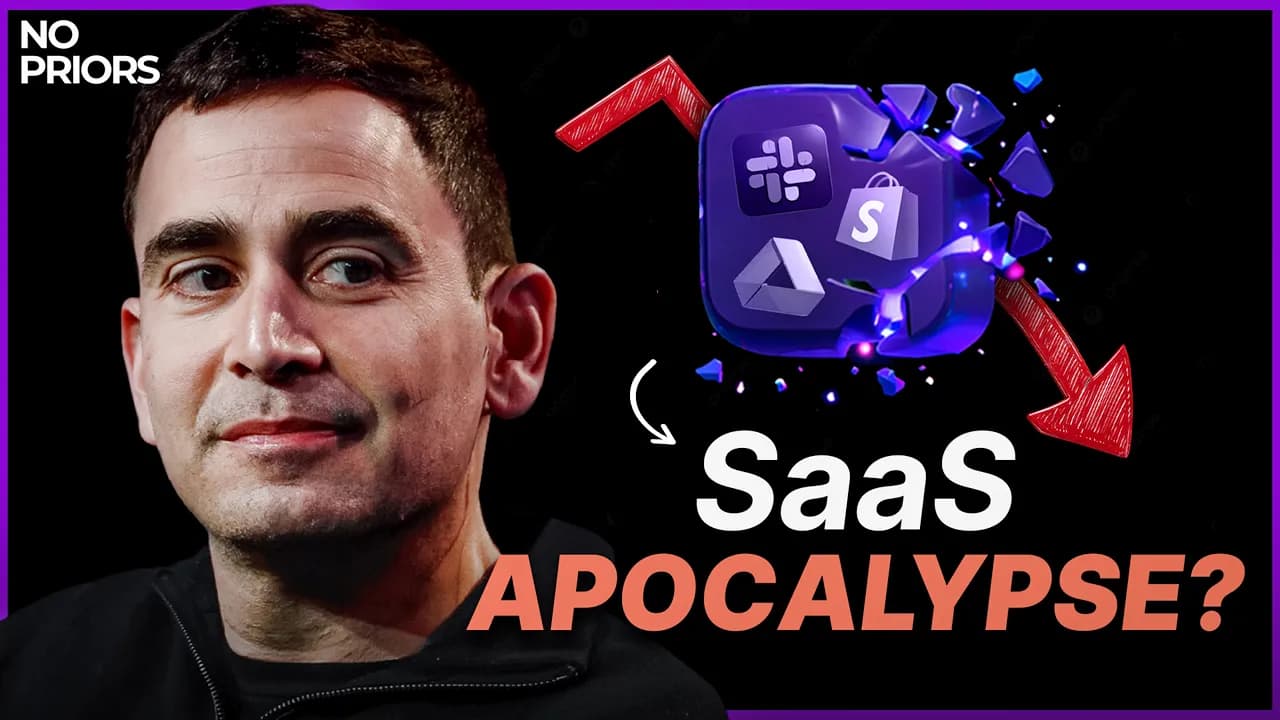
No Priors Live: Is the SaaS "Bear Thesis" Overblown? MongoDB CEO Answers
In a Nutshell
MongoDB CEO CJ Desai argues the SaaS "bear thesis"—fearing AI-generated code erodes software value—is overblown, as platforms like MongoDB achieve rare stickiness through multi-product ecosystems, deep integrations (e.g., 300 critical bank apps), and durable TAM in mission-critical sectors like banking and healthcare. Platforms outlast products by enabling AI-driven innovation and reacceleration, as seen in ServiceNow's durability and MongoDB's cloud/AI transitions, while incumbents must lean into transitions to counter disruption risks. Customer intimacy, speed during tech shifts (AI, cloud), and proving growth via core business plus AI-natives will validate software's future.
These notes were generated by AI and may contain inaccuracies.
Since 2022, the future of software is in question from the investor community and customers. It is a pivotal moment on the software stack. What is the one thing that will always be there? How many companies today have more than $10 billion in pure play software revenue? Single digits. The software industry has been around for a long time, created by many smart people. Why only single-digit companies over $10 billion? Platforms are rare. Speed matters. During technology transitions like the internet age, AI age, or mobile, are you building as fast as you can and learning on that shift? If you fall behind, investors or customers will ask what is the future of your company?
Welcome to the first live recording of the No Priors podcast with host Sarah Guo and MongoDB president and CEO CJ Desai. Great day of announcements at the conference. Excited to zoom out on the future of software, what's happening in SaaS, and where the value is going. Important questions for a venture investor. CJ has worked at platform enterprise software and infrastructure companies and recently became CEO of MongoDB. Every investor asks: what is the value of software when you can generate a bunch of software?
Spicy question. Technology transitions from mainframe to internet age to AI. SaaS applications created late '90s; Salesforce had 25-year anniversary recently, so SaaS around 25 years. Now with AI, what is the future of software, the stack, and moats? Some say moat is great customer relationships or channel. Speed matters. During transitions like Meta's pivot to mobile in early 2010s, pivot fast to leverage the technology. Stay ahead of the game or investors/customers question the future. Extreme terminal value being zero for some software is overblown.
Part of career leading product at ServiceNow, one of the most durable enterprise software companies until recently questioned. For engineering mindset on developer tools/infrastructure, customer stickiness or distribution feels abstract. Platforms are sticky, products are not. Products can be replaced. Hiring manager at ServiceNow Frank Slootman said: > "Tools are for fools."
Position as a platform increases sales cycle vs replacing a tool. Platforms sticky because thoughtful customer decision. Need initial killer use case as wedge (e.g., ServiceNow service desk). Entry easy if disruptive, but exit also easy without things built around it. Gets harder from $100M to $1B, $1B to $5B, $10B+. Single-digit companies over $10B pure play software revenue because platforms are rare.
Aspire to become a platform: n=2+ products used in unison, sticky technologically. Plus integrations with customer's existing systems (e.g., banks, insurance, healthcare 100+ years old; Fortune 10/100/500 TAM). Specific example with bank: run commercial banking apps on MongoDB, built integrations, security, governance. CTO in London: 300 critical applications on MongoDB out of 9,000 total. > "CJ, don't worry. Thank you for coming to London. We are not going anywhere."
More they use, more sticky, in the fabric of infrastructure.
Premise: 9,000 apps could be made on-demand with vibe coding/engineering/code generation, niche by every company, no horizontal/vertical apps. Banks have huge tech budgets. Vibe coding increases app velocity, but still need go-to-market channel, disruptive way. Banks talk to regulators more than vendors: will it pass regulatory tests, resiliency (multi-cloud, on-prem air-gapped)? Wipe coding creates app fast with disruption, but go-to-market hurdles: governance, security audits for enterprise TAM (healthcare, public sector).
Having worked at ServiceNow, Cloudflare: TAM for platforms still large. Understand, protect, strengthen moat with AI. If platform integrated with 50 systems in large healthcare, integrate with 100 more, create products fast using AI, show reacceleration of growth. Innovate more, disrupt within, sell more. Investors look for AI reaccelerating growth; otherwise neutral or bear.
Big shift of dollars from business software to AI infrastructure, model layer, hyperscalers. Data/developer infrastructure not focus of dollar movement. How thought about long-term relevant sectors, committed to platforms. Choices including staying at Cloudflare. First: durable TAM. Started career at Oracle, saw database platform scale, organic growth before acquisitions. Cloudflare to MongoDB: large database market TAM.
Diligence: mission-critical apps (e-commerce, commercial banking, healthcare, insurance claims). Oracle 50th anniversary soon (50 years); MongoDB created 2007 (18 years), disruptive force, only one past $1B/$2B. Digital natives 2010-15, AI natives building on MongoDB accidentally for unstructured data, high velocity, search (perfect for messy AI data). Cloud transition ongoing (Fortune 500 moving to AWS/GCP/Azure); AI transition just started (cloud ~20 years still going). TAM must-have layer, no disruption risk. Previous CEO Dave: many attempts at next disruptive database, none past $1B/$2B, something special.
Investor focus on model vs application layer; anxiety on SaaS apps, data infrastructure (app building evolving), AI natives (value to models). Anxious environment. Bear thesis dominant since 2022/ChatGPT. Pivotal moment, future of software questioned by investors/customers.
Software stack constants: LLMs for foreseeable future in AI apps/agentic frameworks; data layer to store data. Everything else evolves, show true value. Top layer: use case focus (e.g., insurance AI native faster speed-to-value than old SaaS, new possibilities with AI).
Speaks to 10+ customers/week (Fortune 500, Global 2000). Not moving fast. Tried office productivity copilots: unclear value (Excel, PowerPoint natural language). Coding assistance breakthrough 2024 (GitHub Copilot, Anthropic+): positive on innovation, velocity, security. Tinkering customer support: not ready for end-to-end in telco/healthcare. AI natives going after initial use cases.
Customers ask: new AI native customer support an "and" or "or" to systems of record (e.g., Salesforce)? > "Are you a layer on top or can you replace the whole?"
Attention if: replace it, cheaper, faster, better, disrupted pricing for value. Risk-taking, openness ignoring sunk costs. Feasible: CIO Deepa approached daily by AI natives; if hires fewer/makes efficient, use budget to be AI-first, transform business.
Conventional wisdom: wedge/layer on systems of record. Instead: sell platform if use case good. Opportunity for MongoDB: replace systems of record to keep richer interaction info, messy data needs something like MongoDB, might not be Oracle anymore.
European retailer at NRF in New York tried systems of record for ERP, had expensive failed implementations, lots of issues on supply chain to financials, decided to build it themselves on MongoDB. Great use case. Asked their CIO Deepa the same question: are there things we can build ourselves to disrupt within on MongoDB? Compelling value to articulate to customers.
Shift to leadership, especially as a product person. Speaker known first as extraordinary product person, talks a lot about business strategy over decade known. When did start thinking about that as product and engineering person? Talking about defensibility, how people buy—not typical for product-focused role.
Early 2005ish, CEO John Thompson at Symantec taught high bar on interacting with customers, selling, serving, showing up. As director of product management, made huge impression. His bar higher: when speaking to customers, not only ask how to serve better, but ask what other problems, pain points they have—fly there, meet, have coffee, truly understand to see around the corner.
You cannot be a great product and engineering person unless you speak to customers all the time. That allows pattern matching and seeing around the corner.
Example: Met retailer CTO at NRF in New York, uses MongoDB for ecom (20% revenue), happy. Mentioned not using search or vector search, following up. Customer intimacy makes better product person. "If you build it, they will come" does not happen.
Understand how they deploy product, time to deploy, value expected. Never say "large bank bought ServiceNow or Cloudflare," say "Jeremy at large bank bet on Cloudflare." Informed sales teams, pricing, showing up in crisis (outages)—grounded in go-to-market, channel, business strategy.
Step function jumps: single product to multiple products (or platform to multi-product), technology transitions like Atlas dominance, cloud transition, now AI transition. What differentiates product/engineering orgs that succeed vs fail?
Get comfortable doing something well, but leaning in required. Early on ServiceNow AI, engineering skeptical; said no, not leaning in not option. Platform story—matures in 2-4 years, must do it. Change management issue.
Examples: Nokia handsets, BlackBerry—doing really well, iPhone launched, BlackBerry sold a lot 3-5 quarters after, then disrupted. MongoDB nailed Atlas/multi-cloud transition, must nail AI transition. Architectural advantages help, but need customer trust. Otherwise, bear thesis wins. Prove investors wrong by reaccelerating, showing back on track.
Can incumbents get AI right? Worry: large incumbents bundle products, call piece "cloud" or "AI," pricing hijinks to make numbers. Talented people there, need leaders committed to transitions, innovation as north star, guardrails for intellectual honesty between what works for 10 weekly customers and the street.
MongoDB Q3 results: Not because of AI. Core business. On CNBC: core growing. AI-native companies building on MongoDB (hundreds), but small % now. Optimize for that later. AI-native success (100M ARR or 1B ARR): only ~10 companies today, not much data. Some with data use MongoDB. AI wave will add, but core data platform growing. End, not or.
Thank you. [applause] Find on Twitter @nopriorpod. Subscribe YouTube. Follow Apple Podcasts, Spotify. Sign up emails, transcripts at no-priors.com.
Keep No Priors: AI, Machine Learning, Tech, & Startups in your library
Save the videos and channels worth coming back to, and find them again in one place.