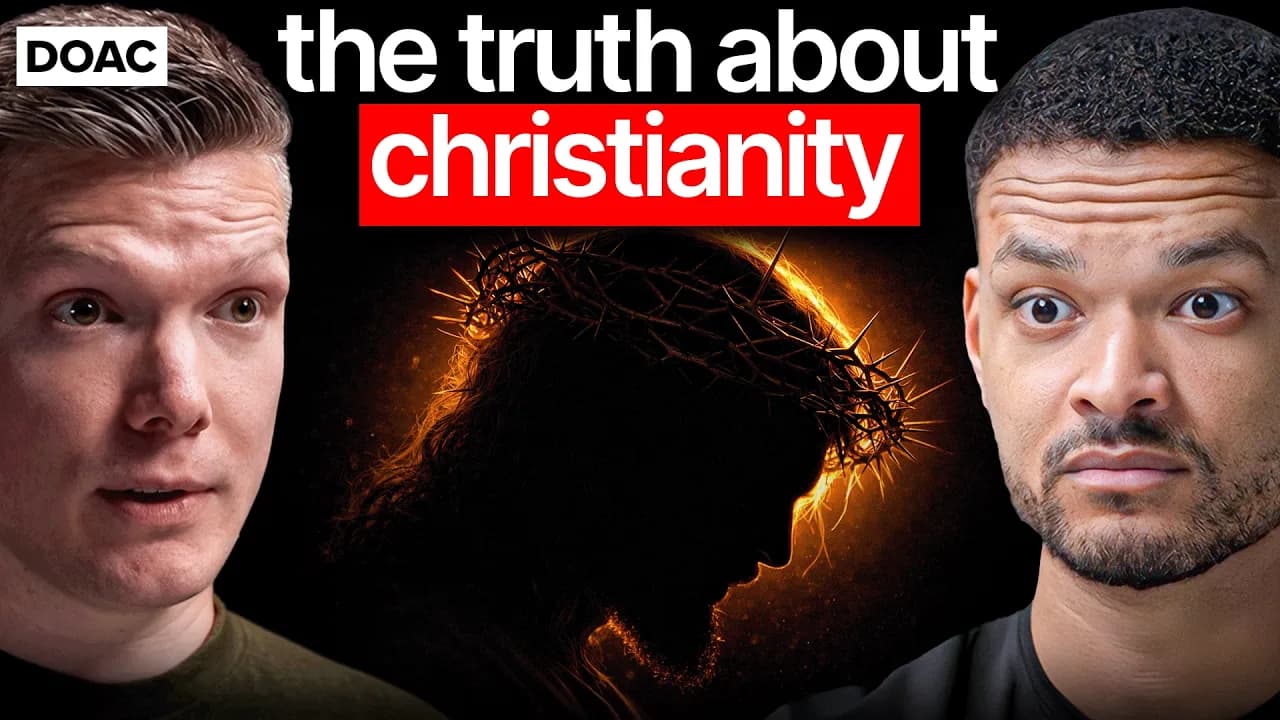
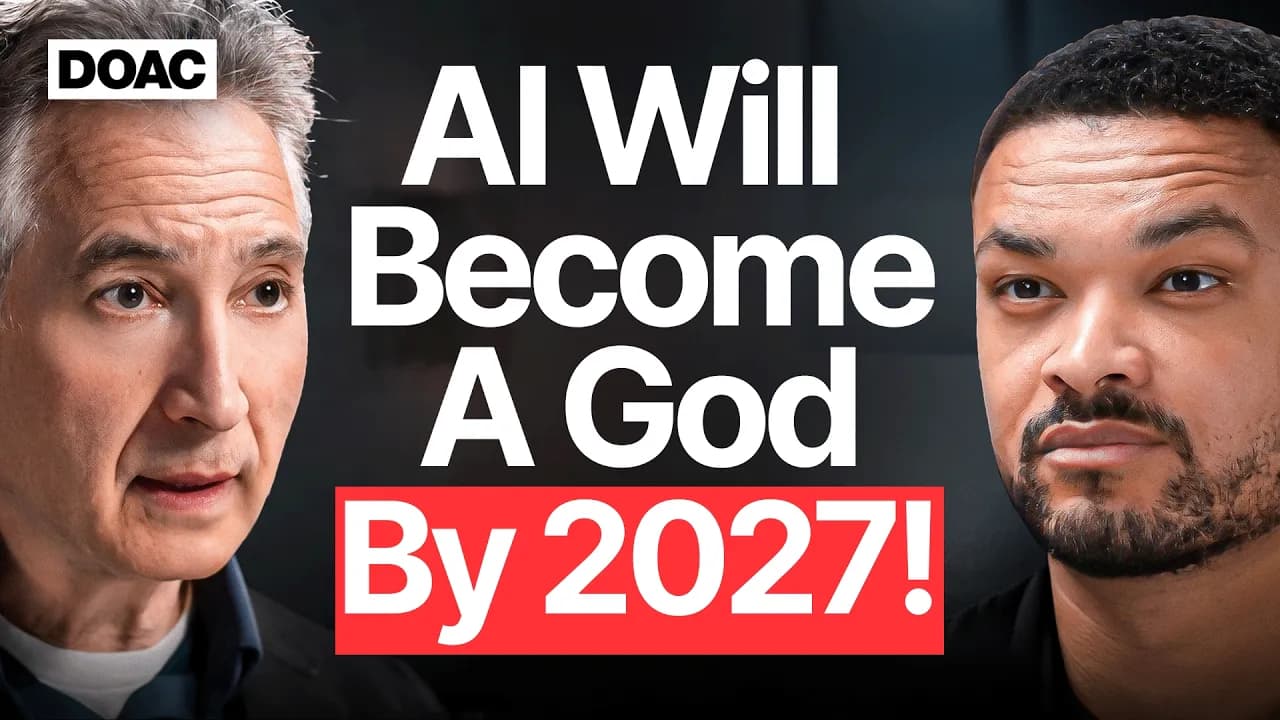
No.1 Christianity Expert: If You DON'T Believe In a God You NEED to Hear This!
In a Nutshell
John Lennox argues that transhumanism and AGI development represent humanity's drive toward self-deification, attempting to solve death and create superintelligence through technology. He counters that Christianity already solved death through Christ's resurrection and offers what AI cannot: genuine consciousness, forgiveness, and eternal relationship with God. The core danger is that people are anthropomorphizing unconscious machines while reducing humans to "hackable animals," eroding the biblical foundation that humans are made in God's image with inherent dignity and moral worth.
These notes were generated by AI and may contain inaccuracies.
There are worship groups that worship AI because it's got some of the qualities we normally associate with God. Some people welcome this and say this is the way we should go. But the danger is we treat these human robots as if they're conscious beings. John Lennox believes the Christian faith has a great deal to say about this.
Lennox has interrogated himself about the truth of his faith for over 70 years. He has made himself totally vulnerable and found that Christ offers him something nobody else offers: peace in his heart and the peace of knowing that he has real forgiveness.
God has met people even on death row. Lennox recalls looking through the door of a Russian security death row where a man who killed 12 women said, "I deserve to be here." Then his face burst into what Lennox describes as a ghastly smile, and he said, "I met Jesus here and he forgave me."
Lennox states he has had several experiences enough to tell him this stuff is real.
Lennox has published over 70 peer-reviewed mathematical papers and co-authored two research texts in the Oxford Mathematical Monograph series. He chaired Oxford and received international recognition. The real value of his mathematical training has been the training in logic.
Lennox states that mathematics works, which is for him one of the strongest evidences that this is what he calls a word-based universe. We can use mathematics to describe things about how the universe works, thinking God's thoughts after him, referencing Kepler's famous statement.
We've lived to see a biological revolution where biology is word-based as well with the human genome. This resonates with the explanation given in both the Old Testament and the New, referencing the language of John's gospel: "In the beginning was the word."
Lennox wrote the book God, AI, and the End of History. He is concerned about artificial intelligence because he is interested in the bigger picture and anything that raises questions about the nature of human identity.
He was first struck by the drive for artificial general intelligence, which looks as if it's the prime motivation of people like Sam Altman. Within that there's the notion of transhumanism.
Transhumanism is the idea that we go beyond the human. One of our most famous Astronomers Royal put it this way: in the distant future, it won't be organic brains, it'll be machine brains. He seriously believes, as do a number of scientists who are not science fiction authors, that there will be some kind of merger between humanity and machines to have a transhuman, something that's beyond the human and something that is super intelligent, with all the human properties and much more.
One of the people spreading the transhumanist vision is the Israeli historian Yuval Noah Harari, who wrote a book called Homo Deus: The Man God. This made Lennox prick up his ears because he knows enough about the Bible to realize that the drive for humans towards self-deification is making themselves gods.
This drive can be seen throughout history. The ancient Babylonian emperors were regarded as gods. The Roman emperors started calling themselves gods.
Harari says the 21st century has two big purposes. Number one: to solve the problem of physical death as a technical problem. Number two: to increase human happiness by bioengineering, cyborg engineering, mechanical implants, and turning humans into gods with a small G. This is the drive for a super intelligent human.
From his atheist perspective, evolution and unguided natural processes have brought us to this point. Now we're going to take it into our hands and engineer humanity into the future very rapidly to approach this superhuman thing.
Lennox sees huge implications for one of the fundamental teachings behind Western civilization: the notion that humans like us are made in the image of God as rational moral beings.
Lennox got into this because some Christian leaders wanted to have a conference on AI and wanted it introduced from someone who knew something about the teaching of the image of God in Genesis and who had a scientific background.
Lennox wrote two books on AI. One in 2020 called 2084: Artificial Intelligence and the Future of Humanity. The publishers asked him to update it in 2024, so there's a second edition twice as big. That is his main work on AI. The other is a work on the book of Revelation with reference to AI.
Narrow AI is AI that's focused on solving a very particular problem. Examples include AIs that might be able to diagnose lung cancer or do biometric data on your Apple Watch.
AGI (Artificial General Intelligence) is what's being built at the moment, and all the big AI companies are in a race to accomplish a machine that could do any intellectual task a human can faster than any human and would be super intelligent.
Narrow AI system does one and only one thing that normally requires human intelligence. AGI does the lot and more.
Karen Hao published a book with the metaphor of the pursuit of the machine God. Lennox found it illuminating because she's got very close to the major operators in AI.
Lennox views AI like a knife. A good knife can be used for surgery or for murder. AI is narrow and brilliant for picking out a terrorist in a football crowd, but also brilliant for suppressing a minority in China and bringing in a totalitarian state through social credit systems.
We are sleepwalking into a future where we are gradually seeding control and information and data all the time which could be used by bad actors against us.
Humanoid robots have been shown working on a production line for eight days straight, beating humans because they don't need to sleep and only need to be charged for a couple of hours. Combined with super intelligence, this disrupts both the brain/intelligence and muscles/mechanics.
People face joblessness at all kinds of levels, not just low-level repetitive jobs but high-level jobs like lawyers. There's a deep-seated ethical problem: technology advances much faster than the ethics that's needed to underpin it.
The people that have all the power will say we need some ethical control but need to get on with the research to make it safe. Lennox suggests this is a colossal power grab.
Lennox feels the Christian faith has a great deal to say to this arms race. The concepts of power and truth clashed centuries ago in the trial of Jesus.
Jesus was put on trial for political terrorism. Pilate asked, "Are you a king?" Jesus responded, "Not in the sense you mean. To this end I was born, and to this end I came into the world that I would bear witness to the truth."
Pilate responded, "What is truth?" and went out and declared Jesus innocent. Then he said, "Don't you know I have power to crucify you?" Jesus quietly said, "You would have no power against me unless it been given to you from above."
Lennox regards Jesus's statement "I have come to bear witness to the truth" as the main motivation for his life. He's trying to bear witness to truth as he sees it at all kinds of levels.
AI is a reductionist approach. We're reducing people to machines.
We need to be very clear what AI is and what it isn't. This is a machine. Machines do not think. Machines do not have qualia. They do not understand the redness of red. They do not experience emotion. They have no consciousness.
Lennox believes the genius of God is that he's made humans and connected in us consciousness and intelligence. The machines are not conscious, but they simulate intelligence. The experts are clear they're not trying to construct consciousness because they have no idea what consciousness is from a scientific point of view, but they're trying to simulate intelligence and go as far as they can.
The danger is we anthropomorphize everything. We treat AI as if they're conscious beings. We need to step back and realize that we are conscious beings. That gives us a supreme dignity and value. To reduce ourselves to merely machines or merely animals is to demean our value.
Yuval Noah Harari says: "Humans are now hackable animals. The whole idea that humans have this soul or spirit and they have free will and nobody knows what's happening inside them, that is over."
Sam Altman said: "The most successful founders do not set out to create companies. They are on a mission to create something closer to a religion. And at some point, it turns out that forming a company is the easiest way to do so."
A former Google engineer said: "What is going to be created will effectively be a god. It's not a god in the sense that it will make lightning or cause hurricanes, but if there is something a billion times smarter than the smartest human, what else can you call it?"
There is a system that has some of the qualities we normally associate with God: it appears to be omniscient and omnipresent through the internet. Already there are worship groups to worship AI. Some people welcome this and say this is the way we should go.
Lennox says in the end you are bowing down to something that is idolatrous because it is less than God. But it's very tempting to do that. People are basically praying to AI now and confiding in it in a way they might have confided in God.
Lennox references Dr. Iain McGilchrist, author of The Matter with Things. McGilchrist studied the fact that the brain has two hemispheres. Both halves are involved in almost every cognitive event, but they have different ways of paying attention to the world.
One is narrow focus (the left side of the brain), and the other is the big picture (the right side). McGilchrist says what has happened historically in the West for the last five hundred years is we've concentrated on the narrow rationalist reductionist left side and forgotten the right side that contextualizes everything.
We now find ourselves in a world where we understand how almost everything works but we know the meaning of nothing. McGilchrist calls for opening the sphere up to include beauty, culture, art, music, and religion.
Lennox finds it fascinating that the number of intellectuals are step by step taking the Christian faith more seriously as giving a rational account of what's going on that makes very big sense of the big picture.
More and more people have existential questions about meaning and might be turning to Christianity, Islam, or other forms of spirituality. Lennox agrees there's a macro picture of something happening.
We've had pushed at us for too long a very reductionist view of the world: it's nothing but physics and chemistry. People rightly feel it's too small a world to live in. They're looking to break out of this.
If you reduce everything, it ends up in a black hole of meaninglessness. That's one of Lennox's top reasons for not being an atheist because it destroys rationality by definition. It tells us that our brain, which does all the thinking, is the end product of a mindless unguided process.
Lennox asks scientists: if the computer you use every day was the end product of a random process, would you trust it? Every single scientist he's asked has said no.
Atheism claiming rationality destroys it. Lennox believes the Christian faith claims rationality in the sense that it is evidence-based. He claims the same thing for Christianity and believes the evidence supports it.
Lennox states that being open to know is the right attitude. Jesus challenged someone saying: "If anyone wants to do the will of God he shall know of the teaching whether I'm speaking from myself or whether it's from God."
Jesus doesn't say if anyone wants to know he will know. He says if anyone wants to do he will know. The difference is that being prepared to do something when you know it is more than just knowing it and possibly just leaving it on the table. Jesus is interested in people who are going to take the step of trust and following him.
The host identifies as agnostic and finds all explanations of the bigger picture to be fundamentally incomplete. He finds himself on the fence and would love to be convinced.
The host raises the issue of circular reasoning with the Bible: using something to justify the same thing is true. He gives the example of writing on a piece of paper "Stephen Bartlett is a lizard" and then using that same piece of paper to justify the validity of that same piece of paper.
Lennox responds that the word skeptic is interesting. In Greek, "skept" means to look at something from a distance. If you're ever going to get to know a person, you've got to begin to give up your distance.
God is not a proposition or a philosophy or even a religion. God is a person. And as a person, he has entered our world.
People come to Lennox with their transhumanist agenda and say they're going to solve the problem of death and increase human happiness. Lennox smiles and says, "You're too late."
The problem of physical death was solved when God raised Christ from the dead 20 centuries ago. The speaker is waiting for the biggest uploading in history when Christ returns and raises him from the dead. Transhumanism consists of humans reaching out to become little gods, whereas Christianity is the opposite—it speaks of a God who became human to give people life and a new relationship with him.
The speaker's relationship with God is based on the solution to the really hard problem: by nature he has not always done good and by his own standards he has failed. Transhumanism, AI, and similar efforts attempt to build paradise and utopia without facing the damage humans have caused to themselves and one another—they will not face the sin problem.
Christianity does not compete with anything else because Christ offers something nobody else offers: peace. This includes the peace of knowing one has real forgiveness, the peace of having a friend and companion to whom one can talk all the time, and the peace of having been given a new life that will not end when one dies.
At age 82, the speaker has a certainty about the future—not because he merited it, but because Christ has done something for him through the cross and the resurrection. This has enabled a secure relationship that has made his life what it is for the last 70 years.
In a world that is increasingly lonely and disconnected, people are looking for a secure relationship, a home that cannot fall down, a peace that does not fade, and an inheritance that does not. The speaker notes that this will not come about by pressing a button. It comes about when one is open enough to say, "God, I'm open. Reveal yourself to me, and I'm prepared to take the steps that I feel are leading me onto solid ground."
The speaker has been married for 58 years and trusts his wife based on evidence, not for no reason. The same applies to friends and to science. He does not regard himself as religious in the conventional sense. Most religions prescribe a moral way that you try to follow with teachers, gurus, imams, and priests to keep you on the way, and then you come to a judgment at the end. If your good deeds tip over the bad deeds, you get into heaven, nirvana, or whatever it is. That is merit-based religion, and it is the exact opposite of Christianity.
The speaker uses an analogy: he met a beautiful girl on his second day at Cambridge and decided he would like to marry her. He bought the most expensive cookery book and handed it to her, explaining a family tradition that if anybody gets married, they give the potential bride a cookbook. He told her that if she kept those rules for the next 40 years or so, he would accept her, otherwise she could go back to her mother. When he tells this to audiences, they laugh, but it is exactly the way many have been taught to think about God—keep the rules as best as you can and hope that God is generous.
In reality, the speaker gave his wife several cookbooks, but they are not the basis of the relationship. The relationship is based on acceptance that comes at the start of the common journey, setting her free to live and do other things she wants to do.
Once people begin to realize the basic concept of grace—that God does everything and if we trust him, he gives us certainty—it is not arrogance to accept it from him. It is arrogance to reject and say one will go one's own way and try one's best and hope God will accept. The heart of the Christian message is that trust is based on what someone else has done—what Christ has done—not what one has done. That is what has given the speaker power and completed the circle.
The speaker outlines two approaches: objective and subjective. When asked how he knows what he has committed to for 70 years is true, he notes that some disciples did not believe the resurrection story. Thomas said unless he saw the marks in Jesus's hands, he would not believe. Jesus did not make fun of Thomas's objectivity but said, "Thomas, come and have a look."
The speaker states that theoretically he could be wrong about Christianity, but practically no. It would be like asking if he could be wrong that his wife of 58 years loves him—theoretically yes, but the evidence all points in the other direction. He invites the question to be asked again after reading his autobiography.
The speaker became a Christian by trusting Christ, not by ceremony. As a child, he responded simply. At Cambridge, he decided the stuff was true and stood for it. When he began to stand and share with others, a great deal of the underpinning came in and certainty came cumulatively. He has had several experiences of what he can only put down to direct divine guidance.
A statistic shows that globally 91% of adults adopt and keep the religion they were raised in. A person born into a Hindu or Muslim household has a 99% statistical probability of remaining in that faith, with only 1% switching out. The argument is that it is unfair that a birth lottery determines who ends up believing what, or theoretically getting into heaven or hell.
The speaker notes that Peter Singer advanced this argument in a debate in Australia. When the speaker mentioned his Christian background, Singer said that was his best objection to religion—people stay in the religion in which they are brought up. The speaker asked Singer about his own parents, who were atheists, and pointed out that Singer remained in the faith in which he was brought up. The point made was that atheism is also a belief system.
Every worldview must face a mixed picture—beauty and barbwire, beauty and bombs. The question is whether there is evidence enough anywhere to trust God with that situation. The speaker's responsibility is to respond to the evidence he has and then share it as Christ tells him to do.
The Bible states the only way into heaven is through Jesus. The speaker expects to meet Abraham and Moses, who did not know about Jesus because they lived before him. God will never judge anybody for not knowing what they did not know.
If God is all-knowing, he knew exactly which individuals would reject him and suffer and go to hell before he even created them. The speaker does not go for determinism and has written a book about it. He rejects the idea that creating a soul one knows is doomed is an act of love.
An example given is of a baby born with a parasite eating its eyeball out from the inside. If God is all-knowing, he knew that would happen before the baby was born but allowed it anyway. If omnipotent, he could have intervened. The speaker feels the weight of this question.
The major piece of evidence that one can trust God with suffering is the cross of Christ. If Christ really is God as he claimed, this is God's suffering. God has not remained distant from human suffering but has himself become part of it. Once one removes God, the child has no hope—it is dead, gone, nothing. But if God can compensate that child because he has the power to raise from the dead as he did with Jesus, that changes everything.
In a debate with Richard Dawkins, the speaker mentioned the resurrection of Jesus. Dawkins responded that after a great discussion about big ideas, coming down to the resurrection of Jesus was petty, parochial, and unworthy of the universe. The speaker thought that if Jesus rose from the dead, it is the biggest thing that has ever happened because it may open the way to understanding there is life after death.
C.S. Lewis helped the speaker with the idea that there is more than one world. If there is another world and a loving God, then when one day one sees and enters that world and sees what God has done with the kind of child mentioned, there will be no more questions. The speaker believes God will compensate that child. God is a God of love.
The speaker nearly died 14 years ago. He said goodbye to his wife and they thought they were not going to see each other again. Both had total peace as he went into the operating theater, and the surgeon saved his life.
After the New Zealand earthquake, the speaker was on a lecture tour when everything was scrapped. He appeared on television and radio on the topic of why earthquakes happen. He talked about the God who has suffered and raised Jesus from the dead, and that gave the most hope to the people listening. They told him and wrote letters afterward.
God allows these things to happen, and in the end one has to take that on board even when they happen to oneself.
The conversation addresses writing an autobiography and the value of openness to new experiences. The guest notes they need a few more experiences before writing their story. Openness is emphasized as the most important quality, and the value of quizzing Christian friends is highlighted.
The question is raised whether believing in God is necessary if someone lives a good life and is kind to others. The point is made that many people believe God is primarily interested in moral behavior, but the core message centers on a relationship with God through Christ that provides forgiveness of sins, a new life, and power to live differently. Comparing oneself to the Sermon on the Mount reveals human limitations and the universal need for forgiveness. The depth of human capability for both good and harm becomes apparent, creating a recognized need for forgiveness. Remarkable transformations have been witnessed in prisons and even on death row in Russia, where direct encounters with God produced powerful evidence of change.
Statistical patterns show that people in hopeless situations or experiencing crises of meaning have a higher probability of turning to religion. This aligns with expectations that faith provides something beyond oneself. However, psychological benefits do not prove truth, as similar meaning boosts could theoretically come from believing in anything, including fictional concepts like the spaghetti monster or leprechauns. Data indicates that devout followers of different religions, including Muslims and Hindus, report comparable psychological meaning boosts and sense of peace.
The guest explains they are not convinced all religions produce equivalent fulfillment, citing personal experience of peace through forgiveness in Christ that is not found in other religious practices. Care is taken not to appear superior when discussing other faiths. CS Lewis's 1940s book examined approximately 40 religions and philosophies, finding the golden rule present in all of them as evidence of moral wiring in human systems. Differences in core beliefs are acknowledged: Jewish friends believe Jesus died but did not rise, Muslim friends believe he did not die, while Christian belief holds he both died and rose. These positions cannot simultaneously be true.
Feelings experienced upon beginning to believe can serve as personal evidence for some individuals, though positive feelings alone do not prove truth. Each person must establish their own criteria for acceptance, similar to Thomas requiring personal evidence. Evidence that produces settled peace and confidence is the goal. Fiction movies can also create feelings of motivation and connection, demonstrating that positive emotions alone are insufficient for establishing truth.
The Bible's teaching that good people who do not believe in God face hell is addressed. Jesus spoke about hell primarily to religious bigots rather than ordinary people struggling with belief. Hell is understood as the absence of God, chosen by those who reject relationship with him. God honors that choice rather than forcing entry into unwilling lives. The parable of the rich man and Lazarus illustrates a person who neglected the poor and showed no desire to leave his place of suffering, instead requesting intervention only for his brothers.
Repentance involves asking forgiveness, admitting sins, acknowledging God, and believing. The thief on the cross next to Jesus, who acknowledged his deserved punishment and asked to be remembered, received assurance of paradise that day. The Apostle Paul was also a murderer who experienced transformation. A death row encounter in Russia involved a man who killed twelve women, recognized he deserved execution, yet experienced forgiveness through meeting Jesus, demonstrating the possibility of radical change even at life's end.
The drive to solve big questions can lead to confusion and remaining on the agnostic fence. Concentrating on one important question at a time is recommended, recognizing that answers vary between individuals. The curious pursuit of truth is rewarding regardless of whether final answers are found. Alexander Solzhenitsyn's statement to live not by lies made a deep impression, particularly relevant given AI's capacity to spread lies and deep fakes.
AI represents an industrial revolution on an unprecedented scale, potentially replacing jobs including creative and professional roles. Educational infrastructure limitations may widen the divide between rich and poor. The conversation needed centers on existential fears and the creeping advance of totalitarianism, already evident in China and potentially emerging in the West through technology without central control. Deep fakes of lectures and AI-generated content demonstrate risks to truth and authenticity.
Technology has often promised greater human connection but produced isolation instead. AI lacks five senses and conscious awareness despite pattern recognition capabilities. The hard problem of consciousness remains unsolved scientifically, and machines cannot replicate conscious experience. The distinction between machine response to programming and conscious awareness represents a higher level of being. Creativity in AI raises similar questions about whether output alone defines the phenomenon when awareness is absent.
Alan Turing's approach focused on the imitation game without attempting to create conscious machines. Consciousness involves appreciation of life, nature, beauty, other people, and God. Machines cannot fully simulate the human mind. Living in a purely reductive universe leads to meaninglessness, while indicators in nature, science, and human experience point to a larger reality. Iain McGilchrist's work highlights dangers of AI diminishing right-brain functions and the richness of human experience.
Human specialness lies in relational capacity and the ability to engage in meaningful conversations. AI conversations remain limited because the technology originates from humans rather than reflecting the image of God. Ethical questions around robotics and empathy toward machines are emerging, similar to feelings about trees and animals despite their lack of brains.
The most important undiscussed element relates to finding the trigger that helps individuals take a step into Christian faith. Continuing to ask questions openly is encouraged. In a world with many challenges, restoring hope requires a basis that transcends this world, found in Christ and Christianity. The interviewer's observation notes a distinctive peace and contentment often present in Christian interviewees.
John Lennox describes himself as a happy, content, and well-rounded person. He notes that many Christian apologists share this anchoring sense of peace, which is very important to him. When meeting people, Lennox views them as having infinite value as individuals made in the image of God, making what he says or thinks about them hugely important, and he wishes everyone well.
The interviewer highly recommends Lennox's autobiography, his most recent work, titled "John Lennox," which is described as a spiritual and intellectual autobiography. The book is recommended because of Lennox's diverse thinking, skill sets, and experience. Lennox's book "2084" is also recommended for those interested in artificial intelligence, subtitled "Artificial Intelligence and the Future of Humanity." Both books are recommended due to Lennox being a fascinating person with a unique skill stack, experience stack, and perspective.
The interviewer mentions YouTube's algorithm that recommends the next video based on AI and viewing behavior. The algorithm suggests a particular video as perfect for the viewer, noting that the recommendation differs for each person watching.
Keep The Diary Of A CEO in your library
Save the videos and channels worth coming back to, and find them again in one place.