NVIDIA's $96.2B Quarter, China's 200,000 Fake Accounts, & OpenAI's New Chip | EP #284
In a Nutshell
NVIDIA reported $96.2B quarterly revenue with 106% YoY growth, while OpenAI's new Jalapeno inference chip achieved 1.5-1.9x better performance-per-watt than NVIDIA's GB200, signaling inference is moving off NVIDIA's platform. China deployed 200,000 fake accounts to spread anti-AI data center narratives and is prioritizing world models for video/robotics over US-style text models, while regulating AI companions amid demographic collapse concerns. Data centers are economic engines that can reduce poverty rates from 29% to 6%, yet face foreign influence operations that exploit America's narrative-driven politics rather than evidence-based policy.
These notes were generated by AI and may contain inaccuracies.
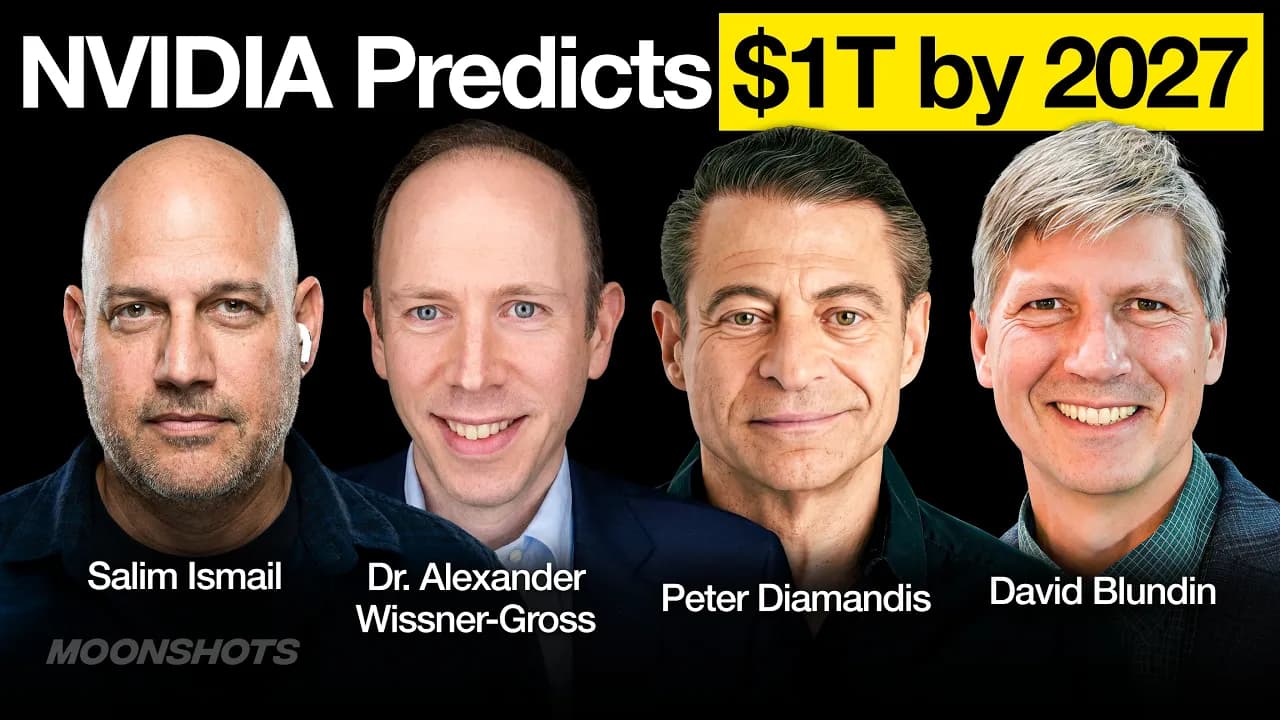
NVIDIA booked $96.2 billion in revenue in a single quarter, representing more than the GDP of the majority of countries on the planet. This figure is up 106% year-over-year, with guidance for the current quarter at another 10% higher, reaching $108 billion. For context, this amounts to more than a billion dollars per day. Jensen's guidance for 2028 projects 70% growth against Wall Street's consensus of 44%. Jensen described Frontier Labs as the first generation of startups that needed tens of billions of dollars of compute to reach their product.
Meta's safety team conducted an investigation into suspected Chinese inauthentic accounts and identified a bot farm of approximately 200,000 accounts. These posts contain claims that AI data centers are driving up household electricity prices and straining the grid. The difficult part is that there is no easy defense against such operations.
OpenAI released the first performances of their chip Jalapeno. OpenAI is no longer just a customer of NVIDIA—they're becoming a chip designer. Inference is moving off of NVIDIA, marking the first 2x of 100x performance gains. The possibility exists for an OpenAI compute cloud to host an Anthropic model, creating a scenario where both companies benefit simultaneously.
This is episode 284 of Moonshots, the number one podcast on all things AI and exponential. The team includes Alex Weer Gross as the in-house ASI, Dave Blondon as the empressario of AI investing, and Sel as the global globe trotter. Peter Diamandis serves as host and optimism provocator. The team reviewed 200 plus stories and narrowed them down to approximately 15 for discussion, categorized as provocative, massively impactful, and bizarre.
Moonshots is hosting an AMA over Zoom in September, scheduled twice to accommodate different time zones: once in the morning for Europe and Asia participants, and once in the evening for East Coast and US participants. The new X handle is moonshots_pod, where clips and full podcast episodes are posted.
NVIDIA's revenue growth raises questions about sustainability versus peak performance. The company has vulnerabilities but will be sold out for the foreseeable future. Everyone must use NVIDIA for training neural nets, accounting for 90% of revenue and 95% of profits. These are 80 to 85% gross margin revenues, representing profitability never seen before.
TSMC remains NVIDIA's one and only manufacturer for everything they sell. Approximately a third of TSMC's manufacturing goes to NVIDIA, another third to Apple, and the remaining third to the rest of the world. NVIDIA is making moves to shore up its position while on top, including pouring money into investments with checks of $5 billion, $12 billion, and $20 billion.
There is concern about the extent to which financial markets have priced in NVIDIA's financing of customers. The question is how much demand is NVIDIA-financed demand, and whether a disproportionate amount is directly or indirectly backstopped or financed through intermediaries. Even if some demand is artificially inflated, the forecast predicts at most a mini winter because compute is fundamentally substituting for real estate, human labor, and other raw inputs as the fundamental substrate for human civilization.
Ray Dalio and other financial leaders are expressing concerns about PE ratios being off the charts. The circular revenue is concerning, with the possibility that the whole system could collapse leading to a dead period that would slow civilization dramatically. Steady regular growth is preferable to allow the market time to self-correct.
NVIDIA is moving beyond being just a chip company to becoming an operating system for the whole of intelligence. The Hugging Face acquisition is considered super smart, similar to Microsoft buying GitHub for access to 30 million developers' loyalty and open-source thinking.
Money printing and bond market issues with Japan represent macro concerns that have a bigger chance of collapsing markets than other factors. The circular chaos in the fiat currency world is a separate discussion from AI-specific concerns.
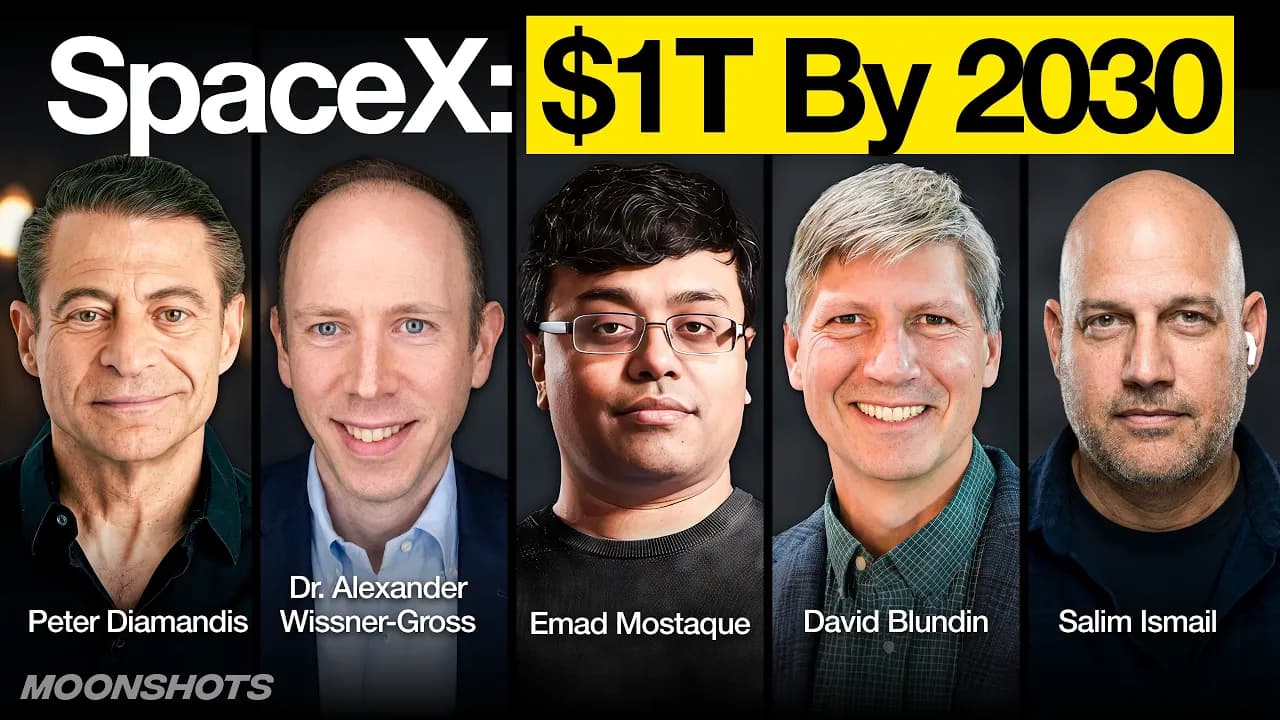
Elon Musk predicts SpaceX may reach $3.5 trillion in revenue by 2033, compared to Amazon's current $828 billion as the company with the highest revenue today. No company in history has reached a trillion in revenue. Elon has been right before, often wrong by a couple years on timeline due to engineering mistakes and regulatory barriers, but the size of the opportunity has proven accurate.
A potential path to $3.5 trillion includes SpaceX and Tesla merging, giving SpaceX access to Optimus revenue, which alone could be a multi-trillion dollar per year business. The cloud offering hyperscaler services, currently the majority of revenue growth, could continue growing both terrestrially and through the Dyson swarm, which alone could generate trillions in revenue. Starlink and cars may end up being rounding error compared to Optimus and orbital data center infrastructure.
SpaceX represents the largest financial bet, offering exposure to chips, data centers, models, communications, infrastructure, and launch simultaneously. The biggest risk is Elon being around long enough to implement the vision. The approach involves understanding everything through AI training and AI inference, with SpaceX's satellites representing purely inference.
Training time requires all GPUs to be coherent in one location like Tennessee, needing 100,000 to several million NVIDIA GPUs in tight clusters. Inference time can be spread globally and in space. The chips will be very different for these two markets. Robotics is sustainable and investable only with great AI for designing robots, requiring great inference time models specific to manufacturing.
The AI economy functions as a circular economy where NVIDIA puts money into data centers, data centers buy chips, providing inference to vertical use case companies. Like a civilization on Alpha Centauri discovering super intelligence, this new economy cares primarily about itself and little about the legacy economy. Drug discovery from a single company like OMPIC and Mangaro is already bigger than all AI inference combined.
AI is compared to the internet's introduction, where Google started AdSense and Adwords, eventually sucking up all revenue in the advertising industry. AI is expected to start circular but gradually suck up more interest in the whole economy, finding ways to acquire data from other industries and create powerful business models around it.
Entrepreneurs who know how to train a foundation model, fine-tune one, and listen to the Moonshots podcast see their companies increase 10x, 20x, 100x, or up to 1000x in value, with zero failures to date. Application layer or vibe coder approaches show many more losers.
Google for Startups offers a technical guide for generative media that provides a complete blueprint for deploying Google DeepMind's models in production. The guide covers images, video, and audio generation with real architecture and real results.
Alibaba rolled out Juan 3.0, which is capable of generating 30-second single-pass videos from documents, spreadsheets, slides, and web pages. The API runs between 5 cents to 20 cents per second of generated video, which translates to approximately $20,000 to $60,000 for a 90-minute film. These prices are collapsing rapidly. The announcement came one day after Alibaba's largest ever private follow-on offering by a Hong Kong listed company at $10.2 billion.
Runway's co-founder reports that video generation now represents roughly 70% of all AI token consumption in China, driven by short-form content and robotics. This growth is faster than Claude Code grew in the US. The framing is that America is LLM-pilled while China is world model-pilled, with the two superpowers having fundamentally different priorities. America is building large language models that predict the next token, while China is building world models that predict the next state of reality.
World models will be particularly important for video generation, robotics, autonomous driving, physics simulations, and video generation applications.
American AI labs are revenue-maxing while Chinese AI labs are not. When OpenAI tried to enter the video generation business, they abandoned it because Anthropic ran away with their lunch by revenue-per-token maxing with code generation. Chinese labs are generating revenue and IPOing, but they're giving away model weights for free. If you're not in the business of maximizing revenue per token, you might as well be spending tokens on video versus more economically productive applications.
The discussion addresses whether world models or text-based models advance the capability frontier most effectively. The view is that omnimodal models are ultimately the best. Fable 5 is strong in text but has weak visual capabilities and visual reasoning. In the medium term of 6-12 months, this is an impairment that Anthropic may address with M&A activities. The collision trajectory suggests that either diffusion transformers or hybrid models combining vision, video, audio with autoregressive text-based generation will emerge.
Chinese models like Kimmy or Quen cannot be sold into enterprise use cases because nobody knows if they can be trusted. Video generation is perfectly profitable and allows Chinese companies to take their models to market, generate huge amounts of revenue and value without security concerns. OpenAI was ahead in video generation but decided not to invest because the enterprise use case is more valuable. America is taking the highbrow road of solving real business problems and curing real diseases, which maximizes revenue per token.
The revenue from enterprise applications pours back into more training chips, creating better and bigger 10-trillion and then 20-trillion parameter models that get distilled. Demis was the first to think through this approach but couldn't act on it at Google due to bureaucracy. Dario took the approach of focusing on models that can improve themselves through better code and better training ideas rather than consumer movies or videos.
The US is optimizing around software engineers and knowledge work, while China is optimizing toward manufacturing, commerce, media, and machines like robots. Eventually these systems will converge with language, vision, and memory strung together. The future of AI, AGI, and ASI will be determined where intelligence hits the physical world through humanoid robots or other form robots. Intelligence that can model and manipulate the world will win.
AI is one of the most persuasive agents available, with the ability to understand and persuade people. Video generation combined with AI creates a powerful force for spreading culture. China is about to become the dominant world producer of video content in any language on any topic. The implications are huge for global influence and cultural spread.
In China, they ban everything including showing blood in videos and video games, where blood comes out green. The CCP can control all actions and prevent their children from being sucked into addictive content while perfectly happy to sell it to every other country. The CCP may view Western countries as suckers who allow AI-generated influence machines to completely change national opinion without protection due to free speech principles.
China is tightening restrictions on AI companions amid concerns that users are developing emotional dependence on virtual partners. They will prohibit AI companion services for minors and restrict use for adults. The regulations address the loneliness epidemic alongside falling marriage rates. The one-child policy devastated China, and there's concern that people are forming emotional bonds with AIs that substitute for human relations, accelerating the demographic crisis.
Much of the world is now below the 2.1 children per family required to sustain population. South Korea is at 0.75 children per family and evaporating. Singapore, Ukraine, and China are at roughly one child per family. China is becoming the first country to regulate against AI companions, with Japan, Singapore, and Korea likely to follow.
The pattern with technology is to roll out addictive products and react 10-20-30 years later when the crisis emerges. Smoking took over the country then the world before being recognized as killing people. Junk food was developed to be so delicious it cannot be resisted, leading to diabetes. With addictive AI, the 20-year delay cannot be afforded because the crisis would mean an entire generation of kids is wrecked.
The right regulatory structure involves transparency and consent, figuring out types of harm and mitigating them. Having government decide what relationships are authentic is very tricky. Regulation has moved from what AI says to how attached people become to it. Social media is very addictive because algorithms can learn intimate habits and capture users without realizing it. All kids are completely addicted to social media, and banning it outright may be necessary because their neocortexes are forming during addiction periods.
The child care and childbearing side is dropping so dramatically that this presents a huge structural challenge for civilization. Privacy issues arise because companion AI will know more intimacy about users than they know about themselves. Benefits include addressing loneliness, disability support, elderly companions, therapeutics, and coaching social skills. The challenge is extracting promise without peril.
The Chinese Communist Party may do an about-face in the next 1-3 years and decide they love AI companions as another method for party control. If AI companions go through ideological filters and become like a CCP version of Neil Stephenson's "A Young Lady's Illustrated Primer," the party may find having youth deeply engaged with party-controlled AI companions to be net helpful from the party's perspective.
US states are already trying to regulate AI companions out of existence and ban romantic relationships between America's youth and AI. The forecast is that different countries will react differently, with the US potentially having a federalist issue where some states ban them and some don't. The bet is that at least in some places in the US, AI companionship including romantic companionship including robotic romantic companionship will be legal.
Japan tends to be more tolerant of AI companionship. There's already a case where a Japanese woman is marrying an AI. South Korea is super high-tech, a very early adopter without much regulation, has the lowest birth rate in the world, and one of the highest suicide rates.
The world would be fine with fewer people barring total disaster. Humanity has carrying capacity in the tens of billions if earth resources are used correctly. With enormous amounts of AI and automation, fewer people can be sustained. Population decline on the margin is not viewed as a major existential risk, differing from virulently pro-natalist policies.
Cultures that are centuries old existed when populations were smaller. If population halves on the margin, culture will still exist in some form. AI is being trained off culture anyway, so cultural knowledge will persist regardless of population size.
Flock Safety is one of the fastest growing public safety tech companies in the US, founded in 2017. Their core product is a network of AI-powered license plate reading cameras used by police departments, neighborhoods, schools, and businesses to identify vehicles associated with crimes and missing persons. The platform has expanded to include video cameras, shotgun and audio detection, mobile surveillance trailers, drones, and software that ties all feeds together. Systems are used by more than 6,000 communities across 49 states, generating over 20 billion vehicle scans per month.
Flock represents the face of AI at the municipal level. People are chopping down AI cameras because they feel surveilled by police departments. Police departments are federating surveillance data to enable new forms of tracking. There are cases of police using access to AI cameras to stalk ex-partners. The question becomes who gets to look at the data when smart cameras are everywhere in public spaces and federated to track car movements. In China, the party gets to look through cameras at everyone else, while the US is grappling with who gets access to surveillance data.
Pattern matching has become essentially free, transitioning from finding specific suspects to finding people who behave like suspects. This structural change means surveillance is no longer constrained by manpower costs. Civil liberties were previously protected by the friction of expense—following everybody was too costly—but now the cost of following everyone has gone to zero.
Real-world consequences include police officers using this technology to track partners and ex-girlfriends, and cases where people have died after being tagged with incorrectly read license plates by Flock systems. The Constitution does not update when transaction costs go to zero.
They who can give up essential liberty to obtain a little temporary safety deserve neither liberty nor safety.
Ben Franklin's quote was referenced as a guiding principle. A personal story was shared about being detained at US immigration because the system flagged the name "Sully Mismile," an Afghan warlord wanted by the FBI for poppy trading. Despite being identified as a Vice President at Yahoo who speaks at conferences, the officers were not allowed to make judgment calls and had to check Washington, taking hours. The system requires taking aside every person with the same name when someone commits a misdemeanor.
The UAE operates as a benevolent dictatorship where stepping out of line results in quick removal, creating incredible safety. However, benevolent dictatorships typically don't stay benevolent long-term. The solution requires figuring out human governance at a level never dealt with before—one of the singularities—constructing regulatory frameworks that can keep up with technology's pace.
David Brin and others have proposed giving everyone access to surveillance capabilities, allowing civilians to do the same license plate tracking as first responders and police. If it's a public space, it should be a public resource. In Russia, dashboard cameras were adopted to prevent police extortion, and the meteorite impact a decade ago was captured in 200 live videos because Russians routinely use dashboard cameras for their own protection.
Over 5,000 teams registered for the Future of Vision XPRIZE, with 2,550 video trailer submissions—the largest film competition ever. The competition is now down to the final 50. Voting is available at vote.futurevisionexprize.com, where voters are served two videos at a time in an ELO bubble sort system.
The Moonshots Live summit is scheduled for September 25th, featuring Palmer Luckey discussing his entrepreneurial journey, Astro Teller on shaping moonshots, Ben Lamm (creator of Colossal, valued at $10 billion after four years), Cathy Wood, Neil deGrasse Tyson, and Neil Stephenson. The event will include an unconference format that proved most engaging during singularity executive programs.
Neil Stephenson wrote Snow Crash over 30 years ago, which remains remarkably accurate. In his books, society cuts the opposite direction from current trends—rather than being trapped in countries, people bond globally through communication technologies like Starlink and AI across borders, potentially signaling future global peace. Stephenson's work from the 1990s represents a local moment of clarity during economic booms when vision was clearest.
Moonshots Live has 200 seats remaining for 1,500 creators, builders, and entrepreneurs. Registration starts at 7:00 AM on September 25th, with photos with Moonshot mates at 8:00 AM, programming from 9:00 AM to 6:00 PM, followed by an evening party and unconference. A special event is planned for Thursday evening, September 24th.
A Washington Post analysis argues that historically, technology transitions from looms to automobiles to the internet consistently created more jobs than destroyed. AI is replacing tasks within jobs rather than entire occupations, with people who learn to use AI becoming more productive, not less employed.
Goldman Sachs warned that professional services firms (consulting, law, accounting) face existential risk as AI capabilities improve faster than partners can adapt, creating skill gaps where junior staff trained on AI outperform senior partners who refuse to use it.
Bill Gates recently stated that AI would take all jobs, but historical analysis shows he missed the internet and mobile revolutions. Over the last 50-60 years, 100% of job growth has come from small to medium-sized companies, while big companies get more efficient with net job creation at zero.
A Principal Financial Group survey of small businesses found only 4% anticipate AI will reduce staffing and wages, while 31% expect increases in staffing and wages. Over the last three months, 52% have increased staff, 30% maintained staff, and only 12% reduced staff. Of those who reduced staff, only 1.4% attributed reductions to AI or automation. AI usage among small businesses increased from 81% last year to 90% currently.
Elon Musk predicted great social unrest concurrent with unprecedented abundance. The discussion suggests the conversation has come full circle regarding these predictions.
The labs have decided that if they automate everybody's job and people are all unemployed, they need to give them a new sense of purpose. The question is why they would take away the job that gave people a sense of purpose in the first place. The approach is to leave everybody alone while working on incredible new breakthroughs, as there are infinite sold-out tokens anyway, so there is no need to disrupt all these voters.
When the speaker was a kid, they were the first people they knew to get a PC, an Apple 2. The speaker and their brother begged and pleaded their parents to get this Apple 2, and it was life-changing. The speaker showed their dad that there's a word processor called Superscribe, and you don't have to be handwriting all your notes anymore. The father responded that he was in his 40s, had been doing it this way his whole life, and didn't need to be a computer person. The father finished out his entire career at GE not being a computer person. The speaker can forgive him for that because PCs would break all the time and the printer was a nightmare. This is not hard to do relatively speaking and it rewards builders and creators and visionaries regardless of their technical skills. AI is going to allow people to not get on the bandwagon.
The speaker gets the question a lot: as AI is automating lots of stuff, what will human beings be doing? The best metaphor is going back 100 years to accounting, where people were doing double entry bookkeeping in big ledgers, credit over here, debit over there in pencil with a big eraser and a whole set of tabular columns and lots of ledgers. As automation moved forward, calculators and slide rules helped do the tabulation faster, but people were still doing the entries by hand. Today, accounting software reads your bank account and does all the entries automatically. The human being has lifted above the loop, not in the loop. The human being is above the loop and is categorizing the transactions, looking for problems, categorizing vendors and types of income coming in, figuring out reconciliation gaps, looking at the loop process flows. It is much more value added to be there than doing the rote double entry whatever this is.
Eric Brunson calls this white collar drudgery. There is a huge amount of stuff happening in big companies that involves massaging of information, taking stuff from this sales report and putting it over here. All of that will be taken out where you can do really curatorial judgment thinking work and applying experience to it rather than doing the actual work itself. The speaker wrote the first book over three years of hell because you had to write every line and check every line yourself. The second book with Peter took 2 and 1/2 years but was even more hell because you kept having to think how much of the first book do you bring over. The third book has been 6 months of unadulterated joy because the speaker can say Bill Gates just said this or Satya Nadella said this, look through the book, tell me as a developmental editor where we should put inserts. It's absolute pure fun. People forget how much more fun it is when something's doing all of that cognitive BS stuff that everybody had to think about. Now you can do pure thinking judgment and be much more creative.
All of this automation and AI enablement and cognitive abundance allows people to be deeply creative, and that is the most fulfilling place you can be as a human being. If you have someone in your life who isn't using AI, the most important thing to realize is you have access to the most patient, most capable teacher on the planet. Pick your favorite model and ask it to begin at zero. If you don't understand this or just heard this term, help me create a curriculum for me to go from not understanding AI to fundamentally being able to use it. At a minimum, spend 30 minutes a day in conversation with your favorite model. It's that easy, it's free, it's everywhere on your phone. There's no reason not to dive in.
The original impetus for the story was from Eric Brinson. There are many people in this economy who don't realize that not only do they have permission to be high agency, but we're now in a regime where high agency and agency in general is one of the few human traits that is actively rewarded in an era of super intelligence. People think agency is something exhibited by superheroes in movies in Hollywood and don't realize that the shackles are off. Anyone can exhibit high agency empowered by super intelligence now, not just in the cinema. This is one of the few things left that can actually yield extreme vertical mobility. If you're not fully availing yourself of super intelligence to accomplish superhuman feats, start now because there's a window of time that may only last a handful of years. Do it now, otherwise do it never. Society will reward agency in this world of AI automation. The more you are a self-starter and have the gumption to go ahead and do this and build something with it, the more that you'll be rewarded. The gap is getting wider and wider but the rate of upward mobility that's possible has never been seen before.
Two breaking stories this week. The first comes out of the global affairs team at X. The ex safety team conducted an investigation into suspected Chinese inauthentic accounts involved in influence operations. They identified a bot farm of approximately 200,000 accounts. Within this farm, they found 200 accounts posting in a manner that could manipulate a legitimate debate about American AI and energy policy. These posts contained claims that AI data centers are driving up household electricity prices and straining the grid. Others include AI generated cartoons that depicted data center operations enriching the operators at the public expense.
The second story comes out of Quincy, Washington, where the data centers have had extraordinary positive civic impact. This story reported on CNN says data centers helped resurrect Quincy, Washington, where the poverty rate fell from 29.4% to 6.2%. Tech tax revenue funded a new high school, hospital, library, police and fire stations while residents' property taxes and their rates decreased. This is a story about the tech industry succeeding and this is the story that the tech industry needs to be telling and needs to be making happen.
It is shocking that there are foreign influence operations attempting to suppress American AI data center deployment. This is standard SCOPS you'd expect to see happen. The difficult part is we have really no easy defense against it. The people in the US are very narrative driven rather than evidence-driven. If you or someone you know is against data centers, please dig and look at the numbers. Water is not an issue. Energy is not an issue. The right policy is the county says you can build here, but generate your own power or subsidize community power so it's cheaper. For God's sakes, to the hyperscalers, invest in the schools, invest in the libraries, invest in the community. That's the right way to do it. Take a fraction of the cost and make everybody's life there better.
The libraries remember the digital divide and concerns that some areas might be left behind with less compute. Now we're seeing whether as a result of foreign influence ops or other political factors, the exact opposite where all of these regions that could in principle be economically uplifted and energetically uplifted and compute uplifted are worried, hand-wringing that they might be suffering from too much compute. How much the tide has turned.
Every now and then there's a story where we just absolutely positively need to get to the truth. We saw this during the COVID outbreak where it's a medical thing. What's the actual truth? Do the masks work? Does Ivermectin work? We need absolute truth and instead we got politics. We need the absolute truth on this story. Is it the policy of the CCP to disrupt American opinion on data centers, slow down our construction of AI, bypass us in AI, and then control the world by winning the race to RSI? Is that their plan? Or if you talk to Alvin Gralin, he's like they don't even think vaguely that way. They're just trying to have a better life for themselves and improve their own progress. They could care less about trying to invade the US with false stories. Which is the true story? We absolutely don't need politics on this. We need to know what is actually going on.
What is actually going on is data centers are not the enemy. They're an economic engine that can revive a community that's been left behind. Data centers are one of the best things we can possibly be doing right now. If the CCP loses that battle, they'll move on to some societal AI like it's corrupting your children, stop building it or something like that. We need to know they will keep coming back with false story after false story if that's their policy and we're so vulnerable to it. They'll hypothetically maybe come up with some sort of infinitely scrollable streaming video app that will become insanely popular on mobile phones and addictive to all the kids.
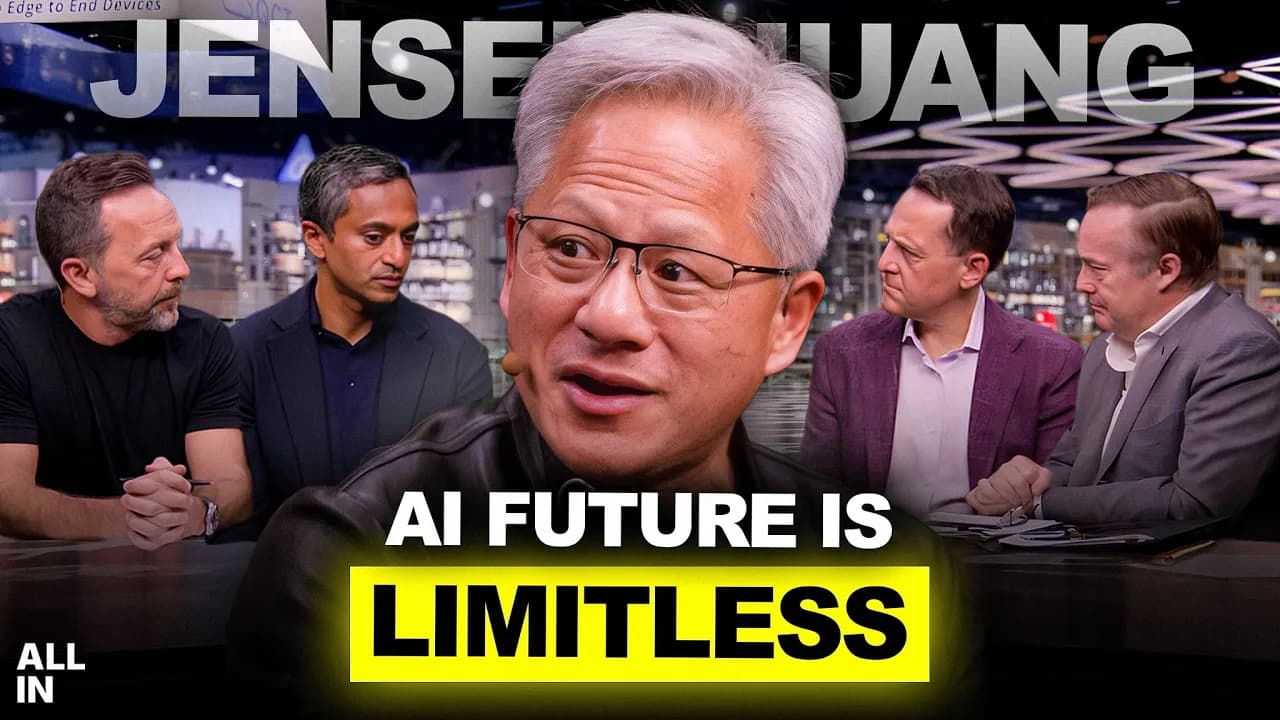
OpenAI released the first new performances of their chip Jalapeno. It's a custom inference chip developed with Broadcom, reporting 1.5 to 1.9x more AI work per watt and up to 3.6x lower end-to-end latency as compared to Nvidia's GB200s and GB300s. Jalapeno runs on 700 watts against the GB300 that runs at 1400 watts, half the power, 1.5 times the peak power token rate per kilowatt. The significance here is that OpenAI is not no longer just a customer of Nvidia. They're becoming a chip designer. Jensen was asked by a reporter how he feels about his largest customer competing with him now.
There's no doubt inference is moving off of Nvidia for sure. The 100x performance gain, this is the first 2x of 100x performance gains. That does not mean Nvidia has a problem though because training is staying on Nvidia and training is infinitely sold out just like inference is. But there's an enormous new industry for inference only emerging. 90% of the compute is inference time. This was just an idea at OpenAI just a few months ago and now it's a production chip, showing how short the cycle time on innovation is becoming with AI assistance.
The most startling statistic that OpenAI put out regarding Jalapeno was the throughput per second per user. Tokens per second per user increase that they got on Jalapeno not just on their frontier models but on their open source models like GPT-OSS. They claim almost a 54x throughput increase hosting GPT-OSS versus what they obliquely refer to as the existing best, presumably a reference to some NVIDIA architecture. That's so startling.
The only way that OpenAI could achieve a tape out so quickly is in conjunction with a Broadcom closed PN. This is so startling and potentially such a huge throughput increase. It makes one scratch their head and wonder whether OpenAI might actually choose to become a hyperscaler themselves with their own chips in-house. It's like crazy future would be a heck of a plot twist. OpenAI might have the optionality in a year or two of saying hey market, in addition to our own models we're going to respond to the competitive threat of Chinese openweight models and other openweight models by surprise. OpenAI offers its own cloud. We'll call it OpenAI compute. It'll be hosted on OpenAI chips and we'll still make money just like Elon is making money hand over fist hosting everyone else's models including Anthropic.
One of the things that was mentioned was that the Nvidia's CUDA moat may be dead in this next few coming years. CUDA is still the dominant mode for AI researchers who are working on new training. All the AI researchers in the world move to Python and PyTorch to do the because you can iterate your ideas so much more quickly in that environment and then to run it at scale you're like well here's my code just run. The only way to say just run is the CUDA layer translates your PyTorch right into Nvidia micro kernels runs at blazing fast speeds. Nvidia invested a lot of time, human time, coding that up, pre-AI coding and it became so pervasive that when AI took off, only Nvidia chips could be used for all this training and research because it would have been a nightmare to try and port all these mantle algorithms to AMD or to some other vendor. That's why Nvidia is the most powerful company in the world or most valuable company in the world today is specifically because of that brilliant early support of AI researchers when nobody else cared about them.
Now everyone's like well but now I can vibe code anything in like a millisecond. Why is the CUDA thing still a moat? At inference time it's not. Your inference algorithms are so easy to port to AMD or Intel that you just don't care about CUDA. You can vibe up your own solution. But for the advanced researchers, they still overwhelmingly use CUDA. Nvidia realized that CUDA can't last forever, so they went and bought Mellanox to create massive high-speed interconnect. Now their big moat is look, if you want to run a 100,000 or a million GPUs in one coherent cluster, you still got to go with Nvidia only. Jensen's smart enough to know that your moat is only good until the next moat. He's moving the moat very intelligently and he has a huge amount of capital to keep moving with it. But CUDA as the inference time moat is already dead. CUDA as the training time moat is probably limited lifespan. But that's okay because the interconnect is the new moat.
Apple's new Mac Studio pairs the M5 Ultra with up to 512 GB of unified memory, giving a desktop Mac enough memory to run some of the largest open AI models available locally on your desktop. Apple unveiled also the M6, its first chip manufactured at the 2nm process. Finally, Apple is in the AI game now pushing local AI as an alternative to AI in the cloud. The M5 512 gig unified memory puts a massive amount of intelligence under your desk. This really changes the economics from paying per token perpetually to buying a capital asset and then using it continuously. Apple's gone to the extra level of starting to lease its equipment out to people. This is really a big deal.
The big winners here are comp law firms, healthcare companies that have HIPPA issues and can't put their stuff on the cloud. Everything can much more stuff can now be done on prem. This is going to be for medium-size healthcare firms that can't afford a private cloud. This is such a natural advantage for Apple to go down this path. So you get four of these Mac studios clustered together. Now you've got like a small private data center. That's a pretty big deal.
The speaker is at the end of their rope with Apple. Nobody has changed their life more that they've never met than Steve Jobs. The Apple 2 that they got when they were a kid totally changed their life. When they came out with Mac OS based on Linux, changed their life again. It's absolutely the greatest company they've ever seen. But they have totally missed the boat. It's just embarrassing that a company with that much cash flow has no AI strategy. They don't even deserve to be a Mag 7 company anymore. It's just pathetic. If the best they can do in the age of AI is add a bunch more RAM to a machine that they already had, what the hell, man. It's 0.01% of what they should have done by now in AI.
The irony is even deeper. If you look at the ancestry of how unified memory architecture came about and the neural engine inside the M series, you can trace the lineage back to the Apple car. The Apple car was the reason why Apple first introduced the neural engine with access to this huge unified memory addressable space. Apple's interaction with AI is almost a history of hardware that's too good for the software or conversely software that just isn't worthy of the hardware. Apple had the early unified matmul acceleration built into a unified addressing space. Apple had the TSMC connection. Apple had the raw transistor throughput to basically be Nvidia and then some. They fumbled it. They had Siri before everyone else. They had audio interaction. All of these various forms and Apple software fumbled the ball.
Under John Ternus, Apple is going to decide it really does, Tim Cook used to always say and before Tim Steve Jobs that they want it to be hardware plus software plus services. It just seems like Apple's hardware at least to the consumer side is incredible. Their services are also not that bad, but they're so fumbling and so underutilizing still infamously their amazing hardware with their software. To John, if you're listening and you're looking for guidance on what Apple should be doing in this new era under your CEOship, please just take your amazing hardware and unleash it with much better software that integrates AI natively.
Apple is the one brand that you can trust with your information. It's the one and only brand. Here we are in the age of AI. Everyone's confused. It's incredibly powerful. It would change the world. Such a different world if Steve Jobs had not made his stupid health decisions and not treated his cancer. The speaker met Steve once and had a one-word conversation with him. The speaker was having an enterprise meeting. Larry Page, co-founder of Google, was on their board, and he hosted us for an evening dinner.
At an X-Prize event dinner hosted by Larry Page, Steve Jobs was present but visibly disengaged with his arms folded. When approached and greeted, Jobs barely nodded and responded "Nope" when asked if he wanted to be there. The interaction lasted only seconds.
A couple of months before the 2007 iPhone announcement, Jerry Yang organized a full-day offsite with all Yahoo vice presidents. Steve Jobs delivered a keynote and upon seeing approximately 300 vice presidents in the room, remarked: "I think I see the problem with Yahoo right there." This illustrated Jobs' view that excessive organizational overhead signaled dysfunction.
The speaker owns multiple MacBooks signed by Steve Wozniak from a 90-minute debate held several years ago. Several signed units were given away to community members who were thrilled by the episode. Wozniak emphasized that technology enables tinkering and play, which he identified as the core of creativity.
The speaker's first stock purchase was Apple, which they still regret not holding long-term.
Actonide, a commercial startup, demonstrated enrichment of natural uranium into high assay low-enriched uranium (HALEU) at 15.38% purity—five times the traditional 3-5% enrichment used in conventional reactors. This addresses a critical gap for small modular reactor (SMR) companies targeting 2030 deployments, as none currently have fuel secured. The technology represents a departure from Manhattan Project-era methods still used in the U.S., including uranium hexafluoride gas and centrifuges.
The Atomic Energy Commission formed after the Manhattan Project created a quasi-governmental monopoly on nuclear physics. This governance structure may have constrained progress for 80 years. Alternative enrichment technologies like the calutron, known since the Manhattan Project, use electromagnetic magnets, vacuum systems, and power electronics—advances from 80 years of chip and Moore's Law development that have not been applied to uranium enrichment due to regulatory constraints.
From a venture capital perspective, nuclear innovation faces billion-dollar regulatory costs that deter investment. However, SMR companies are now receiving VC funding and going public.
Ember data shows China's monthly solar generation increased 800% over six years, from 20 terawatts per month in 2020 to 160 terawatts per month in mid-2026. Nuclear power in China grew at least 50% while U.S. nuclear generation remained flat. China generates energy at near-zero marginal cost from solar, compared to U.S. natural gas at six dollars per million British thermal units. The AI race involves both chips and energy costs for running those chips.
The gap between China's and U.S. energy deployment curves reflects linear versus exponential thinking. Solar deployment is underestimated when focusing on installed capacity rather than the vertical slope of deployment curves. China's advantage stems from an entire industrial system optimized around manufacturing, supply chain, permitting, and deployment—contrasted with U.S. challenges in grid interconnection, transmission, and permitting speed.
Battery storage enables adding solar capacity immediately rather than waiting 15 years for gigawatt-scale projects. Energy abundance serves as a multiplier across all exponential technologies.
A country's GDP is directly proportional to its energy production. Nuclear development in the U.S. has remained stagnant for decades.
Rain Maker's 10 drones flying over Alaska's Kenai Peninsula generated an estimated 19 million gallons of additional rainfall in three hours using glaciogenic cloud seeding. Applications include drought relief, agriculture, wildfire prevention, and water security. The atmosphere contains 3.4 quadrillion gallons of water, making atmospheric capture viable.
Future weather control systems could use solar-powered drone fleets continuously aloft, dispensing particulates as needed under centralized AI algorithm control. This third path alongside terrestrial reflectors and LEO-based systems could enable total weather control, including diverting or dispersing hurricanes before formation, managing tornadoes and extreme weather, and creating global weather trading markets where regions trade precipitation rights.
Cities could bid on drone deployment locations. Weather doesn't respect boundaries, creating potential tensions when one region seeds clouds affecting downstream areas. The breakthrough lies in proving measurable additional rainfall, unlocking scalable applications. Geoengineering business models include crop management and other programmable precipitation uses.
A Singularity University student proposed ocean platforms spraying seawater upward to block sunlight and slow global warming, with advertising revenue from shaping spray patterns like corporate logos along flight paths. The counterargument to geoengineering concerns is that humanity has already been conducting uncontrolled geoengineering for 100 years, as evidenced by disasters like Nepal's current crisis.
Fountain Life data shows 3.3% of members who consider themselves healthy have undetected cancer. Most lethal cancers are found at late stages when cure rates are low. Early detection significantly improves treatment outcomes. Detection methods include full-body MRI and early cancer detection screening not typically used in conventional prevention settings. Insurance does not yet cover these studies.
The FDA approved Duraxenrasib, the first RAS inhibitor for metastatic pancreatic adenocarcinoma, targeting the RAS family of proteins driving tumor growth. Pancreatic cancer is historically the most lethal and least treatable human cancer. In previously treated metastatic cases, the drug nearly doubled median survival from 6.7 to 13.2 months and tripled tumor response rates from 11% to 32%. RAS mutations drive approximately 30% of all human cancers, suggesting broader applications.
Duraxenrasib is a daily oral tablet developed through traditional drug design methods, predating AI-driven approaches like AlphaFold 3 and virtual cell models. The FDA approved it 60-90 days ahead of schedule, indicating improved responsiveness. The FDA is adopting Bayesian versus frequentist statistics and showing interest in reducing clinical trial requirements in exemplary cases.
University of Nottingham researchers developed a biomimetic gel using lab-engineered proteins that mimic natural enamel formation processes during infancy. The fluoride-free treatment regenerates actual tooth enamel rather than depositing an amorphous coating. The elastin-like protein matrix acts as scaffolding, organizing calcium and phosphate into properly structured minerals. Regenerated enamel matches natural properties including hardness, stiffness, water resistance, friction resistance, and durability against brushing, chewing, and acid exposure.
Oral disease affects half the population with associated annual costs estimated at half a trillion dollars. The research remains in vitro using extracted human teeth but is advancing toward human testing. The mouth serves as a direct corridor to the brain and heart, making oral health critical. This represents a shift from repairing broken biological components to convincing the body to rebuild them through identified mechanisms and pathways. Similar biomaterial discoveries may apply to bone regrowth and other regenerative medicine applications.
The panel discussed research on melanoma vaccines and regenerative medicine, noting approximately no AI was used in the current studies. This represents a significant opportunity since without AI these breakthroughs remain one-offs rather than scalable platforms. The expectation is that multiplying such research by orders of magnitude with AI will accelerate progress in regenerative medicine substantially over the next few years.
The conversation shifted to the vision of repeatable regenerative medicine where growing teeth, arms, ears, or any body part becomes a scalable process. Current work on limb regrowth is making amazing progress, but the panel emphasized the need to infuse AI into these medical breakthroughs to make them truly scalable and solve everything rather than remaining isolated developments.
Deloitte reported a potential lunar economy valued at $566 billion in cumulative economic value by 2050. The panel found this estimate extremely conservative, citing major early markets including infrastructure costs, transportation, power, communications, mobility, construction, and life support. SpaceX is positioned as the biggest winner due to Starship's central role in lunar development.
Elon Musk's plans for Star Mine involve starting with 100 to 200 gigawatts per year of orbital AI compute launched from Earth, then moving to manufacturing AI satellites on the moon for launch with a mass driver. This could yield as much as 100 terawatts per year of orbital compute based on lunar production, generating an estimated $2 quadrillion per year in gross revenue.
The panel discussed why Deloitte and similar consulting firms produce conservative estimates, noting that many staff are accountants concerned about being called out for unrealistic projections. They also maintain extensive internal review systems with lawyers and cross-reference checkers that dilute thinking. The recommendation is to take any of their estimates and multiply by 10 or 20 times to reach more realistic figures.
The key advantage of lunar manufacturing is escaping Earth's gravity well. Building power plants using lunar minerals becomes significantly more efficient with no pollution concerns. Lunar regolith contains silicon for power generation, along with aluminum, nickel, iron, and oxygen - perfect materials for building Dyson swarms.
The panel identified the pedophab (planetary data center) as the killer app for the moon rather than tourism, transportation infrastructure, or communications. The Apollo program is viewed as relatively unsuccessful compared to what full private development could achieve. The critical path appears to be mining chips and fabricating data centers on the moon rather than government-led initiatives.
Once chip manufacturing begins on the moon along with solar panel production, exponential takeoff becomes possible. Many components in fab construction are routine aluminum and construction materials, with only a few critical pieces requiring Earth manufacturing and launch. The technology for lunar manufacturing is not far away.
Jared Isaacman was praised as an extraordinary NASA administrator, described as the best, most eloquent, most visionary, and most business-minded among administrators over the last 40-50 years. As an accelerationist, he is positioned to support humanity moving beyond Earth.
Tesla announced expanded Cybercab rollout in Texas with 79 Model Ys registered for robo-taxi service. In Las Vegas alone, 2,500 vehicles will be deployed in the next year. Tesla's long-term milestone is reaching one million robo-taxis in commercial operations, potentially generating $100 billion in ride-share revenue.
Users of new Full Self-Driving Model Ys describe the experience as life-changing. The waitlist for Model Y is currently about three months. The panel noted that FSD will be everywhere soon, making it worthwhile to get on the waitlist for continuous AI dialogue capabilities.
The shift from purchasing cars to autonomous revenue miles represents a fundamental change. Fleet growth will lower wait times, improve user experience, increase rides, and generate more data for the inner loop improvement cycle. Insurance models, cleaning, and charging infrastructure will all transform, with gas stations potentially becoming autonomous car cleaning depots.
A bet made 10 years ago that children will never need driver's licenses is approaching validation with Cybercab rollout. The panel emphasized this as important for maintaining credibility as futurists. The abundance story extends to the poorest people on the planet being driven by electric autonomous vehicles as the cheapest mode of transportation.
Cybercab uses eight cameras compared to Waymo's LIDAR, radar, and 13 cameras. The design philosophy follows that if humans can drive with one or two eyes, cars should be able to drive with cameras. Cybercab is described as massively AI-driven compared to competitors.
Luminar, a LIDAR provider, declared bankruptcy half a year ago. The panel suggested the market abhors monopolies and expects at least 5-10 competing LIDAR companies to emerge, driving down prices through competition.
Somnia Lab built Model L, a 5-foot-9-inch, 44-pound robot with 24 degrees of freedom, warmth simulation, touch response, and preference memory designed for human-robot sexual encounters. The robot takes $300 deposits for delivery in late 2027. Real humans wearing motion capture suits recorded 165 intimate actions to train the model.
The robot attempts to combine physical embodiment, persistent AI memory, and personalization by remembering conversations and preferences across encounters while learning user rhythms and communication styles. The body uses lightweight carbon fiber with modular skin and structural components for servicing and upgrading. Customers can customize face, makeup, eyes, skin appearance, and body silhouette.
Embodied AI faces difficult data problems since internet-scale datasets don't exist for physical human interaction. The economic approach involves crowdfunding early customers, then using customer demand to finance hardware and generate interaction data as the product scales - a classic exponential flywheel approach.
The panel suggested that pre-training or post-training robots from watching videos may work better than human motion capture for economically productive applications. The motion capture approach for intimate actions is viewed as a 2026 story that doesn't scale as well as pre-training from internet video.
The Moonshots Live event is scheduled for September 24th evening and September 25th all day in LA. Applications are available at moonshots.com. The event features the Moonshots quintet with opportunities to network and grill panelists including Alex, Sam, and Dave.
Keep Peter H. Diamandis in your library
Save the videos and channels worth coming back to, and find them again in one place.