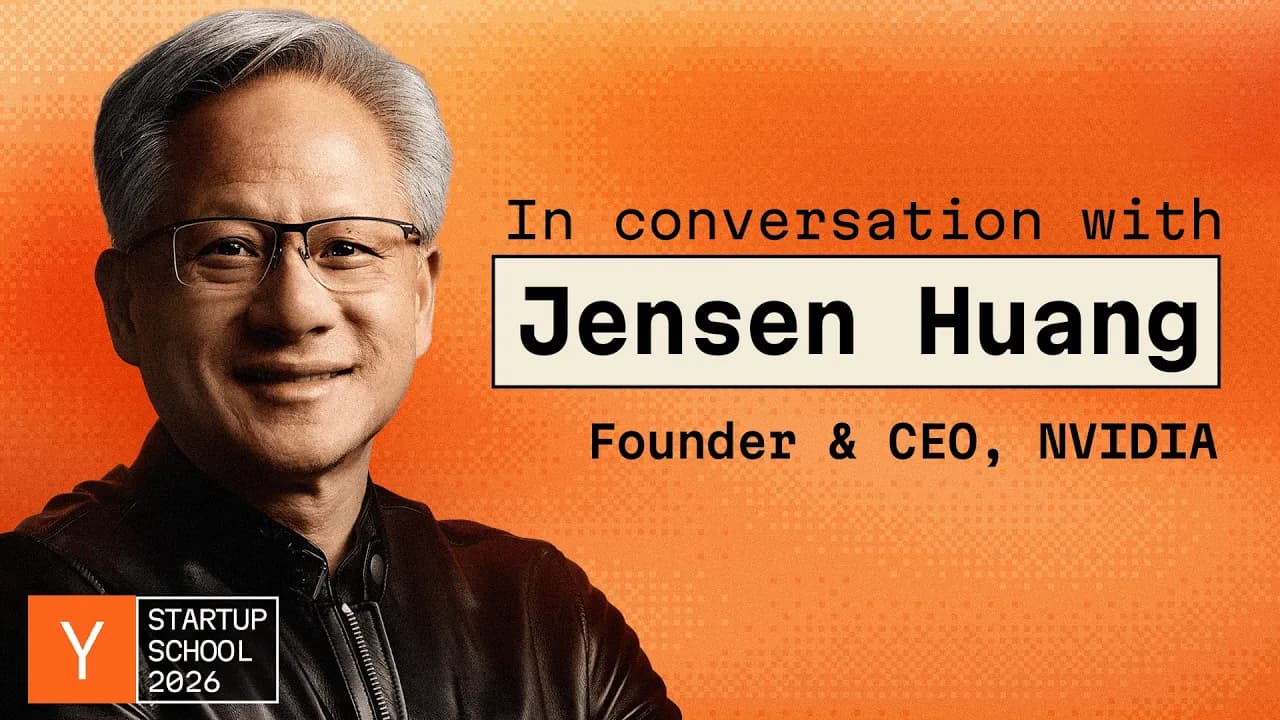
Jensen Huang: Nvidia's Future, Physical AI, Rise of the Agent, Inference Explosion, AI PR Crisis
In a Nutshell
Jensen Huang outlines Nvidia's evolution into an AI factory company via Dynamo OS and disaggregated inference, powering a 1000x inference explosion, agentic AI processing (Vera Rubin GPUs + Grok LPUs), and trillion-dollar markets in physical AI, robotics, digital biology, and autonomous systems. Agentic AI—shift from generative to reasoning to agents—drives 10,000x compute demand, reinvents programming with superhuman employee capabilities, and amplifies enterprise software, while open-source models like Open Claude enable personal AI computers with robust governance. Nvidia dominates via full-stack infrastructure, urges proactive AI PR to counter doomerism, and forecasts explosive growth amid policy shifts favoring US leadership, with robots unlocking economic mobility and jobs transforming rather than disappearing.
These notes were generated by AI and may contain inaccuracies.
Special episode preempting the weekly show for Jensen Huang. Every industry, tech company, and AI company present at the event. Jensen going all in.
If building a global financial system from first principles today, build Airwall, one AI-native platform for global accounts, cards, and payments. Makes the world feel like a local market. Built for the intelligent era from day one. Visit awallix.comallin.
One of the great announcements: purchase of Grok. Discussion on Chamath becoming insufferable post-acquisition. Deal closed in two weeks.
Strategies presented in broad daylight at GTC years in advance. Two and a half years ago, introduced Dynamo, the operating system of the AI factory. Dynamo named after Siemens machine that turned water into electricity, powering the last industrial revolution. Fundamental technology inside Dynamo: disaggregated inference.
Disaggregated inference: processing pipeline of inference is the most complicated computing problem today with incredible scale and lots of mathematics of different shapes and sizes. Disaggregate parts of processing: some run on some GPUs, rest on different GPUs. Led to disaggregated computing with heterogeneous nature. Same sensibility led to Mellanox acquisition. Nvidia's computing now across GPUs, CPUs, switches, scale-up switches, scale-out switches, networking processors, adding Grok. Put the right workload on the right chips. Evolved from GPU company to AI factory company.
Fundamental disaggregation: from GPU to complexion of options. Allocate 25% of data center space to Grok LPU alongside GPUs like Vera Rubin. Shift from large language model processing to agentic processing: accessing working memory, long-term memory, using tools, beating up on storage. Agents working with agents: large models, smaller models, diffusion models, autoregressive models. Vera Rubin designed for diverse workloads. Added four more racks to what was a one-rack company, increasing Nvidia's TAM by 33-50%. Includes storage processors (Blue Field), Grok processors, CPUs, networking processors. All running the computer of the AI revolution: agents. Operating system of modern industry.
Three computers at largest scale: 1) training AI models, 2) evaluating (e.g., virtual gym for robots/cars obeying laws of physics - Omniverse), 3) edge robotics computer (self-driving car, robot, teddy bear). Telecom base stations ($2 trillion industry) transforming into AI infrastructure extension: radios as edge devices for factories, warehouses.
Last year, predicted inference to increase 1000x. Now inference constrained. Announced inference factory 10x better throughput than next factory. Chatter: Nvidia's costs $40-50B vs. custom ASICs/AMD at $25-30B, losing share.
Do not equate factory price with token cost. $50B factory generates lowest cost tokens due to 10x efficiency. $20B is land, power, shell; plus storage, networking, CPUs, servers, cooling. Difference between $50B and $40B not large percentage when 10x throughput. Even if chips free, not cheap enough if can't keep up with tech pace.
Most valuable company, $350B+ revenue next year, $200B free cash flow, compounding crazily. CEO job to define strategy, vision. Informed by computer scientists, technologists. Criteria: insanely hard, never done before, taps company superpowers, expect pain/suffering. Enjoy the pain if super hard.
Physical AI: $50T industry void of tech until now. Invent all tech needed; 10-year journey started 10 years ago, inflecting now, multi-billion business nearing $10B/year, growing exponentially.
Digital biology: Near ChatGPT moment. Represent genes, proteins, cells (already know chemicals). Understand dynamics of biology building blocks in 2-3-5 years. Healthcare industry to inflect in 5 years.
Agriculture inflecting now.
Company built on hobbyists, gamers, graphics cards. Announced Dell 6800 workstation: powerful for local models, 750GB RAM. Shift to open CLaudel (open-source agents).
Three inflections last two years: 1) Generative AI via ChatGPT UI, 2) Reasoning (internal tokens for thinking, grounded info), 3) Agentic (Claude Code, revolutionized for enterprises; Open Claude brought to popular consciousness).
Open Claude important culturally and reinvents computing: memory system, short-term memory file system (scratch), skills, resources, scheduling (cron jobs, spawn/decompose tasks), IO subsystems (input/output, WhatsApp), API for skills. Four elements define a computer: personal artificial intelligence computer, open-source, runs everywhere. Blueprint/OS of modern computing.
Governance essential: agentic software accesses sensitive info, executes code, communicates externally. Contributed to Peter Steinberger and engineers for security, privacy, policies (not all three: access, execute, communicate simultaneously).
Paradigm shift makes much AI legislation moot. Inform policymakers: AI is computer software, not biological, alien, conscious. Understand it well. Avoid doomerism/extremism. Tech moves fast; don't let policy get ahead. National security risk: other countries adopt AI while US fears it, industries/society miss out. Worry about AI diffusion in US.
Anthropic tech incredible; Nvidia large consumer. Admire security/safety focus, culture, excellence. Warning good, scaring less good. Be circumspect, humble; can't fully predict future. Extreme/catastrophic claims without evidence damaging. Tech leaders' words matter now; be moderate, balanced, thoughtful.
Industry needs proactive PR: AI 17% popularity in US. Nuclear example: shut down US industry, China building 100 fission reactors, US zero. Moratoriums on data centers.
Anthropic/OpenAI $5-6B/month (Oppenheimer moment). Trillion-dollar visibility for Blackwell/Vera Rubin. Revenues will scale with intelligence: audience 99% non-Anthropic/OpenAI, diverse AI. Open-source #2 model category after OpenAI, Anthropic distant third.
Generative to reasoning: 100x compute. Reasoning to agentic: another 100x. Two years: 10,000x compute. People pay for work/deeds, not just info/research. Agentic gets work done.
100x more consumption, haven't started scaling: at millionx inference.
43,000 employees, 38,000 engineers. $500K/year engineer must consume $250K+ tokens or alarming (vs. $5K). No different than chip designer refusing tools.
Nvidia employees won't need CAD tools, marking a paradigm shift to all-star employees with superhuman abilities, akin to LeBron James spending a million dollars a year on his health at age 41, still playing.
If these are incredible knowledge workers, why wouldn't we give them superhuman abilities?
Future Efficiency of All-Stars in 2-3 Years
Thoughts like "this is too hard," "this is going to take a long time," "we're going to need a lot of people" disappear. Similar to the industrial revolution where no one says "that building looks heavy" or "that mountain looks too big." Everything too big, too heavy, or taking too long vanishes, reducing work to pure creativity.
Working with Agents: New Programming Paradigm
Future programming involves writing ideas, architectures, specifications, organizing teams, defining evaluation criteria for good vs. bad outcomes, iteration, and brainstorming. Every engineer will have hundreds of agents.
Executives like David Freeberg with Ohalo use Nvidia technology for zero-shot genomic modeling to reduce high-quality calorie production costs. People replace entire enterprise software stacks overnight; one example replaced a whole workload in 90 minutes using Claude on a Sunday night at 10 p.m., done by 11:30 p.m. As CEO, replaced it, and management team did similar exercises over the weekend. By Monday, realized "it's over."
Auto Research Breakthrough
In 30 minutes using Auto Research on a desktop with ingested data, produced results equivalent to a celebrated PhD thesis taking seven years, publishable in Science. Happened Friday after downloading from GitHub. Acceleration widens opportunities unimaginably.
Auto Research Insights
Published with 600 lines of code in a weekend, runs locally on diverse datasets. Timing perfect due to breakthroughs in large language models like Claude, GPT, ChatGPT enabling tool use (web browsers, Excel, Synopsys, Cadence, Omniverse, Blender, Autodesk).
Enterprise IT not destroyed; limited by butts-in-seats, now 100x more agents using tools like SQL, vector databases, Blender, Photoshop. Tools excel and serve as conduits for human control and ground truth (e.g., Synopsys, Cadence).
Closed-source models excellent; open-weight models, including Chinese ones, incredible. BitTensor Subnet 3 trained 4B parameter Llama model distributedly with excess compute from random people, statefully—modern Folding@Home.
End State of Open Source
Need both proprietary models as first-class products and open source. Models are technology, not service. Consumers prefer not fine-tuning; use ChatGPT, Claude, Gemini, X based on mood/problem. Domain expertise requires controllable open models. Open models near frontier; products-as-service thrive alongside.
Startups invest in open source first, then proprietary via routers for world's best model day one, enabling cost reduction, fine-tuning, specialization.
Biden-era diffusion rules anti-American. Under new administration, President Trump wants US industry to lead, spread technology, make US wealthiest. Nvidia gave up 95% market share in second-largest market (China), now at 0%; Trump wants recovery. Licenses approved by Secretary Lutnik for requesting companies; purchase orders received, supply chain cranking up.
National Security and AI Leadership
Security diminished without access to miniature motors, rare earths, telecom control, sustainable energy—don't want AI like that. Ideal: American tech stack (chips, systems, platforms) 90% worldwide; others build apps on it. Avoid solar/rare earth/motors/telecom outcome.
Monitoring China-Taiwan, Middle East helium risks. Nvidia has 6,000 families in Middle East, many Iranians with families in Iran—full support, anxious. 100% committed to Israel, Middle East; post-war more stable, expand AI there.
Taiwan Strategy
- Re-industrialize US (chips, computers, AI factories)—excellent progress via Taiwan friendship, building Arizona/Texas/California fast; Taiwan strategic partner.
- Diversify supply chain (South Korea, Japan, Europe) for resilience.
- Demonstrate restraint/patience.
Helium potentially problematic, but supply chain has buffers.
Everything that moves becomes autonomous completely/partly. Nvidia enables all car companies: built training, simulation, evaluation, car computers; world's safest driving OS; first reasoning AV (Thor) decomposes scenarios like humans. Vertical optimization, horizontal innovation; flexible (e.g., Tesla buys training computers).
Nvidia only AI company building foundation models at frontier across domains, full stack; works with every AI company (they hide, Nvidia shows). Compete on best tech; economic to buy Nvidia. Only architecture for every cloud, on-prem, car, region, space. 40% business requires full CUDA stack for AI factories/infrastructure.
Gaining share: velocity helps realize systems harder than chips; AWS buying 1M chips next couple years atop existing; Anthropic, Meta Llama to Nvidia; open models growth; regional/enterprise/edge growth.
Analysts forecast Nvidia growth at 30% next year, 20% after, 7% in 2029 despite 1M-x compute potential, implying share plummet. They misunderstand AI scale/breadth—not just top 5 hyperscalers; orthodoxy of large numbers limits belief (5T to 15T market impossible).
Nvidia redefines: not chips, full AI infrastructure. CPU data center $25B/year; Nvidia does $25B quickly. AI bigger than OpenAI/Anthropic alone.
Already in space with radiation-hardened CUDA in satellites for imaging/AI processing (do in space, not send data down). Ground first; space has energy but cooling challenge (radiation only, needs large surfaces)—exploring architectures, takes years.
Nvidia big healthcare effort. US spends twice as much, gets half; 15-25% on first GP visits—LLMs like ChatGPT do better consistently. Using Claude for billing code analysis.
Squats, push-ups, sit-ups for health.
Nvidia is involved in several areas in healthcare. First is AI biology, using AI to understand, represent, and predict biological behavior, crucial for drug discovery. Second is AI agents for assisting in diagnosis, with examples like Open Evidence and Hypocratic. Agentic technology will revolutionize interactions with doctors and healthcare. Third is physical AI, where AI understands the laws of physics, used for robotic surgery and instruments like ultrasound or CT scans. Every hospital instrument will be agentic, with a safe version of Open Claw inside, interacting uniquely with patients, nurses, and doctors.
It would be wonderful to see some investment in AI EMTs and paramedics and saving lives, not just taking them.
There's been a lost decade or 20 years in robotics, with Boston Dynamics, Google buying and selling companies, as people thought robotics wasn't ready. Now Elon Musk's Optimus is impressive, along with companies in China. America invented the industry but got exhausted five years before enabling technology like the brain appeared. From high-functioning existence proof to reasonable products takes two to three cycles, or 3 to 5 years. Robots will be everywhere in 3 to 5 years.
China is formidable due to leadership in microelectronics, motors, rare earth, and magnets, foundational to robotics. The global robotics industry relies on their ecosystem and supply chain, leading to fast movements.
Elon predicts one robot per human: 7 billion for 7 billion, 8 billion for 8 billion. Jensen hopes for more. Factories will have robots working around the clock, including stationary ones that move a little; almost everything will be robotic.
Robotics unlocks economic mobility like cars did, enabling new jobs. Everyone with a robot can run an Etsy or Shopify store, create anything, do things independently impossible. Robots are the greatest unlock for prosperity for more people than any prior technology.
Simple math: millions short in labor today; companies could grow more with labor. Robots enable virtual presence: remotely operate home robot to walk the dog, rake leaves, check on house, chat with kids or dog. Time travel at speed of light: send robots ahead, upload AI, not oneself.
Robots unlock moon and Mars colonization with infinite resources. Factories on the moon make goods using solar to accelerate material back at zero energy cost from Earth. Distance no longer matters.
More revenue from models and agents funds infrastructure, unlocking more capabilities. Dario Amodei on Dwarkesh's podcast forecasts hundreds of billions in revenue from model and agent companies by 2027-28, a trillion by 2030 (non-infrastructure AI revenue). Jensen thinks Dario is conservative; Anthropic will do way better, from $30 billion to a trillion.
Every enterprise software company will be a value-added reseller of Anthropic, OpenAI tokens, expanding go-to-market logarithmically.
Deep specialization is the moat. General models connect into software company's agentic system, including cloud, proprietary, and specialized sub-agents trained on their data.
Call to arms for entrepreneurs: know your vertical deeply, better than anyone. Tools are catching up; imbue with your knowledge. Connect agent with customers soonest for flywheel effect.
Inversion of today: now build general software, sell broadly, customize around it via GSIs and consultants (5-6x bigger industry). Platform companies can become vertical specialists and domain experts.
You're not going to lose your job to AI. You're going to lose your job to somebody using AI.
Hold space for two ideas: job displacement and opportunity. 100% of human driving will go away (beautiful, saves lives), displacing 10-15 million in US. Question is fortitude to embrace technologies.
Jobs change: chauffeurs become mobility assistants in self-driving cars, handling luggage, assisting to hotel, coordinating via phone. Autopilot in planes created more pilots despite flying 90% of time.
Every job transforms; some eliminated, many created. Advice to young people: be expert at using AI. Employers want AI experts who specify without overprescribing, leaving room for AI innovation while guiding outcomes—requires artistry.
Study deep science, deep math, language skills (language is AI's programming language; English majors could be most successful). Ensure deep expertise in using AIs.
Early deep learning prediction: computer vision eliminates radiologists. 10 years later, 100% integrated into radiology, but number of radiologists increased, demand skyrocketed. Scans done faster/more, improving healthcare, onboarding/treating patients quicker. Hospitals do more scans, revenues up, productivity increases, wealthier country affords more teachers with personalized AI curricula per student. All students assisted by AI, but need great teachers.
Too much doomermongering; be vocal about positive side. Humility: making software. Invented categories before; no need for scaremongering. We choose how to employ this with autonomy and agency.
Keep All-In Podcast in your library
Save the videos and channels worth coming back to, and find them again in one place.