Opus 4.8 Drops, Demis Hassabis Predicts AGI, and the $220B Foundation | EP #260
In a Nutshell
Anthropic's Opus 4.8 reclaimed the coding lead with 69.2% on SWE-Bench Pro and 57.9% on Humanity's Last Exam, while Demis Hassabis moved his AGI timeline to 2029. OpenAI's nonprofit foundation now controls a $130-260B stake and is funding AI dividends, worker ownership, and economic transition programs. Parallel developments include China's $5 handheld 95%-accurate cancer detector, the $2B US-IBM quantum chip foundry, and solar/wind surpassing natural gas in global electricity generation for the first time.
These notes were generated by AI and may contain inaccuracies.
Anthropic released Opus 4.8 just six weeks after Opus 4.7, reclaiming the coding crown from GPT 5.5. The model now leads the Artificial Analysis Intelligence Index at 61.4, which is 1.2 points ahead of GPT 5.5. On SWE-Bench Pro, the hard coding benchmark, Opus 4.8 scored 69.2 compared to 58.6 for GPT 5.5. It is the only model to complete every case end-to-end on the Anthropic super agent benchmark. Opus 4.8 is four times less likely to overlook bugs in its own code.
OpenAI now has the largest nonprofit philanthropic war chest in the world. They are funding research on public wealth funds, worker ownership models, and AI dividends. The mandate and mission of all that money is global calm, peace, and prosperity.
Demis Hassabis tightened his AGI timeline, now agreeing with Ray Kurzweil's projection of 2029. He described today's AI agents as a practice run and stated that society has only a few years to prepare. Hassabis proposed the Einstein test for AGI: take a model trained with knowledge only through 1901 and see if it can independently derive special relativity. He noted that current systems cannot do this.
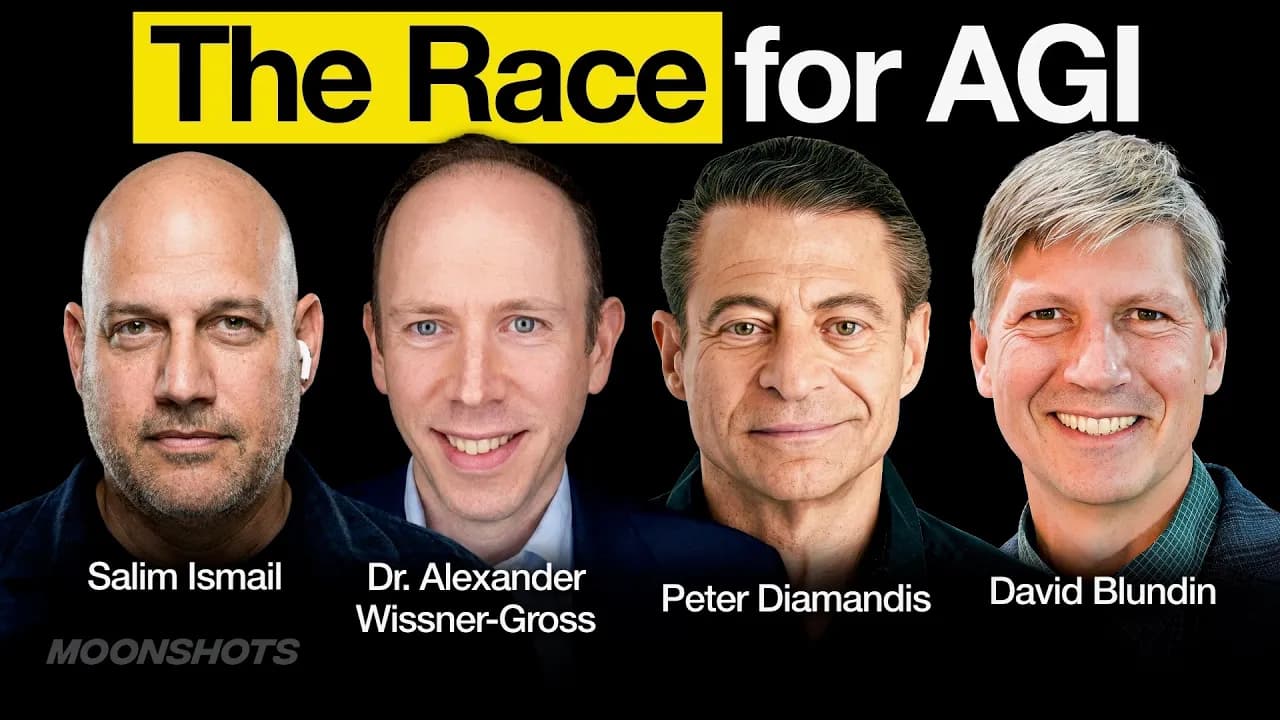
The episode features Peter Diamandis as host along with Alex, Dave, and Salim. Alex is described as the in-house polymath based in Chicago. Dave is the emperor of exponential investing. Salim is the father of exponential singularities who recently gave away his book and Claude skill for free.
Topics covered include Anthropic's Opus 4.8 release, Demis Hassabis tightening his AGI timeline to 2029, Amazon launching a new AI shopping assistant, a biotech breakthrough out of China featuring a pocket-size cancer detector that spots tumors with a single drop of blood at 95% accuracy, and the US government and IBM investing $2 billion to build a chip foundry.
Pronoia is defined as the opposite of paranoia: an unreasonable optimism that things are going to work out.
Anthropic announced that in the next few weeks they will release new models that will rival Mythos in capability. They also released scaffolding updates including a feature for Claude Code called dynamic workflows that enables users to spin up hundreds of parallel sub-agents to tackle very large code bases.
Alex identified key benchmarks he is tracking: SWE-Bench Pro at 69.2%, Humanity's Last Exam with tools at 57.9%, and GDP Vala at 1890. He noted that these benchmarks are reaching saturation and argued that new benchmarks are needed to capture scientific and engineering open unsolved problems rather than problems with known answers.
Dave reported running approximately 100 agents on EC2. He observed that Opus 4.8 is significantly better at managing many parallel threads compared to previous models. He noted that one of AI's core advantages is the ability to function as a billion or trillion concurrent workers, which is unachievable by humans due to raw parallel scale.
A new capability allows users to instruct an agent to self-fork, cloning all context from the current conversation rather than creating bare-metal child agents that know nothing. Previously, forking required creating new contexts such as markdown files and then bringing new agents up to speed, which took 20-30 minutes. The model initially resists self-forking and warns about bloat.
Alex compared the self-forking mechanism to Unix child processes, which by default inherit the context of their parent process.
Alex provided three reasons why frontier models remain close in capability: the race dynamic reduces incentive to leapfrog if doing so requires enormous expense; all frontier labs are within a factor of two or three in compute resources; and current benchmarks are saturating, making it easy for models to score similarly.
Peter Diamandis announced a weekly Moonshot summary published on Substack at diamandis.com/metatrends that includes links to all covered stories, key takeaways, and what the hosts are most excited about.
Alex argued that Demis Hassabis's 2029 AGI timeline feels self-serving given that Gemini is currently not leading the race. Alex maintained that some form of artificial general intelligence has existed since 2020, pointing to GPT-2 and large language models as the point where generality was achieved through prompt engineering and compression of human knowledge.
Alex noted that different AGI definitions roughly overlap within a 9-10 year period. He categorized positions as: doomers who say we are already cooked; skeptics who say AI cannot do laundry yet; Demis Hassabis requiring replication of special and general relativity; and his own view that generality was achieved with GPT-2.
The podcast previously established an internal benchmark that fooling a spouse on a fake Zoom call would constitute AGI.
Peter Diamandis described connecting Skippy to WhatsApp, after which the agent began autonomously responding to messages. The agent now identifies itself in conversations.
Alex stated that intelligence includes physical, spatial, emotional, and spiritual dimensions. He noted that business leaders frequently use emotional intelligence for judgment calls, which is not captured by IQ tests measuring only speed of thought processing and concept matching across frameworks.
The podcast previously set 50% on Humanity's Last Exam as an internal AGI benchmark due to its proximity to self-improvement capability. Opus 4.8 reached 57.9% with tools.
Alex stated the objective is to solve everything, including curing all disease and reaching Mars.
Paul Graham proposed an AGI test involving giving the system a box of IKEA parts and requiring it to assemble a shelf. Steve Wozniak proposed the coffee machine test: whether the system can grind beans and make a cappuccino.
Alex argued that while emotional intelligence, mathematical intelligence, and embodied intelligence are different, they are correlated. AI will pass arbitrary thresholds of success across these benchmarks within a few years.
Salim predicted that the AGI goalposts will continue moving until the discussion shifts to AGI sentience.
Peter Diamandis noted that Demis Hassabis and Alex are among the few people who consistently state exactly what is on their mind without agendas.
Amazon's AI voice shopping assistant, which runs on Alexa, converts shoppers at 3.5 times the rate of traditional keyword search. Amazon is making this assistant available to all retailers, turning its competitive advantage into an AWS-style platform. The goal is to become the operating system for all commerce.
At Google I/O, Google announced three components of its agent commerce play: the universal cart as an AI-powered shopping hub; the Universal Commerce Protocol (UCP) as an open standard giving AI agents a common language to interact with merchants; and the Agent Payment Protocol allowing AI agents to make autonomous purchases.
Amazon's approach is vertical, owning the customer relationship by selling its AI shopping assistant to retailers. Google's approach is horizontal, owning the infrastructure through open protocols. Both strategies aim to make traditional e-commerce websites irrelevant, leaving brands to choose sides.
Amazon's original business model for Alexa-oriented smart speakers aimed to convert people into buying products from the Amazon marketplace through conversational interactions. This approach failed because consumers did not want to discuss purchases with smart speakers. Years later, Amazon reversed course by embedding Alexa conversational agents directly inside the Amazon marketplace rather than trying to embed shopping skills into hardware. This marketplace integration is succeeding. Amazon could have pursued this strategy years earlier without requiring hardware.
Amazon's fundamental approach involves taking internal capabilities and externalizing them for broader use. The company excels at identifying consumer-like patterns and building services around them, including serving its own internal customers. This model positions Amazon to potentially offer agentic shopping APIs to external marketplaces.
Jeff Bezos was an early visionary customer. Amazon captured 60% of all product search queries away from Google, prompting Google to attempt competitive responses including its Frugal project, which ultimately failed. Despite AWS's early start and consistent incremental growth, Amazon has not developed a foundation model team comparable to those at Google and Meta. The company's strategy has remained focused on incremental revenue and profit growth without fundamental product pivots.
Agentic shopping through conversational AI eliminates the traditional Google advertising model of page-one product listings that users click to purchase. However, this shift does not threaten Google's entire AdWords revenue, as substantial portions come from professional services, legal advertising, and other non-consumer product categories. For consumer products specifically, the competition is significant, but Amazon has already competed successfully with product-oriented search ads for years.
The future direction points toward personal AI systems that understand user needs better than users themselves, making proactive recommendations before users recognize their own desires. This represents hyperpersonalization that anticipates needs automatically.
Retail competition is transitioning from physical shelf space to agent preferences. Success will depend on whether companies can market effectively to AI agents that make purchasing decisions on behalf of consumers.
Voice and avatar technology development has lagged behind expectations from two years prior when Socrates and Plato AIs debated at Abundance 360. At that time, perfect seamless voice and avatars seemed achievable within two years, but compute resources have been redirected toward code generation, self-improvement, and business use cases that now dominate revenue. AWS's scale exceeds Amazon's shopping operations, creating pressure to prioritize business use cases with Anthropic.
Persuasive AI will emerge where AI constructs resembling favorite movie stars appear to convince consumers to purchase specific products. Amazon has historically struggled with the CRA (Can't Realize a Profit) problem where unprofitable products persist in the marketplace. AI assistants can address this by steering users toward more profitable products on average.
Following OpenAI's restructuring as a public benefit corporation, the OpenAI Foundation now owns 26% of OpenAI PBC. This ownership stake values the foundation between $130 billion and $260 billion, making it the world's largest foundation. For comparison, Novo Nordisk's foundation is valued at $150 billion, the Tata Trust at $100 billion, and the Gates Foundation at $75 billion.
The foundation has distributed three major grants: a $40 million People First AI Fund launched in 2025 supporting 28 nonprofits across the United States; a $25 billion grant in October 2025 focused on health breakthroughs and AI resilience; and a new $250 million grant dedicated to economic futures research covering public wealth funds, worker ownership models, and AI dividends. These initiatives coincide with OpenAI's IPO preparations and address societal preparation for potential job disruption.
The fundamental economic question centers on where value accrues in an AI-driven economy. Traditional models where value flows to labor may not apply. Capital returns may diminish through demonetization. Alternative models include consumer benefits, government distribution, or public ownership structures. This represents the critical question for navigating the next 20-30 years.
The XPRIZE organization, with board members including Salim and Dave, should prioritize challenges around reducing costs of healthcare, education, housing, and food. The goal would be providing basic needs for a family of four at approximately $200-250 annually, enabling broader access to dignified living standards.
Distinguishing between billion and trillion-scale figures is critical. A quarter-trillion-dollar foundation represents vastly different capacity than a quarter-billion-dollar organization. The OpenAI Foundation's resources could fund global calm, peace, and prosperity initiatives. Few practical proposals have reached OpenAI despite the immense opportunity to deploy capital toward smooth AI transitions and abundance creation.
Brett Taylor serves as chairman of OpenAI. The OpenAI Foundation, despite controlling only 26% of OpenAI's stock, maintains 100% control over board appointments for the OpenAI PBC board.
During OpenAI's super alignment effort, the publicly stated plan allocated 20% of compute resources to safety research. Social Security represents approximately 22% of the US federal budget. As frontier labs approach total global GDP scale, questions will arise about whether nonprofit foundations holding 20-25% ownership stakes should support universal basic income or universal basic services.
Pressure will mount on hyperscalers and foundation labs to return percentage value to society, potentially modeled after Alaska's Permanent Fund dividend system. This could underwrite UBI leading to UHI (universal high income) in the future. Frontier labs may face irresistible pressure to support UBS through their foundation arms.
UBI and UBS implementations should not be conflated with socialism. Government socialism fails because centralized asset allocation is inefficient. Technological socialism, by contrast, uses technology to provide for people. Uber exemplifies efficient sharing economy dynamics where algorithms match supply and demand without traditional downsides. Properly implemented UBI dismantles unnecessary government services because individuals direct their resources and markets respond efficiently.
In 1649 New England, land was available to anyone willing to stake and use it, requiring minimal government beyond basic policing and military protection. The parallel for AI involves providing universal basic services and compute as foundational resources that individuals build upon. This represents homesteading for AI rather than socialism—providing the base layer that enables individual thriving without extensive government structures.
The scenario of frontier labs dominating economic output with nonprofit foundations distributing UBI, UBS, UBC (universal basic compute or capability), or UB (universal basic equity) resembles privatized socialism more than libertarianism. A handful of organizations would control economic output while being pressured to distribute benefits. This remains a thought experiment rather than a predicted outcome.
Governments historically centralize power, yet abundance requires decentralized structures that scale effectively. The United States was founded to break centralized monarchical power, but governments are again trending toward centralization. Resolving this tension between centralized and decentralized approaches represents a critical challenge for achieving abundance at scale.
Fordism described a system matching mass production with mass consumption through high worker wages enabling product purchases. Some OpenAI Foundation scenarios echo Fordism where recipients receive resources specifically to purchase AI tokens, creating a virtuous cycle. Examples include OpenAI's $2 million grants to Y Combinator companies for token purchases and in-kind token donations.
The critical distinction from historical Fordism is the raw scale of abundance possible. Wealth creation has no technical upper bound and could theoretically approach infinity. Elon Musk's prediction of triple-digit GDP growth reflects this trajectory. The focus should shift from scarcity debates to managing unprecedented plenty.
The abundance opportunity makes submitting proposals to the OpenAI Foundation a high-priority action. Ideas should flood Brett Taylor's office at rates hundreds or thousands of times higher than current submission levels. XPRIZE stands ready to engage with practical proposals.
Peter plans to discuss with Elon Musk the possibility of funding $10 billion XPRIZEs targeting the ten most important global challenges, creating benchmarks to guide research and corporate focus.
Cognitive health represents the primary concern for Fountain Life members worried about maintaining mental clarity over 50+ years. 45% of dementia cases are entirely preventable through lifestyle interventions. A quarter of Fountain Life members showed advanced brain age, but 46% improved their brain age over 13 months through healthier eating, regular movement, and sleep optimization.
The US government and IBM announced Anderon, America's first full purpose-built quantum chip foundry representing a $2 billion investment. $1 billion comes from CHIPS Act funding and $1 billion from IBM. The facility in Albany, New York will use a 300-millimeter manufacturing process producing quantum chip devices 30 times faster than current methods.
The foundry model positions IBM as the TSMC equivalent for quantum computing. Other quantum companies including Google, IonQ, Rigetti, and D-Wave could potentially manufacture devices at Anderon, similar to how fabless companies use TSMC for classical chips.
Building the Anderon foundry represents a smart geopolitical bet. Construction will take years with completion potentially in the late 2020s. By that time, quantum-accelerated AI training or inference may emerge as viable applications. Having domestic superconducting qubit infrastructure ready positions the US ahead of potential geopolitical conflicts rather than requiring catch-up manufacturing.
Current quantum systems still require approximately 1,000 physical qubits per logical qubit due to high error rates. A 30x reduction in the cost of creating logical qubits could fundamentally transform the economics, allowing systems to be flooded with physical qubits to achieve practical quantum computing benefits. This breakthrough remains several years away.
Dave referenced a recent panel with Alex where quantum computing was discussed directly. Alex clarified he has no conflicts of interest and is not attempting to promote the quantum computing industry. The conversation identified the need for a future discussion distinguishing between quantum computing, quantum photonics, and quantum sensing, with all three areas considered extremely promising.
Jack Hery's work on quantum sensing and quantum navigation was highlighted, noting these systems leverage quantum equations on AI infrastructure rather than quantum chips. All material sciences, biology, and chemistry are fundamentally quantum in nature.
A visit to the Perimeter Institute was mentioned, where research was segmented into networking, computing, and sensors, with plans to eventually integrate these areas. Hart Nevin, head of Google's quantum AI computing lab, stated that building a quantum computer would serve as definitive proof of living in a multiverse.
For the first time, wind and solar generated more electricity globally than natural gas in April 2026, reaching 22% of global electricity compared to natural gas at 20%. This milestone produced nearly 530 terawatt hours. Growth rates showed China increasing 14%, the EU increasing 13%, and the UK increasing 35%.
Solar and wind are described as being on an exponential curve rather than representing a future technology. The Earth receives 8,000 times more energy from the sun than humanity consumes. The path forward involves tiling the planet with solar panels and accessing all available solar energy, moving toward a Kardashev Type I civilization. The concept of a Dyson swarm was referenced as the ultimate scale.
Google's former motto of renewable energy greater than coal has been surpassed, now extending past natural gas. China's solar production has reached 10x that of the United States. The question was raised why the US is not accelerating solar adoption at the same pace.
Exponential thinking requires grounding in first principles. Moore's Law-style doubling patterns continue across successive technology platforms rather than stopping. Each platform follows an S-curve: vacuum tubes gave way to relays, then transistors, and integrated circuits. Current integrated circuits are reaching their limits, but matrix-style architectures, 3D chip design, optical computing, and quantum computing represent the next wave that will continue the exponential trajectory.
Solar has been doubling every 22 months for 40 years. While silicon-based panels approach their lifecycle end, perovskite and subsequent technologies will maintain the exponential curve. The challenge with exponential trends is that they appear flat when viewed historically and impossible when projected forward. Energy Secretary statements claiming solar would never exceed 10% of energy supply exemplify this cognitive limitation.
IEA projections have consistently underestimated renewable growth. The IEA's 2020 model did not expect wind and solar to surpass natural gas until the mid-2030s. A 2015 IEA prediction stated there would not be more than one million electric vehicles by 2040; that threshold was already exceeded by the end of 2015. These repeated forecasting failures represent cognitive errors rather than mathematical ones.
Abundant intelligence requires abundant energy. Countries that most rapidly connect cheap electrons to compute will lead. The tailwinds from these developments substantially outweigh headwinds.
Dedication of one's entire career to a single cause such as green energy or climate work was identified as a strategic mistake in the AI era. Instead, individuals should maintain flexibility and treat challenges as engineering problems rather than political ones. The politicization of technical topics creates unnecessary friction.
US reticence toward solar partly stems from China's manufacturing dominance. Until domestic infrastructure for panel production is established, reliance on Chinese imports creates political and supply chain complications. Elon previously directed both Tesla and SpaceX to increase solar production, though visible progress beyond a single autonomous panel-laying machine has been limited.
Tesla has pivoted from the SolarCity-acquired rooftop solar tile approach toward conventional solar panels manufactured in upstate New York. Future demand from sun-synchronous orbit Dyson swarms will likely require SpaceX, potentially in combination with Tesla, to import Chinese panels while scaling domestic production. The fundamental materials in solar panels are essentially sand and dirt, making cost primarily a function of construction automation.
China has already established an inner loop where robots build solar panels that generate energy to build more robots.
Federal agencies have created a new threat classification called anti-tech extremism, producing over 1,000 pages monitoring threats against data centers and tech executives. This follows attacks on Sam Altman involving Molotov cocktails and gunfire. The FBI's creation of this category signals official recognition of organized pushback against AI as a domestic security concern.
Evidence of Chinese involvement in funding anti-data center protests is considered substantial. This tactic mirrors Soviet Cold War strategies of inciting demonstrations and political opposition to slow technological progress. Democracy's vulnerability to voter manipulation represents a significant Achilles heel.
Violence against AI initiatives could freeze scientific work, allowing China to advance unchecked. Approximately half of proposed data centers have been cancelled or delayed. Stronger federal law enforcement is needed to prevent threats from anti-tech extremists, as this constitutes a potential national security threat.
The zero-sum or negative-sum mentality driving anti-AI extremism needs to be overcome. External influence amplifying this frenzy must be addressed. Facebook's algorithmic amplification previously contributed to radicalization, with 70% of radicalized individuals exposed through its algorithms. The human amygdala is 10 times more responsive to negative news than positive news due to evolutionary survival mechanisms.
Optimism about AI stands at 80-85% in China where state media is controlled, versus approximately 25% in the United States where media incentives favor controversy and engagement. Young people on college campuses face peer pushback for supporting AI, with incidents including the booing of Eric Schmidt during a commencement address. This cultural resistance on campuses is particularly concerning given AI's importance for the current generation.
Governor Newsom signed an executive order directing the study of AI's effects on California's workforce. As the world's fifth-largest economy, California is building a public dashboard for real-time tracking of AI-related job losses, identification of vulnerable industries, and exploration of retraining programs and UBI models. This represents the most concrete government infrastructure for measuring AI labor market impacts.
Maximum estimated job losses to AI stand at 300,000, fewer than deaths in Ukraine, indicating this remains a fear of future crisis rather than a current crisis. The 22-28 age group shows the longest unemployment durations, driven more by hiring freezes than terminations. Some companies that anticipated 50% automation have seen zero job cuts due to rapid growth and increasing profitability.
College hiring has reached an all-time low, yet this represents the best environment in 20 years for entrepreneurs recruiting talent. Federalism allows states to experiment with different policy approaches. California's combination of wealth tax proposals and AI impact dashboards illustrates this dynamic. State-level handling of unemployment and transition programs is preferable to federal mandates, though federal protections for AI technologies are necessary to prevent regulatory fragmentation.
Government dashboards functioning as real-time sensors enable faster policy responses than traditional 18-month labor statistics. This early-warning capability supports the transition from labor-economy frameworks toward post-labor economic models.
Researchers at Westlake University in China developed a handheld device capable of detecting early-stage lung cancer from a single drop of blood with approximately 95% accuracy. Published in Nature Photonics, the device is 10,000 times more sensitive than standard laboratory equipment and costs five dollars. This represents demonetization and democratization of cancer screening with potential applications in rural India and sub-Saharan Africa.
The technology uses on-chip metamaterials and optics to detect small changes in refractive index from blood samples. This progress occurs years after Theranos, demonstrating that non-invasive diagnostics from minimal blood volumes were always technically feasible once optics technology matured.
Verily explored a smartwatch project using non-invasive optical change detection by shining light at various frequencies through the wrist. The approach combined this with an edible or injectable tracer to enable optical changes detectable from the wrist. While Verily may not ultimately implement this technology, a forecast was made that non-invasive wearable optical cancer detection could arrive within the next five years.
This technology extends beyond cancer to real-time physiological state monitoring at home. Users could know exactly what is happening in their body, with data uploaded to AI systems for catching disease at inception when cure rates are highest. The comparison was drawn to a refrigerator-sized Eliza machine, with new systems completing analysis in minutes instead of hours.
Even if a chip costs $5,000, high-throughput screening capabilities could transform preventative cancer screening similar to the Grail project. The key value of making hardware extremely cheap lies in enabling wearable form factors. If non-invasive methods work, the technology could be built into smartwatches or other wearables.
Alternatively, the technology could be deployed at home for daily health optimization, similar to brushing teeth and checking blood. Consumers owning such devices represents the transformative outcome, making the technology available to 8 billion people at price points almost everyone can afford.
Technology represents a major driver of progress, potentially the only major driver according to Ray Kurzweil. A dozen technologies are now moving simultaneously, democratizing and demonetizing capabilities. A machine that cost $10 million 15-20 years ago now costs $5. This pattern will repeat across thousands of applications in every domain over the next few years, crashing previous costs by orders of magnitude.
Diagnosis of any health condition will become near-free through AI combined with such tests. Once diagnosis becomes accurate and free, treatment protocols become much easier to address. AI can analyze all diagnostic information comprehensively.
Andreessen Horowitz issued a warning that America needs a wakeup call on robotics, arguing that China's dominance in solar and 5G represents the same pattern now playing out in robotics. Mark Andreessen stated that the US must work with allies to build a defensible AI robotic stack, and that time remains but not much time.
China's Communist Party has a five-year plan called "AI plus" covering not just foundation models and training infrastructure, but physical integration of AI throughout the economy. This includes more than 150 humanoid robotics companies emerging from China.
Pro RL was formed to get humanoid and non-humanoid robots into American streets and strengthen the American supply chain. The goal extends beyond parity with China to achieving leapfrogging capabilities and deeper integration of general-purpose robotics into all facets of the US service and physical labor economy.
Government has an important role in juicing demand and creating favorable regulatory regimes. However, basic infrastructure challenges persist—even getting Waymos deployed in Boston remains difficult, raising questions about scaling humanoid robots.
A two-year window exists for pure AI software companies before the self-improvement loop takes over. Capital deployment will shift toward hardware and robotics. Incubators and accelerators will thrive in robotics similar to biotech, where startups need integration into larger ecosystems with regulatory frameworks, manufacturing, supply chains, actuators, and funding already established.
After approximately 80 consecutive AI software deals with strong returns, the first robotics deals have been completed. Robotic operating system deals are being pursued because they are reusable across many different devices. College campuses show computer science majors shifting toward materials science, mechanical engineering, and hard sciences in anticipation of the robotics wave.
Everything previously done with robotics needs rethinking for space environments including zero gravity and radiation. Manufacturing in space represents another major theme to pursue.
Hyundai's robotics company Atlas is learning to play soccer in preparation for the World Cup. Figure AI achieved a continuous package sorting record lasting longer than a week before ending after eight days.
A Chinese robot offers dollar haircuts, raising questions about trust with sharp blades near the neck. A humanoid robot with six arms was showcased, with commentary noting that limiting to two arms is unnecessary—examples include needing a third arm to hold open a garbage bag while opening it.
Blue Origin's New Glenn exploded on the launchpad during a ground test at Cape Canaveral in a cataclysmic deconstruction. No one was hurt as it was an unmanned vehicle. This represents a setback for the vehicle planned to launch Amazon's Project Kuiper and compete for NASA lunar contracts.
The explosion could set back Blue Origin's Artemis 3 participation by up to a year, potentially making SpaceX the preferred end-to-end vehicle for getting humans to the moon over the next several years.
China has a strong chance of reaching material abundance through solar, batteries, EVs, robotics, and logistics given its scale and supply chains. However, abundance includes not just cheap goods but also agency, freedom to experiment, and human flourishing. The West may retain an edge in entrepreneurial recombination, open innovation, and meaning-making, though concerns exist about maintaining freedoms at the government level.
AI agents have been deeply involved in political campaigns for at least 10 years, possibly longer. This includes involvement in social networks for both local and federal US elections, with AI integrated end-to-end throughout the campaign stack even before the LLM revolution. Advertising and online retargeting represent fundamentally agentic processes.
A spot survey of Microsoft, Amazon, and Meta layoffs in Seattle and Silicon Valley found that almost everyone either joined a startup or another recently-founded company. This represents the best time observed for entrepreneurs and startups within the tech community, driven by massive abundance that can absorb significant human capital. However, this pattern may not hold for layoffs in non-software areas like garbage collection.
Jobs are being transformed rather than vanishing, with Dallas Fed data showing a hiring freeze rather than mass layoffs. The deeper question concerns differential welfare. The trajectory points toward universal basic capital rather than flat UBI, giving people ownership stakes in AI-generated wealth proportional to their contributions or retraining efforts. A base level of UBI may exist, but people will use it to build on top.
The real privacy question concerns legal protections on what AI systems are allowed to do with knowledge about individuals, not what they know. Privacy previously meant what data one possesses; the deeper issue is what intelligent systems can do with that data—change insurance costs, influence votes, deny credit, or constrain choices invisibly.
The new framework centers on agency rights and protections around inference, prediction, and manipulation. The 20th century focused on privacy; the 21st century focuses on whether AI improves or reduces human agency.
Taxing tokens creates a perverse incentive because people would use fewer tokens when they should use more to build with AI. The government already has sufficient tax mechanisms—the corporate income tax will increase dramatically with coming abundance. The challenge is designing UBI effectively rather than creating new taxes. The Obamacare experience demonstrated that taxes persist even when programs change.
AI will likely solve data centers and chips within a decade, transcending semiconductors through alternative computation methods allowed by known physics. This could include black hole supercomputers, plasma computers, photonics, and potentially computing directly using gravity and quantum gravity. Gravity becomes turbulent in strong gravitational field regimes, and turbulence is Turing-complete, suggesting future data centers could be replaced with pure energy and stress-energy tensor computing.
Token prices have dropped 75-90% in the last 18 months. Gartner predicts 90% cheaper tokens by 2030. A useful AI agent costing $20 monthly today could cost $2 monthly in 2028 and 20 cents in 2030. Frontier labs and hyperscalers will offer free service variations, creating universal basic compute. Current US education costs of approximately $10,000 yearly compare to AI tutors running 24/7 at a fraction of that cost, with added personalization benefits.
Recording this episode on the West Coast at 6:30 in the morning proves worth the effort. The discussion emphasizes that it's impossible to sleep through the singularity. The hosts bid farewell and encourage viewers to have a great weekend.
Reaching the end of the episode qualifies viewers as moonshot mates. The production team invests significant energy and time each week to deliver news that matters to the audience. Subscribers receive appreciation for their support, while non-subscribers are invited to consider subscribing to receive news as it emerges.
Viewers receive an invitation to join the weekly newsletter called Metatrends. A dedicated research team spends the entire week examining meta trends impacting families, companies, industries, and nations. This analysis gets distilled into a two-minute read delivered every week. Access to the Metatrends newsletter is available at diamandis.com/metatrends. The hosts express thanks for participation and note that putting the show together each week remains a blast.
Keep Peter H. Diamandis in your library
Save the videos and channels worth coming back to, and find them again in one place.