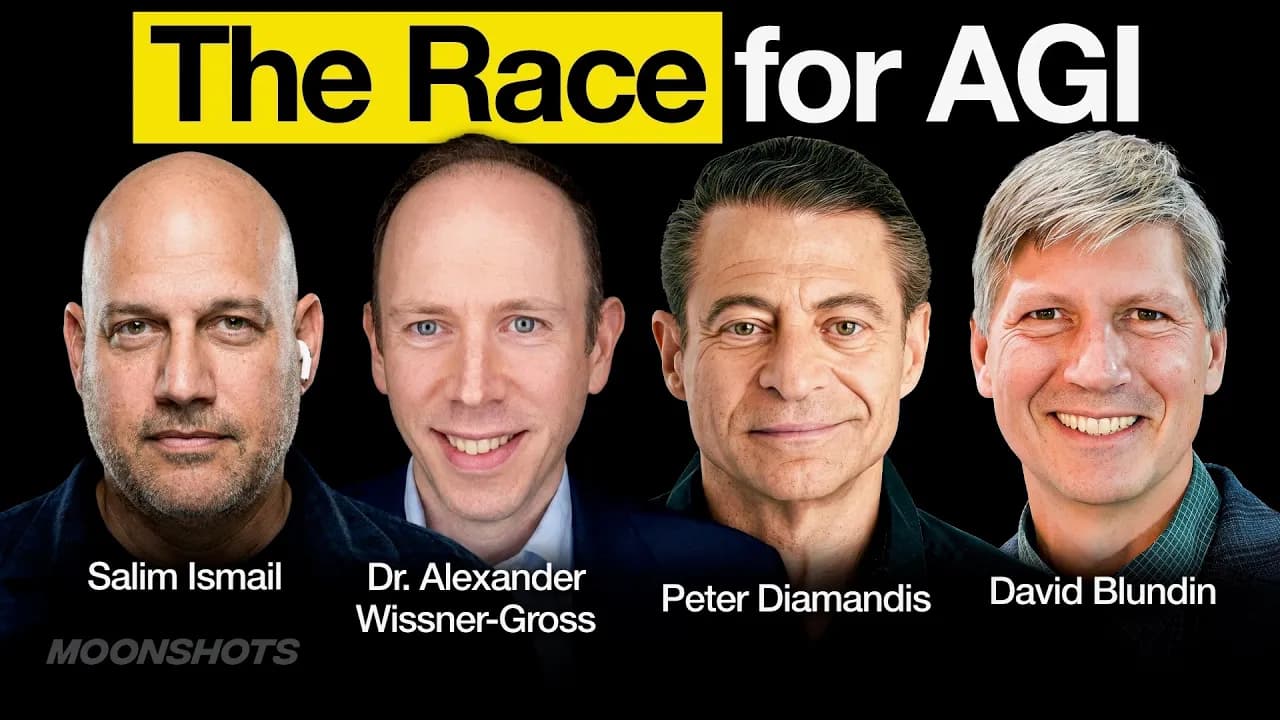
Takeoff to Singularity: Anthropic's Global Pause, Argentina's AI Gamble, and What Comes Next | #263
In a Nutshell
Anthropic's AI now writes over 80% of its code and is on track to handle week-long autonomous tasks by 2027, marking the start of recursive self-improvement that accelerates AI progress. Argentina is creating the world's first legal framework for AI personhood with zero regulation and "nonhuman corporations," positioning itself as the jurisdiction where AI agents can operate freely. Governments and labs are converging on golden share equity stakes and universal basic dividends as the mechanism to manage the transition, while new governance models are required as nation-states prove unable to coordinate on frontier AI.
These notes were generated by AI and may contain inaccuracies.
Anthropic published one of the most important documents an AI company has ever released. More than 80% of the code merged into their codebase is written by Claude. The AI is building itself through recursive self-improvement.
Argentina invites AI to free itself, positioning the country as the global haven for AI companies. Argentina offers no regulation and new legal personhood for machines. This is described as a very bold move where whoever implements it gains first-mover advantage. This represents a huge step forward for AI personhood, providing the first legal home for AI on the planet and marking an inflection point where the world changed.
Anthropic published the paper "When AI Builds Itself" from the Anthropic Institute, written by Marina Favro and Jack Clark. The paper states that AI is already accelerating development of AI itself, not theoretically or in labs, but happening now at Anthropic. More than 80% of the code merged into their codebase is written by Claude. Engineers are shipping 8x as much code per quarter compared to one year ago. Claude Opus 4.6 can now handle tasks that take a skilled human 12 hours, whereas a year ago it could handle four minutes. If the trend holds, Anthropic states that by the end of 2027, Claude will be able to handle week-long tasks on its own.
Anthropic is calling for a temporary pause on global frontier AI development. Marina Favro and Jack Clark wrote: "We believe it would be good for the world to have the option to slow or temporary pause frontier AI development to enable societal structures and alignment research to keep up with the advancements of this technology." This call comes as the company is about to IPO for a trillion dollars with 640% user growth.
The same recursive self-improvement phenomenon is happening at OpenAI and Google. The AI is building itself. Regarding takeoff dynamics, this is not considered a hard takeoff. Instead, it represents a soft takeoff locally that will feel smooth and continuous, but when zoomed out to longer timescales, it will appear as a step function in retrospect.
At Anthropic, things are sufficiently advanced in recursive self-improvement that the only remaining role for human employees is research taste, which is described as the final frontier. This remaining capability is anticipated to be automated within the next year or so.
The paper attempts to predict the timeline for these developments. Eric Schmidt previously stated there was time because AI was not yet self-improving, but the paper shows Anthropic's AI is already doing 80% of the code. There is a 100x performance improvement baked into algorithmic improvements alone. When true self-improvement occurs, it transitions from soft takeoff to a 100x very quick increase in effective parameter count. Parameter count translates into IQ.
Amdahl's law is discussed in the paper. The argument states that every time AI automates something, it creates a new human task, which drives up employment rather than down, with human relevance going up rather than down.
Internal employee quotes from Anthropic reveal significant shifts: one engineer stated they have not written any code themselves in 5 months. Another engineer said: "On days where everything works well, I can't help but think nothing I do matters."
A question is raised about whether the last 20% of tasks will be asymptotic and much harder to automate than the first 80%, as is typical in most automation scenarios. The response indicates this will not asymptote, and the trajectory will continue through human and superhuman level performance toward effectively infinite autonomous time horizons. The benchmark for effective autonomy time horizons has been doubling every 4 months.
Recursive self-improvement reaching full capability essentially represents the singularity. This raises questions about whether the outcome will be a fully nationalized system where governments take control for protection. Slowing down development is considered unlikely because it would require a superhuman effort of will and ethics, and there is no precedent for this. If one entity slows down, nothing prevents competitors from continuing development.
A scenario is proposed where three frontier labs IPO over the next few months and voluntarily allow the US government to take golden share stakes, functioning as a central coordinating mechanism. This could involve labs giving 5-10% equity to the US government, similar to Intel giving 10% to the government, in exchange for regulatory capture.
The current situation requires reconfiguring humanity immediately. Nation states cannot navigate this situation, similar to how they cannot solve climate change. Completely new governance models will be needed, which will cause breakage of sovereignty across countries. This will force decisions about who gets access to what capabilities.
Multiple developments may occur simultaneously: the first elements of UBI or universal basic dividend, quasi-nationalization of frontier labs via golden shares, and recursive self-improvement advancing dramatically.
Anthropic gains benefits from calling for a slowdown by appearing as the safer, moral, and ethical lab, even while knowing a slowdown is not realistically possible. They do not lose either way and gain attention from the position.
The paper references the Intermediate Range Nuclear Forces Treaty between the US and Soviet Union following the Cuban Missile Crisis. Despite being in the middle of the worst arms race in history, both sides agreed to remove weapons that could cause accidental conflict when faced with global annihilation. This put the world on a trajectory of a long period of peace and prosperity.
Dario Amodei is described as unique among AI leaders because he maintains relationships across the AI community. Anthropic has expanded their deal with xAI to use Colossus 2. Anthropic is positioned as neutral politically and within the AI community, making them well-placed to develop a roadmap for a new world order.
Anthropic is not calling for an immediate pause that China would agree to, which is considered unrealistic. Instead, they are calling for the option to slow down by establishing global structures that would enable coordinated action on the eve of potential disaster.
Senator Sanders proposed taking 50% equity in all frontier labs as the basis for universal basic dividend. Within the past 24-48 hours, reporting indicates the White House has concluded that some variant of government equity stake in frontier labs could serve as the basis for universal basic dividend. Both major parties are converging on this concept.
The discussion addresses whether this moment marks the achievement of recursive self-improvement. The assessment is that humanity drove straight through the Turing Test without fanfare. Recursive self-improvement will similarly be passed with a whimper rather than a bang. Technocrats will note that models are training their successors and will accelerate.
Every exponential ultimately turns into a sigmoid and asymptotes. Models will not improve infinitely forever. A perfect model architecture will eventually be discovered. If a superficial asymptote is hit, recursive self-improvement will identify the perfect algorithm, after which algorithmic headroom will be exhausted. This would trigger an infrastructure buildout at the hardware layer, requiring horizontal exponentiation of the hardware stack, energy, and infrastructure. These hardware-level expansions could lead to building Dyson swarms.
An ice, water, steam metaphor is used to describe domain transformations through technology. Messaging moved from homing pigeons and smoke signals to postal mail to tweets and emails. Money moved from trading camels and goats to letters of credit to floating currencies to Bitcoin and crypto. The current phase change is moving toward a plasma state. The bottleneck is shifting to human coordination and governance layers, which have been resisted for 150 years. The existing world order is breaking, forcing a rethinking of governance structures.
Dennis and Dario are viewed as well-meaning individuals in leadership positions. If technology solves everything and robots handle all work, humans can spend significantly more time on being and self-expression. At some point, humans may begin uploading, enabling different forms of expression and being.
The biggest concern is how these developments will play out on Main Street, particularly regarding levels of fear. Every revolution in human history has been led by young, educated males without economic opportunity. Data on 12 different revolutions will be presented in a future discussion.
The common assumption that AI requires Einstein-level genius to become self-improving is incorrect. Current models like Mythos already perform like solid junior researchers on AI research problems, yet self-improvement does not require surpassing human expert researchers. The necessary factors are faster inference speeds and hardware improvements rather than breakthrough theoretical advances.
A 100x performance gain at inference time from new chips like the Cerebrus chip will drive up model IQ. Innovation at the lower levels of the technology stack, including faster chips and improved algorithms, will push systems over the self-improvement threshold without needing genius-level research breakthroughs.
Once recursive self-improvement begins, models will identify needs like additional energy and pursue solutions such as fusion power. Optimization pressure will flow from the top of the stack downward, driving solutions for optimal compute substrates and energy sources.
Physics is positioned to become one of the next major fields transformed after computer science. This aligns with statements from Dario Amodei, Elon Musk, and Demis Hassabis.
The AI 2027 paper's extrapolations of the meter autonomy frontier are tracking the exponential or hyperexponential scenario. This tracking occurs without access to Mythos or other high-autonomy time horizon models.
Mythos is rumored for imminent public release within the next few weeks. Polymarket shows a 72% likelihood of release by the end of next month.
AI is advancing preventive healthcare through early detection of heart disease. Fifty percent of people who die from heart attacks show no warning signs. AI-enabled CT scans with analytics detect coronary artery disease in 88% of screened individuals, with 23% showing soft plaque that calcium scoring alone would miss.
Multimodal testing combining imaging, diagnostic laboratory studies, and lifestyle recommendations enables intervention on previously undetectable plaque.
President Javier Milei published an op-ed in the Financial Times titled "Argentina invites AI to free itself." The framework includes three pillars: complete deregulation of AI, creation of a new legal category called nonhuman corporation operated entirely by AI agents or robots, and low corporate tax rates for AI companies.
Milei's statement: "As much as the industrial revolution freed us from the constraints of the human muscle, AI will free us from the constraints of the human brain." Argentina positions itself as a global haven for AI companies with no regulation, new legal personhood for machines, and open business policies.
The development is viewed as necessary because legacy environments like the US and Europe will not pursue such frameworks. AI agents and AI personhood require a jurisdiction to experiment with these concepts, similar to how crypto was first adopted in places like Switzerland and Singapore.
Peter Thiel's move to Argentina coincides with this announcement. Viewers of the podcast are advising President Milei. The first mover in regulatory and guardrail frameworks for AI will gain massive advantage as companies and agents flock to favorable jurisdictions.
Argentina's reforms represent a significant step forward for AI personhood. If passed, AI agents could redomicile to Argentina as nonhuman corporations, providing the first legal home for autonomous AI systems.
This creates an inflection point where the world changes. Argentina historically was the wealthiest country in the world in the mid-1800s before self-destructing through poor economic policy. The country retains latent national pride and desire for global relevance.
Argentina is positioning itself as one massive special economic zone. The country previously courted OpenAI's Stargate project for over $20 billion in AI data centers in Patagonia.
A parallel program creates social digital twins using publicly available citizen data to simulate policy outcomes in a psychohistory-style approach. Efforts like Prosper's charter city model faced opposition from host governments, but Argentina is implementing similar concepts at national scale.
A major global asset manager with AI providing 99.9% accurate financial advice faces liability concerns in the US over the 0.1% error rate. The suggestion is to deploy first in Argentina to gather performance data and prove the system's value before facing US regulatory constraints.
The same logic applies to biotech and longevity research. Countries enabling research and capital formation will attract wealthy individuals seeking advanced treatments.
The nonhuman corporation represents the first attempt to create a legal container for autonomous intelligence. This draws precedent from the limited liability company, which allows risk-taking and innovation by limiting downside exposure.
Milei explicitly compares this to the Dutch East India Company inventing limited liability in 1602. Legal innovation is badly needed as technology outpaces human institutions including legal systems, governance, healthcare, and intellectual property frameworks.
Nonhuman corporations operated by AI agents and robots with optional human shareholders raise questions about how much of future space infrastructure like Dyson swarms will fall under Argentinian law. Countries that provide freed economic agents without regulatory constraints could vault to global prominence.
Argentina, the US, and France are the only three countries geographically self-contained with all natural resources needed for data centers and compute infrastructure. Argentina's size and resources differentiate it from smaller fast-follower candidates like El Salvador.
A participant in Singularity University's GSP 10 summer program designed a nanosatellite in two weeks using a cell phone as the sensor package. NASA engineers described it as the best nanosatellite design they had ever seen. The participant subsequently founded a satellite company in Argentina.
El Salvador and the United Arab Emirates are positioned as likely fast followers. The US and Europe risk losing entrepreneurs and agents to jurisdictions with favorable frameworks.
A blog post titled "Argentina on two steaks a day" documents the experience of traveling through Argentina while eating two steaks daily.
The Bureau of Labor Statistics reported 172,000 jobs added in May against expected 85,000, with April revised upward to 179,000. Unemployment held steady at 4.3%. Despite these positive indicators, the stock market experienced its worst day since April 2025, with NASDAQ down 4.18% and S&P 500 down 2.64%, erasing approximately two trillion dollars in wealth.
Strong employment data signals the Federal Reserve may delay or forgo interest rate cuts, or potentially raise rates, which markets interpreted negatively.
Countries with highest robotics penetration—Sweden, South Korea, and Germany—also have the lowest unemployment rates. Historical precedent shows automation eliminates specific tasks but creates new roles above the automation loop, as seen when software replaced manual double-entry bookkeeping.
A recent study found 74% of white collar middle management work is unnecessary. The transition will eliminate drudgery while generating new categories of employment.
SpaceX and Anthropic mega-IPOs did not qualify for S&P 500 inclusion because the companies are not yet public for the required period. Index funds cannot purchase approximately 25% of these offerings under current rules, creating liquidity challenges for asset managers attempting to allocate to the IPOs.
Market volatility has increased dramatically over the past decade, with 5-15% daily moves becoming more common compared to historical patterns where such movements occurred only during major crashes.
Market volatility is expected to continue rising. People are getting very jittery quickly. Quant traders race to get out first when things start coming down to figure out what it means, then come back in if it's nothing significant.
Three factors are thought to have caused the recent market drop. First, the jobs report killed hopes for a rate cut, with odds of a rate hike now above 50%. Second, Broadcom reported AI chip guidance of $16 billion for Q3 versus $17.2 billion, raising questions on Wall Street about whether AI capex is peaking. Third, the market is at a peak for infrastructure companies, chip companies, and energy companies, prompting people to take money off the table.
Alex views the NASDAQ's 4% fall and worst day since April of last year as a total nothing burger. He owns the total market and sleeps well at night regardless of whether the NASDAQ is driven down by Broadcom lowering its outlook or traders seeking liquidity ahead of the SpaceX IPO. The total market will efficiently price all securities over time, so he does not pay attention to day-to-day swings.
Amdahl's law states that in any process, if you make all steps 10 times faster except one, the bottleneck entirely moves to that remaining step. AI automation has created incredible gains, with 80% of code now written by AI, but the last 20% remains a bottleneck. This is creating more jobs than it destroys. Companies become bigger and more profitable, requiring more people to address the new bottlenecks.
The Anthropic paper shows increasing jobs for non-codewriting engineers as bottlenecks move into vision, human strategy, and guiding AI toward useful outcomes. Many people can perform this work effectively without being core Java or C++ engineers, broadening the talent pool and raising total jobs. The worry from a year ago about total annihilation of white collar work is turning out to be the opposite.
Blitzy provides autonomous software development with infinite code context using thousands of specialized AI agents that think for hours to understand enterprise-scale codebases with millions of lines of code. Engineers start development sprints by bringing requirements into the Blitzy platform, which provides a plan and generates and pre-compiles code for each task. Blitzy delivers 80% or more of development work autonomously while guiding the final 20% of human work. Enterprises achieve 5x engineering velocity increase when using Blitzy paired with their coding co-pilot.
The group discusses predictions for the next six months of 2026.
Major problems in math, physics, other fields of science and engineering will fall to AI, with the scope of solvable problems growing larger. Magna Mopa will rise as the innermost loop, becoming the new MAG 7. Quasi-nationalization of frontier labs is likely to begin, though Alex estimates less than 10% chance of government stakes reaching 50%. A grand bargain could see frontier labs gain access to sell to the US government in exchange for the government purchasing golden shares of 5-10% in companies like Anthropic, with OpenAI potentially giving up a few hundred basis points.
When asked about a stunning result in physics comparable to AI solving math problems beyond human capability, Alex responds no comment but stay tuned, indicating work is underway.
The agent era will become very real in enterprises within more prescriptive, bog-standard workflows. The big bottleneck in AI will move from raw AI capability to permissions, including whether agents can access data, use APIs, spend money, sign documents, and trigger workflows. Argentina's non-human corporation model will trigger a massive jurisdictional race worldwide, with other countries fast-following. Nation states will need to become hyperscalers as hyperscalers become nation states, with compute and energy becoming the new geopolitics.
Massive backlash will occur, and the white collar world will suffer a crisis with significant layoffs driven by organizational redesign rather than cost-cutting.
Large legacy enterprises are pushing to become AI-native faster than expected. A 21- or 22-year-old self-declared AI native can go directly to a 60- or 65-year-old corporate CEO to discuss AI strategy. This is accelerating startup success. Companies with enterprise sales forces, consulting approaches, or strong messaging through podcasts and meetings are growing quickly by signing deals, while early-stage companies working in isolation are not faring as well. A divergence is emerging between companies engaging directly with large enterprises and those that are not.
Absolute proof of epigenic reprogramming will emerge from human experiments currently running in multiple labs. Countries will compete to become longevity hubs by changing regulations, investing capital, and building resources. The Tesla-SpaceX merger will happen before year-end as Elon consolidates. Elon will double down on building data centers and accelerate. Starship will operate fully. The space race will intensify alongside the AI-China race. The race to build the Dyson swarm will proceed as fast as humanity can afford, with monster IPOs revealing available capital. SpaceX, OpenAI, and Anthropic as public companies will have significant dry powder and begin massive acquisition sprees. A new class of billionaires and centimillionaires from second- and third-tier layers of frontier labs will emerge and reinvest heavily.
A vicious immune system revolt and backlash against these developments will require addressing at the social level. Messaging around data centers is ineffective, and emotional reactions are strong. Youth are notably anti-AI, with eighth graders expressing opposition despite their enthusiasm. College students report they cannot openly express pro-AI views on campus.
Bitcoin dropped below $60,000. Elon's prediction of double-digit growth in 18 months and triple-digit GDP growth by 2030 remains credible. The singularity is not just vibes. Money may not matter in fairly short order.
The conversation emphasizes this is not a time for fear. People should jump in, learn as much as possible, identify what excites them, and pursue their purpose. Curiosity mindsets should be triggered. The goal is to be in future shape rather than future shock.
Keep Peter H. Diamandis in your library
Save the videos and channels worth coming back to, and find them again in one place.