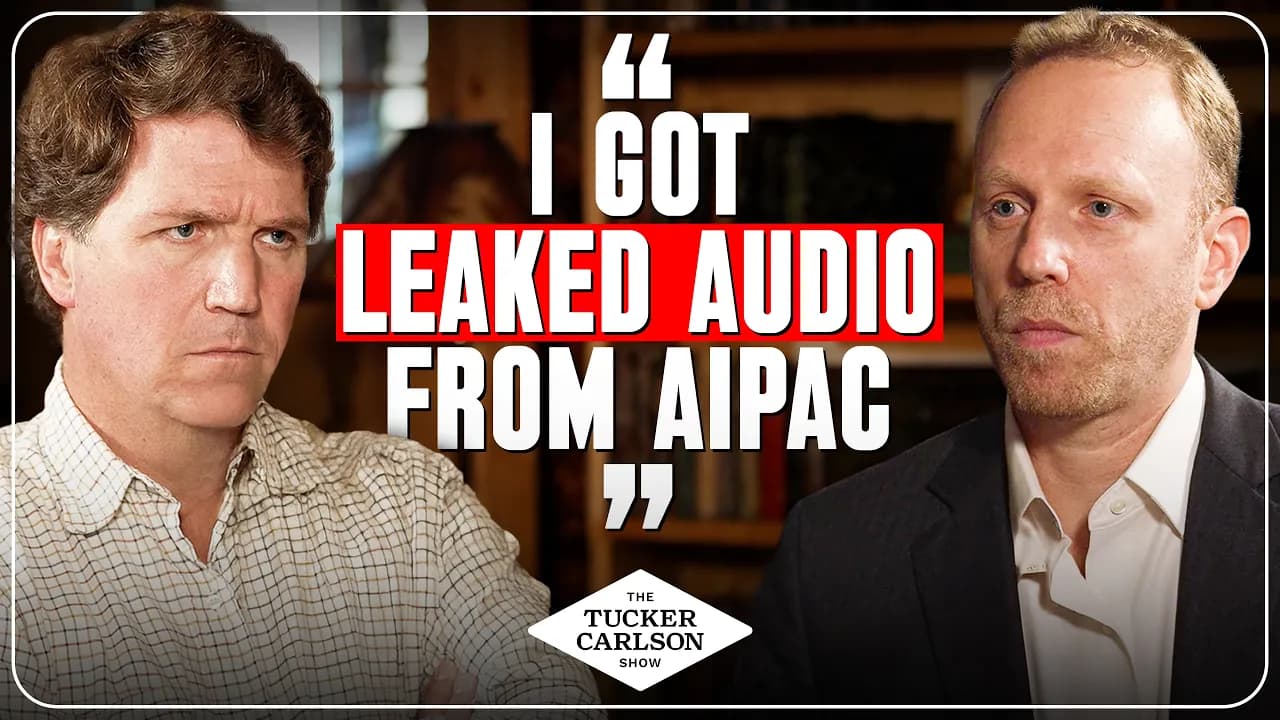
Pardons for Sale and Ponzi Schemes: DOJ Whistleblower on Trump’s Dirty Lawyer Mafia
In a Nutshell
A former DOJ attorney and January 6 defense lawyer claims Trump administration officials including Attorney General Todd Blanche and Harmeet Dhillon are actively protecting the system of federal prosecutorial weaponization rather than dismantling it. He describes how prosecutors who built careers through coercive plea deals and political targeting now occupy reform positions, while victims must pay $250,000-$1 million to connected lawyers for pardons. The whistleblower was terminated after bringing victims into DOJ headquarters to document their cases, revealing that the same offices and personnel who pursued January 6 defendants continue operating without accountability.
These notes were generated by AI and may contain inaccuracies.
Jonathan Gross served as a congregational rabbi for 15 years, including 10 years in Omaha, Nebraska, following in his grandfather's footsteps. After moving back to Baltimore, Maryland, Gross decided to pursue his long-held interest in law and attended law school at age 37 or 38 with four young children. His wife encouraged the career transition. After graduating, he worked as a law clerk for a judge at $40,000 per year at age 40, then moved into a civil rights firm handling high-level civil rights and religious liberties work.
After January 6th, Gross and his wife were distressed by the government's treatment of January 6 defendants. During a Friday night prayer session, Gross asked why nobody was doing anything, and his wife encouraged him to quit his job to help January 6 defendants despite having no prior criminal law experience and four small children at home. Gross represents his wife as an extraordinary woman with deep faith in God who made this decision.
Congresswoman Marjorie Taylor Greene introduced Gross to January 6 defendants and got him involved. He represented over 20 defendants and advised close to 100 others. Some clients were charged nothing, while others paid nominal fees they could afford. Gross had a trial scheduled for January 21st, 2025, which was cancelled due to President Trump's pardons. He notes that arrests of January 6 defendants continued until December 2024.
After Trump's election, Gross was appointed by President Trump as senior counsel to Harmeet Dhillon, who was nominated and confirmed as Assistant Attorney General for Civil Rights. Gross had advocated strongly for Dhillon to receive the position and had known her for decades as his family's lawyer. His sole agenda at DOJ was to investigate weaponization of government.
Gross wanted to be appointed to the United States Attorney's Office for the District of Columbia to lead the Capital Siege Unit, a special unit created to prosecute January 6 defendants for four years. He notes there was no equivalent BLM riot unit or anti-ICE protester unit. He estimates the unit was funded with at least a billion dollars, drawing resources from all 50 states, FBI, DOJ, US Marshals, local law enforcement, and media propaganda. The unit tipped off every local paper about misdemeanor cases against grandmothers to destroy their lives.
The Capital Siege Unit was closed immediately upon Gross's arrival at DOJ, and all related materials were buried like the Ark of the Covenant in Raiders of the Lost Ark. Gross was shocked that President Trump did not make this investigation a priority, discovering within a couple of days that nobody shared his sense of urgency despite only having four years to act.
Gross argued that January 6 defendants went from the Ellipse to the Capitol because President Trump told them to, and that Trump himself was charged with a January 6 offense. His concern extended beyond January 6 cases, as this weaponization could happen to anyone. He emphasized the unchecked power of federal prosecutors to demonize entire classes of people, use media to destroy lives, taint jury pools, and create presidential law that would be considered unfair if applied to others.
Gross explained that the legal process itself destroys defendants, even if they ultimately prevail. Federal prosecutions carry a presumption of guilt, and even if defendants win at trial, their Google presence and public perception remain damaged. He cites the case of Michael Castellar, a January 6 defendant who reported to prison and received an extra year because he went on Diamond and Silk to accuse the government of weaponization, with the judge agreeing he should be punished for making those statements.
Tijuana Brown, a local councilperson in North Carolina, was charged federally with $20,000 in PPP loan fraud during COVID. While her daughters received probation, Brown received 10 months in federal prison because she stated on television that the prosecution was political. The judge and prosecutor explicitly said she should receive more punishment for claiming political motivation. Gross notes that JD Vance announced 870,000 people would be investigated for PPP loan fraud.
Gross describes the routine practice where defendants are told they will receive probation if they plead guilty but face significantly more jail time if they exercise their constitutional right to trial. Lawyers warn clients that going to trial causes more work for courts and prosecutors. Gross filed a lawsuit against Todd Blanche regarding these coercive plea deals used on January 6 defendants, offering to settle for a one-hour meeting that was refused.
Following a June MSNBC interview where Trump stated January 6 defendants were "destroyed by weaponization and dirty cops," Gross formed a group called "J6ers were destroyed by weaponization" and filed a 60-page lawsuit against Todd Blanche. The lawsuit does not seek monetary damages but requests investigation into whether plea deals were coercive, with voiding of any found to be so. The lawsuit details Stalinist tactics including pre-dawn raids with press present, guns and lasers pointed at families, and threats against family members.
Todd Blanche serves as Attorney General of the United States and was a lifelong Democrat who worked for the Southern District of New York as a prosecutor during all eight years of the Obama administration. Gross considers the Southern District of New York the worst of all weaponized offices. Blanche was in the office when it prosecuted Dinesh D'Souza for allegedly giving $15,000 to a Republican congressional candidate without proper legal consultation.
Dinesh D'Souza was held on $50,000 bond despite the $15,000 amount in question and no clear victim. President Trump pardoned him after Senator Ted Cruz advocated for the pardon. Cruz wrote in his book about weaponization that Trump immediately agreed to the pardon without hesitation when Cruz sheepishly raised the issue during a car ride, with Trump turning to his chief of staff and simply saying "Pardon Dinesh."
Restitution can destroy individuals for life beyond the initial sentence. People convicted during the Obama years remain branded as felons decades later, with some still in prison. Endless restitution obligations continue as a permanent collateral consequence. One client in Montana named Kevin Moore was the victim of a political hit job that destroyed his successful business, leaving him as a senior citizen on Social Security receiving $900 monthly with $200 garnished for restitution payments.
Robert Grebble, a New York lawyer, had his career destroyed when DOJ made him a co-conspirator because his client needed to be prosecuted but had an advice of counsel defense. The client was acquitted of the conspiracy charges for which Grebble was convicted. Grebble's dream of becoming a Supreme Court justice ended as he continues paying restitution despite the lack of actual victims. Prosecutors are now going after his 401k, leaving him destitute.
The corruption in SDNY continued unchanged from Obama through Trump to Biden administrations. Todd Blanch served as a prosecutor in SDNY during the eight Obama years. The same patterns of weaponization persisted regardless of which party controlled the White House.
Former prosecutors from offices like SDNY leave to join white collar defense practices at major law firms. These firms function essentially as lobbying operations because they hire former prosecutors who maintain relationships with their former colleagues. This creates opportunities for favorable plea deals through personal connections. The revolving door between prosecution and high-paying defense work incentivizes maintaining weaponization rather than ending it.
Todd Blanch left SDNY for Wilmer Hale where he was a partner alongside Robert Mueller. President Trump issued an executive order in January or February 2025 revoking Wilmer Hale's security clearance due to the firm's involvement in lawfare activities. Blanch subsequently moved to Cadwalder before being hired to represent President Trump in the New York case involving 34 felony counts.
Despite representing President Trump in the New York case, Blanch lost on all 34 counts. The complete failure did not prevent him from gaining Trump's trust and subsequently being appointed to a high position. The speaker notes that whatever Blanch charged for his services, better representation could have been obtained at lower cost.
White collar criminal defense attorneys profit directly from weaponization because it generates clients. Prosecutors earn approximately $250,000 annually with benefits and prestige, then transition to white collar firms where they earn millions defending clients like President Trump. The system creates a self-perpetuating cycle where those who benefit have no incentive to eliminate weaponization.
Effective reformers should be individuals at the end of their careers who are not vulnerable to bar license revocation, media attacks, or career consequences. The administration should have selected people who supported Trump since 2015 or earlier rather than those who joined at the last moment. Todd Blanch had no connection to January 6th events and was not among those who actively supported Trump.
The halls of DOJ contain attorneys who previously worked at lawfare.com and the Brookings Institute. A comparable situation under Biden or Harris would never include high-level attorneys from Turning Point USA.
The weaponization working group conducted only a couple of meetings that were frequently canceled. No staff were assigned to the group, and zero dollars were allocated to its operations. Unlike the capital siege unit, which had extensive staff and prominent resume listings, the weaponization working group had no meaningful support structure.
In July 2025, NPR contacted both the individual and DOJ requesting information about weaponization working group membership. Despite having no Twitter presence and not disclosing the role even to family members, NPR published a hit piece confirming the membership. The source of the leak was never investigated despite being reported to DOJ leadership.
The weaponization working group was supposed to produce quarterly reports including coverage of January 6th. No reports on January 6th were ever produced. Very few reports of any kind were generated, with one recent report characterized as complete window dressing.
Reports were written and circulated via email documenting cases requiring investigation. The response was an order to pause all such activity despite agreement with the substance of the reports. Specific instructions prohibited any January 6th related work, including examining the government response or assisting victims.
Victims of weaponization, including January 6th defendants, were brought into the main Justice building. The building resembles a palace with beautiful artwork and library facilities, accessible only to select individuals with special permission rather than being open to the public.
One high-profile civil rights case became a signature matter for Harit with a major press release, but the case targeted private parties rather than government prosecutors despite requests to pursue the prosecutors involved.
Those tasked with draining the swamp were themselves federal prosecutors drawn from U.S. Attorney offices across the country. Rather than reformers from outside the system who defended January 6th defendants and supported Trump, the positions were filled by career prosecutors receiving promotions.
Henry Queller, a Democratic congressman, was targeted by prosecutors in the Southern District of Texas for breaking with Democrats on immigration policy. President Trump pardoned Queller, but no prosecutors faced consequences. One of the prosecutors listed on the case was subsequently promoted according to LinkedIn records.
Dr. Kirk Moore in Utah provided placebo injections instead of COVID vaccines to children whose parents opposed vaccination but needed documentation for school attendance. He was indicted for destruction of government property and faced 35 years in prison under federal prosecutor Todd Boutton. The trial was ongoing in summer 2025 with daily protests outside the courthouse when Attorney General Pam Bondi ordered dismissal after learning of the case from Marjorie Taylor Greene.
The Kirk Moore case demonstrates that political persecutions can be ended instantly through executive action rather than requiring lengthy pardon application processes. Similar authority could address cases like Desh Duza and Henry Queller where lives have been destroyed by federal indictment.
Nick Seoto created fake vaccine passport cards during the same period as Kirk Moore's activities. He was charged, sentenced, and imprisoned during the Trump administration. He continues on strict probation and pays tens of thousands in restitution that will likely extend for life, creating permanent felony status despite creating the cards under necessity without breaking existing laws.
President Trump could restore tens of thousands of lives by ordering audits of DOJ offices and having outsiders independently review cases. The recommendation includes directing prosecutors to cease certain activities while conducting thorough examinations that would identify individuals like Desh Duza and Henry Queller whose lives were destroyed by politically motivated prosecutions.
Cardiff offers business funding for companies needing cash for inventory, repairs, or hiring. The application takes only a few minutes with same-day approval and funding. Cardiff has been in business for two decades, lending over $12 billion to small businesses. Eligibility requires being in business for at least one year and making at least $20,000 in revenue. Loans of up to half a million dollars are available same day. The application link is cardiff.co/tucker.
Under the current system, identifying weaponization and injustice at the Department of Justice is totally haphazard and relies on getting the president's attention to secure a pardon. This has allowed an economy to grow where lawyers approach desperate families offering pardons for $250,000 to $1 million. Lawyers including Alan Dershowitz and Brett Tolman have started this sideline business getting pardons and getting rich doing it.
This is 100% what's going on right now. People pay hundreds of thousands of dollars and just hope. There is no invoice or bill - just payment of $100,000 to $500,000. The less you charge, the less likely you are to get the gig. Lawyers must charge $500,000 so desperate clients think they're serious. Lawyers claim to have Todd Blanch on their speed dial and charge $300,000 to $500,000 with a $1-2 million success fee if charges are dropped or a pardon is obtained.
President Trump could destroy this economy by opening up the pardon system and letting even people who don't have $500,000 get access. If everybody has access, nobody will pay for it.
Return to the Land is an association of a thousand people nationwide that serves as an online community for people who identify with European heritage. A small group started an intentional community in rural Arkansas where they raise goats. The community consists of a few families and a couple dozen people who are struggling to raise money and raise goats while doing a podcast about their philosophy.
The Justice Department began four separate ongoing nebulous investigations after Arkansas government involvement, including an Arkansas securities investigation where they are not even a security. It is impossible to do business under the microscope of a state or federal agency for fraud. They have done nothing and have never been accused of actually doing anything.
The government claims a Fair Housing Act violation, but the group does not sell housing, does not advertise for housing, and there has not even been a complainant or identified victim. A leftist activist who tried to join the membership organization of a thousand people was declined membership and filed a civil lawsuit, but she never approached the people who actually own the land.
Black to the Land is a black group with an almost identical mission - they require members to be black and advertise on their website that they are for black people to get away, have safety, and have their own community. No investigation has been opened against them.
Epic is a Muslim community in Texas, a massive $40 million development project with hundreds of actual units surrounding a mosque. When an actual complaint was filed against Epic, DOJ opened an investigation, looked into it, and closed it two months later after determining they were still in early planning stages and would amend their advertising to say it's for everyone.
When HUD investigated Return to the Land, they sent a letter that was accusatory from the start with no identified victim. The investigations cover private solo member LLCs including a handyman business and an excavation company, plus a fictional entity that does not even exist. All information came from activist journalists who sent screenshots from the internet archive claiming the group was advertising for the membership organization.
The membership organization has a legal disclaimer stating they are not selling land. All four investigations remain open-ended with zero findings of wrongdoing. HUD offered to end the investigation if the group would give $40,000 to a victim compensation fund that HUD would decide who receives, plus a $10,000 fine. No information was provided about who would administer the money or where it would go.
Greg Trainer, head of HUD and President Trump's appointee, wrote an article stating that the civil rights system has been a racial spoil system operating like an NGO that picks winners and losers and goes after enemies for free speech. Despite this, his agency continues the investigations.
The lawyer representing Return to the Land has emailed Harmeet Dhillon and people underneath her about the case, stating it is a bad look for DOJ if they claim to be ending anti-white discrimination. No response has been received. The lawyer has access to their email addresses but has been completely ignored.
Hundreds of lawyers were brought from all 50 states to be part of the capital siege unit. The FBI field office in Los Angeles conducted extensive surveillance of January 6th defendants, including pre-dawn raids on people not even charged with misdemeanors.
Siaka Masquay walked into the Capitol building for 30 seconds, was told by police to turn around, complied, and left. He was unaware he was not supposed to be there. The FBI had a search warrant and was surveilling him at political events before arresting him.
Victoria White is a single mother from Minnesota who went to Washington DC. She is on video tackling an Antifa-like provocateur in black bloc who was trying to smash a window. She was punched in the face repeatedly by police officer Jason Bagshaw on video and was permanently injured. She was forced to plead guilty to a felony because she had children who would become orphans, despite having video evidence that could have resulted in acquittal. Her lawsuit against the police was thrown out because her plea deal stated she was an insurrectionist and rioter.
The FBI field office in Minneapolis allowed BLM and anti-ICE protests to attack federal officers without pursuing charges, but aggressively pursued January 6th defendants.
Enrique Tario is a January 6th defendant who was charged without even being present at the Capitol. He was sentenced to 22 years in prison for conspiracy to obstruct an official proceeding. A prosecutor told him the charges could go away if he would implicate President Trump. He refused to falsely sign a plea deal. He was held pre-trial for years and subjected to diesel therapy, being shuttled from jail to jail across the country. He is now suing the federal government.
The whistleblower brought victims of alleged weaponization, including other J6ers and people indicted for various things, through the DOJ building to share their stories with prosecutors. While some prosecutors expressed interest in the stories, others were nervous because they recognized these as routine tactics used by the system. The whistleblower noted that Enrique's story is not difficult to prove and that thousands of people could attest to the kinds of allegations being made, enough to fill a stadium with testimony.
After bringing people around the building, the whistleblower was reported on, possibly for going into the wrong office. This led to a call from Har's chief of staff, with Har wanting to meet about the issue. The Office of the Deputy Attorney General (ODAG), under Todd Blanch at the time, was questioning why one of Har's attorneys was engaging in these activities.
The whistleblower explained the actions by stating these were victims of weaponization and that nothing was hidden - the people were checked through security with proper IDs, not given fake names. The response was that the only reason such people should come into the office is with their lawyer to give a proffer, meaning they're ready to plead guilty.
When the whistleblower stated this was a civil rights issue and weaponization that should be addressed, Har responded that "it doesn't matter. We're the DOJ now." When informed that much of this happened under Biden, the response was "it doesn't matter. We are the DOJ. We protect the DOJ." The whistleblower was told that victims need to hire people with access - friends in the White House or otherwise - essentially paying what amounts to a ransom through lobbyists to get justice.
The whistleblower expressed shock at being told their service to the DOJ was appreciated in their exit report, with no disciplinary action noted. The whistleblower questions why it would be unethical to bring victims of weaponization into an agency that declared opposition to weaponization, stating it would be unethical not to do so given the destruction to families, communities, careers, and the lifelong consequences of being branded felons.
The whistleblower sent reports to Colin McDonald, who was Todd Blanch's right-hand deputy and is now Assistant Attorney General for Fraud. One notable case involved Ken Ravenel, a Democrat and Black man from Maryland who grew up in grinding poverty as the child of sharecroppers, becoming one of the best criminal defense attorneys in Maryland.
According to the whistleblower, the U.S. Attorney's Office targeted Ravenel because they didn't like that he won cases. They used a foreign national drug dealer serving 25 years who was offered freedom to become a star witness. The indictment alleged Ravenel was a conspirator because he advised the criminal defendant that cash would be better than other payment methods and meeting in person would be better than talking on the phone.
The whistleblower noted that Ravenel beat most charges but was convicted on one or two, which is a routine government trick - charging ten things so the jury thinks "he did something." Ravenel is currently in federal prison as a senior citizen with health problems. The whistleblower argues that people like Ravenel and Dr. Kirk Moore could be sent home with the stroke of a pen, and questions why pardon applications are required when high-profile cases like Daryl Strawberry's don't involve such applications.
The whistleblower criticizes the pardon process, noting that applications are first sent to prosecutors for input, which makes no sense when the prosecutors are the ones who brought the cases. The whistleblower avoided involvement in pardon matters during this term due to concerns about corruption and sleaze surrounding the process.
The whistleblower referenced Harvey Silverglate's book "Three Felonies a Day," noting that if the government wants to target someone, any person violates at least three felonies daily. The whistleblower argues that President Trump should appoint outside people to examine cases lacking articulable crimes, identifiable victims, or showing political motive.
Desh Duz's case is cited as perfect example of political weaponization - a campaign finance violation with no articulable crime, no identifiable victim, and clear political targeting. The whistleblower notes that George Soros can give a billion dollars with proper legal protection while Duz couldn't get $15,000, and that the people actually tampering with elections have the best lawyers and face no consequences.
The whistleblower states that people in charge of reform are the same people who committed the alleged weaponization. Regarding January 6th, the whistleblower claims authorities are hiding everything, including the terror watch list maintained by the Terror Screening Center, a division of the FBI under DOJ.
All J6ers were put on the terror watch list with only reasonable suspicion required - defined as anything, including being in the vicinity of the Capitol. This was done purely as punishment. People don't know they're on the list until they encounter issues at airports (marked with four S's) or get pulled over by local law enforcement with guns drawn.
The list is disseminated to local law enforcement and foreign governments but hidden from those on it. There's no appeal process. The whistleblower notes this creates a social credit score system where people can be detained in foreign countries without explanation, and that the list persists even after Trump pardoned J6ers - they were removed from the list but could be put back with a new administration.
The whistleblower criticizes the Civil Rights Division for focusing on DEI and anti-white discrimination at colleges while ignoring major civil rights violations. The division is described as going after small groups in Arkansas wanting to raise goats in rural communities, while claiming to target the trans agenda.
Shaina Gaviola's son in California was secretly socially transitioned and indoctrinated in a public school without her knowledge. When she learned about it, the child had already moved out and obtained a protective order. She rescued him and took him to a deprogramming school in Missouri, violating the interstate protective order.
The federal government arrested Gaviola for rescuing her child from what the whistleblower describes as a cult. She was convicted while the deprogramming school's headmaster was acquitted. Gaviola is now in federal prison, and her other children are being sent to child protective services. The whistleblower spoke to her before she reported to prison.
Following the Breonna Taylor incident in Kentucky, the Biden administration's Civil Rights Division charged every cop involved, including those who weren't at the raid but had any connection. Kyle Meanie was charged for not sufficiently supervising the officer who wrote the search warrant, despite not being at the raid himself.
Meanie faced charges under 18 USC 241 for deprivation of civil rights, which carries potential life imprisonment or the death penalty if loss of life results. The case continued into the Trump administration under Pam Bondi and Todd Blanch.
A case in Kentucky was set for trial but was ultimately dropped. None of the people involved in that case were punished, and the Trump administration never made any statement declaring victory or pointing out what happened under the Biden administration. This lack of accountability was notable given the contrast with how other cases were handled.
People were charged criminally under 18 USC 241 for reading Bibles in front of abortion clinics. High-level career prosecutors and attorneys at DOJ signed their names on those lawsuits, and many of these individuals remain at the Department of Justice. Despite Trump pardoning those people, there has been no accountability for the DOJ personnel who pursued those cases.
The whistleblower was confronted by Harit Dylan, who stated that bringing victims of weaponization into the building was wrong. The whistleblower took full responsibility for the actions but refused to resign when asked. After refusing to resign, they were placed on two weeks paid leave, then moved from the main building to an empty building a mile away with career people. All cases were taken away, and the whistleblower was left with no work in an empty office.
The DOJ attempted to create a paper trail by sending an email claiming missed meetings, but the whistleblower responded that they were present and available. Recognizing the situation, they chose to resign rather than allow the DOJ to generate reasons for termination. The decision came from not wanting to collect a paycheck without doing meaningful work.
The whistleblower served from April 2025 to March 2026. After leaving, they attempted to work out issues with the government on behalf of Return to the Land, pointing out investigations into white people doing nothing while other investigations were being closed. Despite bringing these disparities to attention, the efforts were silenced, leading to the conclusion that filing a lawsuit was the only way to get attention.
The core problem identified is how people transition from opposing a system to defending it. Once someone decides to defend a corrupt system, they become corrupt themselves. Career officials like Harit Dylan, despite being known and liked personally, made the decision to defend the system rather than challenge it.
Ron Elfenbine, a doctor from Maryland, is scheduled for trial in January on what appears to be a politically motivated case. He opposed the system by presenting monoclonal antibodies as a potential cure, which had successfully treated President Trump. Four months after appearing on TV to discuss this, he was charged with a process crime unrelated to his earlier statements. An Obama-appointed judge overturned the jury's guilty verdict in a 95-page opinion, stating the government did not prove their case. Despite this, the government appealed and is proceeding with a second trial.
Colin McDonald, now head of fraud as a Trump appointee to an assistant attorney general position, has oversight of the Elfenbine case. The question raised is whether leadership will evaluate such cases not just on win/loss potential, but on whether there's something unusual or potentially retaliatory about targeting someone for speaking out against the system.
The DOJ issues numerous press releases about indictments and allegations but never issues press releases admitting they got cases wrong. The hope is that instead of doubling down due to pressure or dislike of critics, officials would take accusations of weaponization at face value and respond honestly to the public.
People in these positions are conditioned from kindergarten to attend Ivy League schools like Harvard and Yale, creating Pavlovian obedience to authority. This conditioning produces individuals whose minds and souls are corrupted by the system that created them, making them incapable of challenging it. The system rewards those who never deviate from authority, and those produced by it lack the capacity to see its flaws or move outside its boundaries.
Keep Tucker Carlson in your library
Save the videos and channels worth coming back to, and find them again in one place.