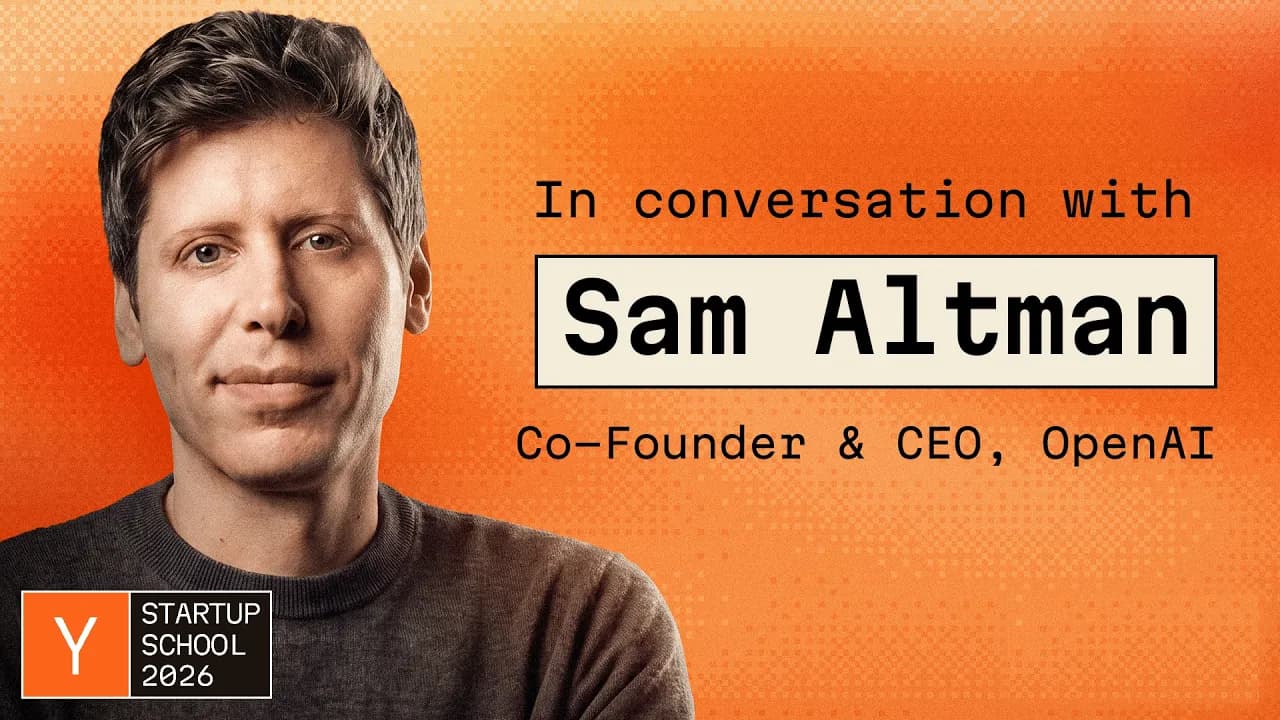
Patrick Collison: "What If You Succeed?"
In a Nutshell
Collison argues that internal knowledge and hands-on building remain essential even with AI tools available, as cognitive speed and deep understanding provide irreplaceable advantages in complex problem-solving. He advises founders to ask "what if you succeed" before committing to long-term ventures like Stripe, which took two years from initial development to public launch. Current data shows this is the best time in history to start a business, with record new company formation, faster revenue growth, and enterprises now willing to buy from early-stage startups.
These notes were generated by AI and may contain inaccuracies.
Patrick Collison and Harj Taggar first met 20 years ago and started a company together. Collison learned a significant amount from Taggar during that collaboration.
When Taggar first met Collison over 20 years ago, his most notable achievement was Chroma, a dialect of Lisp. Collison developed this during high school and had a genuine interest in Lisp programming.
When discussing whether a prolific 16-year-old today should build a Lisp dialect themselves or use AI to generate it, Collison expressed uncertainty about the value of such exercises. He noted that activities like writing assembly code and optimizing memory layouts were once essential but are now handled by compilers, and society does not mourn their loss. However, he personally feels an emotional attachment to these hands-on activities.
Collison uses the metaphor of cognitive L1 cache to explain why internal knowledge remains valuable despite AI capabilities. Jeff Dean's famous set of numbers on bandwidths and latencies serves as an analogy - retrieving information from L1 cache differs significantly from retrieving from RAM or across networks. Even with full AI capabilities, neuronal lookups will remain much faster than querying external systems. Companies like Stripe and AI labs continue to place enormous premium on cognitive ability, suggesting it would be premature to renounce developing these capabilities.
Collison deliberately writes himself rather than using AI-generated suggestions. He cites both philosophical and substantive reasons, noting that while models can prove complex mathematical conjectures like the Jacobian conjecture, he has not encountered LLM-generated essays that he finds compelling. Writing remains fundamental to interpersonal communication and reasoning in the multi-dimensional space of reality. He has never sent any of the pre-written suggestions from tools like Gmail or WhatsApp.
Collison dropped out of college twice to start companies. He first left MIT after his freshman semester to start a company with Taggar, then returned for another year before dropping out again to start Stripe. He initially planned to become an academic and study physics. Growing up in Ireland, he had not considered startups as a viable path. He advises that if students enjoy college, there is no harm in finishing, but if they do not enjoy it, the cost of dropping out appears minimal based on his experience.
Collison felt a general sense of haste about life being short and wanted to accomplish meaningful work. He also worried that opportunities in startups and Silicon Valley were ephemeral and fleeting. In hindsight, he recognizes this intuition was poor, as Silicon Valley has consistently offered abundant opportunities over many decades.
Collison addresses the common concern among students that failing to drop out and start a company will result in being trapped in a permanent underclass. He compares this to historical millenarian thinking, referencing "The Winged Gospel" which documented how the invention of aviation was believed to fundamentally transform civilization. He suggests taking the under on predictions that the current moment represents the final opportunity to create companies.
When pitching Stripe, the idea appeared obviously good because nobody liked existing payment methods, which required filling out extensive paperwork, visiting banks in person, and dealing with antiquated legacy systems. However, it also seemed like a bad idea because two young founders starting a financial services business seemed improbable, and fintech as a sector did not exist at the time. The concrete user problem they identified - the annoying process of moving money on the internet - ultimately saved them.
Stripe needed banking partners to build their product, which required convincing banks to trust two young founders in ways typical software companies did not need. The decision to start Stripe was made after attending Startup School in Berkeley in 2009, when Collison and his brother John decided to pursue the payments idea after getting sushi in Potrero.
Stripe began working seriously the week after Startup School 2009 but did not launch publicly until September 2011 - nearly two years after the first lines of code. They maintained production users from very early on, starting with Ross Boucher at 28 North in January 2010. This customer provided real feedback that drove iterative development of features like dashboards, refunds, and money movement.
Collison suggests that in the AI era, founders may need to be more ambitious with their initial product versions rather than following traditional lean startup doctrine of starting narrow and expanding. The internet is now much more competitive than 20 years ago, making it harder to find untapped niches. Many successful companies over the last 10 years - including AI labs and Anduril - have been very anti-lean startup in their approach.
Despite the mundane tasks involved in any company like setting up payroll, Collison finds Stripe intellectually rewarding because they work with the world's most interesting and innovative companies. 25% of all Delaware incorporations are started with Stripe via Atlas. He emphasizes asking "what if you succeed" before raising significant money, as founders should consider whether they will enjoy working on the business for 10, 17, or 30 years.
Collison addresses concerns about AI labs potentially trampling startup ideas. He notes that human organizations are complicated and it is difficult to aggressively prosecute 100 different priorities simultaneously. Google's track record demonstrates that even organizations with immense resources and talent do not execute on all possible opportunities. He suggests fears about AI labs specifically have been overstated, though model capabilities themselves will likely obviate certain verticals and tasks.
The number of new businesses getting started has increased dramatically compared to even a year ago, representing the largest relative change observed in any given year. From 2019 to 2020, there was a significant jump with growth rate inflecting to approximately 50% year-over-year during the COVID period from February to April 2020. Currently, the number of new businesses starting on Stripe is up around 2x year-over-year.
Despite concerns about lightweight or low-quality businesses, the median business is actually performing better this year than a year ago. When stratified by revenue thresholds including $1 million, $5 million, and $10 million, the probability of reaching these milestones appears to be improving. Companies incorporated with Atlas are seeing declining time to revenue, suggesting objective metrics indicate this is an optimal time to start a business.
As of July 26th, 2024, Stripe data indicates this represents the best time ever to start a business, though future conditions may change. This trend is also visible in Y Combinator batches where companies are growing faster than ever before. Previously, reaching $1 million in annual recurring revenue was considered a major milestone that would generate significant attention, but now this benchmark should be achieved within the first month of operation.
The accelerated growth curves from $1M to $10M and $10M to $100M revenue are primarily driven by enterprises becoming more willing to purchase from startups. This represents a new dynamic where YC companies can sign contracts and generate revenue within the batch timeframe itself, rather than waiting for later stages of development.
Companies across all sectors have become more adaptable and willing to experiment with new solutions due to a genuine fear of being left behind with outdated operational methods. Previously, established companies would hesitate to engage with unproven startups due to concerns about validation and longevity. Now, the risk of maintaining the status quo appears extremely high, making even unproven new solutions appear less dangerous by comparison.
This environment creates unprecedented opportunities for startups to sell products and achieve meaningful adoption scale immediately. This dynamic extends beyond B2B contexts, as consumers also demonstrate openness to experimenting with new products despite complex views on AI infrastructure like data centers.
Stripe data challenges fears that AI will become a centralizing force where only a few companies dominate the economy. While leading AI companies will continue to perform well, the data shows intense activity from thousands of companies either starting new ventures or retooling existing operations to leverage AI capabilities.
Rather than centralization, current trend lines suggest movement toward a more decentralized world with broader prosperity distribution. This represents a shift away from concerns about AI creating winner-take-all scenarios toward expectations of many thousands of winners across the ecosystem.
Keep Y Combinator in your library
Save the videos and channels worth coming back to, and find them again in one place.