India Can Create The Largest AI Companies
In a Nutshell
India's technical talent and AI tools now let founders build global companies from India without US connections or prior networks. High-agency builders who ship fast, obsess over customers, and push frontier models (via max token budgets and heavy tinkering) gain decisive edges over slower or less technical competitors. The fastest path is doing real projects with others, applying to YC for global reach, and treating AI leverage as the new baseline rather than an optional advantage.
These notes were generated by AI and may contain inaccuracies.
This wave is more about living at the edge of the technology rather than understanding the right go-to-market or business model. Success requires understanding the technology 10x better than everyone else, and nobody does that better than India.
The energy around startups, technology, and AI in India is without parallel anywhere else in the world.
Punit and Arnav are former Y Combinator colleagues who helped expand YC into India and are keen observers of the Indian startup ecosystem.
Punit's Background
Punit has been coding since age 10. He attended IIT Bombay. His last startup was Super Daily, a grocery delivery company that went through YC in winter 2017. He scaled the company to approximately $100 million in annual revenue and exited to Swiggy in September 2021. He later joined YC and then became a venture partner at Nexus before returning to building.
Arnav's Background
Arnav worked at YC for many years, particularly with Indian companies and developer companies. He is now with the venture firm Peak 15. He previously had a startup that did not fully work out and worked at a company in the developer space. He now works with young builders in AI and invests in them.
When Super Daily was sold to Swiggy, the company had $100 million ARR with only two engineers total, one being Punit himself.
For the first time, founders can build global companies out of India. Over the last 10-15 years, India has learned how to design well, build good products, and create technically deep products.
The AI revolution is fundamentally different from the mobile revolution. Mobile tokenized labor, creating hyperlocal network effects with companies in India, Latin America, and the US. AI is global rather than local.
This is the time to build global companies in India. Some of the largest companies in the world will come out of India because India has the best technical talent.
Previously, building a SaaS company without US connections required warm intros or living in San Francisco for years. With AI, everyone across the world simultaneously understands that AI is important. Founders no longer need to be physically present in the US market.
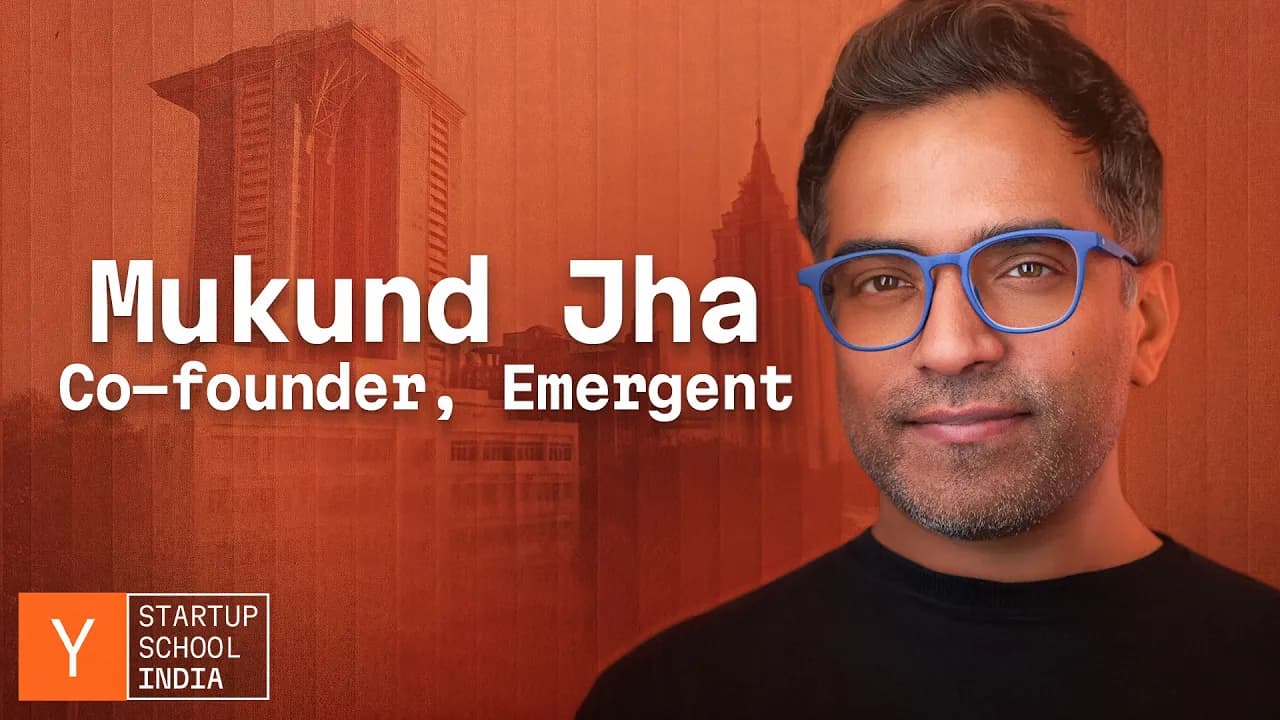
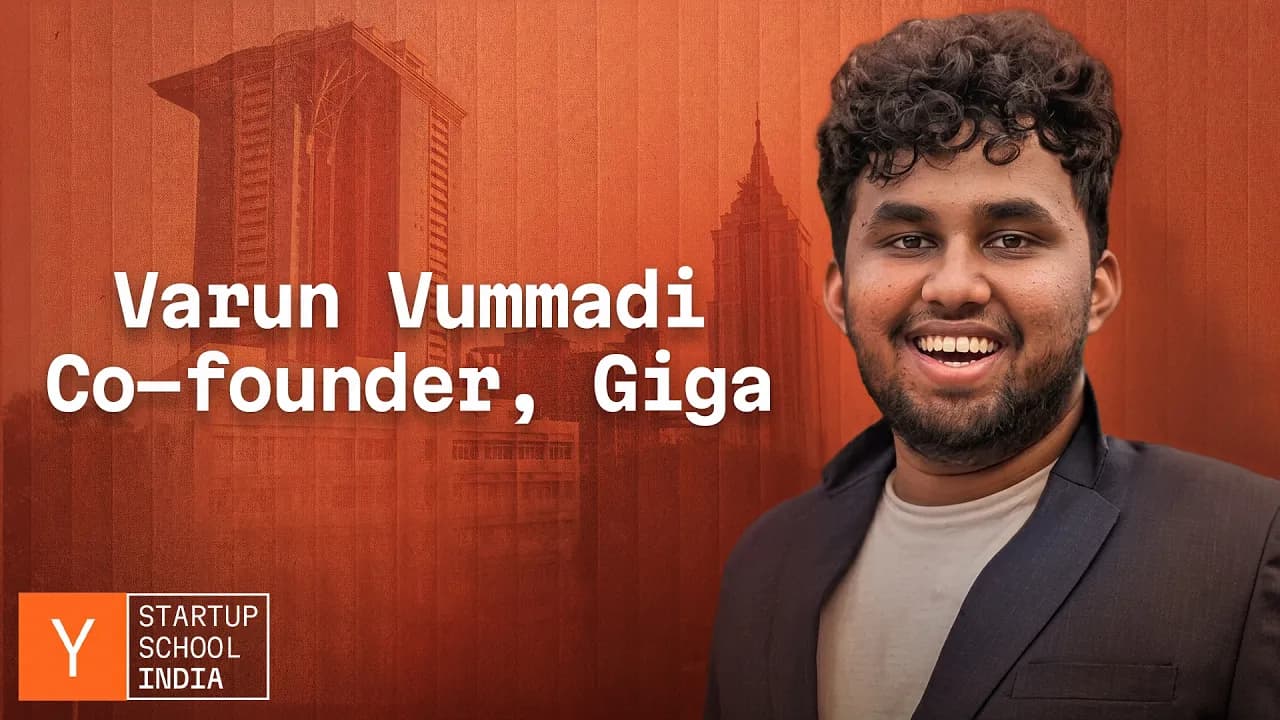
Giga and Emergent founders never lived in San Francisco before starting their companies. The requirement is building at the edge of technology rather than relying on market openness—everyone is now open to AI solutions.
In the last YC batch, an Indian company used cold outreach to sell to insurance companies in the US. An Indian student in their third year at IIT successfully sold to a US insurance company via cold email.
Companies are open to meritocratic solutions that drive outcomes rather than budget allocation decisions.
Applying to YC is the best way to access the US market. YC serves as a conduit to go global. Founders who went through YC and visited San Francisco experienced a 10x increase in ambition.
The future of the India AI ecosystem will be defined by people in the current room, not by people from prior generations. Traditional educational advice is now irrelevant in the AI-native era.
Traditional advice recommends pursuing high-paying, prestigious, safe jobs as bankers, consultants, engineers, or doctors. Many of these jobs may not exist or will change dramatically in 10 years. The historically safe path may now be the risky path.
Owners and entrepreneurs may be the most insulated from these changes. However, it is very hard for an average young Indian to take the types of risks that someone who grew up in Silicon Valley can take, given differences in social safety nets.
The Indian startup ecosystem is booming but may not be as deep as the US ecosystem. For many from humble backgrounds, a high-paying, safe, prestigious job places them in the top 10% of the country.
AI benefits young technical founders who live on the cutting edge. Much of what is needed will not be learned in school today. The era favors people who are super high agency and want to go for it.
The AI boom is only in year three or four. People in the room have 30-40 years ahead to build and will become the experts on AI tools.
To develop an independent point of view, surround yourself with people who are already doing that. YC is powerful because founders enter already good but leave as much stronger versions of themselves through people network effects.
In the Indian education system and many education systems, it is not considered cool to be ambitious. At YC, ambition is expected. Surrounding yourself with people at the cutting edge is a conscious, deliberate choice that compounds over a career.
Following advice from people who are not AI-native is dangerous because they are not in the game with you.
The average age of YC founders has gotten younger over the last 10-20 batches. YC does not intentionally fund older or younger founders.
AI has completely leveled the playing field for young founders. Previously, founders did not need to be experts to get deep into a field. AI has changed this further: founders are no longer limited by their ability to build but by the pace at which they can learn.
Young founders have a huge advantage because they can build very quickly and get insights very quickly.
The best young founders are tinkering more. They follow their curiosities and work on the edge of what might be possible today. The motto "live in the future and find what's missing" describes this approach.
Tinkering involves working on things that are barely good enough for the models to do. This leads to beating benchmarks, establishing new heights, and identifying bottlenecks that become good startup ideas.
Almost every founder from the day's talks had a big idea that was not their first idea. Good startup ideas are not obvious. Founders must be in the field building something to notice really good ideas.
Working on side projects reveals multiple good startup ideas. With coding agents, founders can get something off the ground so fast that college students working nights and weekends or between classes can quickly find extremely good ideas that would not have been obvious from whiteboard thinking alone.
Many successful ideas were not first movers. They were the third, fourth, or even 42nd version of an idea to launch.
Varun from Giga closed DoorDash while competing against companies with several hundred employees while having only eight people, demonstrating what a strong technical team with a superior product can accomplish.
Coding agents allow people with great product clarity and vision to make ideas real extremely fast, often with more precision and quality than expected. The outdated view that AI produces "slop" applies only when models are not used well. People who use them well produce incredibly sophisticated code at a much faster pace.
A reasonable competitive approach is to find something working and then do it better. Unless the first mover has incredible network effects, which few things do, a better product can win. Emergent is an example of a company executing this strategy and scaling rapidly.
Using AI coding at the frontier requires paying for at least the $200 per month maximum plan, such as Anthropic's max plan or the Codex equivalent. Lower usage levels do not reach the frontier.
There is a meaningful unlock from letting tokens rip without budget constraints. Gary Tan spends thousands of dollars per day on token usage, providing a view into the future of what becomes possible when cost is not a constraint.
Cost of compute per level of intelligence will decrease significantly. Writing 10,000 unit tests instead of 20, writing extensive documentation, and covering all corner cases produces incredibly effective and powerful code quickly.
Building side projects while pushing models to their limits reveals new startup ideas. Gmail's auto-reply feature is poor, but spending $5 per email produces results that demonstrate how far models can be pushed when not bandwidth-constrained by intelligence.
Open source models such as the MinimaX models are good, cheap, and accessible. Being at the absolute frontier is extremely useful for a subset of tasks, especially coding, but not necessarily for all tasks.
Vidith from Misho aims to use voice AI to bring the next billion people online for shopping, requiring models at price points the next billion can access, which will involve building on open source models.
YC company Open Code is built on top of open source models and performs very well.
Companies are increasingly giving unlimited token budgets to employees. For those who are budget-constrained, working at companies that encourage token maximization provides access to the frontier.
Cost of tokens will continue decreasing and open source models will continue improving. Being early in the game provides a significant advantage in understanding how tools work.
Building for models 6 months to a year ahead and thinking through future capabilities creates advantages in thinking, roadmap, and types of opportunities that can be capitalized on.
A common misconception is that YC applications should highlight the most impressive or complicated elements. Clarity is most important. If reviewers cannot understand what people are actually building, the application will not work.
The discussion emphasizes that investors are not investing in ideas, as initial concepts may fail or require pivots even after reaching millions in ARR. The focus is on the founder themselves. Taste is not merely about building visually appealing products but about intention—creating products and demos backed by customer insights, with the ability to quickly gather those insights and develop products that reflect them. Agency refers to becoming a more formidable version of yourself, exemplified by the concept from Paul Graham's essay "Relentlessly Resourceful," which asks whether you let the world's conditions happen to you or impose your will on the world.
These qualities matter because they enable founders to navigate extreme challenges. The six founder stories shared earlier demonstrate consistent themes of being relentlessly resourceful and expressing taste through customer obsession. All founders intuitively centered their thinking on customers without prompting, highlighting how critical this obsession is for success.
Before launching companies, people should work on projects, defined specifically as when two people build something that was not assigned to them and get someone to use it. This definition reveals why many with computer science education and jobs never engage in real projects—they work solo, receive assignments from classes or internships, or never get users. Doing projects, especially when young and in college, and using available tools like the starter pack, reliably leads to startup ideas and develops the exact traits discussed.
Despite 20 years in the industry and 10 years at YC, fundamental truths about great founders have remained remarkably consistent, tracing back to figures like Thomas Edison, who would likely share the same obsessions with customers, tinkering, and building at the technological edge. What has changed is that AI has given the best builders significantly more leverage and democratized the ability to create great products. This enables funding founders as young as 18, such as those behind Giga, Audit, and Zeppto, who can build substantial companies rapidly. The speed advantage is tangible—building and shipping can happen tonight rather than a year from now.
All six companies that presented are actively hiring engineers and are specifically interested in hiring from the audience. Interested individuals should apply through their websites or email the founders directly. Working at exceptional companies like these is recommended as one of the best ways to develop into an exceptional founder by learning from top talent.
The room contains many talented people, and attendees are encouraged to stay connected after the event. Projects are best done with two or more people, so participants should hang out during the food and photos on the lawn, exchange contact information, form WhatsApp groups, and potentially meet co-founders. Swag bags will be distributed.
Anit shared that his own introduction to startups came from attending Startup School in San Francisco as a college freshman in 2013, which inspired him to change paths. The goal is for the event to similarly inspire attendees. Over the next few days, teams are encouraged to form and use provided credits to start building. Everyone will receive an email tonight or tomorrow with access to the credits, which can be redeemed immediately and received within a few days. The session closed with thanks and anticipation for what participants will create.
Keep Y Combinator in your library
Save the videos and channels worth coming back to, and find them again in one place.