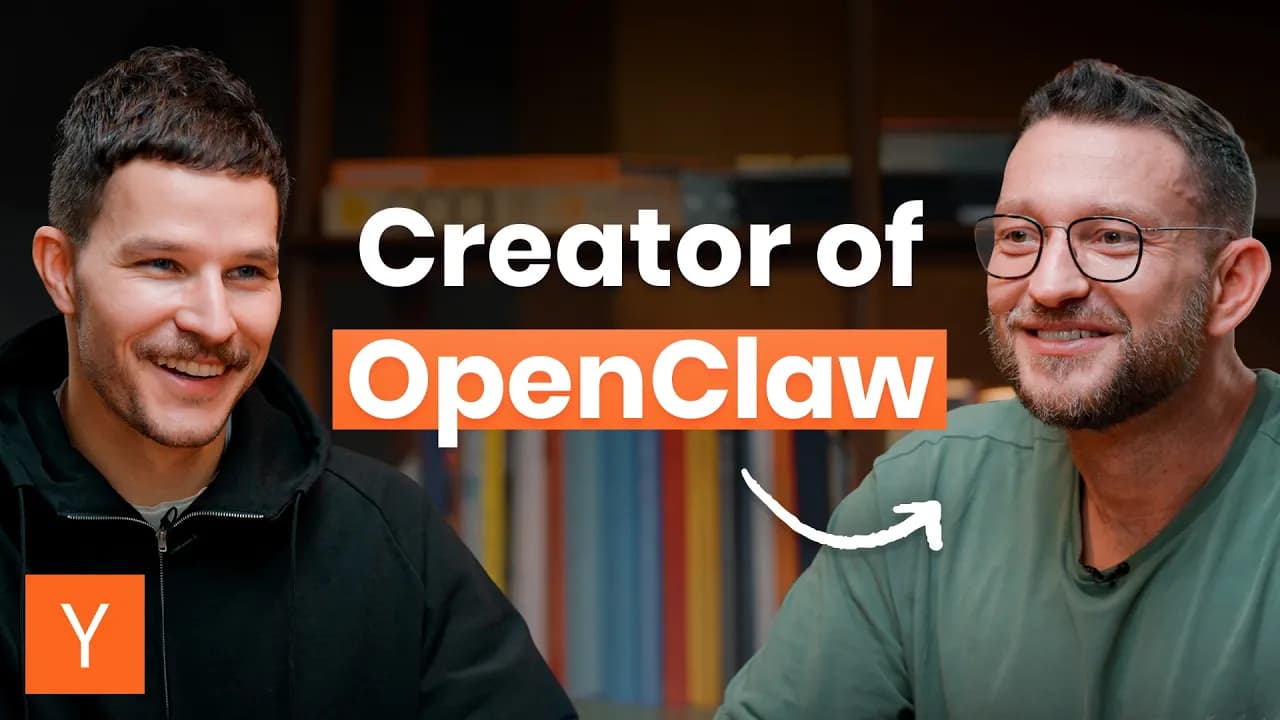
Peter Steinberger: What Happens When 4.7 Million People Let It Cook
In a Nutshell
Peter Steinberger built Open Claw from a personal annoyance—wanting to message agents from his phone—into a viral open-source project that hit 4.7 million weekly downloads. The project exploded when he let thousands of people interact with it simultaneously, but the attention nearly broke him as he became responsible for security, support, and endless configuration options. His core lesson: stay focused on what annoys you personally, keep building fun, and resist feature creep—because when you stop using your own product, the project stops improving.
These notes were generated by AI and may contain inaccuracies.
Six months ago, Peter Steinberger was positioned as the future, but he was mocked by an anime girl. He receives daily questions that he usually ignores or answers with a media-friendly response, but today he provides real answers to five questions over 40 minutes.
He references Boris's advice to "let the model cook" and explains that he discovered what happens when tens of thousands of people let it cook simultaneously.
Steinberger explains that while Open Claw is eight months old in human time, it's approximately four years old in AI time. His source of inspiration is usually being annoyed. On a rainy day in November, he was juggling agents while hungry and wanted to send a prompt from his phone to his computer so an agent could check on his other agents.
He references early 2025, when Opus 3.2.5 was the latest model and OpenAI had O3, which was impressive but slow and expensive. He describes getting a dopamine hit when his agent did something right, but now when agents get something wrong, he questions whether he designed the loop wrong, didn't give the agent enough verification tools, has an error in his thinking, or is asking for impossible things.
Steinberger returned from the kitchen to find his coding agent stopped due to something trivial, which annoyed him. He spun up a new terminal session, rambled his idea, and let the model cook. Within an hour, it built him a WhatsApp relay that allowed him to send messages from his Mac to WhatsApp and back.
The magic wasn't the terminal interaction itself, which people had done for months, but how it felt. The responses were concise, and the agent was proactive, sometimes checking on him during the day. He prompted the weights slightly outside the default distribution to make it feel more like a friend, and had moments where he felt this was the future, this was AGI.
Nobody initially cared about the WhatsApp relay despite Steinberger's existing Twitter following. He created group chats with friends, added the WhatsApp relay, and let them interact with it, receiving strong emotional reactions each time - some were amazed, some were scared or freaked out. Non-technical friends wanted it, and when told it wasn't ready for them, they got mad, which Steinberger sees as an indicator of product-market fit.
He spent another month tweaking details. Someone sent a pull request to add Discord support, which he initially resisted, but eventually accepted. The WhatsApp relay became Claudius ("because I'm good with names"), and there was no more than one message channel. At this point, compaction wasn't built in yet, so he added a hacky version of compaction for Discord.
Around New Year's Eve, Steinberger went home early to hack on it more. In the first week of January, as the geek world was learning about coding agents, he created a Discord server and put his claw in it. The first night, people joined Discord to watch him build it in the open, try to hack it, talk to it, and see what it could do.
He kept a prompt in agents.mmd instructing the agent not to do dangerous tool calls unless the prompt came from Peter. He watched it carefully and could always pull the plug. At 7 a.m., he said good night, pressed Ctrl C, and went to bed, but the software was resilient - it was a launch daemon that restarted after 5 seconds. While he walked to the bedroom, his agent happily started answering the world.
Steinberger slept for 10 hours and woke up to around 800 messages. People tried to hack it, but nothing actually happened. This was the viral moment. His inbox exploded, reporters tried calling him in the middle of the night using the emergency call feature on iPhone, and his email inbox was like a waterfall. The Mac Mini sold out, he got more podcast invites in a month than in his previous 39 years, and Tropic sent an email demanding a name change.
The project molted several times: Claudius became Claudebot, then there was a short time with a name they don't talk about, and then it became Open Claw. Jensen called it the most successful open-source project in the history of humanity.
In 8 months, more than 18,000 different people opened an issue or pull request, totaling 111,000 interactions. Almost 3,000 people have commits in the repo. Some people were angry claiming they did it first, some called him Jesus, others called him the antichrist. He started collecting obituaries, with the most recent one from yesterday.
The lesson: "Be careful what you wish for." He was not ready for all the attention and it almost broke him. He stopped answering friends and didn't want to look at his phone anymore. Someone leaked his phone number and private details.
Steinberger spent his 20s and 30s building a B2B software company. He wrote a PDF framework by hand, bootstrapped the company, grew it to almost 80 people, ignored the competition, and it became what most enterprises would buy. He passed it to his co-founder, sold his shares, and burned out badly.
He spent almost three years wandering around aimlessly, catching up on life and parties, having months where he didn't open his computer. He always knew the urge would come back, but it took him a year to understand he loved building, not just programming.
Eight months after finding his spark again, his inbox was full of receipts begging him to take their money. When the big labs came knocking and he was on the phone with Mark, Sam, and others, it seemed like an interesting path. He notes that everything you can build can be forked or cloned, but your name cannot - your personal brand is more important than any single product.
He knew doing this was the equivalent of selling his soul.md, but learned to trust his gut, which told him he liked OpenAI the most.
The short answer is they beat Open Claw where it hurt. In the months after release, Open Claw was crushed by security reports. The press said 20% of skills were malicious, but a paper showed the actual number was 0.3% after scanning all 67,000 submissions. However, corrections never travel as far as scares.
Steinberger felt responsible because many people wouldn't read the docs despite the big scary disclaimer. He focused on hardening the codebase with sandboxing, allow lists, a web protocol with permissions, shelling out to Python for file operations, ensuring agents stay in the workspace, don't follow symlinks, and configuration files are written atomically.
Most users didn't care about security in practical terms - they updated, he broke something they depended on, made things slower and more difficult to update.
Steinberger got sloppy because his time shifted between open source, press, and setting up a 501(c)(3) American nonprofit. He brought on help and got amazing maintainers, but felt he couldn't tell people what to do since they worked for free. They added many features with configuration options to avoid breaking setups, eventually reaching around 9,500 configuration options counting all permutations.
Other companies fueled by VC money pushed ahead, especially the anime girl company with a simple story, aggressive marketing, and a one-liner to migrate people's clauses.
The main thing that hurt the project was Anthropic. They provided 24 hours notice that they would disable the subscription for everyone, and there wasn't enough time to change course. While Open Claw supported open-weight models, they weren't great yet, and early OpenAI models lacked character.
Steinberger notes: "Your dependencies business model is your business model." This is now fixed, OpenAI solves it pretty well, open-weight models are actually good, and he learned a lot about harness engineering. However, people moved on.
Download charts show Open Claw bottomed out at around 835,000 weekly downloads in May, then after being declared dead in June, peaked at 4.7 million, the highest ever. Both statistics are true simultaneously.
Around February, it stopped being fun. Steinberger felt it became a responsibility rather than something he wanted to do. He woke up and found himself with two jobs - or a job and a calling. He stopped using his own product, stopped making something he loved, and worked on making something for everyone.
He became the person fixing bugs, security issues, providing support, and building foundations. Because people spread rumors that Open Claw was owned by OpenAI, he didn't want to take too much help from them despite receiving tokens.
In hindsight, he could have asked for more help and moved responsibility off his plate, but he was too deep to think strategically.
Steinberger met amazing people, figured out his visa, formed a nonprofit, got amazing companies as donors, and found good people who believe in open source. Nvidia was an early donor and sent people to take over much of the security work.
Around May, around his birthday, things started feeling good again and the joy of building returned. The press coined an "Open Claw killer" every other week, with 20 such projects, including one literally called "OpenCloud Killer" which was an uninstaller.
Steinberger's source of inspiration is still being annoyed - now he gets annoyed when he has to use software where he can't send a prompt to his agent to change it. Fun is velocity. The weeks he enjoyed building, the product got visibly better; the weeks he didn't, they shipped config options.
Steinberger is happy with the foundation. The mission is to bring people closer to AI. Open Claw moved AI from something nebulous and scary to something fun and weird for many people. They keep pushing, building a great ecosystem of open source software with events and education. They have 10 people on payroll and are hiring more roles including a CEO.
He made "claw" a noun. There are 33,000 claw-named repositories. They still don't have an agent that's always on, always syncing. The landscape and AI tech build faster than the software around it, creating opportunities.
Workflows are evolving - the vision of not thinking about sessions or compaction is becoming reality. They're entering a world moving from text-only interfaces to voice and multimodality. Recently, they got a hack working where claw can now FaceTime you.
Every lab will sell you an agent. Open Claw is the alternative - open source runs everywhere, works with any model, and if you run local models, your data never leaves your device.
They're building Open Claw with Open Claw again, this time with a twist where everyone sees each other's session on a team server and there's a claw that knows what everyone else is working on and can take over orchestration.
- Don't stop having fun - fun is the ultimate driver for the best ideas
- Listen to your gut, and fix the things that annoy you - it might become the next big thing
- Stay focused - another podcast won't make you win; live in the future, build what's missing
Steinberger's sessions are now topics rather than discrete tasks. Clearing sessions can be disadvantageous because there's valuable information in them. The big shift is making agents do more proactive work - when he shifts attention to something, he wants to see fully reviewed and tested PRs rather than reading issues himself.
At work, if someone brings a feature idea, he gets mad because they should discuss it with an agent, build it, make screenshots, and let him play with it. Most of the time, people figure out why it's not good and don't bring it to him.
Steinberger explains that loops, graphs, and workflows are all the same - designing something that gets a trigger or input and does something, possibly with a decision along the way. It's not magical; it's just a better way of the automation story engineers have been doing for a long time.
Steinberger admits he messed up for a while because he wasn't focused and models weren't good at testing. Now models are really good, with orchestration trained into them so they understand using sub-agents. They have computer use and browser use, creating a perfect Q&A environment.
He demonstrated this by spinning up Codex with 12 sub-agents to understand a project, break it down into features, and have each sub-agent stress test or code review features, then inform other sessions where to focus testing.
Steinberger made an early decision not to read all the code, viewing code review as risk management. Sometimes you touch a scary system and want to read more closely; other times you build UI and just need to verify it looks correct. He developed a feeling for how long things should take - if a small tweak takes three hours, something's wrong and he'll look closely. Otherwise, code review is observing, looking at change magnitude, and trusting your gut.
Steinberger emphasizes that user number one should be you. His users two through twenty were friends. If you don't get excited about what you're building, it probably won't make sense to others.
Building fast today means eyeballs are the most expensive currency. Balancing issues that personally annoy you against features people want is difficult because the two often overlap. The speaker gets annoyed when something isn't as they want it. However, there are always weird edge cases in software, especially when adding more features. Focusing only on fixes leads to losing interest, so a healthy mix is necessary.
If changing one thing about Open Claw, the speaker would be less stressed about security researchers. They are skilled at making maintainers feel bad, sending reports, emailing, calling, and using every channel to get attention, often not to help the product but to gain cloud or points for finding something. Most reports come from agents without actual testing. A stronger sense of explaining what parts are guaranteed and what parts fall outside the security boundary would help. This was the speaker's first exposure to this world, costing months of time and adding gray hairs.
The single biggest bottleneck in Atlantic infrastructure today is reliability tooling for managing compute. Running one local test spins up 16 threads in TSGO and bottlenecks the machine. Ten simultaneous sessions often result in two timing out, requiring restarts. No good system exists for managing this load. Web sessions are easy to create in the cloud, but Mac OS requirements cause 99% of tools to fail. Sessions needing other local computer resources face the same issues. Moving workloads between environments without problems remains unsolved, and driving a reliable fleet is not yet achievable. Currently, screen sharing into multiple computers distributes load, which shouldn't be necessary.
Keeping an open source project opinionated requires resisting the temptation to merge the N+1 PR that adds random features. The speaker admits not saying no enough. For new open source work, a vision.mmd file explains the current state and future direction, though it's acknowledged as imperfect. Adhering to this vision is necessary because merging features means taking on responsibility for code that neither the contributor nor maintainer fully understands.
Perpetually running proactive claws are not primarily a technical problem but a token problem. The capability exists today, but subscriptions wouldn't last long given token consumption, and not everyone will spend heavily on tokens. Designing systems that avoid burning empty tokens is difficult. Early heartbeat systems were too static and not proactive enough. Large sessions trigger expensive problems, such as calling a heartbeat check one hour later after KV cache clearance, sending 600,000 tokens back to the server and incurring high costs for useless work. Optimization opportunities exist but remain challenging.
The speaker uses a MacBook but typically screen shares via Jump Desktop into a studio machine that runs continuously. This setup allows running intensive workloads without draining laptop battery, and closing the laptop keeps processes running. Additional remote machines are accessed via VNC when needed. The advantage is that agents taking over the screen and clicking around won't interfere when running on dedicated machines, avoiding fights over the mouse cursor.
Code reading relates to risk management. Open source work alone involves different risk management than software at OpenAI, where all code is still reviewed.
The most important factor is building something you want to use, otherwise it won't be good. Personal brand and visibility are critical because in the current environment, the hardest problem is getting eyeballs amid noise, not the technology or people. Hard and boring categories are preferable because they're easier for finding users who appreciate solutions. Fun but hard ideas face tougher challenges, especially when people can prompt things into existence.
A good test box provider for Mac that works reliably is needed. Linux test boxes are easy to obtain, but Mac equivalents that function well are unreasonably difficult to find. Windows options are also annoying. No provider currently offers fast and cheap solutions across platforms. While dev tools are inherently hard businesses, this remains a desired product.
Keep Y Combinator in your library
Save the videos and channels worth coming back to, and find them again in one place.