Polar Street X - Best Deal From Europe? (Scientific Review)
In a Nutshell
Polar Grit X delivers solid heart rate tracking (0.98 correlation for spinning, 0.95 for running) but struggles with cycling (0.79) and weightlifting (0.70). Sleep stage tracking scores average (59% sensitivity), while GPS performs adequately for most use cases but isn't exceptional. At around 250 euros, it offers good value with solid build quality and European data storage, though it lacks standout performance in any category.
These notes were generated by AI and may contain inaccuracies.
Polar Grit X might be the best compromise for you when it comes to sports and health tracking. The focus is on using objective data tested on the reviewer to figure out how good this watch actually is. The introductory video on the Polar Grit X and all its functionalities is linked below.
The easiest exercise tested is spinning. Results show the reference ECG chest strap along the horizontal axis and the values according to the Polar Grit X along the vertical axis. Most points are on or close to the blue line, which is very good for Polar. There are a few moments of deviation where it's detecting too low heart rate. Overall correlation is 0.98, which is really close to the maximum possible correlation of 1.
Individual sessions show that for most intervals, heart rate was detected correctly. There was a tiny bit of struggle in the beginning of sessions, potentially because skin was still warming up. Once properly warm, no trouble was experienced. This suggests potential struggles in the dead of winter.
The Polar Grit X is positioned among some of the better devices in the overview. The correlation of 0.98 places it really among some of the better devices. When zooming in on devices with correlation of 0.95 or higher, the Polar Grit X is not that far away from other quite okay performing devices like the Amazfit Helios strap. It's not quite up there with the actual best performing devices, which are Apple Watches and Huawei devices.
The Polar Grit X is quite close in performance to the Polar Loop worn on the biceps, which should have had an easier job since the biceps is usually an easier position to measure heart rate.
Running is more difficult because there's much more movement and light bleed from the outside. The correlation has dropped to 0.95, which is quite okay, but there is more deviation away from the blue line.
Individual running sessions show good agreement with the reference. One session was a marathon distance where agreement was really good. Another session needed a little bit of time to warm up. Generally, there is quite good agreement with a bit of warming up time.
The Polar Grit X is quite close to the Polar Grit X2, which has a different generation sensor. The older sensor of Polar Grit X is still doing a really good job. The Polar Loop worn on the biceps was doing a better job. The Apple Watch is doing a really good job again, similar to the Pixel Watch and Huawei devices. Apple and Pixel are more smartwatches and have pretty poor battery life.
Biking is one type of exercise where the Polar Grit X struggled a lot. This tends to be one of the harder exercises for devices to track. There are quite a few points below and above the blue line, indicating sometimes too high and sometimes too low heart rate detection. The correlation is 0.79, which is not great.
Individual sessions show mixed results. One session was better and acceptable. Another session struggled a lot, missing many dips and some peaks. Another session was quite good. Overall, it's a mixed bag - not absolutely terrible but okay at best for this type of exercise.
The Polar Grit X is not doing that well in comparison. It's close to the Polar Loop on the biceps with the same sensor. The newer sensor in the Polar Grit X2 appears to be doing a better job. Huawei devices, Pixel watches, Apple watches, and the Amazfit Helios strap worn on the biceps are doing a much better job. Even Garmin devices like the Forerunner 570 or 970 seem to be doing a better job at tracking heart rate during cycling outside.
Weightlifting is generally one of the hardest exercises to track because there's so much tension on the arm and wrist. The correlation is super low at 0.7, with quite a few points above and below the blue line.
Individual weightlifting sessions show the Polar Grit X readings all over the place. Most peaks were actually missed in one session. Another session kept detecting sort of a baseline heart rate and didn't detect all the variations. This would not be good enough.
In general, using a watch without a chest strap is not recommended for weightlifting. For the best heart rate tracking during weightlifting, use an ECG chest strap. If insisting on using a watch, only Apple watches or potentially in-ear devices are recommended. Those tend to do a decent job at tracking heart rate during weightlifting.
A new scoring method gives overall scores for heart rate tracking, sleep stage tracking, and GPS tracking. The final score for heart rate tracking for the Polar Grit X is calculated by averaging the correlation over the three cardio exercises (running, cycling, and indoor cycling) and then multiplying by 100. The final score is 91, which corresponds to the category of good. It's not great or perfect, which are the highest two categories, but it's pretty good. An asterisk indicates it's not that great for biking.
Sleep stage tracking performance is tested by comparing against the Zeemax EEG device, which measures brainwaves specifically designed for sleep stage tracking. It's not perfect but is a silver standard and has shown to perform reasonably well on the reviewer.
Sleep stages tracked by the Zeemax are compared to sleep stages tracked by the Polar Grit X. If they would perfectly agree, all values on the diagonal should be 100%. Deep sleep agreement is the best at 64% agreement. Light sleep agreement is roughly 60%. REM sleep agreement is the worst at 54% agreement.
This is average to slightly above average. Many devices struggle with REM sleep, but this appears to be less of an issue for Polar. They're just not great at any of the sleep stages in particular.
For deep sleep, there is reasonable agreement. Most of the deep sleep was detected, but the Polar Grit X detected a bunch of extra deep sleep. For REM sleep, it looks quite okay. The exact duration doesn't match, but it detects the same REM sleep segment. Overall, not the worst but also not the best out there.
The Polar Grit X is very close in performance to the Polar Grit X2 and the Polar Loop. All are performing about the same and are in the middle of all devices - not amongst the best or worst devices. They're in the same category as Garmin devices, though Garmin devices tend to struggle more with REM sleep than Polar does. The old Amazfit algorithm performs about the same.
The five brands performing best are Google with Fitbit and Pixel devices, Apple Watches, Oura Ring, Whoop Strap, and Eight Sleep Pod. All are doing really well. It's hard to say if one is doing a lot better than the others.
If on iOS, the Apple Watch is really good but doesn't have a great app, so a third-party app might be needed. The Google Pixel Watch is doing a really good job but needs Android. The Whoop Strap and Oura Ring are platform agnostic but require a monthly subscription. The Eight Sleep Pod also requires a subscription but is a sleep improvement device that can cool and heat each side of the bed independently.
The Eight Sleep Pod is quite expensive and requires a subscription. The cooling function allowed sleeping in summer with a partner who could set her side much warmer. With an ex-partner, they would mostly sleep at the reviewer's place because the cooling function allowed sleeping in summer.
The Polar Grit X has an average sensitivity of 59, which is in the category of okay. So far: good heart rate tracking and okay sleep stage tracking.
GPS tracking performance is tested by cycling and running the same route multiple times and checking if the signals overlap. If they overlap, GPS tracking performance is likely very good. If signals diverge a lot, the Polar Grit X is likely not very reliable at tracking position.
For cycling outside, the route to work was tested eight times. Signals look quite okay with good overlap in the beginning. Signals were acquired quickly, almost instantly. There is a little bit of deviation in some areas. The device sees going through a church, which is not actually where cycling occurred. Some areas look messy due to construction with overhead that cycling goes under. Once out of that area, signals are on track again.
One area had different routes due to the Vienna City Marathon preventing cycling on one side of the road. Two different routes were taken in another area. Overall it looks pretty okay to good, though there is some interference in certain areas.
For running, running in a circle many times was done. On the right side there's usually a lot of interference from a big wall. On the left side there's almost no interference. The Polar Grit X is doing quite a good job overall. On the right there is some jittering, not really smooth. The left side is potentially a little bit better. Overall, this looks like pretty good GPS tracking performance.
The performance for cycling was generally pretty good but might be quite sensitive to overhead interference, meaning big buildings might cause more suffering. Overall, pretty solid performance - nothing to write home about in particular, but pretty okay. The GPS tracking performance score is 70 out of 100, which falls in the category of okay GPS tracking. Good enough for most, but Garmin devices usually have really good GPS tracking performance.
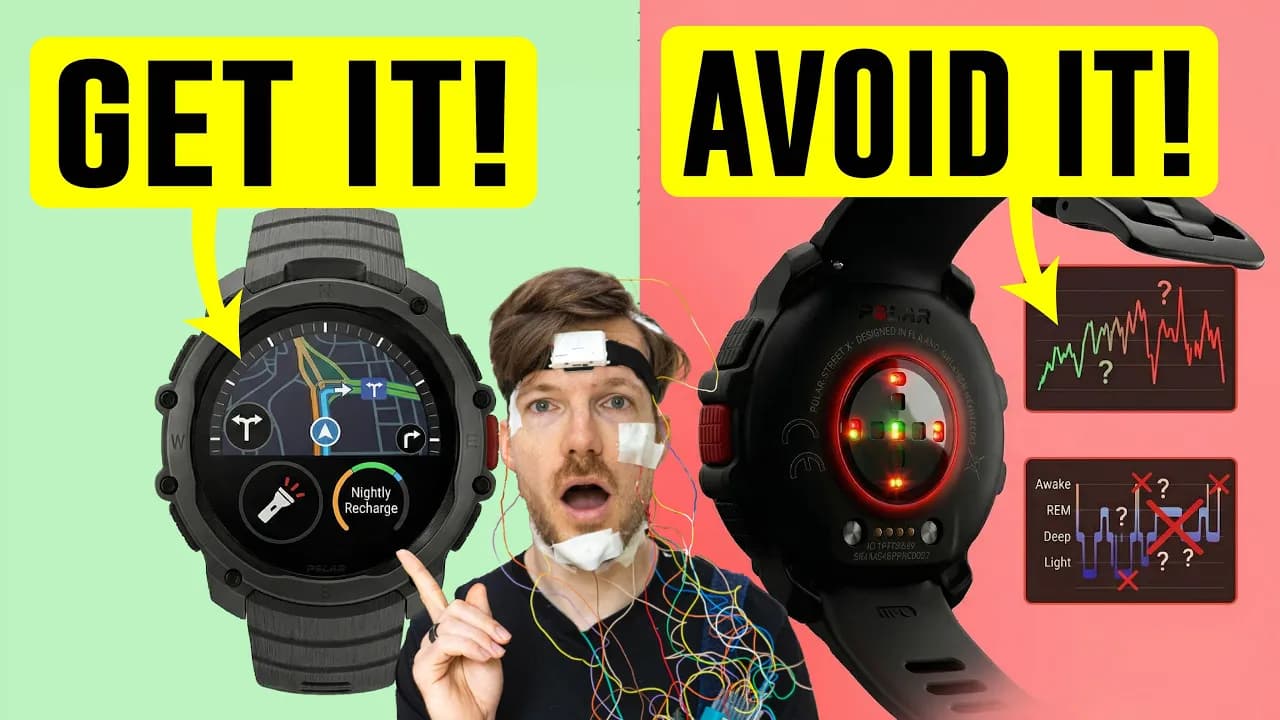
For the price, the Polar Grit X isn't half bad. The reviewer would be happy enough with it. The design is liked, and it now has a light, which is really nice for camping or hiking. The red light is nice for nighttime to not lose night blindness. For the package, the quality of the screen, the quality of the build, and knowing that data stays within Europe if in Europe, the reviewer is not unhappy with the Polar Grit X.
It's not amazing in any category. Heart rate tracking performance was good. Sleep stage tracking performance was okay. GPS tracking performance was okay. However, for the price, which was originally 250 euros and similar in dollars, it's actually not bad. It can already be found cheaper now. Compared to much of the competition, the features and quality of tracking isn't horrible.
A video is coming soon about finding the middle ground of price to performance where the best out there might be wanted, but good enough is often just good enough.
Keep The Quantified Scientist in your library
Save the videos and channels worth coming back to, and find them again in one place.