Post-Labor Economics explained in 10 minutes
In a Nutshell
Automation is dismantling the time-for-money bargain as machines outperform humans on cost, speed, safety, and quality across every task. Most jobs are derived demand—people are just the means—so they vanish once machines can deliver the same result, while only narrow “essential demand” roles that require a specific human (accountability, empathy, exclusivity) survive. With productivity decoupled from wages and the state no longer needing citizens’ labor, lasting security and power must shift from jobs to universal ownership of the productive assets that now generate the wealth.
These notes were generated by AI and may contain inaccuracies.
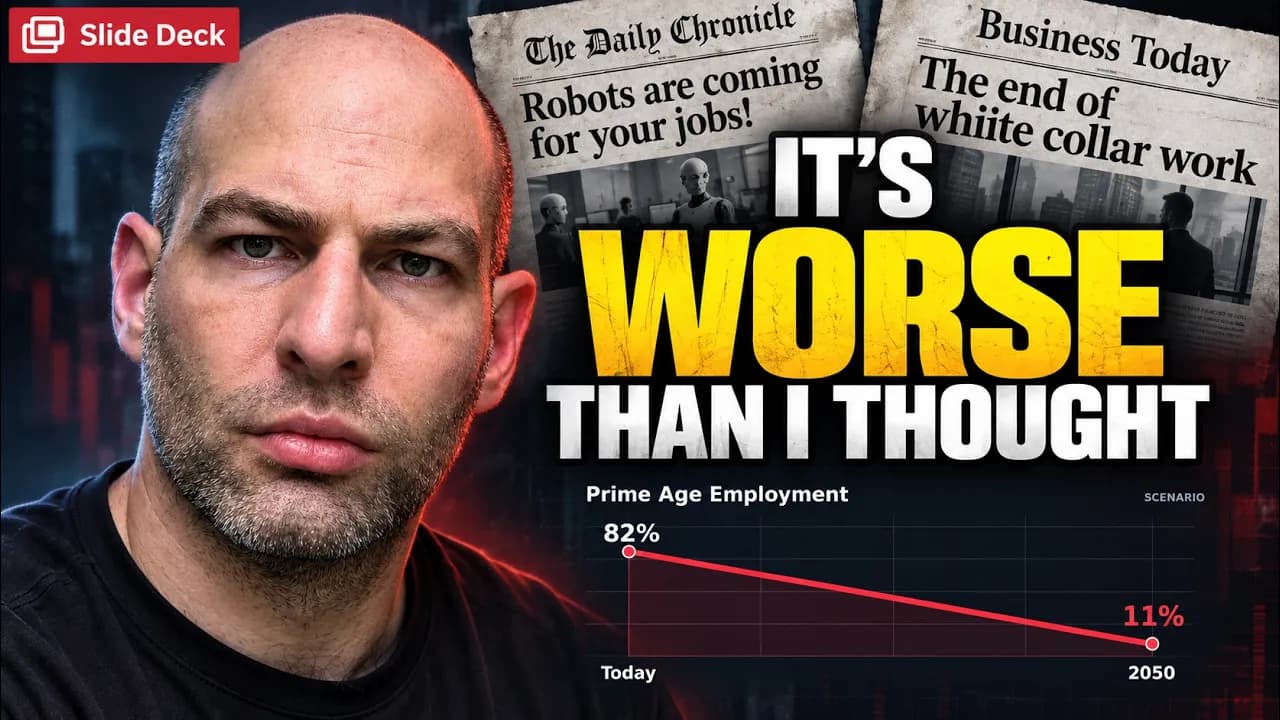
For 200 years, the deal was simple. You traded your time for money. That deal is breaking down. Machines are learning to do the work. This is post-labor economics. Every task faces the same test. Better, faster, cheaper, safer. When a machine wins on all four, the human has to justify the premium. And that gets harder every year.
Automation doesn't take a job all at once. It takes it one task at a time. AI takes the thinking work. Robots take the physical work.
In 1900, 4 in 10 American jobs were on farms. By 2000, fewer than two in a 100. The work still gets done just not by us.
The usual answer is that technology always creates new jobs. But nobody wanted the job. They wanted the result. health, working software, or a place to live. We were never the point. We were the means.
Human labor comes down to four things. Strength, dexterity, cognition, and empathy. Engines took strength. Robots are learning dexterity. AI is learning to reason and to comfort.
Two kinds of demand. With derived demand, you want the house. The builder is just how you get it. Essential demand is different. The person is part of what you're buying. for a massage or for children. Most of us want a person in the room. You may never meet the painter. It still matters that a person made it.
When it goes wrong, we want someone on the hook. A person we can fire, sue, or jail. And sometimes we want one particular person. No one else will do.
The demand is real, but it is narrow. It won't employ everyone.
For most families, a paycheck is the only link to the wealth they help create. After the war, productivity and pay rose together. Since 1979, productivity has grown about 94%. Typical pay about 33%.
Household income comes from three places. What you do, what you receive, and what you own.
Transfers can bridge a gap, but permanent dependence makes us clients of the state. What remains is ownership.
The pieces already exist. The job is to put them in everyone's hands for good.
Income is only half the problem. The other half is power.
Workers had power because the world could not run without. Rights are rarely given. They are usually one. The pattern repeats. Make refusing us cost more than giving in.
To see what happens when a state stops needing its people, look at the Gulf. Oil pays the bills. The state no longer needs your taxes or your labor. So, it shares the wealth and asks for quiet in return.
Now picture an economy where machines, not people, pay the bills. Comfort is not the same as control.
So we build leverage that doesn't depend on a job.
Power that can't impose a cost isn't power. It has to say no and make it stick.
Keep David Shapiro in your library
Save the videos and channels worth coming back to, and find them again in one place.