Robotic Deep-Dive: Beating China, the Race Against Tesla, & New Robotics Timeline With Brett Adcock
In a Nutshell
Figure's Brett Adcock claims the humanoid race is between them and China, with Tesla effectively absent, and that Figure 4 will be the "iPhone 1 moment" for practical humanoids while Chinese demos are non-functional open-loop teleoperation. The company has 1,500+ robots on campus, achieved zero-shot performance in unseen homes with Helix 2.5, and projects home deployments by 2026-2027 with $300-500/month leasing. They're investing billions in compute (100k GPUs), building everything in-house from actuators to AI, and see a path to 20 billion humanoids transforming the global workforce.
These notes were generated by AI and may contain inaccuracies.
Brett Adcock views the competition in humanoid robotics as a race between Figure and China, noting that Tesla has not released much in two to three years while China has been active. Figure focuses on a different approach than what they believe China is pursuing. The speaker states that the work coming out of China is not practical, the technology stack is not practical, and the AI stack can be done by a senior in college.
Adcock outlines four stages for the humanoid race. Chapter one requires building really good functional hardware. Chapter two requires building an AI recipe. Chapters three and four involve scaling intelligence and scaling robots.
Figure 4 is described as the iPhone 1 moment for humanoids, moving beyond the flip phone era. The team is working on making robots cheaper and more capable. A sneak peek shows work on hands where a Figure 4 with a glove and a human with a glove are almost indistinguishable.
Figure 3 is considered the best humanoid on the market by far, but Figure 4 will make it look like a caveman.
The campus has approximately 100 visitor bots that walk around, open doors, walk on stairs, use elevators, greet people, and talk. The team is working on getting robots to get coffee for people. A stretch goal is that visitors can come to campus and never talk to a human for check-in, tours, or other activities.
Figure now has more robots than humans on campus, crossing this threshold four to five months ago. With 700-800 employees, they have approximately 1,500 robots on campus plus robots deployed elsewhere.
Every robot on campus has real-time speech-to-speech capability using HARKC for voice AI, with speaker and microphone equipped. Users can stop a robot and ask questions directly.
The company has two tracks: commercial shipping and home shipping. Commercial applications are easier because tasks are well-specified and can be written on paper, but they require high speed and performance goals where mistakes result in getting fired. Home applications are more difficult because every home is different with varying appliances and setups, and tasks change dynamically.
Figure 3 robots can fold laundry, do dishes, unload groceries, open refrigerators and ovens, and clean houses, but the key constraint is intelligence. The robot needs to work end-to-end for a dozen plus hours per day, every day, seven days a week, for years.
The launch criteria require a high-quality product like an Apple-style product that works like having another person in the home. The team is not going to launch before achieving this magical experience. They are currently testing in 20 to 100 new homes in California that have never been visited before.
Helix 3 is described as a baby AGI moment with an adult body but like a 2-year-old intelligence level. The first model checkpoint was significantly undertrained, and larger models are being trained and evaluated.
The forecast is to see a robot put into any home doing fairly large long-horizon tasks end-to-end within the next sub-six months, perhaps sooner. Maintenance and repair will be kept in-house initially to ensure the highest quality experience.
Adcock's thesis outlines four stages: building really good functional hardware that can match human speed, torque, range of motion, and affordability at scale; building an AI recipe that can run end-to-end longer horizon work with full loco-manipulation; scaling intelligence; and scaling robots.
The K-Cup demonstration with Figure 1 was a turning point, showing the first neural network-based dextrous manipulation in robotics history. This led to raising nearly $700 million and proved deep learning works for robotics.
Chinese robot demonstrations involve dancing using deep learning RL controllers trained through deep mimic with humans wearing mocap suits. These are open-loop systems that do not react to the environment. Some have LiDARs for localization during parades. The work is described as completely orthogonal to what is needed for general robotics at scale.
The technology stack underneath Chinese demonstrations is considered contrived, often involving teleoperation or pre-programmed macros rather than real neural nets learning on the fly.
Chapter three and four involve scaling intelligence and scaling robots. The goal is to see scaling laws where more input produces better output. Input consists of data and compute, with output being robots doing more useful work.
Other companies' language models and multimodal models operate robots for basic tasks on fixed camera frames very slowly, often with videos sped up 5-10-20x. Figure needs robots to move at very different dynamics and frequencies, walking around and performing real work rather than slow, basic tasks.
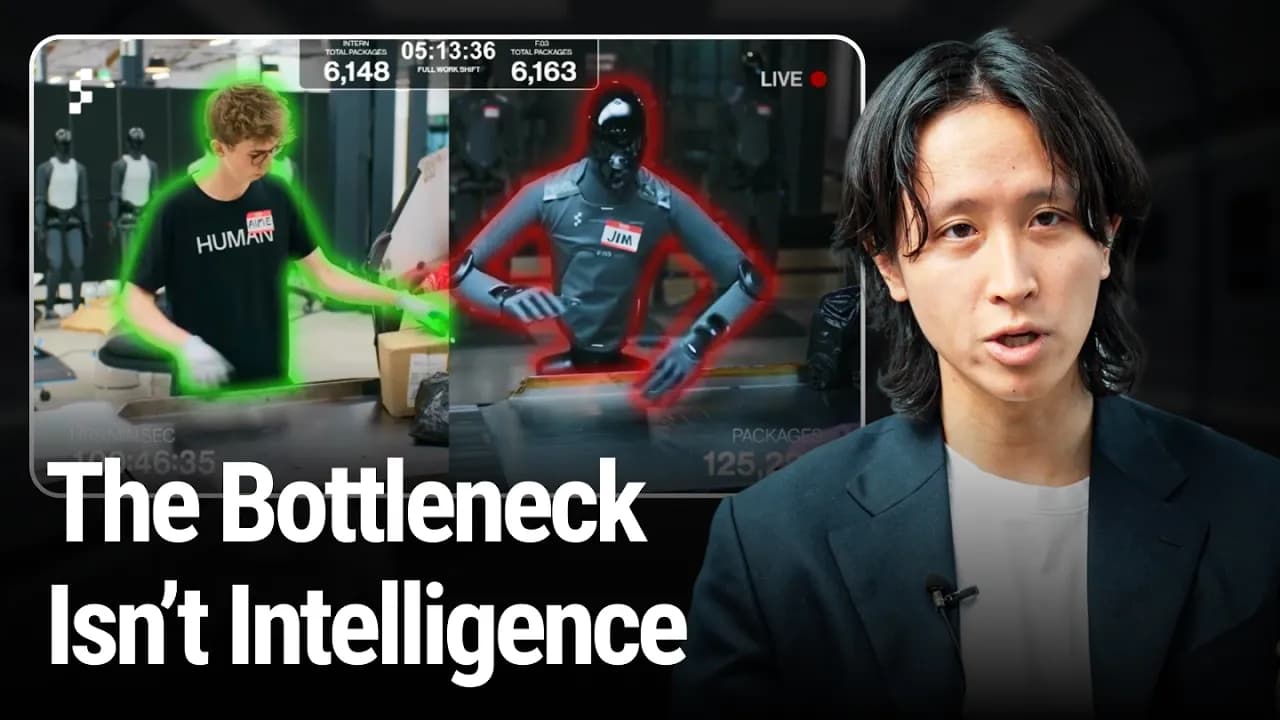
A robot needs to walk around, react to the environment in real time, and move packages in under 3 seconds per package. It must maintain very low error rates across an entire shift. Robots need to enter homes and perform fine-grain manipulation including grabbing cups and dishware, putting items away, opening doors and cabinets, and navigating tight spaces like bedrooms and kitchens. The robot must balance on a quarter-size point in its foot above the center of mass in the torso. This becomes a fundamentally different problem than what appears in tabletop college setups.
University and tabletop setups are not real models for robotics. These systems run on at least one layer of third-party neural nets and LLMs, which cannot be deployed into high-dynamic robots. They cannot scale from simple tasks to full locomotion and manipulation. Academic setups have unlimited compute, low-latency network connections, fixed cameras, and overfit to tables for data collection. None of these conditions are realistic for actual deployment scenarios.
Figure built Helix from the ground up to create the right brain for the robot. The brain architecture needs to change dramatically from academic approaches. The current understanding is that the brain is well understood, but the limiting factors are data and compute. The system lacks enough world understanding of forces, joints, and observations to deploy into every home.
With Helix 2.5, Figure tested in 30 rental homes rented the day before or day of testing. The robots performed tasks like making beds and tidying living rooms without ever seeing the house or objects before. This was fully zero-shot performance with none of the test environments included in training.
Some deployment has already been seen in 2026. More will be seen from Figure in 2026. It would be very surprising if the full picture is not seen by the end of 2027.
Most compute spending today goes toward training. Figure is doubling its internal compute the following week. The company signed a deal with nscale for 100,000 GPUs worth over three billion dollars. These are Ver Rubins VR 2200s coming online in the second half of 2027. This represents over 100x the training compute compared to a month prior.
All inference runs onboard the robot today. Helix handles planning, reasoning, low-level trajectory generation, and torque control entirely on the robot. The only offboard processing is real-time speech-to-speech through servers. Cloud infrastructure handles agent orchestration for fleet management, including task assignment across multiple robots, recharging coordination, and maintenance routing.
Cloud processing faces fundamental physics limitations with high-dynamic robots. Communication to joints and sensors and returning new plans must happen at millisecond level. The best 5G networks achieve 20-30 milliseconds per leg, resulting in nearly 50 milliseconds round trip. At that point the network itself limits operation to 20 hertz before accounting for inference forward passes and image/torque processing.
The current approach runs everything onboard so robots can continue working without internet connectivity. This prevents situations where a robot stops mid-task due to poor 5G service. The architecture allows continued operation even with bad connectivity.
Helix 2.5 demonstrated zero-shot reasoning in 30 unseen homes and showed the first humanoid scaling laws for data. As data increased, model losses decreased and robot execution improved in log-linear relationship. This pattern was previously seen in LLMs but not in robotics. Helix 3 is characterized as little baby AGI, with behavior that looks exactly like a child learning through experimentation rather than pre-programmed responses.
Home deployment requires robots to be affordable at $300 to $500 per month lease, equivalent to under a dollar per hour. The average person indicated they would own at least two robots at that price point. Lease models allow customers to access newest versions every few years as technology improves rapidly.
Figure 4 represents the largest step up between generations. The robot will look significantly different from previous models. Primary drivers are reducing cost to induce more demand and increasing capability. Seven iterations of hands have been built, including both tendon-driven and non-tendon-driven designs. Figure 4 hands with gloves will be almost indistinguishable from human hands with gloves.
Figure 4 represents a full deviation from previous designs. The architecture changed from endoskeleton to exoskeleton where all loads are taken on the exterior, similar to aircraft construction. This represents the largest step up ever made between generations.
All touch systems and components are developed in-house. External components fail production requirements for reliability, cost, firmware understanding, embedded software, thermals, and physical fit. Previous attempts to source externally resulted in components that were three times too large, three times overweight, and too expensive. Actuators need to cost tens of dollars rather than hundreds.
Building actuators in-house requires firmware, electrical, thermals, embedded software, mechanical structures, motor design including rotor and stator, gearbox design, wire and cabling, heat management, and daisy-chaining across the robot. Every improvement on the engineering side can increase size, creating conflicts with elbow and knee packaging and aesthetic requirements.
The face design for the Figure robot remains an ongoing internal discussion. The current black screen face lacks the facial movements needed to create a fully humanlike experience. While the robot can communicate through lights, screens, and body gestures including neck movements, something essential is missing for human interaction.
The black face is described as feeling friendly but somewhat ominous due to its shiny black appearance. Figure has significant plans for the head and face design on Figure 3. This challenge is fundamentally a human psychology problem rather than purely a technical one.
As robots develop memory capabilities, including remembering previous conversations and greeting people by name, the interaction becomes more companion-like. This is particularly relevant for home environments where robots may be around families for extended periods.
Figure has established a dedicated HMI (Human-Machine Interaction) team with an HMI lead, conducting weekly planning meetings and demonstrations. The focus extends beyond just the face to include body reactions such as expressive arm movements, small gestures, and nodding that contribute to more natural interactions.
Figure has deliberately avoided putting googly eyes on the robot, viewing this as a disservice to the technology. The argument is that adding such simplistic features to what is described as one of the most complex pieces of technology on the planet would be misleading about the robot's actual capabilities, including walking upstairs and opening doors.
The company aims to maintain design standards that showcase the technology's true capabilities rather than relying on friendly but misleading visual shortcuts.
The end goal for the consumer market is a home companion that can be trusted and integrated into family life. The vision includes persistent memory allowing the robot to know everyone in the household, provide emotional support such as comforting a sad child returning from school, and handle household tasks like dishwasher work.
The persistent memory and tuning that occurs through long-term robot use creates a bond similar to porting data between iPhones. This includes learned preferences about household tasks and routines. The personality and learned behaviors are designed to transfer between devices rather than remaining tied to specific hardware.
Testing is underway for scenarios where multiple robots can maintain a singular conversation as a person moves between them, creating a shared mind experience across the robot network.
Robots can be personalized both cognitively and physically. Physically, this includes the ability to outfit robots with different soft goods and apparel, similar to iPhone cases. Users will be able to fully accessorize their robots, change voices, and assign different personalities.
Beyond traditional tools like hammers, the discussion covers integration with household appliances such as mixing machines. The vision extends to robots that can control appliances and tools through mental commands rather than physical manipulation, enabled by the device's built-in intelligence from systems like Hark or Helix.
This creates possibilities for remote operation where users can control devices like ovens without physical presence, making the robot fully integrated into daily life.
Safety considerations require building safeguards from the substrate level in nonvolatile memory up through system architecture design. This encompasses both physical safety and semantic safety, where the robot's intelligence must understand risks such as not knocking over candles or spilling hot water.
With 40+ actuators on board, preventing failures that could harm children or pets is critical. The approach mirrors safety standards achieved in turbojet engines (rated to 1×10⁻⁹ hours before catastrophic events) and self-driving cars.
Figure maintains a substantial cybersecurity team handling both product and corporate security concerns. The approach acknowledges that no single solution exists and requires ongoing work across cybersecurity, system safety engineering, and fundamental behavioral rules in nonvolatile memory.
Significant progress has been made on removing Chinese and third-party components from outside the country, driven initially by tariffs that reached 270% at one point, and subsequently by geopolitical considerations. The supply chain is now described as being in good shape regarding domestic sourcing.
No robot insurance industry has emerged yet for either commercial or consumer applications. Financing demand exists from parties wanting to finance robot deployments, with current focus on commercial contracts. Figure is working with major financial institutions on lease financing models similar to automotive credit receivables, though the company itself may not directly provide financing.
The physical world foundation model developed for robotics has potential applications in space, where maintenance costs for human workers are estimated at low tens of millions of dollars per hour. The model could control robots performing maintenance tasks on space infrastructure.
Figure had early conversations about space applications when the company was founded, though current hardware is not rated for space conditions including vacuum-rated joints and appropriate IP ratings.
Figure maintains its policy against defense work, citing the difficulty of selling robots for home and commercial use while also engaging in military applications. The civilian market is viewed as hundreds of times larger than military applications.
Concerns exist about potential vandalism or theft of robots in public spaces, similar to incidents with Bird scooters. The company does not plan to train robots to defend themselves against humans. While cameras provide some deterrent through identification capabilities, the approach is to accept that some negative interactions may occur but represent a small percentage of overall experiences.
The manufacturing process shows exponential scaling, with robot counts increasing from dozens to massive scale within months. The vision extends beyond robots building robots to robots controlling machines that build robots, creating closed-loop exponential growth.
Current production involves significant human labor, but the trajectory suggests movement toward lights-out manufacturing. The rapid progress since founding, driven by deep learning advances and capable robot hardware performing end-to-end neural net work, has exceeded initial expectations of 30-40-50 year development timelines.
A recent demonstration showed Helix 2.5 fully zero-shot completing an entire warehouse task never previously seen by the robot, including variable lighting conditions, different conveyor setups, and diverse package mixes. The same model performed successfully when deployed at a client site after larger-scale pre-training.
Full lights-out manufacturing—complete automation with no humans present and no power or lighting required—is considered achievable within five years. Figure 4 was specifically designed to address challenges encountered with Figure 3 that made closed-loop lights-out manufacturing difficult. Figure 4 is positioned as the robot that will ultimately build itself.
Current manufacturing processes are not expected to present tasks that cannot be accomplished by the new hand design. Activities previously considered difficult for robots—such as ladder climbing and forceful physical interactions—are now being performed successfully, including carrying 50-pound boxes, truck unloading, and domestic tasks like dish handling and laundry folding.
AI has already surpassed human performance in diagnostics across multiple metrics. The next milestone is robotic surgery, where federated learning would enable every robot to access knowledge from every surgical case performed. Robotic surgeons would operate without physiological limitations such as fatigue or emotional state, at approximately one dollar per hour, and could be deployed anywhere globally.
A significant upcoming demonstration will show every manufacturing step for Figure 4 being performed by the new hand design. This includes the complete sequence from receiving components in boxes through final assembly, representing a major historical moment in robotics development.
The current development phase focuses on scaling intelligence rather than narrow task performance. The goal is for humanoids to learn new environments like Baku using the same process as human workers—minimal instructions, documentation, and brief shadowing periods. Hardware improvements are expected to provide steady dexterity gains, with capabilities like needle handling improving year over year.
Neural networks demonstrate strong performance with diverse training data. Logistics operations show robots successfully handling previously unseen package types on moving conveyors. Training data now includes varied scenarios such as hose-based dog washing and house painting, which improve performance on seemingly unrelated tasks like laundry folding.
Current systems have focused on narrow use cases for two years. The target capability is rapid adaptation to novel situations with minimal demonstrations. A surgery-capable robot should maintain general functionality, such as retrieving coffee without specific training, while requiring targeted fine-tuning for specialized procedures.
Current Baku capacity supports approximately 40,000 units annually across four production lines. Plans are underway for expanded manufacturing capacity to meet projected demand that could reach essentially unlimited levels if current technical milestones are achieved.
Figure 4 is positioned to become the first high-volume mass-produced humanoid robot. A potential path exists to scale production to one million units annually from a single facility, contingent on solving current technical challenges related to intelligence scaling.
The commercial workforce of 3.2 billion humans could expand to 5-8 billion with humanoid assistance. Including personal ownership at one robot per human yields a potential market of approximately 20 billion humanoids. Initial deployment phases could absorb this quantity before full 24/7 automated economies become operational.
Current automation is limited by human-dependent processes such as delivery schedules. Full end-to-end automation of logistics, supply chains, healthcare, and data centers would enable continuous 24/7 operation. This represents a fundamental shift from partial automation to complete economic system automation.
As artificial superintelligence develops, robotics becomes essential to prevent dystopian scenarios where digital AI systems direct human labor. The preferred outcome has ASI systems directing robots rather than humans, avoiding situations where humans become effectively enslaved to machine-directed work. Current examples include emerging platforms where AI agents hire humans for physical tasks.
Traditional manufacturing produces identical products with minor configuration variations. LLM-enabled mechanical design combined with robotic manufacturing capability enables creation of diverse physical products. This represents a fundamental shift from standardized output to individualized manufacturing at scale.
Ten billion robots would require unprecedented silicon access. Current chip supply chains are committed to phone and server markets, with phone memory demand alone consuming significant capacity. Memory partnerships have been established for near-term scaling, while long-term chip architecture decisions must account for rapidly evolving model requirements.
Chip development requires 2-3 years minimum, making three-year forward planning essential. Current inference compute designs would have been considered incorrect three years ago. The rapid evolution of model architecture and training methods makes locking into specific chip architectures risky given current acceleration rates.
Six-nanometer process nodes offer available capacity that can be directed toward robotics-specific requirements, unlike 2-3 nanometer nodes committed to phones and GPUs. This represents a potential stepping stone while longer-term custom chip development proceeds.
All entrepreneurs across history, only Zuck is ahead of Brett Adcock at age 40. Serial entrepreneurs like Jobs, Elon, and a handful of others are far more likely to change the world in the future. If someone can do it once or twice, they're statistically likely to do it three, four, five times. Among serial entrepreneurs at age 40, Adcock has 20x the resources available compared to where Elon or Jobs were at the same age. Part of this is simply the sign of the times with far more capital available today.
Adcock grew up in Illinois farm country and has DNA oriented toward machinery. He likes touching hardware. If he had been born 20 years earlier, he would have run headlong into the "hardware is hard" reality where Silicon Valley would never invest in it. The current moment is perfect for hardware entrepreneurship.
The FCC has put a regulatory block on importing Chinese robots. Adcock viewed the FCC ban on Chinese robots as somewhat of a shock. He would love to see a really level playing field to compete. There hasn't been much conversation about regulating robots in the home or on the street, though the space is evolving.
Adcock hasn't seen much out of Tesla in two or three years, only teleoperated robots. He hasn't seen any dancing robots from Tesla. China has been doing a lot of dancing, but their neural network architecture is 180 degrees different work. If asked to out-dance China, Figure would need to pivot everyone's strategy entirely, as they don't have a dancing roadmap.
Adcock views China as the closest collective competitor to Figure today, with a lot of work happening there and fast movement. There are around 150 humanoid robot companies in China. The hardware isn't great, the policies and models don't look strong, but the amount of progress they're making year-to-year is really significant. Figure intends to beat this group.
China needs robots desperately for manufacturing and elder care. The Chinese companies are in a race to show how capable their robots are at gymnastics, while Figure focuses on shipping robots into homes for zero-shot long horizon reasoning. Companies like Unry don't build good hardware - they're tiny, come out of the box waving with a controller, have no hands, and compute the size of a USB stick. Research groups put compute backpacks on their robots. Sensors aren't great and hardware is basically duct taped together.
Adcock comes in every morning thinking about how to move faster, believing there is always a way to move faster. Speed and agility are accessible advantages. Entrepreneurs can literally always move faster. Working double the hours will probably generate 1.5 to 2 times more speed per year. All of this matters when competing against the global collective of China.
Figure has a founder company advantage versus large industrial companies trying to enter the space. They're willing to take bigger risks, pursue disruptive strategies, and iterate rapidly. The talent level walking around the building can't be found at big industrial companies. The only way to build really capable general purpose robots is in the Bay Area, which is better than Shenzhen for this work.
Robotics was invented in the Bay Area. AI was literally invented there. Silicon was built there. Batteries, motors, embedded software, thermals, AI, deep learning, and all infrastructure were built in the Bay Area. Self-driving cars happened there before China. The people growing up there have worked in these areas and understand the technologies well. Figure has assembled a top tier team of maniacs who are great at what they do, love being there, are mission-driven, and are there to beat everybody in the space.
Adcock grew up in Illinois farm country, went to college in Florida, then moved to New York City. He started a software company called Vetery, an online recruiting marketplace connecting employers and job seekers. He sold it in 2017 to the world's largest recruiting company for a little over $100 million. As soon as he got the term sheet, he knew he had things he wanted to do in the hardware space.
He started Archer Aviation the next year, initially in New York with intention to move. He was going to move to LA because of aerospace talent, but found that what he was working on - electric motors, battery systems, control software - wasn't what aerospace was building. It was all happening in the Bay Area with groups like Kittyhawk and Airbus building electric tall aircraft and the electrification and robotics communities. He moved to the Bay Area and has been there ever since.
Archer is basically a flying robot with electric motors, batteries, control systems, embedded software, and sensors. Doing robotics in the Bay Area is arguably the best place in the world, maybe second only to Shenzhen. If general robotics will be solved, it will be in one of these two places.
With $9 trillion of new liquidity from Anthropic's IPO and Nvidia's run-up, Silicon Valley has become the new capital. If someone woke up tomorrow needing $20 billion to start building their own ship fab, they could do that in the Bay Area but couldn't come close in New York or LA. New York is one of the best places Adcock ever lived and probably the number two market in the US besides San Francisco for software engineering, but he now understands the San Francisco advantage.
Silicon Valley is the most condensed place in the world of talent in the right cultural phase of life to really punch it. It's the easiest place to import talent - if you're in Austin, Chicago, or Boston trying to do robotics, you'll get maybe 1 or 2 out of 50 people to move there from SF, but in SF you get 50 out of 50. In robotics, there are around 12 different divisions of folks needed to build one robot, and getting all 12 groups from SF is extremely difficult.
Peggy Johnson took Agility public because she needed capital. Archer went public because they needed the money - they were raising their series B and needed hundreds of millions, actually a few billion dollars to get through FAA certification, which is very difficult. They couldn't see it in the private markets and ended up going public, raising a little under a billion dollars. It was the right move at the time but they were really early and too young to be public. Given the constraints, Adcock would do it over again, but if they had access to private markets, Archer would probably still be private today.
For Figure, Adcock thinks it's somewhat inevitable they'll be public at some point for access to the right public capital and public trust for disclosures. It's great for employees, liquidity, and investors. Adcock is an early investor in Figure, having invested specifically in Adcock and the team he assembled. The signal was strong based on what Adcock had done as a serial entrepreneur, but even stronger because he was putting his own capital into it and the team assembled was a rockstar team.
Figure's big focus is solving general robotics - building a general purpose robot. They've seen a glimpse of what that looks like today, and it will get much better. That will kick off significant scale manufacturing, even larger significance in inference and compute needed as they scale, and overall working capital and capex needed to grow the business. They want to hit that milestone privately and feel like they're approaching it.
Every new model they train feels like it could be the one, though there are always bugs to work on. They have 10 times more data sitting in their servers today that they can train a new model on than what was shown. They have 100x the compute coming on - maybe way more than 10, maybe a factor of 15 or so more data sitting there.
The data comes from a variety of sources, but they need really rich physical world information that can't be scraped from the internet. They need to know how a human would grab a cup, how they're oriented, what forces they feel, what the hands are doing. The video feedback is all over the internet, but the feeling and feedback can't be obtained that way.
They have an effort called Index for large-scale data collection. They have to audit the data, make sure it's the right distribution, clean it, annotate it, and get it ready for training. That takes time. When it's ready, they need to be at the right place for a new checkpoint for pre-training. Most of their compute over the last month, more than half, has been taken from one giant pre-training run for Helix 3.
Figure pays low nine figures a year for compute right now, with 50-70% of that going into pre-training for Helix 3. If they had 10 times more compute, they would train on 10 times more compute. Next summer they expect to be doing billion dollar training runs on Helix, assuming everything goes well. They have the data, compute, and capital, but getting larger clusters set up is hard.
They went out six or seven months ago for compute for their current cluster. Four vendors came back with pretty decent chips, new Blackwell series chips. They beat the vendors hard on pricing, got it down on GPU per hour, and signed a great deal. A couple months later when they went out for double their compute capacity for Helix 3, they got no bids back initially. After pushing harder, they got one bid back from a big cluster, but then the vendors beat them on price.
Adcock made a prediction earlier in the year that in 2027 you wouldn't be able to get compute anymore, and that happened in September 2026. The world ran out of compute. You can't get H100s, they're trading above par. The whole world is out of compute, and compute is constrained by memory. The whole world is out of memory. It takes three or four years to build those fabs from scratch. Nvidia has been one of the best places - you can't train on anything else besides this.
A lot of investment is coming from Nvidia and other public companies. Public companies never used to invest in startups or early stage companies, but now they're wide open for business. This Silicon Valley invention allows much bigger things to be built highly efficiently in the private market. The new HBM memory fabs won't be online for three years, but if you look at how many are being built, they'll be overbought before they even come online. None of these are forecasting humanoids.
Multiple companies report that their AI-related demand is not appearing in any official forecasts. The CTO of one major group confirmed they have no AI projections included in their planning. This pattern repeats across software for mechanical design, space, and other sectors where demand consistently exceeds projections.
The scaling laws for compute show a log-linear relationship where training the same amount of data and parameter models on more compute continues to deliver real ROI. The trend shows no signs of stopping, with consistent improvements from increased computational resources.
The emerging AI systems, including digital systems like heart-related applications and Figure's work, are described as magical. The assessment is that this technology will be 100 to 1,000 times bigger than the internet in importance and impact.
Hark operates from a campus location approximately 100 feet from Figure's facilities. Hark focuses on building personalized intelligence as the digital counterpart to Figure's physical robotics work. The companies collaborate on computer use, speech, memory, and vision technologies.
Hark Pro launched approximately one month ago as the non-hardware version of the platform. The launch exceeded expectations with over 1.2 million signups and nearly five million browser sessions. Usage grew so rapidly that access was restricted in some countries to manage server load.
Hark develops its own real-time speech-to-speech models internally without third-party components. These models power the voice interactions for robots being developed. The speech pace model is developed in-house, representing a vertically integrated approach that differs significantly from Chinese robotics implementations.
Current speech-to-speech systems suffer from multiple deficiencies: inappropriate hardware platforms, poor tool-calling capabilities, high latency issues, interruption handling problems, and lack of human-like interaction quality. These systems are currently used only occasionally rather than as primary interfaces.
Both Figure and Hark consider speech the optimal UI layer and default interface for robotics and AI hardware. The companies are fully committed to making speech interfaces work effectively rather than relying on existing inadequate solutions.
Figure has been using Hark for five months as the first beta user. Internal adoption rates are extremely high, with employees voluntarily choosing to use the system for productivity assistance throughout the company.
Hark emphasizes large-scale multimodal pre-training as critical for the field. Figure works on generating action predictions from robot systems, with several areas of collaboration between the companies.
A running bet exists within the Moonshot team that Figure will eventually acquire Hark. However, revenue projections suggest Hark could become larger than Figure within six months or possibly 90 days due to digital scaling advantages versus robotics scaling constraints.
Hark already exceeds Figure in revenue, with growth described as exceptional. Digital products can scale differently than physical robotics, creating different growth trajectories. Hardware development and major commercial agreements are planned for Hark.
The decision to create Hark stemmed from observing that existing AI systems like ChatGPT function primarily as search engine replacements rather than providing the desired personal assistance. The vision was for an AI that could accompany users everywhere, manage personal accounts, handle tasks like property tax payments, provide reminders, and book travel with user permission.
OpenAI led Figure's Series B round alongside Microsoft and joined the board. After approximately one year of collaboration, the partnership ended due to lack of engagement from OpenAI's team, who cited distance from San Francisco and reluctance to visit the robotics facility.
Current consumer AI interactions with computers and phones represent broken experiences. The founder spent significant time researching deep learning applications in this space before deciding to build rather than observe from the sidelines.
The long-term vision includes AI systems that maintain continuous relationships throughout users' lifetimes, with usage increasing rather than following typical relationship patterns that decline over time. The goal is having the smartest person in the world available everywhere with aligned interests.
Both Hark and Figure require users to trust the systems with their most personal information. Daily team communications emphasize maintaining users' personal diaries with unprecedented security and privacy standards that prevent typical advertising-based business models.
Hark is over one year old, with Pro launching one month ago. The current state is compared to 1999 internet development - foundational work is occurring but the optimal form hasn't emerged yet. Four to five major product announcements are planned for the current week.
Two categories of AI devices are proposed: centerpiece devices (currently phones and computers at one billion units annually) and accessory devices (AirPods, watches, glasses). The thesis suggests AI devices will eventually replace phones and computers as the main platforms, with accessories representing single-digit revenue percentages.
Existing AI peripheral devices like Meta glasses are considered failures that require phone apps for network connectivity and provide poor user experiences. The fundamental issue is that these accessories must interface with existing phone platforms rather than functioning as independent AI devices.
Hark has working AI hardware in the lab adjacent to the main facility, with daily usage by the founder. The specific form factor remains undisclosed but represents the next generation of AI interface devices.
The OpenAI partnership with Figure involved weekly meetings and dedicated teams, but OpenAI personnel never visited the robotics facility. Progress sharing became one-sided, with Figure advancing 10-100 times faster while sharing all developments. The relationship ended when OpenAI's interest in robotics became apparent after seeing Figure's results.
Johnny IV is believed to be working on AI devices rather than humanoid robotics at OpenAI. The goal appears to be creating a device compelling enough to replace the iPhone as the primary AI interface and personal information repository.
Apple faces challenges from multiple directions as traditional phone interfaces become obsolete. The company has not made the necessary investments in GPUs and AI model development that would be required to compete in the emerging AI device space.
AI devices must be co-designed with their underlying models rather than having AI capabilities added afterward. This applies whether the interface is BCI, language devices, or other forms. The devices serve as interfaces to raw, personalized intelligence.
Significant investments have been made in four BCI companies, with recent meetings revealing progress toward mouse connectivity and eventually human connectivity that would fundamentally change human-AI interaction.
Current development focuses on language devices, with BCI and brain alignment phases expected to follow. Hark plans to participate throughout this entire evolution process.
Current phone and computer interfaces remain unchanged for 20 years despite AI capabilities now including thinking, computer usage, speech, vision, and persistent memory. Real-time interaction with these capabilities requires new interface paradigms.
Phones are viewed primarily as expensive cameras ($1,500 devices) when cameras cost approximately $3, indicating that current phone pricing may not be sustainable as AI interfaces evolve.
The strategy focuses on launching high-quality, safe products rather than engaging extensively with regulatory processes in Washington DC. Incremental commercial shipping began last year with increased deployments planned for the current year.
No significant regulatory discussions about humanoid robotics have been observed comparable to superintelligence concerns. The only recent regulatory action noted was the FCC ban on Chinese humanoids within the last 90 days.
The approach prioritizes building and shipping robots over regulatory engagement activities. The position is that AI and robotics will be beneficial for humanity, with the ability to shut down systems if needed, though this outcome is considered unlikely.
The evolution of founder control from Steve Jobs era limitations through Google and Facebook's founder-controlled models to Elon's multi-company approach has enabled more aggressive business planning and execution in the current technology landscape.
Elon Musk reinvented robotics by enabling multiple simultaneous operations, creating significant advantages for Figure and Hark. The rapid progress at Hark has been remarkable, with potential for the company to surpass Figure within three to nine months.
Beyond the primary robotics companies, there's a concurrent school safety project that's important for society but won't reach the scale of the other two ventures.
Today's entrepreneurs possess far greater power than those in the Steve Jobs era, let alone the Zuckerberg era. This represents an inspiring time for entrepreneurship. The question arises whether a 20-year-old entrepreneur today can follow similar paths, or if AI advancement has made such opportunities unattainable.
Managing three companies while raising three kids creates an intense but rewarding experience. The current moment represents the best time of life despite the difficulty, with the future generation positioned to be AI-native. The ability to build hardware through prompt product development will be transformative.
AI currently lacks imagination, which represents its primary constraint. Entrepreneurs excel at idea generation and future thinking, maintaining notebooks of business concepts. This creates an unbounded opportunity for new entrepreneurs, potentially marking the best time in history for entrepreneurship.
Today's entrepreneurial environment offers capital access, incubators, and a community of people wanting to work at startups. Unlike previous generations where entrepreneurship wasn't considered a viable path after graduation, the current ecosystem provides extensive support networks that will accelerate future entrepreneurs.
The promised three or four-day work week has instead resulted in a ten-day work week reality. The emphasis on hard work includes coming in on weekends and working nights, with the team enjoying the grind. The company culture explicitly rejects work-from-home policies and day-off strategies, requiring daily in-person collaboration. This approach stands in contrast to typical Silicon Valley norms.
Building physical products provides intrinsic rewards that justify the intensive work. The office environment benefits from robots walking around, adding energy to the workspace in an unexpected way.
Figure 4 can handle tasks including setting up meetings, checking in guests, providing water and coffee, and conducting facility tours. The robot's capabilities extend to speaking on behalf of its creator during interviews, with plans to include Figure 4 demonstrations in future discussions.
Keep Peter H. Diamandis in your library
Save the videos and channels worth coming back to, and find them again in one place.