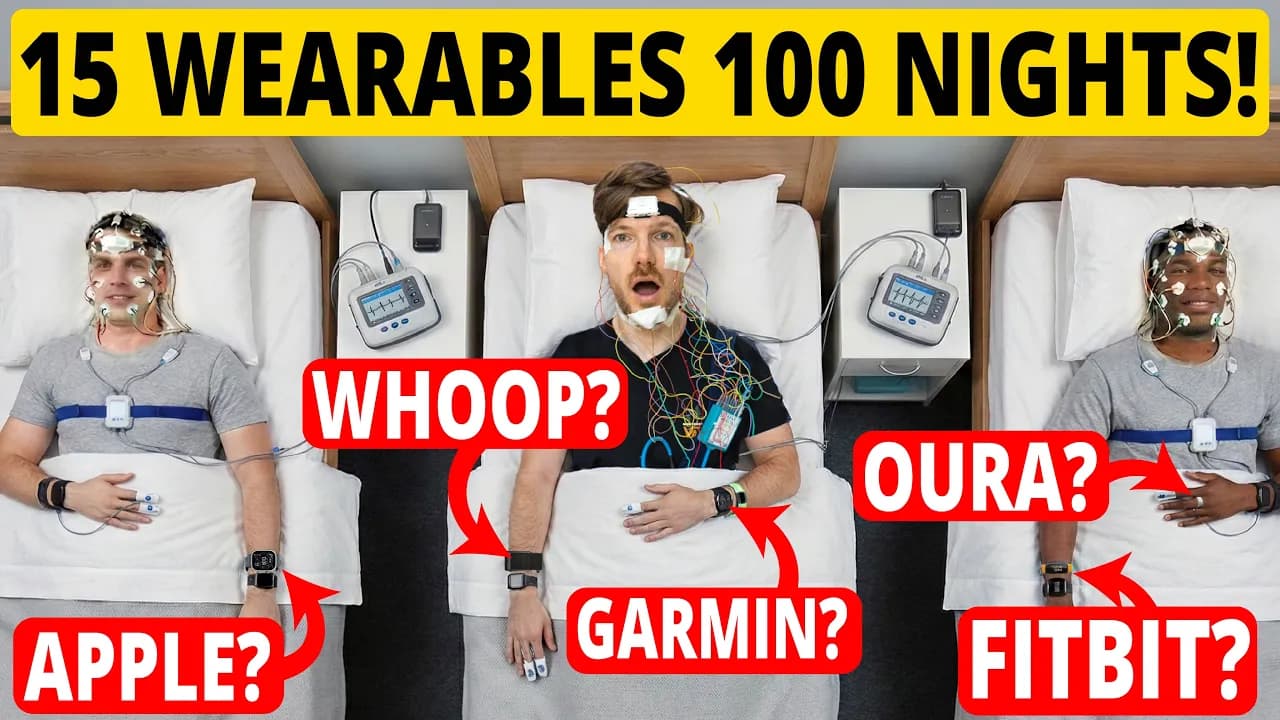
Scientific Review: Best Wearables for Sleep HRV and Heart Rate!
In a Nutshell
Garmin devices deliver the most accurate nighttime heart rate and HRV measurements, with mean errors around 0.7 bpm against ECG reference. Fitbit watches match Garmin’s HRV correlation but stop reporting values below ~38 bpm. Apple Watch and Amazfit lag in accuracy, while Samsung performs well for heart rate but produces unreliable HRV numbers.
These notes were generated by AI and may contain inaccuracies.
When waking up each morning, the first assessment is sleep quality, followed by heart rate variability and resting heart rate. The question addressed is which brand or device performs best at measuring and tracking these indicators. An overview of device performance is presented based on extensive work analyzing biological data, with surprising findings that some best-performing devices for heart rate metrics may be average at measuring sleep stages, with Garmin highlighted as a prominent example of high quality in heart rate and heart rate variability measurement.
The Polar H10 ECG chest strap serves as the reference standard for comparison, as it measures the electrical activity of the heart and is used by major companies including Apple and Google. Two key metrics evaluate data quality: mean absolute error on the horizontal axis, representing the average difference between reference values and device measurements, and the correlation coefficient (R-value) on the vertical axis, where points closer to the diagonal line indicate better performance. The mean absolute error is considered slightly more important than correlation because correlation can be high even with systematic deviation, though both metrics are included for comprehensive evaluation.
Devices are categorized as excellent, good, or acceptable based on performance metrics, with no devices rated as bad. The top-performing devices cluster in the top right corner of the comparison graph. Garmin devices, including the Garmin Circa watch and Fenix 9 Pro, demonstrate excellent performance with average errors of approximately 0.7 beats per minute and typical deviations within 1-2 beats per minute, though maximum deviations reached approximately 7 beats per minute as exceptions.
Fitbit Edge and Fitbit Charge 6 show exceptional performance with data points very close to the reference line. However, a notable limitation exists where Fitbit devices do not monitor heart rates below approximately 38 beats per minute, instead showing conservative readings that maintain values above 38-39 beats per minute. This was verified on nights when reference devices recorded heart rates around 35 beats per minute, which the Whoop strap and Eight Sleep app also detected, confirming the Fitbit limitation.
The Apple Watch shows larger deviations than competitors, with some points recording very low or very high heart rates, potentially due to export process glitches. The Amazfit Helio band also underperformed with export problems and occasional very high heart rate registrations. Some devices may calculate maximum values in specific regions rather than averages, which could affect the default average calculation methodology.
The Oura Sleep mattress cannot measure heart rate while the user is out of bed, whereas the reference device continues measuring. This creates a disadvantage in the comparison since the average reading of the reference device is calculated while the user is out of bed.
For heart rate variability, correlation and mean absolute error metrics show less agreement than with heart rate measurements. Fitbit Air and Fitbit Charge 6 excel in connectivity but show higher absolute error rates, while Garmin devices, Fitbit Edge, and Apple Watches perform better in absolute error average but show average correlation. The Oura Gen 5 is described as fairly good but not matching top competitors.
The Fitbit Charge 6 demonstrates good correlation with the best-fit line but tends to detect lower HRV values in higher ranges. The Apple Watch Ultra 4 shows the opposite pattern with good average absolute error but weaker correlation. Garmin devices like the Forerunner 170 and Fenix 9 Pro show slight systematic deviations, detecting slightly higher HRV values in lower ranges and slightly lower values in higher ranges.
When plotting both metrics together using mean absolute error, Garmin devices cluster as top performers for both heart rate and heart rate variability measurements. Apple Watches excel at HRV but are not excellent at heart rate. When using correlation metrics, most Fitbit devices show great performance in both measurements. The situation varies depending on which metric is prioritized.
The Samsung Galaxy Watch Ultra 2 performed well for heart rate measurements with good agreement between reference and device readings, accurately recording both low heart rates around 43 beats per minute and higher averages around 48 beats per minute. However, HRV data showed illogical numbers that were not presented.
Garmin and Fitbit devices perform very well overall, with the Sleep Pod 6 also showing good but not top-tier performance. If choosing between devices already owned, none will provide bad data since the tested devices represent pre-selected top options. Garmin is recommended for excellent average absolute error in both heart rate and HRV measurements. Technology has advanced significantly compared to five or ten years ago, with most devices performing well despite the wrist being one of the worst locations for measuring heart rate and its fluctuations.
Data doesn't lie, but the truth isn't always perfectly clear.
Keep The Quantified Scientist in your library
Save the videos and channels worth coming back to, and find them again in one place.