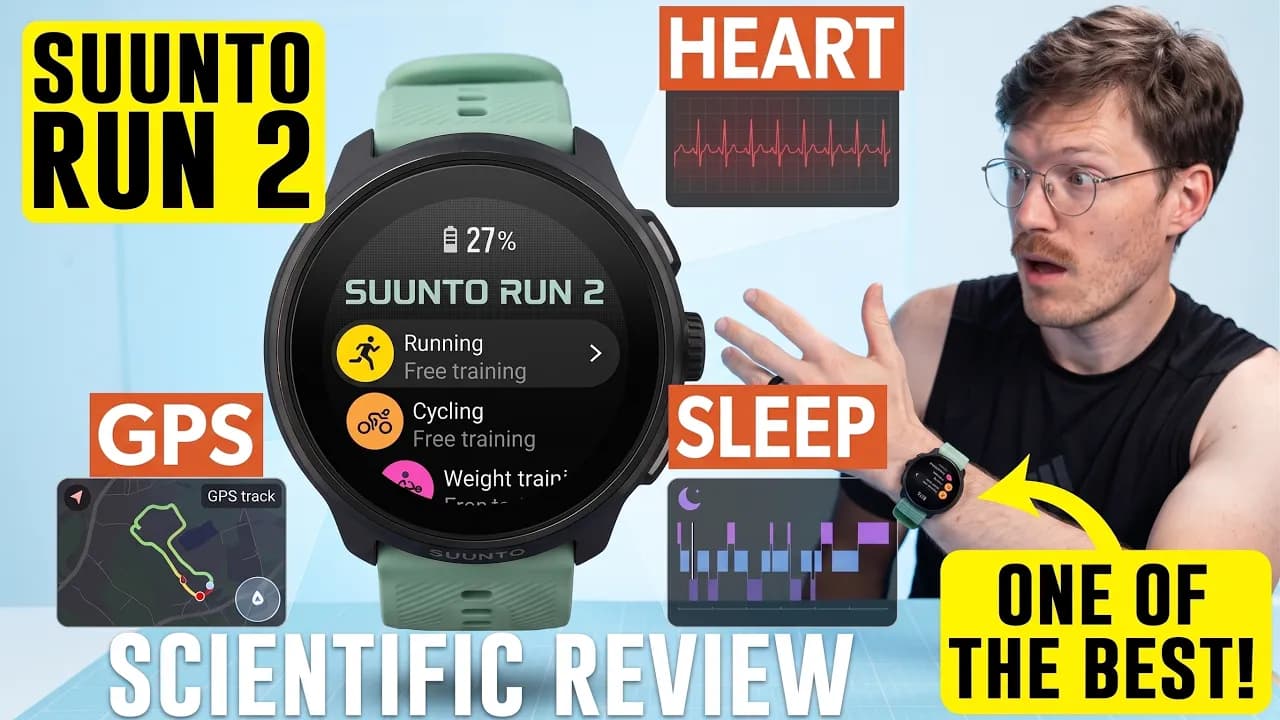
Suunto Race 3S Ultimate Scientific Review
In a Nutshell
The Suunto Race 3S delivers strong GPS performance (90/100) with excellent outdoor tracking, but its wrist-based heart rate sensor underperforms during exercise (0.92-0.98 correlations) compared to the Run 2, though overnight HR tracking remains highly accurate. Sleep stage detection scores in the mid-tier range with good REM tracking but poor deep sleep accuracy (~39% concordance), while the 56g titanium watch offers premium specs including 2000-nit AMOLED, 64GB storage, offline maps, and AI coaching for €499/$599. The core message is that this is a capable navigation-focused running watch with excellent GPS, but users needing precise exercise heart rate should pair it with a chest strap.
These notes were generated by AI and may contain inaccuracies.
The new Suunto Race 3S features a 2000-nit AMOLED display, sapphire glass, titanium components, free offline maps, up to 38 hours of dual-band GPS tracking, 64GB of storage, and Suunto's latest optical heart rate sensor, all in a 56-gram design. The watch also offers offline music playback for the Race series and launches alongside Suunto's new AI trainer.
The Race 3S is designed as a compact performance watch focused on running, off-road running, and outdoor navigation. The case measures approximately 46mm in size and is about 11.4mm thick, weighing approximately 56 grams with the silicone strap or 38 grams without it. The rear of the structure and the frame are made of titanium, while the rest is mainly polymer, with sapphire crystal glass.
The Race 3S features a 1.32-inch AMOLED touchscreen with 466 x 466 pixel resolution and maximum brightness of up to 2000 nits, a significant increase from the previous Race S version's 600 lumens.
Battery life in dual-frequency GPS mode reaches up to 38 hours of GPS tracking or up to 32 hours with the screen always on.
The navigation system includes a dual-frequency L1 and L5 positioning system across five satellite constellations: GPS, GLONASS, Galileo, BeiDou, and QZSS. The watch contains free offline maps with contour lines, roads, place names, and water features, plus route creation capabilities, GPX/KML file import, and climb guidance features. A race planning tool is planned for a future firmware update.
The Apollo 510 processor powers the watch, paired with an improved optical heart rate sensor featuring six LEDs and four light detectors behind a curved sensor lens. This sensor is the same as the one found in the Run 2 watch.
Suunto's new AI coach launches with the Race 3S, providing interactive coaching within the Suunto app that uses user data to answer training and recovery questions. The AI can create training plans, structured exercises, and routes that sync with the watch. Users get three months of Suunto Smart Coach for free if activating the watch before year-end, with no automatic renewal.
The watch includes 64GB of internal storage for maps, routes, training data, and offline music support for local MP3 and WAV files played via Bluetooth headphones. Offline music requires a software update expected around launch time.
Additional features include over 100 sports modes, wrist-based running power measurement, running dynamics, blood oxygen measurements, stress and recovery metrics, sleep tracking via heart rate variability, and support for Bluetooth accessories including chest straps, power meters, speed/cadence sensors, and Stride. The watch is water-resistant up to five atmospheres.
The Race 3S launches in Orchid, Feather, and Black colors, with European pricing at €499 and US pricing at $599. European release is October 15, with North American and Asia-Pacific release on October 29.
Testing methodology uses the Polar H10 ECG chest strap as reference device on the horizontal axis, with Race 3S data on the vertical axis. Perfect correlation would place all points on the blue line.
Indoor cycling correlation achieved 0.92, placing the device in a very low percentile rank, performing better than only 15% of tested devices. Two distinct moments showed very low heart rate detection, with one instance detecting approximately half the actual heart rate. Performance varied across sessions, with some nearly perfect matches and others showing initial difficulties that resolved later in the workout.
Running correlation reached 0.98, outperforming 60% of tested devices. Results showed the watch consistently slightly below reference device readings. Only two runs were tested due to minor injury, each approximately 5 kilometers.
Outdoor cycling correlation achieved 0.93, performing better than 56% of tested devices. Performance was acceptable overall with some delays in detecting heart rate increases and incomplete peak detection.
Weightlifting correlation reached 0.94, performing better than 73% of tested devices. The watch struggled to detect heart rate peaks during sets, particularly during chest press and parallel bar exercises, which is common across many devices.
The Suunto Race 3S scored 94 for heart rate across three cardio exercises, while the Suunto Run 2 scored 99. The Run 2 performed significantly better in stationary cycling, cycling, and running tests, though weightlifting performance was similar or slightly worse.
Overnight heart rate measurements showed excellent correlation between chest strap reference and Race 3S, with heart rates ranging between 42-54 beats per minute. Average differences were only about two beats per minute across four tested nights, with the device accurately detecting these variations. Individual night measurements showed very good matches, with one instance of lost contact.
Sleep stage tracking data is limited to three nights due to manual activation requirement for Suunto devices. The Zeo Sleep EEG headband served as reference device.
Light sleep and REM sleep concordance was very good, with REM sleep achieving 87% concordance. Deep sleep concordance was poor at approximately 39%. One night showed particularly odd results from the Race 3S that significantly impacted deep sleep accuracy.
REM sleep tracking was notably good, with most reference-detected REM periods overlapping with Race 3S detection, though some additional data was recorded. The best overall match required shifting Race 3S data by 12.5 minutes due to clock drift between devices.
Suunto devices tested, including the Race 3S, cluster in the middle of the performance range for sleep stage tracking, neither among the worst nor best performers. Top-performing devices include Google/Fitbit Pixel watches, Fitbit devices, Apple Watches, Whoop band, Oura Ring 4, and Eight Sleep Pod.
The Cohen-Kappa coefficient provides an alternative scoring system for sleep tracking performance. Devices with the best performance appear in the upper right corner of the visualization. Suunto devices cluster in roughly the same area, while the top-performing devices remain largely consistent across different evaluation methods.
Limited data was available for Suunto devices in these tests, with very few nights recorded. The total sleep points show Race 3S and Run 2 achieving scores exceeding the 65 mark, earning a "good" rating, while Vertical 2 scored lower and received only an "acceptable" rating. All three devices use the same algorithm, suggesting no fundamental differences should exist between them.
The Race 3S showed some inaccuracy in deep sleep tracking, while the Run 2 had REM sleep tracking issues. Light sleep stage compatibility was very close across all devices, though REM and deep sleep measurements were not identical. The Vertical 2 appears to fall in the middle between the other two devices.
GPS tracking proved to be a significant strength of the Race 3S. Two runs along the same route produced signals that were very close together and appeared accurate. The device handled challenging areas well, including near walls where many devices struggle, with no noticeable deviation between tracks. The watch also avoided incorrectly showing movement through a pool, which some other devices do.
Satellite view analysis revealed only one instance where the track incorrectly passed through a hedge. There was a slight deviation near a fence line, though this could represent either tracking offset or actual route variation. Overall GPS performance was rated highly satisfactory.
Five bicycle commutes along the identical route showed excellent GPS performance. Signal acquisition was quick in most cases, with only one instance of delayed start. The tracks remained very close together and accurately followed expected paths, including clean turns. Additional routes tested also performed well, with signals maintaining precision throughout.
Homeward bicycle journeys also showed strong GPS tracking. Slight deviations occurred between buildings, though the path remained correctly positioned. One signal showed an unexplained deviation, but this appeared to be an isolated exception. The tracks generally wrapped around roundabouts accurately and maintained good positioning overall.
GPS tracking received a manual score of 90 out of 100, indicating great performance. This places the Race 3S among the best-performing devices, comparable to Garmin units. GPS tracking represents one of the device's strongest features.
Sleep tracking rates as good to acceptable, just above the "good" threshold but close to "acceptable." Nighttime heart rate measurements proved highly reliable. Wrist-based heart rate tracking during exercise was disappointing compared to expectations from Run 2 testing. The device performs well for its features and GPS capabilities, though heart rate tracking during activity could be improved.
The discrepancy between Run 2 and Race 3S heart rate performance raises questions about whether this represents a genuine difference or testing coincidence. Additional testing with newer firmware may provide clarification. The new heart rate sensor represents a real upgrade compared to previous generations based on overall experience, despite these specific test results.
A Suunto chest strap using electrocardiography (ECG) performed very well in testing. Chest straps remain among the best heart rate tracking devices available. For most sports watches, including the Race 3S, using a chest strap provides the most accurate heart rate data.
Referral links are available for the Suunto Race 3S, Suunto Run 2, Garmin Fenix 9 Pro, Whoop strap, Eight Sleep Pod, and Amazon products. These links provide discounts without additional cost while supporting the channel. Related videos include coverage of the Suunto Run 2 and Eight Sleep Pod 6.
Keep The Quantified Scientist in your library
Save the videos and channels worth coming back to, and find them again in one place.