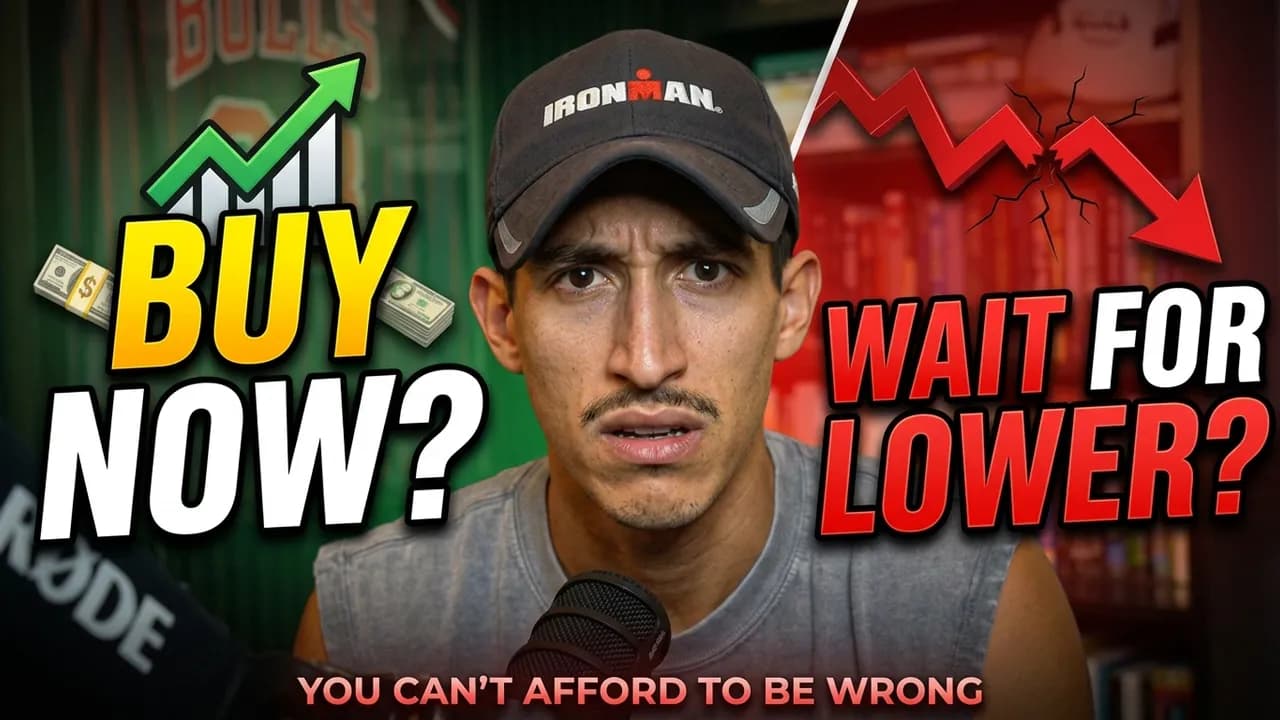
The 20% Micron Crash: What You Need To Know Now
In a Nutshell
Micron's 20% stock crash highlights a critical lesson: beginners should avoid leverage entirely, as it amplifies losses and triggers margin calls that can wipe out accounts during normal market volatility. The speaker emphasizes starting with small positions (one share) to build risk tolerance, since even strong companies like Micron can drop 40% in 30 days, turning leveraged positions into catastrophic losses. The core message is that conservative position sizing and proper risk management allow traders to survive downturns and capitalize on buying opportunities rather than being forced to liquidate.
These notes were generated by AI and may contain inaccuracies.
Micron's stock fell by more than 20% in just one trading week. The Nasdaq index was at its highest level ever, making this a slight decline rather than a sharp collapse. Micron Technologies' stock was trading at its highest level of $1,113 a few days ago, making it one of the best performing stocks in 2025. The stock dropped from $113 to below $900 during the after-hours session, reaching approximately $887 or $888.
Micron is a highly volatile stock and one of the best performing stocks in 2026. The speaker positions it as a great company both technically and fundamentally, with a fair value showing upside potential of 43%, a price-to-earnings ratio of 12.2 (very low compared to competition), revenues of $133 billion, and net income of nearly $85 billion.
The biggest mistake beginner traders make is trying to take advantage of every possible opportunity to make a profit by using maximum leverage. The speaker warns against this approach, stating: "If you were offered double or quadruple leverage, you would say: the higher the leverage, the better."
The speaker does not think beginners should sell short. While the LPPT team, including the speaker, prefers to actively short sell, this involves greater risk. The speaker shares risk and doesn't want beginners to imitate this strategy. Greater profits can be made by buying more than selling, especially during a bull market like in 2026, because the overall trend favors buyers.
The Kospi index has fallen 35% from its all-time high due to financial leverage. People become very greedy, especially at levels of consumer saturation, leading to market instability.
Using a $10,000 trading amount as an example with WeBull brokerage offering 2x leverage:
- With $10,000 and double leverage, a trader could trade with $20,000
- The speaker recommends buying one share instead of 20 shares for beginners
- The goal is not to become a millionaire quickly, as neither buying one share nor 20 shares guarantees millionaire status
If markets decline and the Producer Price Index data report comes in worse than expected, causing the stock price to fall another 20%:
- With $20,000 position using double leverage, this represents a $4,000 loss
- This equates to 40% of the initial $10,000 balance
- If the balance drops by 10% of account balance, brokers typically issue margin calls requiring additional funding or position liquidation
- After forced liquidation, the trader would have $6,000 in purchasing power remaining
Beginners must learn to walk before they run. While buying 10 shares is possible with available cash, the speaker emphasizes starting small. A 5% loss on one share ($50) is manageable, while a 5% loss on a leveraged $20,000 position ($1,000) represents 10% of the account balance and causes significant discomfort.
Buying one share that constitutes one-tenth of the account provides the ability to withstand worst-case scenarios. Traders remain in a position to buy more when opportunities arise and cannot be forced to liquidate investments. This contrasts with leveraged positions where brokers can force liquidation.
One of the worst things beginners can do is use leverage thinking only about profit potential without assessing risks. When things turn against them, leverage becomes a very bad tool that exacerbates feelings of loss and helplessness.
Micron is described as a great company with concerns including:
- The market may be cyclical
- Competition from China, though American companies currently cannot purchase Chinese products due to restrictions
- News circulation affects stock prices
Traders should develop plans that account for both downside and upside scenarios. A plan might include buying one share with awareness that the situation may worsen before improving. Stop-loss orders can be placed to manage and limit risk. More experienced traders know when to raise average purchase prices when trends move favorably, without taking excessive risks.
There is fear in the market now, though just a week or ten days ago there was no fear when MEU stock was trading at $1,100. The market is about to begin earnings week, which may stimulate movement either up or down.
The current decline presents a golden opportunity, especially for memory chip stocks. Missing opportunities by buying large quantities too early can lead to regret if stocks continue falling. Nobody can predict the future, including the biggest asset managers.
Traders manipulate the market themselves by putting themselves in positions they cannot tolerate given the fluctuations of highly volatile stocks. The speaker emphasizes wanting viewers to succeed and frequently discusses risk management and position sizing on YouTube.
Greater profits can be made by buying compared to selling, especially in a rising market. The current price decline represents a golden opportunity that should not be wasted through leverage use. Traders should make plans and position themselves to withstand market fluctuations.
All planned trades should exceed the risk-to-expected-reward ratio. Over time, traders gain experience and confidence, moving from buying one stock to increasing investments appropriately as knowledge and experience develop.
A bad deal remains bad regardless of account size, even with a million dollars. A good deal guarantees profit much greater than potential loss, recognizing that the stock is highly volatile despite strong performance.
The stock fell from highs of $1,200 by 40% in 30 days. With double leverage, this would result in 80% losses. Platforms offering 4x, 5x, or 10x leverage could result in complete capital loss with a 40% price decline.
It is better to keep investments light rather than relying on leverage, especially for beginners. Once traders understand risk management and position sizing and gain experience, they can be bolder. Mistakes will continue to occur along the way.
Buying just one share that returns to $1,100 generates $210 profit per share. Over time, investment amounts should increase as traders develop and understand the market at the same rate as account growth. During strong bull markets, traders may think they know everything due to short-term profits, but they remain beginners who took advantage of favorable timing.
Just one losing deal without proper risk management can result in losing everything. Traders may feel frustrated, believe the market is manipulated, and abandon trading, when the real issue is positioning themselves beyond their risk tolerance.
Live trading sessions occur every morning, designed specifically for beginners, not for imitation. These are part of the LPP team with a one-time subscription providing lifetime access. During October, available at a $225 discount. Over 5,000 students worldwide, with sessions lasting 30 minutes to one hour when markets open. All sessions are archived with access to the LPP Lessons Library and LPP Discord Channel. Members who joined in 2018 paid once and continue receiving updates and access to live trades.
Keep Ricky Gutierrez in your library
Save the videos and channels worth coming back to, and find them again in one place.