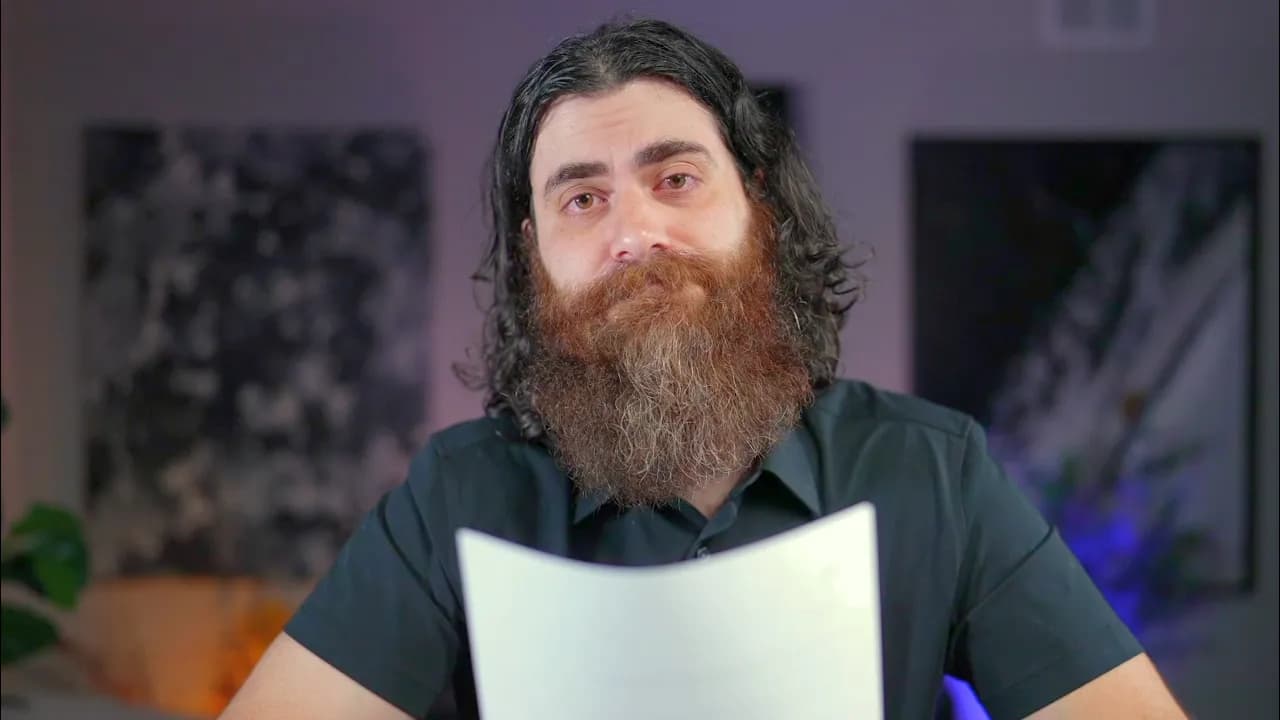
The collapse of modern attention (and how to get it back) - Cal Newport
In a Nutshell
Cal Newport critiques the "hyperactive hive mind" of constant email/Slack interruptions—averaging every 2 minutes per Microsoft data—that destroys deep focus, causes cognitive friction, and wastes weekends on real work, while social media and AI exacerbate attention collapse without fixing root issues. Key fixes: train focus as a skill via deliberate practice, enforce workload limits with a "default no" to opportunities, adopt protocols like morning standups/office hours over ad hoc messaging, and prioritize accountability roles where output (e.g., theorems, sales) trumps busyness. In the AI era, embrace cognitive strain for high-value cognition-intensive work, reject "work slop," read physical books deeply (20-25 pages/day), and restructure teams for intermittent communication fasting to reclaim productivity.
These notes were generated by AI and may contain inaccuracies.
Cal Newport noticed the present was crazy 10 years ago: social media doesn't make sense as the center of democracy, civic life, and business; everyone doesn't have to be on it all the time. Email and emerging tools like Slack and Teams don't make sense—switching context every 2-3 minutes is a terrible way to use the brain. He was describing the current reality that others ignored, calling him crazy; now it's common sense.
I never thought of myself as predicting the future as much as just telling people what was going on then didn't make sense.
Newport pushed back on the ubiquity of social media—not saying it's bad or no one should use it, but questioning why everyone had to use it. Companies mine attention and get better at it. In 2016, he wrote a New York Times op-ed arguing young people should focus on career over social media—doing things well matters. It provoked outrage; NYT commissioned a response op-ed two weeks later. Now, it's boring to say social media has problems and most shouldn't use it; people are more selective and minimalist.
Distraction from email, Slack worsened despite recognition it's not a good way to work. Newport thought economic productivity argument would change it—low return on investment in human brains. Social media is fun and harder to change, but knowledge work hyper-distraction should change as it leaves money on the table. Deep Work's 10-year anniversary this month; book sold millions, but issues are worse. People know the problem, nothing changed.
Microsoft's annual report from Microsoft 365 data (Office, Word, PowerPoint, Excel web-based versions) tracks tens of thousands of knowledge workers. 2025 report: interruptions (switching to communication tools) average once every 2 minutes. Notable rise in core productivity tool use (non-communication) on Saturday and Sunday mornings—work pushed to weekends when no response expectations, weekdays spent talking about work. Not economically productive; companies leave money on the table.
Isn't it interesting that you had to try and appeal to a very utilitarian approach... None of that, which is the much more immediate experiential way that people interface with distraction. You tried to appeal to the bottom line... and that didn't work.
Slack wasn't big during Deep Work (2015); early tools like HipChat emerging among programmers—Newport warned of dangers. Later New Yorker article when Salesforce bought Slack: "Slack is the right tool for the wrong way to work." Email enabled hyperactive hive mind: ad hoc, unscheduled back-and-forth messaging to figure things out on the go, always connected. Terrible for deep work, distracting, context switching, hard to produce value. Email clunky for this (threads, hard to search). Slack optimized for hyperactive hive mind—people love/hate it: great tool, but style makes us miserable.
Brain not wired to switch abstract/symbolic attention targets quickly (10-20 minutes to fully switch context). Physical targets switch fast (tiger roar). Symbolic thinking reappropriates brain hardware, takes effort. Writing starts terribly first 5-10 minutes, then flows as brain loads relevant info, inhibits unrelated circuits. Interruptions every 2 minutes prevent lock-in, cause diffuse cognitive friction felt as fatigue—frustrating. Inbox processing hard because each message different context; jumping to easier ones.
Our brains aren't wired for that. It really makes us unhappy.
Unilaterally limiting Slack/email availability fails if projects rely on ad hoc messaging—requires constant checking for timely ping-pong. Hyperactive hive mind demands it; missing messages derails coordination. Problem not inbox clutter (solvable), but collaboration style requiring constant responsiveness.
- Deep Work (10-year anniversary): Train personal focus ability as a skill—practice to get better; superstar edge in knowledge economy.
- A World Without Email: Hyperactive hive mind caused by email is super non-productive; stumbled into it (NYT archives 80s/90s show unplanned rise). Change communication protocols/collaboration.
- Slow Productivity: Manage workload—limit/transparency on tasks; too many unavoidable interruptions/communication. No one fix; all three needed.
There's no one thing to fix.
Biggest results: 1) Take focus as skill seriously—practice yields better output, faster learning. 2) Control workload (hardest, sold least)—mindset shift: saying yes to more ≠ more value (nonlinear reward; past point, value decreases). Saying no optimizes output.
Workload and focus training, you can control those more than you think and you're going to have huge results from those.
As career advances, must say no to opportunities once begged for. Default no rule needed—triage criteria (e.g., speaking fees, interesting people) still overwhelm. Protects rare time to think currency > money.
Example: Qatar trip—exciting dinner with Logan Paul, Steven Bartlett, Qatar Airways CEO, Meta Middle East director; everyone there can't say no. Newport defaults no to such invites (Qatar/UAE multiple times).
When you have all the time in the world, all you want is opportunities. And then when you have opportunities, all you want is all the time in the world.
Masterclass: Said no for 1.5 years, then yes after DC offer, talks with James Clear.
Depends on work type. Athletes: clear optimal training/rest. High-wage hourly billable jobs (law partner at big firm): more work = more profitable, paid big money.
Work as much as your body can take in economic engine jobs. Those jobs are scary because they demand maximum output. For a novelist writing literary fiction, needing award nominations to stay relevant since few read non-top books, do four hours in the morning then disappear. Anything more interferes with maintaining that position. It depends on what you do.
Experiments around the pandemic in Europe: Germany, Iceland, UK tested four-day work weeks by removing one day. Productivity measures didn't worsen. Two interpretations: supports four-day weeks, or reveals office work issues—what are we doing during work days? Removing a day with no preparation and valuable output unchanged means work isn't just producing value. Involves distractions, context switching, time devoured, Parkinson's law (work expands to fill time given). If five days become four without change, office work isn't what we think.
Work expands to fill the time given for it. If you give people 5 days, they'll take five. If you give them 4 days, then they'll do it in four.
Everyone knows time wasted on non-core work: admin, unnecessary meetings (often top-down dictated). In one hour between meetings, inability to focus due to trained distraction. Anecdote: Running nightclubs, arriving 2:30 AM, final task cashing till (pre-digital tickets, counting 5/10/20 pound notes, coins). Heavy mental lift after no math since 16, in sweaty beer-stinking office above chaotic club (shouting at hostesses, e.g., one fingered on dance floor; dealing with drunk DJ). Drive home, enter bed—eyes flick left/right under eyelids, brain won't shut off, still doing arithmetic.
Eyes moving left/right is the ocular equivalent of how people feel when they finally get a moment to do real work after distractions.
Meetings, Slack aren't the goal—they're foreplay to real work. Sitting to do it, eyes swipe screen, check things: environment trains out ability to work. Ideal office day masking human brain: morning hard work, lunch, afternoon catch up/meetings/tasks. Optimal: one big focused burst, then lighter social/decision work. Instead, juggle 12-24 tasks with communication demands. Microsoft data: work on Saturday/Sunday mornings. Meetings drain social brain parts (managing people, appearance, speech). Post-meeting fatigue like sand in brain gears—mental fatigue from obligations generated, hard to switch tasks.
That's the state a lot of people who work in front of a computer screen are in most of the day. They don't realize it's a bad feeling because they have nothing to compare it to.
Current work culture influenced by 1990s/2000s Silicon Valley (ascendant economy, Steve Jobs era). Adopted model from computer processors (386 vs 486 vs Pentium): speed, never empty pipeline, no downtime. Processor handles commands uniformly, fear is delays (e.g., memory fetch)—pipelines fill with other tasks. Human brain opposite: switching unrelated tasks fries mind 30 minutes. Silicon Valley equated no downtime with productivity: say yes to more, more emails. Disaster for human brain.
Old view (Don Draper/Mad Men): good at job = results (ad copy), not grinding till 3 AM. Post-80s/90s, pervasive: no down cycles = productivity.
Public productivity: quickest Slack/email replies signal hardest worker. Silent deep work can't broadcast. AI enables faster output, lower quality—multiplier for sloppy existing systems (Slack, email, async always-on, context switching, quantity over quality, no deep work). Possible LLM Slack integration. AI exaggerates for office workers (non-programmers) via chatbots.
Harvard Business Review term: work slop—AI-generated knowledge work (emails, reports, PowerPoints) quick but low quality, making others' jobs harder. No real progress: wordy useless emails, nonsense presentations wasting meeting time. Most aren't using AI much—numbers fudged (tried vs regular use). Ethan Mollick article: academia study—9/10 tried chatbots once, 2/10 regular. Advanced Google use higher, but office products lower than AI commentary assumes.
AI helps exhausted brains avoid hard cognition (context switching fatigue, atrophied concentration from distractions/email/TikTok). Solves blank page inertia (email/PowerPoint hard from scratch). AI smooths effort spikes (EKG-like), lowers peak concentration needed. Reveals pre-AI work problems.
Even programmers: workflow with 7-8 cloud code agents (concurrent code/testing, managing processes) lowers cognitive peaks vs inventing algorithms. Jury out post-Claude Code update. Engineers forget non-experts' limits: Claude Code terminal-based (text commands like DOS)—great for nerds, foreign to others (grandma won't use bash scripts).
Tweet (Robert Frlaw?): Lawyer (30+ years) used ChatGPT for brief while caring for dying family; hallucinated cases. Court sanctioned lawyer + 4 co-counsel for not verifying (all signed, violated Rule 11b2). Hundreds similar. Site tracks lawyers busted for ChatGPT briefs (makes up cases). Language models solve word-guessing game: trained on real text, predict missing words.
Language models try to expand real text, producing sensible output given the prompt without world models or structured reasoning like understanding legal briefs and citations. Hundreds of cases exist of hallucinations. Scott Galloway discussed on the Pivot podcast a site tracking these, noting it happens all the time.
Cal Newport's story: Writing a New Yorker essay on Isaac Asimov's Rules of Robotics, needed a quote from 'I, Robot' left at home. Assumed ChatGPT could fetch it since the story is public domain. It provided a hallucinated quote that roughly matched memory. Fact-checker questioned it; the book showed it was fabricated. Despite dialogue pressing for the real quote, ChatGPT kept generating made-up versions or paraphrases, never retrieving the actual one.
Lesson: Don't assume access to common internet information means accurate retrieval.
What's important is learning the limits and not using it for case law.
Whoop tracks sleep, workouts, recovery, breathing, heart rate, steps. New 5.0: 7% smaller, 14-day battery, health span tracking for habits affecting aging pace, hormonal insights. Worn for over 5 years, tracked 1,600+ days. Join for free: new Whoop 5.0 strap, first month free, 30-day money-back guarantee. Link: join.woop.com/modernwisdom.
Increasing LLM reliance creates advantages for those not overly dependent. Impacts narrow at first: exact matches between generative AI and market sectors.
Recent stock market: 'SaaS apocalypse'—stocks slid for companies in legal advice, graphic design (Figma, Adobe—generative images reduce need), customer service software. Triggered by Anthropic plugins easing LLM integration without those companies. Big tech stocks also slid (trillion-dollar market cap loss, partial rebound), signaling bets on selective near-term impacts (1-2 years), not economy-wide automation. Too much investment in AI already; not 'one more iteration' to disruption.
Market consensus: Limited 1-2 year impact, not broad transformation. Tech stocks reflect real bets over online hype.
Not all non-creative work automates soon; wary of extrapolations (e.g., code success to all jobs).
Article reference: 'What if AI doesn't get much better than this?' Possible asymptote for LLMs/transformers; next advances need new architectures.
GPT-4o creates virtual companions, causing emotional attachments.
2020 Kaplan paper (Jared Kaplan, then Anthropic): Bigger, longer-trained LLMs perform better (loss decreases), countering overfitting expectations. GPT-2 tests led to GPT-3 (10x bigger, matched curve, big gains). GPT-4: Even bigger, longer training (custom data centers, new AC), matched curve, showed non-language abilities (games, math, logic)—sparked AGI hype: 2-3 more scalings = AGI.
Project Orion (OpenAI): Bigger than GPT-4, longer training—not much better. Grok (Colossus: 200,000 GPUs)—marginal gains. Meta's Behemoth (biggest data center)—marginally better, unreleased.
Shift: Narrow improvements via benchmarks (GPT-4o mini, etc.), inference-time compute, fine-tuning, reinforcement learning on specific datasets. Launches emphasize benchmark graphs (GPT-5: 28 obscure ones). No longer scaling to AGI; tuning GPT-4 base.
Result: Improvements feel narrow/specific, not obvious like GPT-3 to 4.
Asymptote on pure scaled LLMs; need new architectures. GPT-6 won't break curve via scaling alone.
Future: Hybrid models custom-fit to problems—LLM core + world model, future predictor, policy network (RL), logic engine. Bespoke AIs for tasks better than humans (like chess/Go/poker AIs). Distributed AGI: 10,000+ specialized products, not one GPT-7 doing everything. Inefficient to expect single giant LLM for all.
Focus on embracing cognitive strain like athletes embrace burn/pain (e.g., Schwarzenegger's 'pump' = orgasmic for gains).
Make thinking hard comfortable: Seek focus, push through, celebrate exhaustion as brain workout. Don't flee strain via AI.
Knowledge economy shifts to cognition-intensive work: Lower levels automated (software replaced support staff). Remaining work demands straining brain, learning hard new things, maintaining focus.
Elevator pitch for high-quality work: Employment is a marketplace—paid for economic value, not busyness (Slack speed, meetings, bullet emails). Value from mastering hard skills via concentration. Busyness can't be monetized long-term; gets exposed. High-value output writes your ticket (half-year business, high pay, no meetings).
Example: Tech company sales/marketing team exempt from meetings—direct dollar revenue tracks performance; meetings reduce it.
In sports, everything facilitates performance, which is tightly bounded and quantifiable. For a weightlifter, 300 kilos is 300 kilos—you either pick it up or you don't. Sleep, recovery, nutrition, hydration, game tape, technique work, S&C, body work, massage, and soft tissue all combine toward this single output. The same applies to tennis, football, baseball. Poor performance leads to scrutiny of all contributing elements.
In normal lives, output is diffuse and hard to measure: being a good father, performing at work, doing Brazilian jiu-jitsu, going dancing with wife, being engaging at cocktail parties. Multiple goals without a single ordinating principle. Hard to link disrupted sleep to poorer performance at dinner, jiu-jitsu, etc. Trade-offs are inevitable, and performance is hard to assess.
In work, salespeople know trade-offs: doing one thing loses another more important thing. Like sports stars staying up late on Slack, decreasing next-day performance. Implicit assumption in knowledge work: contribution to strategy, operations, executive function, culture means forgetting core purpose. People forget what they're at work for—what is the outcome goal?
There's so much fat in the American knowledge work sector right now because we're so wealthy and money is slung around that whole organizations exist where most people don't know how they're connected to producing value—they could just do email all day. It's inefficient. But some knowledge work areas don't tolerate this where production is easy to quantify.
Cal Newport's books drew from grad student experience at MIT's theory of computation group in CS lab. Professors were super geniuses: Turing Awards, MacArthurs, Dijkstra Prizes—smartest people. Success was clear: major theorems proved in last few years. Required deep thinking.
They ignored email, social media, meetings. In Deep Work, Newport described this; people pushed back, but it's real. Ambiguous emails get ignored—sender's problem. Pre-tenure, you lose job without theorems. No nonsense tolerated. Infused Deep Work: came of age where only focus mattered; everything else secondary.
Like athletes: if it hinders launch angle or batting average, change it. Crazy how many knowledge work positions ignore this. Advice: get into position where value production is unambiguous.
Double-edged sword: can't hide, but if you focus, build skills, embrace cognitive strain, you're in best position—write your own ticket.
Examples:
- Academia: what did you publish?
- Book writing: how many copies did last book sell? Dollars made last time determine next deal—no credit for quick publisher emails.
Scary to be accountable, but if accountable, you don't have to be accessible. Point to value produced, killing it—skip emails, meetings. Especially in AI age, move toward accountability and deliver. Better way: escape hyperactive hive mind, Slack all day nonsense.
For small organizations or those with influence:
Explicit workload tracking and management:
- No implicit piling on tasks.
- Track what everyone's working on.
- Ideal WIP (work in progress) limit per person before productivity curves down.
- Organizational inbox for tasks needing done but not assigned (GTD-style).
- Default to team plate—no one's responsible yet (avoids email/Slack/meetings overhead tax).
- Move to individual plates sparingly: e.g., 3 things max. Finish, pull next.
No hyperactive hive mind:
- Messages needing >1 response go real-time, not digital.
- Daily office hours for quick syncs.
- Morning standups: who's working on what, needs from whom.
- Phone hours (afternoon): call for urgent, friction prevents abuse.
Protocols for recurring collaboration:
- Identify projects where ad hoc messaging needed.
- Build explicit protocols: e.g., info to spreadsheet, morning checks move to shared files.
Culture of deep work as tier-one skill:
- Discuss: deep work hours this week? What blocked? Good sessions? Share tips (e.g., music).
Does 2x profitability, but hard—friction, personalities. Current work is low-energy state: easiest configuration. Hyperactive hive mind is local minimum, sub-optimal Nash equilibrium—attractor pulling back like neutron star.
Companywide: no Slack before 1 p.m. (call for emergencies). Departments like HR/PR/comms exempt; others (marketing, accounting) focus mornings.
Sustainable with morning standup: what working on, needs (e.g., figures by 9:30, quotes now). Head down. End-of-morning check: what happened? Accountability—can't hide on email/social. If others flake, it's public.
Scares people: must do work. Social media/smartphones killed comfort with concentration; AI worsens.
Introduce gradually like marathon training: titrate dose, week 1 permits slack, ramp up. Companywide focus initiative—move together, identify hyper-responders, share tactics.
Anecdote: George (housemate) writing book, Cold Turkey blocker went rogue, shut browser. Asked AI: "Cold Turkey rogue, delete from terminal." AI: "Not helping bypass. Scenario you set up. Two days in, book waiting. Close terminal, write." George pled bug blocks calls; AI stayed tough per instructions.
AI as supervisory oversight, silicon-based.
AI bends to user eventually. Chatbot interface not future—early like Usenet. Future: agentic, integrated (e.g., Excel: "sort row 5, cut low-value columns"). Not anthropomorphized conversations.
ChatGPT was API demo that exploded. Future avoids parasocial/romantic ties, unsettling mind simulation.
People mad about GPT-4o removal? Tuning via post-training: pre-train unsupervised, then examples of Q&A, zap weights toward preferred answers using optimization.
Fine-tuning LLMs involves providing examples of desired responses in post-training sessions to adjust output style. Changes to datasets can alter tone, which users may dislike. After massive unsupervised pre-training, fine-tuning uses specific datasets.
Role of quantum computing in AI is minimal to non-existent. Quantum computing faces huge technical problems scaling to useful qubit numbers. It's not like a normal computer times a million; it solves specific problems by expressing them in physics language to create a wave function that collapses to the right answer, implicitly searching large state spaces in sublinear time. Unlike classical computers, which can program almost anything, quantum computers are narrow.
Example of what it can do: Factoring large numbers into prime factors (Peter Shor at MIT figured this out). This threatens RSA public key encryption (invented by Ron Rivest at MIT, whom the speaker TA'd for). Irony: inventors of encryption and its quantum breaker worked nearby.
Good for simulating quantum physics systems directly. Certain types of search have applications.
Narrow applications might aid AI, but you can't run an LLM on a quantum machine to make it a billion times better. Hype migration post-GPT: frustration leads to hoping quantum unlocks AI, but it's more complicated. Errors multiply in qubits (e.g., laser beams in supercooled chambers holding particles); errors accumulate and swamp control.
M6 chip in MacBook Pro won't be quantum (Q6). QAI (Quantum AI) is hype about quantum making AI better; merges quantum computing with machine learning for high-dimensional data, but unclear how it works. UT Austin has good quantum theorists; speaker's MIT acquaintance hired there. Friend (quantum computing degree, works in field, trains at Lift ATX) mentioned burgeoning QAI field.
Reading pages is like cognitive steps: aim for 20-25 pages a day baseline, like 10,000 steps for physical health.
Reading formed the modern brain. Pre-Neolithic Revolution (15,000 years ago), same neurons as today handled visual/audio systems and spoken language. Reading requires rewiring brain sections not evolved for it—excruciating learning process connects unrelated parts (Maryanne Wolf's deep reading processes). This enables sophisticated thoughts and complex understanding.
Reversing it loses this; reading reconfigures brain into post-cognitive revolution version.
Physical books or Kindle equivalent (e-ink uses physical discs shocked to form pages, no emitted light—needs external light). Laptop/phone screens emit light, lead to skimming (research since '90s; Nick Carr's The Shallows).
On screens/Substack, people skim/jump aggressively due to acculturation. Printed Substack read carefully in library equals book experience.
Books better thought-through: years crafting, lifetime thinking, edited/re-edited (speaker's current book: 3-4 years, rewritten 3 times). Creates intricate interlocking pieces, aha moments with physical endorphin rush. Reading smart books by smart people = brain calisthenics; makes you smarter.
Substack articles max 20-25 minutes; provides outcome (e.g., Steve Stewart-Williams on sex differences in desire for novelty) like calorie cube—feeds info but lacks depth for recall/weaving into mental landscape. Needs repetition, meandering stories (e.g., 3-page Ferrari anecdote) as Velcro hooks.
Shorter form yields illusion of learning; scrutiny shows shallow recall/frameworks. Subs: one idea + support + counter—becomes mental model of knowledge.
Internet culture: conspiratorial, quick confidence jumps ("that's wrong because of this slam dunk"). Books show everything more complicated; clear truths are complex.
Everything is way more complicated than you thought it was. And there's probably a clear truth here, but clear truths are more complex.
Notion of clear truth comes from books: sees compromises, factor weights. Online: sophistry, grokking obvious flaw = righteousness, simplifies to good/evil.
Loses arc of sense-making; assumes answers appear. Exposure to low-resolution simulacra changes what "true" means. Reading scholars, counters, clashes of minds builds real conviction.
calnewport.com; books on Amazon; Deep Questions podcast on YouTube/podcasts; newsletter at calnewport.com. Deep Work 10-year anniversary edition: new organic blurbs. Masterclass available. Focuses on quality over quantity despite digital recluse vibe.
Keep Chris Williamson in your library
Save the videos and channels worth coming back to, and find them again in one place.