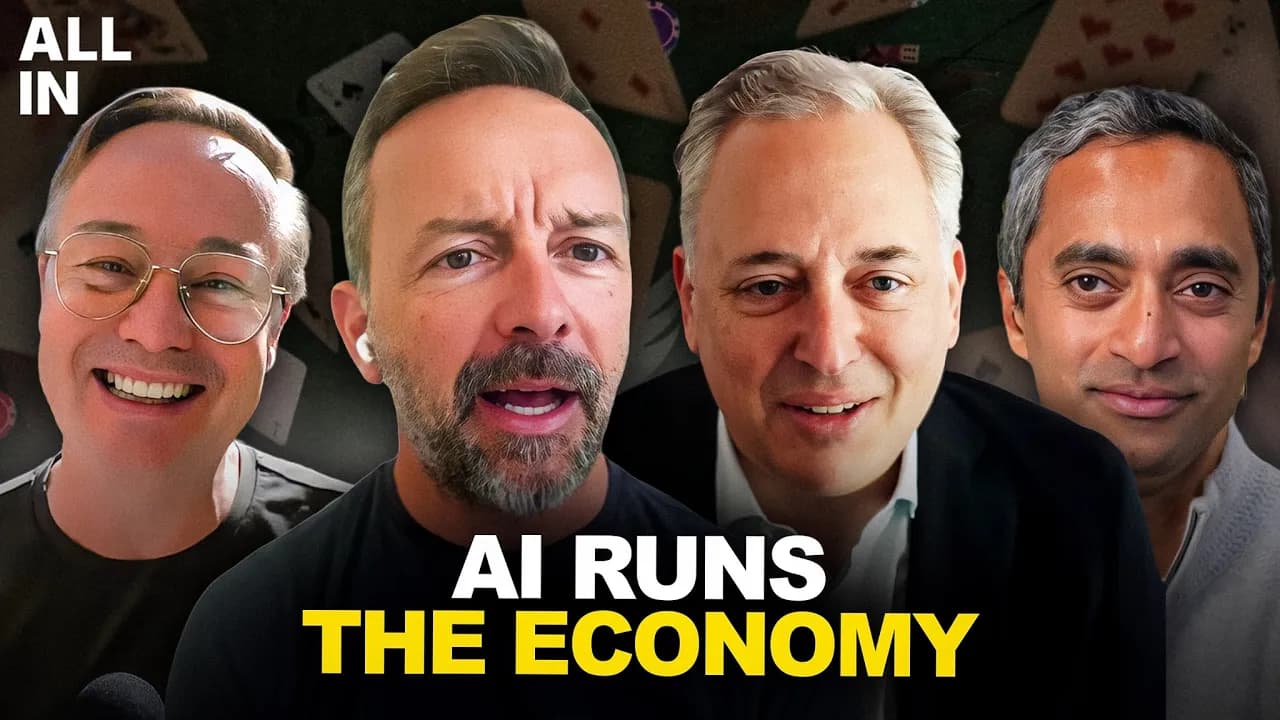
The Fight Over Open Source AI, Anthropic's $1.5B Payout, NYC Socialists: Evictions = Violence?
In a Nutshell
US policymakers are debating whether to ban Chinese open-source AI models amid claims of industrial-scale distillation by Moonshot AI's Kimi K3, with David Sacks arguing this would be a strategic mistake that forces American companies to pay 50-100x more for AI while China gains the manufacturing advantage. Anthropic settled a $1.5B copyright lawsuit for pirating books to train Claude and is simultaneously pushing for government protection against Chinese distillation, creating hypocrisy since they argue training on copyrighted material is fair use but object when others apply the same logic to their outputs. NYC socialists are advancing rent control and eviction bans that treat property rights as violence, mirroring the same pattern of regulatory capture that undermines the knowledge economy's foundation.
These notes were generated by AI and may contain inaccuracies.
Kimmy K3, released by China's Moonshot AI, is the leading global story. The open source model performs on par with Opus 4.8 and GPT 5.6, not 6 or 12 months behind. It is approximately 50% cheaper, creating panic similar to the Deep Seek moment in early 2025.
The White House became involved after Michael Katzio stated Moonshot AI distilled Anthropic's model for K3 development. Axios reported Monday that the White House was considering banning Chinese open source models. Three weeks earlier, this was presented as a hypothetical. On Wednesday, Wired reported Howard Letic does not want to ban Chinese models, indicating internal differences within the Trump administration.
Polymarket gives a 45% chance the US government bans an open source model in 2026, up from 22% a few days earlier.
David Sacks stated there is no White House decision to ban open source models. The administration is having an ongoing conversation about Chinese distillation but no decision has been made. He noted President Trump listens to multiple voices and has shown impeccable instincts on tech issues, supporting lighter regulation and more open approaches.
Sacks argued it would be a tragic mistake for government to act against the open source ecosystem, as it would hurt America's position in the AI race. He stated American companies must be able to use everything in the public domain, because the rest of the world will use those things.
Sacks accused Anthropic of regulatory capture and seeking government protection. Despite being the fastest growing tech company at scale, having grown from $10 billion to over $70 billion ARR in one year, Anthropic is pushing for government intervention.
The tell that distillation concerns are not genuine is that if stopping distillation were the primary objective, Anthropic would push to ban Chinese access to American models, not American access to Chinese models. Anthropic is in the best position to stop distillation at the source.
Sacks noted that if distillation is occurring at industrial scale, it should be obvious to detect through patterns like waves of accounts created by students in Manila and India using American IP addresses, then sold on the dark web.
Chamath reported enterprise customers are inquiring about on-premise open source deployment as they hear about AI sovereignty and cost advantages.
Distillation occurs when a model is queried and its outputs are used to train another model. At industrial scale, this involves tens of millions of queries extracting trillions of question-answer pairs. If companies genuinely cared about distillation, they would implement KYC requiring identification and bounded credit cards, though this would slow revenue growth.
All frontier labs have engaged in distillation. The situation resembles nine Spider-Men pointing at each other. Anthropic paid a $1.5 billion fine for distilling from publishers. OpenAI faces an ongoing New York Times lawsuit for distillation.
Models are commoditizing faster than anticipated. Within weeks of performance criteria publication, other models match or exceed performance. Closed frontier labs face valuation preservation concerns because the business model is shifting from foundational models to the application layer above and infrastructure layer below.
Banning open source would force American enterprises to pay 50-100x more for AI than competitors outside the United States. For companies like Coca-Cola, this would create unsustainable cost structures, leading to market rerating. The capital markets would recognize the artificial constraint and force valuations down.
Closed frontier labs' revenue would crater because it depends on regulatory capture rather than market demand. The US would become an island of overly expensive AI while the rest of the world uses cheaper alternatives.
Banning Chinese models would be escalatory. Graham Allison's framework suggests Xi Jinping and the CCP would respond to such restrictions. The question becomes how to win the AI race without shooting ourselves in the foot.
Freeberg clarified distillation is not unique to AI. Every industry uses this technique. Car makers examine competitors' vehicles to improve their designs. Google submitted millions of search queries to Yahoo and Microsoft to benchmark and improve their algorithms. This is benchmarking, not stealing software.
The IP argument fails because distillation involves looking at outputs, not stealing software code. Copyright infringement requires taking copies of copyrighted software, not observing outputs.
OpenAI and Anthropic have argued they are free to train on all the world's output regardless of creator consent. This is their position in the New York Times lawsuit. Yet they object when Chinese models apply the same logic to their outputs.
The ethical issue is industrial scale covert breaking of terms of service. Sacks was the first administration official to publicly discuss distillation in January 2025 on Laura Ingraham, and co-authored the "Winning the AI Race" report focused on beating China.
Open source models are downloadable software packages. Once downloaded, they run locally without internet connection. Restricting open source would require preventing people from using software they already possess, creating enforcement challenges with little legal precedent.
Netscape created proprietary browser and server software and went public. Mozilla Foundation created open source Firefox. Apache Foundation created the first open source HTTP server. Anyone could download Apache software to create web servers without paying Netscape, Microsoft, or Oracle.
The value accrued to the broader internet economy rather than gatekeepers. Google, eBay, Etsy, Amazon, and millions of small businesses benefited. If the internet had remained closed with proprietary gates, it would not have grown, and jobs would have been limited to AOL and similar services.
Open source AI will ensure economic value diffuses broadly rather than concentrating among a small number of companies and billionaire shareholders. A million AI-integrated enterprises worldwide will benefit. The economy will grow, jobs will be created, and AI becomes a force for broadly shared prosperity.
If Chinese companies violate copyrights or steal software, trade sanctions and other measures can address that. But open source AI proliferation transforms the global economy and prevents value capture by a small number of oligarchs.
The speed of value capture evaporation at this market segment is unprecedented in 25 years in Silicon Valley. A sector absorbed hundreds of billions of dollars
The speed of value capture evaporation at this market segment is unprecedented in 25 years in Silicon Valley. A sector absorbed hundreds of billions of dollars and then economic pricing power many decades into the future effectively evaporates in months.
Third party tracking shows a stall in Anthropic's revenue in the last couple of months, presenting a clear headwind. Tokens are still growing, but routers that track open router show that the better an open source model does and the easier it is to implement on your own servers and take it in-house, the more dark tokens exist that are not recorded and do not show up on revenue charts because they are free.
Well over 50% of open source models are coming from Chinese sources. Markets are very savvy in looking through current earnings and asking what this revenue looks like 10 years from now, whether there is more competition or less competition, and whether it is monopolistic or more of a commodity.
Technology creates a market where the cycle from exclusive provider to commodity provider gets compressed into a few years. It is very hard for capital allocators to look at this data and not wonder why it is not a commodity in 5 to 7 to 10 years. The real money is going to the cloud and infrastructure.
There is an unlimited appetite for on-demand intelligence with no upper bound for how much intelligence can be tapped as long as it continues to get better. The thesis is that it becomes a commodity with prices going down but consumption going up. Intelligence becomes completely ubiquitous, widely available, with marginal cost effectively zero and energy to generate it effectively zero.
Intelligence becomes like the web browser - a mechanism to get to a place where the apps that are the actual places are where the value is captured. If intelligence becomes completely ubiquitous, it becomes subsumed into Amazon Web Services cloud businesses, Elon's web service, and similar infrastructure.
Both open source and closed source will be big winners because the market is huge and they each serve their purpose. With the introduction of Kimi K3, there was panic that Chinese models have caught up and are giving them away for free, destroying American frontier labs. Anthropic and OpenAI argue they cannot continue investing billions if Chinese companies can steal their weights.
Kimi K3 is not that much cheaper to run and does not have a significant cost advantage. China has not caught up. Kimi K3 scored well on arena battleground for front-end coding and web development, but that is just one test and one dimension. There are areas where it scores well and lots of other areas where it does not.
There are unreleased models in the pipeline. Sam Altman is going to Washington to talk about GPT-6.0 which is blowing the doors off. The United States remains 6 months ahead of China.
Anthropic and OpenAI are blowing the doors off in revenue, representing the fastest growing tech companies at scale ever seen. Anthropic's internal forecast was to 10x from 10 to 100 billion ARR this year. They are already over 70 billion of ARR at midpoint and will easily reach 100 billion.
OpenAI has reaccelerated over the past month. OpenAI's run rate rose from 33 billion in May to 41.3 billion in July. Sam Altman is tweeting they have their mojo back and taking their forecast up from 60 billion to 75 billion exit ARR.
The frontier model duopoly in the United States shows no slowdown or blip. They are taking their forecasts up. Distillation has been happening since January 2025 with DeepSeek, so it has been present throughout their exponential growth period.
Anthropic and OpenAI are trying to draw the government into giving them a government-protected duopoly. They are in the middle of road shows and face legitimate questions about commoditization over time by open source.
The best response is that these companies will go up the stack to the application layer. They have done this in a ham-handed way in some cases, but they are excellent at it. The end-user apps are really good and they should own that.
The real answer is that these companies may have a version of a model they do not release and keep for themselves to use in their own applications. This would be anti-competitive in the eyes of customers, who would stop using them and go to open source if they cannot access the latest models.
Startups are all moving off these platforms and using open source at much cheaper rates. Many jobs do not need the latest models and can use last generation models. People are moving them local and hosting them themselves. There is a non-zero chance this will derail Anthropic and OpenAI IPOs.
These companies are spending so much money they will get caught in a trap. They overspend, do not have the same profitability, and it does not pencil out. Startups are the future and what enterprise eventually copies.
95% of tasks can be done by many different models, not that 95% of bleeding edge tasks can be done by everybody. Anthropic can say they have the next generation class of model and instantiate life sciences programs and cybersecurity businesses where they can capture trillions in enterprise value.
Building a business model that tries to ascribe this layer as having a lot of terminal value is a mathematical mistake. Open source is going to be a specific headwind because all their best customers have moved on en masse to GLM-5.2 and making their own models.
Lovable and 11 Labs, startups that were spending hundreds of thousands of dollars quarterly, have all moved on. Google and AWS are going to host these open source models.
Using Perplexity as the best harness found, starting with Grok, Neutron, GLM-5.2, and Claude produces results that are as good or better. The difference between these models cannot be detected.
Growing a business like this requires more than just the model. It also requires the harness, connectors, and enterprise agreements. Racing to the government for protection against competitive risk that might happen in the future is unseemly and gross.
American developers need to use everything in the public domain. Marathi from Thinking Machines currently has the best American open-source model, bootstrapped and distilled off a Chinese model Kimi K-2.5.
Cursor rolled out Composer 2, post-training that model using Kimi K-2.5 on their own proprietary coding data. They started with a Chinese open-source model and used their own data to create a new derivative product.
Open source works by taking things in the public domain, forking them, and making them your own. Once in the public domain, it is not a Chinese model anymore but open weights freely available to anyone. An American company takes open-source contributions, makes it their own, and develops their own model.
Saying American companies cannot do this or that it is tainted with IP theft puts a dagger through the heart of the entire American open source ecosystem, which is exactly what Anthropic wants because they do not want competition.
The US has accrued value by being at the core of the knowledge economy and services economy through development of intellectual property and knowledge, then conversion of one bit to another bit to derive trillions in GDP. Manufacturing was outsourced, creating a sleeping giant in China with incredible manufacturing capacity.
Human technology evolution and prosperity is driven by capacity to convert molecules from one form to another using the least amount of energy possible. All technology ultimately leads to molecule conversion - making materials, semiconductors, everything in the world.
If the knowledge economy and services economy gets compressed, AI and open source AI flattens that value because all value is now open source, free, and simply a function of turning on a switch and running it. The value of the US and Western economy has been largely degraded.
The US has one terawatt of electricity production capacity while China is on their way to having eight. The US has about 10 billion square feet of manufacturing capacity while China has 200 billion square feet. China has 20x the manufacturing capacity and 8x the electricity production.
China's long game over a decade or two or three decade process is compressing the knowledge economy and services economy, commoditizing it completely, and being left holding all the value in the global economy because they can make stuff cheaper than anyone due to most electricity production.
China is trying to commoditize the knowledge and services economy just like they did for global cars, leaving the creation of electricity and molecules as the remaining value, both of which they have a difficult to surmount advantage that will make them the core dependency for the world.
Open source takes share because the market is so big. There is always a market for open because it is more controllable, customizable, allows ownership, data sovereignty, and sovereignty. It is also more work, so there are different use cases and different parts of the market.
Three to six months ago it was so much work to stand up open source models, but now there are many intermediaries building the harnesses that default to it, and that is getting worked out.
Everyone is talking their books, including Anthropic and OpenAI investors. Brad was on the show two weeks ago explaining why this is going to work out. He is objective about public policy given that he owns all these companies.
Many folks who are suddenly China hawks and saying we need to stop China wanted to sell their chips. Disclosure should be required regarding whether people are on the cap table of Anthropic.
Open source AI is punk rock and exciting with so much to be done with it. Most models can do 95% of the tasks. If that is the case, then it is not that everyone needs to scramble to get the best open source model, but rather open source needs to do 95% of what you want to do with AI, and then the other 5% requires specialized or high value models or paying a premium.
Big enterprises that need wrappers and support and all these other tools for their employees can buy Anthropic or OpenAI or use open source depending on their specific requirements.
Anthropic settled their AI copyright lawsuit for $1.5 billion on Monday, representing the largest copyright settlement in United States history and the first major AI training lawsuit to settle. Anthropic had downloaded 7 million books from pirated websites to train Claude, though downloading from these sources may or may not constitute a crime. Courts have previously ruled that AI training on copyrighted books can be legal under fair use, but future cases will address this issue. The settlement avoided going to trial, with lawyers receiving $101 million and authors receiving $3,000 per book across 500,000 covered books. 91% of covered authors have already claimed their share, with more lawsuits expected in the pipeline.
Content providers need to unite to fight for their rights collectively. The New York Times, media outlets, and publishers should present unified demands to AI companies or refuse indexing. Companies are interfering with creators' ability to leverage their own content, which is considered profoundly unfair. Media outlets risk being steamrolled if they don't organize, similar to how YouTube handled creator rights. There will likely be settlements allowing content creators to claim their share of AI training revenues.
The language models are hitting parity quickly, making training data increasingly valuable while models may become commoditized. Open source may ultimately win in the model space, making data owners the real winners. Companies with valuable training data like the New York Times, Reddit, X, YouTube, and similar platforms stand to benefit most from this shift.
The $1.5 billion Anthropic judgment resulted specifically from their decision to pirate books from LibGen rather than purchase even one copy of each book. If Anthropic had purchased single copies, they would have avoided piracy charges and potentially qualified for fair use defense. Both Anthropic and OpenAI maintain they should be able to train on copyrighted material under fair use if they purchase one copy, though this issue remains unresolved in courts.
Anthropic and OpenAI argue they should train on all creators' output worldwide regardless of consent, yet claim their own model outputs should never be used for training by others. This represents a clear hypocrisy in their position. In February, Anthropic coined the term "industrial scale distillation attacks" in a blog post, though distillation was previously standard industry practice. Notably, Anthropic avoided using the term "IP theft" in this blog post despite their later claims.
Anthropic initially framed Chinese distillation of their models as a national security threat rather than IP theft, arguing these models would lack guardrails. This argument failed to gain traction with policymakers. Only later did Anthropic begin claiming IP theft, but they have avoided making this argument publicly because it would undermine their own fair use lawsuits. The New York Times is currently suing OpenAI for what amounts to an industrial scale distillation attack, using scrapers to extract content at scale beyond human capability.
Copyright law clearly prohibits lifting text from books and reprinting it as one's own work. However, reading books, consuming reviews, and the diffusion of knowledge leading to abstract transformations into new outputs likely won't violate copyright. Knowledge cannot be contained as it naturally diffuses. The four-part fair use test has been discussed extensively, and American AI companies should consider allocating 10% of revenue for settlements with content creators.
When AI systems compete directly with copyright holders' businesses, different legal standards apply. The Thompson Reuters versus Ross case represents a final judgment on AI training copyright, involving Westlaw (similar to LexisNexis). Direct competition creates special copyright considerations where arguments about fair use may not hold when companies are in the same business.
AI companies should form self-regulatory groups, pool 10% of revenue, and obtain permission from content creators to access updates and new content. This approach would provide ongoing access to books, New York Times stories, Reuters content, and similar sources. Content creators should study the music industry's approach of fighting aggressively through courts until settlements are reached.
Anthropic and OpenAI may have made a fatal mistake by arguing that distilling content against creators' wishes constitutes IP theft, as this position could apply to their own activities. A more nuanced approach would have framed Chinese activities as deceptive business practices through fake accounts and proxy usage violating terms of service, rather than claiming IP theft. This would have avoided self-incrimination while still seeking government assistance.
Content providers are increasingly demanding that Google separate their search indexing from AI training crawlers. Publishers want to remain in Google search results while opting out of AI indexing. Rupert Murdoch's approach of collective action against Google indexing could have forced royalty negotiations if all newspapers had united. Current deals include paywall exclusion rules allowing limited free articles.
AI companies engaging in regulatory capture through Washington may face unintended consequences. By claiming IP theft regarding Chinese activities, they have potentially exposed themselves to claims that their entire products are stolen works. Content creators could now assert entitlement to 100% of Anthropic's revenue. The startup ecosystem has been activated against these arguments, with Gary Tan and 200 startups writing letters warning that IP theft claims would taint all derivative works from Chinese models.
The 2027 publishing schedule includes several new titles: "Ferrari on my wrist: How to win at life and afford a $250,000 watch" by David Sax, "The fight to save America: Destroying Socialism, Shrinking the Debt, and Winning AI" by David, a romance novel titled "Chama polyatina, a sexual Italian summer," and "Enterprise sales: Chimat dystopia - How my software startup affects my Italian summer." Additional titles featuring Brad Gerstner, Bill Gurley, and Elon Musk are planned.
Google reported exceptional results with Google Cloud on a $100 billion run rate and growing 25% year-over-year. Capex forecast increased from $195-205 billion for the current year. Tesla's capex surged 140% year-over-year with expected $25 billion in capital expenditures. Both companies reported negative free cash flow, with Google's being the first negative result since going public. Despite strong performance, both stocks declined with Tesla down 14% and Google down 7%.
SpaceX stock is down 30% from its day-one closing price, now trading at $1.5 trillion after going public at $2 trillion. Lockups are occurring at staged intervals creating potential downward pressure, though the situation remains unprecedented given the IPO size.
Google's massive capex investments are building AI infrastructure while reselling capacity through Google Cloud. The company demonstrates 32% average return on invested capital over 20 years since going public. Fragmentation across multiple AI models benefits Google as they profit from silicon, cloud services, and improved ad targeting through AI applications. The market reaction may stem from the unprecedented scale, with capex approaching 20% of the annual military budget.
Apple has bought back half their stock and returned hundreds of billions in profits through share buybacks and dividends. Tech companies are now choosing to invest in on-demand intelligence rather than returning cash to shareholders. The argument is that there is no upper bound for intelligence and companies will continue demanding more AI capabilities.
Hundred to two hundred billion dollars is being deployed into capex depending on the company. This represents a fundamental shift from returning capital to shareholders toward infrastructure investment. The thesis is that betting against companies like Google deploying capital into AI infrastructure would mean missing significant value creation.
Google has substantial consumer business, YouTube, GCP, and a portfolio of other bets including 10% of SpaceX and a significant stake in Anthropic. Whimworth recorded a hundred billion dollar write-up on Anthropic in a single quarter. The argument is that Google has diversified exposure across multiple high-value businesses.
Google Cloud Platform has unique access to enterprise data including email and drive information that would enable AI to improve workplace productivity. GCP is model agnostic, allowing customers to run any model and workflow without being locked into specific providers. Other cloud service providers tend to be model dependent with fixed operational approaches.
Even in the worst-case scenario where Google's application layer and models fail to gain traction, they would still possess the world's best infrastructure for running other people's models as a service. The comparison is made to Elon's Colossus installation and the returns being generated from that infrastructure investment.
Previous discussion concluded that Apple should consider building cloud services given their developer relationships and app store position. However, becoming a cloud service provider requires building critical infrastructure that took Amazon 17 years to perfect and Google 12-13 years to mostly catch up.
Cloud service providers must deliver 59s of reliability and uptime. Getting to 99% uptime can be done relatively cheaply for basic hosting. Achieving 99.9% reliability costs billions. Reaching 99.99% costs tens of billions. The fifth nine requires hundreds of billions in investment and exceptional technical skill. Only three companies currently operate at this level.
Apple has returned 900 billion dollars over the past decade through 755 billion in buybacks and 140 billion in dividends. The argument is that investing even half that amount in companies like Anthropic and SpaceX could have created new products and enabled the car project. The strategy is characterized as "do no harm" capital allocation that worked for the stock price.
The discussion transitions to recurring analysis of socialist policies, with particular focus on New York City developments. Producer is asked to show previous videos on socialism going back six years.
City Council member Zohran Mamdani held a rental ripoff hearing at New York City's Tenement Museum and introduced a rental ripoff report. If passed, the legislation would bar landlords from charging for credit checks while allowing either credit checks or the 40x rent income standard but not both. The proposal would legally recognize tenant unions and includes a one-year rent freeze.
An activist wearing a COVID mask referred to "the violence of evictions" at the hearing, stating that the Mamdani administration is emboldening tenants to no longer tolerate evictions as business as usual.
In 1787, John Quincy Adams published "A Defense of the Constitutions of Governments of the United States of America," stating that "the moment the idea is admitted into society, that property is not as sacred as the laws of God, and that there is not a force of law and public justice to protect it, anarchy and tyranny commence." In 1791, he publicly stated that "property must be secured or liberty cannot exist."
The foundation of the United States was built on private property rights as a reaction to tyrannical governments and monarchies where overlords could arbitrarily seize property. Individuals had no private property rights under these systems. The concept that one person can own something that cannot be taken away forms the foundation of American liberty.
Anarchy is characterized as a temporary state that always evolves into tyranny. When private property rights are eliminated, groups fight over resources until powerful factions emerge to establish tyrannical control. The argument is that anarchy and tyranny are fundamentally connected, with socialist principles representing the beginning of this transition.
Socialist policies begin with the framing that private property owners are evil and have committed injustice against those without property. This moralistic justification enables the removal of property rights. The process starts with characterizing landlords as committing violence through evictions and wealthy individuals as having taken too much wealth.
When landlords cannot collect rent from delinquent tenants, they cannot fund upkeep and maintenance, leading to dilapidated buildings that affect all residents. Problematic tenants who cannot be evicted often create noise disturbances, property damage, unpleasant odors, and disorderly behavior that disproportionately impacts long-standing residents, particularly elderly tenants on fixed incomes.
Progressive policies are characterized as luxury beliefs held by highly educated, affluent individuals who do not use public amenities like buses, subways, or parks. When these spaces are taken over by homeless drug addicts, the policies defend the addicts rather than middle-class users. The working class bears the greatest burden because they depend on these public resources.
Basic economics suggests that increasing housing supply reduces prices regardless of unit type. Adding luxury units, multifamily housing, or single-family homes all contribute to lower prices when transportation access is available. Tokyo, Texas, Florida, and Nevada have successfully implemented supply-side solutions, while New York, Los Angeles, and San Francisco have not.
Data from Austin demonstrates that relaxing permitting constraints increases unit construction, with each new unit driving down rent. The argument is that the same political will required to pass restrictive legislation could instead be used for permitting reform that would achieve better outcomes.
The principle is illustrated through analogies: if someone jumps into your car and claims they cannot be removed, or enters your home and refuses to leave, the concept seems obviously wrong. Similarly, preventing landlords from using credit checks and income verification will lead to higher rents as landlords price in increased risk.
Argentina eliminated rent control, resulting in decreased rents. The argument is that socialists fail to learn from failed experiments, with Chicago cited as another example of unsuccessful socialist policies.
When landlords cannot raise rents reasonably, they lose incentive to invest in or upgrade units. New York City's renovation codes make improvements extremely expensive, leading to ghost apartments. Landlords may leave units empty rather than undertake costly renovations that cannot be recovered through rent increases.
Proposed legislation would ban landlords from conducting credit and background checks on potential tenants, preventing verification of income or rental history. Combined with eviction bans, this removes landlords' ability to assess tenant reliability.
Landlords facing these restrictions would likely set initial rents three to four times higher and require multi-month prepayments, then gradually adjust toward market-clearing prices. This approach would result in higher rather than lower rents.
When tenants know they cannot be evicted, their incentive to pay rent approaches zero. A significant percentage of tenants could treat rent as optional, forcing landlords to absorb losses and pass costs to other tenants through higher rents.
Reports indicate 50,000 ghost apartments in New York City. Landlords may find it more economical to leave units empty rather than renovate them under restrictive codes. Airbnb has been banned in New York, eliminating short-term rental options as an alternative use for vacant units.
Landlords under these restrictions could sell properties and relocate to more favorable jurisdictions, or wait out the policies by leaving buildings empty if debt levels permit. The fundamental issue is that without ability to raise rents, evict problematic tenants, or screen applicants, operating apartment buildings becomes unprofitable.
Keep All-In Podcast in your library
Save the videos and channels worth coming back to, and find them again in one place.