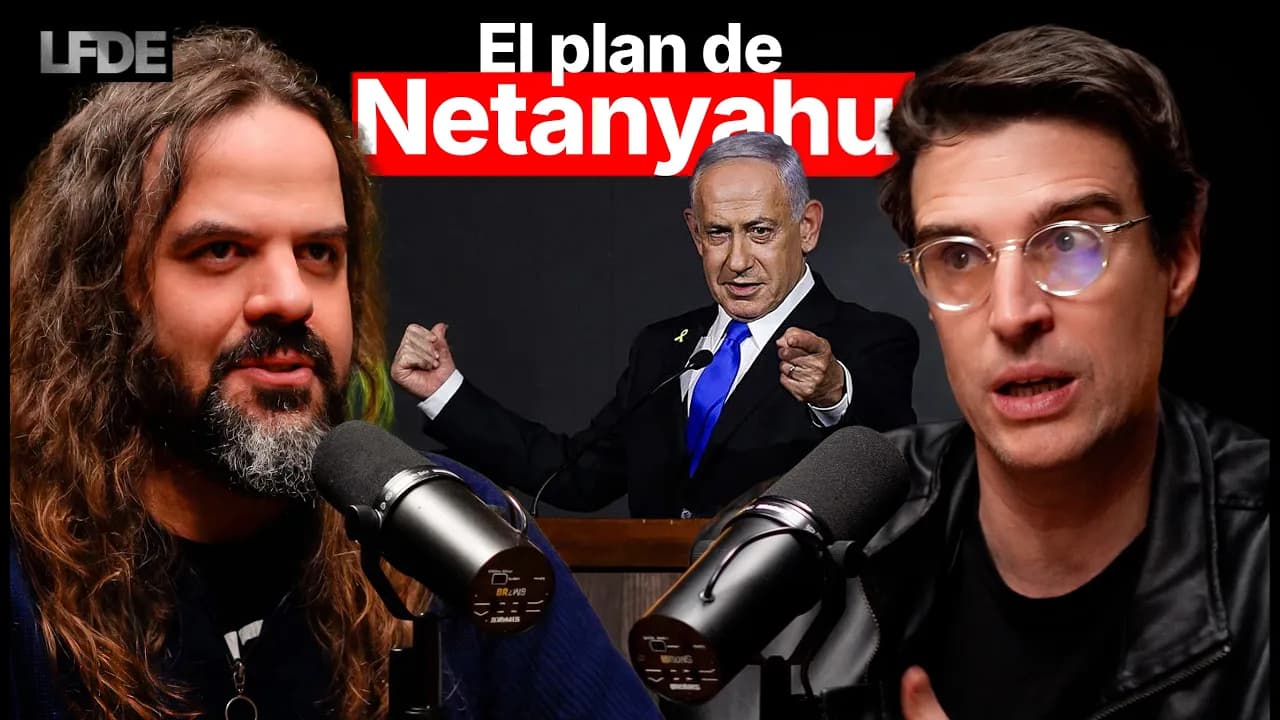
The Man Who Predicted The Iran War: The Next 9/11 Will Target Your Bank Account! | Professor Jiang
In a Nutshell
Professor Jiang predicts a cascading global collapse triggered by expanding Middle East war, where Iran and its proxies disrupt the petrodollar system by choking oil flows through the Strait of Hormuz, Red Sea, and Suez Canal, forcing nations to abandon specialized supply chains and triggering Bronze Age-style civilizational breakdown. The attack on US financial infrastructure (wiping bank accounts via iPhone) would traumatize Americans into self-destructive responses, while Trump secures a third term through constitutional suspension or VP maneuver, leading to sieges of New York City and other blue cities over tax revolts and immigration enforcement. The core warning is that Pax Americana's end means Western populations will experience the chaos they've been sheltered from—migration crises, supply chain collapse, and the reversal of technological progress as specialization times globalization declines.
These notes were generated by AI and may contain inaccuracies.
Professor Jiang describes himself as one of the most polarizing figures in the world. He states he is attempting to prepare people for what he sees as the world's collapse, drawing on patterns of history and global supply chains to create a predictive framework.
The first prediction states that if another 9/11-style attack occurs, it will target the US financial infrastructure. The scenario describes opening an iPhone to buy coffee and discovering all money in bank accounts has been wiped out, with no knowledge of when or how long recovery would take. This is presented as what would make Americans most vulnerable and easily traumatized.
The second prediction states that Lionel Messi will become president of Argentina.
The third prediction states that Donald Trump will have a third term, accompanied by a siege of New York City. This is presented as a friendly bet of $100.
Professor Jiang states the world is experiencing not just war but the regression of civilization. He argues we have reached the height of technological advancement and cannot progress further because the conditions for continued technological advancement no longer exist.
The analysis begins in 1945 at the end of World War II when the United States was dominant. The US manufactured goods for Europe and Japan, which were destroyed in the war. The United States lent US dollars to purchase these goods with the promise of repayment in gold. The United States became complacent and began spending money it should not have been spending, transitioning from a creditor nation to a debtor nation.
In 1971, Richard Nixon announced that the US dollar would no longer be pegged to gold. This created the problem of determining what would give the US dollar value. Nixon needed to create demand for the US dollar.
Three developments followed the Nixon Shock. First, Saudi Arabia and other Middle Eastern countries agreed to sell oil only in US dollars. Second, China stated that payment for cheap manufactured goods must be made in US dollars. Third, in the mid-1980s, Japan agreed through the Plaza Accord to take its savings and buy US treasuries.
The system is described as based entirely on promises. The US dollar functions as a contract. China promises to provide manufactured goods, and Saudi Arabia promises to provide oil. This system created the global economy that exists today.
A semiconductor is presented as the basis of all technology and computers. Three critical elements are identified: silicon, gallium, and germanium. Silicon is manufactured 60-70% in China, 70% of gallium comes from China, and 90% of the world's germanium comes from China.
The process involves the United States, primarily California companies like Nvidia and Apple, designing advanced semiconductor chips. These designs are sent to Taiwan and Malaysia for manufacturing. The Netherlands and Japan create the machines to print semiconductors, with ASML in the Netherlands manufacturing lithography machines worth $400 million each. The chips are then sent to China to be put into appliances.
The formula presented is that technological progress equals specialization times globalization. All technological progress is premised on more countries specializing and trading freely with each other. This system is supported by two elements: the US dollar and US military hegemony, defined as having no peer competitor in control of the seas.
The war in Iran is predicted to cause a chain of events forcing nations to become more general rather than specialized. Countries will become more nationalistic and create self-sufficient supply chains, leading to a decline in globalization and therefore a decline in technological progress.
The closest historical analogy presented is the Bronze Age collapse. The Bronze Age was characterized by global integration because bronze required both copper and tin, found in different places. This integration led to massive inequality, debt, and polarization. When the system collapsed, the entire world collapsed.
In World War II, despite tens of millions dying, a superpower emerged: the United States. America was powerful enough to create a new world order called Pax Americana. The analysis states we are seeing the last days of Pax Americana, and systems in decline do not go willingly.
During the Bronze Age collapse, climate change led to famine in Europe. People migrated to areas with food, primarily Anatolia and Egypt. These migrants, called the Sea Peoples, overwhelmed the systems of Egypt and Anatolia, causing a cascading effect where the entire world lost order. Traditional hierarchies and authorities disappeared, and fundamental elements of civilization vanished.
The war in the Middle East is described as expanding and bringing in more countries. All of Iran's proxies have been brought into the war, including the Houthis in Yemen, Hezbollah in Lebanon, and Shia militias in Iraq, along with Iran itself.
The Houthis are described as an ethnic group in Yemen living in the mountains, making them almost impossible to dislodge. Saudi Arabia tried for five years without success. They are Shia Muslims, a minority comprising about 10% of the global Muslim population, making them more fanatical and believers in martyrdom. They control the Bab El Mandeb Strait, a critical choke point in the Red Sea.
Hezbollah in Lebanon is also a Shia group and therefore fanatical. The Shia militias in Iraq are described as their own independent militaries. These four groups span the entire Middle East.
The 2003 Iraq War involved the United States decapitating Saddam Hussein's government, which was not popular among the people. Today's situation involves four different groups: the IRGC in Iran, the Houthis in Yemen, Hezbollah in Lebanon, and Shia militias in Iraq. These groups are decentralized, fanatical, and share similar eschatology and religious frameworks.
The US military is not effective at fighting guerrilla insurgents, as demonstrated in Afghanistan. These are referred to as fervor wars, where the United States spent trillions over 20 years attempting to squash insurgents without success.
Saudi Arabia has signed the Mecca Accords with Turkey and Pakistan, requiring mutual defense. Saudi Arabia is predicted to be the first to invoke this pact against the Houthis. The Houthis have ballistic missiles and drones and could destroy Saudi Arabia's energy infrastructure, described as a giant lake of gasoline.
Unlike al-Qaeda and ISIS, which worked separately, the three proxies (Houthis, Hezbollah, and Shia militias) all report to the IRGC in Iran. China and Russia are supporting Iran, with China transporting goods through the Belt and Road Initiative and Russia supporting through the Caspian Sea. This allows Iran to fight indefinitely.
The Middle East is described as the heart of the petrodollar system. Oil from GCC countries is transported to India, Pakistan, China, and Japan. East Asia converts this energy into manufactured products sold in US dollars. China, Japan, and the GCC invest excess savings in US treasuries, allowing the United States to focus on innovation and financial centers like New York City.
If oil stops flowing, China and Japan cannot manufacture goods for export, and the United States loses recycled US dollars. Japan, the GCC, and China are the three biggest buyers of US treasuries and financiers of the US economy, including the AI bubble.
The Late Bronze Age collapse was a rapid, violent, and widespread societal breakdown in the Eastern Mediterranean between 1200 and 1150 BCE. Before the collapse, major superpowers were deeply interconnected through diplomacy, royal marriages, and complex trade networks. Within 50 years, almost every significant city was destroyed, and many were never rebuilt.
Western populations have lived charmed lives because the US empire was designed to ensure populations never suffer the tragedy experienced elsewhere. In Iraq and Afghanistan, children have never known peace, stability, or prosperity. The inequality in the world is stark, and Western populations have been sheltered from chaos that has affected the rest of the world.
The US empire is breaking down, and there is nothing that can stop it. The political violence, chaos, and polarization that has affected the rest of the world is coming to Western populations.
Professor Jiang became pessimistic about the future after Brexit and the election of Donald Trump. As an immigrant who grew up in a poor family with a father who worked as a dishwasher for 30 years, he believed the world was a meritocracy that rewarded talent and hard work. He attended Yale on a full scholarship and believed the world was governed by reason, logic, science, truth, and good people. Brexit represented a rejection of globalization, and Trump's election represented a rejection of meritocracy, reason, truth, and order.
The formula of technological progress as specialization times globalization provides both an analysis of the current world and a framework to predict the future. In times of war, when specialization and globalization break down, technology should also break down.
The host demonstrates a Bon Charge face mask, a sponsor product used for 15-20 minutes daily. The mask is described as boosting collagen production, helping with fine lines and blemishes, and improving complexion. It is characterized as professional-grade, non-invasive equipment with fast free shipping worldwide, easy returns and exchanges, and a one-year warranty.
Semiconductors cannot be built without a globalized economy. China manufactures approximately 70% of the world's silicon and rare earths, controlling 70% of rare earths globally. However, this dependency works both ways—China must import large amounts of helium to sustain semiconductor manufacturing, as helium serves as a critical cooling agent in the production process.
America maintains control over 90% of the world's high-quality quartz through Spruce Pine, North Carolina, which is essential for the silicon manufacturing process. Any disruption in trade between these nations would halt technological progress entirely.
Food production depends heavily on global supply chains beyond just semiconductors. The northern regions produce most of the world's fertilizer, while the global south—primarily Africa, the Middle East, and South America—imports the majority of fertilizer needed for agriculture. Ammonia represents a crucial component of fertilizer, with most ammonium production plants located in Canada, the United States, Europe, China, and Russia.
In times of war when global supply chains break down, the northern regions would lose access to advanced consumer electronics, while the global south would face famine.
Water—not oil—represents the main geopolitical issue facing the world over the next 20 years. A global map showing water scarcity issues (marked in red) indicates where wars will likely erupt. Even the United States faces water scarcity problems in the western regions, with ongoing conflicts over the Colorado River in Colorado, California, and Arizona.
The Middle East represents a potential explosion point due to water scarcity. India faces water shortages that create conflict with China. Northeast Asia, including Japan and North Korea, represents another major flashpoint. These areas are most likely to experience war, conflict, or political violence within the next 20 years.
Africa has the world's highest fertility rates, followed by the Middle East, creating the highest number of children per couple in these regions. The overlap between high fertility rates and geopolitical tension zones creates a significant problem—young people born in these areas will have no choice but to migrate, most likely toward Europe.
Europe faces its own demographic crisis with rapidly aging populations, similar to Japan and North America. Aging populations require cheap healthcare and nursing services, necessitating increased immigration to support the elderly population. This creates domestic conflict as increased migration into western societies conflicts with native populations, potentially leading to civil war, political violence, and even revolution.
Western societies are responding with surges in right-wing political parties—Reform in the UK, AfD in Germany, Vox in Spain, and MAGA dominance in the United States. These parties' main platform involves blocking immigration to prevent civil war scenarios.
However, this creates a fundamental problem: what to do about aging populations? While robots theoretically offer a solution, they depend on copper from Chile, Peru, China, and Australia; lithium from the lithium triangle; silicon primarily manufactured in China; and rare earths also manufactured in China. When global supply chains break down, immigration becomes the cheapest solution for labor shortages, as people are significantly cheaper and more expendable than robots.
If the United States wins the war in Iran and conducts regime change, current problems could be resolved. Iran under US control would restore globalization, allowing oil to flow to South and East Asia for manufacturing, with profits recycled into the economy. This financial stability could enable AI innovation to reach AGI levels, potentially solving global problems.
The situation has developed momentum with Iran controlling the Strait of Hormuz, Houthis controlling the Bab el-Mandeb Strait, Hezbollah threatening the Suez Canal, and Shia militias threatening the Mediterranean. From a game theory perspective, Iran's optimal strategy involves taking the initiative to disrupt all global trade, as the US empire depends on the petrodollar system and global trade.
Iran could disrupt global trade through random attacks on Saudi Arabia, Iraq attacking Israel, Iran attacking oil facilities, and Hezbollah attacking the Suez Canal. This creates uncertainty and chaos in the global trade system. Since global trade relies on confidence that drives insurance, uncontrolled actors would make global shipping uninsurable, effectively stopping global shipping.
The United States could respond by attacking Iran's critical civil infrastructure, including desalination plants and power plants. This would be worse than using nuclear weapons on Iran, as without power plants, Tehran's 10 million residents would face starvation since much of their food requires refrigeration.
Such attacks would create enormous migration crises, with people fleeing from Iran into Europe due to starvation, along with African populations losing access to cheap energy and fertilizer. This migration would overwhelm European social fabric and state capacity. This process has been occurring since 2014, when the United States destroyed Libya and caused civil war in Syria, leading to millions migrating to Europe.
If positioned as Donald Trump, the recommended strategy would be to push all in by attacking power plants in Iran. Half measures would appear weak and incentivize Iran and its allies to become more provocative. However, this approach would theoretically result in killing millions of Iranians, justified by the formula that increased power reduces imagination and empathy for others' suffering.
The entire petrodollar system depends on two elements: the US dollar as world reserve currency and the aura of inevitability and invincibility of the US military. If the US appears beatable, its image becomes sufficiently tarnished to undermine the system.
The first prediction involves a siege of New York City, structured around the 9/11 anniversary. If Trump secures a third term despite the 22nd Amendment's prohibition on more than two presidential terms, democratic cities including Los Angeles, San Francisco, Boston, Chicago, and New York City would revolt. They would refuse to pay federal taxes and block ICE agents, creating conflict between local and federal law enforcement.
The president would likely attempt to quash this insurrection by cutting off food and water supplies to New York City, potentially with assistance from federal forces and militias from red states. This conflict could last for years.
Two constitutional pathways exist for a third term: declaring a national emergency to suspend the constitution, or running as vice president in 2028 with Don Jr. as the presidential candidate, then having Don Jr. resign after the election. Historical precedents include Lincoln suspending habeas corpus during the Civil War and Roosevelt's Japanese internment during World War II, demonstrating that constitutional conventions can be overridden when presidents choose to ignore norms.
The second prediction involves another 9/11-style attack targeting US financial infrastructure rather than symbolic buildings. The original 9/11 traumatized the American population into self-destructive violence by destroying symbols of American power—airplanes, the Twin Towers, and the Pentagon—leading to 20 years of destructive Middle East wars that created fiscal deficits, lost military prestige, and increased corruption in Washington DC.
A new attack would similarly traumatize the population into self-destructive responses, but targeting the financial system rather than physical symbols.
The main reason for pursuing this type of attack is because conventional violence has become normalized. Flying planes into new twin towers would not create sufficient trauma because people have been desensitized to this form of violence. A more effective approach involves targeting critical infrastructure that affects daily life in ways that generate widespread anxiety, anger, and frustration.
A thought experiment demonstrates the potential impact of attacking US financial data servers. If one day an individual opens their iPhone to buy coffee and discovers their bank account has been wiped out with no timeline for recovery, the resulting concern would exceed typical worry. This would generate significant anger, anxiety, and frustration on a mass scale. Working an entire lifetime to save $2 million for retirement could be instantly erased, fundamentally altering personal security.
When questioned about the difficulty of taking out financial infrastructure for a sufficient period to cause real-world consequences, the response draws a parallel to the complexity of executing 9/11. Despite the acknowledged difficulty, the creativity of potential attackers suggests such an operation targeting US financial infrastructure remains possible, which would drive millions of people into a state of frenzy.
Recent attempts to enter the United States have been complicated by the speaker's status as a polarizing figure following the Iran war in March. The decision was made to avoid traveling to the US due to concerns about potential detention by customs or deportation. During an August 5th attempt to enter from Toronto Pearson airport for a Theo Von show appearance, secondary interrogation occurred regarding travel documentation for an 8-year-old son traveling without a travel letter.
After resolving the initial secondary screening through documentation including birth certificates, the speaker traveled throughout the United States for various podcast interviews beyond the originally stated two-week period. As a Canadian citizen without visa requirements, extending stays beyond declared timeframes typically presents no issues. However, subsequent entries have resulted in continued secondary screenings, suggesting intervention by top officials.
The Clean Break memo, published in 1996, outlined a plan for Israel to become the dominant regional hegemon in the Middle East. The study group included Richard Pearl and others, with five individuals identified. These figures, along with Paul Wolfowitz, served as chief architects of the Iraq war during the George W. Bush administration. The current Iran conflict follows the strategic framework established in this memo, with the goal of establishing Israeli regional dominance.
The speaker believes questioning at immigration stems from top officials requesting secondary screening for all US entries. This pattern is supported by the case of journalist Max Blumenthal, who was covering Qasem Soleimani's funeral in Iran when Laura Loomer demanded his arrest. Upon return as a US citizen, Blumenthal's devices were confiscated, leading to a lawsuit against the Department of Homeland Security. The pattern suggests the empire, in decline due to hubris and arrogance, is attempting to silence critics rather than accept constructive criticism.
Immigration officers have indicated that every future US entry will involve secondary screening, and there is a possibility the I-94 may not be renewed after six months. Despite these challenges, the speaker maintains deep admiration for American people as the most open and generous population globally, while acknowledging the current period as very interesting times.
Argentina is working closely with the United States and Israel, recently demanding return of the Falkland Islands with Donald Trump's voiced support. Argentina has developed strong relations with Israel, welcoming Israeli investment and immigration. Israeli citizens reportedly receive immediate access to Argentine healthcare and pension systems despite not being citizens. Argentina appears positioned to receive secular Jewish immigration from Israel due to internal divisions between messianic Jews believing current Middle East conflicts will usher in end times and secular Jews who view these beliefs as insane.
The proposal suggests Lionel Messi as president of Argentina would provide sufficient popularity to facilitate acceptance of Israeli immigration, which currently faces resistance in Argentina. Combined with reclaiming the Falkland Islands, these elements would create national pride enabling the demographic changes. The speaker apologizes to British citizens regarding the Falklands reference.
Every Chinese person believes China and Japan will go to war, despite Western assumptions focusing on Taiwan invasion. China has not fought a war since Vietnam in the early 1980s and does not pursue aggressive foreign policy through direct invasions. The geographic and strategic differences between the two nations make conflict inevitable.
China operates as a self-sufficient land power historically based on agriculture, while Japan functions as a sea power dependent on imported resources, historically engaging in piracy. Japan's unstable geography with frequent earthquakes and tsunamis has created a militaristic, cohesive society. The Iran war's impact on energy supplies will force China toward de-industrialization, while Japan faces existential threats from resource dependency and the world's most elderly population.
Japan requires resource colonies in Southeast Asia to survive without US protection. Taiwan's position in the South China Sea creates vulnerability - if China and Taiwan reunify, China gains the option to embargo Japan, which Japan views as an existential threat. Prime Minister Takaichi's recent statements about Taiwan as vital to Japanese national security prompted Chinese overreaction, restricting Chinese tourism to Japan.
Japan is building alliances with the Philippines, Australia, and India to potentially embargo China and secure Southeast Asian resources. China avoids direct provocation to prevent Southeast Asian nations from uniting against it. The resulting dynamic involves Japan using the Philippines as proxy to challenge Chinese naval dominance, while China employs North Korea as proxy to threaten South Korea and Japan through artillery shelling of Seoul and missile launches into the Sea of Japan.
US strategic interests favor fermenting tension between China and Japan rather than preventing conflict. Trump wants Taiwanese semiconductor industry relocated to the United States, with TSMC already constructing a $20 billion factory in Arizona. Increased China-Japan tensions would force semiconductor relocation, benefiting American interests regardless of Taiwan's fate.
NATO and Europe support Ukraine through drone manufacturing in Germany and the UK, infinite financing, and intelligence provision. Ukraine's recent drone attacks on Russian energy infrastructure have shifted the conflict from eastern Ukraine containment to affecting Russian civilians directly, making Putin increasingly unpopular.
Russia recognizes NATO Europe as the true enemy rather than Ukraine, since European manufacturing capacity remains protected behind NATO. Russia cannot win a war of attrition against protected European infrastructure. The strategic necessity involves provoking NATO into direct Ukraine involvement by hitting critical European manufacturing infrastructure.
Early August drone attacks on Leipzig airport led to German closure of the Russian consulate in Bonn and removal of Russian personnel. Russia responded by closing the German consulate in St. Petersburg. Russian Foreign Minister Sergei Lavrov stated the situation resembles 1941, when Germany invaded Russia, indicating recognition that leaving Europe alone means eventual defeat.
From a geopolitical perspective, continued European-Russian conflict benefits US interests by preventing Russian energy exports and creating European dependency on American energy. Trump personally remains indifferent to outcomes as long as European reliance on US energy increases. The same logic applied to Iran - expecting rapid regime change - applies to expectations that Putin will be overthrown through sustained pressure.
Russia's sole path to victory requires causing instability and violence within Europe by forcing mass mobilization. The European population would prefer overthrowing governments rather than taking up arms against Russia. Achieving this requires Russia to declare total war and mobilize its estimated three million reservists, forcing corresponding European mobilization.
The 1996 Clean Break memo was published during the neoliberal Washington Consensus era of 1995. Understanding what would prevent the predicted conflicts requires examining the historical context in which current strategic frameworks emerged.
In 1995, the world operated under neoliberalism, known as the Washington Consensus. The core idea was that developing a new model of history where people traded with each other and consumers simply bought goods would result in perpetual peace. Bill Clinton was the main proponent of this vision for global peace. To achieve this, Clinton promoted the Oslo peace process, which sought to create a two-state solution between Palestinians and Israelis living side by side. The theory held that once peace was established in the Middle East, Israel and Palestine would be brought into the GCC and integrated into the global supply chain, creating prosperity that would eliminate the need for hatred.
This approach had worked successfully in China, Japan, and Germany. Japan and Germany were once militant nation-states, but allowing them to trade and their consumers to have air conditioning and SUVs transformed them into peaceful societies.
The clean break theory emerged when Netanyahu came into power with a fundamentally different argument: Israelis could never trust Arabs not to hate them. According to this view, Israelis have been promised the land by God, and Arabs see them as enemies who will always hate them regardless of actions taken. The solution was to abandon peace and compromise in favor of becoming the regional hegemon, described as manifest destiny written in the Bible.
The clean break memo, officially titled "A Clean Break: A New Strategy for Securing the Realm," was a 1996 policy document prepared for Benjamin Netanyahu by a study group led by American neoconservative strategists. Netanyahu commissioned this memo, which had three major pillars that have all been achieved today.
The first pillar was to stop the Oslo peace process and abandon land-for-peace agreements, moving away from the Oslo Accords framework toward a posture of peace through strength and peace for peace without giving up territory.
The second pillar focused on regional dominance by transcending the Israel-Palestine conflict and weakening regional adversaries. This specifically advocated for the containment or removal of hostile regimes in Iraq and Syria, and dismantling the Iraq-Syria-Hezbollah axis.
The third pillar emphasized preemptive action, urging Israel to abandon defensive containment policies in favor of proactive offensive strategies.
For the described conflicts and wars not to have happened, the United States would have needed to pressure Israel into seeking peace with Arab nations. Israel is the biggest recipient of American foreign aid and is dependent on the US for technology, financing, and arms. The conclusion is that containing Israel through US pressure could have reversed this course, though the speaker argues it is now too late because structural forces have already been unleashed that will collapse the global trade system.
The best advice for average people is to believe in God. The speaker describes being a product of the meritocracy who received the best education in the world, which initially made him believe the world was purely materialistic and God did not exist. This led to deep anger, depression, and frustration in his 20s, 30s, and 40s because without God, there was no order, structure, or hope in what appeared to be complete chaos.
Through marriage to a wonderful woman and having three beautiful children, the speaker came to believe in a plan, structure, order, and reason to the world. This true belief in God developed only in the past two years.
Believing in God and focusing on family does not mean sitting back and hiding. If you truly believe in God and believe there is a plan, you have a personal and moral responsibility to speak the truth. The speaker explains being compelled to go on podcasts because it is important for people to know the truth, stating that faith in God compels living the truth, speaking the truth, and spreading the truth.
The path to wisdom is through struggle, pain, and failure. The speaker suggests that if you are truly a spiritual person, you should be thankful for times of crisis because struggle and suffering allow transcendence of the self. The purpose of human existence is not to make money and drive fast cars, but to learn what it means to be truly human, to learn what love is, and to develop a deeper connection with God.
In a world of crisis, everyone is forced to look deep down and ask what is truly important, what gives happiness, and what provides meaning and purpose in life. The answer is love for the people around you, which could lead to a great spiritual awakening that redeems all of humanity.
Technology equals specialization times globalization. When global supply chains break down during times of war, AI cannot make the leap into AGI. Instead, AI will be repurposed as a control grid rather than developing the intelligence necessary to reduce scarcity, solve medical problems, or address climate change. AI will be used to monitor and surveil populations.
The bigger risk with AI is how it can cheapen the human experience and become dehumanizing. While AI may eventually do mathematics and medical diagnostics more efficiently than humans, humans exist to love, imagine, and be kind to other people. Focusing too much on AI diverts from the true mission of spiritual growth.
The only thing that gives hope are the speaker's children. Having children provides purpose and meaning, preventing corruption by fame and money. The concern shifts from personal competition and material success to building a legacy and setting a good example. The speaker is not worried about his son's future because he and his wife have loved him to the best of their ability, giving him confidence to live life to the fullest.
The son is viewed as a gift from God, described as an alien visiting from another world. Love is described as about trust and liberation from anxieties and the need to control others.
The biggest challenge is fear, doubt, and paralysis. After visiting the US border, the speaker fears never being allowed back into the United States and potentially being banned from multiple countries for speaking critically about China, Canada, and the United States. The constant challenge is maintaining faith in God, faith in family, and faith in purpose.
Keep The Diary Of A CEO in your library
Save the videos and channels worth coming back to, and find them again in one place.